A Proposal for combining “general” and specialized frames
Marie-Claude L’Homme
Observatoire de linguistique
Sens-Texte (OLST)
Université de Montréal
C.P. 6128, succ. Centre-ville
Montréal (Québec)
H3C 3J7, Canada
[email protected]
Carlos Subirats
Universitat Autónoma de
Barcelona
Facultad de Letras
Dept. Filología Española
08193 Bellaterra, Spain
[email protected]
Benoît Robichaud
Observatoire de linguistique
Sens-Texte (OLST)
Université de Montréal
C.P. 6128, succ. Centre-ville
Montréal (Québec)
H3C 3J7, Canada
[email protected]
Abstract
The objectives of the work described in this paper are: 1. To list the differences between a general language resource (namely FrameNet) and a domain-specific resource; 2. To devise solutions to merge their contents in order to increase the coverage of the general resource. Both resources are based on Frame Semantics (Fillmore 1985; Fillmore and Baker 2010) and this raises specific challenges since the theoretical framework and the methodology derived from it provide for both a lexical description and a conceptual representation. We propose a se-ries of strategies that handle both lexical and conceptual (frame) differences and implemented them in the specialized resource. We also show that most differences can be handled in a straightforward manner. However, some more domain specific differences (such as frames de-fined exclusively for the specialized domain or relations between these frames) are likely to be much more difficult to take into account since some are domain-specific.
1
Introduction
During the past two decades, Frame Semantics (Fillmore, 1985; Fillmore and Baker, 2010) has drawn the attention of an increasing number of scholars interested in accounting for the relationship between the lexicon and background knowledge that speakers of a language are assumed to share (details about Frame Semantics are given in Section 2.1). This led to the compilation of a number of lexical re-sources in different languages (English, German, Spanish, Japanese, Chinese, Portuguese, etc.)1to de-scribe what we will call from now on the general lexicon. In this paper, we refer to the English re-source FrameNet (Fillmore et al., 2003; Ruppenhofer et al., 2010).
Frame semantics is also increasingly cited in terminology and other fields focusing on specialized lexical items and has been used to describe terms in different domains, such as the environment, law, soccer and biomedicine (Schmidt, 2009; Faber, 2012, among others). Semantic frames are especially attractive in terminology since it is assumed that there is a connection between the conceptual struc-ture of specialized fields of knowledge and the linguistic units used to convey this knowledge.
However, work on the general lexicon and specialized terms is usually carried out separately result-ing in resources that could be linked but that seldom are. The objective of the work reported in this paper is twofold. Assuming that it would be productive to link existing resources (specialized and gen-eral) to increase the coverage of the lexicon contained in different kinds of texts:
1. List the differences observed between a domain-specific resource that contains terms related to the environment (the Framed DiCoEnviro, 2016; L’Homme and Robichaud, 2014) and the con-tents of FrameNet.
This work is licensed under a Creative Commons Attribution 4.0 International Licence. Licence details: http://creativecommons.org/licenses/by/4.0/.
1 Frame Semantics based projects are listed here:
https://framenet.icsi.berkeley.edu/fndrupal/framenets_in_other_languages.
2. Devise solutions in order to manage these differences and propose ways to link the content of a domain-specific resource and a general resource such as FrameNet. It should be pointed out that the two resources considered in this paper are under construction. Hence, the solutions proposed must take this fact into consideration.
It is assumed that the sets of lexical units (LUs) recorded in these resources (terms in the Framed DiCoEnviro and general LUs in FrameNet) share the same fundamental linguistic properties and that their relationship to human cognition is the same.2 However, differences might occur at more superfi-cial levels that should be managed inside Frame Semantics. This extension of Frame Semantics to spe-cialized terms has theoretical implications and opens new perspectives for Natural Language Pro-cessing (NLP). From a theoretical viewpoint, this work implies that two different areas of the lexicon that were traditionally separated artificially – general and specialized – could be unified, thus reveal-ing the general processes leadreveal-ing to the construction of meanreveal-ing. From a more applied viewpoint, this new integration can lead to improving automated semantic processing systems by training them on texts annotated according to Frame Semantics.3
Previous studies have examined solutions to merge the contents of resources based on the same the-oretical and/or methodological framework (e.g. Amaro and Mendes, 2012; L’Homme and Polguère, 2007; Magnini and Speranza, 2001). However, to our knowledge, no attempt has been made to devise methods to link general and domain-specific resources based on Frame Semantics. As will be seen below, Frame Semantics accounts for both a lexical level and a conceptual representation. While dif-ferences at the lexical level have already been studied, the conceptual level raises challenges that other resources (such as WordNet, for example) do not.
The paper is organized as follows. Section 2 is a brief overview of the structure and contents of FrameNet and the Framed DiCoEnviro and gives details about the subset of data analyzed. Section 3 lists the lexical and conceptual (frame) differences that were discovered in this data. Section 4 presents a series of solutions to deal with these differences and shows how they were implemented in the Framed DiCoEnviro.
2
Frame Semantics, FrameNet and a framed based domain-specific resource
2.1 Frame Semantics and FrameNet
Linguistic theories, including Frame Semantics, have been influenced by the seminal work on proto-type theory, developed by Rosch in Berkeley in the 70s. Protoproto-type theory highlighted the role played by cognitive processes of subjects in categorization. It soon became an alternative to the classic Aris-totelian theory of categorization (based on necessary and sufficient conditions), a theory that constitut-ed – albeit implicitly – the semantic basis of Western linguistic theories in the 80s. Research work car-ried out by Rosch (1973, 1975) provided experimental evidence that categorization is not achieved based on an abstract model, but rather is construed based on the comparison of objects or experience that better represent a category. Rosch’s pioneering experiments showed that for a given semantic cat-egory, certain member concepts are consistently understood as more central to the category—the pro-totypes—than others.
Rosch’s findings led linguistics to research on cognitive models, like semantic frames (Fillmore, 1985), image schemas (Lakoff, 1987), i.e. cognitive models which are created as a result of our inter-action with our environment at a pre-conceptual level. It is these conceptual models that allow the speaker and the hearer to construct and understand the meanings that shape linguistic communication.
2 This being said, it should be pointed out that in given fields of knowledge, efforts are made to standardize
ter-minology and the way it is used and defined (e.g., animal and plant species, medical concepts). This might result in meanings assigned to lexical units that differ from those that appear in “general usage”. Although these efforts usually concern a subset of the lexicon used in specialized texts, their impact on the lexicon need to be taken into account.
3
More specifically, Frame Semantics is based on the assumption that the meanings of lexical units are constructed in relation to background knowledge (experience, beliefs, conventions, etc.). Frame Semantics has devised a theoretical model and a methodology for structuring this background knowledge and make the connection between lexical units and the knowledge explicit. Prototypical situations are structured within “semantic frames” that are evoked by a certain number of lexical units. In all the projects based on this theory, a large number of frames evoked by lexical units (LUs) were analyzed along with hierarchical semantic relations that hold between frames. The descriptions appear in FrameNets devoted to different languages.
FrameNet describes frames and lexical units in three different modules:
1. The description of the frame itself (in which a definition of the frame is given along with lin-guistic examples and a list of obligatory and optional participants (in Frame Semantics, partic-ipants are called frame elements (FEs)). For instance, a situation whereby “an organic sub-stance undergoes the natural process of decaying from an initial state to a result” is structured in a frame called Rotting (FrameNet, 2016). This situation has a Patient (an obligatory partic-ipant, called a core FE, that undergoes the process of decaying) and a Degree, Circumstances, Duration, Frequency, etc. (optional participants, called non-core FEs).
2. Lexical entries: each LU that evokes a frame is described in a separate entry (that contains a short definition of the LU and lists of syntactic or valence patterns). For instance, the follow-ing LUs evoke the Rotting frame: decay.n, decay.v, decompose.v, fester.v, moulder.v, per-ish.v, putrefy.v, rot.n, rot.v, spoil.v. and each has its own entry.
3. Contextual annotations: a list of sentences – extracted from the British National Corpus – in which specific LUs appear are annotated in order to highlight their syntactic behaviour. The examples below show how sentences in which the verb decay appears are annotated:
Were the corpses' hands honourably amputated during the funeral rites -- or later, after [Patientthe flesh] had DECAYEDTarget ?
[PatientTheir flesh] DECAYSTarget, their shells and their bones become
scat-tered and turn to powder.
-- Carnivorous animals -- which readily transmitted infection in a warm climate where [Patientflesh] DECAYEDTarget [Speedrapidly].
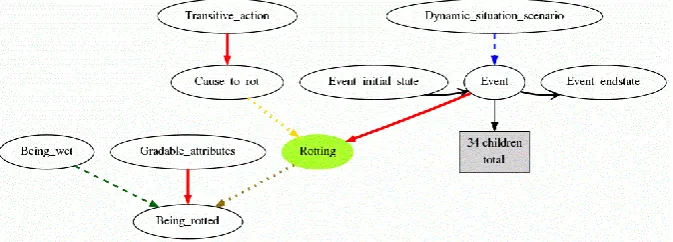
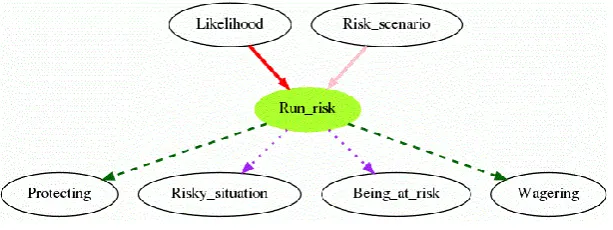
[image:3.595.159.496.543.664.2]4. Finally, frames are interconnected based on a number of relations (Is Causative of, Inherits, Is Subframe of, etc.) giving a more complete and precise picture of a general conceptual situation in which a frame is involved. Figure 1 shows the relationships held by the Rotting frame with other ones. Figure 2 shows how the Run_risk frame is connected to other frames defined in FrameNet (2016).
Figure 2: Relations between frames: Run_risk
The FrameNet data to which we refer in this paper is that contained in the 1.6 XML release (Baker and Hung, 2010).
2.2 A frame-based domain-specific resource
In previous work (L’Homme et al, 2014; L’Homme and Robichaud, 2014), we showed that the the-ory of Frame Semantics and the methodology devised within the FrameNet project (Fillmore et al., 2003; Ruppenhofer et al., 2010) provide useful means to account for the semantic and constructional aspects of terms (especially terms that denote events). It also provides for a connection between lin-guistic descriptions and a more abstract conceptual structure related to a terminological domain (in other words, relate the frame evoked by a term to a hierarchy of conceptual structures).
The specialized data considered in this work is extracted from a resource on the environment (called the Framed DiCoEnviro). In this resource, terms (e.g. sustainable, contaminate, biodegradable, emis-sion) are grouped according to the frames they evoke. In addition, most frames are interconnected and these relations account for larger scenarios that inform about situations that occur in the field of the environment (e.g., Species activities, Risks, Contamination).
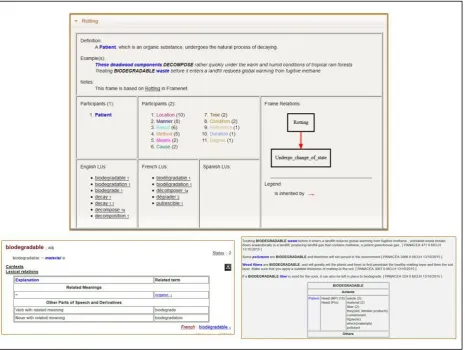
This first resource is linked to a terminological resource in which lexical descriptions of terms are given (called the DiCoEnviro. Dictionnaire fondamental de l’environnement). In addition, most lexical entries provide contextual annotations that show how terms combine with their participants (argu-ments and adjuncts). Figure 3 shows an example of the frame Rotting along with an entry and annota-tions that can be found in the DiCoEnviro. Figure 4 shows how relaannota-tionships between the Rotting and the Run_risk frames were defined in the Framed DiCoEnviro.
This work takes into consideration the English data recorded in the Framed DiCoEnviro. This in-cludes 363 terms that evoke 176 different frames.4 Verbs, nouns, and adjectives have been dealt with at this point. All terms have up to 20 annotated sentences that are extracted from corpora that contain specialized texts on the environment. Annotated sentences for the terms analyzed amount to 7,189.
2.3 Basic differences between FrameNet and the environmental resource
Although the Framed DiCoEnviro was compiled according to the methodology devised in the FrameNet project (Ruppenhofer et al., 2010), some methodological choices were made that affect the way terms are described. We mention the most important ones below:
In the Framed DiCoEnviro (FD), participants are labelled arguments (for obligatory ones) and ad-juncts (for optional ones). As was seen above, in FrameNet, participants are labelled frame elements, FEs (and these are divided into core and non-core).
4 Note that the frames defined also include French and Spanish terms. However, for the purpose of the
Figure 3: Rotting frame and lexical entry and annotations for the term biodegradable
In the FD, the methodology for discovering frames is bottom-up. According to this method-ology, the definition of argument structures of terms precedes the description of frames. Once the terms and their argument structures have been described, we locate terms that have similar arguments structures and see if these terms can be associated to frames. The FrameNet methodology is slightly different. It consists of defining frames, their frame ele-ments and then associate LUs to these defined frames. This methodological difference often results in different numbers of arguments vs. FEs between the two resources. For instance, [image:5.595.176.419.449.633.2]in FrameNet the Cause_change_of_temperature frame has three core frame elements (Agent | Cause5, Item, Hot_cold_source). The environmental terms that evoke this frame have only two arguments (Agent | Cause, Patient).
In the FD, labels used for participants are more traditional (Agent, Patient, Destination) since they are defined for the entire set of terms in the resource. In FrameNet, FEs are de-fined according to a frame. This results in a much larger number of labels in FrameNet that may correspond to a single one in the FD (for instance, Patient, Theme, Undergoer, Item in FrameNet correspond to Patient in the FD).
Alternations: Some distinctions were made in the lexical entries of the FD that are not al-ways made in FrameNet. For instance, the FD contains two different entries for the verb
predict: predict1a (a model predicts a change); predict1b (an expert predicts a change with a model). In many cases, the two terms are placed in the same frame, since they evoke the same situation.
We do notfocus on these differences in this work since they are linked to methodological choices ra-ther than relying on true semantic or conceptual differences between lexical units, terms or frames. However, we do account for them in the FD. First, we state if the number of arguments recorded in the FD differs with respect to the number of core FEs in FrameNet. We also mention cases of alternations. Finally, the FD lists (on demand) the different labels for participants used in each resource, as shown in Figure 5.
Cause_temperature_change […]
Notes:
This frame is based on Cause_temperature_change in FrameNet. The number of actants vs. core FEs differs. […]
Framed Di-CoEnviro
Participants(1) Agent | Cause Patient
Participants (2)
Time (3), Degree (2), Value (2), Location (2), Duration (1), Re-sult (1), Method (1)
FrameNet FrameNet Core FEs: Agent
Cause
Hot_Cold_Source Item
FrameNet
Core-Unexpressed FEs
FrameNet Non-Core FEs: Container, Degree, Duration, Instrument, Manner, Means, Place, Temperature_change, Temperature_goal, Tempera-ture_start, Time
Figure 5: Labels for participants in the FD and FrameNet
3
Specificities in specialized fields of knowledge
Many lexical items and lexical units (LUs) are similar in the Framed DiCoEnviro and FrameNet, and thus do not raise problems from the point of view of linking resources. However, several terms display some degree of difference with the lexical content of FrameNet. In this section, we make a list of the differences we observed keeping in mind the consequences these differences may have on the poten-tial integration or specialized data in a general resource such as FrameNet.
3.1 Specificities at the lexical level
A.1 New lexical items: Many lexical items recorded in the FD do not appear in FrameNet. Some of these lexical items are highly specialized (eutrophication, acidification, deforestation); others have simply not been added yet to the general resource (biodegradable, introduce, landfill). These new lex-ical items are likely to evoke existing frames in FrameNet or lead to the creation of a new potentially domain-specific frame.
5 We consider the “Agent | Cause” case as a split argument in the Framed DiCoEnviro. Hence we count it as one
A.2. New senses and A.3 Specific “environmental” uses: In this case, the lexical item is recorded in FrameNet, but the meaning accounted for is not the one observed in the environment data. As with new lexical items, lexical units with different senses can evoke existing frames in FrameNet or require the creation of new ones.
We observed two different phenomena regarding meanings. First, there are new meanings per se (A.2). For instance, the adjectives green and clean do appear in FrameNet, but for the time being no frame accounts for their environmental meaning which can loosely read as follows: “that does not have a negative impact on the environment”.
Specific “environmental” uses (A.3 ) apply to terms that cannot be said to convey a different meaning (such as green mentioned above). However, we noted a series of “sense modulations” caused by usage in a specialized field of knowledge, or a restriction imposed on arguments due again to the fact that the LU is used in a specialized field of knowledge (this latter case may be related to phenomena that Cruse (2011) labelled microsenses or spectral subsenses).
For instance, the verb introduce is used in the field of the environment to denote an activity whereby someone places a species in an area where it can live and reproduce (Toad populations, predatory fish should not BE INTRODUCED into breeding ponds). It is related to reintroduce and introduction and is opposed to eliminate and extirpate. In the general lexicon, introduce has a much broader meaning and includes activities in which someone places something in a given location. We also made meaning distinctions that appear relevant for the field of the environment but that might not be relevant in other contexts. For instance, two different meanings were identified for the verb hunt. One corresponds to the activity whereby an animal chases and captures other animals for food; the second corresponds to the activity carried out by human beings that consists in chasing animals for other kinds of reasons, this activity having a negative impact on the conservation of species. Hunt1 is linked to other terms,
such as predation, and predate; while hunt2 is linked to poach, capture, and fish.A.4 Different
rela-tionships between lexical units: This phenomenon is a consequence of the previous one (case A.3). Since lexical units such as introduce can be defined differently in the field of the environment, they are also likely to appear in different lexical networks. We already mentioned the relationship between
introduce and reintroduce in the environment as well as the two sets of terms to which hunt1 and hunt2
are linked respectively. Given the broader use of introduce in general language, it is linked to a much larger set of different LUs(such as imbed, implant, insert, place, etc.).
3.2 Specificities at the level of frames
B.1 Different lexical contents: Many LUs we analyzed are compatible with the data that appear in FrameNet. We can thus consider that they evoke the same frames. However, in many of those frames, the LUs recorded in FrameNet and those that we could identify in our corpora differ as shown in Fig-ure 6.
Rotting in FrameNet Rotting in Framed DiCoEnviro
decay.n, decay.v, decompose.v, fes-ter.v, moulder.v, perish.v, putrefy.v, rot.n, rot.v, spoil.v
[image:7.595.130.464.539.589.2]biodegradable 1, biodegradation 1, biodegrade 1, decay 1, decay 1.1, decompose 1a, decomposition 1
Figure 6: Different lexical contents for the Rotting frame in FrameNet and the FD
B.2 “New” frames: new frames need to be created to account for environmental data. For the data con-sidered in this work, 96 new frames were created (54,5% of frames necessary for the terms analyzed), Some of these frames include new lexical items and new senses (cases A.1 and A.2), some comprise LUs that are recorded in FrameNet but correspond to “environmental” uses (case A.3). For instance, a new frame called Adding_species_in_location was created for the LUs introduce (and contains terms such as reintroduce, and introduction). Similarly, a new frame called Man_hunting was created for the LUs hunt2, (and will also contain verbs such as capture, poach and fish (a different frame – based
on the one found in FrameNet – contains the term hunt1).
whole set of new frames were created in the FD to account the different situations in which waste is managed: Managing_waste, Collecting, Sorting, etc. These frames are connected according to the order in which these different activities are carried out. The relations are certainly valid as far as the environment is concerned, but their generality might be questioned from the point of view of the gen-eral lexicon.
4
Dealing with differences
In this section, we present the solutions we devised and implemented to account for the similarities and highlight the differences between the two resources. For the time being, these solutions were im-plemented in the environmental resource.
4.1 Dealing with differences at the level of lexical units
Cases A.1 and A.2 can be solved quite easily. New LUs are added to an existing frame provided that there is one that accounts for their meaning (e.g. biodegradable is added to the Rotting frame). If no frame exists, then the solution consists in creating a new one (e.g. a frame Judg-ment_of_impact_on_the_environment was created for the LUs green, clean, and environmental2).
Case A3 may lend itself to different solutions. New frames may be created (case B.2) (for instance, an Adding_species_in_location frame is created to account for the use of introduce in the field since it evokes a situation that differs in the environment). For this reason, we did not add this term to the ex-isting Placing frame.
It should be mentioned at this point that some “environmental uses” were not considered different enough from general usage to justify a separate description or the creation of a new frame in the FD. For instance, the transitive verb warm (as in carbon dioxide warms the Earth) is used in the field of the environment with a restricted set of arguments (Agents or Causes such as gas, energy, increase; and Patients such as atmosphere, surface, Earth). In general usage – at least based on the description given in FrameNet – the use of warm is much broader and includes but is not limited to the uses ob-served in the field of the environment. However, we did not create a new frame to account for warm in this case since the description given in FrameNet could be applied to it.
Case A.4 is described in the next section (when dealing with case B.3).
4.2 Dealing with differences at the level of frames
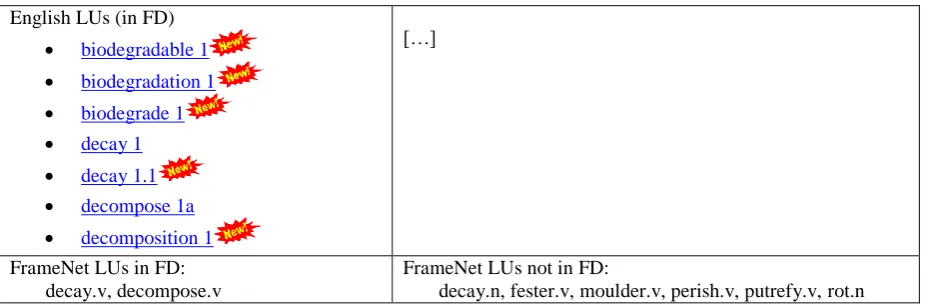
B.1. Resources can provide views on the lexical content of frames that differ between general lan-guage and specific fields of knowledge if this lexical content is defined precisely. The lexical contents of FrameNet and the FD are highlighted as shown in Figure 7 for the frame Rotting.
Frame: Rotting […]
Notes:
This frame is based on Rotting in Framenet.
English LUs (in FD) biodegradable 1
biodegradation 1
biodegrade 1
decay 1
decay 1.1
decompose 1a
decomposition 1
[…]
FrameNet LUs in FD: decay.v, decompose.v
FrameNet LUs not in FD:
[image:8.595.66.530.580.733.2]decay.n, fester.v, moulder.v, perish.v, putrefy.v, rot.n
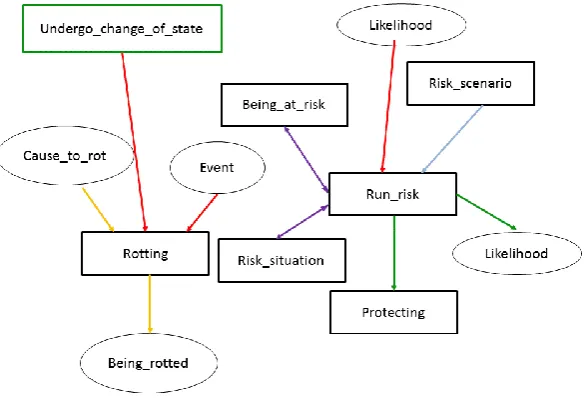
B.2. New frames (96) are created on the basis of the environmental data. Frames created specifical-ly for the environment are distinguished from others with a green color, as shown in Figure 8. They could also be added to the general resource and be connected to existing frames according to the solu-tion devised for case B.3.
[image:9.595.145.438.236.437.2]B.3. Cases in which frames appear in relations that would not necessarily be valid from the point of view of the general lexicon are much more difficult to handle since many appear to be domain-specific. For the time being, we provide access to the specific views on relations as they are recorded in each resource. Figure 8 shows the interconnections between the Rotting and Run_risk frames in the FD, on the one hand, and in FrameNet, on the other. As was mentioned earlier, domain-specific frames are those in the green rectangles. Frames that are common to both resources appear in the black rectangles. Finally, frames that were defined in FrameNet, but not used in the FD appear in ellipses.
Figure 8: Relations in the FD and FrameNet for Rotting and Run_risk
5
Conclusion
In this paper, we made a list of lexical and conceptual differences observed between a terminological resource on the environment and FrameNet. The proposals made apply to the environmental terms (363) and frames (176) that we analyzed. At the lexical level, differences observed were: new lexical items, new meanings (or new lexical units) and sense modulations that can be explained by domain specific uses of units (sense distinctions that might appear irrelevant from the point of view of general language, more restricted used of LUs in the environment). Sense modulations can also lead to new relationships between LUs.
At the level of frames, differences can be summarized as: differences in lexical contents of similar frames, the need for new frames, and finally different relationships held between frames.
We devised various strategies to deal with these differences and implemented them in the Framed DiCoEnviro. The implementation allows users to view how the lexicon and frames differ when con-sidered from the perspective of a specialized subject while still seeing how these connect to the way the general lexicon was defined and represented in a general resource such as FrameNet. In addition, if changes are introduced in either resources (since they are both under construction), there are immedi-ately taken into account.
Acknowledgements
This work is supported by the Social Sciences and Humanities Research Council (SSHRC) of Canada and the Fonds de recherche Société et Culture du Québec.
References
Raquel Amaro, and Sara Mendes. 2012. Towards Merging Common and Technical Lexicon WordNets. In Pro-ceedings of the 3rd Workshop on Cognitive Aspects of the Lexicon (CogALex-III). Mumbai, India, 147-156. Alan Cruse. 2011. Meaning in Language. Oxford: Oxford University Press.
Collin Baker, and J. Hung. 2010. Release 1.6 of the FrameNet data. International Computer Science Institute. Berkeley.
DiCoEnviro. Dictionnaire fondamental de l’environnement
(http://olst.ling.umontreal.ca/cgi-bin/dicoenviro/search_enviro.cgi).
Charles J. Fillmore. 1985. Frames and the semantics of understanding. Quaderni di Semantica, 6(2): 222-254. Charles J. Fillmore, and Collin Baker. 2010. A frames approach to semantic analysis. In The Oxford Handbook
of Linguistic Analysis, Bernd Heine and Haiko Narrog (eds), 313-339. Oxford: OUP.
Charles Fillmore. C.R. Johnson, and Miriam Petruck. 2003. Background to FrameNet. International Journal of Lexicography, 16(3): 235-250.
Pamela Faber. (ed.). 2012. A Cognitive Linguistics View of Terminology and Specialized Language. Berlin/New York: Mouton de Gruyter.
A Framed version of the DiCoEnviro (http://olst.ling.umontreal.ca/dicoenviro/framed/index.php). FrameNet. (https://framenet.icsi.berkeley.edu/fndrupal/)
Marie-Claude L’Homme, and Benoît Robichaud. 2014. Frames and terminology: representing predicative units in the field of the environment. In Cognitive Aspects of the Lexicon (Cogalex 2014), Coling 2014, Dublin, Ire-land.
Marie-Claude L’Homme, Benoît Robichaud, and Carlos Subirats. 2014. Discovering frames in specialized do-mains, In Language Resources and Evaluation, LREC 2014, Reykjavik, Iceland.
George Lakoff. 1987. Women, Fire, and Dangerous Things: What Categories Reveal About the Mind Chicago: University of Chicago Press.
Bernardo Magnini, and Manuela Speranza. 2001. Integrating Generic and Specialized Wordnets. In Proceedings of Recent Advances in Natural Language Processing, RANLP 2001, Tzigov Chark, Bulgaria, 149-153). Ely Edison da Silva Matos. 2014. LUDI: Um framework para desambiguação lexical com base no eriquecmento
da Semântica de Frames. Ph. D. Diss. Universidade Federal de Juiz de Fora. Eleanor H. Rosch. 1973. Natural categories. Cognitive Psychology, 4.3: 328–350.
Eleanor H. Rosch, 1975. Cognitive representations of semantic categories. Journal of Experimental Psychology, 104(3): 192–233.
Josef Ruppenhofer, Michael Ellsworth, Miriam L. Petruck, Christopher R. Johnson, and Jan Scheffczyk. 2010. FrameNet II: Extended Theory and Practice. 2010. (http://framenet.icsi.berkeley.edu).
Thomas Schmidt. 2009. The Kicktionary – A Multilingual Lexical Resources of Football Language. In Boas, H.C. (ed). Multilingual FrameNets in Computational Lexicography. Methods and Applications, Ber-lin/NewYork: Mouton de Gruyter, 101-134.
Spanish FrameNet. An Online Lexical Resource and its Application to Spanish NLP (http://spanishfn.org/). Carlos Subirats. 2013. Frames, constructions, and metaphors in Spanish FrameNet. In I. Verdaguer, N. J. Laso,
and D. Salazar, eds. Biomedical English: A corpus-based approach. Amsterdam / Philadelphia: John Benja-mins, pp. 185-210.