Care Episode Retrieval
Hans Moen1, Erwin Marsi1, Filip Ginter2,
Laura-Maria Murtola3,4, Tapio Salakoski2, Sanna Salanter¨a3,4, 1Dept. of Computer and Information Science,
Norwegian University of Science and Technology, Norway 2Dept. of Information Technology, University of Turku, Finland
3Dept. of Nursing Science, University of Turku, Finland 4Turku University Hospital, Finland
{hans.moen,emarsi}@idi.ntnu.no, [email protected],
{lmemur,tapio.salakoski,sansala}@utu.fi
Abstract
The documentation of a care episode con-sists of clinical notes concerning patient care, concluded with a discharge sum-mary. Care episodes are stored electron-ically and used throughout the health care sector by patients, administrators and pro-fessionals from different areas, primarily for clinical purposes, but also for sec-ondary purposes such as decision support and research. A common use case is, given a – possibly unfinished – care episode, to retrieve the most similar care episodes among the records. This paper presents several methods for information retrieval, focusing on care episode retrieval, based on textual similarity, where similarity is measured through domain-specific mod-elling of the distributional semantics of words. Models include variants ofrandom indexing and a semantic neural network model calledword2vec. A novel method is introduced that utilizes the ICD-10 codes attached to care episodes to better induce domain-specificity in the semantic model. We report on an experimental evaluation of care episode retrieval that circumvents the lack of human judgements regarding episode relevance by exploiting (1) ICD-10 codes of care episodes and (2) seman-tic similarity between their discharge sum-maries. Results suggest that several of the methods proposed outperform a state-of-the art search engine (Lucene) on state-of-the re-trieval task.
1 Introduction
Information retrieval (IR) aims at retrieving and ranking documents relative to a textual query ex-pressing the information need of a user (Manning et al., 2008). IR has become a crucial technology for many organisations that deal with vast amounts of partly structured and unstructured (free text) data stored in electronic format, including hospi-tals and other health care providers. IR is an es-sential part of the clinical practice; e.g., on-line IR systems are associated with substantial improve-ments in clinicians decision-making concerning clinical problems (Westbrook et al., 2005).
The different stages of the clinical care of a pa-tient are documented in clinical care notes, con-sisting mainly of free text. Acare episodeconsists of a sequence of individual clinical care notes, concluded by a discharge summary, as illustrated in Figure 1. Care episodes are stored in elec-tronic format in electronic health record (EHR) systems. These systems are used throughout the health care sector by patients, administrators and professionals from different areas, primarily for clinical purposes, but also for secondary purposes such as decision support and research (H¨ayrinen et al., 2008). IR from EHR in general is therefore a common and important task.
This paper focuses on the particular task of re-trieving those care episodes that are most similar to the sequence of clinical notes for a given pa-tient, which we will call care episode retrieval. In conventional IR, the query typically consists of several keywords or a short phrase, while the re-trievable units are typically documents. In con-trast, in care episode retrieval, the query consist of the clinical notes contained in a care episode. The discharge summary is used separately for
A
B
Time
[image:2.595.71.289.62.147.2]Clinical notes Discharge summary
Figure 1: Illustration of care episode retrieval. The two care episodes (A and B) are composed of a number of individual clinical notes and a sin-gle discharge summary. Given an ongoing care episode (minus the discharge summary), the task is to retrieve other, similar care episodes.
ation purposes, and is assumed to be unavailable for constructing a query at retrieval time. Retriev-able units are thus complete care episodes without summaries.
We envision a number of different use cases for a care episode retrieval system. Firstly, it could fa-cilitate clinicians in decision-making. For exam-ple, given a patient that is being treated in a hos-pital, an involved clinician may want to find previ-ous patients that are similar in terms of their health history, symptoms or received treatments. Supple-mentary input from the clinician would enable the system to give heightened weight to keywords of particular interest within the care episodes, which would further be emphasized in the semantic sim-ilarity calculation during IR. It may help consider-ably to see what similar patients have received in terms of medication and further treatment, what related issues such as bi-conditions or risks oc-curred, how other clinicians have described cer-tain aspects, what clinical practice guidelines have been utilized, and so on. This relates to the un-derlying principle in textual case-based reasoning (Lenz et al., 1998). Secondly, it could help man-agement to get almost real time information con-cerning the overall situation on the unit for a spe-cific follow-up period. Such a system could for ex-ample support managerial decision-making with statistical information concerning care trends on the unit, adverse events or infections. Thirdly, it could facilitate knowledge discovery and research. For instance, it could enable researchers to map or cluster similar care episodes to find common symptoms or conditions. In sum, care episode re-trieval is likely to improve care quality and consis-tency in hospitals.
From the perspective of NLP, care episode re-trieval – and IR from EHRs in general – is a challenging task. It differs from general-purpose web search in that the vocabulary, the informa-tion needs and the queries of clinicians are highly specialised (Yang et al., 2011). Clinical notes contain highly domain-specific terminology (Rec-tor, 1999; Friedman et al., 2002; Allvin et al., 2010) and generic text processing resources are therefore often suboptimal or inadequate (Shatkay, 2005). At the same time, development of dedi-cated clinical NLP tools and resources is often dif-ficult and costly. For example, popular data-driven approaches to NLP are based on supervised learn-ing, which requires substantial amounts of tailored training data, typically built through manual anno-tation by annotators who need both linguistic and clinical knowledge. Additionally, variations in the language and terminology used in sub-domains within and across health care organisations greatly limit the scope of applicability of such training data (Rector, 1999).
Recent work has shown that distributional mod-els of semantics, induced in an unsupervised man-ner from large corpora of clinical and/or medical text, are well suited as a resource-light approach to capturing and representing domain-specific ter-minology (Pedersen et al., 2007; Koopman et al., 2012; Henriksson et al., 2014). This raises the question to what extent distributional models of semantics can alleviate the aforementioned prob-lems of NLP in the clinical domain. The work reported here investigates to what extent distribu-tional models of semantics, built from a corpus of clinical text in an fully unsupervised manner, can be used for care episode retrieval. Models include several variants ofrandom indexingand a seman-tic neural network model calledword2vec, which will be described in more detail in Section 4.
retrieval.
Apart from issues related to clinical terminol-ogy, another problem in care episode retrieval is the lack of benchmark data, such as the relevance scores produced by human judges commonly used for evaluation of IR systems. Although collec-tions of care episodes may be available, producing gold standard similarity scores required for evalu-ation is costly. Another contribution of this paper is the proposal of evaluation procedures that cir-cumvent the lack of human judgements regarding episode similarity. This is accomplished by ex-ploiting either (1) ICD-10 codes of care episodes or (2) semantic similarity between their discharge summaries. Despite our focus on the specific task of care episode retrieval, we hypothesize that the methods and models proposed here have the po-tential to increase performance of IR on clinical text in general.
2 Data
The data set used in this study consists of the elec-tronic health records from patients with any type of heart related problem that were admitted to one particular university hospital in Finland between the years 2005-2009. Of these, only the clini-cal notes written by physician are used. A sup-porting statement for the research was obtained from the Ethics Committee of the Hospital District (17.2.2009§67) and permission to conduct the re-search was obtained from the Medical Director of the Hospital District (2/2009). The total set consist of 66884 care episodes, which amounts to 398040 notes and 64 million words in total. This full set was used for training of the semantic models. To make the experimentation more convenient, we chose to use a subset for evaluation. This com-prises 26530 care episodes, amounting to 155562 notes and 25.7 million words in total.
Notes are mostly unstructured, consisting of free text in Finnish. Some meta-data – such as names of the authors, dates, wards, and so on – is present, but is not used for retrieval.
Care episodes have been manually labeled ac-cording to the 10th revision of the International Classification of Diseases (ICD-10) (World Health Organization and others, 2013), a standardised tool of diagnostic codes for classifying diseases. Codes are normally applied at the end of the pa-tient’s stay, or even after the patient has been dis-charged from the hospital. Care episodes have
one primary ICD-10 code attached and optionally a number of additionally relevant codes. In this study, only the primary one is used, because ex-traction of the secondary codes is non-trivial.
ICD-10 codes have an internal structure that re-flects the classification system ranging from broad categories down to fine-grained subjects. For ex-ample, the first character (J) of the code J21.1 signals that it belongs to the broad category Dis-eases of the respiratory system. The next two digits (21) classify the subject as belonging to the subcategory Acute bronchiolitis. Finally, the last digit after the dot (1) means that it belongs to the sub-subclassAcute bronchiolitis due to hu-man metapneumovirus. There are 356 unique “pri-mary” ICD-10 codes in the evaluation data set.
3 Task
The task addressed in this study is retrieval of care episodes that are similar to each other. In con-trast to the normal IR setting, where the search query is derived from a text stating the user’s in-formation need, here the query is based on an-other care episode, which we refer to as thequery episode. As the query episode may document on-going treatment, and thus lack a discharge sum-mary and ICD-10 code, neither of these informa-tion sources can be relied upon for constructing the query. The task is therefore to retrieve the most similar care episodes using only the information contained in the free text of the clinical notes in the query episode.
Evaluation of retrieval results generally re-quires an assessment of their relevancy to the query. Since similarity judgements by humans are currently lacking, and obtaining these is time-consuming and costly, we explored alternative ways of evaluating performance on the task. The first alternative is to assume that care episodes are similar if they have the same ICD-10 code. That is, a retrieved care episode is considered correct if its ICD-10 code is identical to the code of the query episode. It should be noted that ICD-10 codes are not used in the query in any of the experiments.
dis-charge summaries. That is, if the disdis-charge sum-mary of a retrieved episode is semantically simi-lar to the discharge summary of the query episode, the retrieved episode is assumed to be correct. In practice, textual similarity between discharge summaries, and therefore the relevance score, is continuous rather than binary. It is measured using the same models of distributional semantics used for retrieval, which will be described in Section 4. It should be stressed that the discharge summaries are not taken into consideration during retrieval in any of the experiments and are only used for eval-uation.
4 Method
4.1 Semantic models
A crucial part in retrieving similar care episodes is having a good similarity measure. Here similar-ity between care episodes is measured as the sim-ilarity between the words they contain (see Sec-tion 4.2). Semantic similarity between words is in turn measured through the use of word space mod-els (WSM), without performing an explicit query expansion step. Several variants of these models were tested, utilizing different techniques and pa-rameters for building them. The models trained and tested in this paper are: (1) classic random indexing with a sliding window using term in-dex vectors and term context vectors (RI-Word); (2) random indexing with index vectors for doc-uments (RI-Doc); (3) random indexing with in-dex vectors for ICD-10 codes (RI-ICD); (4) a ver-sion of random indexing where only the term in-dex vectors are used (RI-Inin-dex); and (5) a seman-tic neural network model, usingword2vecto build word context vectors (Word2vec).
RI-Word
Random Indexing (RI) (Kanerva et al., 2000) is a method for building a (pre) compressed WSM with a fixed dimensionality, done in an incremen-tal fashion. RI consist of the following two steps: First, instead of allocating one dimension in the multidimensional vector space to a single word, each word is assigned an “index vector” as its unique signature in the vector space. Index vectors are generated vectors consisting of mostly zeros together with a randomly distributed set of several 1’s and -1’s, uniquely distributed for each unique word; The second step is to induce “context vec-tors” for each word. A context vector represents
the contextual meaning of a word in the WSM. This is done using a sliding window of a fixed size to traverse a training corpus, inducing context vec-tors for the center/target word of the sliding win-dow by summing the index vectors of the neigh-bouring words in the window.
As the dimensionality of the index vectors is fixed, the dimensionality of the vector space will not grow beyond the sizeW ×Dim, whereW is the number of unique words in the vocabulary, and
Dimbeing the pre-selected dimensionality to use for the index vectors. As a result, RI models are significantly smaller than plain word space mod-els, making them a lot less computationally expen-sive. Additionally, the method is fully incremental (additional training data can be added at any given time without having to retrain the existing model), easy to parallelize, and scalable, meaning that it is fast and can be trained on large amounts of text in an on-line fashion.
RI-Doc
Contrary to sliding window approach used in RI-Word, a RI model built withdocument index vec-tors first assigns unique index vectors to every document in the training corpus. In the training phase, each word in a document get the respective document vector added to its context vector. The resulting WSM is thus a compressed version of a term-by-document matrix.
RI-ICD
J
0.125 0.25 0.5 1
Weight
2 1
0 1
1 0
J21.1
[image:5.595.89.271.72.208.2]0
Figure 2: Weighting applied to ICD-code index vectors when training WSMs based on ICD-10 codes (RI-ICD).
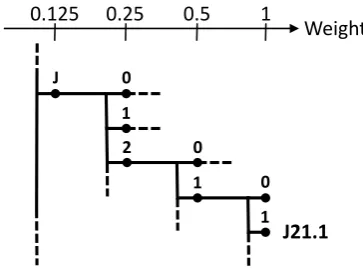
this similarity is encoded in the resulting WSM. As a example: for a clinical note labelled with the code J21.1, we add the following index vectors to the context vectors of all its constituting words:
iv(J)×0.125,iv(J2)×0.25,iv(J21)×0.5and
iv(J21.1)×1.0. The underlying hypothesis for building a WSM in this way is that it may cap-ture relations between words in a way that bet-ter reflects the clinical domain, compared to the other domain-independent methods for construct-ing a WSM.
RI-Index
As an alternative to using word’s (semantic) con-text vectors, we simply only use their index vec-tors as their “contextual meaning”. When con-structing document vectors directly from word in-dex vectors (see Section 4.2), the resulting docu-ment vectors represent a compressed version of a document-by-term matrix.
Word2vec
Recently, a novel method for inducing WSMs was introduced by Mikolov et al. (2013a), stemming from the research in deep learning and neural net-work language models. While the overall objec-tive of learning a continuous vector space repre-sentation for each word based on its textual con-text remains, the underlying algorithms are sub-stantially different from traditional methods such as Latent Semantic Analysis and RI. Considering, in turn, every word in the training data as a target word, the method induces the representations by training a simplified neural network to predict the nearby context words of each target word
(skip-gram architecture), or alternatively the target word based on all words in its immediate context (BoW architecture). The vector space representation is subsequently extracted from the learned weights within the neural network. One of the main prac-tical advantages of the word2vec method lies in its scalability, allowing quick training on large amounts of text, setting it apart from the majority of other methods of distributional semantics. Ad-ditionally, the word2vec method has been shown to produce representations that surpass in quality traditional methods such as Latent Semantic Anal-ysis, especially on tasks measuring the preserva-tion of important linguistic regularities (Mikolov et al., 2013b).
4.2 Computing care episode similarity After having computed a WSM, the next step is to build episode vectors to use for the actual re-trieval task. This is done by first normalizing the word vectors and multiplying them with a word’s TF*IDF weight. An episode vector is then ob-tained by summing the word vectors of all its words and dividing the result by the total num-ber of words in the episode. Similarity between episodes is determined by computing the cosine similarity between their vectors.
4.3 Baselines
Two baselines were used in this study. The first one is random retrieval of care episodes, which can be expected to give very low scores and serves merely as a sanity check. The second one is Apache Lucene (Cutting, 1999), a state-of-the-art search engine based on look-up of similar docu-ments through a reverse index and relevance rank-ing based on a TF*IDF-weighted vector space model. Care episodes were indexed using Lucene. Similar to the other models/methods, all of the free text in the query episode, excluding the discharge summary, served as the query string provided to Lucene. Being a state-of-the-art IR system, the scores achieved by Lucene in these experiments should indicate the difficulty of the task.
5 Experiments
clin-ical notes are split into sentences, tokenized, and lemmatized using a Constraint-Grammar based morphological analyzer and tagger extended with clinical vocabulary (Karlsson, 1995). After stop words were removed1, the total training corpus
contained 39 million words (minus the query episodes), while the evaluation subset contained 18.5 million words. The vocabulary consisted of 0.6 million unique terms. Twenty care episodes were randomly selected to serve as the query episodes during testing, with the requirement that each had different ICD-10 codes and consisted of a minimum of six clinical notes. The average num-ber of words per query episode is 830.
RI-based and word2vec models have a prede-fined dimensionality of 800. For RI-based mod-els, 4 non-zeros were used in the index vectors. For the RI-Word model, a narrow context win-dow was employed (5 left + 5 right), weighting index vectors according to their distance to the tar-get word (weighti = 21−distit). In addition, the
index vectors were shifted once left or right de-pending on what side of the target word they were located, similar to direction vectors as described in (Sahlgren et al., 2008) These parameters for RI were chosen based on previous work on semantic textual similarity (Moen et al., 2013). Also a much larger window of 20+20 was tested, but without noteworthy improvements. The word2vec model is trained with the BoW architecture and otherwise default parameters. In addition to Apache Lucene (version 4.2.0)2, the word2vec tool3 was used to
train the word2vec model, and the RI-based meth-ods utilized the JavaSDM package4. Scores were
calculated using thetrec evaltool5.
5.1 Experiment 1: ICD-10 code overlap In this experiment retrieved episodes with a pri-mary ICD-10 code identical to that of the query episode were considered to be correct. The num-ber of correct episodes varies between 49 and 1654. The total is 7721, and the average is 386. The high total is mainly due to three query episodes with ICD-10 codes that occur very fre-quently in the episode collection (896, 1590, and
1http://www.nettiapina.fi/
finnish-stopword-list/
2http://archive.apache.org/dist/
lucene/java/
3https://code.google.com/p/word2vec/ 4http://www.nada.kth.se/˜xmartin/java/ 5http://trec.nist.gov/trec_eval/
IR model MAP P@10
Lucene 0.1379 0.3000
RI-Word 0.0911 0.2650
RI-Doc 0.1015 0.3300
RI-ICD 0.3261 0.5150
RI-Index 0.1187 0.3200
Word2vec 0.1768 0.3350
[image:6.595.306.527.62.148.2]Random 0.0154 0.0200
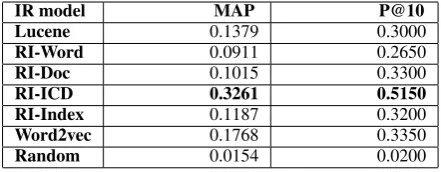
Table 1: Mean average precision and precision at 10 for retrieval of care episodes with the same pri-mary ICD-10 code as the query episode
1654 times). When conducting the experiment all care episodes were retrieved for each of the 20 query episodes.
Performance was measured in terms of mean average precision (MAP) and precision among the top-10 results (P@10), averaged over all 20 queries, as shown in in Table 1. The best MAP score is achieved by RI-ICD, almost twice that of word2vec, which achieved the second best MAP score, whereas RI-Word performed worst of all. All models score well above the random baseline, whereas RI-ICD outperforms Lucene by a large margin. P@10 scores follow the same ranking. The latter scores are more representative for most use cases where users will only inspect the top-n retrieval results.
5.2 Experiment 2: Discharge summary overlap
In this experiment retrieved episodes with a dis-charge summary similar to that of the query episode were considered to be correct. Using the discharge summaries of the query episodes, the top 100 care episodes with the most similar dis-charge summary were selected as the most simi-lar care episodes (disregarding the query episode). This was repeated for each of the methods – i.e. the five different semantic models and Lucene – resulting in six different tests. The top 100 was used rather than a threshold on the similarity score, because otherwise six different thresholds would have to be chosen. This procedure thus resulted in six different test collections, each consisting of 20 query episodes with their corresponding 100 most similar collection episodes.
re-trieval and test set construction, the resulting bias gives rise to relatively high scores. In contrast, averaging over the scores for all six construction methods is assumed to be a less biased indicator of performance.
Table 2 shows the number of correctly retrieved episodes by the different models, with the maxi-mum being 2000 (20 queries times 100 most sim-ilar episodes). This gives an indication of the re-call among a 1000 retrieved episodes per query, but without caring about precision or ranking. In general, the numbers are relatively good when the same model is used for both retrieval and construc-tion of the test set (cf. values on the diagonal), al-though in a couple of cases (e.g. with word2vec) results are better with different models. The RI-ICD model performs best when used for both re-trieval and test construction. Looking at the av-erages, which presumably are less biased indica-tors, RI-ICD and word2vec seem to have compa-rable performance, with both of them outperform-ing Lucene. Other models are less successful, al-though still much better than the random baseline. The MAP scores in Table 3 show similar re-sults, although here RI-ICD yields the best aver-age score. Both models RI-ICD and word2vec outperform Lucene. Again the RI-ICD model per-forms exceptionally well when used for both re-trieval and test construction.
Finally Table 4 presents precision for top-10 re-trieved care episodes. Here RI-Doc yields the best average scores, while RI-ICD and word2vec both perform slightly worse.
6 Discussion
The goal of the experiments was primarily to determine which distributional semantic models work best for care episode retrieval. The exper-imental results show that several models outper-form Lucene at the care episode retrieval task. This suggests that models of higher order seman-tics contribute positively to calculating document similarities in the clinical domain, compared with straight forward boolean word matching (cf. RI-Index and Lucene).
The relatively good performance of the RI-ICD model, particularly in Experiment 1, suggests that exploiting structured or encoded information in building semantic models for clinical NLP is a promising direction that calls for further investi-gation. This approach concurs with the arguments
in favor of reuse of existing information sources in Friedman et al. (2013). On the one hand, it may not be surprising that the RI-ICD model is performing well on Experiment 1, given how it in-duces semantic relations between words occurring in episodes with the same ICD-10 code. On the other hand, being able to accurately retrieve care episodes with similar ICD-10 codes evidently has practical value from a clinical perspective.
The different ranking of models in experiments 1 versus 2 confirms that there is a difference be-tween the two indicators of episode similarity, i.e. similarity in terms of their ICD-10 codes versus similarity with regard to their discharge summaries. In our data a single care episode can potentially span across several hospital wards. A better correlation between the similarity mea-sures is to be expected when narrowing the def-inition of a care episode to only a single ward. Also, taking into consideration all ICD-10 codes for care episodes – not only the primary one – could potentially improve discrimination among care episodes. This could be useful in two ways: (1) to create more precise test sets of the type used in Experiment 1; (2) to extend RI-ICD models with index vectors also for the secondary ICD-10 codes.
IR model\Test set Lucene RI-Word RI-Doc RI-ICD RI-Index Word2vec Average Rank
Lucene 889 700 670 687 484 920 725 2
RI-Word 643 800 586 600 384 849 644 5
RI-Doc 665 630 859 697 436 795 680 4
RI-ICD 635 459 659 1191 490 813 707 3
RI-Index 690 491 607 654 576 758 629 6
Word2vec 789 703 702 870 516 1113 782 1
Random 74 83 86 67 84 85 79 7
Table 2: Number of correctly retrieved episodes (max 2000) for different IR models (rows) when using different models for measuring discharge summary similarity (columns)
IR model\Test set Lucene RI-Word RI-Doc RI-ICD RI-Index Word2vec Average Rank
Lucene 0.0856 0.0357 0.0405 0.0578 0.0269 0.0833 0.0550 3
RI-Word 0.0392 0.0492 0.0312 0.0412 0.0151 0.0735 0.0416 6
RI-Doc 0.0493 0.0302 0.0677 0.0610 0.0220 0.0698 0.0500 4
RI-ICD 0.0497 0.0202 0.0416 0.1704 0.0261 0.0712 0.0632 1
RI-Index 0.0655 0.0230 0.0401 0.0504 0.0399 0.0652 0.0473 5
Word2vec 0.0667 0.0357 0.0404 0.0818 0.0293 0.1193 0.0622 2
Random 0.0003 0.0003 0.0005 0.0002 0.0003 0.0004 0.0003 7
Table 3: Mean average precision for different IR models (rows) when using different models for measur-ing discharge summary similarity (columns)
IR model\Test set Lucene RI-Word RI-Doc RI-ICD RI-Index Word2vec Average Rank
Lucene 0.2450 0.1350 0.1200 0.1650 0.0950 0.1900 0.1583 5
RI-Word 0.1350 0.1500 0.1000 0.1350 0.0600 0.2100 0.1316 6
RI-Doc 0.2000 0.1250 0.2050 0.2200 0.0900 0.2400 0.1800 1
RI-ICD 0.1700 0.0650 0.1350 0.3400 0.0950 0.2050 0.1683 2
RI-Index 0.2000 0.1250 0.1550 0.1250 0.1700 0.2050 0.1633 3
Word2vec 0.1800 0.1200 0.1150 0.2100 0.0850 0.2650 0.1625 4
[image:8.595.71.529.62.150.2]Random 0.0000 0.0000 0.0050 0.0000 0.0000 0.0000 0.0008 7
Table 4: Precision at top-10 retrieved episodes for different IR models (rows) when using different models for measuring discharge summary similarity (columns)
7 Conclusion and future work
In this paper we proposed the task ofcare episode retrieval as a way of evaluating several distribu-tional semantic models in their performance at IR. As manually constructing a proper test set of clas-sified care episodes is costly, we experimented with building test sets by exploiting either ICD-10 code overlap or semantic similarity of discharge summaries. A novel method for generating se-mantic models utilizing the ICD-10 codes of care episodes in the training corpus was presented (RI-ICD). The models, as well as the Lucene search engine, were applied to the care episode retrieval task and their performance was evaluated against the test sets using different evaluation measures. The results suggest that the RI-ICD model is bet-ter suited to IR tasks in the clinical domain com-pared with models trained on local distributions of words, or those relying on direct word matching. The word2vec model performed relatively well and outperformed Lucene in both experiments.
In the results reported here, the internal
se-quence of clinical notes is ignored. Future work should focus on exploring the temporal (sub-) se-quence similarities between care episode pairs for doing care episode retrieval. Further work should also focus on expanding on the RI-ICD method by exploiting other types of structured and/or en-coded information related to clinical notes for training semantic models tailored for NLP in the clinical domain.
Acknowledgments
References
Helen Allvin, Elin Carlsson, Hercules Dalianis, Ri-itta Danielsson-Ojala, Vidas Daudaraviˇcius, Mar-tin Hassel, Dimitrios Kokkinakis, Helj¨a Lundgren-Laine, Gunnar Nilsson, Øystein Nytrø, et al. 2010. Characteristics and analysis of finnish and swedish clinical intensive care nursing narratives. In Pro-ceedings of the NAACL HLT 2010 Second Louhi Workshop on Text and Data Mining of Health Docu-ments, pages 53–60. Association for Computational Linguistics.
Doug Cutting. 1999. Apache Lucene open source package.
Carol Friedman, Pauline Kra, and Andrey Rzhetsky. 2002. Two biomedical sublanguages: a description based on the theories of zellig harris. Journal of biomedical informatics, 35(4):222–235.
Carol Friedman, Thomas C Rindflesch, and Mil-ton Corn. 2013. Natural language process-ing: State of the art and prospects for significant progress, a workshop sponsored by the national li-brary of medicine. Journal of biomedical informat-ics, 46(5):765–773.
Dan Gusfield. 1997. Algorithms on strings, trees and sequences: computer science and computational bi-ology. Cambridge University Press.
Kristiina H¨ayrinen, Kaija Saranto, and Pirkko Nyk¨anen. 2008. Definition, structure, content, use and impacts of electronic health records: a review of the research literature. International journal of medical informatics, 77(5):291–304.
Aron Henriksson, Hans Moen, Maria Skeppstedt, Vi-das Daudaravi, Martin Duneld, et al. 2014. Syn-onym extraction and abbreviation expansion with ensembles of semantic spaces. Journal of biomed-ical semantics, 5(1):6.
Pentti Kanerva, Jan Kristofersson, and Anders Holst. 2000. Random indexing of text samples for latent semantic analysis. In Proceedings of 22nd Annual Conference of the Cognitive Science Society, page 1036.
Fred Karlsson. 1995. Constraint grammar: a language-independent system for parsing unre-stricted text. Mouton de Gruyter, Berlin and New York.
Bevan Koopman, Guido Zuccon, Peter Bruza, Lauri-anne Sitbon, and Michael Lawley. 2012. An evalu-ation of corpus-driven measures of medical concept similarity for information retrieval. InProceedings of the 21st ACM international conference on Infor-mation and knowledge management, pages 2439– 2442. ACM.
Mario Lenz, Andr´e H¨ubner, and Mirjam Kunze. 1998. Textual cbr. In Case-based reasoning technology, pages 115–137. Springer.
Christopher D Manning, Prabhakar Raghavan, and Hinrich Sch¨utze. 2008. Introduction to information retrieval, volume 1. Cambridge University Press Cambridge.
Tomas Mikolov, Ilya Sutskever, Kai Chen, Greg S. Cor-rado, and Jeff Dean. 2013a. Distributed representa-tions of words and phrases and their compositional-ity. InAdvances in Neural Information Processing Systems 26, pages 3111–3119.
Tomas Mikolov, Wen-tau Yih, and Geoffrey Zweig. 2013b. Linguistic regularities in continuous space word representations. InProceedings of the 2013 Conference of the North American Chapter of the Association for Computational Linguistics: Human Language Technologies, pages 746–751. Associa-tion for ComputaAssocia-tional Linguistics, June.
Hans Moen, Erwin Marsi, and Bj¨orn Gamb¨ack. 2013. Towards dynamic word sense discrimination with random indexing. ACL 2013, page 83.
Ted Pedersen, Serguei VS Pakhomov, Siddharth Pat-wardhan, and Christopher G Chute. 2007. Mea-sures of semantic similarity and relatedness in the biomedical domain. Journal of biomedical infor-matics, 40(3):288–299.
Alan L Rector. 1999. Clinical terminology: why is it so hard? Methods of information in medicine, 38(4/5):239–252.
Magnus Sahlgren, Anders Holst, and Pentti Kanerva. 2008. Permutations as a means to encode order in word space. InProceedings of the Annual Meeting of the Cognitive Science Society.
Hagit Shatkay. 2005. Hairpins in bookstacks: infor-mation retrieval from biomedical text. Briefings in Bioinformatics, 6(3):222–238.
Johanna I Westbrook, Enrico W Coiera, and A So-phie Gosling. 2005. Do online information retrieval systems help experienced clinicians answer clinical questions? Journal of the American Medical Infor-matics Association, 12(3):315–321.
World Health Organization and others. 2013. Interna-tional classification of diseases (icd).