Efficient Logical Inference for Semantic Processing
Ran Tian∗ Yusuke Miyao Takuya Matsuzaki
National Institute of Informatics, Japan
{tianran,yusuke,takuya-matsuzaki}@nii.ac.jp
Abstract
Dependency-based Compositional Se-mantics (DCS) provides a precise and expressive way to model semantics of natural language queries on relational databases, by simple dependency-like trees. Recently abstract denotation is pro-posed to enable generic logical inference on DCS. In this paper, we discuss some other possibilities to equip DCS with logical inference, and we discuss further on how logical inference can help textual entailment recognition, or other semantic precessing tasks.
1 Introduction
Dependency-based Compositional Semantics (DCS) was proposed as an interface for querying relational databases by natural language. It features DCS trees as semantic representation, with a structure similar to dependency trees. In its basic version, a node of a DCS tree indicates a table in the database, and an edge indicates a join relation. Both ends of an edge are labeled by a field of the corresponding table (Liang et al., 2011). However, when DCS is applied to logical inference on unrestricted texts, it is unrealistic to assume an explicit database, because we cannot prepare a database for everything in the world. For this reason, DCS trees are detached from any specific relational database, in a way that each node of a DCS tree indicates a content word in a sentence (thus no fixed set of possible word labels for a DCS tree node), and each edge indicates
∗Current affiliation of the first author: Graduate School
of Information Sciences, Tohoku University, Japan. Email address:[email protected]
a semantic relation between two words. Labels on the two ends of an edge, initially indicating fields of tables in a database, are considered as semantic roles of the corresponding words. Abstract denotation is proposed to capture the meaning of this abstract version of DCS tree, and a textual inference system based on abstract denotation is built (Tian et al., 2014).
It is quite natural to apply DCS trees, a simple and expressive semantic representation, to textual inference; however the use of abstract denotations to convey logical inference is somehow unusual. There are two seemingly obvious way to equip DCS with logical inference: (i) at the tree level, by defining a set of logically sound transformations of DCS trees; or (ii) at the logic level, by convert-ing DCS trees to first order predicate logic (FOL) formulas and then utilizing a theorem prover. For (i), it may not be easy to enumerate all types of logically sound transformations, but tree transfor-mations can be seen as an approximation of logical inference. For (ii), abstract denotation is more ef-ficient than FOL formula, because abstract deno-tation eliminates quantifiers and meanings of nat-ural language texts can be represented by atomic sentences.
To elaborate the above discussion and to pro-vide more topics to the literature, in this paper we discuss the following four questions: (§2) How well can tree transformation approximate logical inference? (§3) With rigorous inference on DCS trees, where does logic contribute in the system of Tian et al. (2014)? (§4) Does logical inference have further potentials in Recognizing Textual En-tailment (RTE) task? and (§5) How efficient is ab-stract denotation compared to FOL formula? We provide examples or experimental results to the above questions.
storm
T : H :
ARG
blame death DebbyARG OBJ ARG
[image:2.595.309.526.63.141.2]stormARG ARG IOBJ tropicalARG MOD cause loss life ARG SBJ ARG MOD OBJ
Figure 1: DCS trees ofT:Tropical storm Debby is blamed for deathandH:A storm has caused loss of life
2 Tree transformation vs. logical inference
In the tree transformation based approach to RTE, it has been realized that some gaps betweenTand Hcannot be filled even by a large number of tree transformation rules extracted from corpus (Bar-Haim et al., 2007a). For example in Figure 1, it is possible to extract the ruleblamed for death→
cause loss of life, but not easy to extracttropical storm Debby→storm, because “Debby” could be an arbitrary name which may not even appear in the corpus.
This kind of gaps was typically addressed by approximate matching methods, for example by counting common sub-graphs of T andH, or by computing a cost of tree edits that convert T to H. In the example of Figure 1, we would expect thatTis “similar enough” (i.e. has many common sub-graphs) withH, or the cost to convertTintoH (e.g. by deleting the nodeDebbyand then add the nodestorm) is low. As for how similar is enough, or how the cost is evaluated, we will need a statis-tical model to train on RTE development set.
It was neglected that some combinations of tree edits are logical (while some are not). The entail-ment pair in Figure 1 can be easily treated by log-ical inference, as long as the apposition tropical storm = Debby is appropriately handled. In con-trast to graph matching or tree edit models which theoretically admit arbitrary tree transformation, logical inference clearly discriminate sound trans-formations from unsound ones. In this sense, there would be no need to train on RTE data.
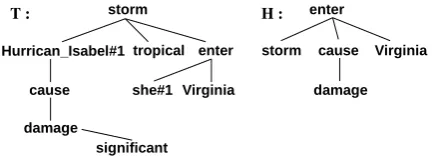
When coreference is considered, logically sound tree transformations can be quite compli-cated. The following is a modified example from RTE2-dev:
[image:2.595.77.285.69.122.2]T: Hurricane Isabel, which caused significant damage, was a tropical storm when she entered Virginia. Hurrican_Isabel#1 cause significant damage tropical storm Virginia she#1 ARG enter enter cause damage storm T : H : ARG TIME ARG MOD TIME ARG SBJ OBJ ARG ARG MOD OBJ SBJ ARG ARG ARG ARG SBJ SBJ SBJ OBJ ARG OBJ Virginia
Figure 2: DCS trees with coreference
H:A storm entered Virginia, causing damage. The corresponding DCS trees are shown in Fig-ure 2. Though the DCS trees of T and H are quite different,Hcan actually be proven fromT. Note the coreference between Hurricane Isabel andshe, suggesting us to copy the subtree of Hur-ricane Isabeltoshe, in a tree edit approach. This is not enough yet, because the headstorminTis not placed at the subject ofcause. The issue is in-deed very logical: from “Hurricane Isabel = she”, “Hurricane Isabel = storm”, “she =subject of en-ter” and “Hurricane Isabel = subject of cause”, we can imply that “storm =subject ofenter = sub-ject ofcause”.
3 Alignment with logical clues
Tian et al. (2014) proposed a way to generate on-the-fly knowledge to fill knowledge gaps: ifHis not proven, compare DCS trees of T and H to generate path alignments (e.g. blamed for death
∼cause loss of life, as underscored in Figure 1); evaluate the path alignments by a similarity score function; and path alignments with a score greater than a threshold (0.4) are accepted and converted to inference rules.
The word vectors Tian et al. (2014) use to calculate similarities are reported able to cap-ture semantic compositions by simple additions and subtractions (Mikolov et al., 2013). This is also the case when used as knowledge resource for RTE, for example the similarities between
blamed+death and cause+loss+life, or between
found+shot+dead and killed, are computed >
0.4.
However, generally such kind of similarity is very noisy. Tian et al. (2014) used some logical clues to filter out irrelevant path alignments, which helps to keep a high precision. To evaluate the effect of such logical filters, we compare it with some other alignment strategies, the performance of which on RTE5-test data is shown in Table 1.
Strategy Prec. Rec. Acc. LogicClue + Inference 69.9 55.0 65.7
[image:3.595.88.275.61.114.2]LexNoun + Inference 64.2 57.3 62.7 LexNoun + Coverage 57.1 75.0 59.3 NoFilter + Coverage 54.2 87.7 56.8
Table 1: Comparison of different alignment strate-gies
LogicClue + Inference This is the system of
Tian et al. (2014)1, which use logical clues to filter out irrelevant path alignments, and apply accepted path alignments as inference rules.
LexNoun + Inference The same system as
above, except that we only align paths between lexically aligned nouns. Two nouns are aligned if and only if they are synonyms, hyponyms or derivatively related in WordNet.
LexNoun + Coverage As above, paths between
lexically aligned nouns are aligned, and aligned paths with similarity score>0.4are accepted. If all nodes in Hcan be covered by some accepted path alignments, then output “Y”. This is very similar to the system described in Bar-Haim et al. (2007b).
NoFilter + Coverage Same as above, but all
paths alignments with similarity score > 0.4are accepted.
4 How can logical inference help RTE?
Logical inference is shown to be useful for RTE, as Tian et al. (2014) demonstrates a system with competitive results. However, despite the expec-tation that all entailment matters can be explained logically, our observation is that currently logical inference only fills very limited short gaps fromT toH. The logical phenomena easily addressed by Tian et al. (2014)’s framework, namely universal quantifiers and negations, seems rare in PASCAL RTE data. Most heavy lifting is done by distribu-tional similarities between phrases, which may fail in complicated sentences. An especially complex example is:
T:Wal-Mart Stores Inc. said Tuesday that a Mas-sachusetts judge had granted its motion to decer-tify a class action lawsuit accusing the world’s largest retailer of denying employees breaks.
H:Employee breaks had been denied by a motion granted by a Massachusetts judge.
1http://kmcs.nii.ac.jp/tianran/tifmo/
100 1000 10000 100000 1000000
1 2 3 4 5 6
R² = 0.24
Weight of statements
T
im
e (
S
ec
.)
Figure 3: Time of forward-chaining (seconds) in our system, plotted on weights of statements (log-arithmic scale).
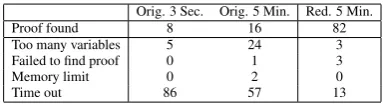
Orig. 3 Sec. Orig. 5 Min. Red. 5 Min. Proof found 8 16 82 Too many variables 5 24 3 Failed to find proof 0 1 3 Memory limit 0 2 0
[image:3.595.339.496.64.154.2]Time out 86 57 13
Table 2: Proportion (%) of exit status of Prover9
The system of Tian et al. (2014) generated on-the-fly knowledge to join several fragments inT and wrongly provedH. In examples of such com-plexity, distributional similarity is no longer reli-able. However, it may be possible to build a pri-ori logical models at the meta level, such as on epistemic, intentional and reportive attitudes. The models then can provide signals for semantic pars-ing to connect the logic to natural language, such as the words “grant”, “decertify”, and “accuse” in the above example. We hope this approach can bring new progress to RTE and other semantic pro-cessing tasks.
5 Efficiency of abstract denotations
To evaluate the efficiency of logical inference on abstract denotations, we took 110 true entailment pairs from RTE5 development set, which are also pairs that can be proven with on-the-fly knowl-edge. We plot the running time of Tian et al. (2014)’s inference engine (single-threaded) on a 2.27GHz Xeon CPU, with respect to the weighted sum of all statements2, as shown in Figure 3. The graph shows all pairs can be proven in 6 seconds, and proof time scaleslogarithmicallyon weight of statements.
On the other hand, we converted statements on abstract denotations into FOL formulas, and tried to prove the same pairs using Prover9,3 a
popu-2If a statement is translated to FOL formula, the weight of
this statement equals to the weighted sum of all predicates in the FOL formula, where ann-ary predicate is weighted asn.
[image:3.595.320.512.220.272.2]lar FOL theorem prover. As the result turns out (Table 2), only 8% of the pairs can be proven in 3 seconds (the “Orig. 3 Sec.” column), and only 16% pairs can be proven in 5 minutes (the “Orig. 5 Min.” column), showing severe difficulties for an FOL prover to handle textual inferences with many (usually hundreds of) on-the-fly rules. As such, we use Tian et al. (2014)’s inference engine to pin down statements that are actually needed for provingH(usually just 2 or 3 statements), and try to proveHby Prover9 again, using only necessary statements. Proven pairs in 5 minutes then jump to 82% (the “Red. 5 Min.” column), showing that a large number of on-the-fly rules may drastically increase computation cost. Still, nearly 20% pairs cannot be proven even in this setting, suggesting that traditional FOL prover is not suited for tex-tual inference.
6 Conclusion and future work
We have discussed the role that logical infer-ence could play in RTE task, and the efficiency of performing inference on abstract denotations. Though currently logical inference contributes at places that are somehow inconspicuous, there is the possibility that with some meta level logical models and the methodology of semantic parsing, we can build systems that understand natural lan-guage texts deeply: logic implies (in)consistency, which is in turn used as signals to produce more accurate semantic interpretation. And after all, as there may be many possible variations of seman-tic representations, it is good to have an efficient inference framework that has the potential to con-nect them. It would be exciting if we can combine different types of structured data with natural lan-guage in semantic processing tasks. Directions of our future work are described below.
Improvement of similarity score To calculate
phrase similarities, Tian et al. (2014) use the co-sine similarity of sums of word vectors, which ig-nores syntactic information. We plan to add syn-tactic information to words by some supertags, and learn a vector space embedding for this struc-ture.
Integration of FreeBase to RTE It would be
exciting if we can utilize the huge amount of Free-Base data in RTE task. Using the framework of abstract denotation, meanings of sentences can be explained as relational database queries; to convert
it to FreeBase data queries is like relational to on-tology schema matching. In order to make effec-tive use of FreeBase data, we also need to recog-nize entities and relations in natural language sen-tences. Previous research on semantic parsing will be very helpful for learning such mapping.
Winograd Schema Challenge (WSC) As the
RTE task, WSC (Levesque et al., 2012) also pro-vides a test bed for textual inference systems. A Winograd schema is a pair of similar sentences but contain an ambiguity of pronouns that is resolved in opposite ways. A complicated partial example is:
Michael decided to freeze himself in cryo-stasis even though his father was against it, because he hopes to be un-frozen in the future when there is a cure available.
The logical interplay among decided, hopes, even though,because, and the realization that he is coreferent toMichael(but nothis father) is in-triguing. By working on the task, we hope to gain further understanding on how knowledge can be gathered and applied in natural language reason-ing.
Acknowledgments This research was supported
by the Todai Robot Project at National Institute of Informatics.
References
Roy Bar-Haim, Ido Dagan, Iddo Greental, and Eyal Shnarch. 2007a. Semantic inference at the lexical-syntactic level. InProceedings of AAAI 2007. Roy Bar-Haim, Ido Dagan, Iddo Greental, Idan
Szpek-tor, and Moshe Friedman. 2007b. Semantic in-ference at the lexical-syntactic level for textual en-tailment recognition. In Proceedings of the ACL-PASCAL Workshop on Textual Entailment and Para-phrasing.
Hector Levesque, Ernest Davis, and Leora Morgen-stern. 2012. The winograd schema challenge. In
Knowledge Representation and Reasoning Confer-ence.
Percy Liang, Michael Jordan, and Dan Klein. 2011. Learning dependency-based compositional seman-tics. InProceedings of ACL 2011.