Designing extra-curricular dance programs: UK
physical education and dance teachers’
perspectives
Simon J. Sebire1*, Jade McNeill1, Laura Pool1, Anne M. Haase1, Jane Powell2, Russell Jago1
1
Centre for Exercise, Nutrition & Health Sciences, School for Policy Studies, University of Bristol, Bristol, UK; *
Corresponding Author: [email protected] 2
Faculty of Health & Life Sciences, University of the West of England, Bristol, UK
Received 19 December 2012; revised 20 January 2013; accepted 27 January 2013
ABSTRACT
Many girls do not engage in sufficient physi- cal activity (PA). Dance is a popular form of PA among UK secondary school-aged girls and extracurricular dance programs delivered by dance specialists may provide an alternative way to increase PA amongst girls aged 11 - 12. The purpose of this study was to explore the views of physical education and dance teachers on the structure, content and delivery of an ex-tra-curricular dance-based PA intervention for adolescent girls. Methods: Semi-structured quali-tative interviews were conducted with eleven physical education teachers and eleven dance teachers, and were analyzed using thematic analysis. Results: Themes identified addressed key logistical and content/delivery-based fac- tors to be considered when designing a dance- based PA intervention. Logistical factors in-cluded optimizing participant recruitment and aligning external providers with school behavior management policies. Content/delivery factors focused on teacher-student rapport, facilitating dance competence, and balancing teacher and student-led time. Conclusions: This formative study highlighted that an extra-curricular dance- based PA intervention would be welcomed in UK schools. A number of considerations central to the design and delivery of such a program were identified from key user groups which can be used to inform the development of school- based dance (and non-dance) interventions aimed at increasing PA amongst adolescent girls.
Keywords:Physical Activity Intervention;
Intervention Design; Qualitative Research
1. INTRODUCTION
Physical activity (PA) is associated with lower levels of cardiovascular risk and type 2 diabetes among chil-dren [1,2], and is linked with improved psychological health including emotional well being, self esteem and confidence [3]. Despite this, many young people do not meet PA guidelines of 60 minutes of moderate-to- vigorous PA per day [4] and there is an age-related de- cline in PA during childhood, particularly among girls [5] during the transition from primary (elementary) to secondary (high) school [6]. Therefore, childhood and adolescence are key periods to promote PA and the de- velopment and evaluation of interventions to target PA during youth is a priority [7].
Schools are a popular setting for the implementation of interventions, due to their frequent contact with most children. However, many school-based interventions have not yielded increases in youth PA [8]. Due to the pressures to raise academic standards and improve test scores, curriculum time devoted to PA and physical edu-cation (PE) is limited [9]. Therefore, there is a need for interventions delivered at school, but outside of curricu-lum time.
Dance is a highly favored form of PA among UK sec- ondary school-aged girls [10]. Dance does not require exceptional abilities or equipment and can motivate and excite young people, develop team working and creative thinking [11,12]. Importantly, participating in dance contributes towards moderate-to-vigorous PA amongst 11 - 18 years old girls [13].
skills and expertise needed to teach dance suggests that extra-curricular dance programs delivered by dance spe-cialists may provide an alternative way to increase PA amongst adolescent girls aged 11 - 12 [15].
Guidance for the design and implementation of school-based dance programs is not available. However it is crucial to conduct and disseminate formative and feasibility research so that interventions can be devel-oped which align with best practice and user group ex-perience [16]. As such, the first aim of the present for-mative study was to explore dance and PE teachers’ views on key considerations for the structure, content and delivery of a dance-based PA intervention for ado-lescent girls. PE teachers’ views were sought on school-based issues (e.g., logistics, dance provision & perceived interest) and dance teachers’ views were sought on de-livering dance-based PA programs.
Incorporating theoretical frameworks in to the devel-opment of interventions facilitates an understanding of the process and mechanisms by which interventions might work [17]. However, the apriori selection of a given theory may exclude potentially important factors that are part of the intervention context (e.g., dance). As such, the second aim of this study was to use the views of the dance and PE teachers to identify a theoretical framework which could guide the development of a dance-based afterschool PA intervention.
2. METHODS
2.1. Participants
Physical education teachers were recruited from 10 secondary schools, without a dance specialism, from Bristol (UK) to represent a range of socio-economic sta- tus (SES) groups. Eleven nationally-recognized expert female dance teachers were recruited using a snowball-ing method. To be eligible for inclusion, dance teachers were required to have a minimum of two years teaching experience, hold dance education qualifications equiva-lent to UK A-Level and have worked with the target population for a minimum of one year. Participants in-cluded current dance teachers, dance educators, national and local dance development officers and school-based dance leads. All participants provided written informed consent. The study was approved by a University ethics committee.
2.2. Procedure
Semi-structured interviews were employed to allow the PE and dance teachers to talk freely and openly within a framework of topics. Twenty two interviews (11 dance teachers and 11 PE teachers) were conducted ei-ther face-to-face or by telephone by two trained inter-viewers and were digitally recorded (Mean duration = 40
minutes; range = 30 - 50 minutes).
A semi-structured interview guide was developed in collaboration with an expert with extensive experience in dance teaching and education. It aimed to facilitate open discussions and prompts were used to gather in-depth perspectives. The PE teachers’ interview explored: 1) logistical issues within a school environment (e.g., facili-ties, timetabling activities and travel/safety concerns); 2) how to structure the dance program and its content and 3) recruitment into an extra-curricular dance program. The dance instructors’ interview focused on content and deliv-ery of dance sessions for adolescent girls. Topics included: 1) barriers to participation in a dance program; 2) success-ful strategies to teach dance, aid development and pro-gression; 3) effective ways to retain participation and 4) the content of the session, (e.g., enhancing enjoyment and behavior management strategies). Following com-pletion of 22 interviews it was agreed that saturation had been reached.
2.3. Data Analysis
Recordings were transcribed verbatim, anonymised and transcripts were imported into NVivo (Version 8, QSR, Southport, UK). As the data were considered ex- ploratory, we adopted a thematic analysis approach [18] using three stages. First, transcripts were read line-by- line and annotated with codes that described notable content. Second, a different team member reviewed all annotated transcripts to scrutinize codes and themes and to identify any differences in interpretations. Another team member acted as the arbitrator of any differences in interpretation. Third, codes were analyzed for links in order to generate themes.
3. RESULTS
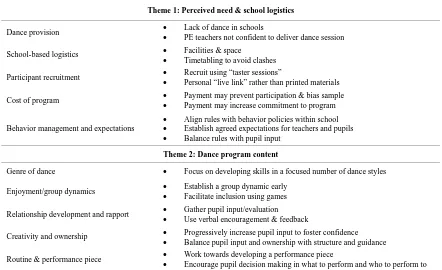
Ten themes were identified which highlighted factors pertinent to the design and delivery of a school-based extra-curricular dance program (Table 1). The themes were grouped into two higher-order themes; 1) Perceived Need and School Logistics contained themes addressing current dance provision, school logistic issues, partici-pant recruitment, program cost and behavior manage-ment and 2) Dance Program Content contained five themes addressing dance genre, building enjoyment, teacher-student rapport, fostering ownership and per-formance opportunities. All themes are discussed in de-tail below.
3.1. Theme 1: Perceived Need and School Logistics
Dance provision. All of the PE teachers highlighted a
Table 1. Summary of themes.
Theme 1: Perceived need & school logistics
Dance provision Lack of dance in schools
PE teachers not confident to deliver dance session
School-based logistics Facilities & space
Timetabling to avoid clashes
Participant recruitment Recruit using “taster sessions”
Personal “live link” rather than printed materials
Cost of program Payment may prevent participation & bias sample Payment may increase commitment to program
Behavior management and expectations
Align rules with behavior policies within school Establish agreed expectations for teachers and pupils Balance rules with pupil input
Theme 2: Dance program content
Genre of dance Focus on developing skills in a focused number of dance styles
Enjoyment/group dynamics Establish a group dynamic early Facilitate inclusion using games
Relationship development and rapport Gather pupil input/evaluation Use verbal encouragement & feedback
Creativity and ownership Progressively increase pupil input to foster confidence Balance pupil input and ownership with structure and guidance
Routine & performance piece Work towards developing a performance piece
Encourage pupil decision making in what to perform and who to perform to
ers felt they lacked the knowledge, confidence and abil-ity to teach dance.
“Yes I definitely think there would be a demand, […] I
do a little bit of dance, I teach half of Year 7, but I
ha-ven’t got that much experience.” (PE 4).
“It’s just basically getting the pupils, or people,
in-volved, and getting somebody actually to take the
ses-sion… I’m not a dancer, or a dance specialist. I can’t
take the sessions.” (PE 2).
School-based logistics. PE teachers highlighted
chal-lenges associated with running an extra-curricular pro-gram such as facilities and timetabling alongside existing activities.
“It would be space, where you would do it, and what
other activities are going on outside because we have
rounders and cricket and things going on, in different
areas.” (PE 4).
“Some schools have a stand-alone dance studio, but
others might be competing with other activities and
sports, and even subjects with the sports halls etc. So, it
would have to be carefully planned and be integrated
with the school’s other extra-curricular activities.” (PE 8).
Participant recruitment. Both PE teachers and dance
specialists highlighted the intervention recruitment proc-ess as a key factor in a dance program. PE teachers sug-gested that a “dance taster session” which reflected the program and was delivered during a PE session to reach the entire year group, would maximise recruitment.
“That’s always quite a good way of getting to, to the
girls, definitely. Taster sessions.” (PE 1).
“Posters… or information giving, doesn’t always lead
to much uptake… a live link, is much better. Or an active
link where there is some kind of personal interaction.”
(PE 8).
Cost of the program to pupils. Participants held mixed
opinions of whether the dance program should be paid for by the pupils, or free of charge. Some PE teachers suggested that a fee may deter some pupils and their parents from signing up, resulting in a recruitment bias towards higher SES participants:
“I don’t think you’d get, I don’t think you’d get a
rep-resentative sample.” (PE 4).
“I think when money is involved, again, you get those
kids who do everything anyway, … and they have to pay
for it, and they have to pay up front. And, so many
par-ents said, can’t afford it.” (PE 2).
However, some participants thought that a fee would increase perceived value and commitment to the pro-gram.
“I don’t think there’s anything wrong with kids paying
to attend. If there is a charge, then it will help them to
commit to it I think. On the other hand you don’t want to
price people out of the market. So it might be that a token
charge might be made of say 50p a session.” (PE 8).
“Ground rules, because an external person going in,
sometimes the school have behavior policies and things like that and the dance teacher needs to work alongside
those policies to some degree, so that there are those
kind of boundaries in place without being too strict with
them. It’s just aligning the dance teacher with a much
broader knowledge of what’s happening in school time
and behavior policies.”(Dance Teacher 7).
The dance teachers also stressed the importance of clarifying the expectations of both the teacher and pupils from the start of the dance intervention. However, they also highlighted the importance of achieving a balance of agreed rules and being too strict.
“You can draw up a contract between the student and
the teacher and you say, this is what we expect of you,
this is behavior, attendance, uniform and performance.
What do you expect? As students on this project, what do
you want from it?”(Dance Teacher 4).
“You have to have an approach that when it’s out of
school you need to be out of teacher mode, because out
of school it’s their choice to come. So you can’t be too
strict. But then it’s laying those foundation and ground
rules and boundaries still, so that it’s not a free for all.”
(Dance Teacher, 7).
3.2. Theme 2: Dance Program Content
The dance teachers converged in their views of the key dance content that should guide the development of an extra-curricular school-based dance intervention. Factors included specifying a dance genre, structuring sessions to optimize ownership, enjoyment and teacher-pupil rapport and the inclusion of a performance element.
Genre of dance. The dance teachers suggested that
participants should work towards learning one style of dance to facilitate the development and refinement of individual skills.
“I think it would be probably best either do one, or
maybe at the most, two styles. Because that way you’re
going to get the most out of them and they’re going to be
able to learn more.” (Dance Teacher 2).
Establishing enjoyment and group dynamics. The
dance instructors noted the importance of activities which foster friendships and generate a group ethos:
“I would go ahead with name games, some ice
break-ers, particularly in the first couple of weeks. Because the
key thing is, the group needs to get to know each other…
and hopefully, they’ll feel more included and want to
come back because they are making new friends.”
(Dance Teacher 4).
“I would go in with a whole taster of games and
ac-tivities, different styles, but very short, five, ten minute
tasks, then move on to keep it really snappy.” (Dance
Teacher 7).
Relationship development and rapport. The dance
teachers highlighted the importance of establishing a good relationship with the pupils. This was characterized by two-way communication, listening to pupil opinions and encouragement.
“You need to develop a good rapport where you are
continually asking them for feedback as well and they
won’t come back if they didn’t like it. So it’s quite
im-portant that at the end of each session you say what have
you enjoyed today, what has gone well, what shall we
change for next time?” (Dance Teacher 10).
“...encouragement, constant feedback, letting them
know how close they are to reaching their goal, or
achievement, whether it’s a show “it’s looking really
good for the show, can’t wait to invite your parents” and
especially if they’ve got their input then it would cer-
tainly start to be more fun and enjoyable.” (Dance
Teacher 1).
Creativity and ownership. All of the dance instructors
noted the importance of student-directed time as a means of fostering ownership. The participants noted that the initial sessions should be mainly teacher-led with stu- dent-led time introduced and increased over the course of the intervention as the girls increase in confidence and competence.
“The first couple of sessions, it’s mostly teacher-led
because they might not have any dance vocabulary in
their bodies. They might not be brave enough.So I would
just give very simple choreographic task and games
where they didn’t even know where composing dances,
they just felt like they were playing games to get them a
bit more brave.” (Dance Teacher 11).
It was suggested that student-led input would be en- hance the development, confidence and creative thinking of the pupils whilst also giving them the opportunity of working with other pupils within the class.
“It encourages that ownership and attracts what you
want to achieve and they certainly need a chance to put
into action what they see, or they might have created
their own little movements at home that they want to
show off.” (Dance Teacher 8).
The dance instructors highlighted a number of chal- lenges that dance teachers might face with student-led time including keeping pupils engaged, dealing with pu- pils with varied abilities and providing sufficient struc- ture to student-led tasks. They suggested a number of potential means of addressing these difficulties:
“I think keeping a really tight time frame, very clear
structured tasks.”“Right, I’ve taught you that sequence, I
want you to put that together, three of you, all facing
different directions, and add one more of your own.” So
it’s very clear.” (Dance Teacher 6).
“It is that role of just watch and see and step in if
And they’re doing so well I’ll just step back because
they’re doing all the right things, including everybody,
not spending too much time chatting about other stuff.”
(Dance Teacher 9).
Routine and performance element. The PE teachers
and dance teachers suggested that working towards a dance performance with the option of demonstrating what the pupils had learnt would positively influence their motivation, encourage engagement and create a sense of belonging amongst pupils.
“I would definitely build it up towards a performance.
Absolutely, that’s always got to be the aim.” (Dance
Teacher 11).
“The element of performance can take many different
forms and I think that has to come from the young people
to keep them engaged.” (Dance teacher 7).
“We have an evening of gym and dance where they
can show the work to their parents and those are always really powerful and really popular both in terms of
rein-forcing girls’ attitudes and the likelihood they’ll stay
with dance and in a role modeling effect, inspiring others
to want to take part.” (PE 7).
4. DISCUSSION
The first aim of the present study was to engage PE teachers and dance teachers in the process of developing an extra-curricular dance program by identifying fac- tors that might influence its design and delivery. PE teachers felt that there was a lack of dance provision in schools, and the majority lacked the knowledge, confi- dence and experience to teach dance. This is consistent with the findings of Youth Dance England [12] which highlights the lack of provision across schools in Eng- land and that many teachers who deliver dance within the national curriculum are general PE teachers with no dance qualifications. Youth Dance England have noted that priorities for dance in schools are: to improve the workforce of teachers delivering dance, to increase the accessibility of dance in the curriculum and during ex-tra-curricular activities and to focus on the least engaged individuals. As such, one possible solution is to recruit specialist dance instructors to inspire and engage youth in dance as a form of PA.
In order to effectively recruit participants, an interven-tion must target all pupils within a school year group, be relevant, reflect current trends, be appropriate for and adaptable to the ability level of participants to be opti-mally challenging and encourage pupil input. Delivering a fun and exciting taster session may inspire and excite pupils about dance and encourage recruitment. These findings agree with the beliefs of adolescent girls identi-fied in previous research which suggests that fun (of moving, having a sense of freedom, creativity, self-ex- pression & learning new skills), social interaction,
teacher support and links to current trends are important in engaging adolescents in dance [19,20].
Logistical issues that were highlighted included align-ing the program with current extra-curricular activities to avoid competition with other PA opportunities. Again this reflects previously identified perspectives of adoles-cent girls [19]. Such competition may influence recruit-ment and the composition of participant groups. It is therefore necessary to carefully target less active girls for whom attending an extra-curricular dance class would represent an addition to their weekly activities rather than a displacement of an alternative PA. Further, in line with previous work [21] both the PE teachers and dance teachers stressed the importance of establishing expecta-tions for behavior and attendance. The findings suggest that aligning these with the school behavior policy is essential so that the intervention has clear and consistent guidelines which the participants are familiar with.
Findings were mixed with regards to whether the intervention should be free of charge or carry a fee. Some participants believed a fee would be a barrier to some pupils whereas others thought it would enhance the value pupils place on the program as it is common to incur a fee for extra-curricular activities. If a fee were charged, it would be important to balance cost with value for money and ensure that it does not prevent participa-tion amongst low income groups. Further research using economic frameworks is required to explore adolescents’ and parents’ preferences with regards to financial charges for such programs.
Physical activity interventions should be grounded in theory to facilitate their development and to identify why
[24].
In terms of dance program content, dance teachers’ knowledge and experience can help to create a relevant, fun and enjoyable dance intervention whilst fostering a supportive relationship with and between the pupils. In line with the views of adolescent girls [19], dance teach- ers emphasized the development of participant owner- ship of the dance intervention. The social context such as the classroom climate created by teachers is an additional feature of SDT which emphasizes how teacher-created climates influence pupil motivation and psychological need satisfaction [25,26]. Dance teachers can enhance autonomous motivation and need satisfaction by 1) be- ing autonomy-supportive (e.g., giving choice during dance sessions), 2) providing structure (e.g., clear ex- pectations guidelines and rules) and 3) being interper- sonally involved (e.g., showing interest and understand- ing pupils). These empowering strategies, many of which were articulated by the dance teachers and PE teachers in the present study and have previously been documented by adolescent dancers [20] and have positive effects on the motivation, need satisfaction and psychological well- being of dancers [24,26].
Limitations
Although the sample size was small, we were able to triangulate the views of the PE and dance teachers and there was clear evidence of saturation where no new in- formation was obtained within the later interviews. We are therefore confident that the data are an accurate rep- resentation of the views of dance teachers and PE teach- ers in the local area. A further limitation is that although participants offered their experiences of the teaching strategies that they have previously found to be success- ful, and there was consistency among participants in this regard, we are unable to identify the degree to which these were successful in engaging young people or whether their opinions reflected strategies that they be- lieve would work rather than what is effective in prac- tice.
5. CONCLUSION
The data presented have shown that an after school extra-curricular dance program would be welcomed in UK secondary schools. Developers of extra-curricular interventions need to respond to logistical challenges posed in school settings. A dance intervention can be grounded in behavioral theory and run by specialist dance teachers using a combination of teacher-led tasks and student- directed time with the aim of increasing PA. The intervention should focus on being fun, energetic and encouraging, work towards a dance performance element and developing pupils’ skills and confidence to
engage in dance and PA more broadly.
6. ACKNOWLEDGEMENTS
This work was supported by the National Prevention Research Initia- tive (http://npri.org.uk), consisting of the following funding partners: Alzheimer’s research Trust; Alzheimer’s Society; Biotechnology and Biological Sciences Research Council, British Heart Foundation; Can- cer Research UK; Chief Scientist Office; Scottish Government Health Directorate; Department of Health; Diabetes UK; Economic and Social Research Council; Engineering and Physical Sciences Research Coun- cil; Health & Social Care Research & Development Office for Northern Ireland; Medical Research Council; The Stroke Association; Welsh Assembly Government and World Cancer Research Fund. This work was also supported by a Career Development Fellowship (to Dr. Jago) supported by the National Institute for Health Research. The views expressed in this publication are those of the authors and not neces- sarily those of the NHS, the National Institute for Health Research or the Department of Health.
REFERENCES
[1] Jago, R., Baranowski, T., Baranowski, J.C., Thompson, D. and Greaves, K.A. (2005) BMI from 3-6 y of age is pre- dicted by TV viewing and physical activity, not diet. In- ternational Journal of Obesity, 29, 557-564.
doi:10.1038/sj.ijo.0802969
[2] Jago, R., et al. (2008) Six-year change in youth physical activity and effect on fasting insulin and HOMA-IR. American Journal of Preventive Medicine, 35, 554-560.
doi:10.1016/j.amepre.2008.07.007
[3] Schmalz, D.L., Deane, G.D., Birch, L.L. and Davison, K.K. (2007) A longitudinal assessment of the links be- tween physical activity and self-esteem in early adoles- cent non-Hispanic females. Journal of Adolescent Health,
41, 559-65. doi:10.1016/j.jadohealth.2007.07.001
[4] Riddoch, C.J., et al. (2009) Prospective associations be- tween objective measures of physical activity and fat mass in 12-14 year old children: The Avon Longitudinal Study of Parents and Children (ALSPAC). British Medi- cal Journal, 339, Article ID: b4544.
doi:10.1136/bmj.b4544
[5] Kimm, S.Y., et al. (2002) Decline in physical activity in black girls and white girls during adolescence. New Eng- land Journal of Medicine, 347, 709-715.
doi:10.1056/NEJMoa003277
[6] Nader, P.R., Bradley, R.H., Houts, R.M., McRitchie, S.L. and O’Brien, M. (2008) Moderate-to-vigorous physical activity from ages 9 to 15 years. Journal of the American Medical Association, 300, 295-305.
doi:10.1001/jama.300.3.295
[7] van Sluijs, E.M., McMinn, A.M. and Griffin, S.J. (2007) Effectiveness of interventions to promote physical ac- tivity in children and adolescents: Systematic review of controlled trials. British Medical Journal, 335, 703.
doi:10.1136/bmj.39320.843947.BE
tion of obesity: A review of interventions. Obesity Re- views, 8, 127-130.
doi:10.1111/j.1467-789X.2007.00331.x
[9] Chomitz, V.R., et al. (2009) Is there a relationship be- tween physical fitness and academic achievement? Posi- tive results from public school children in the Northeast- ern United States. Journal of School Health, 79, 30-37.
doi:10.1111/j.1746-1561.2008.00371.x
[10] O’Donovan, T. and Kay, A. (2005) Focus on girls in sport. British Journal of Teaching Physical Education, 36, 29- 31.
[11] Beaulac, J., Olavarria, M. and Kristjansson, E. (2010) A community-based hip-hop dance program for youth in a disadvantaged community in Ottawa: Implementation find- ings. Health Promotion Practice, 11, 61S-69S.
doi:10.1177/1524839909353738
[12] (2010) Young people’s dance: A ten year vision 2010- 2020 for the development of dance for children and young people in England. Australian WomenSport and Recrea- tion Association, Panton Hill.
[13] O’Neill, J.R., Pate, R.R. and Hooker, S.P. (2011) The contribution of dance to daily physical activity among adolescent girls. International Journal of Behavioral Nu- trition and Physical Activity, 8, 87.
doi:10.1186/1479-5868-8-87
[14] (2008) Youth sports trust, audit of dance provision in English schools 2006/2007.
[15] Pate, R.R. and O’Neill, J.R. (2009) After-school interven- tions to increase physical activity among youth. British Journal of Sports Medicine, 43, 14-18.
doi:10.1136/bjsm.2008.055517
[16] Jago, R. and Sebire, S.J. (2012) Publishing pilot and fea- sibility evaluations of behavioural interventions: Implica- tions for Preventive Medicine. Preventive Medicine, 55, 548-549. doi:10.1016/j.ypmed.2012.07.005
[17] Michie, S. and Prestwich, A. (2010) Are interventions theory-based? Development of a theory coding scheme. Health Psychology, 29, 1-8. doi:10.1037/a0016939
[18] Braun, V. and Clarke, V. (2006) Using thematic analysis in psychology. Qualitative Research in Psychology, 3, 77- 101. doi:10.1191/1478088706qp063oa
[19] Jago, R., et al. (2011) Adolescent girls' and parents' views on recruiting and retaining girls into an after-school dance intervention: Implications for extra-curricular physical activity provision. International Journal of Behavioral Nutrition and Physical Activity, 8, 91.
doi:10.1186/1479-5868-8-91
[20] Stinson, S.W. (1997) A question of fun: Adolescent en- gagement in dance education. Dance Research Journal,
29, 49-69. doi:10.2307/1478734
[21] Simonsen, B., Fairbanks, S., Briesch, A. and Myers, D. (2008) Evidence-based practices in classroom manage- ment: Considerations for research to practice. Education and Treatment of Children, 31, 351-380.
doi:10.1353/etc.0.0007
[22] Brug, J., Oenema, A., and Ferreira, I. (2005) Theory, evidence and intervention mapping to improve behavior nutrition and physical activity interventions. International Journal of Behavioral Nutrition & Physical Activity, 2, 2.
doi:10.1186/1479-5868-2-2
[23] Deci, E.L. and Ryan, R.M. (2000) The “what” and “why” of goal pursuits: Human needs and the self-determination of behavior. Psychological Inquiry, 11, 227-268.
doi:10.1207/S15327965PLI1104_01
[24] Quested, E. and Duda, J.L. (2010) Exploring the so- cial-environmental determinants of well- and ill-being in dancers: A test of basic needs theory. Journal of Sport & Exercise Psychology, 32, 39-60.
[25] Reeve, J. (2002) Self-determination theory applied to educational settings: In: Deci, E.L. and Ryan, R.M., Eds., Handbook of Self-Determination Theory Research, The University of Rochester Press, New York, 183-204.