Why Well Spread Probability Samples Are Balanced
Anton Grafström1, Niklas L. P. Lundström2
1Department of Forest Resource Management, Swedish University of Agricultural Sciences, Umeå, Sweden
2Department of Mathematics and Mathematical Statistics, Umeå University,Umeå, Sweden
Email: [email protected], [email protected]
Received November 22,2012; revised December 24, 2012; accepted January 8, 2013
ABSTRACT
When sampling from a finite population there is often auxiliary information available on unit level. Such information can be used to improve the estimation of the target parameter. We show that probability samples that are well spread in the auxiliary space are balanced, or approximately balanced, on the auxiliary variables. A consequence of this balancing effect is that the Horvitz-Thompson estimator will be a very good estimator for any target variable that can be well ap- proximated by a Lipschitz continuous function of the auxiliary variables. Hence we give a theoretical motivation for use of well spread probability samples. Our conclusions imply that well spread samples, combined with the Horvitz- Thompson estimator, is a good strategy in a varsity of situations.
Keywords: Balanced Sample; Local Pivotal Method; Spatial Balance; Spatially Correlated Poisson Sampling; Voronoi Polytopes
1. Introduction
In many fields there has been a great interest in selecting samples that are well spread or spatially balanced. Such samples are considered to produce good estimates for target variables that exhibit spatial trends, see e.g. [1,2]. The focus in this paper is to explain the connection be- tween a well spread sample and a balanced sample. Roughly speaking, a sample is well spread if the number of selected units is close to what is expected on average, in every part of the auxiliary space. A sample is balanced on a variable if the Horvitz-Thompson (HT) estimator of the total of that variable agree exactly with the known population total of the variable. In fact, with a short ana- lysis, this paper clarifies why a well spread sample is ap- proximately balanced. We also explain that, if the sample is well spread, the variance of commonly used estimators is usually low.
It is well known that samples that are balanced or ap- proximately balanced on the auxiliary variables may be selected by using the cube method, see e.g. [3]. Sampling methods for selection of well spread samples in a general auxiliary space, by utilizing a distance function, are more recent and less well known than the cube method. Two such methods are the local pivotal method (LPM) and spatially correlated Poisson sampling (SCPS). The LPM design, based on the pivotal method [4], was first intro- duced in [5]. The other method, SCPS, was first intro- duced in [6] and it is a special case of the method de- scribed in [7].
In many areas, such as forest inventories, environ- mental studies, and even in official statistics, different forms of stratification are commonly used to obtain sam- ples that are well spread geographically or in other avail- able information. Often, stratification is used as a vari- ance reduction technique without particular interest in the different strata. Constructing a stratified sampling design is often not straightforward, especially if several mixed auxiliary variables are available. It is not uncommon that statisticians try to stratify using several variables, but crossing all strata of all variables usually results in cells that are too small. In such situations it may be preferable and less complicated to define a distance measure in the auxiliary space, and then use a sampling method that in general avoid selection of nearby units, thus forcing the sample to be well spread.
In Section 2, a theoretical motivation for the balancing effect of well spread samples is given. In Section 3, we give arguments indicating that using well spread samples provides a small anticipated variance for the HT-estima- tor under a very general super-population model. Some sampling methods for selecting well spread samples are briefly discussed in Section 4. Final comments are pro- vided in Section 5.
2. Main Results
estimate some characteristics of U. It is assumed that we have access to auxiliary information on unit level, i.e. the values of q auxiliary variables i
i1, i2, , iq
q
x x x R
i i U
Y
x
i U
i, d x xi U πi
i U
n
are known for each unit . We also assume that it is possible to calculate the distance j between
two units i and j in the auxiliary space. Usually the total y
πi
of one or more target variables are the pa- rameters we wish to estimate. It is assumed that each population unit i is included in the sample with a known probability , , with
, where n is the sample size. In this case the unbiased and commonly used HT-estimator [8] of Y isˆ .
π
i i s i
y Y
We are now ready to formalize what a well spread sample is. As suggested in [2], we use Voronoi polytopes to measure how well spread a sample is. The Voronoi polytope , for , includes all population units j satisfying i j k j for all sample units
. Let ni denote the number of units in pi, with the
correction that if a unit j is included in mj polytopes, then j is counted as
i
p d x x
i
,
s
, d x x
ks
1mj. Next, let vi be the sum of the inclu-
sion probabilities in pi. Again, if a unit j is included in mj
polytopes, then its inclusion probability is divided equally
πj mj
to each of the mj polytopes. Hence,π
.
i i
1
and j
i i
j p j j p j
n v
m m
i s
i i s
v n
Note that
and . We are now ready to give the definition of a well spread sample.i
n N
Definition 1 A sample is said to be well spread (or spatially balanced) with respect to the inclusion prob- abilities if each vi is equal or close to 1.
As a measure of how well spread a sample is, we may use
21
1 ,
i i s
B v
n
(1)see e.g. [2]. A small value of B indicates a very well spread sample. The mean of B over repeated samples is an indicator of how well spread samples a design pro- duces. We next define a balanced and an approximately balanced sample.
Definition 2 We say that a sample s is balanced on the auxiliary x-variables if
.
π
i i i U i s i
xx
i i U
Moreover, a sample is said to be approximately bal-
anced if
x is close toπ
i i s i
x1 for all .
i
v i s
.
In order to show that well spread samples are balanced we start by making three quite strong assumptions on the sample and the population. Later we will relax these as- sumptions a bit and then show that a larger class of well spread samples are approximately balanced. We first as- sume the following.
(A.0) In each polytope the inclusion probabilities sum to 1, i.e.
i s
(A.1) In each polytope the inclusion probabilities are equal, i.e.for every , we assume
π πi for all jpi.
is j
(A.2) In each polytope the auxiliary variables are equal for all units, i.e. for every ,
i, j
0 for all id x x jp
i p
.
The assumptions (A.0) and (A.1) tell us that the size ni
of the polytope is equal to 1πi and (A.2) tells us
that f
xj f
xi , for jpi. Note that πj, xjand hence f
xj
are allowed to vary between poly- topes. Under the three assumptions it follows that
1 .π i
i j i
i U i s j p j
i i
i s j p j i s i f
f
m
f f
m
x x
x x
(2)
Thus the sample is balanced on any function f x and in particular, it is balanced on the auxiliary variables if we put f
x x.The next step consists of introducing the following three new and less restrictive assumptions.
A.1
For each polytope pi, the inclusion probabili-ties satisfies
πiπj ifor all jpiand some 0 i πi.
A.2
In each polytope pi, we have
i, j
ifor all iand some i 0.d x x r jp r
A.3
The target is a Lipschitz continuous function of the auxiliary variables, i.e.
,
for all and some 0.
i j i i j i i
f f c d
j p c
x x x x
ables, so they should not vary much within a polytope. Remember that the polytopes are constructed by group- ing together units with similar x-values.
We are now ready to state and prove our main result. Theorem 1 Let s be a well spread sample satisfying
1
i i for all i and for some i . Assume also that
v s 0
s is from a population satisfying assumptions . Then
A.1
- A.3
s is approximately balanced. In particular,
1
.i i i i i i
f c r
,c ri, i 0 1 π
π
i i i
i i i s i i i U
i s
f c r
f
x x x By sending i i
we obtain exact balance on the target since
i .i U f
xπ
i i s i
f x
Note also that if we put f
x x,
then we get a bal- anced sample, see Definition 2. Besides that Theorem 1 tells us that when i,r ci i i are small, the sample will
be approximately balanced on
x and , it also x
i i Uf
xf
gives bounds for the target parameter . We can however do better than the bounds in Theorem 1. For instance, we have
,
i i i j
i i s j pi j i U
i s j pi
f c d
f m
x x x
x
, ,
i i i j j
f c d
m
x x x
.1 Abut these bounds are constructed by applying a worst case senario, within each polytope, so we cannot expect the bounds to be very good.
Proof of Theorem 1. By assumption
and since vi 1 i we have, for all is,
π
1 π and
π
1 π .
j
i i i i j pi j
j
i i i i j pi j
n m n m
(3)The inequalities in (3) give 1 i i 1 . π π i i i i i n
A.3
(4)Moreover, from assumptions
A.2 and we see that
Theorem 1 now follows from (4) and (5). In particular,
,
.j i i i j i i
f x f x cd x x c r
(5)
1
π
j
i i i i i i U i s j pi j i s
i i i i i s i i
f
f n f c r
m
f c r
x x x x
and
1 . π ji i i i i i U i s j pi j i s
i i i i i s i i
f
f n f c r
m
f c r
x x x x
The proof is complete.
3. Variance under a General Model
It is interesting to see how well spread samples perform under a general super-population model. Following [9], but here with a possibly non-linear model, we assume
for all ,i f xi i i U
y (6)
f is a Lipschitz continuous function, where
2
2M i i i
0EM i
2
, V x , and is a
Lipschitz continuous function. Moreover,
covM i, j i j ij withi j,
EM VM
where , and covM are the expecta-
tion, variance and covariance under the model. The cor- relations ij
, are supposed to be decreasing in function of the distance between the units i and j.
With some routine calculations, the anticipated vari- ance of the HT-estimator under model (6) can be shown to be
ˆ
2
2π
π π π , π π
i
p M p i i s i i U
ij i j i j ij
i U j U i j f
E E Y Y E f
x x (7)
p Ewhere is the expectation under the design. Now, if we study expression (7), it becomes evident that we want the samples to be as balanced as possible on f x
to minimize the term
2.π
i
p i
i s i i U
f E f
x x π ijWe also want to make sure that ij is small whenever
is large in order to minimize the term
π π π
π π
ij i j i j ij
i U j U i j
If the samples are selected to be well spread (i.e. small joint inclusion probabilities for nearby units), then both terms in (7) becomes small. However, if the model standard deviation i is known, it is possible to also
choose the inclusion probabilities to minimize further. The diagonal term of (8) is dominant, i.e.
21 π. π
i i i U i
πi i U
n
π π π
π π
ij i j i j ij
i U j U i j
(9)With the constraint of fixed sample size
and by using a Lagrangian function, it follows that the minimum in πi of the right hand side of (9) isπ i ,
i
j j U
n
i j j U
n
(10)
if each
. As a result, a very efficient sam- pling design under this general model is to select samples that are well spread in the x-space with inclusion prob-abilities given by (10). The requirements needed in order for the samples to be approximately balanced on f x
x
f x
f xare then fulfilled. The inclusion probabilities will not vary much within the polytopes since is sup- posed to be a Lipschitz continuous function of x. Hence,
with this strategy, the anticipated variance of the HT- estimator becomes small.
It is not possible to balance the sample directly on since the function is obviously not known in ad- vance. Probably, the best we can do in practise is to make sure the samples are well spread in x to have a balancing
effect on the unknown function , and hence also have small πij when ij may be large.
If we use well spread probability samples together with the HT-estimator, the estimator will be very effi- cient (i.e. have a small variance) if the population is close to a realization of the model (6). Note also that the ap- proach is purely design based, and the estimator main-tains design unbiasedness and design consistency even if the model is false.
Example 2, given in the next section, supports the above statements. In particular, the example compares different sampling methods with respect to variance and spatial balance. It is clear that methods obtaining well spread samples are more balanced and hence produce smaller variance.
4. Some Methods for Selecting Well Spread
Samples
Besides spatial stratification, one of the first more novel designs for selecting a well spread sample is called gen- eralized random tessellation stratified (GRTS), and was
introduced in [2]. The GRTS design uses a specific ran- dom mapping to map two (or more) dimensions to one dimension. Basically the units are re-ordered to a list and units close in the list tend to also be close in the auxiliary space. Then a systematic ps sample is selected from the list, making sure the sample becomes well spread in the list and hence also in the auxiliary space. A drawback of GRTS is that a lot of information is lost in the map- ping, especially if the space has many dimensions (i.e. many auxiliary variables). However, for two dimensions, the GRTS produces rather well spread samples.
π
q
R
x
Another idea is to map dimensions to one by use of space-filling curves, and one such design was presented and evaluated in [10]. However, we believe that mapping several dimensions to one is not the best way to achieve a well spread sample. Too much information is lost in such a mapping.
A more recent idea to achieve well spread samples is to first define a distance measure in the auxiliary space. To do so, let be all available auxiliary vari- ables, where
1, , p
correspond to the quantitative variables and
p1, , q
to the qualitative variables. To measure the distance between unit i and j in this q-dimensional space, [11] propose the following defini- tion of distance
2
1 1
, p q 1ik jk,
i j ik jk x x k k p
d x x
x x
where xk is the standardized version of xk. By stan-dardizing, the auxiliary variables are approximately of equal importance. However, the above distance function is just an example and in a particular situation some other distance function may be more appropriate. Given the distace measure, the design should create a negative cor-relation of the inclusion indicators for close units, so that two close units seldom appear in the sample together. Such a design is not necessarily complicated. For in-stance, the local pivotal method (LPM) introduced in [5] is quite simple. The LPM is based on the pivotal method [4]. The main idea in LPM is to make similar units (i.e. nearby units) compete with each other for inclusion in the sample. The LPM successively updates the pre- scribed vector of inclusion probabilities
π1,π2, , πN
0π 1 0π 1
min 1,πi πj
a
π π
b a
π π 1
to become a vector with zeros and ones, where the ones indicate inclusion in the sample. In one step of LPM, two close units i and j with i and j are
chosen to compete. The winner takes as much probability mass as possible from the other unit. Hence, the winner receives the new probability and the looser gets the new probability i j . Thus, if i j
π π 1
, , with probability π,π
, , with probability
i j
a b a
b a a
π π
j i
a b
a b
π ,π
π 1
0πj1 Now, replace
with
i j . The final out-come is decided for at least one unit each update, and thus the procedure has at most N steps. In each update, unit i is chosen randomly (with equal probabilities among the units with 0 i ) and then its nearest
neighbor (among the units with ) is chosen.
πi,πj
ji
Another method, spatially correlated Poisson sampling (SCPS) was first described in [6] and it is a special case of the method introduced in [7]. The SCPS algorithm is a bit more complicated than LPM, but is based on the same idea. Weights are used to create a negative correlation between the inclusion indicators of nearby units, forcing the sample to be well spread. For more on the above dis- cussed methods, for selecting well spread samples, we refer the reader to the previously mentioned papers.
The two designs, LPM and SCPS were used in [11] to obtain well spread probability samples. The fact that LPM and SCPS produce well spread samples has been justified by both theoretical results and simulation results in the previously mentioned papers. Variance estimators for the HT-estimator under well spread samples was suggested in the papers [11,12]. To our knowledge LPM and SCPS are the designs that in general produce the lowest mean value of the balance measure (1) in general auxiliary space with prescribed inclusion probabilities.
When it comes to efficiency of the HT-estimator for well spread samples, we can also make heuristic argu- ments that such samples produce a low variance of the HT-estimator. When the sample size is fixed, the vari- ance of ˆ i πi
i s
X x
can be written as
,
1
ˆ π π
2
π
2 π π
j i ij i j
i j U i j
x x V X
πij
i, jd x x πij π πi j
i,d x x πij d
x xi, j
. (11)
A property that e.g. the LPM and SCPS design have is that is small (minimum or close to minimum) when is small and is large (close to ) when
j is large. If is small when is
small, then
x
small when πij is all, i.e.2
π π
i ixj j is sm
xi πixj πj
2 is small when
πijπ πi j
is large. Also, if
xi πi xj πj
i.e.2
is large ( d
x xi, j
πij π πi j i πij π πi j
is large), then
s small since . As a result the va becomes small.For well spread samples, the balancing prop riance (11)
erty can on
es Um and
fe
ly be shown to hold exactly in very specific situations, i.e. under assumptions (A.0)-(A.2), see (2). For a cate- gorical auxiliary variable, the sample will be balanced if
the design produces stratification with fixed sample size for each category. A simple example follows.
Example 1. Let U be a population of mal
males Uf. Let x be the only auxiliary variable and let
0
i
x if male and xi1 if female. Also, let
πm
i nm Nm and π f Nf be the inclusio
re nm a egers. In this special case,
we have that e.g. the LPM and SCPS automatically pro- duces stratification with fixed sample sizes. Hence we have
f
i n n prob-
abilities, whe nd nf are int
0 1
,
π mπ f π
i
f i m f
i s i i s i i s i i U x
N x
where sm and sf are the sampled males and females re- 2. We compare the different sampling meth- od
spectively. Example
s LPM, SCPS, GRTS and simple random sampling (SRS) using a model satisfying (6). In particular, the population is generated from yi f
xi i with
i i1 i2
sin 6
xi1xi2
The population size is N = 200 and the x-v lues are
ge
3 .
f x x x
a
nerated from a uniform distribution on the unit square. Using Euclidean distance, the covariance function for
is defined as cov
,
2 exp
,
M i j d x x r , which
is a simple co y fields
[13]. The -values are generated in two steps. First ran-dom independent and identically distributed data
e1, ,eN
i j
variance function used for stationar
e is generated from N
0,1 . Then, the constructed as-values are 1 2 sing the co-
ariance matrix
e u
v
covM i,j
. In this example0.5
and r0.1. The units are inclusio abiliti
i i U
.alization the true value is Y607. The result is pre-
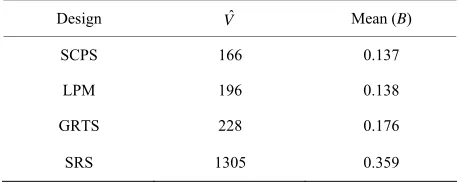
able 1. Results for Example 2. Empirical variance V of ˆ
ˆ
V Mean (B)
sampled with equal n prob es and n50 units are sampled. The target parameter is Y y In our particular re-
sented in Table 1. A clear connection between well spread samples and variance can be observed. A design with a small expected value of B, see (1), gives better estimates. Concerning anticipated variance we get similar results if we average over repeated realizations from the model.
T
the HT-estimator and the mean of the measure B for 1000 samples of size 50.
Design
SCPS 166 0.137
LPM 196 0.138
GRTS 228 0.176
[image:5.595.308.537.642.733.2]5. Final Comments
It has been shown that in general there is a significant spread samples. Usually, well
icate
balancing effect for well
spread samples are not as balanced on the auxiliary
x-variables as samples selected by the cube method, but
nearly so if the sample size is not too small. However, for target variables that are non-linear in x, well spread sam-
ples are likely to be more balanced on the target variables than samples selected by the cube method. In that way, well spread samples are good for more general situations. Hopefully, the fact that a significant balancing effect has been shown will increase the interest of using well spread probability samples when auxiliary x-variables are avail-
able.
There also exists a possibility to combine the cube method with a similar idea as used in the LPM, to have a local cube method. Then samples that are both well spread (spatially balanced) and balanced on the auxiliary variables can be selected. Such a method was developed in [9].
In [1,14], properties of spatial total estimators are studied under a tessellation stratified design in a contin- ues universe. With similar assumptions on the target function, as used in this paper, they show that the con- vergence rate of the variance of the total estimator is
2O n for such a design. Even though our setting is different and does not imply a strict stratification, this ind s that spreading the sample locations well proba- bly gives a small variance when there are spatial trends.
In the setting of Voronoi polytopes used in this paper, we may consider the nearest neighbor estimator (NN- estimator) in place of the HT-estimator. The NN-esti- mator of Y is, if ni is the number of units in polytope
i
p ,
.
i i i s
y n
Under the assumptions (A.0) and (A.1), we have 1π
i i
n and the NN-estimator s equal to the HT-esti- be ap- i
mator. This implies that the NN-estimator will proximately design unbiased for well spread samples. Moreover, the NN-estimator can probably adjust for some minor spatial imbalance in the sample by using the realized polytope sizes ni instead of 1 πi, which can
be viewed as the estimated polytope sizes. The possible benefit of using the NN-estimator in place of the HT- estimator will be investigated in a future paper.
6. Acknowledgements
Thanks to Lennart Bondesson and an anonymous at improved this m
REFERENCES
[1] L. Barabesi and S. Franceschi, “Sampling Properties of
Spatial Total E ation Stratified De-
signs,” Enviro 3, 2011, pp. 271-
stimators under Tessell
nmetrics, Vol. 22, No.
278. doi:10.1002/env.1046
[2] D. L. Stevens Jr. and A. R. Olsen, “Spatially Balanced
Sampling of Natural Resources,” Journal of the American
Statistical Association, Vol. 99, No. 465, 2004, pp. 262-
278. doi:10.1198/016214504000000250
[3] J.-C. Deville and Y. Tillé, “Efficient Balanced Sampling:
the Cube Method,” Biometrika, Vol. 91, No. 4, 2004, pp.
893-912. doi:10.1093/biomet/91.4.893
[4] J.-C. Deville and Y. Tillé, “Unequal Probability Sampling
without Replacement through a Splitting Method,” Bio-
metrika, Vol. 85, No. 1, 1998, pp. 89-101.
doi:10.1093/biomet/85.1.89
[5] A. Grafström, N. L. P. Lundström and L. Schelin, “Spa-
tially Balanced Sampling through the Piv Biometrics, Vol. 68, No. 2, 20
otal Method,” 12, pp. 514-520.
doi:10.1111/j.1541-0420.2011.01699.x
[6] A. Grafström, “Spatially Correlated Poisson Sampling,”
Journal of Statistical Planning and Inference, Vol.
No. 1, 2012, pp. 139-147.
142,
doi:10.1016/j.jspi.2011.07.003
[7] L. Bondesson and D. Thorburn, “A List Sequential Sam-
pling Method Suitable for Rea dinavian Journal of Statistics,
l-Time Sampling,” Scan-
Vol. 35, No. 3, 2008, pp.
466-483. doi:10.1111/j.1467-9469.2008.00596.x
[8] D. G. Horvitz and D. J. Thompson, “A Generalization of
Sampling without Replacement from a Finite Universe,” Journal of the American Statistical Association, Vol. 47, No. 260, 1952, pp. 663-685.
doi:10.1080/01621459.1952.10483446
[9] A. Grafström and Y. Tillé, “Doubly Balanced Spatial
Sampling with Spreading and Restitu Totals,” Environmetrics, in Press, 2012.
tion of Auxiliary
doi:10.1002/env.2194
[10] A. J. Lister and C. T. Scott, “Use of Space-Filling Curves
to Select Sample Locations in Natural R toring Studies,” Envir
esource Moni- onmental Monitoring and Assess- ment, Vol. 149, No. 1-4, 2009, pp. 71-80.
doi:10.1007/s10661-008-0184-y
[11] A. Grafström and L. Schelin, “How to Select Representa-
tive Samples,” Scandinavian Journal of Statistics, 2013.
-
[12] D. L. Stevens Jr. and A. R. Olsen, “Variance Estimation
for Spatially Balanced Samples of Environmental Re-
sources,” Environmetrics, Vol. 14, No. 6, 2003, pp. 593
610. doi:10.1002/env.606
[13] N. A. C. Cressie, “Statistics for spatial data,” Wiley, New York, 1993.
[14] L. Barabesi and M. Marcheselli, “A Modified Monte
Carlo Integration,” International Mathematical Journal,
Vol. 3, No. 5, 2003, pp. 555-565.