Augmenting FrameNet Via PPDB
Pushpendre Rastogi1 and Benjamin Van Durme1,2 1Center for Language and Speech Processing 2Human Language Technology Center of Excellence
Johns Hopkins University
[email protected], [email protected]
Abstract
FrameNet is a lexico-semantic dataset that embodies the theory of frame semantics. Like other semantic databases, FrameNet is incomplete. We augment it via the para-phrase database, PPDB, and gain a three-fold increase in coverage at 65% precision. 1 Introduction
Frame semanticsdescribes the meaning of a word in relation to real world events and entities. In frame semantics the primary unit of lexical analy-sis is theframeand thelexical unit. A frame aims to capture the most salient properties of a con-cept, situation or event. For example, the frame representing the concept ofAbandonment con-tains eight attributes:1 Agent, Theme, Place,
Time, Manner, Duration, Explanation
andDepictive. Alexical unitis a tuple of three elements: the lemma of a word, its POS tag and the associated frame.
FrameNet is large lexico-semantic dataset that contains manually annotated information includ-ing frame descriptions, frame-frame relations and frame annotated sentences. It has been used build to frame semantic parsers, which are systems that can analyze a sentence and annotate its words with the frames that they evoke and the correspond-ing frame elements. The task of frame seman-tic parsing was introduced by Gildea and Jurafsky (2002) and later it matured into a community-wide shared task (Baker et al., 2007), with CMU’s SE-MAFOR system being the current state-of-the-art parser (Das et al., 2013).
Common to rich, manually constructed seman-tic resources, the coverage of FrameNet across its
1An attribute of a frame is also called aFrame Element.
targetted language (English) is incomplete. State-of-the-art frame semantic parsers thus employ var-ious heuristics to identify the frame evoked by out-of-vocabulary items (OOVs) at test-time.2 For instance, an OOV if present in WordNet might be aligned to frame(s) assigned to in-vocabulary items in shared synsets (see the work by Ferr´andez et al. (2010) and the related works section therein). In this work we take a different approach and attempt to directly increase the coverage of the FrameNet corpus by automatically expanding the collection of training examples via PPDB, The Paraphrase Database (Ganitkevitch et al., 2013).
In Section 2 we analyze FrameNet and com-ment on the sparsity in its different parts. In Sec-tion 3 we describe PPDB, and how it was used to augment FrameNet. We present our evaluation ex-periments and results in the latter half of the sec-tion followed by conclusions.
2 FrameNet Coverage
FrameNet is a rich semantic resource, yet cur-rently lacks complete coverage of the language. In the following we give examples of this incom-pleteness, in particular the OOV issue that we will focus on in latter sections.
Frames A frame represents an event, a situ-ation or a real life concept; FrameNet version 1.5 contains 1,019 such frames. These thou-sand frames do not cover all possible situa-tions that we might encounter. For example, FrameNet does not have a frame for the activity ofProgrammingeven though it has frames for
Creating, Text Creation, etc. The
situa-2For example the Abandonmentframe lacks jettisonas
one of its lexical units, and further, that word is not listed as a lexical unit in FrameNet v1.5, makingjettisonan OOV.
tion of writing a computer program is stereotypi-cal and attributes that a reader might associate with such an activity are: agent(who wrote the pro-gram), language (the programming language used) andfunction(the program’s purpose).
Further, FrameNet’s granularity is at times un-even. For example, the Explosion frame and the Become Triggered frames do not have agentive attributes, instead there exist separate frames Detonate Explosive and
Triggering which have the attributes Agent
andActor respectively. This suggests a pattern that events which are frequently described without an agent are assigned their own frames. However, there is no Burialframe which focuses on the event corresponding to frame ofBurying, which itself focuses on theActor.
This difference in granularity could be resolved by either making distinctions more evenly fine-grained: trying to automatically inducing new frames; or by making things more evenly-coarse grained: automatically merging existing frames that are deemed similar. Researchers have ex-plored methods for automatically learning frames and on learning collocations of frames to their syntactic dependent phrases. Recent examples in-clude using either a Bayesian topic model to learn clusters of words (O’ Connor, 2012; Materna, 2012), or attempting to learn symbolic concepts and attributes from dictionary definitions of words (Orfan and Allen, 2013).
Frame-Frame Relations FrameNet encodes certain types of correlations between situations and events by adding defeasible typed-relations between frames encoding pairwise dependencies.
There are eight types of frame-frame rela-tions: Inherits from, Perspective on,
Precedes, Subframe of, See also,
Uses, Is Inchoative of, and
Is Causative of.3 For example the frame
Being Born is related to Death through the relation Is Preceded By. Such common-sense knowledge of event-event relationships would be of significant utility to general AI, however it is a large space to fill: with 1,019 frames and 8 binary relations there is a large upper bound on the number of total possible
3Five frame-frame relations also have an antonym
relation: Is Used by, Is Inherited by, Is Perspectivized in, Has Subframe(s), Is Preceded by, however an antonym relation does not add any extra information over its corresponding relation.
relation pairs, even if not considering the pre-vious issue of incomplete frame coverage. For example, theExperience bodily harm and
Hostile encounter frames are not related through the Is Causative Of relation, even though it is reasonable to expect that a hostile encounter would result in bodily harm.4 Though researchers have used FrameNet relations for tasks such as recognizing textual entailment (RTE) (Aharon et al., 2010) and for text under-standing (Fillmore and Baker, 2001), to the best of our knowledge there has been no work on automatically extending frame-frame relations.
Frame Annotated Sentences FrameNet con-tains annotated sentences providing examples of: lexical units, frames those lexical units evoked, and frame elements present in the sentence (along with additional information). These annotated sentences can be divided into two types based on whether all the frame evoking words were marked as targets or not.
The first type, which we call lexicographic, contains sentences with a single target per sen-tence. The second type, called fulltext, contains sentences that have been annotated more com-pletely and they contain multiple targets per sen-tence. There are 4,026 fulltext sentences con-taining 23,921 targets. This data has proved to be useful for lexico-semantic tasks like RTE and paraphrasing e.g. (Aharon et al., 2010; Coyne and Rambow, 2009). As compared to Prop-Bank (Palmer et al., 2005), which annotated all predicates occurring within a collection of pre-existing documents, FrameNet providesexamples, but not a corpus that allows for directly estimating relative frequencies.
Frame-Lemma Mappings As said earlier, lexi-cal unitsare tuples of the lemma form of a word, its POS-tag and its associated frame. One compo-nent of FrameNet is its information about which words/lemmas prompt a particular frame. An an-notated word that evokes a frame in a sentence is referred to as a Target. There are two areas where these mappings could be incomplete: (1) lemmas contained within FrameNet may have al-ternate senses such that they should be placed in more Frames (or related: a currently missing frame might then give rise to another sense of
4Reasonable highlights the issue that we would
such a lemma); and (2) lemmas from the language may not be in FrameNet in any form. Most re-search on mitigating this limitation involves map-ping FrameNet’s frames to WordNet’s synsets.5 Fossati et al. (2013) explored the feasibility of crowdsourcing FrameNet coverage, using the dis-tributed manual labor of Mechanical Turk to com-plete the lemma coverage.
3 Augmenting FrameNet with PPDB In order to expand the coverage of FrameNet, we performed an initial study on the use of a new broad-coverage lexical-semantic resource, PPDB, to first add new lemmas as potential triggers for a frame, and then automatically rewrite existing example sentences with these new triggers. The eventual goal of would be to enable any existing FrameNet semantic parser to simply retrain on this expanded dataset, rather than needing to encode methods for dynamic OOV-resolution at test-time (such as employed by SEMAFOR).
PPDB Ganitkevitch et al. (2013) released a large collection of lexical, phrasal and syntactic para-phrases6 collectively called PPDB. We used the lexical rules in PPDB to find potential paraphrases of target words of frame annotated sentences. A lexical rule in PPDB looks like the following:
[VB] ||| help ||| assist ||| p(e|f)=2.832, p(f|e)=1.551, ...
This rule conveys that the log-probability that help would be paraphrased by the word assist is -2.832 but the log probability ofassistbeing para-phrased as help is -1.551.7 Ganitkevitch et al. (2013) released quality-sorted subsets of the full (large) collection, varying in size fromStoXXXL
by applying thresholds over a linear combination of the feature values to prune away low quality paraphrases. They verified that the average human judgement score of randomly sampled paraphrases from smaller sized collections was higher than the
5It is worth noting that substituting a larger automatically
derived WordNet (as derived in Snow et al. (2004)) could im-prove the recall of some of the methods which automatically learn a mapping from FrameNet frames to WordNet synsets.
6Lexical: Two words with the same meaning; phrasal:
two strings of words with the same meaning; syntactic: strings of surface words and non-terminal categories that have the same meaning. These strings are templates with the non-terminals serving the role of constraints over what can go in the blanks.
7See complete list at http://github.com/
jweese/thrax/wiki/Feature-functions.
average human judgement score of a random sam-ple from a larger collection.
Approach We used the lexical rules sans fea-tures along with a 5-gram Kneser-Ney smoothed language model trained using KenLM (Heafield et al., 2013) on the raw English sequence of An-notated Gigaword (Napoles et al., 2012) to para-phrase the fulltext frame annotated sentences of FrameNet. We used a combination of the WordNet morphological analyzer and Morpha8 for lemma-tization and Morphg9for generation.
Evaluation We present our evaluation of the quantity and quality of generated paraphrases in this section. Note that we did not use syntac-tic reordering to generate the paraphrases. Also we paraphrased the frame evoking targets individ-ually i.e. we did not consider combinations of paraphrases of individual targets to be a new para-phrase of a sentence and we ignored those frame evoking targets that contained multiple words.10
With the above mentioned constraints we conducted the following experiments with dif-ferent sizes of PPDB. In Experiment 1 we generated a set of candidate paraphrases for every target word in a sentence by directly querying that word and its dictionary form in PPDB. In Experiment 2 we first enlarged the set of lexical units mapped to a frame by merging lexical units of frames that were related to the target word’s frame through either of the fol-lowing relations: Is Perspectivized In,
Is Inherited By, Has Subframe (s). For example, if frame A has a subframe B then lexical units mapped toA can evoke B. We then queried PPDB to gather paraphrases for all the lexical units collected so far. This experiment simulates the situation where a frame has been mapped to a set of words, e.g. synsets in WordNet, so that every word in that larger set is a paraphrase of any word that evokes a frame. This procedure increases the average number of paraphrases mapped to a frame and we present those averages in Table 1.
For both these experiments we also calculated the incremental benefit of PPDB over WordNet by
8http://ilexir.co.uk/applications/
rasp/download
9http://cl.naist.jp/˜eric-n/
ubuntu-nlp/pool/hardy/english/morph_ 0.0.20030918-2nlp1˜0hardy1.tar.gz
10Among fulltext sentences less than 3% of targets
Database Lexical Unit/Frame
Framenet 20.24
PPDB S 23.15
PPDB M 32.00
PPDB L 74.08
[image:4.595.320.512.62.153.2]PPDB XL 214.99
Table 1:Average count of lexical units per frame for differ-ent sizes of PPDB in experimdiffer-ent 2.
The General Assembly should set asidemoneyfor a new state health lab , millions of doses of antiviral drugs and a fund to help meet basic needs after a disas-ter , a legislative panel recommended Thursday . 1: The General Assembly should set asidecash... 2: The General Assembly should set asidefund... 1: The General Assembly should set asidedough... 3: The General Assembly should set asidesilver...
Table 2:Examples and their judgements, with the last being debatable.
filtering out paraphrases that could have been re-trieved as synonyms11 from WordNet v3.0. The results of these experiments are in Table 3.
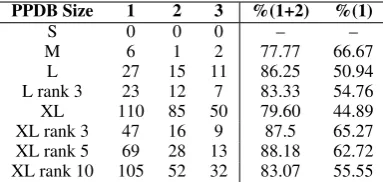
To evaluate the quality of our additional output over WordNet we assigned one of the following labels to 25 paraphrase sets generated at the end of Experiment 1b12: 1, the paraphrase (a) invoked the correct frame and (b) was grammatical; or 2, only (a) held; or 3, (a) did not hold. Table 4 presents aggregates over the labels.
PPDB 1a 1b 2a 2b
S 4,582 2,574 1,064,926 1,022,533 M 15,459 9,752 1,314,169 1,263,087 L 73,763 55,517 2,417,760 2,347,656
[image:4.595.113.252.62.124.2]XL 340,406 283,126 – –
Table 3:The total number of paraphrases generated for the 23,226 input targets versus different sizes of PPDB. The para-phrase count excludes the input. Column 1a and 2a represent unfiltered paraphrases as opposed to 1b and 2b where they have been filtered using WordNet v3.0.
4 Discussion And Conclusion
We presented initial experiments on using PPDB to automatically expand FrameNet through para-phrastic re-writing. We found that over a sample of 25 target words the top three paraphrases pro-duced by PPDB XL evoked the correct frame and were grammatical 65% of the time.13 However,
11Two lemmas that appear in the same synset at least once
are synonyms in our experiments.
12Experiment 2 generated significantly more candidates;
here we consider only the potential scope of expansion and rely on Experiment 1 to gauge the likely paraphrase quality.
13We have released the generated corpus as well as the
manual annotations atcs.jhu.edu/˜prastog3/res/ fnppdb.html
PPDB Size 1 2 3 %(1+2) %(1)
S 0 0 0 – –
M 6 1 2 77.77 66.67
L 27 15 11 86.25 50.94
L rank 3 23 12 7 83.33 54.76
XL 110 85 50 79.60 44.89
XL rank 3 47 16 9 87.5 65.27
XL rank 5 69 28 13 88.18 62.72
[image:4.595.85.277.439.491.2]XL rank 10 105 52 32 83.07 55.55
Table 4: Average quality of all paraphrases for 25 ran-dom sentences. Rows markedA rank Bconvey that we used PPDB of sizeAand kept only the topBsentences after sorting them by their language model score. Column %(1) indicates the percentage of output which was grammatical and evoked the correct frame. Column%(1+2) represents the output that evoked the correct frame.
work remains in recognizing the contexts in which a paraphrase is appropriately applied, and in im-proving the quality of PPDB itself.
Upon error analysis, we found two major rea-sons for ungrammaticality of lexical paraphrases. First: within FrameNet some sentences will have a single token annotated as trigger, when in fact it is part of a multi-word expression. For example, it was grammatically infelicitous to replacepart by portionin the expressionpart of the answer. The other major source of error was the inaccuracy in PPDB itself. We found that for a large number of cases when PPDB XL did not have a high number of paraphrases the paraphrases were wrong (e.g., PPDB XL had only 2 paraphrases for the words labandmillions.)
Going forward we aim to increase the precision of our paraphrases and our ability to recognize their appropriate contexts for application. Fur-ther, we wish to augment additional resources in a similar way, for example PropBank or the ACE corpus (Walker et al., 2006). We should be able to increase the precision by using the paraphrase probability features of a PPDB rule and by using better language models with lower perplexity than n-grams e.g. recurrent neural net based language models. Improving the accuracy of PPDB, espe-cially in the large settings, would be another fo-cus area. Also, we would use Amazon Mechani-cal Turk to evaluate the quality of a larger set of paraphrases to make our evaluation robust and so that we can evaluate the efficacy of our second ex-periment.
References
Roni Ben Aharon, Idan Szpektor, and Ido Dagan. 2010. Generating entailment rules from framenet. In Proceedings of the ACL 2010 Conference Short Papers, pages 241–246.
Collin Baker, Michael Ellsworth, and Katrin Erk. 2007. Semeval’07 task 19: frame semantic structure extraction. InProceedings of the 4th International Workshop on Semantic Evaluations, pages 99–104. ACL.
Bob Coyne and Owen Rambow. 2009. Lexpar: A freely available english paraphrase lexicon
automat-ically extracted from framenet. 2012 IEEE Sixth
International Conference on Semantic Computing, pages 53–58.
Dipanjan Das, Desai Chen, Andr´e F. T. Martins,
Nathan Schneider, and Noah A. Smith. 2013.
Frame-semantic parsing. Computational
Linguis-tics, 40(1):9–56.
Oscar Ferr´andez, Michael Ellsworth, Rafael Munoz, and Collin F Baker. 2010. Aligning framenet and wordnet based on semantic neighborhoods. In
LREC, volume 10, pages 310–314.
Charles J Fillmore and Collin F Baker. 2001. Frame
semantics for text understanding. In Proceedings
of WordNet and Other Lexical Resources Workshop, NAACL.
Marco Fossati, Claudio Giuliano, and Sara Tonelli.
2013. Outsourcing framenet to the crowd. In
Pro-ceedings of the 51st Annual Meeting of the ACL, pages 742–747.
Juri Ganitkevitch, Benjamin Van Durme, and Chris Callison-Burch. 2013. PPDB: The paraphrase
database. In Proceedings of NAACL-HLT, pages
758–764, Atlanta, Georgia, June. ACL.
Daniel Gildea and Daniel Jurafsky. 2002. Automatic
labeling of semantic roles. Computational
linguis-tics, 28(3):245–288.
Kenneth Heafield, Ivan Pouzyrevsky, Jonathan H. Clark, and Philipp Koehn. 2013. Scalable
modi-fied Kneser-Ney language model estimation. In
Pro-ceedings of the 51st Annual Meeting of the ACL, Sofia, Bulgaria.
Jiˇr´ı Materna. 2012. Lda-frames: An unsupervised
ap-proach to generating semantic frames. In
Compu-tational Linguistics and Intelligent Text Processing,
volume 7181 ofLecture Notes in Computer Science,
pages 376–387. Springer Berlin Heidelberg. Courtney Napoles, Matthew Gormley, and Benjamin
Van Durme. 2012. Annotated gigaword. In
Pro-ceedings of the Joint Workshop on Automatic Knowl-edge Base Construction and Web-scale KnowlKnowl-edge Extraction, pages 95–100. ACL.
Brendan O’ Connor. 2012. Learning frames from text with an unsupervised latent variable model. In Tech-nical Report. Carnegie Mellon University.
Jansen Orfan and James Allen. 2013. Toward learning high-level semantic frames from definitions. In Pro-ceedings of the Second Annual Conference on Ad-vances in Cognitive Systems, volume 125.
Martha Palmer, Daniel Gildea, and Paul Kingsbury. 2005. The proposition bank: An annotated
cor-pus of semantic roles. Computational Linguistics,
31(1):71–106.
Rion Snow, Daniel Jurafsky, and Andrew Y Ng. 2004. Learning syntactic patterns for automatic hypernym
discovery. InNIPS, volume 17, pages 1297–1304.
Christopher Walker, Stephanie Strassel, Julie Medero, and Kazuaki Maeda. 2006. Ace 2005
multilin-gual training corpus. Linguistic Data Consortium,