A Unified Approach to Minimum Risk Training and Decoding
Abhishek Arun, Barry Haddow and Philipp Koehn
School of Informatics University of Edinburgh Edinburgh, EH8 9AB, UK
[email protected], {bhaddow,pkoehn}@inf.ed.ac.uk
Abstract
We present a unified approach to perform-ing minimum risk trainperform-ing and minimum Bayes risk (MBR) decoding with BLEU
in a phrase-based model. Key to our ap-proach is the use of a Gibbs sampler that allows us to explore the entire probabil-ity distributionand maintain a strict prob-abilistic formulation across the pipeline. We also describe a new sampling algo-rithm called corpus sampling which al-lows us at training time to use BLEU
in-stead of an approximation thereof. Our approach is theoretically sound and gives better (up to +0.6%BLEU) and more sta-ble results than the standard MERT opti-mization algorithm. By comparing our ap-proach to lattice MBR, we are also able to gain crucial insights about both methods.
1 Introduction
According to statistical decision theory, the opti-mal decision rule for any statistical model is the solution that minimizes its risk (expected loss). This solution is often referred to as the Minimum Bayes Risk (MBR) solution (Kumar and Byrne, 2004). Since machine translation (MT) mod-els are typically evaluated by BLEU (Papineni et
al., 2002), a loss function which rewards partial matches, the MBR solution is to be preferred to the Maximum A Posteriori (MAP) solution.
In most statistical MT (SMT) systems, MBR is implemented as a reranker of a list1 of trans-lations generated by a first-pass decoder. This de-coder typically assigns unnormalised log probabil-ities (known asscores) to each translation
hypoth-1We use the term list to denote any enumerable
represen-tation of translation hypotheses e.gn-best list, translation lat-tice or forest.
esis, so these scores must be converted to proba-bilities in order to apply MBR. In order to perform this conversion, it is first necessary to compute the normalization function Z. Since Z is defined as an intractable sum over all possible translations, it is approximated by summing over the translations in the list. The second step is to find the correct scale factor for the scores using a hyper-parameter search over held-out data. This is needed because the model parameters for the first-pass decoder are normally learnt using MERT (Och, 2003), which is invariant under scaling of the scores.
Both these steps are theoretically unsatisfactory methods of estimating the posterior probability distribution since the approximation toZis an un-bounded term and the scaling factor is an artificial way of inducing a probability distribution.
Recently, (Tromble et al., 2008; Kumar et al., 2009) have shown that using a search lattice to im-prove the estimation of the true probability distri-bution can lead to improved MBR performance. However, these approaches still rely on MERT for training the base model, and in fact introduce sev-eral extra parameters which must also be estimated using either grid search or a second MERT run. The lattice pruning required to make these tech-niques tractable is quite drastic, and is in addi-tion to the pruning already performed during the search. Such extensive pruning is liable to render any probability estimates heavily biased (Blunsom and Osborne, 2008; Bouchard-Cˆot´e et al., 2009).
Here, we present a unified approach to training and decoding in a phrase-based translation model (Koehn et al., 2003) which keeps the objective constant across the translation pipeline and so ob-viates the need for any extra hyper-parameter fit-ting. We use the phrase-based Gibbs sampler of Arun et al. (2009) at training time to compute the gradient of ourminimum risk trainingobjective in order to apply first-order optimization techniques,
and at test time we use it to estimate the posterior distribution required by MBR (Section 3).
We experimented with two different objective functions for training (Section 4). First, follow-ing (Arun et al., 2009), we define our objective at the sentence-level using a sentence-level variant ofBLEU. Then, in order to reduce the mismatch between training and test loss functions, we also tried directly optimising the expected corpus level
BLEU, where we introduce a novel sampling tech-nique, which we callcorpus samplingto calculate the required expectations.
The methods presented in this paper are theo-retically sound. Moreover, experimental evidence on three language pairs shows that our training regime is more stable than MERT, able to gener-alize better and generally leads to improvement in translation when used with sampling based MBR (Section 5). An added benefit is that the trained weights also lead to better performance when used with a beam-search based decoder.
2 Inference methods for MT
We assume a phrase-based machine translation model, defined with a log-linear form, with feature function vectorhand parametrized by weight vec-torθ, as described in Koehn et al. (2003). The in-put sentence,f, is segmented into phrases, which are sequences of adjacent words. Each source phrase is translated into the target language, to produce an output sentence e and an alignment arepresenting the mapping from source to target phrases. Phrases are allowed to be reordered.
p(e, a|f;θ) = P exp [θ·h(e, a, f)]
he0,a0iexp [θ·h(e0, a0, f)]
(1)
MAP decoding under this model consists of finding the most likely output string,e∗:
e∗=argmaxe X
a∈4(e,f)
p(e, a|f) (2)
where4(e, f)is the set of all derivations of output stringegiven source stringf.
Summing over all the derivations is intractable, making approximations necessary. The most com-mon of these approximations is theViterbi approx-imation, which simply chooses the most likely derivation he∗, a∗i. This approximation can be computed in polynomial time via dynamic pro-gramming (DP). Though fast and effective for many problems, it has two serious drawbacks for probabilistic inference. First, the error incurred
by the Viterbi maximum with respect to the true model maximum is unbounded. Second, the DP solution requires substantial pruning and restricts the use of non-local features. The latter problem persists even in thevariationalapproximations of Li et al. (2009), which attempt to solve the former.
2.1 Gibbs sampling for phrase-based MT
An alternate approximate inference method for phrase-based MT without any of the previously mentioned drawbacks is the Gibbs sampler (Ge-man and Ge(Ge-man, 1984) of Arun et al. (2009) which draws samples from the posterior distribu-tion of the transladistribu-tion model. For the work pre-sented in this paper, we use this sampler.
The sampler produces a sequence of samples,
SN
1 = (e1, a1). . .(eN, aN), that are drawn from
the distribution p(e, a|f). These samples can be used to estimate the expectation of a function h(e, a, f)as follows:
Ep(a,e|f)[h] = lim N→∞
1
N N
X
i=1
h(ai, ei, f) (3)
3 Decoding
In this work, we are interested in performing MBR decoding withBLEU. We define the MBR decision rule following Tromble et al. (2008):
e∗ = arg max
e∈H
X
e0∈
E
BLEUe(e0)p(e0|f) (4)
where H refers to the hypothesis space from
which translations are chosen, E refers to the
evidence space used for calculating risk and
BLEUe(e0)is a gain function that indicates the
re-ward of hypothesisinge0 when the reference solu-tion ise.
To perform MBR decoding using the sampler, let the function h in Equation 3 be the indica-tor function h = δ(a,aˆ)δ(e,ˆe). Then, Equa-tion 3 provides an estimate ofp(ˆa,ˆe|f), and using h = δ(e,eˆ) marginalizes over all derivationsa0, yielding an estimate ofp(ˆe|f). MBR is computed at the sentence-level whileBLEUis a corpus-level metric, so instead we use a sentence-level approx-imation ofBLEU.2
The sampler can be used to perform two other decoding tasks: the mode of the estimated dis-tribution p(ˆa,eˆ|f) is the maximum derivation (MaxDeriv) solution while the mode ofp(ˆe|f)is the maximum translation (MaxTrans) solution.
2The ngram precision counts are smoothed by adding 0.01
4 Minimum Risk Training
In order to train models suitable for use with Max-Trans or MBR decoding, we need to employ a training method which takes account of the whole distribution. To this end, we employ minimum risk training to find weightsθfor Equation 1 that mini-mize the expected loss on the training set. We con-sider two variants of minimum risk training: sen-tence sampling optimizes an objective defined at the sentence level andcorpus samplinga corpus-based objective.
4.1 Sentence sampling
Since BLEU, the metric we care about, is a gain function, our objective function maximizes the ex-pected gain of our model. The exex-pected gain, G
of a probabilistic translation model on a corpusD, defined with respect to the gain functionBLEUeˆ(e) is given by
G= X
hˆe,fi∈D
X
e,a
p(e, a|f)BLEUˆe(e) (5)
whereeˆis the reference translation,eis a hypoth-esis translation and BLEU refers to the sentence-level approximation of the metric.
Using the probabilistic formulation of Equation 1, the optimization of the objective in (5) is facil-itated by the fact that it is continuous and differ-entiable with respect to the model parametersθto give
∂G
∂θk
= X
hˆe,fi ∈D
X
e,a
BLEUeˆ(e) ∂p
∂θk
where ∂p ∂θk
= hk−Ep(e,a|f)[hk]
p(e, a|f)
(6)
Since the gradient is expressed in terms of ex-pectations of feature values, it can easily be calcu-lated using the sampler and then first-order opti-mization techniques can be applied to find optimal values of θ. Because of the noise introduced by the sampler, we used stochastic gradient descent (SGD), with a learning rate that gets updated after each step proportionally to difference in succes-sive gradients (Schraudolph, 1999).
While our initial formulation of minimum risk training is similar to that of Arun et al. (2009), in preliminary experiments we observed a tendency for translation performance on held-out data to quickly increase to a maximum and then plateau. Hypothesizing that we were being trapped in lo-cal maxima as G is non-convex, we decided to
employ deterministic annealing (Rose, 1998) to smooth the objective function to ensure that the optimizer explored as large a region as possible of the space before it settled on an optimal weight set. Our instantiation of deterministic annealing (DA) is based on the work of Smith and Eisner (2006), and involves the addition of an entropic prior to the objective in Equation 5 to give
ˆ
G= X
hˆe,fi∈D
" X
e,a
p(e, a|f)BLEUˆe(e)
!
+T.H(p)
#
whereH(p)is the entropy of the probability dis-tribution p(e, a|f), and T > 0 is a temperature paramater which is gradually lowered as the opti-mization progresses according to someannealing schedule.
Differentiating with respect to θk then shows
that the annealed gradient is given by the follow-ing expression:
X
hˆe,fi ∈D
X
e,a
(BLEUˆe(e)−T(1 + logp)) ∂p ∂θk
where ∂p ∂θk
= hk−Ep(e,a|f)[hk]
p(e, a|f)
A high value of T leads the optimizer to find weights which describe a fairly flat distribution, whereas a lower value of T pushes the optimizer towards a more peaked distribution. We perform 10 to 20 iterations of SGD at each temperature.
In their deterministic annealing formulation, (Smith and Eisner, 2006; Li and Eisner, 2009), ex-press the parameterization of the distributionθ as γθˆ(whereγis thescaling factor) and perform op-timization in two steps, the first optimizingθˆand the second optimizingγ. We experimented with this two stage optimization process, but found that simply performing an unconstrained optimization onθgave better results.
4.2 Corpus sampling
While the objective functions in Equations 5 and 4.1 use a sentence-level variant of BLEU, the model’s test-time performance is evaluated with corpus level BLEU. The lack of correlation be-tween sentence-level BLEU and corpus BLEU is well-known (Chiang et al., 2008a). Therefore, in an effort to address this issue, we tried maximizing expected corpusBLEUdirectly.
In other words, given a training corpus of the form hCF,CEˆi where CF is a set of source
hypothesized translationCE of the inputCF with respect toCEˆ.
The objective in equation5therefore becomes:
G=X
CE
P(CE|CF)BLEUCEˆ(CE) (7)
The pair (CE,CF) is denoted as a
cor-pus sample corresponding to a sequence
(e1, a1), . . . ,(eN, aN) of derivations of the corresponding source strings f1, . . . , fN of
source corpusCF.
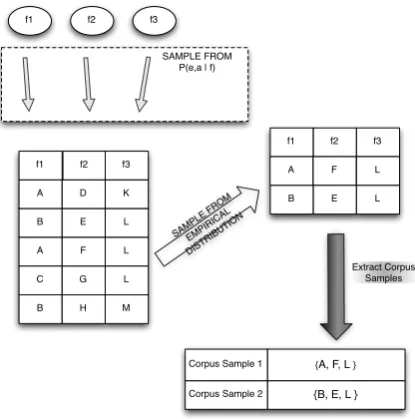
Although the sampler described in Section 2 generates samples at the sentence level, we can use it to generate corpus samples by applying the fol-lowing procedure (see Figure 1). For each source sentencefi in the corpus, we generate a sequence of samples (ei1, ai1), . . . ,(ein, ain) using the sam-pler. From each of these sequences of samples, we then resample new sequences of derivation sam-ples, one for each source sentence in the corpus. The first corpus sample is then obtained by iter-ating through the source sentences and taking the first resampled derivation for each sentence, then the second corpus sample by taking the second re-sampled derivation, and so on. The resampling step is necessary to eliminate any biases due to the order of the generated samples.
The corpus sampling procedure invariably gen-erates a set of samples which are all distinct and so would give us a uniform estimate of the probabil-ity distributionP(CE|CF). However this is not a problem since we are not interested in evaluating the actual distribution; we just need to calculate expectations of feature values and BLEU scores
over the distribution. The feature values of a cor-pus sample are the average of the feature values of its constituting derivations and its BLEU score is
computed based on the yield of its derivations. When training using corpus sampling we pro-cess the training corpus in batcheshCF,CEˆi, treat-ing each batch as a corpus in its own right, and updating the weights after each batch.
The gradient for the objective function in (7) is: ∂G
∂θk
=X
CE
BLEUCEˆ(CE)
∂P ∂θk
where ∂P ∂θk
= hCk−EP(CE|CF)[h C k]
P(CE|CF)
where hCk is the k-th component of a corpus sample feature vector.
During deterministic annealing for sentence sampling, the entropy term is computed over the
f1 f2 f3
A D K
B E L
A F L
C G L
B H M
f1 f2 f3
A F L
B E L
SAMPLE FROM EMPIRICAL DISTRIBUTION
Extract Corpus Samples f1 f2 f3
{A, F, L } Corpus Sample 1
{B, E, L }
Corpus Sample 2 SAMPLE FROM
[image:4.595.315.523.68.278.2]P(e,a | f)
Figure 1: Example illustrating the extraction of 2 corpus samples for a corpus of source sentences f1, f2, f3. In the first step, we sample 5 deriva-tions for each source sentence. We then resample 2 derivations from the empirical distributions of each source sentence.
distributionp(e, a|f)of each individual sentence. While corpus sampling, we are considering the distributionP(CE|CF) but the estimated
distribu-tion is always uniform. So we define the entropic prior term over the distribution p(e, a|f) of the sentences making up the corpus sample.
The annealed corpus sampling objective is therefore:
X
CE
P(CE|CF)BLEUCEˆ(CE)+
T
|CF|
X
f∈CF
H(p(e, a|f))
The gradient of this objective is of similar form to the sentence sampling gradient in Equation (6).
5 Experiments
5.1 Training Data and Preparation
The experiments in this section were performed using the Europarl section of the French-English and German-English parallel corpora from the WMT09 shared translation task (Callison-Burch et al., 2009), as well as 300k parallel Arabic-English sentences from the NIST MT evaluation train-ing data.3 For all language pairs, we constructed
3The Arabic-English training data consists of the
a phrase-based translation model as described in Koehn et al. (2003), limiting the phrase length to 5. The target side of the parallel corpus was used to train 3-gram language models. For the German and French systems, the DEV2006 set was used for model tuning and the first half of TEST2007 (in-domain) for heldout testing. Final testing was performed on NEWS-DEV2009B(out-of-domain) and the first half of TEST2008 (in-domain). For the Arabic system, the MT02 set (10 reference
translations) was used for tuning and MT03 and
MT05 (4 reference translations, each) were used for held-out testing and final testing respectively. To reduce the size of the phrase table, we used the association-score technique suggested by Johnson et al. (2007). Translation quality is reported using case-insensitiveBLEU.
5.2 Baseline
Our baseline system is phrase-based
Moses (Koehn et al., 2007) with feature weights trained using MERT. Moses and the Gibbs sampler use identical feature sets.4
The MERT optimization algorithm uses multi-ple random restarts to avoid getting stuck in a poor local optima. Therefore, every time MERT is run, it produces a slightly different final weight vector leading to varying test set results. While this char-acteristic of MERT is typically ignored, we ac-count for it by performing MERT training 10 times for each of the 3 language pairs, decoding the test sets with each of the 10 optimized weight sets. We present the best and the worst test set results along with the mean and the standard deviation (σ) of these results in Table 1. We report results using the Moses implementation of Viterbi, nbest MBR and lattice MBR decoding (Kumar et al., 2009). 5 For both nbest and lattice MBR decoding, the hy-pothesis set was composed of the top 1000 unique translations produced by the Viterbi decoder, and the same 1000 translations were used as evidence set for nbest MBR.
As Table 1 shows, translation results using MERT optimized weights vary markedly from one
sentences with confidencec >0.995in the ISI automatically extracted web parallel corpus (LDC2006T02).
4We use 5 translation model scores, distance-based
distor-tion, language model and word penalty. The reordering limit is set to 6 for all experiments.
5For nbest and lattice MBR decoding, we optimized for
the scaling factor using a grid-search on held-out data. For lattice MBR decoding, we optimized the lattice density and set thepandrparameters as per Tromble et al. (2008).
tuning run to the other, with results varying from a range of 0.3%BLEUto 1.3%BLEUwhen using Viterbi decoding. We also see that, bar in-domain German to English, MBR decoding gives a small improvement on all other datasets.
Surprisingly, lattice MBR only gives improve-ments on two datasets and actually leads to adrop
in performance on the other 3 datasets. We discuss possible reasons for this in Section 6.
5.3 Sentence sampling
At training time, the optimization algorithm is tialized with zero weights and the sampler is ini-tialized with a random derivation from Moses. To get rid of any initialization biases, the first 100 samples are discarded.6 We then run the sampler for 1000 iterations after which we perform reheat-ingwhereby the distribution is progressively flat-tened. Samples are not collected during this pe-riod. Reheating allows the sampler more mobil-ity around the search space thus possibly escaping any local optima it might be trapped in. We subse-quently run the sampler for 1000 more iterations. We denote this procedure as running 2 chains of the sampler. We use batch sizes of 96 randomly selected sentences for SGD optimization.
During DA, our cooling schedule is an exponen-tially decaying one with decay rate set to 0.9, per-forming 20 iterations of SGD optimization at each temperature setting. Five training runs were per-formed and the BLEUscores averaged. The fea-ture weights were output every 50 iterations and performance measured on the heldout set by run-ning the sampler as a decoder. At decode time, we use the same sampler configurations as during training but run 2 chains each for 5000 iterations.
For MBR decoding, we use the entirety of this sample set as our evidence set and use the top 1000 most probable translations as the hypothesis set.
5.4 Corpus sampling
For our corpus sampling experiments, we sample using the same procedure as in sentence sampling but using 2 chains of 2000 iterations. We then resample 2000 corpus samples from the empiri-cal distribution estimated from the first 4000 sam-ples. For Arabic-English training, we used batch sizes of 100 randomly selected sentences for ex-periments without DA and batches of 400 random
6This procedure is referred to as
Viterbi nMBR lMBR
min max mean σ min max mean σ min max mean σ
[image:6.595.89.506.61.136.2]AR-EN MT05 43.7 44.3 44.0 0.17 44.2 44.5 44.4 0.13 44.2 44.6 44.5 0.12 FR-EN In 33.1 33.4 33.3 0.10 33.2 33.6 33.4 0.12 32.3 32.7 32.6 0.13 FR-EN Out 19.1 19.6 19.4 0.18 19.3 19.7 19.5 0.12 19.1 19.4 19.3 0.12 DE-EN In 27.6 27.9 27.8 0.10 27.6 27.9 27.7 0.10 27.2 27.5 27.4 0.10 DE-EN Out 14.9 16.2 15.7 0.33 15.0 16.3 15.7 0.33 15.3 16.4 16.0 0.30
Table 1: Baseline results - MERT trained models decoded using Viterbi, nbest MBR (nMBR) and lattice MBR (lMBR). MERT was run 10 times for each language pair. We report minimum, maximum, mean and standard deviation of test setBLEUscores across the 10 runs.
200 400 600 800
15
20
25
30
Training iterations
Bleu
Sentence Sampling, Without DA
●● ●●●
●●●●●●●●●●●●
27.4
● MaxDeriv MaxTrans MBR
100 300 500 700
15
20
25
30
Training iterations
Bleu
Sentence Sampling, With DA
● ●
● ●
● ●
●●
● ●●●●●● 28.2
● MaxDeriv MaxTrans MBR
50 100 150 200 250
15
20
25
30
Training iterations
Bleu
Corpus Sampling, Without DA
● ● ● ● ● ● ● ● ● ● ● ● ● 28.1
● MaxDeriv MaxTrans MBR
50 150 250 350
15
20
25
30
Training iterations
Bleu
Corpus Sampling, With DA
●● ●
●●
●●●●●●●●●●● ● 28.5
● MaxDeriv MaxTrans MBR
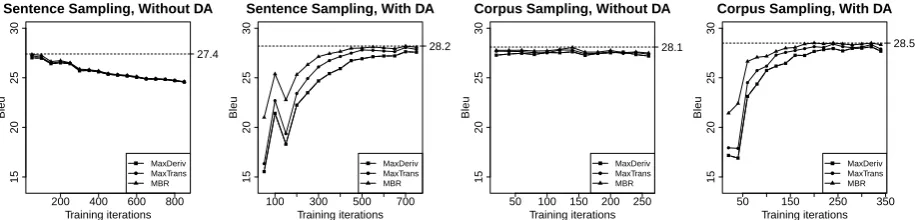
Figure 2: Heldout performance for German-English training averaged across 5 minimum risk training runs. Best scores achieved are indicated by dotted line.
sentences with DA. The size of the batches cor-responds to the number of sentences that form a corpus sample. For German/French to English ex-periments, we used batches of 100 random sen-tences for training with and without DA. We per-form 10 optimizations at each temperature setting during deterministic annealing. Test time condi-tions are identical to the sentence sampling ones and we measure performance on a held-out set af-ter every 20 iaf-terations of the learner.
5.5 Results
Figures 2 and 3 show the scores on the German-English and Arabic-German-English held-out sets respec-tively comparing all four training regimes: corpus vs sentence sampling, DA vs without DA. Results for French-English training are similar.
We focus our analysis on the Arabic-English ex-perimental setup. Without deterministic anneal-ing, the learner converges quickly, usually after just 20 iterations, after which performance de-grades steadily. The magnitudes of the weights are large, sharpening the distribution. There is not much diversity amongst the sampled deriva-tions, i.e. the entropy of the sample set is low. Therefore, all 3 decoding regimes give very simi-lar results. With the addition of the entropic prior, the model is slow to converge before the so-called
phase transition occurs (usually after around 50
iterations), after which performance goes up to reach a peak (45.2BLEU) higher than that without the prior (44.2 BLEU), before steadily declining. The entropic prior encourages diversity among the sample set, especially at high temperature settings. In the presence of diversity, the benefits of marginalization over derivations is clear: Max-Trans does better than MaxDeriv and MBR does best, confirm recent findings of (Blunsom et al., 2008; Arun et al., 2009) that MaxTrans improves over MaxDeriv decoding for models trained to ac-count for multiple derivations. As the temperature decreases to zero, the model sharpens, effectively intent on maximizing one-best performance and thus voiding the benefits of MaxTrans and MBR. Figures 2 and 3 also show that corpus sampling improves over sentence sampling, although not by much (+ 0.3BLEU).
5.6 Comparison with MERT baseline
[image:6.595.76.534.201.311.2]0 200 600 1000 1400
30
35
40
45
50
Training iterations
Bleu
Sentence Sampling, Without DA
● ● ● ●● ● ●●
● ●
●
● ● ● ● ● ● ● ● ● ● ●● ● ● ● ● ●●
44.2
● MaxDeriv MaxTrans MBR
0 500 1000 1500
30
35
40
45
50
Training iterations
Bleu
Sentence Sampling With DA
● ●●
● ●●● ●
● ●● ● ● ● ● ● ● ● ● ● ● ● ● ● ● ● ● ●● ●●
● ● ● ●
45.2
● MaxDeriv MaxTrans MBR
20 40 60 80 100 140
30
35
40
45
50
Training iterations
Bleu
Corpus Sampling, Without DA
● ● ● ● ● ● ● 44.5
● MaxDeriv MaxTrans MBR
100 200 300 400
30
35
40
45
50
Training iterations
Bleu
Corpus Sampling, With DA
● ●●
●● ● ●● ●●
● ● ● ● ● ● ● ●
● ●●
45.5
[image:7.595.76.535.65.175.2]● MaxDeriv MaxTrans MBR
Figure 3: Heldout performance for Arabic-English training averaged across 5 minimum risk training runs. Best scores achieved are indicated by dotted line.
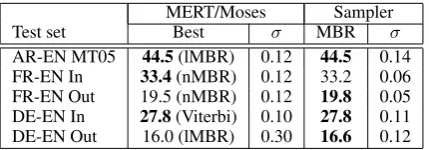
are shown in Table 2.7
We observe that on 3 out of 5 datasets, the sam-pler results are much more stable than MERT and as stable on the other 2 datasets. We attribute the improved stability to the more powerful optimiza-tion algorithm used by the sampler which uses gra-dient information to steer the model towards better weights. MERT, alternatively, optimizes one fea-ture at a time using line search and therefore does not explore the full feature space as thoroughly.
Translation results with the sampler are better than with MERT on 2 datasets, are equal on an-other 2 and worse in one case. The improvements withe the sampler are obtained in the case of out-of-domain data suggesting that the minimum risk training objective generalizes better than the 1-best objective of MERT.
MERT/Moses Sampler
Test set Best σ MBR σ
AR-EN MT05 44.5(lMBR) 0.12 44.5 0.14 FR-EN In 33.4(nMBR) 0.12 33.2 0.06 FR-EN Out 19.5 (nMBR) 0.12 19.8 0.05 DE-EN In 27.8(Viterbi) 0.10 27.8 0.11 DE-EN Out 16.0 (lMBR) 0.30 16.6 0.12
Table 2: Final results comparing MERT/Moses pipeline with unified sampler pipeline. Sampler uses corpus sampling during training and MBR decoding at test time. Moses results are aver-aged across decoding runs using weights from 10 MERT runs and sampler results are averaged across 10 decoding runs for each of 5 different training runs. We reportBLEUscores and standard
deviation (σ).
7The MBR decoding times, averaged over 10 decoding
runs of 50 sentences each, are 10 secs/sent for Moses nbest MBR, 40 secs/sent for Moses lattice MBR and 180 secs/sent for the sampler.
Viterbi nMBR lMBR Sampler MBR
AR-EN MT05 44.2 44.4 44.8 44.8
FR-EN In 33.1 33.2 33.3 33.3
FR-EN Out 19.6 19.8 19.9 19.9
DE-EN In 27.7 27.9 28.0 28.0
[image:7.595.307.523.226.301.2]DE-EN Out 16.0 16.3 16.6 16.6
Table 3: Comparison of decoding methods using expectedBLEUtrained weights. We report Viterbi, nbest MBR (nMBR) and lattice MBR (lMBR) de-coding scores vsbestsampler MBR decoding per-formance. We selected the best weight set based on performance on heldout data.
5.7 Moses with expectedBLEUweights
In a final set of experiments, we reran the Moses decoder this time using weights obtained through expectedBLEU optimization. Here, for each lan-guage pair, we picked the weight set that gave the best results on held-out data. Note that the results which we show in Table 3 are over one run only, so are not strictly comparable to those in Table 2 which are averaged over several training and de-coding runs. We also report the best results ob-tained with the sampler MBR decoder using these weights.
[image:7.595.74.289.480.555.2]6 Discussion
We have shown that the sampler of Arun et al. (2009) can be used to perform minimum risk train-ing over an unpruned search space. Our pro-posed corpus sampling technique, like MERT, is able to optimize corpus BLEU directly whereas alternate parameter estimation techniques usually employed in SMT optimize approximations of
BLEU. Chiang et al. (2008b) accounts for the on-line nature of the MIRA optimization algorithm by smoothing the sentence-level BLEU precision
counts of a translation with a weighted average of the precision counts of previously decoded sen-tences, thus approximating corpus BLEU. As
for minimum risk training, prior implementations have either used sentence-levelBLEU(Zens et al., 2007) or a linear approximation to BLEU (Smith
and Eisner, 2006; Li and Eisner, 2009).
At test time, the sampler works best as an MBR decoder, but also allows us to verify past claims about the benefits of marginalizing over align-ments during decoding. We compare the sam-pler MBR decoder’s performance against MERT-optimized Moses run under three different decod-ing regimes, finddecod-ing that the sampler does as well or better on 4 out of 5 datasets.
Our training and testing pipeline has the advan-tage of being able to handle a large number of both local and global features so we expect in the future to outperform the standard MERT and dynamic programming-based search pipeline further.
As shown in Section 5.2, lattice MBR in some cases leads to a marked drop in performance. (Ku-mar et al., 2009) mention that the linear approx-imation to BLEU used in their lattice MBR algo-rithm is not guaranteed to match corpusBLEU,
es-pecially on unseen test sets. To account for these cases, they allow their algorithm toback-off to the MAPsolution. One possible reason for the drop in performance in our lattice MBR experiments is that the implementation we use does not employ this back-off strategy.
Table 3 provides valuable insights as to the mer-its of the lattice MBR approach versus our own sampling based pipeline. Firstly, whereas with MERT optimized weights, the benefits of lattice MBR are debatable (Table 1), running Moses with minimum risk trained weights gives results that are in line with what we would expect - lattice MBR does systematically better than competing decoding algorithms. This suggests that the
unbi-ased minimum risk training criterion used by the sampler is a better fit for lattice MBR than the MERT criterion, and also that the mismatch be-tween linear and corpus BLEU mentioned before might not be the reason for the results in Table 1.
Secondly, we find that sampling MBR matches lattice MBR on the minimum risk trained weights. The MBR sampler uses samples drawn from the distribution as hypothesis and evidence sets, typi-cally 1000 samples for the former and 10000 sam-ples for the latter. In the lattice MBR experiments of Tromble et al. (2008), it is shown that this size of hypothesis set is sufficient. Their evidence set, however, is significantly larger than ours.8Table 3 suggests that, since it is not biased by heuris-tic pruning, the sampler’s limited evidence set is enough to give a good estimate of the probabil-ity distribution whereas beam-search based MBR needs to scale from using n-best lists to lattices to get equivalent results.
Sampling the phrase-based model is expensive, meaning that lattice MBR is still faster (around 4x) to run than sampler MBR. However, due to theunifiednature of the training and decoding cri-terion in our approach, the minimum risk trained weights can be plugged directly into the sam-pler MBR decoder, whereas lattice MBR requires an additional expensive step of tuning the model hyper-parameters (Kumar et al., 2009).
In future work, we also intend to look at more efficient ways of generating samples. One pos-sibility is to interleave Gibbs sampling steps us-ing low order ngram language model distributions with Metropolis-Hasting steps that use higher or-der language model distributions.
7 Related Work
ExpectedBLEU training for phrase-based models
has been successfully attempted by (Smith and Eisner, 2006; Zens et al., 2007), however they both used biased n-best lists to approximate the pos-terior distribution. Li and Eisner (2009) present work on performing expectedBLEUtraining with deterministic annealing on translation forests gen-erated by Hiero (Chiang, 2007). SinceBLEUdoes not factorize over the search graph, they use the linear approximation of Tromble et al. (2008) in-stead.
Pauls et al. (2009) present an alternate training criterion over translation forests called CoBLEU,
similar in spirit to expected BLEU training, but aimed to maximize theexpected countsof n-grams appearing in reference translations. This training criterion is used in conjunction with consensus de-coding (DeNero et al., 2009), a linear-time ap-proximation of MBR.
In contrast to the approaches above, the algo-rithms presented in this paper are able to explore anunprunedsearch space. By using corpus sam-pling, we can perform minimum risk training with corpus BLEU rather than any approximations of this metric. Also, since we maintain a probabilis-tic formulation across training and decoding, our approach does not require a grid-search for a scal-ing factor as in Tromble et al. (2008).
8 Conclusions
We have presented a unified approach to the task of parameter estimation and decoding for a phrase-based system using the standard translation eval-uation metric, BLEU. Using a Gibbs sampler to explore the entire probability distribution allows us to implement two probabilistic sound algo-rithms, minimum risk training and its equivalent, MBR decoding, in an unbiased way. The proba-bilistic formulation also allows us to use gradient based optimization techniques which produce sta-ble model parameters. At decoding time, we show the benefits of marginalizing over derivations and that MBR gives better results than other decoding criteria.
Since our optimization algorithm can cope with a large number of features, in future work, we plan to incorporate more expressive features in the model. We use a Gibbs sampler for inference so there is scope for exploring non-local features which might not easily be added to dynamic pro-gramming based models.
Acknowledgments
This research was supported in part by the GALE pro-gram of the Defense Advanced Research Projects Agency, Contract No. HR0011-06-2-001; and by the EuroMa-trix project funded by the European Commission (6th Framework Programme). The project made use of the resources provided by the Edinburgh Compute and Data Facility (http://www.ecdf.ed.ac.uk/). The ECDF is partially supported by the eDIKT initiative (http://www.edikt.org.uk/).
References
Abhishek Arun, Chris Dyer, Barry Haddow, Phil Blunsom, Adam Lopez, and Philipp Koehn. 2009. Monte carlo in-ference and maximization for phrase-based translation. In
Proceedings of CoNLL, pages 102–110.
Phil Blunsom and Miles Osborne. 2008. Probabilistic infer-ence for machine translation. InProc. of EMNLP 2008. Phil Blunsom, Trevor Cohn, and Miles Osborne. 2008. A
discriminative latent variable model for statistical machine translation. InProc. of ACL-HLT.
Alexandre Bouchard-Cˆot´e, Slav Petrov, and Dan Klein. 2009. Randomized pruning: Efficiently calculating ex-pectations in large dynamic programs. In Advances in Neural Information Processing Systems 22, pages 144– 152.
Chris Callison-Burch, Philipp Koehn, Christoph Monz, and Josh Schroeder, editors. 2009.Proc. of Workshop on Ma-chine Translations.
David Chiang, Steve DeNeefe, Yee Seng Chan, and Hwee Tou Ng. 2008a. Decomposability of transla-tion metrics for improved evaluatransla-tion and efficient algo-rithms. InProceedings of the 2008 Conference on Empir-ical Methods in Natural Language Processing, pages 610– 619, Honolulu, Hawaii, October. Association for Compu-tational Linguistics.
David Chiang, Yuval Marton, and Philip Resnik. 2008b. On-line large-margin training of syntactic and structural trans-lation features. In Proceedings of the 2008 Conference on Empirical Methods in Natural Language Processing, pages 224–233, Honolulu, Hawaii, October. Association for Computational Linguistics.
D. Chiang. 2007. Hierarchical phrase-based translation.
Computational Linguistics, 33(2):201–228.
John DeNero, David Chiang, and Kevin Knight. 2009. Fast consensus decoding over translation forests. In Proceed-ings of ACL/AFNLP, pages 567–575.
Stuart Geman and Donald Geman. 1984. Stochastic relax-ation, Gibbs distributions and the Bayesian restoration of images. IEEE Transactions on Pattern Analysis and Ma-chine Intelligence, 6:721–741.
J.H. Johnson, J. Martin, G. Foster, and R. Kuhn. 2007. Improving translation quality by discarding most of the phrasetable. InProc. of EMNLP-CoNLL, Prague. P. Koehn, F.J. Och, and D. Marcu. 2003. Statistical
phrase-based translation. InProc. of HLT-NAACL, pages 48–54, Morristown, NJ, USA.
P. Koehn, H. Hoang, A. Birch Mayne, C. Callison-Burch, M. Federico, N. Bertoldi, B. Cowan, W. Shen, C. Moran, R. Zens, C. Dyer, O. Bojar, A. Constantin, and E. Herbst. 2007. Moses: Open source toolkit for statistical machine translation. In Proceedings of ACL Demos, pages 177– 180.
S. Kumar and W. Byrne. 2004. Minimum Bayes-risk decod-ing for statistical machine translation. InProcessings of HLT-NAACL.
Shankar Kumar, Wolfgang Macherey, Chris Dyer, and Franz Och. 2009. Efficient minimum error rate training and minimum bayes-risk decoding for translation hypergraphs and lattices. InProceedings of ACL/AFNLP, pages 163– 171.
Zhifei Li, Jason Eisner, and Sanjeev Khudanpur. 2009. Vari-ational decoding for statistical machine translation. In
Proceedings of ACL/AFNLP, pages 593–601.
F. Och. 2003. Minimum error rate training in statistical ma-chine translation. InProceedings of ACL, pages 160–167. K. Papineni, S. Roukos, T. Ward, and W.-J. Zhu. 2002. BLEU: a method for automatic evaluation of machine translation. InProceedings of ACL, pages 311–318. Adam Pauls, John Denero, and Dan Klein. 2009. Consensus
training for consensus decoding in machine translation. In
Proceedings of EMNLP, pages 1418–1427.
Kenneth Rose. 1998. Deterministic annealing for clustering, compression, classification, regression, and related opti-mization problems. In Proceedings of the IEEE, pages 2210–2239.
Nicol N. Schraudolph. 1999. Local gain adaptation in stochastic gradient descent. Technical Report IDSIA-09-99, IDSIA.
David A. Smith and Jason Eisner. 2006. Minimum risk an-nealing for training log-linear models. InProceedings of COLING-ACL, pages 787–794.
Roy Tromble, Shankar Kumar, Franz Och, and Wolfgang Macherey. 2008. Lattice Minimum Bayes-Risk decod-ing for statistical machine translation. InProceedings of EMNLP, pages 620–629.