PRISMATIC: Inducing Knowledge from a Large Scale Lexicalized Relation
Resource
∗James Fan and David Ferrucci and David Gondek and Aditya Kalyanpur IBM Watson Research Lab
19 Skyline Dr Hawthorne, NY 10532
{fanj, ferrucci, gondek, adityakal}@us.ibm.com
Abstract
One of the main bottlenecks in natural lan-guage processing is the lack of a comprehen-sive lexicalized relation resource that contains fine grained knowledge on predicates. In this paper, we present PRISMATIC, a large scale lexicalized relation resource that is automati-cally created over 30 gb of text. Specifiautomati-cally, we describe what kind of information is col-lected in PRISMATIC and how it compares with existing lexical resources. Our main fo-cus has been on building the infrastructure and gathering the data. Although we are still in the early stages of applying PRISMATIC to a wide variety of applications, we believe the resource will be of tremendous value for AI researchers, and we discuss some of potential applications in this paper.
1 Introduction
Many natural language processing and understand-ing applications benefit from the interpretation of lexical relations in text (e.g. selectional preferences for verbs and nouns). For example, if one knows that things being annexed are typically geopolitical enti-ties, then given the phraseNapoleon’s annexation of Piedmont, we can infer Piedmont is a geopolitical entity. Existing linguistic resources such as VerbNet and FrameNet provide some argument type infor-mation for verbs and frames. However, since they are manually built, they tend to specify type con-straints at a very high level (e.g, Solid, Animate),
∗
Research supported in part by Air Force Contract FA8750-09-C-0172 under the DARPA Machine Reading Program
consequently they do not suffice for cases such as the previous example.
We would like to infer more fine grained knowl-edge for predicates automatically from a large amount of data. In addition, we do not want to re-strict ourselves to only verbs, binary relations, or to a specific type hierarchy.
In this paper, we present PRISMATIC, a large scale lexicalized relation resource mined from over 30 gb of text. PRISMATIC is built using a suite of NLP tools that includes a dependency parser, a rule based named entity recognizer and a coreference resolution component. PRISMATIC is composed of frames which are the basic semantic representa-tion of lexicalized relarepresenta-tion and surrounding context. There are approximately 1 billion frames in our cur-rent version of PRISMATIC. To induce knowledge from PRISMATIC, we define the notion of frame-cuts, which basically specify a cut or slice operation on a frame. In the case of the previous Napoleon annexation example, we would use a noun-phrase → object type cut to learn the most frequent type of things being annexed. We believe there are many potential applications that can utilize PRISMATIC, such as type inference, relation extraction textual en-tailment, etc. We discuss some of these applications in details in section 8.
2 Related Work
2.1 Manually Created Resources
al., 1998). WordNet is a lexical resource that con-tains individual word synset information, such as definition, synonyms, antonyms, etc. However, the amount of predicate knowledge in WordNet is lim-ited.
FrameNet is a lexical database that describes the frame structure of selected words. Each frame rep-resents a predicate (e.g. eat, remove) with a list of frame elements that constitutes the semantic argu-ments of the predicate. Different words may map to the same frame, and one word may map to multiple frames based on different word senses. Frame ele-ments are often specific to a particular frame, and even if two frame elements with the same name, such as “Agent”, may have subtle semantic mean-ings in different frames.
VerbNet is a lexical database that maps verbs to their corresponding Levin (Levin, 1993) classes, and it includes syntactic and semantic information of the verbs, such as the syntactic sequences of a frame (e.g. NP V NP PP) and the selectional restriction of a frame argument valuemust be ANIMATE,
Compared to these resources, in addition to being an automatic process, PRISMATIC has three major differences. First, unlike the descriptive knowledge in WordNet, VerbNet or FrameNet, PRISMATIC of-fers only numeric knowledge of the frequencies of how different predicates and their argument values through out a corpus. The statistical profiles are eas-ily to produce automatically, and they allow addi-tional knowledge, such as type restriction (see 8.1), to be inferred from PRISMATIC easily.
Second, the frames are defined differently. The frames in PRISMATIC are not abstract concepts generalized over a set of words. They are defined by the words in a sentence and the relations between them. Two frames with different slot values are con-sidered different even though they may be semanti-cally similar. For example, the two sentences “John loves Mary” and “John adores Mary” result in two different frame even though semantically they are very close. By choosing not to use frame concepts generalized over words, we avoid the problem of determining which frame a word belongs to when processing text automatically. We believe there will be enough redundancy in a large corpus to produce valid values for different synonyms and variations.
Third, PRISMATIC only uses a very small set of
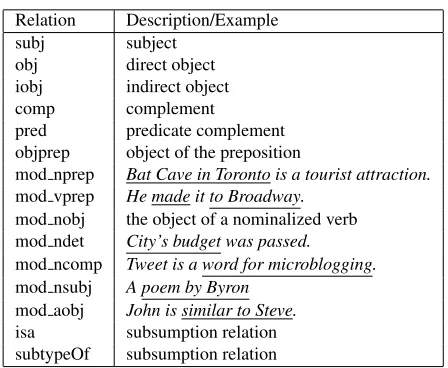
slots (see table 1) defined by parser and relation an-notators to link a frame and its arguments. By using these slots directly, we avoid the problem of map-ping parser relations to frame elements.
2.2 Automatically Created Resources
TextRunner (Banko et al., 2007) is an information extraction system which automatically extracts re-lation tuples over massive web data in an unsuper-vised manner. TextRunner contains over 800 mil-lion extractions (Lin et al., 2009) and has proven to be a useful resource in a number of important tasks in machine reading such as hypernym discov-ery (Alan Ritter and Etzioni, 2009), and scoring in-teresting assertions (Lin et al., 2009). TextRunner works by automatically identifying and extracting relationships using a conditional random field (CRF) model over natural language text. As this is a rela-tively inexpensive technique, it allows rapid applica-tion to web-scale data.
DIRT (Discovering Inference Rules from Text) (Lin and Pantel, 2001) automatically identifies in-ference rules over dependency paths which tend to link the same arguments. The technique consists of applying a dependency parser over 1 gb of text, col-lecting the paths between arguments and then cal-culating a path similarity between paths. DIRT has been used extensively in recognizing textual entail-ment (RTE).
PRISMATIC is similar to TextRunner and DIRT in that it may be applied automatically over mas-sive corpora. At a representational level it differs from both TextRunner and DIRT by storing full frames from which n-ary relations may be indexed and queried. PRISMATIC differs from TextRun-ner as it applies a full dependency parser in order to identify dependency relationships between terms. In contrast to DIRT and TextRunner, PRISMATIC also performs co-reference resolution in order to in-crease coverage for sparsely-occurring entities and employs a named entity recognizer (NER) and rela-tion extractor on all of its extracrela-tions to better repre-sent intensional information.
3 System Overview
The PRISMATIC pipeline consists of three phases:
Figure 1: System Overview
by a suite of components which perform depen-dency parsing, co-reference resolution, named entity recognition and relation detection.
2. Frame ExtractionFrames are extracted based on the dependency parses and associated anno-tations.
3. Frame-Cut ExtractionFrame-cuts of interest (e.g. S-V-O cuts) are identified over all frames and frequency information for each cut is tabu-lated.
4 Corpus Processing
The key step in the Corpus Processing stage is the application of a dependency parser which is used to identify the frame slots (as listed in Table 1) for the Frame Extraction stage. We use ESG (McCord, 1990), a slot-grammar based parser in order to fill in the frame slots. Sentences frequently require co-reference in order to precisely identify the participat-ing entity, and so in order to not lose that informa-tion, we apply a simple rule based co-reference reso-lution component in this phase. The co-reference in-formation helps enhance the coverage of the frame-cuts, which is especially valuable in cases of sparse data and for use with complex frame-cuts.
A rule based Named Entity Recognizer (NER) is used to identify the types of arguments in all frame slot values. This type information is then registered in the Frame Extraction stage to construct inten-tional frames.
5 Frame Extraction
Relation Description/Example
subj subject
obj direct object iobj indirect object comp complement
pred predicate complement objprep object of the preposition
mod nprep Bat Cave in Toronto is a tourist attraction. mod vprep He made it to Broadway.
mod nobj the object of a nominalized verb mod ndet City’s budget was passed. mod ncomp Tweet is a word for microblogging. mod nsubj A poem by Byron
[image:3.612.315.539.81.265.2]mod aobj John is similar to Steve. isa subsumption relation subtypeOf subsumption relation
Table 1: Relations used in a frame and their descriptions
The next step of PRISMATIC is to extract a set of frames from the parsed corpus. A frame is the basic semantic unit representing a set of entities and their relations in a text snippet. A frame is made of a set of slot value pairs where the slots are dependency relations extracted from the parse and the values are the terms from the sentences or annotated types. Ta-ble 2 shows the extracted frame based on the parse tree in figure 2.
In order to capture the relationship we are inter-ested in, frame elements are limited to those that represent the participant information of a predicate. Slots consist of the ones listed in table 1. Further-more, each frame is restricted to be two levels deep at the most, therefore, a large parse tree may re-sult in multiple frames. Table 2 shows how two frames are extracted from the complex parse tree in figure 2. The depth restriction is needed for two reasons. First, despite the best efforts from parser researchers, no parser is perfect, and big complex parse trees tend to have more wrong parses. By lim-iting a frame to be only a small subset of a complex parse tree, we reduce the chance of error parse in each frame. Second, by isolating a subtree, each frame focuses on the immediate participants of a predicate.
ap-Figure 2: The parse tree of the sentence In 1921, Einstein received the Nobel Prize for his original work on the photoelectric effect.
Frame01 verb receive subj Einstein
type PERSON/ SCIENTIST obj Nobel prize
mod vprep in objprep 1921
type YEAR mod vprep for
objprep Frame02
Frame02
noun work
mod ndet his / Einstein mod nobj on
[image:4.612.150.464.52.287.2]objprep effect
Table 2: Frames extracted from Dependency Parse in Fig-ure 2
plications described in section 8. We also include a flag to indicate whether a word is proper noun. These two kinds of information allow us to easily separate the intensional and the extensional parts of PRISMATIC.
6 Frame Cut
One of the main reasons for extracting a large amount of frame data from a corpus is to induce interesting knowledge patterns by exploiting redun-dancy in the data. For example, we would like to learn that things that are annexed are typically re-gions, i.e., a predominant object-type for the noun-phrase “annexation of” is “Region” where “Region” is annotated by a NER. To do this kind of knowledge induction, we first need to abstract out specific por-tions of the frame - in this particular case, we need to isolate and analyze the noun-phrase → object-type relationship. Then, given a lot of data, and frames containing only the above relationship, we hope to see the frame [noun=“annexation”, prepo-sition=“of”, object-type=“Region”] occur very fre-quently.
[image:4.612.101.271.343.564.2]dif-ferent dimensions. Continuing with the annexation example, we can use the V-OT frame cut to learn that a predominant object-type for the verb “annex” is also “Region”, by seeing lots of frames of the form [verb=“annex”, object-type=“Region”] in our data.
To make frame-cuts more flexible, we allow them to specify optional value constraints for slots. For example, we can define an S-V-O frame cut, where both the subject (S) and object (O) slot values are constrained to be proper nouns, thereby creating strictly extensional frames, i.e. frames containing data about instances, e.g., [subject=“United States” verb=“annex” object=“Texas”]. The opposite ef-fect is achieved by constraining S and O slot val-ues to common nouns, creating intensional frames such as [subject=“Political-Entity” verb=“annex” object=“Region”]. The separation of extensional from intensional frame information is desirable, both from a knowledge understanding and an appli-cations perspective, e.g. the former can be used to provide factual evidence in tasks such as question answering, while the latter can be used to learn en-tailment rules as seen in the annexation case.
7 Data
The corpora we used to produce the initial PRIS-MATIC are based on a selected set of sources, such as the complete Wikipedia, New York Times archive and web page snippets that are on the topics listed in wikipedia. After cleaning and html detagging, there are a total of 30 GB of text. From these sources, we extracted approximately 1 billion frames, and from these frames, we produce the most commonly used cuts such as S-V-O, S-V-P-O and S-V-O-IO.
8 Potential Applications
8.1 Type Inference and Its Related Uses
As noted in Section 6, we use frame-cuts to dis-sect frames along different slot dimensions, and then aggregate statistics for the resultant frames across the entire dataset, in order to induce relationships among the various frame slots, e.g., learn the pre-dominant types for subject/object slots in verb and noun phrases. Given a new piece of text, we can apply this knowledge to infer types for named en-tities. For example, since the aggregate statistics shows the most common type for the object of
the verb “annex” is Region, we can infer from the sentence “Napoleon annexed Piedmont in 1859”, that “Piedmont” is most likely to be a Region. Similarly, consider the sentence: “He ordered a Napoleon at the restaurant”. A dictionary based NER is very likely to label “Napoleon” as a Per-son. However, we can learn from a large amount of data, that in the frame: [subject type=“Person” verb=“order” object type=[?] verb prep=“at” ob-ject prep=“restaurant”], the obob-ject type typically denotes a Dish, and thus correctly infer the type for “Napoleon” in this context. Learning this kind of fine-grained type information for a particular con-text is not possible using traditional hand-crafted re-sources like VerbNet or FrameNet. Unlike previ-ous work in selectional restriction (Carroll and Mc-Carthy, 2000; Resnik, 1993), PRISMATIC based type inference does not dependent on a particular taxonomy or previously annotated training data: it works with any NER and its type system.
The automatically induced-type information can also be used for co-reference resolution. For ex-ample, given the sentence: “Netherlands was ruled by the UTP party before Napolean annexed it”, we can use the inferred type constraint on “it” (Region) to resolve it to “Netherlands” (instead of the “UTP Party”).
Finally, typing knowledge can be used for word sense disambiguation. In the sentence, “Tom Cruise is one of the biggest stars in American Cinema”, we can infer using our frame induced type knowledge base, that the word “stars” in this context refers to a Person/Actor type, and not the sense of “star” as an astronomical object.
8.2 Factual Evidence
Frame data, especially extensional data involving named entities, captured over a large corpus can be used as factual evidence in tasks such as question answering.
8.3 Relation Extraction
as a “PERSON” and “XYZ Corporation” an “OR-GANIZATION” since the “employs” relation is de-fined between a “PERSON” and an “ORGANIZA-TION”.
We envision PRISMATIC to be applied to rela-tion extracrela-tion in two ways. First, as described in section 8.1, PRISMATIC can complement a named entity recognizer (NER) for type annotation. This is especially useful for the cases when NER fails. Second, since PRISMATIC has broad coverage of named entities, it can be used as a database to check to see if the given argument exist in related frame. For example, in order to determine if “em-ploys” relation exists between “Jack Welch” and “GE” in a sentence, we can look up the SVO cut of PRISMATIC to see if we have any frame that has “Jack Welch” as the subject, “GE” as the object and “work” as the verb, or frame that has “Jack Welch” as the object, “GE” as the subject and “employs” as the verb. This information can be passed on as an feature along with other syntactic and semantic fea-tures to th relation extractor.
9 Conclusion and Future Work
In this paper, we presented PRISMATIC, a large scale lexicalized relation resource that is built au-tomatically over massive amount of text. It provides users with knowledge about predicates and their ar-guments. We have focused on building the infras-tructure and gathering the data. Although we are still in the early stages of applying PRISMATIC, we believe it will be useful for a wide variety of AI ap-plications as discussed in section 8, and will pursue them in the near future.
References
Stephen Soderland Alan Ritter and Oren Etzioni. 2009. What is this, anyway: Automatic hypernym discovery. In Proceedings of the 2009 AAAI Spring Symposium on Learning by Reading and Learning to Read. Collin F. Baker, Charles J. Fillmore, and John B. Lowe.
1998. The berkeley framenet project. InProceedings of the 17th international conference on Computational linguistics, pages 86–90, Morristown, NJ, USA. Asso-ciation for Computational Linguistics.
Michele Banko, Michael J Cafarella, Stephen Soderl, Matt Broadhead, and Oren Etzioni. 2007. Open
information extraction from the web. In In Inter-national Joint Conference on Artificial Intelligence, pages 2670–2676.
Razvan C. Bunescu and Raymond J. Mooney. 2005. A shortest path dependency kernel for relation extrac-tion. In HLT ’05: Proceedings of the conference on Human Language Technology and Empirical Meth-ods in Natural Language Processing, pages 724–731, Morristown, NJ, USA. Association for Computational Linguistics.
John Carroll and Diana McCarthy. 2000. Word sense disambiguation using automatically acquired verbal preferences. Computers and the Humanities Senseval Special Issue, 34.
Christiane Fellbaum, 1998.WordNet: An Electronic Lex-ical Database.
Beth Levin, 1993. English Verb Classes and Alterna-tions: A Preliminary Investigation.
Dekang Lin and Patrick Pantel. 2001. Dirt - discovery of inference rules from text. InIn Proceedings of the ACM SIGKDD Conference on Knowledge Discovery and Data Mining, pages 323–328.
Thomas Lin, Oren Etzioni, and James Fogarty. 2009. Identifying interesting assertions from the web. In
CIKM ’09: Proceeding of the 18th ACM conference on Information and knowledge management, pages 1787– 1790, New York, NY, USA. ACM.
Michael C. McCord. 1990. Slot grammar: A system for simpler construction of practical natural language grammars. InProceedings of the International Sympo-sium on Natural Language and Logic, pages 118–145, London, UK. Springer-Verlag.
Philip Resnik. 1993. Selection and Information: A Class-Based Approach to Lexical Relationships. Ph.D. thesis, University of Pennsylvania.