Evidentiality for Text Trustworthiness Detection
Qi Su
1, 2, Chu-Ren Huang and Helen Kai-yun Chen
1
Depart of Chinese & Bilingual Studies, The Hong Kong Polytechnic University
2Key Laboratory of Computational Linguistics, Peking University
[email protected], {helenkychen, churen.huang}@gmail.com
Abstract
Evidentiality is the linguistic representation of the nature of evidence for a statement. In other words, it is the linguistically encoded evidence for the trustworthiness of a state-ment. In this paper, we aim to explore how linguistically encoded information of eviden-tiality can contribute to the prediction of trustworthiness in natural language processing (NLP). We propose to incorporate evidential-ity into a framework of machine learning based text classification. We first construct a taxonomy of evidentials. Then experiments involving collaborative question answering (CQA) are designed and implemented using this taxonomy. The experimental results con-firm that evidentiality is an important clue for text trustworthiness detection. With the bi-narized vector setting, evidential based text representation model has considerably per-formaned better than both the bag-of-word model and the content word based model. Most crucially, we show that the best trust-worthiness detection result is achieved when evidentiality is incorporated in a linguistically sophisticated model where their meanings are interpreted in both semantic and pragmatic terms.
1
Introduction
With the exponential increase in web sites and documents, the amount of information is no longer a main concern for automatic knowledge acquisition. This trend raises, however, at least two new issues. The first is how to locate the information which exactly meets our needs among the vast web content. Efforts to address this issue can be exemplified by advanced
re-search in information retrieval, information ex-traction, etc. The second is how to judge the va-lidity of the acquired information, that is, the trustworthiness of information. This issue has attracted considerable interest in some related research areas recently. Taking the specific in-formation retrieval task, question answering (QA) as an example, a QA system attempts to retrieve the most appropriate answers to ques-tions from web resources. To determine the trustworthiness of the extracted candidate an-swers, a common approach is to exploit the co-occurrence frequency of questions and candidate answers. That is, if a candidate answer co-occurs more frequently with the question than other candidates, the QA system may judge it as the best answer (Magnini, 2002). This approach psupposes and relies crucially on information re-dundancy. Although this heuristic method is simple and straightforward, it is not applicable to all cases. For the applications which don’t involve much information redundancy, the heu-ristic could cease to be effective. The task of collaborative question answering (CQA) which we will address in this paper is just one of such examples. For a user posted question, there are usually only few answers provided. So, the heu-ristic is not useful in providing the best answer. In addition, since the spread of unsubstantiated rumors on the Internet is so pervasive, the high-frequency information on the Web sometimes may mislead the judgment of trustworthiness. In terms of the above consideration, it is essential to look for other approaches which allow di-rectly modeling of the trustworthiness of a text. Given that non-textual features (such as user's Web behavior) used in text trustworthiness de-tection are often manipulated by information providers, as well as no directly related textual features for the task has been proposed up to
date, we need a more felicitous model for detect-ing the trustworthiness of statements. Notdetect-ing that evidentiality is often linguistically encoded and hence provides inherent information on trustworthiness for a statement, we propose to incorporate the linguistic model of evidentiality in our study. Specifically, we incorporate evi-dentiality into a machine learning based text classification framework, and attempt to verify the validity of evidentiality in trustworthiness prediction of text information in the context of collaborative question answering. The experi-mental results show that evidentials are impor-tant clues in predicting the trustworthiness of text. Since none of the task-specific heuristics has been incorporated, the current approach could also be easily adapted to fit other natural language processing applications.
The paper proceeds as follows. In section 2 we discuss related work on text trustworthiness detection. The section is divided into two parts: the current methodology and the textual features for analysis in the task. Section 3 introduces the linguistic researches on evidentiality and our taxonomy of evidentials based on the trustwor-thiness indication. Section 4 presents the ex-periment settings and results. Finally, in section 5 we discuss the experiment results and con-clude the current research.
2
Related Work
The research of text trustworthiness is very helpful for many other natural language process-ing applications. For example, in their research on question answering, Banerjee and Han (2009) modulate answer grade by using a weighted combination of the original score and answer credibility evaluation. Also, Weerkamp and Ri-jke (2008) incorporate textual credibility indica-tors in the retrieval process to improve topical blog posts retrieval. Gyongyi et al (2004) pro-pose a TrustRank algorithm for semi-automatically separating reputable, good Web pages from spams.
2.1 General Approaches for Text Trust-worthiness Detection
In past research, the judgment for the trustwor-thiness or credibility of a given text content is usually tackled from two aspects: entity oriented and content oriented (Rubin and Liddy, 2005). The former approach takes into consideration the information providers’ individual profiles, such as their identity, reputation, authority and
past web behavior; whereas the latter approach considers the actual content of texts. Metzger (2007) reviews several cognitive models of credibility assessment and points out that credi-bility is a multifaceted concept with two primary dimensions: expertise and trustworthiness. Fol-lowing Matzger’s framework, Rubin and Liddy (2005) compile a list of factors that users may take into account in assessing credibility of blog sites. This list could also be summarized as the above mentioned two-folds: the bloggers’ pro-files and the information posted in the entries.
Comparing these two aspects, most existing research on text trustworthiness focuses on the user oriented features. Lots of user oriented fea-tures have been proposed in the research of credibility detection. To score the user oriented features such as user’s authority, a common ap-proach is based on a graph-based ranking algo-rithm such as HITS and PageRank (Zhang et al, 2007; Bouguessa et al, 2008).
In the research of text trustworthiness detec-tion, the overwhelmingly adaption of non-textual features such as entity profiles over text content based features reflect some researchers’ belief that superficial textual features cannot meet the need of text credibility identification (Jeon et al, 2006). In this paper, we examine the lexical semantic feature of evidential and argue that evidentiality, as a linguistically instantiated representation of quality of information content, offers a robust processing model for text trust-worthiness detection.
The detection of information trustworthiness also has promising application values. Google News1 is just such an application that ranks search results according to the credibility of the news. Other online news aggregation service, such as NewTrust 2, also focuses on providing users with credible and high quality news and stories. The existed applications, however, rely on either the quality of web sites or user voting. So, it is anticipated that the improvement on the technology of text trustworthiness detection by incorporating lexical semantic cues such as evi-dentiality may shed light on these applications.
2.2 Textual Feature Based Text Trustwor-thiness Detection
Although non-textual features have been popular in text credibility detection, there has been a few research focusing on textual features so far. Gil
1
http://news.google.com/
2
and Artz (2006) argue that the degree of trust in an entity is only one ingredient in deciding whether or not to trust the information it pro-vides. They further point out that entity-centered issues are made with respect to publicly avail-able data and services, and thus will not be pos-sible in many cases. In their research of topical blog posts retrieval, Weerkamp and Rijke (2008) also consider only textual credibility indicators since they mentioned that additional resources (such as bloggers’ profiles) is hard to obtain for technical or legal reasons.
However, most research which utilizes textual features in text trustworthiness detection usually equates writing quality of document with its trustworthiness. Therefore, some secondary fea-tures which may not directly related to trustwor-thiness are proposed, including spelling errors, the lack of leading capitals, the large number of exclamation markers, personal pronouns and text length (Weerkamp and Rijke, 2008). There has not been attempted to directly evaluate in-herent linguistic cues for trustworthiness of a statement.
3
On Evidentiality in Text
Evidentiality, as an explicit linguistic system to encode quality of information, offers obvious and straightforward evidence for text trustwor-thiness detection. Yet it has not attracted the at-tention which it deserves in most of the natural language processing studies. In this paper, we aim to explore how we can incorporate the lin-guistic model of evidentiality into a robust and efficient machine learning based text classifica-tion framework.
Aikhenvald (2003) observes that every lan-guage has some way of making reference to the source of information. Once the language is be-ing used, it always imprinted with the subjective relationship from the speakers towards the in-formation. Evidentiality is information provid-ers’ specifications for the information sources and their attitudes toward the information. As a common linguistic phenomenon to all the lan-guages, it has attracted linguists’ attention since the beginning of 20th century. In any language, evidentiality is a semantic category which could be expressed on both grammatical level (as in some American Indian language) and lexical level (as in English, Chinese and many other languages). The linguistic expressions of eviden-tiality are named as evidentials or evidential markers.
Mushin (2000) defines evidential as a marker which qualifies the reliability of information. It is an explicit expression of the speaker’s atti-tudes toward the trustworthiness of information source. For instance,
a). It’s probably raining. b). It must be raining. c). It sounds like it’s raining.
d). I think/guess/suppose it’s raining. e). I can hear/see/feel/smell it raining.
It is obvious that the information provided in the above examples is subjective. The informa-tion expresses the personal experience or atti-tudes, while at the same time reflects the speak-ers’ estimation for the trustworthiness of the statement by information providers.
3.1 The Definition of Evidentiality
There are two dimensions of the linguistic defi-nition for evidentiality. The term evidentiality is originally introduced by Jakobson (1957) as a label for the verbal category indicating the al-leged source of information about the narrated events. In line with Jakobson’s definition, the narrow definition of evidentiality proposed by other researchers focuses mainly on the specifi-cation of the information sources, that is, the evidence through which information is acquired (DeLancey, 2001). Comparing with the narrow definition, the board definition explains eviden-tiality in a much wider sense, and characterizes evidentiality as expressions of speaker’s attitude toward information, typically expressed by mo-dalities (Chafe, 1986; Mushin, 2000).
Ifantidou (2001) also holds that evidential has two main functions: 1) indicating the source of knowledge; 2) indicating the speaker’s degree of certainty about the proposition expressed. He further divides them in details as follows.
a) Information can be acquired in various ways, including observation (e.g. see), hearsay (e.g. hear, reportedly), inference (e.g. must, de-duce), memory (e.g. recall).
b) Evidentiality can indicate the speaker’s de-gree of certainty, including certain propositional attitude (e.g. think, guess) and adverbials (e.g. certainly, surely), also epistemic models (e.g. may, ought to).
3.2 The Taxonomy of Evidentials
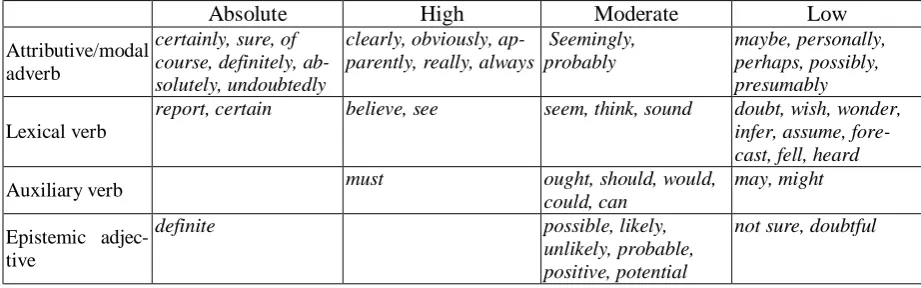
Table 1. The Categorization and Inside Items of Evidentiality
Oswalt (1986) suggests a priority hierarchy of evidentials as:
Performative > Factual > Visual > Auditory > Inferential > Quotative
In this evidential hierarchy, performative car-ries the highest degree of trustworthiness since Oswalt considers that the speaker is speaking of the act he himself is performing. It is the most reliable source of evidence for the knowledge of that event.
Whereas Barners (1984) proposes the follow-ing hierarchy:
Visual > Non-visual > Apparent > Second-hand > Assumed
He points out that visual evidence takes precedence over the auditory evidence and is more reliable.
The above two hierarchies are based on the narrow definition of evidentiality mentioned above. There are also some hierarchies involving the board definition of evidentiality, such as Chafe (1986)’s categories of evidentiality.
In this paper, we adopt a broad definition of evidentiality and focus on a trustworthiness categorization. This categorization follows the model of four-dimensional certainty categoriza-tion by Rubin et al (2005). In this model, it is suggested that the division of the certainty level dimension into four categories - Absolute, High, Moderate and Low. With some revision, there are different items of evidential words and phrased that we extracted from the corpus. These items from each category to be adopted in our experiments are presented in Table 1.
4
Incorporating Evidentiality into
Ma-chine Learning for Trustworthiness
Detection
In this section, we apply evidentiality in an ac-tual implement of text trustworthiness detection.
It is based on a specific web application service, collaborative question answering (CQA), in which the trustworthiness of text content is very helpful for finding the best answers in the ser-vice.
With the development of Web2.0, the services of CQA in community media have largely at-tracted people’s attention. Comparing with the general ad hoc information searching, question answering could help in finding the most accu-rate answers extracted from the vast web content. Whereas in the collaborative question answering, the CQA community media just provide a web space in which users can freely post their ques-tions, and at the same time other users may an-swer these questions based on their knowledge and interests. Due to the advantage of interactiv-ity, CQA usually could settle some questions which cannot be dealt with by ad hoc informa-tion retrieval. However, since the platform is open to anyone, the quality of the answers pro-vided by users is hard to identify. People may present answers of various qualities due to the limitation of their knowledge, attitude and pur-pose of answering the questions. As a result, the issue of how to identify the most trustworthy answers from the user-provided content turns out to be the most challenging part to the system.
As mentioned previously, the trustworthiness of text content could be identified from two di-mensions. The first one relies on the features related with information distributors. The second one relies on the content of a text. In current re-search we focus on textual features, especially the feature of evidentiality in texts. The feature will be incorporated into a machine learning based text classification framework in order to identify the best answers for CQA questions.
Absolute High Moderate Low
Attributive/modal adverb
certainly, sure, of course, definitely, ab-solutely, undoubtedly
clearly, obviously, ap-parently, really, always
Seemingly, probably
maybe, personally, perhaps, possibly, presumably
Lexical verb
report, certain believe, see seem, think, sound doubt, wish, wonder,
infer, assume, fore-cast, fell, heard
Auxiliary verb must ought, should, would,
could, can
may, might
Epistemic adjec-tive
definite possible, likely,
unlikely, probable, positive, potential
4.1 The Dataset
For the experiments, we use the snapshot of Ya-hoo! Answers dataset which is crawled by Emo-ry University3. Since our experiments only in-volve text features, we use the answer parts from it without considering the question sets and user profiles. Such information could be incorporated to achieve a higher performance in the future.
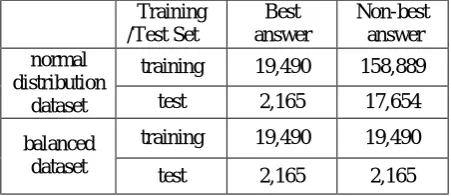
With regard to the text classification problems, there is typically a substantial class distribution skew (Forman, 2003). For the Yahoo! Answers dataset, a question only has one best answer and accordingly all the other answers will be marked as non-best answers. Thus the class of best an-swer contains much fewer texts than the class of non-best answers. In our dataset (a proportion of the overall CQA dataset provided by Emory University), the number of best answers is 2,165, and the number of non-best answers is 17,654. The proportion of the size of the two answer sets is around 1:8.15, showing a significant skews. For a better comparison of experimental results, we use a balanced dataset which is generated from a normal distribution dataset.
A 10-fold validation is used for the evaluation, where the datasets of best and non-best answers are divided into 10 subsets of approximately equal size respectively. In the normally distrib-uted dataset, we use one of the ten subsets as the test set, while the other nine are combined to-gether to from the training set. In the balanced dataset, for each subset of the non-best answers, we only use the first k answers, in which k is the size of each subset of best answers. The training data and test data used in the machine learning process are shown in Table 2.
Training /Test Set
Best answer
Non-best answer
training 19,490 158,889 normal
distribution
dataset test 2,165 17,654 training 19,490 19,490 balanced
[image:5.595.65.291.545.643.2]dataset test 2,165 2,165
Table 2. The Dataset Used for the Experiments
4.2 Experiment Settings
To conduct a machine learning based classifica-tion for best answers and non-best answers, we first need to construct the feature vectors. The representation of text is the core issue in the
3
http://ir.mathcs.emory.edu/shared
chine learning model for text classification. In text domains, feature selection plays an essential role to make the learning task efficient and more accurate. As the baseline comparison, we use the following feature vector settings.
·Baseline1 represents using all the words in the text as features (when the frequency of the word in the dataset is bigger than a predefined threshold j).
·Baseline2 represents using all the content words (here we include the four main categories of content words - nouns, verbs, adjectives and adverbs identified by a POS tagger) in the data-set as features.
We use both the above two baselines. The bag-of-word model of Baseline1 is a conven-tional method in text representation. However, since not all the words are linguistically signifi-cant, in Baseline2, we consider only the content words in the dataset, since content words convey the core meaning of a sentence.
For the evidentiality-based classification, we adopt the following feature vector settings.
·Evidential represents using all the evidentials in text as features.
·Evidential’ represents using all the eviden-tials except for those in the category of Moder-ate as features.
·Evid.cat4 represents using the four eviden-tiality categories of Absolute, High, Moderate and Low from Table 1.
·Evid.cat2 represents using the two categories of Absolute and High as the positive evidential and Moderate and Low as the negative evidential.
·Evid.cat2’ omits the evidential category of Moderate, and represents using the two catego-ries of Absolute and High as the positive eviden-tial and only the category of Low as the negative evidential feature.
of evidentiality into text representation can lead to improvement in classification performance.
In our experiment, we perform text preproc-essing including word segmentation and part-of-speech (POS) tagging. The Stanford Log-linear Part-Of-Speech Tagger (http://nlp.stanford.edu/ software/tagger.shtml) is used for POS tagging. We adopt support vector machine (SVM) as the machine learning model to classify best answers from non-best ones, and use the SVMlight pack-age (http://svmlight.joachims.org) as the classi-fier with the default parameters and a linear ker-nel. For the evaluation, we use the metrics of precision (Prec. as in table 3), recall (Rec. as in table 3), accuracy (Acc. as in table 3) and F1: F1-measure, the harmonic mean of the precision
and recall.
4.3 Evaluation
Table 3 shows the experimental results using the balanced dataset with Boolean weighting. The focus of the experiment evaluation is on identi-fying the best answers, so the evaluation metrics are all for the best answers collection. From the table, we see increases of the two feature vector setting of evidentials over both baseline results. The highest improvement is 14.85%, achieved by the feature set of Evidential’. However, there is no increase found in the settings of using evi-dential categories. This means that although the category of evidentials in indicating text trust-worthiness is obvious for human, it is not neces-sary a preferred feature for machine learning.
Prec. Rec. Acc. F1
Baseline1 45.62% 51.51% 45.15% 47.94%
Baseline2 59.58% 39.20% 56.30% 47.28%
Evidential 67.78% 44.18% 61.59% 53.49%
Evidential’ 47.40% 90.12% 45.06% 62.13%
Evid.cat4 64.15% 25.85% 55.70% 36.85%
Evid.cat2 60.86% 28.21% 55.03% 38.55%
Evid.cat2’ 40.35% 25.85% 43.81% 31.51%
Table 3. Experimental Results Using the Bal-anced Training/Test Dataset (with Boolean Weighting)
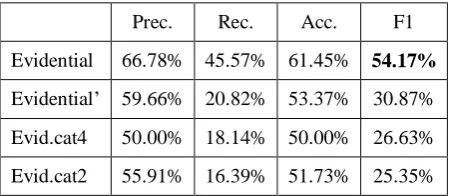
To eliminate the potential effect of term weighting scheme on performance trend among different text representation models, we also conduct experiments using TF weighting. By the
experiments, we aim to compare the relative per-formances of different feature vectors con-structed with evidentials, and the results are demonstrated in Table 4.
Prec. Rec. Acc. F1
Evidential 66.78% 45.57% 61.45% 54.17%
Evidential’ 59.66% 20.82% 53.37% 30.87%
Evid.cat4 50.00% 18.14% 50.00% 26.63%
Evid.cat2 55.91% 16.39% 51.73% 25.35%
Table 4. Experimental Results Using the Bal-anced Training/Test Dataset (with TF Weighting)
From the table, it can be observed that using evidentials as features shows better improve-ment in the performance than the category of evidentials as a feature. A similar performance has been summarized in Table 3.
Finally, but not the least, to better understand the effect of evidential category on the machine learning performance, we design additional ex-periments as follows.
·Evid_cat1 stands for combining the four evi-dential categories into one, and uses only this one category of evidential as a feature. The ap-proach of Boolean weighting is actually the same as a rule-based approach that classifies the test dataset according to whether evidential oc-curs or not.
BOOL Prec. Rec. Acc. F1
Evid_cat1 59.42% 61.59% 59.76% 60.49%
Table 5. Experimental Results Using the Bal-anced Training/Test Dataset (with Boolean Weighting; Only One Evidential Category)
[image:6.595.303.528.133.231.2]1). However, we should address the question of why not all types of evidential features demon-strate improvement of detection. We will further discuss the issue from a pragmatic viewpoint in the next section.
5
Conclusion and Discussion
In this paper, we propose to incorporate the lin-guistic knowledge of evidentiality in the NLP task of trustworthiness prediction. As evidential-ity is an integral and inherent part of any state-ment and explicitly expresses information about the trustworthiness of this statement, it should provide the most robust and direct model for trustworthiness detection. We first set up the taxonomy of lexical evidentials. By incorporat-ing evidentiality into a machine learnincorporat-ing based text classification framework, we conduct ex-periments for a specific application, CQA. The evidentials in the dataset are extracted to form different text representation schemes. Our ex-perimental results using evidentials show im-provements up to 14.85% over the baselines. However, not all types of evidential features contributed to the improvement of detection. We also compared the effect of different types of evidential based feature representation schemes on the classification performance.
The way to model evidentiality for trustwor-thiness detection which we adopted in our initial experiment design actually could also be ex-plained by Grice’s Maxim of Quality: be truthful. As the Maxim of Quality requires one “not to say that for which one lacks adequate evidence”, we hypothesize that evidential constructions mark the adequacy of evidence and should indi-cate reliable answers. However, the results from our experiments only partially supported this hypothesis. The results showed a satisfactory performance was achieved when all evidential markers were treated as negative evidence for reliability. This result could then be accounted by invoking another Gricean maxim: Quantity.
The Maxim of Quantity requires that “one makes his/her contribution as informative as is required, and at the same time does not make the contribution more informative than is required.” As evidentiality is not grammaticalized in Eng-lish, the use of evidentiality is not a required grammatical element. An answer marked by evi-dentials would violate Maxim of Quantity if it is correct. The Maxim of Quantity predicts that good answers are plain statements without evi-dential markers. On the frequent use of
eviden-tial markers for less reliable answers can be ac-counted for by speakers’ attempt to follow both Maxims of Quality and Quantity. The evidential marks are used to compensate for the fact that speakers are not very confident about the answer, yet would like to adhere to the Maxim of Quality. In other words, evidentials are not likely to be used in reliable answers because of the Maxim of Quality, but it is likely used in less reliable answers because the speakers may try to provide proof of adequate evidence by a grammatical device instead of providing true answer.
Therefore, this model elaborated above takes into account not only the grammatical function of evidential constructions but also how this lin-guistic structure is used as a pragmatic/discourse device. In other words, this study suggests that modeling linguistic theory in NLP needs to take a more comprehensive approach than the simple modular approach where only one module (based on evidentiality) is used. Linguistic mod-eling needs to consider both how linguistic structure/knowledge is represented and proc-essed, we also need to model how a particular linguistic device in use.
In the further works, we plan to continue de-veloping and elaborate on a multi-modular lin-guistic model of evidentiality for knowledge acquisition. We will also explore the possibility of incorporating other features, both textual and non-textual, to further improve performances in the tasks of text trustworthiness detection.
References
Agichtein E, Castillo C, and etc. 2008. Finding high-quality content in social media. In Proceedings of WSDM2008.
Aikhenvald A and Dixon, ed. 2003. Studies in evi-dentiality. Amsterdam/Philadelphia: John Benja-mins Publishing Company
Banerjee P, Han H. 2009. Credibility: A Language Modeling Approach to Answer Validation, In Pro-ceedings of NAACL HLT 2009, Boulder, Bolorado, US
Barners J. 1984. Evidentials in the Tuyuca Verb. IN
International Journal of American Linguistics, 50
Bouguessa M, Dumoulin B, Wang S. 2008. Identify-ing Authoritative Actors in Question-AnswerIdentify-ing Forums - The Case of Yahoo! Answers, In Pro-ceedings of KDD’08, Las Vegas, Nevada, USA
Nich-ols, (ed.). Evidentiality: The Linguistic Coding of Epistemology. Norwood, NJ: Ablex
DeLancey S. 2001. The mirative and evidentiality. In
Journal of Pragmatic, 33
Forman G. 2003. An Extensive Empirical Study of Feature Selection Metrics for Text Classification, In Journal of Machine Learning Research, 3
Gil Y, Artz D. 2006. Towards Content Trust of Web Resources, In Proceedings of the 15th International World Wide Web Conference, Edinburgh, Scotland
Gyongyi Z, Molina H, Pedersen J. 2004. Combating Web Spam with TrustRank. In Proceedings of the 30th VLDB Conference, Toronto, Canada
Ifantidou E. 2001. Evidentials and Relevance. John Benjamins Publishing Company.
Jeon J, Croft W, Lee J and Park S. 2006. A Frame-work to Predict the Quality of Answers with Non-textual Features, In Proceedings of SIGIR’06, Se-attle, Washington, USA
Leopold E, Kindermann J. 2002. Text Categorization with Support Vector Machines. How to Represent Texts in Input Space?, In Machine Learning, 46, 423-444
Oswalt R. 1986. The evidential system of Kashaya. IN Chafe W and Nichols (Eds.), Evidentiality: The linguistic coding of epistemology. Norwood, NJ: Ablex
Rubin V, Liddy E, Kando N. 2005. Certainty Identi-fication in Texts: Categorization Model and Man-ual Tagging Results, In Shanahan J and et al (Eds.),
Computing Attitude and Affect in Text: Theory and Applications (The Information Retrieval Series): Springer-Verlag New York, Inc.
Rubin V, Liddy E. 2006. Assessing Credibility of Weblogs, In Proceedings of the AAAI Spring Sym-posium: Computational Approaches to Analyzing Weblogs (CAAW)
Magnini B, Negri M, Prevete R and Tanev H. 2002. Is It the Right Answer? Exploiting Web Redun-dancy for Answer Validation, In Proceedings of the 40th Annual Meeting of the Association for Computational Linguistics, Philadelphia, PA
Metzger M. 2007. Evaluating Online Information and Recommendations for Future Research, Journal of the American Society for Information Science and Technology, 58(13)
Mushin I. 2000. Evidentiality and Deixis in Retelling, In Journal of Pragmatics, 32
Weerkamp W, Rijke M. 2008. Credibility Improves Topical Blog Post Retrieval. In Proceedings of ACL08: HLT
Zhang J, Ackerman M, Adamic L. 2007. Expertise Networks in Online Communities: Structure and