Google Web 1T 5-Grams Made Easy (but not for the computer)
Stefan Evert
Institute of Cognitive Science University of Osnabr¨uck 49069 Osnabr¨uck, Germany
Abstract
This paper introduces Web1T5-Easy, a sim-ple indexing solution that allows interactive searches of the Web 1T 5-gram database and a derived database of quasi-collocations. The latter is validated against co-occurrence data from the BNC and ukWaC on the automatic identification of non-compositional VPC.
1 Introduction
The Google Web 1T 5-gram (Web1T5) database
(Brants and Franz, 2006) consists of frequency counts for bigram, trigrams, 4-grams and 5-grams extracted from 1 trillion words of English Web text, i.e. from a corpus 10,000 times the size of the British National Corpus (Aston and Burnard, 1998). While primarily designed as a resource to build better lan-guage models for machine translation and other NLP applications, its public release in 2006 was greeted with great enthusiasm by many researchers in com-putational linguistics. As one example, Mitchell et al. (2008) used the Web1T5 data successfully to pre-dict fMRI neural activation associated with concrete noun concepts.
For linguistic applications, though, the Web1T5 database presents three major obstacles:
(i) The lack of linguistic annotation: Google’s to-kenisation splits hyphenated compounds (e.g., part-timeis split into a three-token sequencepart|-|time) and differs in many other ways from the rules used in liguistic corpora. The n-grams are neither anno-tated with part-of-speech tags nor lemmatised, and there are separate entries for sentence-initial upper-case and the corresponding lowerupper-case forms.
(ii) The application of frequency thresholds: De-spite the enormous size of the database, its com-pilers found it necessary to omit low-frequency n-grams with fewer than 40 occurrences. This means that non-adjacent word combinations are listed only if the occur in a relatively frequent pattern. As a consequence, it is impossible to obtain reliable fre-quency estimates for latent phenomena by pooling data (e.g. the co-occurrence frequency of a particu-lar verb with nouns denoting animals).
(iii) The difficulty of interactive search:The com-plete Web1T5 database consists of 24.4 GiB of binary-sorted, compressed text files. While this for-mat is suitable for building n-gram language models and other offline processing, searching the database is not efficient enough for interactive use. Except for simple, case-sensitive prefix searches – which can be restricted to a single file containing 50–90 MiB of compressed text – every query requires a linear scan of the full database.
This paper presents a simple open-source soft-ware solution to the third problem, called Web1T5-Easy. The n-gram data are encoded and indexed in a relational database. Building on convenient open-source tools such as SQLite and Perl, the software aims to strike a good balance between search efficiency and ease of use and implemen-tation. With its focus on interactive, but accu-rate search it complements the approximate index-ing and batch processindex-ing approaches of Hawker et al. (2007). Web1T5-Easy can be downloaded from
http://webascorpus.sf.net/Web1T5-Easy/.1
1An online demo of the complete Web1T5 database is avail-able athttp://cogsci.uos.de/~korpora/ws/Web1T5/.
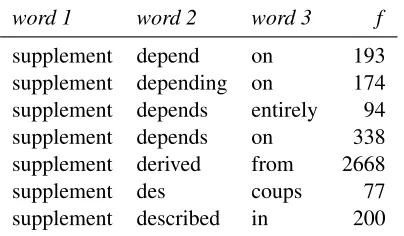
word 1 word 2 word 3 f
[image:2.612.86.288.59.177.2]supplement depend on 193 supplement depending on 174 supplement depends entirely 94 supplement depends on 338 supplement derived from 2668 supplement des coups 77 supplement described in 200
Table 1: Example of Web1T5 3-gram frequency data (ex-cerpt from file3gm-0088.gz).
The rest of this paper is organised as follows. Sec-tion 2 describes the general system architecture in more detail. Section 3 explains how collocations (with a maximal span size of four tokens) and dis-tributional semantic models (DSM) can be approxi-mated on the basis of Web1T5 frequency data. Some technical aspects are summarised in Section 4. Sec-tion 5 addresses the consequences of problems (i) and (ii). The linguistic usefulness of Web1T5 col-location data is validated on a multiword extraction task from the MWE 2008 workshop.2Section 6 con-cludes with a brief outlook on the future develop-ment of Web1T5-Easy.
2 System architecture
While designing the fastest possible indexing archi-tecture for the Web1T5 database is an interesting computer science problem, linguistic applications typically do not require the millisecond response times of a commercial search engine. It is sufficient for interactive queries to be completed within a few seconds, and many users will also be willing to wait several minutes for the result of a complex search operation. Given the tabular format of the Web1T5 n-gram frequency data (cf. Table 1), it was a natural choice to make use of a standard relational database (RDBMS). Database tables can be indexed on sin-gle or multiple columns for fast access, and the SQL query languge allows flexible analysis and aggrega-tion of frequency data (see Secaggrega-tion 2.2 for some ex-amples). While the indexing procedure can be very time-consuming, it is carried out offline and has to run only once.
2http://multiword.sf.net/mwe2008/
Web1T5-Easy was designed to balance com-putational efficiency against implementation effort and ease of use. Its main ingredients are the public-domain embedded relational database engine SQLite and the open-source scripting language Perl which are connected through the portable DBI/DBD interface.3 The Web1T5-Easy package consists of two sets of Perl scripts. The first set automates pre-processing and indexing, detailed in Section 2.1. The second set, which facilitates command-line ac-cess to the database and provides a Web-based GUI, is described in Section 2.2. Technical details of the representation format and performance figures are presented in Section 4.
The embedded database engine SQLite was pre-ferred over a full-fledged RDBMS such as MySQL or PostgreSQL for several reasons: (i) running the database as a user-level process gives better con-trol over huge database files and expensive indexing operations, which might otherwise clog up a ded-icated MySQL server computer; (ii) each SQLite database is stored in a single, platform-independent file, so it can easily be copied to other locations or servers; (iii) an embedded database avoids the over-head of exchanging large amounts of data between client and server; (iv) tight integration with the ap-plication program allows more flexible use of the database than pure SQL queries (e.g., a Perl script can define its own SQL functions, cf. Section 3).
It is quite possible that the sophisticated query op-timisers of MySQL and commercial RDMBS im-plementations would improve performance on com-plex SQL queries. Since Web1T5-Easy uses the generic DBI interface, it can easily be adapted to any RDMBS back-end for which DBI/DBD drivers are available.
2.1 The indexing procedure
Indexing of the Web1T5 n-gram data is carried out in four stages:
1. In an optional pre-processing step, words are filtered and normalised to lowercase.4 Each
3See the Web pages athttp://www.sqlite.org/,http:
//www.perl.org/andhttp://dbi.perl.org/.
word in an n-gram entry is then coded as a nu-meric ID, which reduces database size and im-proves both indexing and query performance (see Section 4 for details on the representation format). The resulting tuples ofn+1 integers (nword IDs plus frequency count) are inserted into a database table.
2. If normalisation was applied, the table will con-tain multiple entries for many n-grams.5 In Stage 2, their frequency counts are aggregated with a suitable SQL query. This is one of the most expensive and disk-intensive operations of the entire indexing procedure.
3. A separate SQL index is created for each n-gram position (e.g.,word 1,word 2andword 3
in Table 1). Multi-column indexes are currently omitted, as they would drastically increase the size of the database files.6 Moreover, the use of an index only improves query execution speed if it is highly selective, as explained in Sec-tion 4. If desired, the Perl scripts can trivially be extended to create additional indexes.
4. A statistical analysis of the database is per-formed to improve query optimisation (i.e., ap-propriate selection of indexes).
The indexing procedure is carried out separately for bigrams, trigrams, 4-grams and 5-grams, using a shared lexicon table to look up numeric IDs. Users who do not need the larger n-grams can easily skip them, resulting in a considerably smaller database and much faster indexing.
2.2 Database queries and the Web GUI
After the SQLite database has been populated and indexed, it can be searched with standard SQL queries (typically a join between one of the n-gram tables and the lexicon table), e.g. using thesqlite3
5For example, with the default normalisation,bought 2
bot-tles, bought 5 bottles, Bought 3 bottles, BOUGHT 2 BOT-TLESand many other trigrams are mapped to the representation
bought NUM bottles. The database table thus contains multiple entries of the trigrambought NUM bottles, whose frequency counts have to be added up.
6For the 5-gram table, 10 different two-column indexes would be required to cover a wide range of queries, more than doubling the size of the database file.
command-line utility. Since this requires detailed knowledge of SQL syntax as well as the database layout and normalisation rules, the Web1T5-Easy package offers a simpler, user-friendly query lan-guage, which is internally translated into appropriate SQL code.
A Web1T5-Easy query consists of 2–5 search terms separated by blanks. Each search term is ei-ther a literal word (e.g.sit), a set of words in square brackets (e.g.[sit,sits,sat,sitting]), a prefix
(under%) or suffix (%ation) expression,*for an
ar-bitrary word, or?to skip a word. The difference be-tween the latter two is that positions marked by*are included in the query result, while those marked by?
are not. If a query term cannot match because of nor-malisation, an informative error message is shown. Matches can be ranked by frequency or by associa-tion scores, according to one of the measures recom-mended by Evert (2008): t-score (t), log-likelihood (G2), chi-squared with Yates’ correction (X2), point-wise MI, or a version of the Dice coefficient.
For example, the query web as corpus shows that the trigram Web as Corpus occurs 1,104 times in the Google corpus (case-insensitive).
%ly good fun lists ways of having fun such
as really good fun (12,223×), jolly good fun
(3,730×) and extremely good fun (2,788×). The query[sit,sits,sat,sitting] * ? chair re-turns the patternsSIT in . . . chair (201,084×),SIT on . . . chair(61,901×), SIT at . . . chair(1,173×), etc. Corpus frequencies are automatically summed over all fillers in the third slot.
The query implementation is available as a command-line version and as a CGI script that provides a Web-based GUI to the Web1T5-Easy database. The CGI version also offers CSV and XML output formats for use as a Web service.
3 Quasi-collocations and DSM
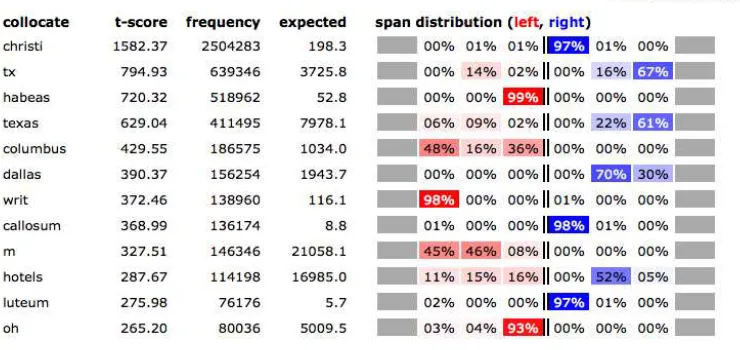
Figure 1: Quasi-collocations for the node wordcorpusin the Web GUI of Web1T5-Easy.
words (which have at least 50 different collocates in the database, and f ≥10,000 in the original Google corpus).
Unfortunately, the Web1T5 distribution does not include co-occurrence frequencies of word pairs, except for data on immediately adjacent bigrams. It is possible, though, to derive approximate co-occurrence frequencies within a collocational span of up to 4 tokens. In this approach, each n-gram ta-ble yields information about a specific collocate po-sition relative to the node. For instance, one can use the 4-gram table to identify collocates of the node word corpusat position +3 (i.e., 3 tokens to the right of the node) with the Web1T5-Easy query
corpus ? ? *, and collocates at position−3 (i.e.,
3 tokens to the left of the node) with the query
* ? ? corpus. Co-occurrence frequencies within
a collocational span, e.g.(−3,+3), are obtained by
summation over all collocate positions in this win-dow, collecting data from multiple n-gram tables.
It has to be kept in mind that such quasi-collocationsdo not represent the true co-occurrence frequencies, since an instance of co-occurrence of two words is counted only if it forms part of an n-gram with f≥40 that has been included in Web1T5. Especially for larger distances of 3 or 4 tokens, this limitation is likely to discard most of the evidence for co-occurrence and put a focus on collocations that form part of a rigid multiword unit or insti-tutionalised phrase. Thus, cars becomes the most
salient collocate of collectiblesmerely because the two words appear in the sloganfrom collectibles to cars(9,443,572×). Section 5 validates the linguistic usefulness of Web1T5 quasi-collocations in a multi-word extraction task.
Web1T5-Easy compiles frequency data for quasi-collocations in an additional step after the complete n-gram data have been indexed. For each pair of co-occurring words, the number of co-occurrences in each collocational position (−4,−3, . . . ,+3,+4) is
recorded. If the user has chosen to skip the largest n-gram tables, only a shorter collocational span will be available.
The Web GUI generates SQL code to determine co-occurrence frequencies within a user-defined col-locational span on the fly, by summation over the appropriate columns of the quasi-collocations table. Collocates can be ranked by a range of association measures (t, G2, X2, MI, Dice, or frequency f), which are implemented as user-defined SQL func-tions in the Perl code. In this way, sophisticated statistical analyses can be performed even if they are not directly supported by the RDBMS back-end. Figure 1 shows an example of quasi-collocations in the Web GUI, ranked according to the t-score mea-sure. On the right-hand side of the table, the distri-bution across collocate positions is visualised.
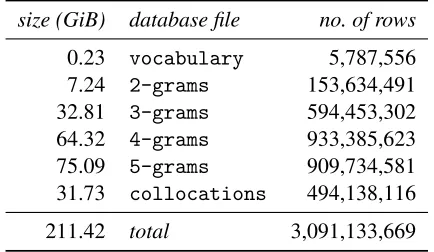
size (GiB) database file no. of rows
0.23 vocabulary 5,787,556
7.24 2-grams 153,634,491
32.81 3-grams 594,453,302 64.32 4-grams 933,385,623 75.09 5-grams 909,734,581 31.73 collocations 494,138,116
[image:5.612.77.294.58.184.2]211.42 total 3,091,133,669
Table 2: Size of the fully indexed Web1T5 database, in-cluding quasi-collocations.
(DSM), with association scores used as feature weights (see e.g. Curran (2004, Sec. 4.3)). The Web1T5-Easy quasi-collocations table provides a sparse representation of such a term-term matrix, where only 494×106or 0.0015% of the 5.8×10
6·
5.8×10
6=33
.5×10
12cells of a full co-occurrence
matrix are populated with nonzero entries.
4 Technical aspects
An essential feature of Web1T5-Easy is the numeric coding of words in the n-gram tables, which allows for compact storage and more efficient indexing of the data than a full character string representation. A separate lexicon table lists every (normalised) word form together with its corpus frequency and an in-teger ID. The lexicon is sorted by decreasing fre-quency: since SQLite encodes integers in a variable-length format, it is advantageous to assign low ID numbers to the most frequent terms.
Every table is stored in its own SQLite database file, e.g. vocabulary for the lexicon table and
collocations for quasi-collocations (cf.
Sec-tion 3). The database files for different n-gram sizes
(2-grams, 3-grams, 4-grams, 5-grams) share
the same layout and differ only in the number of columns. Table 2 lists the disk size and number of rows of each database file, with default normalisa-tion applied. While the total size of 211 GiB by far exceeds the original Web1T5 distribution, it can eas-ily be handled by modern commodity hardware and is efficient enough for interactive queries.
Performance measurements were made on a midrange 64-bit Linux server with 2.6 GHz AMD Opteron CPUs (4 cores) and 16 GiB RAM. SQLite
database files and temporary data were stored on a fast, locally mounted hard disk. Similar or better hardware will be available at most academic institu-tions, and even in recent personal desktop PCs.
Indexing the n-gram tables in SQLite took about two weeks. Since the server was also used for mul-tiple other memory- and disk-intensive tasks during this period, the timings reported here should only be understood as rough indications. The indexing process might be considerably faster on a dedicated server. Roughly equal amounts of time were spent on each of the four stages listed in Section 2.1.
Database analysis in Stage 4 turned out to be of limited value because the SQLite query optimiser was not able to make good use of this information. Therefore, a heuristic optimiser based on individual term frequencies was added to the Perl query scripts. This optimiser chooses the n-gram slot that is most likely to speed up the query, and explicitly disables the use of indexes for all other slots. Unless another constraint is much more selective, preference is al-ways given to the first slot, which represents a clus-tered index (i.e. database rows are stored in index order) and can be scanned very efficiently.
With these explicit optimisations, Stage 4 of the indexing process can be omitted. If normalisation is not required, Stage 2 can also be skipped, reducing the total indexing time by half.
At first sight, it seems to be easy to compile the database of quasi-collocations one node at a time, based on the fully indexed n-gram tables. However, the overhead of random disk access during index lookups made this approach intractable.7 A brute-force Perl script that performs multiple linear scans of the complete n-gram tables, holding as much data in RAM as possible, completed the compilation of co-occurrence frequencies in about three days.
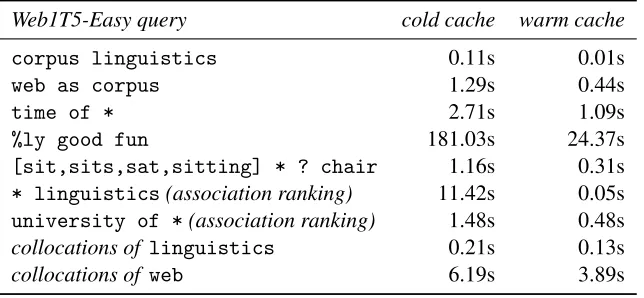
Table 3 shows execution times for a selection of Web1T5-Easy queries entered in the Web GUI. In general, prefix queries that start with a reasonably specific term (such as time of *) are very fast, even on a cold cache. The query %ly good fun
is a pathological case: none of the terms is selec-tive enough to make good use of the corresponding
Web1T5-Easy query cold cache warm cache
corpus linguistics 0.11s 0.01s
web as corpus 1.29s 0.44s
time of * 2.71s 1.09s
%ly good fun 181.03s 24.37s
[sit,sits,sat,sitting] * ? chair 1.16s 0.31s
* linguistics(association ranking) 11.42s 0.05s
university of *(association ranking) 1.48s 0.48s
collocations of linguistics 0.21s 0.13s
[image:6.612.147.469.58.207.2]collocations of web 6.19s 3.89s
Table 3: Performance of interactive queries in the Web GUI of Web1T5-Easy. Separate timings are given for a cold disk cache (first query) and warm disk cache (repeated query). Re-running a query with modified display or ranking settings will only take the time listed in the last column.
index, and entries matching the wildcard expression
%ly in the first slot are scattered across the entire trigram table.
5 Validation on a MWE extraction task
In order to validate the linguistic usefulness of Web1T5 quasi-collocations, they were evalu-ated on the English VPC shared task from the MWE 2008 workshop.8 This data set consists of 3,078 verb-particle constructions (VPC), which have been manually annotated as compositional or non-compositional (Baldwin, 2008). The task is to iden-tify non-compositional VPC as true positives (TP) and re-rank the data set accordingly. Evaluation is carried out in terms of precision-recall graphs, using average precision (AP, corresponding to the area un-der a precision-recall curve) as a global measure of accuracy.
Frequency data from the Web1T5 quasi-collocations table was used to calculate association scores and rankings. Since previous studies suggest that no single association measure works equally well for all tasks and data sets, several popular mea-sures were included in the evaluation: t-score (t), chi-squared with Yates’ continuity correction (X2), Dice coefficient (Dice), co-occurrence frequency (f), log-likelihood (G2) and Mutual Information (MI); see e.g. Evert (2008) for full equations and references. The results are compared against rank-ings obtained from more traditional, linguistically
8http://multiword.sf.net/mwe2008/
annotated corpora of British English: the balanced, 100-million-word British National Corpus (Aston and Burnard, 1998) and the 2-billion-word Web corpus ukWaC (Baroni et al., 2009).
For BNC and ukWaC, three different extraction methods were used: (i) adjacentbigrams of verb + particle/preposition; (ii) shallow syntactic patterns
based on POS tags (allowing pronouns and simple noun phrases between verb and particle); and (iii) surface co-occurrence within acollocational spanof 3 tokens to the right of the node(+1,+3), filtered
by POS tag. Association scores were calculated us-ing the same measures as for the Web1T5 quasi-collocations. Preliminary experiments with different collocational spans showed consistently lower accu-racy than for(+1,+3). In each case, the same
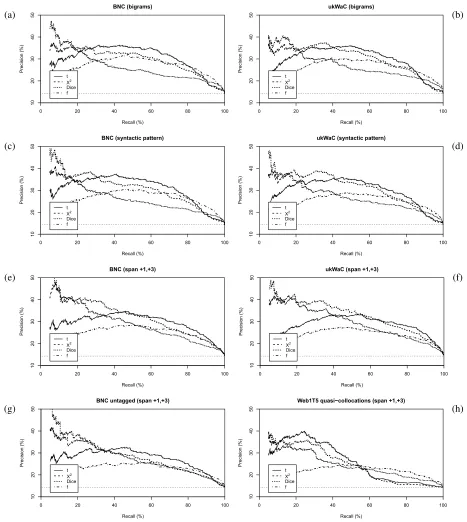
asso-ciation measures were applied as for Web1T5. Evaluation results are shown in Figure 3 (graphs) and Table 4 (AP). The latter also describes the cover-age of the corpus data by listing the number of can-didates for which no frequency information is avail-able (second column). These candidates are always ranked at the end of the list. While the BNC has a coverage of 92%–94% (depending on extraction method), scaling up to Web1T5 completely elimi-nates the missing data problem.
coverage average precision (%)
(missing) t X2 Dice f G2 MI
BNC (bigrams) 242 30.04 29.75 27.12 26.55 29.86 22.79 BNC (syntactic patterns) 201 30.42 30.49 27.48 25.87 30.64 22.48 BNC (span+1. . .+3) 185 29.15 32.12 30.13 24.33 31.06 22.58
ukWaC (bigrams) 171 29.28 30.32 27.79 25.37 29.63 25.13 ukWaC (syntactic patterns) 162 29.20 31.19 27.90 24.19 30.06 25.08 ukWaC (span+1. . .+3) 157 27.82 32.66 30.54 23.03 30.01 25.76
Web1T5(span+1. . .+3) 3 25.83 25.27 25.33 20.88 25.77 20.81
[image:7.612.104.508.59.221.2]BNC untagged (+1. . .+3) 39 27.22 27.85 28.98 22.51 28.13 19.60
Table 4: Evaluation results for English non-compositional VPC (Baldwin, 2008): average precision (AP) as a global indicator. The baseline AP for random candidate ranking is 14.29%. The best result in each row is highlighted in bold.
(Figure 3.h). On the annotated corpora, where nodes and collocates are filtered by POS tags, best results are obtained with the least constrained extraction method and the chi-squared (X2) measure. Scal-ing up to the 2-billion-word ukWaC corpus gives slightly better coverage and precision than on the BNC. Moreover,X2is now almost uniformly better than (or equal to) any other measure (Figure 3.f).
● ● ● ● ● ● ● ● ● ● ● ● ● ● ● ● ● ● ● ● ● ● ● ● ●● ● ● ● ● ● ● ● ● ● ● ● ● ● ● ● ● ● ● ● ● ● ● ● ● ● ● ● ● ● ● ● ● ● ● ● ● ● ● ● ● ● ● ● ● ● ● ● ● ● ● ● ● ● ● ● ● ● ● ● ● ● ● ● ● ● ● ● ● ● ● ● ● ● ● ● ● ● ● ● ● ● ● ● ● ● ● ● ● ● ● ● ● ● ● ● ● ●
−4 −2 0 2 4 6
−5
0
5
ukWaC (rescaled X²)
W
eb1T5 (rescaled X²)
● TP
[image:7.612.86.279.401.593.2]FP
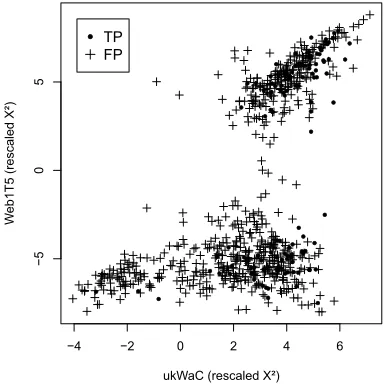
Figure 2: Comparison ofX2association scores on ukWaC
and Web1T5. Axes are rescaled logarithmically, preserv-ing sign to indicate positive vs. negative association.
In order to determine whether the poor perfor-mance of Web1T5 is simply due to the lack of lin-guistic annotation or whether it points to an intrin-sic problem of the n-gram database, co-occurrence
data were extracted from an untagged version of the BNC using the same method as for the Web1T5 data. While there is a significant decrease in precision (cf. Figure 3.g and the last row of Table 4), the results are still considerably better than on Web1T5. In the MWE 2008 competition, Ramisch et al. (2008) were also unable to improve on the BNC results using a phrase entropy measure based on search engine data. The direct comparison ofX2association scores on ukWaC and Web1T5 in Figure 2 reveals that the lat-ter are divided into strongly positive and strongly negative association, while scores on ukWaC are spread evenly across the entire range. It is re-markable that many true positives (TP) exhibit neg-ative association in Web1T5, while all but a few show the expected positive association in ukWaC. This unusual pattern, which may well explain the poor VPC evaluation results, can also be observed for adjacent bigrams extracted from the 2-grams ta-ble (not shown). It suggests a general prota-blem of the Web1T5 data that is compounded by the quasi-collocations approach.
6 Future work
(a)
0 20 40 60 80 100
10
20
30
40
50
BNC (bigrams)
Recall (%)
Precision (%)
t X2
Dice f
0 20 40 60 80 100
10
20
30
40
50
ukWaC (bigrams)
Recall (%)
Precision (%)
t X2
Dice f
(b)
(c)
0 20 40 60 80 100
10
20
30
40
50
BNC (syntactic pattern)
Recall (%)
Precision (%)
t X2
Dice f
0 20 40 60 80 100
10
20
30
40
50
ukWaC (syntactic pattern)
Recall (%)
Precision (%)
t X2
Dice f
(d)
(e)
0 20 40 60 80 100
10
20
30
40
50
BNC (span +1,+3)
Recall (%)
Precision (%)
t X2
Dice f
0 20 40 60 80 100
10
20
30
40
50
ukWaC (span +1,+3)
Recall (%)
Precision (%)
t X2
Dice f
(f)
(g)
0 20 40 60 80 100
10
20
30
40
50
BNC untagged (span +1,+3)
Recall (%)
Precision (%)
t X2
Dice f
0 20 40 60 80 100
10
20
30
40
50
Web1T5 quasi−collocations (span +1,+3)
Recall (%)
Precision (%)
t X2
Dice f
[image:8.612.74.541.105.627.2](h)
References
Guy Aston and Lou Burnard. 1998. The BNC Hand-book. Edinburgh University Press, Edinburgh. See also the BNC homepage at http://www.natcorp. ox.ac.uk/.
Timothy Baldwin. 2008. A resource for evaluating the deep lexical acquisition of English verb-particle con-structions. InProceedings of the LREC Workshop To-wards a Shared Task for Multiword Expressions (MWE
2008), pages 1–2, Marrakech, Morocco.
Marco Baroni, Silvia Bernardini, Adriano Ferraresi, and Eros Zanchetta. 2009. The WaCky Wide Web: A collection of very large linguistically processed Web-crawled corpora. Language Resources and Evalua-tion, 43(3):209–226.
Thorsten Brants and Alex Franz. 2006. Web 1T 5-gram
Version 1. Linguistic Data Consortium,
Philadel-phia, PA. http://www.ldc.upenn.edu/Catalog/ CatalogEntry.jsp?catalogId=LDC2006T13. Thorsten Brants and Alex Franz. 2009. Web
1T 5-gram, 10 European Languages Version
1. Linguistic Data Consortium, Philadelphia, PA. http://www.ldc.upenn.edu/Catalog/ CatalogEntry.jsp?catalogId=LDC2009T25. James Richard Curran. 2004. From Distributional to
Se-mantic Similarity. Ph.D. thesis, University of
Edin-burgh.
Stefan Evert. 2008. Corpora and collocations. In Anke L¨udeling and Merja Kyt¨o, editors,Corpus Linguistics.
An International Handbook, chapter 58. Mouton de
Gruyter, Berlin.
Tobias Hawker, Mary Gardiner, and Andrew Bennetts. 2007. Practical queries of a massive n-gram database.
InProceedings of the Australasian Language
Technol-ogy Workshop 2007, pages 40–48, Melbourne,
Aus-tralia.
Tom M. Mitchell, Svetlana V. Shinkareva, Andrew Carl-son, Kai-Min Chang, Vicente L. Malave, Robert A. Mason, and Marcel Adam Just. 2008. Predicting human brain activity associated with the meanings of nouns. Science, 320:1191–1195.
Carlos Ramisch, Paulo Schreiner, Marco Idiart, and Aline Villavicencio. 2008. An evaluation of methods for the extraction of multiword expressions. In Proceed-ings of the LREC Workshop Towards a Shared Task
for Multiword Expressions (MWE 2008), pages 50–53,
Marrakech, Morocco.