Generating clausal coordinate ellipsis multilingually:
A uniform approach based on postediting
Karin Harbusch
Computer Science Department
University of Koblenz-Landau
PO Box 201602, 56016 Koblenz/DE
[email protected]
Gerard Kempen
Max Planck Institute for Psycholinguistics
PO Box 310, 6500AH Nijmegen/NL
& Cognitive Psychology Unit, Leiden University
[email protected]
Abstract
Present-day sentence generators are often in-capable of producing a wide variety of well-formed elliptical versions of coordinated clauses, in particular, of combined elliptical phenomena (Gapping, Forward and Back-ward Conjunction Reduction, etc.). The ap-plicability of the various types of clausal co-ordinate ellipsis (CCE) presupposes detailed comparisons of the syntactic properties of the coordinated clauses. These nonlocal comparisons argue against approaches based on local rules that treat CCE structures as special cases of clausal coordination. We advocate an alternative approach where CCE rules take the form of postediting rules ap-plicable to nonelliptical structures. The ad-vantage is not only a higher level of modu-larity but also applicability to languages be-longing to different language families. We describe a language-neutral module (called Elleipo; implemented in JAVA) that gener-ates as output all major CCE versions of co-ordinated clauses. Elleipo takes as input linearly ordered nonelliptical coordinated clauses annotated with lexical identity and coreferentiality relationships between words and word groups in the conjuncts. We dem-onstrate the feasibility of a single set of postediting rules that attains multilingual coverage.
1
Introduction
In present-day Natural-Language Generation (NLG) architectures, elision rules typically form part of the Aggregation component, i.e. of the module that decides how to group conceptual messages into a sentence—a module belonging to the Microplanner (cf. Reiter & Dale, 2000, for an authoritative overview of sentence and text generation technology). In such generators, the computation of coordinate structures takes place at a relatively early stage of syntactic processing. However, many types of clausal
co-ordinate ellipsis (CCE) require detailed com-parisons of the final syntactic shape of the coor-dinated clauses (conjuncts). This is even more true when it is desirable to combine elision con-structions, as in German example (1a), where Subgapping—a form of Gapping—combines with Backward Conjunction Reduction (for definitions and examples see Table 1). Example (1) also illustrates that often more than one el-liptical option is available: (1b) shows a variant with Subgapping alone. If the nonelliptical sen-tence generator would choose a different Verb order in the second conjunct (‘gestutzt werden sollen’ as in (1d)), then Subgapping would be the sole alternative.
(1) a. Die Bäume sollen gefällt werden und
The trees should cut-down be and
die Sträucher sollen gestutzt werden the shrubs should pruned be
'The trees should be cut down and the shrubs pruned’
b. Die Bäume sollen gefällt werden und
die Sträucher sollen gestutzt werden
c. *Die Bäume sollen gefällt werden und
gestutzt werdensollen die Sträucher
d. Die Bäume sollen gefällt werden und
gestutzt werdensollen die Sträucher
The comparisons between the clausal con-juncts mainly pertain to the linear order of their major constituents and to identity relations be-tween the lexical material contained in them. For instance, if a right-peripheral string of lexi-cal items in the anterior conjunct is identilexi-cal to such a string in the posterior conjunct, then Backward Conjunction Reduction licenses eli-sion of the former string. In (1a), the two one-word strings ‘werden’ meet this requirement.
families. This suggests the possibility of a multi-lingual approach to CCE where the main CCE processes are defined as procedures that are iso-lated from the “normal” grammar rules for nonelliptical structures, and are independent from each other (see Section 4).
Instead of having an aggregation component where the rules for nonelliptical clausal coordi-nate structures are intermingled with rules for elliptical variants, we consider an alternative approach where the application of the ellipsis rules is deferred until the nonelliptical structures have been completed. That is, the elision options are calculated and executed during a postediting
stage, after the strategic and tactic components of the generator have delivered the nonelliptical versions. We claim that this modular approach facilitates the development of multilingual CCE components for different languages by switch-ing on and off the individual CCE procedures (e.g. no Gapping in Japanese).
The structure of the paper is as follows. In Section 2, we introduce the four main CCE phe-nomena and informally define their treatment in a procedural manner. Section 3 lays out the ba-sic postediting rules that we implemented in JAVA as a language-neutral algorithm (nick-named Elleipo, which means ‘I leave out’ in classical Greek). In Section 4, we present some findings from language-typological studies and explore their implications for potential multilin-gual applicability of Elleipo. Finally, in section 5, we draw some conclusions.
The Elleipo version described here embodies several important improvements to a version described briefly in Harbusch & Kempen (2006), particularly with respect to Subject Gap in clauses with Finite/Fronted Verbs (SGF).
Moreover, the space allowed here enables us to explain Elleipo’s inner workings in more detail, and to demonstrate its multilingual potential.
2
Clausal coordinate ellipsis (CCE)
2.1 Clausal coordinate ellipsis in linguistic theories and in NLG: State of the art
Treatments of the phenomena of clausal coordi-nation and CCE are provided by all major grammar formalisms. Some representative stud-ies are Sarkar & Joshi (1996) for Tree Adjoining Grammar; Steedman (2000) for Combinatory Categorial Grammar; Bresnan (2000) and Frank (2002) for Lexical-Functional Grammar; Crys-mann (2003) and Beavers & Sag (2004) for Head-driven Phrase-Structure Grammar; and te
Velde (2005) for the Minimalist Program. Their treatments of CCE take the form of special de-clarative coordination rules, in contrast with the modular and procedural approach we propose.
In the NLG community, modular treatments of CCE—implemented as programs that take unreduced coordinations expressed in the sys-tem’s grammar formalism as input and return elliptical versions as output—have been elabo-rated in several projects (Shaw, 1998; Dalianis, 1999; Hielkema, 2005). These systems are lim-ited in that that they do not cover all of the four CCE processes and are monolingual.
2.2 Clausal coordinate ellipsis types
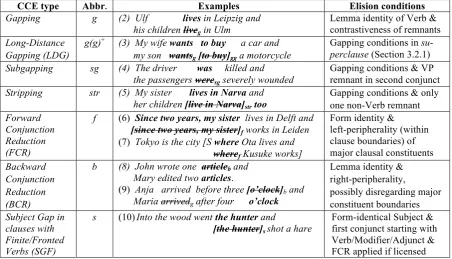
In the linguistic literature on clausal coordinate ellipsis, four main CCE processes are often dis-tinguished, as shown in Table 1.
In the theoretical framework by Kempen (2009) and its implementations (Harbusch & Kempen (2006) for German and Dutch; Har-busch et al. (2009) for Estonian), the elision process is guided by identity constraints and
linear order (cf. column 4 in Table 1). We dis-tinguish three basic types of identity relations between words or word groups (constituents) belonging to different conjuncts1:
(1) Lemma identity: two different words be-long to the same inflectional paradigm; e.g. the Verbs ‘live’ and ‘lives’ in example (2). (2) Form identity: two words have the same
spelling/sound and are lemma-identical; e.g., two tokens of ‘want’ are form-identical if they are both Verbs, but not if one is a Verb and the other is a Noun. (3) Coreferentiality: two words/constituents
denote the same entity or entities in the ex-ternal context, i.e. have the same reference.
1 Very often, lemma- and form identity coincide with
Table 1. Clausal coordinate ellipsis (CCE) types. Column 2 lists the abbreviations for the types mentioned in column 1 (see Elleipo’s algorithm in Section 3). Column 3 illustrates the CCE types. Column 4 summarizes the elision conditions explained in Section 3.
CCE type Abbr. Examples Elision conditions
Gapping g (2) Ulf lives in Leipzig and his children liveg in Ulm
Lemma identity of Verb & contrastiveness of remnants
Long-Distance Gapping (LDG)
g(g)+ (3) My wife wants to buy a car and my son wantsg [to buy]gg a motorcycle
Gapping conditions in su-perclause (Section 3.2.1)
Subgapping sg (4) The driver was killed and the passengers weresg severely wounded
Gapping conditions & VP remnant in second conjunct
Stripping str (5) My sister lives in Narva and her children [live in Narva]strtoo
Gapping conditions & only one non-Verb remnant
Forward Conjunction Reduction (FCR)
f (6) Since two years, my sister lives in Delft and [since two years, my sister]f works in Leiden (7) Tokyo is the city [S where Ota lives and wheref Kusuke works]
Form identity &
left-peripherality (within clause boundaries) of major clausal constituents
Backward Conjunction Reduction (BCR)
b (8) John wrote one articleb and
Mary edited two articles.
(9) Anja arrived before three [o’clock]b and Maria arrivedg after four o’clock
Lemma identity & right-peripherality,
possibly disregarding major constituent boundaries
Subject Gap in clauses with Finite/Fronted Verbs (SGF)
s (10)Into the wood went the hunter and [the hunter]sshot a hare
Form-identical Subject & first conjunct starting with Verb/Modifier/Adjunct & FCR applied if licensed
As summarized in column 4 of Table 1, all forms of Gapping (i.e. including LDG, Subgap-ping and Stripping) are characterized by elision of the posterior member of a paired lemma-identical Verb. The position of this Verb need not be peripheral but is often medial, as in ex-amples (2) through (5), and (9). Non-elided con-stituents in the posterior conjunct are called
remnants. All remnants should pair up with a constituent in the anterior conjunct that has the same grammatical function but is not coreferen-tial. Stated differently, the members of such a pair are contrastive—in (2): the Subjects ‘Ulf’
vs. ‘his children’, and the locative Modifiers ‘in Leipzig’ vs. ‘in Ulm.’ (Notice that although two tokens of ‘my’ in (3) occupy comparable posi-tions in the two conjuncts, it is not possible to elide any of them. On the other hand, ‘were’ in (4) can be elided from the posterior conjunct although it has no literal anterior counterpart.)
In LDG, the remnants originate from different clauses (more precisely: different clauses that belong to the same superclause; term defined in Section 3.2.1). In (3), ‘my son’ belongs to the main clause but ‘a motorcycle’ to the infinitival complement clause. In Subgapping, the poste-rior conjunct includes a remnant in the form of a nonfinite complement clause (VP; ‘severely wounded’ in (4)). In Stripping, the posterior conjunct is left with one non-Verb remnant, of-ten supplemented by the Adverb ‘too.’
In Forward Conjunction Reduction (FCR), elision affects the posterior token of a pair of left-peripheral strings consisting of one or more form-identical major constituents. In (6) and (7), the posterior tokens of ‘since two years,my sis-ter’ and ‘where,’ respectively, belong to such pairs and are eligible for FCR.
Backward Conjunction Reduction (BCR) is
almost the mirror image of FCR as it deletes the anterior member of a pair of right-peripheral lemma-identical word strings (‘o’clock’ in (9)); however, BCR may elide part of a major con-stituent—e.g. only the part ‘article’ of the Direct Object in (8) and ‘o’clock’ of the temporal Modifier ‘before three o’clock’ in (9). In addi-tion, it requires only lemma identity—witness examples like (8).2
Subject Gap in clauses with Finite/Fronted Verbs (SGF) can elide the Subject of the poste-rior conjunct when in the anteposte-rior conjunct the form-identical Subject follows the Verb (Sub-ject-Verb inversion); moreover, the Head Verbs of the conjoined clauses—both with main or interrogative clause word order—are different. (FCR cannot have caused the absence of the posterior Subject since the anterior Subject is not left-peripheral.) The examples in (11)
2However, case-identity is required as well, at least in
[image:3.595.72.525.106.365.2]through (14) show that the first constituents of the unreduced clauses must meet certain special requirements, which extend the rule proposed in our previous publications. In particular, these constituents are allowed to be non-identical finite Head Verbs (11) or form-identical Modifiers (12) but not form-identical arguments, e.g. Direct Objects (13) or Comple-ments (14). Additionally, if FCR is licensed, as in (12), it should actually be realized in order to allow SGF.
(11) Stehen die Leute noch am Eingang und
Stand the people still at-the entrance and
rufen [die Leute]s Parolen?
shout the people slogans
‘Are the people still standing at the entrance (and are they) shouting slogans?’ (12) Warum/Gestern bist du gegangen und
Why/Yesterday have you left and
[warum/gestern]f hast dus nichts gesagt
why/yesterday have you nothing said
‘Why did you leave and didn’t you tell me anything?’ / ‘Yesterday you left and ...’
(13) *Diesen Wein trinke ich nicht mehr und
This wine drink I not anymore and
[diesen Wein]f gieße ichs weg
this wine throw I away
‘I don’t drink this wine anymore and throw it away’
(14) *Das Examen bestehen will er und
The exam pass will he and
[das Examen bestehen]f kann ers auch
the exam pass can he too/as-well ‘He wants to pass the exam and will be able to as well’
3
Language-neutral CCE generation
In this Section, we describe Elleipo’s algorithm in more detail than we were able to in Harbusch & Kempen (2006), again using the German ex-ample (15). Moreover, we elaborate on SGF, given the new, more detailed rules. We limit ourselves to ‘and’-coordinations of only n=2 conjuncts. Actually, Elleipo can handle n-ary coordinations consisting of n≥2 conjuncts by processing n–1 consecutive pairs of conjuncts (1+2, 2+3, etc.), together with an asyndeton rule that replaces non-final ‘and’-s by commas.
(15) Heute wird Hans sein Auto putzen und
Today will Hans his car clean and
heute wird Susi ihr Fahrrad putzen
today will Susi her bike clean
‘Today, Hans will clean his car and today, Susi will clean her bike’
Elleipo’s functioning is based on the assump-tion that CCE does not result from the
applica-tion of local declarative grammar rules for clause formation but from a procedural compo-nent that inspects nonelliptical (unreduced) sen-tences produced by the sentence generator and may block the overt expression of certain con-stituents. Due to this feature, Elleipo can be combined, at least in principle, with various generators. However, the module needs a for-malism-dependent interface that converts gen-erator output to a (simple) canonical form.
3.1 Elleipo’s input
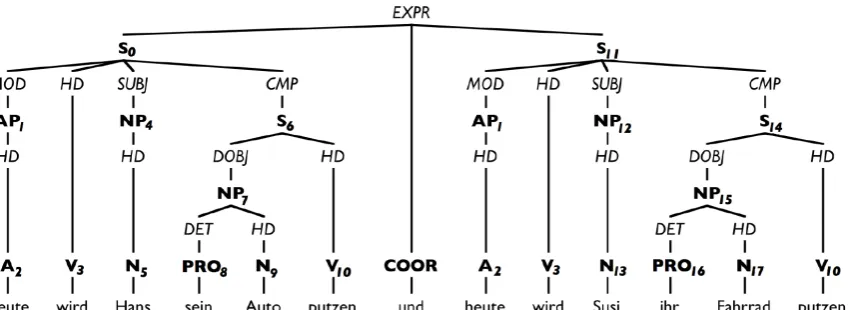
Elleipo takes as input nonelliptical syntactic trees in canonical form, supplied with identity tags (cf. Figure 1). Every categorial node of an input tree is immediately dominated by a func-tional node. Each conjunct is rooted in a cate-gorial node whose daughter nodes (immediate constituents) are grammatical functions (Sub-ject, Direct Ob(Sub-ject, Head, Subordinating Con-junction, Expr(ession), etc.). Within a conjunct, all major constituents are represented at the same hierarchical level (“flat” trees).
Categorial nodes are adorned with numerical identity tags (ID-tags) which express lemma identity. In Figure 1, the ID “2” is attached to the head node of both exemplars of AP ‘heute’
‘today’, thus marking their lemma identity. In contrast, the Subject NPs ‘Hans’ and ‘Susi’ carry different ID-tags, indicating that they are not lemma-identical and cannot be elided by any CCE process.
3.2 The three stages of Elleipo
Elleipo is called for every coordination domain within a non-elliptical input clause. We define a
coordination domain as a (sub)tree rooting in a grammatical function node that dominates two or more categorial S-nodes separated by coordi-nating conjunctions (‘and’). For any given coor-dination domain, Elleipo’s task consists of three consecutive stages: Preparation, Diagnosis, and ReadOut.
3.2.1 Preparation
Figure 1. Non-elliptical input tree in canonical form, underlying sentence (15). Categorial nodes are printed in bold, functional nodes in italics. The numerical subscripted tags denote lemma identity or coreference.
conjunction, with the possible exception of the topmost member of the hierarchy.3
Next, Elleipo inspects and compares the con-tent of the conjoined clauses by assembling four lists: FUNC-PAIRS, LI-FUNC-PAIRS, LPERIPH and RPERIPH (see Table 2). The lists FUNC-PAIRS and LI-FUNC-PAIRS are crucial not only in calculating whether a form of Gap-ping is applicable but also in the determination of contrastiveness of Gapping remnants. We presuppose a division of MODifier constituents into MOD types—locative (LMOD), temporal (TMOD, causal (CMOD), etc.—which are re-corded in the two lists of pairs. Gapping requires the set of grammatical functions, including MOD types, in the anterior and posterior con-juncts to be identical. If so, and if FUNC-PAIRS includes at least one pair of non-coreferential members (carrying different ID-tags), the Boo-lean variable CONTRAST is set to true. In the example, FUNC-PAIRS(S0, S11) includes two
pairs of non-coreferential major constituents (the Subjects and the Complements); hence, CONTRAST = true. LPERIPH is crucial in FCR, where only complete form-identical major constituents may be elided. RPERIPH is used in BCR, which sometimes leaves incomplete con-stituents behind, as exemplified by (8) and (9).
3 The “embedded” clauses referred to in the definition of
superclause fulfill the grammatical function of Subject or Object Complement within the embedding clause, or they are adverbial clauses fulfilling the function of Modifier within the embedding clause. In Figure 1, the Complement clauses S6 and S14 are major constituents of S0 and S11,
respectively. The hierarchy spanning S0 and S6 is a super-clause, and so is the hierarchy consisting of S11 and S14. In ‘Hans sagte, dass Susi ihr Fahrrad putzen wird’ ‘Hans said that Susi will clean her bike,’ the Complement clause does not belong to the same superclause as the main clause ‘Hans sagte ...,’ but instead starts up its own superclause. Gapping and its varieties can only be applied to two coor-dinated superclauses.
3.2.2 Diagnosis
For each of the four CCE processes, Elleipo in-spects all coordination domains for elision op-tions. This requires interpreting the lists col-lected during the Preparation stage. Any li-censed elision option for a word or constituent causes the current value of the parameter CCE-TYPE to be added as a tag to that word or con-stituent (cf. the subscripts in examples (2) through (10)). Different elliptical variants (cf. examples (1a/b)) are represented by multiple tags and yield alternative realizations, to be spelled out during the final ReadOut stage. If the Boolean variable CONTRAST is true, Gapping runs recursively within the current coordination domain. Figure 2 shows pseudocode for Gap-ping, with input parameters LC = left conjunct, RC=right conjunct, and CCE-TYPE=g). In the example: GAPPING(S0, S11, “g”).
Lemma identity of the Head Verbs of the clausal conjuncts licenses Gapping. So, the tem-poral Adverbial Modifier and the Head Verb of the posterior conjunct can both be marked for elision: ‘Heute wird Hans sein Auto putzen und heuteg wirdg Susi ihr Fahrrad putzen’ (steps 8
and 9). Earlier on, in step 3 and 4, Elleipo has already noticed that one of the non-lemma-identical pairs—S6 and S14—consists of
Table 2. Definitions of the (possibly empty) lists of paired major clause constituents calculated during Elleipo’s
Preparation stage. Column 3 shows the content of the lists for example (15), i.e. the superclauses S0 and S11.
List Definition Content of lists for example (15)
FUNC-PAIRS
All constituent pairs LCAT–RCAT with same gram-matical function, dominated by an S-node pair; if (LCAT, RCAT) is an S-node pair, then FUNC-PAIRS is assembled recursively for this pair as well.
FUNC-PAIRS(S0,S11)={AP1–AP1,V3–V3,
NP4–NP12, S6–S14}
Due to recursive application:
FUNC-PAIRS(S6,S14)={NP7–NP15,V10–V10}
LI-FUNC-PAIRS
Lemma-Identical pairs of corresponding FUNC-PAIRS (i.e., LI-FUNC-FUNC-PAIRS ⊆ FUNC-PAIRS).
LI-FUNC-PAIRS(S0,S11)={AP1–AP1,V3–V3}
LI-FUNC-PAIRS(S6,S14)={V10–V10}
LPERIPH Left-peripheral form-identical complete major con-stituents shared by the conjuncts.
LPERIPH(S0,S11)={A2,V3}
RPERIPH Right-peripheral lemma-identical lexical string shared by the conjuncts.
RPERIPH(S0,S11) ={V10}
1 proc GAPPING(LC, RC, CCE-TYPE) {
2 for all pairs (LCAT, RCAT) in FUNC-PAIRS(LC, RC){
3 if (LCAT is an S-node) & (LCAT doesn’t begin a new superclause) then {// call GAPPING recursively//
4 ifNOT (LCAT and RCAT are lemma-identical)
5 then {attach “g” to CCE-TYPE; //LDG//
6 call GAPPING(LCAT, RCAT, CCE-TYPE);}
7 else markRCAT for elision, with CCE-TYPE}
8 if (LCAT and RCAT are lemma-identical) &NOT(LCAT is an S-node)
9 then markRCAT for elision, with CCE-TYPE}}
Figure 2. Pseudocode for the GAPPING procedure
Hanssein Auto putzen undheuteg wirdg Susi ihr
Fahrrad putzengg.’
FCR and BCR are both executed by one proce-dure, called CR. In FCR mode, CR is called with the value of LPERIPH as input; in BCR mode, it takes RPERIPH’s value as input. Recall that these lists were computed in the Preparation stage and may contain a form-identical (LPERIPH) or a lemma-identical (RPERIPH) lexical string. In calls to CR (see the pseudocode in Figure 3), pa-rameter PERIPH is set to LPERIPH or RPERIPH, and CCE-TYPE to “b” or “f” depending on whether BCR or FCR is to be executed. In our example, the main program calls are:
CR(S0, S11, LPERIPH(S0, S11), “f”), and
CR(S0, S11, RPERIPH(S0, S11), “b”).
FCR and BCR are attempted after, and fully in-dependently from, Gapping, irrespective of whether the latter was successful or not. As Modi-fier ‘heute’ and Head Verb ‘wird’ are both listed in LPERIPH(S0, S11), both major constituents are
marked as eligible for elision from the posterior conjunct (line 6 of Figure 3)—an effect which happens to coincide with the effects of Gapping:
‘Heute wird Hans sein Auto putzen und
heuteg-f wirdg-f Susi ihr Fahrrad putzengg’.
1 proc CR(LC, RC, PERIPH, CCE-TYPE) {
2 while PERIPH {
3 set (LCAT, RCAT) to PERIPH’s first element;
4 PERIPH =PERIPH minus first element;
5 ifCCE-TYPE = “f”
6 then markRCAT else LCAT for elision, with CCE-TYPE}}
Figure 3. Pseudocode for procedure CR (executing FCR or BCR).
When attempting BCR, Elleipo discovers the lemma-identical ‘putzen’ (V10), and marks the
an-terior exemplar with “b”: ‘Heute wird Hans sein Auto putzenb und heuteg-f wirdg-f Susi ihr Fahrrad
putzengg’.
Elleipo’s fourth check concerns SGF (Figure 4; see section 2.1 for the rules), here with negative result. In example (15), Subject-Verb-inversion is realized in the first conjunct. However, the two Subjects ‘Peter’ and ‘Susi’ are not coreferential.
1 proc SGF(LC, RC) {
2 if (Head Verb precedes SUBJ in LC)
& (coreferential SUBJs in LI-FUNC-PAIRS)
& (Head Verb or MOD in 1st position in LC) & (1st position in RC is occupied by SUBJ or a major constituent already marked for FCR)
3 thenmark RC’s SUBJ for elision “s”;}
[image:6.595.55.534.92.232.2]3.2.3 ReadOut
The resulting terminal string annotated with eli-sion marks is handed over to the ReadOut stage. As ReadOut assumes that all elisions are optional, it may deliver more than one elliptical output string. However, not every possible combination of elisions is legitimate; certain combinations have to be ruled out. We mention four important restrictions here. First, Gapping and BCR cannot elide both tokens of a lexical item. For instance, if ‘putzen’ in the anterior conjunct of (15) is elided due to BCR, then its posterior counterpart ‘putzen,’ which could be Gapped, should re-main—and vice-versa. Second, in LDG, if a Verb with n subscripts “g” is elided, then all Verbs with
m>n subscripts “g” should be elided as well. Third, in Gapping, if only one non-Head-Verb constituent remains (i.e. Stripping), then (the lan-guage-specific equivalent of) the Adverb ‘too’ is added. Fourth, SGF requires that FCR, if licensed, is actually executed. Moreover, the ReadOut stage performs certain types of embellishments, e.g. it applies an asyndeton rule that replaces all but the last token of the coordinating conjunction by commas.
3.4 Elleipo evaluated for German
A detailed evaluation of Elleipo is currently only available for the German version (Harbusch & Kempen, 2007). In the TIGER corpus with 50,000 sentences, 99 percent of the CCE sentences con-form to Elleipo’s CCE rules. Nevertheless, we are aware that these rules do not handle SGF in con-joined subordinate clauses where the first conjunct has the standard Verb-final word order but the second conjunct (with SGF) embodies Verb-second order. Furthermore, Elleipo does not take into account certain semantic constraints (“one-event semantics”; Reich, in press; see also Frank, 2002; Kempen, 2009). Another insufficiency con-cerns the rules for asyndeton, which are more complicated than simply converting prefinal
‘and’-s to commas (see Borsley (2005) for perti-nent examples).
4
Multilingual CCE generation
4.1 CCE rules in typological studies
The four CCE processes have been attested in two Germanic languages (German and Dutch) and in a Finno-Ugric language (Estonian; Harbusch et al.,
2009), where they account for a wide range of CCE phenomena. This invites the prediction that CCE obeys the same rules in many other lan-guages as well. However, Haspelmath’s (2007) survey immediately falsifies this prediction: Other CCE processes may be at work in other languages, and/or some of the above four main processes may be absent.
Japanese may provide illustrations of both points. On the one hand, it is uncontroversial that it does not have Gapping. On the other hand, it may have a form of CCE that stands midway be-tween FCR and BCR. Yatabe (2001) interprets (16) as Left Node Raising, i.e. as the mirror image of BCR. Like FCR, it elides a left-peripheral string of the posterior conjunct; like BCR, the elided string need not be a complete major con-stituent. The elided Verb yonde is part of the prenominal Relative clause yonde agenakatta
which is a major constituent (immediate daughter) of the NP headed by the Noun hito. But notice that (16) embodies coordination of NPs rather than clauses. If Japanese indeed exhibits partial elision of left-peripheral major constituents at the clausal
level, thus violating our FCR definition, then we obviously need to define an additional CCE type.
(16) Yonde ageta hito to
readgerund givepast person and
yondef agenakatta hito ga ita readgerund giveneg-past person NOM bepast
‘There were people who gave (him/her) the favor of reading (it) (to him/her) and people who didn’t’
In contrast, Abe & Hoshi (1997) analyze Japa-nese example (17) in terms of Preposition Strand-ing. As far as we can see, this structure does not require a special CCE process because Elleipo treats it as BCR, which allows partial elision of the PP Modifier in the anterior conjunct, hence stranding of the Preposition.
(17) John-ga Bill[-nituite hanasita]b, sosite John-Nom Bill -about talked and
Mary-ga Susan-nituite hanasita
Mary-Nom Susan-about talked
‘John talked about Bill and Mary about Susan’
this CCE structure: FCR and BCR require pe-ripherality of the elided constituent; SGF only applies to Subjects; and Gapping presupposes eli-sion of the Head Verb. In order to encompass the problematic pattern, we may need to define a new CCE process. However, at least in Turkish SOV&S_V cases, the elision may be due to prag-matic factors. Göksel & Kerslake (2005) show that major clause constituents fulfilling diverse grammatical functions can be elided as long their referents are recoverable on the basis of the ac-companying linguistic or nonlinguistic context. Because the anterior conjunct may provide such a context, one first needs to rule out contextual re-coverability as the licensing factor.
At the same time, Haspelmath also shows that Elleipo’s four CCE processes cover a high propor-tion of CCE patterns occurring cross-linguisti-cally. (However, he does not discuss SGF.) A typical illustration is the set of nine “more widely attested patterns” of CCE that he enumerates with respect to elision of Objects or Verbs in four lan-guage groups with different basic word orders of S, O and V (Table 2 in Haspelmath, 2007). All these patterns are covered by our four CCE proc-esses, except SOV&S_V.
5
Discussion
We conclude that a software module embodying Elleipo’s four main CCE processes—maybe with relatively minor adjustments—will be able to gen-erate a great deal of CCE structures for many dif-ferent languages.
As for possible practical applications, Elleipo’s status as a postprocessor working on input specifi-cations of unreduced syntactic structures facili-tates combinability with sentence generators based on various grammar formalisms. Even template-based message generators, such as used in car navigation and weather forecast systems, can at-tain higher levels of fluency and conciseness if the templates are annotated with syntactic structure and ID-tags.
References
Abe, J. & Hoshi, H. 1997. Gapping and P-Stranding.
Journal of East Asian Linguistics, 6.
Beavers, J. & Sag, I.A. 2004. Coordinate Ellipsis and Apparent Non-Constituent Coordination Procs. of 11th Int. Conf. on HPSG, Louvain.
Borsley, R.D. 2005. Against ConjP. Lingua, 115. Bresnan, J.W. 2000. Lexical-Functional Syntax.
Blackwell, Oxford, UK.
Crysmann, B. 2003. An asymmetric theory of periph-eral sharing in HPSG: Conjunction reduction and coordination of unlikes. Procs. of 8th Conf. on For-mal Grammar, Vienna.
Dalianis, H. 1999. Aggregation in natural language generation. Computational Intelligence, 15.
Göksel, A. & Kerslake, C. 2005. Turkish: A compre-hensive Grammar. Routledge, Abington, Oxon, UK. Frank, A. 2002. A (discourse) functional analysis of asymmetric coordination. Procs. of LFG02 Conf., Athens.
Harbusch, K. & Kempen, G. 2006. Elleipo: A module that computes coordinative ellipsis for language generators that don’t. Procs. of 11th EACL, Trento. Harbusch, K. & Kempen, G. 2007. Clausal coordinate
ellipsis in German.Procs. of 16thNODALIDA, Tartu.
Harbusch, K., Koit, M. & Õim, H. 2009. A comparison of clausal coordinate ellipsis in Estonian and Ger-man. Procs. of 12th EACL, Athens.
Hielkema, F. 2005. Performing syntactic aggregation using discourse structures. Unpublished Master’s thesis, AI Unit, University of Groningen.
Haspelmath, M. 2007. Coordination. In: Shopen, T. (Ed.), Language typology and linguistic description.
Cambridge University Press [2nd Ed.], Cambidge
UK.
Kempen, G. 2009. Clausal coordination and coordinate ellipsis in a model of the speaker. Linguistics,
47(3).
Reich, I. In press. From discourse to “odd coordina-tions”—On Asymmetric Coordination and Subject Gaps in German. In: Fabricius-Hansen, C. & Ramm, W. (Eds.), ‘Subordination’ vs. ‘Coordination’ in Sentence and Text. Benjamins, Amsterdam.
Reiter, E. & Dale, R. 2000. Building natural language generation systems. Cambridge University Press, Cambridge, UK.
Sarkar, A. & Joshi, A. 1996. Coordination in Tree Ad-joining Grammars. Procs. of 16th COLING, Copen-hagen.
Shaw, S. 1998. Segregatory coordination and ellipsis in text generation. Procs. of 17th COLING, Montreal.
Steedman, M. 2000. The syntactic process. MIT Press, Cambridge MA.
te Velde, J.R. 2006. Deriving Coordinate Symmetries.
Benjamins, Amsterdam.