Proceedings of SIGDIAL 2010: the 11th Annual Meeting of the Special Interest Group on Discourse and Dialogue, pages 1–8,
Towards Incremental Speech Generation in Dialogue Systems
Gabriel Skantze
Dept. of Speech Music and Hearing KTH, Stockholm, Sweden [email protected]
Anna Hjalmarsson
Dept. of Speech Music and Hearing KTH, Stockholm, Sweden [email protected]
Abstract
We present a first step towards a model of speech generation for incremental dialogue systems. The model allows a dialogue system to incrementally interpret spoken input, while simultaneously planning, realising and self-monitoring the system response. The model has been implemented in a general dialogue system framework. Using this framework, we have implemented a specific application and tested it in a Wizard-of-Oz setting, comparing it with a non-incremental version of the same system. The results show that the incremental version, while producing longer utterances, has a shorter response time and is perceived as more efficient by the users.
1 Introduction
Speakers in dialogue produce speech in a piece-meal fashion and on-line as the dialogue pro-gresses. When starting to speak, dialogue partici-pants typically do not have a complete plan of how to say something or even what to say. Yet, they manage to rapidly integrate information from different sources in parallel and simultane-ously plan and realize new dialogue contribu-tions. Moreover, interlocutors continuously self-monitor the actual production processes in order to facilitate self-corrections (Levelt, 1989). Con-trary to this, most spoken dialogue systems use a silence threshold to determine when the user has stopped speaking. The user utterance is then processed by one module at a time, after which a complete system utterance is produced and real-ised by a speech synthesizer.
This paper has two purposes. First, to present an initial step towards a model of speech genera-tion that allows a dialogue system to incremen-tally interpret spoken input, while simultaneously planning, realising and self-monitoring the sys-tem response. The model has been implemented
in a general dialogue system framework. This is described in Section 2 and 3. The second purpose is to evaluate the usefulness of incremental speech generation in a Wizard-of-Oz setting, us-ing the proposed model. This is described in Sec-tion 4.
1.1 Motivation
A non-incremental dialogue system waits until the user has stopped speaking (using a silence threshold to determine this) before starting to process the utterance and then produce a system response. If processing takes time, for example because an external resource is being accessed, this may result in a confusing response delay. An incremental system may instead continuously build a tentative plan of what to say as the user is speaking. When it detects that the user’s utter-ance has ended, it may start to asynchronously realise this plan while processing continues, with the possibility to revise the plan if needed.
1.2 Related work
Incremental speech generation has been studied from different perspectives. From a psycholin-guistic perspective, Levelt (1989) and others have studied how speakers incrementally pro-duce utterances while self-monitoring the output, both overtly (listening to oneself speaking) and covertly (mentally monitoring what is about to be said). As deviations from the desired output is detected, the speaker may initiate self-repairs. If the item to be repaired has already been spoken, an overt repair is needed (for example by using an editing term, such as “sorry”). If not, the ut-terance plan may be altered to accommodate the repair, a so-called covert repair. Central to the concept of incremental speech generation is that the realization of overt speech can be initiated before the speaker has a complete plan of what to say. An option for a speaker who does not know what to say (but wants to claim the floor) is to use hesitation phenomena such as filled pauses (“eh”) or cue phrases such as “let’s see”.
A dialogue system may not need to self-monitor its output for the same reasons as hu-mans do. For example, there is no risk of articu-latory errors (with current speech synthesis tech-nology). However, a dialogue system may utilize the same mechanisms of self-repair and hesita-tion phenomena to simultaneously plan and real-ise the spoken output, as there is always a risk for revision in the input to an incremental mod-ule (as described in Section 2.1).
There is also another aspect of self-monitoring that is important for dialogue systems. In a sys-tem with modules operating asynchronously, the dialogue manager cannot know whether the in-tended output is actually realized, as the user may interrupt the system. Also, the timing of the synthesized speech is important, as the user may give feedback in the middle of a system utter-ance. Thus, an incremental, asynchronous system somehow needs to self-monitor its own output.
From a syntactic perspective, Kempen & Hoenkamp (1987) and Kilger & Finkler (1995) have studied how to syntactically formulate sen-tences incrementally under time constraints. Dohsaka & Shimazu (1997) describes a system architecture for incremental speech generation. However, there is no account for revision of the input (as discussed in Section 2.1) and there is no evaluation with users. Skantze & Schlangen (2009) describe an incremental system that partly supports incremental output and that is evaluated
with users, but the domain is limited to number dictation.
In this study, the focus is not on syntactic con-struction of utterances, but on how to build prac-tical incremental dialogue systems within limited domains that can handle revisions and produce convincing, flexible and varied speech output in on-line interaction with users.
2 The Jindigo framework
The proposed model has been implemented in Jindigo – a Java-based open source framework for implementing and experimenting with incre-mental dialogue systems (www.jindigo.net). We will here briefly describe this framework and the model of incremental dialogue processing that it is based on.
2.1 Incremental units
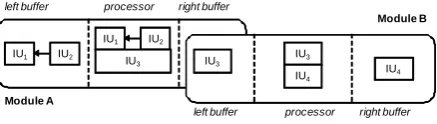
Schlangen & Skantze (2009) describes a general, abstract model of incremental dialogue process-ing, which Jindigo is based on. In this model, a system consists of a network of processing mod-ules. Each module has a left buffer, a processor, and a right buffer, where the normal mode of processing is to receive input from the left buffer, process it, and provide output in the right buffer, from where it is forwarded to the next module’s left buffer. An example is shown in Figure 1. Modules exchange incremental units (IUs), which are the smallest ‘chunks’ of infor-mation that can trigger connected modules into action (such as words, phrases, communicative acts, etc). IUs are typically part of larger units: individual words are parts of an utterance; con-cepts are part of the representation of an utter-ance meaning. This relation of being part of the same larger unit is recorded through same-level
links. In the example below, IU2 has a same-level link to IU1 of type PREDECESSOR, meaning that
they are linearly ordered. The information that was used in creating a given IU is linked to it via
grounded-in links. In the example, IU3 is grounded in IU1 and IU2, while IU4 is grounded
in IU3.
IU1 IU2
IU1 IU2
IU3 IU3
IU3
IU4
IU4
Module A
Module B
left buffer processor right buffer
[image:2.595.308.527.663.725.2]left buffer processor right buffer
A challenge for incremental systems is to han-dle revisions. For example, as the first part of the word “forty” is recognised, the best hypothesis might be “four”. As the speech recogniser re-ceives more input, it might need to revise its pre-vious output, which might cause a chain of revi-sions in all subsequent modules. To cope with this, modules have to be able to react to three basic situations: that IUs are added to a buffer, which triggers processing; that IUs that were er-roneously hypothesized by an earlier module are
revoked, which may trigger a revision of a
mod-ule’s own output; and that modules signal that they commit to an IU, that is, won’t revoke it anymore.
Jindigo implements an efficient model for communicating these updates. In this model, IUs are associated with edges in a graph, as shown in Table 1. The graph may be incrementally amended without actually removing edges or vertices, even if revision occurs. At each time-step, a new update message is sent to the con-suming module. The update message contains a pair of pointers [C, A]: (C) the vertex from which the currently committed hypothesis can be con-structed, and (A) the vertex from which the
cur-rently best tentative hypothesis can be con-structed. In Jindigo, all modules run as threads within a single Java process, and therefore have access to the same memory space.
2.2 A typical architecture
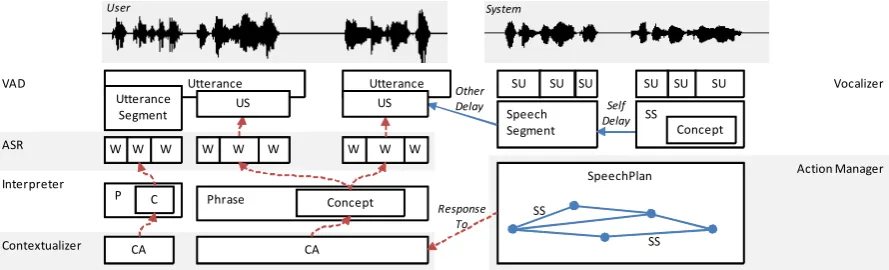
[image:3.595.315.517.70.218.2]A typical Jindigo system architecture is shown in Figure 2. The word buffer from the Recognizer module is parsed by the Interpreter module which tries to find an optimal sequence of top phrases and their semantic representations. These phrases are then interpreted in light of the current dialogue context by the Contextualizer module and are packaged as Communicative Acts (CAs). As can be seen in Figure 2, the Contextualizer also self-monitors Concepts from the system as they are spoken by the Vocalizer, which makes it possible to contextually interpret user responses to system utterances. This also makes it possible for the system to know whether an intended ut-terance actually was produced, or if it was inter-rupted. The current context is sent to the Action Manager, which generates a SpeechPlan that is sent to the Vocalizer. This is described in detail in the next section.
Figure 2: A typical Jindigo system architecture.
String Right buffer Update message
t1: one w1 one w2 [w1, w2]
t2: one five w1 one w2 five w3 [w1, w3]
t3: one w1 one w2 five w3 [w1, w2]
t4: one four five w1 one w2 five w3
five w5 four w4
[w1, w5]
t5: [commit] w1 one w2 five w3
five w5 four w4
[w5,w5]
[image:3.595.70.293.74.206.2]Table 1: The right buffer of an ASR module, and up-date messages at different time-steps.
Figure 3: Incremental Units at different levels of processing. Some grounded-in relations are shown with dotted lines. W=Word, SS=SpeechSegment, SU=SpeechUnit, CA=Communicative Act.
Interpreter VAD
ASR
Action Manager Vocalizer
Contextualizer
SpeechPlan Speech
Segment
SU SU SU SU SU SU
Self Delay Other
Delay
W W W W W W W W W
P
CA
SS Concept
CA
Response To
SS C Phrase Concept
Utterance Utterance Utterance
Segment
US US
User System
SS
User
Vocalizer Speech
Speech
Interpreter Word
Contextualizer ActionManager
Utterance Segment
ASR
SpeechPlan
Context
[image:3.595.75.520.592.727.2]3 Incremental speech generation
3.1 Incremental units of speech
In order for user and system utterances to be in-terpreted and produced incrementally, they need to be decomposed into smaller units of process-ing (IUs). This decomposition is shown in Figure 3. Using a standard voice activity detector (VAD) in the ASR, the user’s speech is chunked into Utterance-units. The Utterance bounda-ries determine when the ASR hypothesis is committed. However, for the system to be able to respond quickly, the end silence threshold of these Utterances are typically too long. Therefore smaller units of the type UtteranceSegment
(US) are detected, using a much shorter silence threshold of about 50ms. Such short silence thresholds allow the system to give very fast re-sponses (such as backchannels). Information about US boundaries is sent directly from the ASR to the Vocalizer. As Figure 3 illustrates, the grounded-in links can be followed to derive the timing of IUs at different levels of processing.
The system output is also modelled using IUs at different processing levels. The widest-spanning IU on the output side is the
SpeechPlan. The rendering of a SpeechPlan
will result in a sequence of SpeechSegment’s, where each SpeechSegment represents a con-tinuous audio rendering of speech, either as a synthesised string or a pre-recorded audio file. For example, the plan may be to say “okay, a red doll, here is a nice doll”, consisting of three seg-ments. Now, there are two requirements that we need to meet. First, the output should be varied: the system should not give exactly the same re-sponse every time to the same request. But, as we will see, the output in an incremental system must also be flexible, as speech plans are incmentally produced and amended. In order to re-lieve the Action Manager of the burden of vary-ing the output and makvary-ing time-critical adjust-ments, we model the SpeechPlan as a directed graph, where each edge is associated with a
SpeechSegment, as shown in Figure 4. Thus, the
Action Manager may asynchronously plan (a set of possible) responses, while the Vocalizer se-lects the rendering path in the graph and takes care of time-critical synchronization. To control the rendering, each SpeechSegment has the properties optional, committing, selfDelay
and otherDelay, as described in the next
sec-tion. It must also be possible for an incremental system to interrupt and make self-repairs in the middle of a SpeechSegment. Therefore, each
SpeechSegment may also be decomposed into an
array of SpeechUnit’s, where each SpeechUnit
contains pointers to the audio rendering in the
SpeechSegment.
3.2 Producing and consuming SpeechPlans
The SpeechPlan does not need to be complete
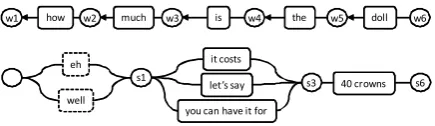
before the system starts to speak. An example of this is shown in Figure 4. As more words are recognised by the ASR, the Action Manager may add more SpeechSegment’s to the graph. Thus, the system may start to say “it costs” before it knows which object is being talked about.
w1 how w2 much w3 is w4 the w5 doll w6
eh
well s1
you can have it for it costs
let’s say s3 40 crowns s6
Figure 4: The right buffer of an ASR (top) and the
SpeechPlanthat is incrementally produced (bottom). Vertex s1 is associated with w1, s3 with w3, etc. Op-tional, non-committing SpeechSegment’s are marked with dashed outline.
The SpeechPlan has a pointer called
finalVertex. When the Vocalizer reaches the
finalVertex, the SpeechPlan is completely
realised. If finalVertex is not set, it means that
the SpeechPlan is not yet completely
con-structed. The SpeechSegment property
optional tells whether the segment needs to be
realised or if it could be skipped if the
finalVertex is in sight. This makes it possible
to insert floor-keeping SpeechSegment’s (such as “eh”) in the graph, which are only realised if needed. The Vocalizer also keeps track of which
SpeechSegment’s it has realised before, so that it
can look ahead in the graph and realise a more varied output. Each SpeechSegment may carry a semantic representation of the segment (a
Concept). This is sent by the Vocalizer to the
Contextualizer as soon as the segment has been realised.
The SpeechSegment properties selfDelay
and otherDelay regulate the timing of the
out-put (as illustrated in Figure 3). They specify the number of milliseconds that should pass before the Vocalizer starts to play the segment, depend-ing on the previous speaker. By settdepend-ing the
otherDelay of a segment, the Action Manager
[image:4.595.307.525.247.310.2]on how such dynamic delays can be derived us-ing machine learnus-ing.)
If the user starts to speak (i.e., a new
UtteranceSegment is initiated) as the system is
speaking, the Vocalizer pauses (at a SpeechUnit
boundary) and waits until it has received a new response from the Action Manager. The Action Manager may then choose to generate a new re-sponse or simply ignore the last input, in which case the Vocalizer continues from the point of interruption. This may happen if, for example,
the UtteranceSegment was identified as a
back-channel, cough, or similar.
3.3 Self-repairs
As Figure 3 shows, a SpeechPlan may be grounded in a user CA (i.e., it is a response to this CA). If this CA is revoked, or if the
SpeechPlan is revised, the Vocalizer may
initial-ize a self-repair. The Vocalinitial-izer keeps a list of the
SpeechSegment’s it has realised so far. If the
SpeechPlan is revised when it has been partly
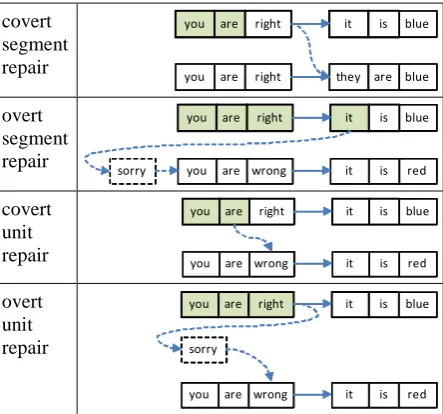
realised, the Vocalizer compares the history with the new graph and chooses one of the different repair strategies shown in Table 2. In the best case, it may smoothly switch to the new plan without the user noticing it (covert repair). In case of a unit repair, the Vocalizer searches for a zero-crossing point in the audio segment, close to the boundary pointed out by the SpeechUnit.
covert segment repair
you are right it is blue
you are right they are blue
overt segment repair
you are right it is blue
you are wrong it is red
sorry
covert unit repair
you are right it is blue
you are wrong it is red
overt unit repair
you are right it is blue
you are wrong it is red sorry
Table 2: Different types of self-repairs. The shaded boxes show which SpeechUnit’s have been realised, or are about to be realised, at the point of revision.
The SpeechSegment property committing
tells whether it needs to be repaired if the
SpeechPlan is revised. For example, a filled
pause such as “eh” is not committing (there is no
need to insert an editing term after it), while a request or an assertion usually is. If (parts of) a committing segment has already been realised and it cannot be part of the new plan, an overt repaired is made with the help of an editing term (e.g., “sorry”). When comparing the history with the new graph, the Vocalizer searches the graph and tries to find a path so that it may avoid mak-ing an overt repair. For example if the graph in Figure 4 is replaced with a corresponding one that ends with “60 crowns”, and it has so far partly realised “it costs”, it may choose the cor-responding path in the new SpeechPlan, making a covert repair.
4 A Wizard-of-Oz experiment
A Wizard-of-Oz experiment was conducted to test the usefulness of the model outlined above. All modules in the system were fully functional, except for the ASR, since not enough data had been collected to build language models. Thus, instead of using ASR, the users’ speech was transcribed by a Wizard. As discussed in section 1.1, a common problem is the time it takes for the Wizard to transcribe incoming utterances, and thus for the system to respond. Therefore, this is an interesting test-case for our model. In order to let the system respond as soon as the user finished speaking, even if the Wizard hasn’t completed the transcription yet, a VAD is used. The setting is shown in Figure 5 (compare with Figure 2). The Wizard may start to type as soon as the user starts to speak and may alter whatever he has typed until the return key is pressed and the hypothesis is committed. The word buffer is updated in exactly the same manner as if it had been the output of an ASR.
User VAD
Vocalizer Speech
Speech
Interpreter Word
Contextualizer ActionManager
Utterance Segment
Wizard
Figure 5: The system architecture used in the Wizard-of-Oz experiment.
[image:5.595.70.292.464.671.2] [image:5.595.316.518.552.696.2]com-mitted by pressing the return key. Since we did not have mature models for the Interpreter either, the Wizard was allowed to adapt the transcrip-tion of the utterances to match the models, while preserving the semantic content.
4.1 The DEAL domain
The system that was used in the experiment was a spoken dialogue system for second language learners of Swedish under development at KTH, called DEAL (Hjalmarsson et al., 2007). The scene of DEAL is set at a flea market where a talking agent is the owner of a shop selling used goods. The student is given a mission to buy items at the flea market getting the best possible price from the shop-keeper. The shop-keeper can talk about the properties of goods for sale and negotiate about the price. The price can be re-duced if the user points out a flaw of an object, argues that something is too expensive, or offers lower bids. However, if the user is too persistent haggling, the agent gets frustrated and closes the shop. Then the user has failed to complete the task.
For the experiment, DEAL was
[image:6.595.71.290.425.584.2]re-implemented using the Jindigo framework. Fig-ure 6 shows the GUI that was shown to the user.
Figure 6: The user interface in DEAL. The object on the table is the one currently in focus. Example ob-jects are shown on the shelf. Current game score, money and bought objects are shown on the right.
4.2 Speech segments in DEAL
In a previous data collection of human-human interaction in the DEAL domain (Hjalmarsson, 2008) it was noted that about 40% of the speaker turns were initiated with standardized lexical ex-pressions (cue phrases) or filled pauses. Such speech segments commit very little semantically to the rest of the utterance and are therefore very useful as initiations of utterances, since such
speech segments can be produced immediately after the user has stopped speaking, allowing the Wizard to exploit the additional time to tran-scribe the rest of the utterance.
The DEAL corpus was used to create utter-ance initial speech segments for the experiment. The motivation to use speech segments derived from human recordings was to make the system sound convincing in terms of both lexical choice and intonation. In particular, we wanted a reper-toire of different types of filled pauses and feed-back expression such as “eh” and “mm” in order to avoid a system that sounds monotone and re-petitive. First, a number of feedback expression such as “ja”, “a”, “mm” (Eng: “yes”), filled pauses such as “eh”, “ehm” and expressions used to initiate different domain specific speech acts (for example “it costs” and “let me see”) were extracted. The segments were re-synthesized using Expros, a tool for experimentation with prosody in diphone voices (Gustafson & Edlund, 2008). Based on manual transcriptions and sound files, Expros automatically extracts pitch, dura-tion and intensity from the human voice and cre-ates a synthetic version using these parameters. In the speech plan, these canned segments were mixed with generated text segments (for example references to objects, prices, etc) that were syn-thesized and generated on-line with the same diphone voice.
An example interaction with the incremental version of the system is shown in Table 3. S.11 exemplifies a self-correction, where the system prepares to present another bid, but then realizes that the user’s bid is too low to even consider. A video (with subtitles) showing an interaction with one of the users can be seen at http://www.youtube.com/watch?v=cQQmgItIMvs.
S.1 [welcome] [how may I help you] U.2 I want to buy a doll
S.3 [eh] [here is] [a doll] U.4 how much is it?
S.5 [eh] [it costs] [120 crowns] U.6 that is too expensive
how much is the teddy bear?
S.7 [well] [you can have it for] [let’s see] [40 crowns]
U.8 I can give you 30 crowns
S.9 [you could have it for] [37 crowns] U.10 I can give you 10 crowns
S.11 [let’s say] [or, I mean] [that is way too little]
4.3 Experimental setup
In order to compare the incremental and non-incremental versions of the system, we con-ducted an experiment with 10 participants, 4 male and 6 female. The participants were given a mission: to buy three items (with certain charac-teristics) in DEAL at the best possible price from the shop-keeper. The participants were further instructed to evaluate two different versions of the system, System A and System B. However, they were not informed how the versions dif-fered. The participants were lead to believe that they were interacting with a fully working dia-logue system and were not aware of the Wizard-of-Oz set up. Each participant interacted with the system four times, first two times with each ver-sion of the system, after which a questionnaire was completed. Then they interacted with the two versions again, after which they filled out a second questionnaire with the same questions. The order of the versions was balanced between subjects.
The mid-experiment questionnaire was used to collect the participants’ first opinions of the two versions and to make them aware of what type of characteristics they should consider when inter-acting with the system the second time. When filling out the second questionnaire, the partici-pants were asked to base their ratings on their overall experience with the two system versions. Thus, the analysis of the results is based on the second questionnaire. In the questionnaires, they were requested to rate which one of the two ver-sions was most prominent according to 8 differ-ent dimensions: which version they preferred; which was more human-like, polite, efficient, and
intelligent; which gave a faster response and
bet-ter feedback; and with which version it was eas-ier to know when to speak. All ratings were done on a continuous horizontal line with System A on the left end and System B on the right end. The centre of the line was labelled with “no differ-ence”.
The participants were recorded during their in-teraction with the system, and all messages in the system were logged.
4.4 Results
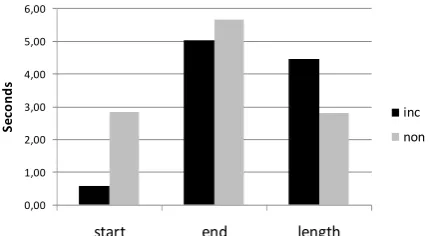
Figure 7 shows the difference in response time between the two versions. As expected, the in-cremental version started to speak more quickly (M=0.58s, SD=1.20) than the non-incremental version (M=2.84s, SD=1.17), while producing longer utterances. It was harder to anticipate
whether it would take more or less time for the incremental version to finish utterances. Both versions received the final input at the same time. On the one hand, the incremental version initiates utterances with speech segments that contain little or no semantic information. Thus, if the system is in the middle of such a segment when receiving the complete input from the Wizard, the system may need to complete this segment before producing the rest of the utter-ance. Moreover, if an utterance is initiated and the Wizard alters the input, the incremental ver-sion needs to make a repair which takes addi-tional time. On the other hand, it may also start to produce speech segments that are semantically relevant, based on the incremental input, which allows it to finish the utterance more quickly. As the figure shows, it turns out that the average response completion time for the incremental version (M=5.02s, SD=1.54) is about 600ms faster than the average for non-incremental
ver-sion (M=5.66s, SD=1.50), (t(704)=5.56,
p<0.001).
0,00 1,00 2,00 3,00 4,00 5,00 6,00
start end length
S
e
c
o
n
d
s
inc
[image:7.595.308.523.377.495.2]non
Figure 7: The first two column pairs show the average time from the end of the user’s utterance to the start of the system’s response, and from the end of the user’s utterance to the end of the system’s response. The third column pair shows the average total system utterance length (end minus start).
Hence, the incremental version was rated as more polite, more efficient, and better at indicat-ing when to speak.
diff z-value p-value
preferred 0.23 -1.24 0.214
human-like 0.15 -0.76 0.445
polite 0.40 -2.19 0.028*
efficient 0.29 -2.08 0.038*
intelligent 0.11 -0.70 0.484
faster response 0.26 -1.66 0.097
feedback 0.08 -0.84 0.400
when to speak 0.35 -2.38 0.017*
Table 4: The results from the second questionnaire. All differences are positive, meaning that they are in favour of the incremental version.
A well known phenomena in dialogue is that of entrainment (or adaptation or alignment), that is, speakers (in both human and human-computer dialogue) tend to adapt the conversa-tional behaviour to their interlocutor (e.g., Bell, 2003). In order to examine whether the different versions affected the user’s behaviour, we ana-lyzed both the user utterance length and user re-sponse time, but found no significant differences between the interactions with the two versions.
5 Conclusions & Future work
This paper has presented a first step towards in-cremental speech generation in dialogue systems. The results are promising: when there are delays in the processing of the dialogue, it is possible to incrementally produce utterances that make the interaction more efficient and pleasant for the user.
As this is a first step, there are several ways to improve the model. First, the edges in the
SpeechPlan could have probabilities, to guide
the path planning. Second, when the user has finished speaking, it should (in some cases) be possible to anticipate how long it will take until the processing is completed and thereby choose a more optimal path (by taking the length of the
SpeechSegment’s into consideration). Third, a
lot of work could be done on the dynamic gen-eration of SpeechSegment’s, considering syntac-tic and pragmasyntac-tic constraints, although this would require a speech synthesizer that was bet-ter at convincingly produce conversational speech.
The experiment also shows that it is possible to achieve fast turn-taking and convincing re-sponses in a Wizard-of-Oz setting. We think that this opens up new possibilities for the
Wizard-of-Oz paradigm, and thereby for practical develop-ment of dialogue systems in general.
6 Acknowledgements
This research was funded by the Swedish research council project GENDIAL (VR #2007-6431).
References
Bell, L. (2003). Linguistic adaptations in spoken hu-man-computer dialogues. Empirical studies of user behavior. Doctoral dissertation, Department of Speech, Music and Hearing, KTH, Stockholm. Dohsaka, K., & Shimazu, A. (1997). System
architec-ture for spoken utterance production in collaborative dialogue. In Working Notes of IJCAI 1997 Work-shop on Collaboration, Cooperation and Conflict in Dialogue Systems.
Fraser, N. M., & Gilbert, G. N. (1991). Simulating speech systems. Computer Speech and Language, 5(1), 81-99.
Gustafson, J., & Edlund, J. (2008). expros: a toolkit for exploratory experimentation with prosody in customized diphone voices. In Proceedings of Per-ception and Interactive Technologies for Speech-Based Systems (PIT 2008) (pp. 293-296). Ber-lin/Heidelberg: Springer.
Hjalmarsson, A., Wik, P., & Brusk, J. (2007). Dealing with DEAL: a dialogue system for conversation training. In Proceedings of SigDial (pp. 132-135). Antwerp, Belgium.
Hjalmarsson, A. (2008). Speaking without knowing what to say... or when to end. In Proceedings of SIGDial 2008. Columbus, Ohio, USA.
Kempen, G., & Hoenkamp, E. (1987). An incremental procedural grammar for sentence formulation. Cog-nitive Science, 11(2), 201-258.
Kilger, A., & Finkler, W. (1995). Incremental Gen-eration for Real-Time Applications. Technical Re-port RR-95-11, German Research Center for Artifi-cial Intelligence.
Levelt, W. J. M. (1989). Speaking: From Intention to Articulation. Cambridge, Mass., USA: MIT Press. Raux, A., & Eskenazi, M. (2008). Optimizing
end-pointing thresholds using dialogue features in a spoken dialogue system. In Proceedings of SIGdial 2008. Columbus, OH, USA.
Schlangen, D., & Skantze, G. (2009). A general, ab-stract model of incremental dialogue processing. In Proceedings of EACL-09. Athens, Greece.