Exploring a Probabilistic Earley Parser for
Event Composition in Biomedical Texts
Mai-Vu Tran
1Hoang-Quynh Le
1Van-Thuy Phi
1Thanh-Binh Pham
1Nigel Collier
2,3 1University of Engineering and Technology, VNU, Hanoi, Vietnam
2
National Institute of Informatics, Tokyo, Japan
3
European Bioinformatics Institute, Cambridge, UK
{vutm,lhquynh,thuypv,binhpt}@vnu.edu.vn, [email protected]
Abstract
We describe a high precision system for ex-tracting events of biomedical significance that was developed during the BioNLP shared task 2013 and tested on the Cancer Genetics data set. The system achieved an F-score on the de-velopment data of 73.67 but was ranked 5th out of six with an F-score of 29.94 on the test data. However, precision was the second highest ranked on the task at 62.73. Analysis suggests the need to continue to improve our system for complex events particularly taking into ac-count cross-domain differences in argument distributions.
1
Introduction
In this paper we present our approach to the Bi-oNLP 2013 shared task on Cancer Genetics (CG) (Pyysalo et al., 2013, Pyysalo et al., 2012), aimed at identifying biomedical relations of sig-nificance in the development and progress of cancer. Our system explored a multi-stage ap-proach including trigger detection, edge detec-tion and event composidetec-tion. After trigger edge detection is finished we are left with a semantic graph from which we must select the optimal subset that is consistent with the semantic frames for each event type. Previous approaches have derived sub-graph matching rules using heuris-tics (Jari Björne et al. 2009) or machine learning using graph kernels (
Liu
et al., 2013). Based on McClosky et al. (2011)’s observation that event structures have a strong similarity to dependency graphs, we proposed a novel method for the composition of ambiguous events used a proba-bilistic variation of the Earley chart parsing algo-rithm (Stolcke 1995) for finding best derived trigger-argument candidates. Our method uses the event templates and named entity classes as grammar rules. As an additional novel step our chart parsing approach incorporates a linear in-terpolation mechanism for cross-domainadaptiv-ity between the training and testing (develop-ment) data.
2
Approach
The system consists of five main modules: pre-processing, trigger detection, edge detection, simple event extraction, complex event extrac-tion. Each of these is described below with an emphasis on event composition where we ap-plied a probabilistic variation on the Earley par-ser.
2.1 Experimental Setting
As our team’s first attempt at the BioNLP shared task we decided to focus our attention on the Cancer Genetic Task. The CG Task aims to ex-tract events related to the development and pro-gression of cancer.
A characteristic feature of the CG Task is that there are a large number of entity and event types: 18 entity classes, 40 types of event and 8 types of arguments. Among these events, there are 7 that may have no arguments: Blood vessel development, Cell death, Carcinogenesis, Metas-tasis, Infection, Amino acid catabolism and Gly-colysis. On the other hand, some events may have more than one argument: Binding and Gene Expression may have more than one Theme ar-gument, and Planned process may have more than one Instrument argument.
We divided events into two groups based on definitions of Miwa et al.(2010) : simple and complex events. Simple events include 36 events whose arguments must be entities. Complex events include 4 event types whose arguments may be other events.
2.2 Pre-processing
Pre-processing conventionally made use of the GeniaTagger (Tsuruoka and Tsujii, 2005) for sentence splitting and tokenizing, and the HPSG
parser Enju1 (Miyao and Tsujii, 2008). Both of these were provided in the supporting resources by the task organisers. Gold standard named enti-ty annotations were also provided.
2.3 Trigger Detection
In the CG Task dataset, 95% of the triggers that indicate events are single token. We there-fore treated trigger detection as a token labeling problem in a similar way to Björne et al. (2009). Here the system has to classify whether a token acts as a trigger for one of the forty event types or not. We used the Liblinear-java library2 (Fan
et al., 2008) with the L2-regularized logistic re-gression method for both trigger detection and edge detection. We performed a manual grid search to select a C-value parameter of 0.5. This parameter value is same from that of the Turku system (Björne et al. (2009), in which the C-values were tuned for all of their detectors.
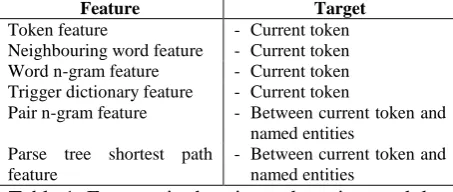
The major features used are primarily based on Miwa, et al. (2012) and shown in Table 1. In our experiments this led to a relatively large number of features: about 500k features for the trigger detection model, 900k features in the T-E model and 600k features in the EV-EV model. Our choice of the Liblinear library was partly motivated by its efficient performance with large feature sets.
Feature Target
Token feature - Current token Neighbouring word feature - Current token Word n-gram feature - Current token Trigger dictionary feature - Current token
Pair n-gram feature - Between current token and named entities
Parse tree shortest path feature
[image:2.595.303.532.261.394.2]- Between current token and named entities
Table 1: Features in the trigger detection module.
2.4 Event edge detection
For edge detection, we used Liblinear to con-struct two models: one model is designed primar-ily to extract trigger-entity edges (T-E model), while the other system is designed primarily to extract event-event edges (EV-EV model).
The T-E model classifies edge candidates to one of the 8 argument roles (theme, cause, site, atloc, toloc, fromloc, instrument, participant) and a negative argument class. Relation pairs are identified through the simple event extraction module (cf Section 2.5).
1
http://www-tsujii.is.s.u-tokyo.ac.jp/enju/
2
http://www.bwaldvogel.de/liblinear-java/
The EV-EV model identifies relations in the sentences between 4 types of complex events (Regulation, Negative regulation, Positive Regu-lation and Planned process) and other events (including events belonging to the 4 complex events). The relations are classified into three classes: the two argument roles (theme or cause)
or NOT.
The features used in these two models are mostly the same as those used in the earlier trig-ger detection module. Table 2 shows features and their applied target objects used in T-E model, Table 3 shows features and target objects for each feature of EV-EV model.
Feature Target
Token feature - Current trigger - Trigger argument entity Class feature - Current trigger
- Trigger argument entity Neighbouring word
feature
- Current trigger - Trigger argument entity Word n-gram feature - Current trigger
- Trigger argument entity
Pair n-gram feature - Between current trigger and argument entity
Parse tree shortest path feature
- Between current trigger and rigger argument entity
Table 2: Features in the T-E model.
Feature Target
Token feature Current trigger, target trigger, cur-rent arguments, target arguments Class feature Current trigger, target trigger,
cur-rent arguments, target arguments Neighbouring word
feature
Current trigger, target trigger, cur-rent arguments, target arguments Word n-gram feature Current trigger, target trigger,
cur-rent arguments, target arguments Pair n-gram feature Between current trigger and target
trigger, between current trigger and target arguments, between current arguments and target trigger, be-tween current arguments and target arguments
Parse tree shortest path feature
Between current trigger and target trigger, between current trigger and target arguments, between current arguments and target trigger, be-tween current arguments and target arguments
Table 3: Features in the EV-EV model.
2.5 Simple event extraction
[image:2.595.67.294.453.549.2]Figure 1: An example of representing two complex events as two event trees.
we combined edge candidates identified in the T-E model into complete simple events. After this step, we had the results which belong to the 36 simple event types and relations between 4 com-plex events and entities.
In order to select the edge candidates for each trigger, we used event-argument pattern based probabilities derived from the training set. An example of a Development event-arguments pat-tern is:
Development Theme(Gene_expression) + At-Loc(Cancer)
In practice there are several problems that arose when opting for this simple strategy:
- Firstly, there may be multiple candidates with the same argument role label linking to a trigger (such triggers do not belong to Binding,
Gene Expression and Planned process). We used the output probability from the logistic regres-sion event edge classifiers to select the best can-didate in these cases.
- Secondly, there are triggers whose candidate edge types link to entities that do not match pat-terns observed in the training set or do not have any relation. We introduced a rule-based seman-tic post-processing step: triggers are checked to see if they belong to the 7 event types which have no argument; if they do not, we rejected these from the results.
- Thirdly, there may be an imbalance between the argument distribution in the training and test-ing data (development data). In the development data, we observed some event-argument patterns which do not occur in training set, this problem may lead to false negatives. For example:
Cell_transformation Theme(Cell) +
At-Loc(Cell) or Mutation
Site(DNA_domain_or_region). This was one
cause of false negatives in our system’s perfor-mance (cf Section 3).
2.6 Complex event extraction with
proba-bilistic Earley Parser
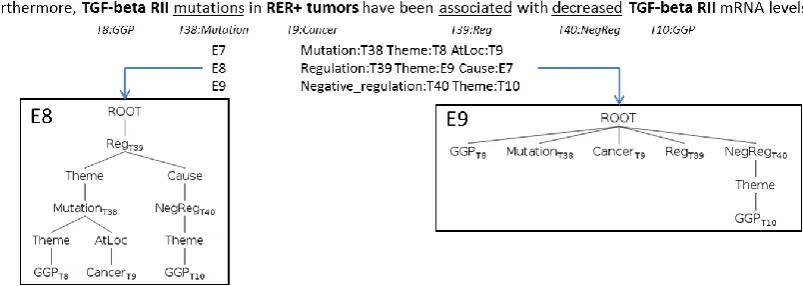
For complex event extraction, based on the idea of McClosky et al. (2011) that treats event extraction as dependency parsing, we represent complex events in the form of event trees which are similar to dependency trees. Our idea differs from McClosky et al. in that they represented all events in a sentences within a single tree, where-as we build a tree for each complex event. This solution helps avoid the problem of directed cy-cles if there are two complex event that relate to the same entity or event.
Figure 1 shows an example of representing two complex events as two event trees. To build the event tree, we create a virtual ROOT node; the complex event target will be linked directly to this ROOT node, and triggers and entities that do not belong to sub-structure of the target event will also have links to ROOT node, too. In the event tree, labels of entity classes and event types are retained while terms of triggers and entities are removed.
For event tree parsing, we used the Earley parsing algorithm proposed by Jay Earley (1970) to find alternative structures. The event tree is stored in memory in the form of Earley rules. The inputs to the parser are the entities and trig-gers which have been identified in the trigger detection module, and the outputs are the event tree candidates.
search and reflects the confidence we have in the generalisability of the edge detection module on the testing (development) data.
The scoring function for each node is:
Occurrence (edge | argrument)
(node) (arguments | node)
(edges) edges node
P
Score P
num
where,
num(edge) is the number of edges that have a link to the node
POccurence(arguments|node) is a
distribu-tion which represents the co-occurrence of entity/trigger labels in the arguments of an event type.
P(edge | argrument) PClassifier(edge | argument)
(1 )*PPrior(edge | argument)
λ is a linear interpolation parameter in the range of [0,1]
PClassifier(edge|argument) is the
probabil-ity obtained from the edge classifier.
PPrior(edge|argument) is the training set’s
prior probability for the edge.
Edges that linked directly to ROOT and did not relate to the target complex event had a de-fault value of zero. The final score of an event tree candidate was calculated as ROOT’s value.
We used a filter_threshold parameter to re-move event tree candidates which had an edge with P(edge|argument) less than filter_threshold. On the other hand, we used a cut-off_threshold
parameter to choose event tree candidates which have highest value. Event tree candidates which are sub-structure of other event tree candidates were removed from the final results.
3
Results and Discussion
We evaluated each component of the system on the training and held out data sets. The opti-mal configuration of parameters was then used on the shared task test data. We set these as fol-lows:α=0.5;filter_threshold=0.2;cutoff_threshol
d=0.45.
Table 4 shows F-score performance for event composition on the development data set. We found that complex events such as regulation and planned process performed at the lower end of accuracy due to their high complexity. This re-sulted in relatively low recall compared to preci-sion (figures not shown). The three Regulation
events in particular are very productive in terms of the variety of named entities and triggers they
take as arguments and their distribution in the development data was quite different to the train-ing data.
Event F1 Event F1
Development 86.67 Phosphorylation 68.45
Blood vessel development
84.15 Dephosphorylation 66.67
Growth 76.77 DNA methylation 85.71
Death 61.95 DNA demethyla-tion
-
Cell death 53.06 Pathway 61.81
Breakdown 77.68 Localization 66.11
Cell proliferation 59.82 Binding 70.68
Cell division 100.00 Dissociation 100.00
Remodeling 60.00 Regulation 69.55
Reproduction - Positive regulation 68.13
Mutation 78.74 Negative regula-tion
68.57
Carcinogenesis 60.67 Planned process 49.99
Metastasis 74.39 Acetylation 100.00
Metabolism 62.50 Glycolysis 69.89
Synthesis 52.63 Glycosylation -
Catabolism 59.27 Cell transformation 66.67
Gene expression 79.18 Cell differentiation 71.18
Transcription 75.00 Ubiquitination 75.00
Translation 80.00 Amino acid ca-tabolism
100.00
Protein pro-cessing
100.00 Infection 75.86
[image:4.595.299.527.108.513.2]Total 73.67
Table 4: Baseline results for event composi-tion on the development data.
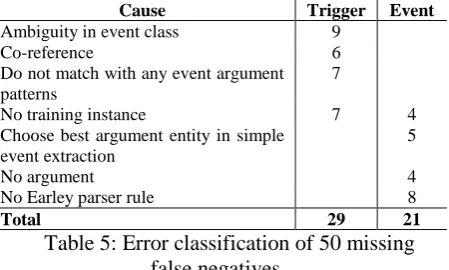
From our analysis on the development set we found that trigger detection was performing well overall with F-scores in the range 78 to 80. We choose 50 false negative events at random for error analysis. There are 29 triggers and 21 events missing. Table 5 shows a stratified analy-sis by major error type (we note that errors may of course have multiple causes).
Cause Trigger Event
Ambiguity in event class 9
Co-reference 6
Do not match with any event argument patterns
7
No training instance 7 4
Choose best argument entity in simple event extraction
5
No argument 4
No Earley parser rule 8
Total 29 21
[image:4.595.306.531.626.761.2]Performance on the shared task testing set was overall disappointing with an F-score of 29.94 (Recall = 19.66, Precision = 62.73, F-score of simple event extraction = 47.96 and F-score of complex event extraction = 12.49) indicating low coverage caused by severe over-fitting issues. Analysis revealed that one cause of this was the imbalance in the distribution of arguments be-tween training and testing sets.
4
Conclusion
We presented a system built on supervised machine learning with rich features, semantic post-processing rules and the dynamic program-ming Earley parser. The system achieved an F-score of 29.94 on the CG task with high preci-sion of 62.73. Future work will focus on extend-ing recall for complex events and lookextend-ing at how we can avoid over-fitting to benefit cross-domain adaptivity.
Acknowledgements
We thank the shared task organisers for sup-porting this community evaluation and to the supporting resource providers. Nigel Collier also gratefully acknowledges funding support from the European Commission through the Marie Curie International Incoming Fellowship (IIF) programme (Project: Phenominer, Ref: 301806).
References
David McClosky, Mihai Surdeanu, and Chris Man-ning. 2011. Event extraction as dependency pars-ing. In Proceedings of the BioNLP Shared Task 2011 Workshop at the Association for Computa-tional Linguistics Conference, pp. 41-45.
Jari Björne, Juho Heimonen, Filip Ginter, Antti Airo-la, Tapio PahikkaAiro-la, and Tapio Salakoski. 2009.
Extracting complex biological events with rich graph-based feature sets. In Proceedings of the Bi-oNLP 2009 Shared Task Workshop at the Associa-tion for ComputaAssocia-tional Linguistics Conference, pp. 10–18.
Jari Björne, Filip Ginter, Tapio Salakoski: University of Turku in the BioNLP'11 Shared Task. BMC Bi-oinformatics 13(S-11): S4 (2012)
Fan R-E, Chang K-W, Hsieh J, Wang X-R, Lin C-J. 2008. LIBLINEAR: A library for large linear classification. J Machine Learn Res 9:1871–1874.
Miwa, M., Thompson, P., McNaught, J., Kell, D., Ananiadou, S. 2012. Extracting semantically en-riched events from biomedical literature. BMC Bi-oinformatics 13, 108.
Makoto Miwa, Rune Sætre, Jin-Dong Kim, and Jun’ichi Tsujii. 2010. Event extraction with com-plex event classification using rich features. Jour-nal of Bioinformatics and ComputatioJour-nal Biology (JBCB), 8(1):131–146.
Earley, Jay (1970). An efficient context-free parsing algorithm. Communications of the ACM 13 (2): 94–102
Andreas Stolcke (1995). An efficient probabilistic context-free parsing algorithm that computes pre-fix probabilities. Journal Computational Linguis-tics (1995) Volume 21 Issue 2: 165-201
Sampo Pyysalo, Tomoko Ohta and Sophia Anani-adou. (2013). Overview of the Cancer Genetics (CG) task of BioNLP Shared Task 2013. Proceed-ings of BioNLP Shared Task 2013 Workshop at the Association for Computational Linguistics Confer-ence, (in press).
Sampo Pyysalo, Tomoko Ohta, Makoto Miwa, Han-Cheol Cho, Jun'ichi Tsujii and Sophia Ananiadou. (2012). Event extraction across multiple levels of biological organization. Bioinformatics, 28(18):i575-i581.