Relation Annotation for Understanding Research Papers
Yuka Tateisi† Yo Shidahara‡ Yusuke Miyao† Akiko Aizawa† †National Institute of Informatics, Tokyo, Japan
{yucca,yusuke,aizawa}@nii.ac.jp
‡Freelance Annotator [email protected]
Abstract
We describe a new annotation scheme for formalizing relation structures in research papers. The scheme has been developed through the investigation of computer sci-ence papers. Using the scheme, we are building a Japanese corpus to help develop information extraction systems for digital libraries. We report on the outline of the annotation scheme and on annotation ex-periments conducted on research abstracts from the IPSJ Journal.
1 Introduction
Present day researchers need services for search-ing research papers. Search engines and pub-lishing companies provide specialized search ser-vices, such as Google Scholar, Microsoft Aca-demic Search, and Science Direct. AcaAca-demic so-cieties provide archives of journal articles and/or conference proceedings such as the ACL Anthol-ogy. These services focus on simple keyword-based searches as well as extralinguistic relations among research papers, authors, and research top-ics. However, because contemporary research is becoming increasingly complicated and interre-lated, intelligent content-based search systems are desired (Banchs, 2012). A typical query in compu-tational linguistics could bewhat tasks have CRFs been used for?, which includes the elements of a typical schema for searching research papers; researchers want to find relationships between a technique and its applications (Gupta and Man-ning, 2011). Answers to this query can be found in various forms in published papers, for example, (1) CRF-based POS tagging has achieved state-of-the-art accuracy.
(2) CRFs have been successfully applied to se-quence labeling problems including POS tagging and named entity recognition.
(3) We apply feature reduction to CRFs and show its effectiveness in POS tagging.
(4) This study proposes a new method for the ef-ficient training of CRFs. The proposed method is evaluated for POS tagging tasks.
Note that the same semantic relation, i.e., the use of CRFs for POS tagging, is expressed by var-ious syntactic constructs: internal structures of the phrase in (1), clause-level structures in (2), inter-clause structures in (3), and discourse-level struc-tures in (4). This implies that an integrated frame-work is required to represent semantic relations for phrase-level, clause-level, inter-clause level, and discourse-level structures. Another interesting fact is that we can recognize various fragments of in-formation from single texts. For example, from sentence (1), we can identify CRF is applied to POS tagging,state-of-the-art accuracy is achieved for POS tagging, andCRFs achieve high POS tag-ging accuracy, all of which is valuable content for different search requests. This indicates that we need a framework that can cover (almost) all con-tent in a text.
In this paper we describe a new annotation scheme for formalizing typical schemas for repre-senting relations among concepts in research pa-pers, such as techniques, resources, and effects. Our study aims to establish a framework for rep-resenting the semantics of research papers to help construct intelligent search systems. In particular, we focus on the formalization of typical schemas that we believe exemplify common query charac-teristics.
From the above observations, we have de-veloped the following criteria for our proposed framework: use the same scheme for annotating contents in all levels of linguistic structures, an-notate (almost) all contents presented in texts, and capture relations necessary for surveying research papers. We investigated 71 computer science ab-stracts (498 sentences) and defined an annotation
scheme comprising 16 types of semantic relations. Computer science is particularly suitable for our purpose because it is primarily concerned with ab-stract concepts rather than concrete entities, which are typically the primary focus of empirical sci-ences such as physics and biology. In addition, computer and computational methods can be ap-plied to an extraordinarily wide range of top-ics; computer science papers might discuss a bus timetable (for automatic optimization), a person’s palm (as a device for projecting images), or look-ing over another person!Gs shoulder (to obtain
pass-words). Therefore, to annotate all computer sci-ence papers, we cannot develop predefined entity ontologies, which is the typical approach taken in biomedical text mining (Kim et al., 2011).
However, most computer science papers have characteristic schemata: the papers describe a problem, postulate a method, apply the method to the problem using particular data or devices, and perform experiments to evaluate the method. The typical schemata clearly represent the structure of interests in this research field. Therefore, we can focus on typical schemata, such asapplication of a method to a problemandevaluation of a method for a task. As we will demonstrate in this paper, the proposed annotation scheme can cover almost all content, from phrase levels to discourse levels, in computer science papers.
Note that this does not necessarily mean that our framework can only be applied to computer sci-ence literature. The characteristics of the schemata described above are universal in contemporary sci-ence and engineering, and many other activities in human society. Thus, the framework presented in this study can be viewed as a starting point for re-search focusing on representative schemata of hu-man activities.
2 Related Work
Traditionally, research on searching research pa-pers has focused more on the social aspects of papers and their authors, such as citation links and co-authorship analysis implemented in the aforementioned services. Recently, research on content-based analysis of research papers has been emerging.
For example, methods of document zoning have been proposed for research papers in biomedicine (Mizuta et al., 2006; Agarwal and Yu, 2009; Li-akata et al., 2010; Guo et al., 2011; Varga et
al., 2012), and chemistry and computational lin-guistics (Teufel et al., 2009). Zoning provides a sentence-based information structure of papers to help identify the components such as the pro-posed method and the results obtained in the study. As such, zoning can narrow down the sections of a paper in which the answer to a query can be found. However, zoning alone cannot always cap-ture the relation between the concepts described in the sections as it focuses on relation at a sentence level. For example, the examples (1), (2), (3) in the previous section require intra-sentence analysis to capture the relation between CRF and POS tag-ging. Our annotation scheme, which can be seen as conplementary to zoning, attempts to provide a structure for capturing the relationship between concepts at a finer-grained level than a sentence.
Establishing semantic relations among scien-tific papers has also been studied. For example, the ACL Anthology Searchbench (Sch¨afer et al., 2011) provides querying by predicate-argument relations. The system accepts specifications of subject, predicate, and object, and searches for texts that semantically match the query using the results from an HPSG parser. It can also search by topics automatically extracted from the papers. Gupta and Manning (2011) proposed a method for extractingFocus,Domain, andTechniquefrom pa-pers in the ACL anthology: Focus is a research article’s main contribution,Domainis an applica-tion domain, and Techniqueis a method or a tool used to achieve theFocus. The change in these as-pects over time is traced to measure the influence of research communities on each other. Fukuda et al. (2012) developed a method of technical trend analysis that can be applied to both patent appli-cations and academic papers, using the distribu-tion of named entities. However, as processes and functions are key concepts in computer science, elements are often described in a unit with its own internal structures which include data, systems, and other entities as substructures. Thus, tech-nical concepts such as technique cannot be cap-tured fully by extracting named entities. Gupta and Manning (2011) analyzed the internal struc-tures of concepts syntactically using a dependency parser, but did not further investigate the structure semantically.
infor-mation that we also want to capture, such as how the author evaluates current systems and methods or the previous efforts of others. An attempt to identify the evaluation and other meta-aspects of scientific papers was made by Thompson et al. (2011), which, on top of the biomedical events annotated in the GENIA event corpus (Kim et al., 2008), annotated meta-knowledge such as the certainty level of the author, polarity (positive– negative), and manner (strong–weak) of events, as well as source (whether the event is attributed to the current study or previous studies), along with the clue mentioned in the text. For in-domain relations within and between the events, they re-lied on the underlying GENIA annotation, which maps events and their participants to a subset of Gene Ontology (The Gene Ontology Consortium, 2000), a standard ontology in genome science.
We cannot assume the existence of standard do-main ontology in the variety of dodo-mains to which computer systems are applied, as was mentioned in Section 1. On the other hand, using domain-general linguistic frameworks, such as FrameNet (Ruppenhofer et al., 2006) or the Lexical Concep-tual Structure (Jackendoff, 1990) is also not sisfactory for our purpose. These frameworks at-tempt to identify the relations lexicalized by verbs and their case arguments; however, they do not consider discourse or other levels of linguistic rep-resentation. In addition, relying on a linguistic the-ory requires that annotators understand linguistics. Most computer scientists, the best candidates for performing the annotation task, would not have the necessary knowledge of linguistics and would re-quire training, which would increase costs for cor-pus annotation.
3 Annotation Scheme
The principle is to employ a uniform structure to represent semantic relations in scientific papers in phrase-level, clause-level, inter-clause level, and discourse-level structures. For this purpose, a bottom-up strategy that identifies relations be-tween the entities mentioned is used. This strat-egy is similar to dependency parsing/annotation, which identifies the relations between constituents to find the overall structure of sentences.
We did not want the relations to be uncondi-tionally concrete and domain-specific, because, as mentioned in the previous section, new concepts and relations that may not be expressed by
pre-In this paper, we propose a novel strategy for parallel preconditioning of large scale linear systems by means of a two-level approximate inverse technique with AISM method. Accord-ing to the numerical results on an origin 2400 by using MPI, the proposed parallel technique of computing the approximate inverse makes the speedup of about 136.72 times with 16 proces-sors.
Figure 1: Sample Abstract
defined (concrete, domain-specific) concepts and relations may be created. For the same reason, we did not set specific entity types on the basis of domain ontology. We simply classified entities as “general object,” “specific object,” and “measure-ment.”
To illustrate our scheme, consider the two-sentence abstract1shown in Figure 12.
In the first sentence, we can read that a method called two-level approximate inverse is used for parallel preconditioning (1), the preconditioning is applied to large-scale linear systems, the AISM method is a subcomponent or a substage of the two-level technique, and the author claims that the use of two-level approximate inverse is a novel strategy.
In the second sentence, we can read that the author has conducted a numerical experiment, the experiment was conducted on an origin 2400 (a computer system), message Passing Interface (MPI, a standardized method for message passing) was used in the experiment, the proposed parallel technique was 136.72 times quicker than existing methods, and the speedup was achieved using 16 processors.
In addition, by comparing the two sentences, we can determine thatthe proposed parallel technique in the second sentence refers to the parallel pre-conditioning using two-level approximate inverse mentioned in the first sentence. Consequently, we can infer the author’s claim that the parallel pre-conditioning using two-level approximate inverse achieved 136.72 times speedup.
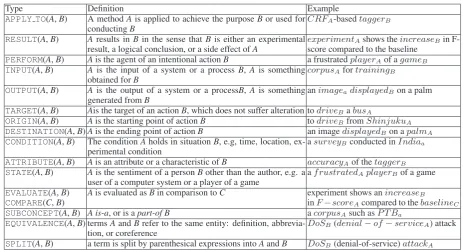
We define binary relations including APPLY TO(A, B) (A method A is applied to achieve the purpose B or used for do-ing B), EVALUATE(A, B) (A is evaluated as
1Linjie Zhang, Kentaro Moriya and Takashi Nodera.
2008. Two-level Parallel Computation for Approximate In-verse with AISM Method. IPSJ Journal, 48 (6): 2164-2168.
2Although the annotation was done for abstracts in
APPLY TO(two-level approximate inverse,parallel preconditioning)
APPLY TO(parallel preconditioning,large scale linear systems)
SUBCONCEPT(AISM method,two-level approximate inverse)
EVALUATE(two-level approximate inverse,novel)
RESULT(numerical results,136.72 times speedup)
CONDITION(origin 2400,136.72 times speedup)
APPLY TO(MPI,numerical results)
EVALUATE(the proposed parallel technique,136.72 times speedup)
CONDITION(16 processors,136.72 times speedup)
EQUIVALENCE(the proposed parallel technique,two-level approximate inverse)
Figure 2: Relations Found in the Sentences in Figure 1
B), SUBCONCEPT(A, B) (A is a part of B), RESULT(A,B) (The result of experimentAisB), CONDITION(A, B) (The condition A holds in situation B), and EQUIVALENCE(A, B) (A and B refer to the same entity), with which we can express the relations mentioned in the example, as shown in Figure 2.
Note that it isthe use of two-level approximate inverse for parallel preconditioning(A) that the au-thor claims to be novel. However, the relation inA is already represented by the firstAPPLY TO rela-tion. Consequently, it is sufficient to annotate the EVALUATE relation between two-level approxi-mate inverse and novel. This is approximately equivalent to paraphrasingthe use of two-level ap-proximate inverse for parallel preconditioning is novel as two-level approximate inverse used for parallel preconditioning is novel. The same holds for the equivalence relation involvingthe proposed method.
Expressing the content as the set of relations fa-cilitates discovery of a concept that plays a par-ticular role in the work. For example, if a reader wants to know the method for achieving paral-lel preconditioning, X, which satisfies the relation APPLY TO(X, parallel preconditioning) must be searched for. By using the APPLY TO relations mentioned in Figure 2 and inference on anis-a re-lation expressed by theSUBCONCEPT, we can ob-tain the result thatAISM methodis used for paral-lel preconditioning.
After a series of trial annotations on 71 abstracts from the IPSJ Journal (a monthly peer-reviewed journal published by the Information Processing Society of Japan), the following tag set was fixed. The annotation was conducted by the two of the authors of this paper.
3.1 Entity and Relation Types
The current tag set has 16 relation types and three entity types. An entity is whatever can be an
argu-Type Definition Example
OBJECT the name of concrete entities such as a system, a person, and a company
Origin 2400, SGI
MEASUREvalue, measurement, necessity, obli-gation, expectation, and possibility
novel, 136.72
TERM any other
Table 1: Entity Tags
ment or a participant in a relation. Entity types are OBJECT, MEASURE, or TERM, as shown in Table 1. Note that, unlike most schemes where the termentityrefers to a nominal (named entity), in our scheme, almost all syntactic types of con-tent words can be an entity, including numbers, verbs, adjectives, adverbs, and even some auxil-iaries. The 16 types of relations are shown in Ta-ble 2. They are binary relations are directed from AtoB.
All relations exceptEVALUATE COMPARE, and ATTRIBUTE can hold between any types of en-tity. EVALUATE and COMPARE relations hold between an entity (of any type) and an entity of the MEASURE type. The entities involved in an ATTRIBUTE relation must not be of the MEASUREtype.
zero-Type Definition Example
APPLY TO(A,B) A methodAis applied to achieve the purposeBor used for conductingB
CRFA-basedtaggerB
RESULT(A,B) Aresults inBin the sense thatBis either an experimental result, a logical conclusion, or a side effect ofA
experimentAshows theincreaseBin
F-score compared to the baseline
PERFORM(A,B) Ais the agent of an intentional actionB a frustratedplayerAof agameB INPUT(A,B) Ais the input of a system or a processB, A is something
obtained forB
corpusAfortrainingB
OUTPUT(A,B) Ais the output of a system or a processB,A is something generated fromB
animageadisplayedBon a palm
TARGET(A,B) Ais the target of an actionB, which does not suffer alteration todriveBabusA
ORIGIN(A,B) Ais the starting point of actionB todriveBfromShinjukuA DESTINATION(A,B)Ais the ending point of actionB an imagedisplayedBon apalmA CONDITION(A,B) The conditionAholds in situationB, e.g, time, location,
ex-perimental condition
asurveyBconducted inIndiaa
ATTRIBUTE(A,B) Ais an attribute or a characteristic ofB accuracyAof thetaggerB STATE(A,B) Ais the sentiment of a personBother than the author, e.g. a
user of a computer system or a player of a game
af rustratedAplayerBof a game
EVALUATE(A,B) Ais evaluated asBin comparison toC experiment shows anincreaseB
COMPARE(C,B) inF−scoreAcompared to thebaselineC SUBCONCEPT(A,B) A is-a, or is apart-of B acorpusAsuch asP T Ba
EQUIVALENCE(A,B) termsAandBrefer to the same entity: definition, abbrevia-tion, or coreference
DoSB(denial−of−serviceA) attack
[image:5.595.68.532.59.309.2]SPLIT(A,B) a term is split by parenthesical expressions intoAandB DoSB(denial-of-service)attackA
Table 2: Relation Tags
knowledge proof. Therefore, bothbiometricsand zero-knowledge proofare annotated asINPUTs of combines, and protocol is annotated as OUTPUT of combines. This scheme is not only used for computer-related verbs, but is further extended to any verb phrases or phrases with nominalized verbs. In change in a situation, situation is an-notated as both INPUT and OUTPUTof change. It is as if we regard change as a machine that changes something, and when we input a situa-tion, the change-machine processes it and output a different situation. Similarly, inevolution of mo-bile phones, mobile phones is annotated as both INPUT and OUTPUT of evolution. Here we re-gard evolutionas a machine, and when we input (old-style) mobile phones, theevolution-machine processes them and outputs (new-style) mobile phones. We have found that a wide variety of pred-icates can be interpreted using these relations.
3.2 Other Features
Although we aim to annotate all possible relations mentioned, some conventions are introduced to re-duce the workload.
First, we do not annotate the structure within entities. No nested entities are allowed, and com-pound words are treated as a single word. In ad-dition, polarity (negation) is not expressed as a re-lation but as a part of an entity. We assume that the internal structure of entities can be analyzed
by mechanisms such as technical term recognition. On the other hand, nested and crossed relations are allowed.
Second, we do not annotate words that indicate the existence of relations. This is because the re-lations are usually indicated by case markers and punctuation3 and marking them up was found to be a considerable mental workload. In addition, words and phrases that directly represent the re-lations themselves are not annotated as entities. For example, inCG iteration was applied to the problem, we directlyCG relationandthe problem directly withAPPLY TOand skip the phrasewas applied to.
Third, relations other thanEQUIVALENCEand SUBCONCEPT are annotated within a sentence. We assume that the discourse-level relation can be inferred by the composition of relations.
In addition, the annotation of frequent verbs and their case elements was examined in the trial pro-cess. Verbs were classified, according to the pat-tern of the annotated relation with the case ele-ments. For example, verbs semantically similar to assembleandcompileform a class. The semantic role of the direct object of these verbs varies by context. For example, the materials in phrases like compile source codesor the product in phrases like
3This is in the case with Japanese. In languages such as
compile the driver from the source codes. In our scheme, the former is theINPUTof the verb, and the latter is theOUTPUTof the verb. Another ex-ample is the class of verbs that includeslearnand obtain. The direct object (what is learned) is the INPUT to the system but is also the result or an output of the learning process. In such cases, we decided that bothINPUTandOUTPUTshould be annotated between the verb and its object.
Other details of annotation fixed in the process of trial annotation include:
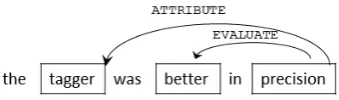
1) The span of entities, which is determined to be the longest possible sequences delimited by case suffix (-ga,-wo, etc.) in the case of nominals and to separate the-surusuffix of verbs and the-dasuffix of adjectives but retain other conjugation suffixes; 2) How to annotate evaluation sentences involv-ing nouns derived from adjectives that imply eval-uation and measurement, such as necessity, diffi-culty, and length. The initial agreement was that we would consider that they loseMEASURE-ness when nominalized; however, with the similarity of Japanese expressions hitsuyou/mondai de aru (is necessary/problematic) and hitsuyou/mondai ga aru(there is a necessity/problem), there was con-fusion about which word should be theMEASURE argument necessary for the EVALUATE relation. It was determined that, for example, in hit-suyou/mondai de aru, de aru, a copula, is ig-nored and hitsuyou/mondai is the MEASURE. In hitsuyou/mondai ga aru,aruis theMEASURE; 3) How to annotate phrases like the tagger was better in precision, where it can be understood that the systemis evaluated as beingbetter in precision. While what is actually measured in the evaluation process described in the paper is the precision (an attribute) of the tagger and the sentence has almost the same meaning as the tagger’s precision was better, the surface (syntactic) subject of is better is the tagger. This can lead to two possibilities for the target of theEVALUATErelation. We de-cided that theEVALUATErelation holds between precisionandbetter, and theATTRIBUTErelation holds betweenprecisionandtagger, as illustrated in Figure 3.
[image:6.595.332.502.64.114.2]A set of annotation guidelines was compiled as the result of the trial annotation, including the clas-sifications and the pattern of annotation on fre-quent verbs and their arguments.
Figure 3: Annotation of the tagger was better in precision
Entity Relation
[image:6.595.326.502.168.245.2]Conunt % Conunt % Total 1895 100.0 Total 2269 100.0 OK 1658 87.5 OK 1110 48.9 Type 56 3.0 Type 250 11.0 Span 67 3.5 Direction 6 0.3 Direction+Type 106 4.7 None 114 6.0 None 797 35.1
Table 3: Tag Counts
4 Annotation Experiment
We conducted an experiment on another 30 ab-stracts (197 sentences) from the IPSJ Journal. The two annotators who participated in the develop-ment of the guidelines annotated the abstracts in-dependently, and inter-annotator discrepancy was checked. The annotation was performed man-ually using the brat annotation tool(Stenetorp et al., 2012). No automatic preprocessing was per-formed. Figure 4 shows the annotation results for the abstract shown in Figure 1. The 30 pairs of an-notation results were aligned automatically; The results are shown in Tables 3, 4, and 5.
Table 3 shows the matches between the two annotators. “Total” denotes the count of enti-ties/relations that at least one annotator found, “OK” denotes complete matches, “Type” denotes cases where two annotations on the same span have different entity/relation types, “Span” de-notes entities where two annotations partially overlap, “Direction” denotes the count of relations where (only) the direction is different, and “Direc-tion+Type”denotes relations where the same pair of entities were in different types of relation and in opposite directions, and “None” denotes cases where no counterpart was found in the other re-sult.
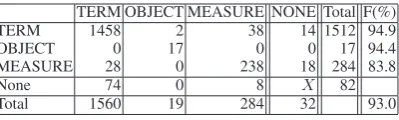
Tables 4 and 5 are the confusion matrices for entity type and relation type, respectively. The differences in the span and direction are ignored. Agreement in F-score calculated in the same man-ner as in Brants (2000) for each relation is shown in column F, with the overall (micro-average) F-score shown in the bottom row of column F.
Figure 4: Annotation Results with brat
TERM OBJECT MEASURE NONE Total F(%) TERM 1458 2 38 14 1512 94.9 OBJECT 0 17 0 0 17 94.4 MEASURE 28 0 238 18 284 83.8
None 74 0 8 X 82
[image:7.595.81.281.214.274.2]Total 1560 19 284 32 93.0
Table 4: Confusion Matrix for Entity
the annotators recognized (the value of the cell X in the tables) to be zero, the observed
agree-ment and Cohen’s κ coefficient are 90.3% and 70.0% for entities, and 49.3% and 43.5% for re-lations, respectively. If we ignore the count for the cases where one annotator did not recognize the entity/relation (“None” rows and columns in the tables), the observed agreement andκ are 96.1% and 89.3% for entities, and 76.1% and 74.3% for relations, respectively. The latter statistics indi-cate the agreement on types for entities/relations that both annotators recognized.
These results show that entity annotation was consistent between the annotators but the agree-ment for relation annotation varied, depending on the relation type. Table 5 shows that agreement
for DESTINATION, ORIGIN, EVALUATE, and
SPLIT was reasonably high, but was low for CONDITIONandTARGET. The rise in agreement (simple andκ) by excluding cases where only one annotator recognized the relation indicate that the problem is recognition, rather than classification, of relations4.
From the investigation of the annotated text, the following was found:
(1) ATTRIBUTE/CONDITION decision was in-consistent in phrases involving EVALUATE rela-tion, such asthe disk space is smaller for the im-age(Figure 5). TheEVALUATErelation between the disk spaceandsmaller was agreed; however, the two annotators recognized different relations betweenthe image and other words. One
annota-4The same observation was true for entities
tor recognized theATTRIBUTErelation between the disk spaceandthe image(“the disk spaceas a feature ofthe image is smaller”). The other recog-nized theCONDITIONrelation betweenthe image andsmaller(“the disk space is smallerin the case ofthe image”).
(2) We were not in complete agreement about skipping phrases that directly represent a relation. The expressions to be skipped in the 71 trial ab-stracts were listed in the guidelines; however, it is difficult to exhaust all such expressions.
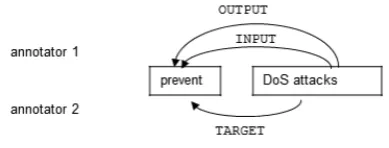
(3) In the case of some verbs, an argument can be INPUTandOUTPUT simultaneously (Section 3.1). We agreed that an object that undergoes alter-ation in a process should be tagged as bothINPUT and OUTPUT but one that does not undergo al-teration or which is just moved is the TARGET. Conflicts occurred for verbs that denote preven-tion of some situapreven-tions such asprevent,avoid, and suppress, as illustrated in Figure 6. One annota-tor claimed that the possibility of DoS attacks is reduced to zero; hence the argument of the verb should be annotated with INPUT and OUTPUT. The other claims that since the DoS attack itself does not change, it is aTARGET.
(4) In a coordination expression, logical inference may be implicitly stated. For example, in it re-quires the linguistic knowledge and is costly, the reason for costly is likely to be the need for lin-guistic knowledge, i.e., employment of an expert linguist. However, the relation is not readily ap-parent. We wanted to capture the relation in such cases, but the disagreement shows that it is diffi-cult to judge such a relation consistently.
APP ATT COMP COND DEST EQU EVAL IN ORIG OUT PER RES SPL STA SUB TAR None Total F(%) APPLY TO 136 9 0 2 1 1 2 10 1 0 0 3 0 0 1 0 65 231 53.0 ATTRIBUTE 14 154 0 19 6 0 9 5 1 0 7 1 0 0 3 0 28 247 59.7 COMPARE 0 0 6 1 0 0 0 0 0 0 0 0 0 0 0 0 4 11 54.5 CONDITION 4 11 1 77 0 0 1 4 0 0 0 5 0 0 0 0 49 152 48.7 DESTINATION 6 0 0 0 39 0 0 0 0 1 0 0 0 0 0 0 4 50 77.2 EQUIVALENCE 4 1 0 1 0 54 0 0 0 0 0 0 0 0 4 0 23 87 60.0 EVALUATE 0 11 0 0 0 0 215 3 0 9 0 0 0 0 0 1 41 280 76.1 INPUT 12 2 0 0 0 1 4 96 0 11 0 0 0 0 0 9 15 150 58.7 ORIGIN 0 0 0 0 0 0 0 0 16 0 0 0 0 0 0 0 2 18 78.0 OUTPUT 2 1 0 3 0 0 4 23 0 141 0 0 0 0 0 18 37 229 56.5 PERFORM 1 0 0 0 0 0 0 0 0 0 19 0 0 0 0 0 2 22 74.5 RESULT 8 1 0 0 0 0 1 1 0 0 0 38 0 0 0 0 22 71 54.3 SPLIT 0 0 0 0 0 0 0 0 0 0 0 0 2 0 0 0 0 2 80.0 STATE 0 0 0 0 0 0 0 0 0 0 0 0 0 0 0 0 0 0 0 SUBCONCEPT 14 10 0 3 0 4 5 0 0 2 0 0 0 0 81 0 34 153 58.1 TARGET 6 2 1 3 2 0 7 12 0 14 1 0 0 0 0 42 6 96 47.7 None 75 67 3 55 3 33 37 23 5 92 2 22 1 0 37 10 X 465 Total 282 269 11 164 51 93 285 177 23 270 29 69 3 0 126 80 332 59.8
[image:8.595.87.277.256.317.2]Table 5: Confusion Matrix for Relation
Figure 5:ATTRIBUTE/CONDITIONDisagreement
Figure 6:INPUT/OUTPUT/TARGETDisagreement
to be exceptions because the possibility of XX is expressed by dekiru/kanou and it seemed natural to relate XX anddekiru/kanou with EVALUATE. Unfortunately, confusion about splitting them re-mains.
5 Conclusions
We set up a scheme to annotate the content of re-search papers comprehensively. Sixteen semantic relations were defined, and guidelines for anno-tating semantic relations between concepts using the relations were established. The experimen-tal results on 30 abstracts show that fairly good agreement was achieved, and that while entity-and relation-type determination can be performed consistently, determining whether a relation exists between particular pairs of entities remains prob-lematic. We also found several discrepancy pat-terns that should be resolved and included in a fu-ture revision of the guidelines.
Traditionally, in semantic annotation of texts in the science/engineering domains, corpus cre-ators focus on specific types of entities or events in which they are interested. On the other hand, we did not assume such specific types of entities or events, and we attempted to design a scheme that annotates more general relations in computer science/engineering domain.
Although the annotation is conducted for com-puter science abstracts in Japanese, we believe the scheme can be used for other languages, or for the broader science/engineering domains. The an-notated corpus can provide data for constructing comprehensive semantic relation extraction sys-tems. This would be challenging but worthwhile since such systems are in great demand. Such relation extraction systems will be the basis for content-based retrieval and other applications, in-cluding paraphrasing and translation.
The abstracts annotated in the course of the ex-periment have been cleaned up and are available on request. We are planning to increase the vol-ume and make the corpus widely available.
In the future, we will assess machine-learning performance and incorporate the relation extrac-tion mechanisms into search systems. Comparison of the annotated structure and the structures that can be given by existing semantic theories could be an interesting theoretical subject for future re-search.
Acknowledgments
[image:8.595.84.279.363.437.2]References
Shashank Agarwal and Hong Yu. 2009. Automatically classifying sentences in full-text biomedical articles into introduction, methods, results and discussion.
Bioinformatics, 25(23):3174–3180.
Rafael E. Banchs, editor. 2012. Proceedings of the ACL-2012 Special Workshop on Rediscovering 50 Years of Discoveries. Association for Computational Linguistics.
Thorsten Brants. 2000. Inter-annotator agreement for a German newspaper corpus. InProceedings of the Second International Conference on Language Re-sources and Evaluation.
Satoshi Fukuda, Hidetsugu Nanba, and Toshiyuki Takezawa. 2012. Extraction and visualization of technical trend information from research papers and patents. InProceedings of the 1st International Workshop on Mining Scientific Publications.
Yufan Guo, Anna Korhonen, and Thierry Poibeau. 2011. A weakly-supervised approach to argumen-tative zoning of scientific documents. In Proceed-ings of the 2011 Conference on Empirical Methods in Natural Language Processing, pages 273–283.
Sonal Gupta and Christopher D Manning. 2011. An-alyzing the dynamics of research by extracting key aspects of scientific papers. InProceedings of 5th IJCNLP.
Ray Jackendoff. 1990. Semantic Structures. The MIT Press.
Jin-Dong Kim, Tomoko Ohta, and Jun ichi Tsujii. 2008. Corpus annotation for mining biomedical events from literature.BMC Bioinformatics, 9.
Jin-Dong Kim, Sampo Pyysalo, Tomoko Ohta, Robert Bossy, Ngan Nguyen, and Jun’ichi Tsujii. 2011. Overview of bionlp shared task 2011. In Proceed-ings of BioNLP Shared Task 2011 Workshop, pages 1–6.
Maria Liakata, Simone Teufel, Advaith Siddharthan, and Colin Batchelor. 2010. Corpora for concep-tualisation and zoning of scientific papers. In Pro-ceedings of LREC 2010.
Yoko Mizuta, Anna Korhonen, Tony Mullen, and Nigel Collier. 2006. Zone analysis in biology articles as a basis for information extraction.International Jour-nal of Medical Informatics, 75(6):468–487.
Josef Ruppenhofer, Michael Ellsworth, Miriam R.L. Petruck, Christopher R. Johnson, and Jan Schef-fczyk. 2006. FrameNet II: Extended Theory and Practice. International Computer Science Institute.
Ulrich Sch¨afer, Bernd Kiefer, Christian Spurk, J¨org Steffen, and Rui Wang. 2011. The ACL anthology searchbench. InProceedings of the ACL-HLT 2011 System Demonstrations, pages 7–13.
Pontus Stenetorp, Sampo Pyysalo, Goran Topi´c, Tomoko Ohta, Sophia Ananiadou, and Jun’ichi Tsu-jii. 2012. brat: a web-based tool for NLP-assisted text annotation. InProceedings of the Demonstra-tions Session at EACL.
Simone Teufel, Advaith Siddharthan, and Colin Batch-elor. 2009. Towards discipline-independent ar-gumentative zoning: evidence from chemistry and computational linguistics. In Proceedings of the 2009 Conference on Empirical Methods in Natural Language Processing, pages 1493–1502.
The Gene Ontology Consortium. 2000. Gene ontol-ogy: tool for the unification of biology. Nature Ge-netics, 25(1):25–29.
Paul Thompson, Raheel Nawaz, John McNaught, and Sophia Ananiadou. 2011. Enriching a biomedi-cal event corpus with meta-knowledge annotation.
BMC Bioinformatics, 12.