Generating Elliptic Coordination
Claire Gardent
CNRS, LORIA, UMR 7503 Vandoeuvre-l`es-Nancy, F-54500, France
Shashi Narayan
Universit´e de Lorraine, LORIA, UMR 7503 Villers-l`es-Nancy, F-54600, France
Abstract
In this paper, we focus on the task of gen-erating elliptic sentences. We extract from the data provided by the Surface Realisa-tion (SR) Task (Belz et al., 2011) 2398 in-put whose corresponding outin-put sentence contain an ellipsis. We show that 9% of the data contains an ellipsis and that both cov-erage and BLEU score markedly decrease for elliptic input (from 82.3% coverage for non-elliptic sentences to 65.3% for ellip-tic sentences and from 0.60 BLEU score to 0.47). We argue that elided material should be represented using phonetically empty nodes and we introduce a set of rewrite rules which permits adding these empty categories to the SR data. Finally, we evaluate an existing surface realiser on the resulting dataset. We show that, after rewriting, the generator achieves a cover-age of76%and a BLEU score of0.74 on
the elliptical data.
1 Introduction
To a large extent, previous work on generating el-lipsis has assumed a semantically fully specified input (Shaw, 1998; Harbusch and Kempen, 2009; Theune et al., 2006). Given such input, elliptic sentences are then generated by first producing full sentences and second, deleting from these sen-tences substrings that were identified to obey dele-tion constraints.
In contrast, recent work on generation often as-sumes input where repeated material has already been elided. This includes work on sentence com-pression which regenerates sentences from surface dependency trees derived from parsing the initial text (Filippova and Strube, 2008); Surface realisa-tion approaches which have produced results for regenerating from the Penn Treebank (Langkilde-Geary, 2002; Callaway, 2003; Zhong and Stent,
2005; Cahill and Van Genabith, 2006; White and Rajkumar, 2009); and more recently, the Surface Realisation (SR) Task (Belz et al., 2011) which has proposed dependency trees and graphs de-rived from the Penn Treebank (PTB) as a com-mon ground input representation for testing and comparing existing surface realisers. In all these approaches, repeated material is omitted from the representation that is input to surface realisation.
As shown in the literature, modelling the inter-face between the empty phonology and the syn-tactic structure of ellipses is a difficult task. For parsing, Sarkar and Joshi (1996), Banik (2004) and Seddah (2008) propose either to modify the derivation process of Tree Adjoining Grammar or to introduce elementary trees anchored with empty category in a synchronous TAG to accom-modate elliptic coordinations. In HPSG (Head-Driven Phrase Structure Grammar), Levy and Pol-lard (2001) introduce a neutralisation mechanism to account for unlike constituent coordination ; in LFG (Lexical Functional Grammar), Dalrym-ple and Kaplan (2000) employ set values to model coordination; in CCG (Combinatory Categorial Grammar, (Steedman, 1996)), it is the non stan-dard notion of constituency assumed by the ap-proach which permits accounting for coordinated structures; finally, in TLCG (Type-Logical Cat-egorial Grammar), gapping is treated as like-category constituent coordinations (Kubota and Levine, 2012).
In this paper, we focus on how surface reali-sation handles elliptical sentences given an input where repeated material is omitted. We extract from the SR data 2398 input whose correspond-ing output sentence contain an ellipsis. Based on previous work on how to annotate and to represent ellipsis, we argue that elided material should be represented using phonetically empty nodes (Sec-tion 3) and we introduce a set of rewrite rules which permits adding these empty categories to
the SR data (Section 4). We then evaluate our sur-face realiser (Narayan and Gardent, 2012b) on the resulting dataset (Section 5) and we show that, on this data, the generator achieves a coverage of76%
and a BLEU score, for the generated sentences, of
0.74. Section 6 discusses related work on
generat-ing elliptic coordination. Section 7 concludes.
2 Elliptic Sentences
Elliptic coordination involves a wide range of phe-nomena including in particular non-constituent coordination (1, NCC) i.e., cases where sequences of constituents are coordinated; gapping (2, G) i.e., cases where the verb and possibly some additional material is elided; shared subjects (3, SS) and right node raising (4, RNR) i.e., cases where a right most constituent is shared by two or more clauses1.
(1) [It rose]i 4.8 % in June 1998 and ǫi 4.7% in
June 1999. NCC
(2) Sumitomo bank [donated]i $500,000, Tokyo
prefecture ǫi $15,000 and the city of Osaka ǫi
$10,000. Gapping
(3) [the state agency ’s figures]i ǫi confirm pre-vious estimates and ǫi leave the index at 178.9 . Shared Subject (4) He commissions ǫi and splendidly interprets
ǫi[fearsome contemporary scores]i . RNR
We refer to the non elliptic clause as the source and to the elliptic clause as the target. In the source, the brackets indicate the element shared with the target while in the target, the ǫi sign in-dicate the elided material with co-indexing indi-cating the antecedent/ellipsis relation. In gapping clauses, we refer to the constituents in the gapped clause, as remnants.
3 Representing and Annotating Elided Material
We now briefly review how elided material is rep-resented in the literature.
Linguistic Approaches. While Sag (1976), Williams (1977), Kehler (2002), Merchant (2001)
1
Other types of elliptic coordination include sluicing and Verb-Phrase ellipsis. These will not be discussed here be-cause they can be handled by the generator by having the appropriate categories in the grammar and the lexicon e.g., in a Tree Adjoining Grammar, an auxiliary anchoring a verb phrase for VP ellipsis and question words anchoring a sen-tence for sluicing.
and van Craenenbroeck (2010) have argued for a structural approach i.e., one which posits syn-tactic structure for the elided material, Keenan (1971), Hardt (1993), Dalrymple et al. (1991), Ginzburg and Sag (2000) and Culicover and Jack-endoff (2005) all defend a non structural approach. Although no consensus has yet been reached on these questions, many of these approaches do pos-tulate an abstract syntax for ellipsis. That is they posit that elided material licenses the introduction of phonetically empty categories in the syntax or at some more abstract level (e.g., the logical form of generative linguistics).
Treebanks. Similarly, in computational linguis-tics, the treebanks used to train and evaluate parsers propose different means of representing el-lipsis.
For phrase structure syntax, the Penn Treebank Bracketing Guidelines extensively describe how to annotate coordination and missing material in En-glish (Bies et al., 1995). For shared complements (e.g., shared subject and right node raising con-structions), these guidelines state that the elided material licenses the introduction of an empty *RNR* category co-indexed with the shared com-plement (cf. Figure 1) while gapping construc-tions are handled by labelling the gapping rem-nants (i.e., the constituents present in the gapping clause) with the index of their parallel element in the source (cf. Figure 2).
(S
(VP (VB Do)(VP (VB avoid)
(S (VP (VPG puncturing(NP *RNR*-5)) (CC or)
(VP (VBG cutting)(PP (IN into) (NP *RNR*-5)))
(NP-5 meats)))))
Figure 1: Penn Treebank annotation for Right Node Raising “Do avoid puncturingǫior cutting intoǫi
[meats]i.”
(S
(S (NP-SBJ-10 Mary)
(VP (VBZ likes) (NP-11 potatoes))) (CC and)
(S (NP-SBJ=10 Bill)
(, ,) (NP=11 ostriches)))
Figure 2: Penn Treebank annotation for gapping “Mary [likes]ipotatoes and Billǫiostriches.”
is-sue of how to represent the daughters of an empty head. Three main types of approaches have been proposed. In dependency treebanks for German (Daum et al., 2004; Hajiˇc et al., 2009) and in the Czech treebank ( ˇCmejrek et al., 2004; Hajiˇc et al., 2009), one of the dependents of the head-less phrase is declared to be the head. This is a rather undesirable solution because it hides the fact that there the clause lacks a head. In contrast, the Hungarian dependency treebank (Vincze et al., 2010) explicitly represents the elided elements in the trees by introducing phonetically empty ele-ments that serve as attachment points to other to-kens. This is the cleanest solution from a linguistic point of view. Similarly, Seeker and Kuhn (2012) present a conversion of the German Tiger treebank which introduces empty nodes for verb ellipses if a phrase normally headed by a verb is lacking a head. They compare the performance of two sta-tistical dependency parsers on the canonical ver-sion and the CoNLL 2009 Shared Task data and show that the converted dependency treebank they propose yields better parsing results than the tree-bank not containing empty heads.
In sum, while some linguists have argued for an approach where ellipsis has no syntactic represen-tation, many have provided strong empirical evi-dence for positing empty nodes as place-holders for elliptic material. Similarly, in devising tree-banks, computational linguists have oscillated be-tween representations with and without empty cat-egories. In the following section, we present the way in which elided material is represented in the SR data; we show that it underspecifies the sen-tences to be generated; and we propose to mod-ify the SR representations by making the relation-ship between ellipsis and antecedent explicit using phonetically empty categories and co-indexing.
4 Rewriting the SR Data
The SR Task 2011 made available two types of data for surface realisers to be tested on: shallow dependency trees and deep dependency graphs. Here we focus on the shallow dependency trees i.e., on syntactic structures.
The input data provided by the SR Task were obtained from the Penn Treebank. They were derived indirectly from the LTH Constituent-to-Dependency Conversion Tool for Penn-style Tree-banks (Pennconverter, (Johansson and Nugues, 2007)) by post-processing the CoNLL data to
re-d o n a t e
S u m i t o m o b a n k SBJ
a n d COORD
$ 5 0 0 , 0 0 0 OBJ
Tokyo prefecture GAP-SBJ
[image:3.595.332.500.64.159.2]$ 1 5 , 0 0 0 GAP-OBJ
[image:3.595.319.515.562.654.2]Figure 3: Gapping in the SR data. “Sumitomo bank [donated]i$500,000and Tokyo prefectureǫi$15,000.”
move word order, inflections etc. It consists of a set of unordered labelled syntactic dependency trees whose nodes are labelled with word forms, part of speech categories, partial morphosyntac-tic information such as tense and number and, in some cases, a sense tag identifier. The edges are labelled with the syntactic labels provided by the Pennconverter. All words (including punctuation) of the original sentence are represented by a node in the tree. Figures 3, 4, 5 and 6 show (simplified) input trees from the SR data.
In the SR data, the representation of ellipsis adopted in the Penn Treebank is preserved modulo some important differences regarding co-indexing. Gapping is represented as in the PTB by la-belling the remnants with a marker indicating the source element parallel to each remnant. However while in the PTB, this parallelism is made explicit by co-indexing (the source element is marked with an index iand its parallel target element with the marker=i), in the SR data this parallelism is
ap-proximated using functions. For instance, if the remnant is parallel to the source subject, it will be labelledGAP-SBJ(cf. Figure 3).
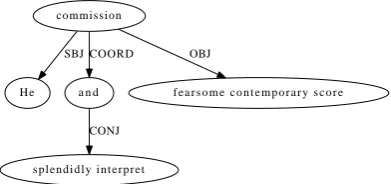
commission
H e SBJ
a n d COORD
f e a r s o m e c o n t e m p o r a r y s c o r e OBJ
s p l e n d i d l y i n t e r p r e t CONJ
Figure 4: Subject Sharing and RNR in the SR data. “[He]jǫjcommissionsǫiandǫjsplendidly interprets
ǫi[fearsome contemporary scores]i.”
under-b e
T h e y SBJ
s h o w VC
n o t ADV
t a k e OPRD
James Madison OBJ
o r COORD
a puff OBJ
[image:4.595.122.242.81.247.2]light up CONJ
Figure 5: Non shared Object “They aren’t showing James Madison taking a puff or lighting up”
rise
It SBJ
a n d COORD
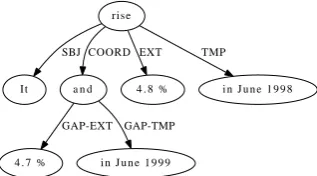
4 . 8 % EXT
i n J u n e 1 9 9 8 TMP
4 . 7 % GAP-EXT
[image:4.595.102.261.336.424.2]i n J u n e 1 9 9 9 GAP-TMP
Figure 6: NCC in the SR data. “It rose 4.8 % in June 1998 and 4.7% in June 1999.”
V V
FUNC COORD FUNC COORD
X CONJ W X CONJ W
GAP-FUNC ⇒ CONJ
Y Vǫ
FUNC
Y Wǫ
Figure 7: Gapping and Non Constituent Coordina-tion structures rewriting (V: a verb, CONJ: a con-junctive coordination,X,Y andW three sets of de-pendents). The antecedent verb (V) and the source material without counterpart in the gapping clause (W) are copied over to the gapping clause and marked as phonetically empty.
specifies the relation between the object and the coordinated verbs in RNR constructions: the ob-ject could be shared as inHe commissionsǫiand
splen-didly interpretsǫi[fearsome contemporary scores]i.
(Fig-ure 4) or not as inThey aren’t showing James Madison taking a puff or lighting up (Figure 5). In both cases, the representation is the same i.e., the shared ob-ject (fearsome contemporary scores) and the unshared object (a puff) are both attached to the first verb.
Finally, NCC structures are handled in the same way as gapping by having the gapping remnants labelled with a GAP prefixed function (e.g., GAP-SBJ) indicating which element in the source the gapping remnant is parallel to (cf. Figure 6).
Summing up, the SR representation schema un-derspecifies ellipsis in two ways. For gapping and non-constituent coordination, it describes paral-lelism between source and target elements rather than specifying the syntax of the elided material. For subject sharing and right node raising, it fails to explicitly specify argument sharing.
V1 V1
SUBJ COORD SUBJ COORD
X CONJ Y1 X CONJ Y1
CONJ ⇒ CONJ
V2 V2
SUBJ
[image:4.595.323.517.360.483.2]Y2 Xǫ Y2
Figure 8: Subject sharing: the subject dependent is copied over to the target clause and marked as phonetically empty.
To resolve this underspecification, we rewrite the SR data using tree rewrite rules as follows.
In Gapping and NCC structures, we copy the source material that has no (GAP- marked) coun-terpart in the target clause to the target clause marking it to indicate a phonetically empty cate-gory (cf. Figure 7).
For Subject sharing, we copy the shared subject of the source clause in the target clause and mark it to be a phonetically empty category (cf. Figure 8). For Right-Node-Raising, we unfold the am-biguity producing structures where arguments present in the source but not in the target are op-tionally copied over to the target (cf. Figure 9).
[image:4.595.79.292.511.635.2]V1 V1 V1
COORD OBJ COORD OBJ COORD OBJ
X1 CONJ Y X1 CONJ Y X1 CONJ Yǫ
CONJ ⇒
CONJ , CONJ
V2 V2 V2
OBJ
[image:5.595.154.445.63.163.2]X2 X2 X2 Y
Figure 9: Right-Node-Raising: the object dependent is optionally copied over to the target clause and marked as phonetically empty in the source clause.
using GrGen, an efficient graph rewriting sys-tem (Geißet al., 2006).
5 Generating Elliptic Coordination
5.1 The Surface Realiser
To generate sentences from the SR data, we use our surface realiser (Narayan and Gardent, 2012b), a grammar-based generator based on a Feature-Based Lexicalised Tree Adjoining Gram-mar (FB-LTAG) for English. This generator first selects the elementary FB-LTAG trees associated in the lexicon with the lemmas and part of speech tags associated with each node in the input de-pendency tree. It then attempts to combine the selected trees bottom-up taking into account the structure of the input tree (only trees that are se-lected by nodes belonging to the same local input tree are tried for combination). A language model is used to implement a beam search letting through only thenmost likely phrases at each bottom up combination step. In this experiment, we setnto 5. The generator thus outputs at most 5 sentences for each input.
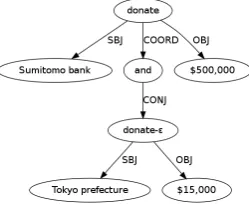
[image:5.595.119.244.567.669.2]Figure 10: Gapping after rewriting “Sumitomo bank [donated]i$500,000and Tokyo prefectureǫi$15,000.”
As mentioned in the introduction, most compu-tational grammars have difficulty accounting for ellipses and FB-LTAG is no exception.
The difficulty stems from the fact that in ellip-tical sentences, there is meaning without sound. As a result, the usual form/meaning mappings that in non-elliptic sentences allow us to map sounds onto their corresponding meanings, break down. For instance, in the sentence John eats apples and Mary pear, the Subject-Verb-Object structure which can be used in English to express a binary relation is present in the source clause but not in the elided one. In practice, the syntax of ellipti-cal sentences often leads to a duplication of the grammatical system, one system allowing for non elliptical sentences and the other for their elided counterpart.
For parsing with TAG, two main methods have been proposed for processing elliptical sentences. (Sarkar and Joshi, 1996) introduces an additional operation for combining TAG trees which yields derivation graphs rather than trees. (Seddah, 2008) uses Multi-Component TAG and proposes to asso-ciate each elementary verb tree with an elliptic tree with different pairs representing different types of ellipses.
We could use either of these approaches for generation. The first approach however has the drawback that it leads to a non standard notion of derivation (the derivation trees become derivation graphs). The second on the other hand, induces a proliferation of trees in the grammar and impacts efficiency.
then select all FB-LTAG rules that are compatible with the lexical and the morpho-syntactic features labelling that node. Generation will then proceed as usual by composing the trees selected on the ba-sis of the input using substitution and adjunction; and by retrieving from the generation forest those sentences whose phrase structure tree covers the input.
[image:6.595.315.517.60.276.2]For instance, given the rewritten input shown in Figure 10, the TAG trees associated in the lexi-con with donate will be selected; anchored with the empty string and combined with the TAG trees built for Tokyo Prefecture and$15,000 thus yield-ing the derivation shown in Figure 11.
NP
Tokyo prefecture
S
NP↓ VP
V NP↓
ǫ
NP
$15,000
Figure 11: Derivation for “Tokyo prefectureǫ$15,000”
5.2 The Data
We use both the SR test data (2398 sentences) and the SR training data (26604 sentences) to evaluate the performance of the surface realiser on elliptic coordination. Since the realiser we are using is not trained on this data (the grammar was written manually), this does not bias evaluation. Using the training data allows us to gather a larger set of elliptic sentences for evaluation while evaluating also on the test data allows comparison with other realisers.
To focus on ellipses, we retrieve those sentences which were identified by our rewrite rules as po-tentially containing an elliptic coordination. In essence, these rewrite rules will identify all cases of non-constituent coordination and gapping (be-cause these involveGAP-Xdependencies with “X”
a dependency relation and are therefore easily de-tected) and of shared-subjects (because the tree patterns used to detect are unambiguous i.e., only apply if there is indeed a shared subject). For RNR, as discussed in the previous section, the SR format is ambiguous and consequently, the rewrite rules might identify as object sharing cases where in fact the object is not shared. As noted by one of our reviewers, the false interpretation could be
Elliptic Coordination Data
Elliptic Coordination Pass BLEU Scores
COV ALL
RNR (384)
Before 66% 0.68 0.45
After 81% 0.70 0.57
Delta +15 +0.02 +0.12
SS (1462)
Before 70% 0.74 0.52
After 75% 0.75 0.56
Delta +5 +0.01 +0.04
SS + RNR (456)
Before 61% 0.71 0.43
After 74% 0.73 0.54
Delta +13 +0.02 +0.11
Gapping (36)
Before 3% 0.53 0.01
After 67% 0.74 0.49
Delta +64 +0.21 +0.48
NCC (60)
Before 5% 0.68 0.03
After 73% 0.74 0.54
Delta +68 +0.06 +0.51
Total (2398)
Before 65% 0.72 0.47
After 76% 0.74 0.56
[image:6.595.84.270.279.341.2]Delta +11 +0.02 +0.09
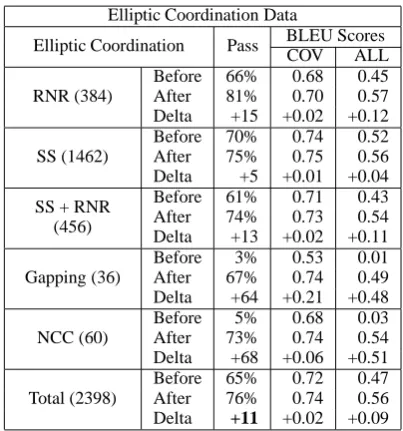
Table 1: Generation results on elliptical data be-fore and after input rewriting (SS: Shared Subject, NCC: Non Constituent Coordination, RNR: Right Node Raising). The number in brackets in the first column is the number of cases. Pass stands for the coverage of the generator. COV and ALL in BLEU scores column stand for BLEU scores for the covered and the total input data.
dropped out by consulting the Penn Treebank2. The approach would not generalise to other data however.
In total, we retrieve 2398 sentences3 potentially containing an elliptic coordination from the SR training data. The number and distribution of these sentences in terms of ellipsis types are given in Ta-ble 1. From the test data, we retrieve an additional 182 elliptic sentences.
5.3 Evaluation
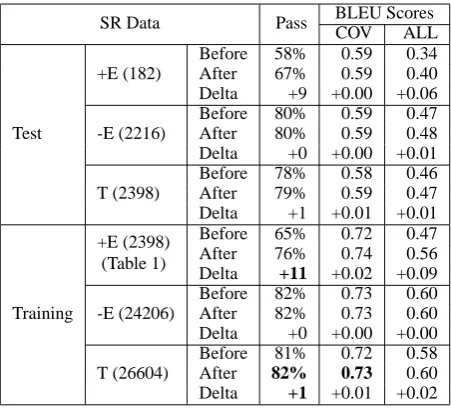
We ran the surface realiser on the SR input data both before and after rewriting elliptic coordina-tions; on the sentences estimated to contain ellip-sis; on sentences devoid of ellipellip-sis; and on all sen-tences. The results are shown in Table 2. They indicate coverage and BLEU score before and af-ter rewriting. BLEU score is given both with re-spect to covered sentences (COV) i.e., the set of input for which generation succeeds; and for all sentences (ALL). We evaluate both with respect to the SR test data and with respect to the SR training
2The Penn Treebank makes the RNR interpretations
ex-plicit (refer to Figure 1).
3It is just a coincidence that the size of the SR test data
SR Data Pass BLEU Scores
COV ALL
Test
+E (182)
Before 58% 0.59 0.34
After 67% 0.59 0.40
Delta +9 +0.00 +0.06
-E (2216)
Before 80% 0.59 0.47
After 80% 0.59 0.48
Delta +0 +0.00 +0.01
T (2398)
Before 78% 0.58 0.46
After 79% 0.59 0.47
Delta +1 +0.01 +0.01
Training
+E (2398) (Table 1)
Before 65% 0.72 0.47
After 76% 0.74 0.56
Delta +11 +0.02 +0.09
-E (24206)
Before 82% 0.73 0.60
After 82% 0.73 0.60
Delta +0 +0.00 +0.00
T (26604)
Before 81% 0.72 0.58
After 82% 0.73 0.60
[image:7.595.72.298.62.266.2]Delta +1 +0.01 +0.02
Table 2: Generation results on SR test and SR training data before and after input rewriting (+E stands for elliptical data, -E for non elliptical data and T for total.)
data. We use the SR Task scripts for the computa-tion of the BLEU score.
The impact of ellipsis on coverage and preci-sion. Previous work on parsing showed that co-ordination was a main source of parsing failure (Collins, 1999). Similarly, ellipses is an important source of failure for the TAG generator. Ellipses are relatively frequent with 9% of the sentences in the training data containing an elliptic struc-ture and performance markedly decreases in the presence of ellipsis. Thus, before rewriting, cov-erage decreases from 82.3% for non-elliptic sen-tences to 80.75% on all sensen-tences (elliptic and non elliptic sentences) and to 65.3% on the set of el-liptic sentences. Similarly, BLEU score decreases from 0.60 for non elliptical sentences to 0.58 for all sentences and to 0.47 for elliptic sentences. In sum, both coverage and BLEU score decrease as the number of elliptic input increases.
The impact of the input representation on cov-erage and precision. Recent work on treebank annotation has shown that the annotation schema adopted for coordination impacts parsing. In par-ticular, Maier et al. (2012) propose revised annota-tion guidelines for coordinaannota-tions in the Penn Tree-bank whose aim is to facilitate the detection of co-ordinations. And Dukes and Habash (2011) show that treebank annotations which include phoneti-cally empty material for representing elided
mate-rial allows for better parsing results.
Similarly, Table 2 shows that the way in which ellipsis is represented in the input data has a strong impact on generation. Thus rewriting the input data markedly extends coverage with an overall improvement of 11 points (from 65% to 76%) for elliptic sentences and of almost 1 point for all sen-tences.
As detailed in Table 1 though, there are impor-tant differences between the different types of el-liptic constructs: coverage increases by 68 points for NCC and 64 points for gapping against only 15, 13 and 5 points for RNR, mixed RNR-Shared Subject and Shared Subject respectively. The rea-son for this is that sentences are generated for many input containing the latter types of con-structions (RNR and Shared Subject) even with-out rewriting. In fact, generation succeeds on the non rewritten input for a majority of RNR (66% PASS), Shared Subject (70% PASS) and mixed RNR-Shared Subject (61% PASS) constructions whereas it fails for almost all cases of gapping (3% PASS) and of NCC (5% PASS). The reason for this difference is that, while the grammar can-not cope with headless constructions such as gap-ping and NCC constructions, it can often provide a derivation for shared subject sentences by using the finite verb form in the source sentence and the corresponding infinitival form in the target. Since the infinitival does not require a subject, the tar-get sentence is generated. Similarly, RNR con-structions can be generated when the verb in the source clause has both a transitive and an intran-sitive form: the tranintran-sitive form is used to gener-ate the source clause and the intransitive for the target clause. In short, many sentences contain-ing a RNR or a shared subject construction can be generated without rewriting because the grammar overgenerates i.e., it produces sentences which are valid sentences of English but whose phrase struc-ture tree is incorrect.
Nevertheless, as the results show, rewriting consistently helps increasing coverage even for RNR (+15 points), Shared Subject (+5 points) and mixed RNR-Shared Subject (+13 points) construc-tions because (i) not all verbs have both a transi-tive and an intransitransi-tive verb form and (ii) the input for the elliptic clause may require a finite form for the target verb (e.g., in sentences such as “[they]i
weren’t fired but insteadǫiwere neglected” where the
participial which in this context requires a sub-ject).
Precision is measured using the BLEU score. For each input, we take the best score obtained within the 5 derivations4 produced by the gener-ator. Since the BLEU score reflects the degree to which a sentence generated by the system matches the corresponding Penn Treebank sentence, it is impacted not just by elliptic coordination but also by all linguistic constructions present in the sen-tence. Nonetheless, the results show that rewrit-ing consistently improves the BLEU score with an overall increase of 0.09 points on the set of ellip-tic sentences. Moreover, the consistent improve-ment in terms of BLEU score for generated sen-tences (COV column) shows that rewriting simul-taneously improves both coverage and precision that is, that for those sentences that are generated, rewriting consistently improves precision.
Analysing the remaining failure cases. To bet-ter assess the extent to which rewriting and the FB-LTAG generation system succeed in generating el-liptic coordinations, we performed error mining on the elliptic data using our error miner described in (Narayan and Gardent, 2012a). This method permits highlighting the most likely sources of er-ror given two datasets: a set of successful cases and a set of failure cases. In this case, the suc-cessful cases is the subset of rewritten input data for elliptic coordination cases for which genera-tion succeeds . The failure cases is the subset for which generation fails. If elliptic coordination was still a major source of errors, input nodes or edges labelled with labels related to elliptic coordination (e.g., theCOORDand theGAP-Xdependency
rela-tions or the CONJ part of speech tag) would sur-face as most suspicious forms. In practice how-ever, we found that the 5 top sources of errors highlighted by error mining all include theDEP re-lation, an unknown dependency relation used by the Pennconverter when it fails to assign a label to a dependency edge. In other words, most of the remaining elliptic cases for which generation fails, fails for reasons unrelated to ellipsis.
Comparison with other surface realisers
There is no data available on the performance of surface realisers on elliptic input. However, the performance of the surface realiser can be
4The language model used in the generator allows only 5
likely derivations (refer to section 5.1).
compared with those participating in the shallow track of the SR challenge. On the SR training data, the TAG surface realiser has an average run time of 2.78 seconds per sentence (with an average of 20 words per sentence), a coverage of 82% and BLEU scores of 0.73 for covered and 0.60 for all. On the SR test data, the realiser achieves a coverage of 79% and BLEU scores of 0.59 for covered and 0.47 for all. In comparison, the statistical systems in the SR Tasks achieved 0.88, 0.85 and 0.67 BLEU score on the SR test set and the best symbolic system 0.25 (Belz et al., 2011).
6 Related work
Previous work on generating elliptic sentences has mostly focused on identifying material that could be elided and on defining procedures capable of producing input structures for surface realisation that support the generation of elliptic sentences.
Shaw (1998) developed a sentence planner which generates elliptic sentences in 3 steps. First, input data are grouped according to their simi-larities. Second, repeated elements are marked. Third, constraints are used to determine which oc-currences of a marked element should be deleted. The approach is integrated in the PLANDoc sys-tem (McKeown et al., 1994) and shown to gen-erate a wide range of elliptic constructs includ-ing RNR, VPE and NCC usinclud-ing FUF/SURGE (El-hadad, 1993), a realisation component based on Functional Unification Grammar.
between words and word groups in the conjuncts; and returns as output structures annotated with elision marks indicating which elements can be elided and how (i.e., using which type of ellip-sis). The focus is on developing a language in-dependent module which can mediate between the unreduced input syntactic structures produced by a generator and syntactic structures that are enriched with elision marks rich enough to determine the range of possible elliptic and non elliptic output sentences.
In CCG, grammar rules (type-raising and com-position) permit combining non constituents into a functor category which takes the shared element as argument; and gapping remnants into a clause tak-ing as argument its left-hand coordinated source clause. White (2006) describes a chart based algo-rithm for generating with CCG and shows that it can efficiently realise NCC and gapping construc-tions.
Our proposal differs from these approaches in that it focuses on the surface realisation stage (as-suming that the repeated elements have already been identified) and is tested on a large corpus of newspaper sentences rather than on hand-made document plans and relatively short sentences.
7 Conclusion
In this paper, we showed that elliptic structures are frequent and can impact the performance of a surface realiser. In line with linguistic theory and with some recent results on treebank annota-tion, we argued that the representation of ellipsis should involve empty categories and we provided a set of tree rewrite rules to modify the SR data ac-cordingly. We then evaluated the performance of a TAG based surface realiser on 2398 elliptic input derived by the SR task from the Penn Treebank and showed that it achieved a coverage of 76% and a BLEU score of 0.74 on generated sentences. Our approach relies both on the fact that the grammar is lexicalised (each rule is associated with a word from the input) and on TAG extended domain of locality (which permits using a rule anchored with the empty string to reconstruct the missing syntax in the elided clause thereby making it grammati-cal).
We will release the 2398 input representations we gathered for evaluating the generation of el-liptic coordination so as to make it possible for other surface realisers to be evaluated on their
abil-ity to generate ellipsis. In particular, its would be interesting to examine how other grammar based generators perform on this dataset such as White’s CCG based generator (2006) (which eschews empty categories by adopting a more flexible notion of constituency) and Carroll and Oepen’s HPSG based generator (2005) (whose do-main of locality differs from that of TAG).
Acknowledgments
We would like to thank Anja Belz and Mike White for providing us with the evaluation data and the evaluation scripts. The research presented in this paper was partially supported by the European Fund for Regional Development within the frame-work of the INTERREG IV A Allegro Project.
References
Eva Banik. 2004. Semantics of VP coordination in LTAG. In Proceedings of the 7th International
Workshop on Tree Adjoining Grammars and Re-lated Formalisms (TAG+), volume 7, pages 118–
125, Vancouver, Canada.
Anja Belz, Michael White, Dominic Espinosa, Eric Kow, Deirdre Hogan, and Amanda Stent. 2011. The first surface realisation shared task: Overview and evaluation results. In Proceedings of the 13th
Eu-ropean Workshop on Natural Language Generation (ENLG), Nancy, France.
Ann Bies, Mark Ferguson, Katz Katz, Robert MacIn-tyre, Victoria Tredinnick, Grace Kim, Marry Ann Marcinkiewicz, and Britta Schasberger. 1995. Bracketing guidelines for treebank II style penn tree-bank project. University of Pennsylvania.
Aoife Cahill and Josef Van Genabith. 2006. Robust pcfg-based generation using automatically acquired lfg approximations. In Proceedings of the 21st
Inter-national Conference on Computational Linguistics (COLING) and the 44th annual meeting of the Asso-ciation for Computational Linguistics (ACL), pages
1033–1040, Sydney, Australia.
Charles B Callaway. 2003. Evaluating coverage for large symbolic nlg grammars. In Proceedings of the
18th International joint conference on Artificial In-telligence (IJCAI), volume 18, pages 811–816, San
Francisco, CA, USA. Morgan Kaufmann Publishers Inc.
John Carroll and Stephan Oepen. 2005. High ef-ficiency realization for a wide-coverage unification grammar. In Proceedings of the 2nd International
Joint Conference on Natural Language Process-ing (IJCNLP), pages 165–176, Jeju Island, Korea.
M. ˇCmejrek, J. Hajiˇc, and V. Kubo ˇn. 2004. Prague czech-english dependency treebank: Syntactically annotated resources for machine translation. In
Proceedings of the 4th International Conference on Language Resources and Evaluation (LREC),
Lis-bon, Portugal.
Michael Collins. 1999. Head-Driven Statistical
Mod-els for Natural Language Parsing. Ph.D. thesis, University of Pennsylvania.
Peter W. Culicover and Ray Jackendoff. 2005. Simpler
Syntax. Oxford University Press.
Mary Dalrymple and Ronald M. Kaplan. 2000. Fea-ture indeterminacy and feaFea-ture resolution. Lan-guage, pages 759–798.
Mary Dalrymple, Stuart M. Sheiber, and Fernando C. N. Pereira. 1991. Ellipsis and higher-order unifi-cation. Linguistics and Philosophy.
Michael Daum, Kilian Foth, and Wolfgang Menzel. 2004. Automatic transformation of phrase treebanks to dependency trees. In Proceedings of the 4th
In-ternational Conference on Language Resources and Evaluation (LREC), Lisbon, Portugal.
Kais Dukes and Nizar Habash. 2011. One-step sta-tistical parsing of hybrid dependency-constituency syntactic representations. In Proceedings of the
12th International Conference on Parsing Technolo-gies, pages 92–103, Dublin, Ireland. Association for
Computational Linguistics.
Michael Elhadad. 1993. Using argumentation to
con-trol lexical choice: a functional unification imple-mentation. Ph.D. thesis, Columbia University.
Katja Filippova and Michael Strube. 2008. Depen-dency tree based sentence compression. In
Proceed-ings of the Fifth International Natural Language Generation Conference (INLG), pages 25–32, Salt
Fork, Ohio, USA. Association for Computational Linguistics.
Rubino Geiß, Gernot Veit Batz, Daniel Grund, Sebas-tian Hack, and Adam M. Szalkowski. 2006. Grgen: A fast spo-based graph rewriting tool. In
Proceed-ings of the 3rd International Conference on Graph Transformation, pages 383–397. Springer. Natal, Brasil.
Jonathan Ginzburg and Ivan Sag. 2000. Interrogative
investigations. CSLI Publications.
J. Hajiˇc, M. Ciaramita, R. Johansson, D. Kawahara, M.A. Mart´ı, L. M`arquez, A. Meyers, J. Nivre, S. Pad ´o, J. ˇStˇep´anek, et al. 2009. The conll-2009 shared task: Syntactic and semantic dependencies in multiple languages. In Proceedings of the 13th
Con-ference on Computational Natural Language Learn-ing: Shared Task, pages 1–18.
Karin Harbusch and Gerard Kempen. 2009. Gener-ating clausal coordinate ellipsis multilingually: A uniform approach based on postediting. In
Proceed-ings of the 12th European Workshop on Natural Lan-guage Generation, pages 138–145, Athens, Greece.
Association for Computational Linguistics.
Daniel Hardt. 1993. Verb phrase ellipsis: Form, meaning and processing. Ph.D. thesis, University
of Pennsylvania.
Richert Johansson and Pierre Nugues. 2007. Ex-tended constituent-to-dependency conversion for en-glish. In Proceedings of the 16th Nordic Conference
of Computational Linguistics (NODALIDA), pages
105–112, Tartu, Estonia.
Edward Keenan. 1971. Names, quantifiers, and the sloppy identity problem. Papers in Linguistics,
4:211–232.
Andrew Kehler. 2002. Coherence in discourse. CSLI Publications.
Yusuke Kubota and Robert Levine. 2012. Gapping as like-category coordination. In Proceedings of the
7th international conference on Logical Aspects of Computational Linguistics (LACL), pages 135–150,
Nantes, France. Springer-Verlag.
Irene Langkilde-Geary. 2002. An empirical verifi-cation of coverage and correctness for a general-purpose sentence generator. In Proceedings of the
12th International Natural Language Generation Workshop, pages 17–24.
Roger Levy and Carl Pollard. 2001. Coordination and neutralization in HPSG. Technology, 3:5.
Wolfgang Maier, Erhard Hinrichs, Julia Krivanek, and Sandra K¨ubler. 2012. Annotating coordination in the Penn Treebank. In Proceedings of the 6th
Linguistic Annotation Workshop (LAW), pages 166–
174, Jeju, Republic of Korea. Association for Com-putational Linguistics.
Kathleen McKeown, Karen Kukich, and James Shaw. 1994. Practical issues in automatic documentation generation. In Proceedings of the fourth conference
on Applied natural language processing (ANLC),
pages 7–14, Stuttgart, Germany. Association for Computational Linguistics.
Jason Merchant. 2001. The syntax of silence: Sluicing,
islands, and the theory of ellipsis. Oxford
Univer-sity Press.
Shashi Narayan and Claire Gardent. 2012a. Error min-ing with suspicion trees: Seemin-ing the forest for the trees. In Proceedings of the 24th International
Con-ference on Computational Linguistics (COLING),
Mumbai, India.
Shashi Narayan and Claire Gardent. 2012b. Structure-driven lexicalist generation. In Proceedings of the
Ivan Sag. 1976. Deletion and logical form. Ph.D. thesis, Massachusetts Institute of Technology, Cam-bridge, Massachusetts.
Anoop Sarkar and Arvind Joshi. 1996. Coordination in tree adjoining grammars: Formalization and im-plementation. In Proceedings of the 16th conference
on Computational linguistics-Volume 2, pages 610–
615, Copenhagen, Denmark. Association for Com-putational Linguistics.
Djam´e Seddah. 2008. The use of mctag to process elliptic coordination. In Proceedings of The Ninth
International Workshop on Tree Adjoining Gram-mars and Related Formalisms (TAG+ 9), volume 1,
page 2, T¨ubingen, Germany.
Wolfgang Seeker and Jonas Kuhn. 2012. Making el-lipses explicit in dependency conversion for a ger-man treebank. In Proceedings of the 8th
Interna-tional Conference on Language Resources and Eval-uation (LREC), Istanbul, Turkey.
James Shaw. 1998. Segregatory coordination and ellipsis in text generation. In Proceedings of the
36th Annual Meeting of the Association for Com-putational Linguistics and 17th International Con-ference on Computational Linguistics, pages 1220–
1226, Montreal, Quebec, Canada.
Mark Steedman. 1996. Surface Structure and
Inter-pretation, volume 30. MIT press Cambridge, MA.
Mari¨et Theune, Feikje Hielkema, and Petra Hendriks. 2006. Performing aggregation and ellipsis using dis-course structures. Research on Language &
Compu-tation, 4(4):353–375.
Jeoren van Craenenbroeck. 2010. The syntax of
ellip-sis: Evidence from Dutch dialects. Oxford
Univer-sity Press.
V. Vincze, D. Szauter, A. Alm´asi, G. M´ora, Z. Alexin, and J. Csirik. 2010. Hungarian dependency tree-bank. In Proceedings of the 7th International
Conference on Language Resources and Evaluation (LREC), Valletta, Malta.
Michael White and Rajakrishnan Rajkumar. 2009. Perceptron reranking for ccg realization. In
Pro-ceedings of the 2009 Conference on Empirical Meth-ods in Natural Language Processing (EMNLP),
pages 410–419, Singapore. Association for Compu-tational Linguistics.
Michael White. 2006. Efficient realization of coordi-nate structures in combinatory categorial grammar.
Research on Language & Computation, 4(1):39–75.
Edwin Williams. 1977. Discourse and logical form.
Linguistic Inquiry.
Huayan Zhong and Amanda Stent. 2005. Building surface realizers automatically from corpora. In
Proceedings of the Workshop on Using Corpora for Natural Language Generation (UCNLG), volume 5,