Proceedings of the 2nd Workshop on Cognitive Modeling and Computational Linguistics, pages 49–57, Portland, Oregon, June 2011. c2011 Association for Computational Linguistics
Exploring the relationship between learnability and linguistic universals
Anna N. Rafferty ([email protected])
Computer Science Division, University of California, Berkeley, CA 94720 USA
Thomas L. Griffiths (tom [email protected])
Department of Psychology, University of California, Berkeley, CA 94720 USA
Marc Ettlinger ([email protected])
Department of Communication Sciences and Disorders Northwestern University, Evanston, IL 60208 USA
Abstract
Greater learnability has been offered as an ex-planation as to why certain properties appear in human languages more frequently than oth-ers. Languages with greater learnability are more likely to be accurately transmitted from one generation of learners to the next. We ex-plore whether such a learnability bias is suffi-cient to result in a property becoming preva-lent across languages by formalizing language transmission using a linear model. We then examine the outcome of repeated transmission of languages using a mathematical analysis, a computer simulation, and an experiment with human participants, and show several ways in which greater learnability may not result in a property becoming prevalent. Both the ways in which transmission failures occur and the relative number of languages with and with-out a property can affect whether the rela-tionship between learnability and prevalence holds. Our results show that simply finding a learnability bias is not sufficient to explain why a particular property is a linguistic univer-sal, or even frequent among human languages.
1 Introduction
A comparison of languages around the world reveals that certain properties are far more frequent than others, which are taken to reflect linguistic univer-sals (Greenberg, 1963; Comrie, 1981; Croft, 2002). Understanding the origins of linguistic universals is an important project for linguistics, and understand-ing how they relate to human cognitive processes is an important project for cognitive science. One prominent explanation for the existence of these pat-terns is the presence of cognitive biases that make
certain properties of language more easily learned than others (Slobin, 1973; Wilson, 2003; Finley & Badecker, 2007; Wilson, 2006). Under this hypothe-sis, certain properties are common across languages because they are more easily learned than others (a
learnability bias) and are therefore more likely to be maintained when a language is passed from one gen-eration to the next. These universals generally reflect tendencies, rather than properties that are present in each and every language (Croft, 2002).
Recent work in psycholinguistics has provided support for a relationship between learnability bi-ases and the properties that are prevalent in human languages. A number of studies have shown that cer-tain common phonological patterns, such as vowel harmony, voicing agreement and final devoicing are, indeed, more learnable than other unattested patterns (Finley & Badecker, 2007; Moreton, 2008; Becker, Ketrez, & Nevins, 2011). Based on these findings, it is tempting to argue that learnability biases alone might account for the prevalence of these proper-ties in human languages. However, this argument assumes that more accurate learning of a language with a certain property is sufficient for that property to become widespread across languages and does not account for why a property might be prevalent but not universal across languages.
In this paper, we examine the assumption that greater learnability is sufficient for a property to be-come prevalent. We formalize language transmis-sion using a simple linear model, and then show two basic scenarios in which greater learnability for a particular language does not result in that language becoming prevalent. We first perform a mathemat-ical analysis to show that one way this can occur is for errors in transmission to favor particular
guages over others. We next use a simulation to show another scenario in which greater learnabil-ity can fail to result in a dominant pattern: when the number of alternative languages is large. We conduct two experiments with human participants to illustrate the occurrence of this second scenario in the case of a particular property of human language, vowel harmony.
2 Linking Learnability and Transmission
Languages change over time due to transmission from generation to generation (e.g., Labov, 2001). Our goal is to understand how long-term trends of language change are related to cognitive, perceptual, and production biases observed in a single instance of transmission. We begin by formalizing transmis-sion using a general mathematical model in order to uncover what long term trends emerge given that certain languages are more likely to be accurately transmitted than others.
We use a linear model of cultural transmission, in which it is assumed that each person learns a lan-guage from utterances produced by one person in the previous generation. This linear model of transmis-sion has many specific instantiations in the literature on language evolution, such as the iterated learn-ing model (Kirby, 2001; Griffiths & Kalish, 2007) or the replicator dynamics (Schuster & Sigmund, 1983; Komarova & Nowak, 2003). To specify this model, we first define the set of possible languages, denotedH. Each elementh∈His one possible lan-guage. Transmission occurs when a new member of the population receives linguistic data (a set of utter-ances) from another member of the population and learns a languageh∈H. We assume transmission occurs only from one person to another person, and that each person learns only one language. For ex-ample, someone who knows language jmight speak to another member of the population, and based on hearing those utterances, the learner might also learn the language j. Alternatively, the learner might learn another language: The learner might not have heard enough language to fully specify jas the language or might have misheard something, and thus simply infers another languageithat is consistent with the data she or he heard. More generally, we assume that for alli,j∈H,qi j is the probability that
some-Q=
00..90 004 0..05 076 0..0708
0.06 0.19 0.85
(a)
(b)
(c)
π= 00..39200.41
This process may continue indefinitely, with the
t
thlearner
re-ceiving the output of the
(
t
−
1
)
thlearner. The iterated
learn-ing models we analyze make the simplifylearn-ing assumptions
that language evolution occurs in only one direction
(previ-ous generations do not change their hypotheses based on the
data produced by future generations) and that each learner
re-ceives input from only one previous learner. We first
charac-terize how learning occurs, independent of specific
represen-tation, and then give a more detailed description of the form
of these hypotheses and data.
Our models assume that learners represent (or act as if they
represent) the degree to which constraints predispose them to
certain hypotheses about language through a probability
dis-tribution over hypotheses, and that they combine these
pre-dispositions with information from the data using Bayesian
inference. Starting with a
prior
distribution over hypotheses
p
(
h
)
for all hypotheses
h
in a hypothesis space
H
, the
pos-terior
distribution over hypotheses given data
d
is given by
Bayes’ rule,
p
(
h
|
d
) =
∑
p
(
d
|
h
)
p
(
h
)
h�∈H
p
(
d
|
h
�)
p
(
h
�)
(1)
where the
likelihood p
(
d
|
h
)
indicates the probability of
see-ing
d
under hypothesis
h
. The learners thus shape the
lan-guage they are learning through their own biases in the form
of the prior probabilities: the prior
p
(
h
)
incorporates the
hu-man learning constraints. These probabilities might, for
ex-ample, tend to favor lword forms with alternating
consonant-vowel phonemes. We assume that learners’ expectations
about the distribution of the data given the hypothesis are
consistent with the actual distribution (i.e. that the
probabil-ity of the previous learner generating data
d
from hypothesis
h
matches the likelihood function
p
(
d
|
h
)
). Finally, we
as-sume that learners choose a hypothesis by sampling from the
posterior distribution (although we consider other ways of
se-lecting hypotheses in the Discussion section).
1The analyses we present in this paper are based on the
ob-servation that iterated learning defines a Markov chain. A
Markov chain is a sequence of random variables
X
tsuch that
each
X
tis independent of all preceding variables when
condi-tioned on the immediately preceding variable,
X
t−1. Thus,
p
(
x
t|
x
1, . . . ,
x
t−1) =
p
(
x
t|
x
t−1)
. There are several ways of
reducing iterated learning to a Markov chain (Griffiths &
Kalish, 2007). We will focus on the Markov chain on
hy-potheses, where transitions from one state to another occur
each generation: the
t
thlearner assumes the data were
gen-erated by
h
t, where these data are dependent only on the
hypothesis
h
t−1chosen by the previous learner. The
transi-tion probabilities for this Markov chain are obtained by
sum-ming over the data from the previous time step
d
i−1, with
p
(
h
t|
h
t−1) =
∑
di−1p
(
h
t|
d
i−1)
p
(
d
i−1|
h
t−1)
(see Figure 1).
Identifying iterated learning as a Markov chain allows us to
draw on mathematical results concerning the convergence of
1
Note that these various probabilities form our model of the
learners. Learners need not actually hold them explicitly, nor
per-data
...
(a)
(c)
...
(b)
...
data hypothesis hypothesis data∑dp(h|d)p(d|h)
d
0 p(h|d)h
1 p(d|h)d
1 p(h|d)h
2 p(d|h)d
2h
2h
1 ∑dp(h|d)p(d|h)Figure 1: Language evolution by iterated learning. (a) Each
learner sees data, forms a hypothesis, and generates the data
provided to the next learner. (b) The underlying stochastic
process, with
d
tand
h
tbeing the data generated by the
t
th
learner and the hypothesis selected by that learner
respec-tively. (c) We consider the Markov chain over hypotheses
formed by summing over the data variables. All learners
share the same prior
p
(
h
)
, and each learner assumes the input
data were created using the same
p
(
d
|
h
)
.
Markov chains. In particular, Markov chains can converge to
a
stationary distribution
, meaning that after some number of
generations
t
, the marginal probability that a variable
X
ttakes
value
x
tbecomes fixed and independent of the value of the
first variable in the chain (Norris, 1997). Intuitively, the
sta-tionary distribution is a distribution over states in which the
probability of each state is not affected by further iterations
of the Markov chain; in our case, the probability that a learner
learns a specific grammar at time
t
is equal to the probability
of any future learner learning that grammar. The stationary
distribution is thus an equilibrium state that iterated
learn-ing will eventually reach, regardless of the hypothesis of the
first ancestral learner, provided simple technical conditions
are satisfied (see Griffiths & Kalish, 2007, for details).
Previous work has shown that the stationary distribution
of the Markov chain defined by Bayesian learners sampling
from the posterior is the learners’ prior distribution over
hy-potheses,
p
(
h
)
(Griffiths & Kalish, 2007). These results
illus-trate how constraints on learning can influence the languages
that people come to speak, indicating that it is possible for
iterated learning to converge to an equilibrium that is
deter-mined by these constraints and independent of the language
spoken by the first learner in the chain.
However, characterizing the stationary distribution of
iter-ated learning still leaves open the question of whether enough
generations of learning have occurred for convergence to this
distribution to have taken place in human languages. To
un-derstand the degree to which linguistic universals reflect
con-straints on learning rather than descent from a common
ances-tor, it is necessary to establish bounds on convergence time.
Previous work has identified factors influencing the rate of
convergence in very simple settings (e.g., Griffiths & Kalish,
2007). Our contribution is to provide analytic upper bounds
on the convergence time of iterated learning with relatively
complex representations of the structure of a language that
Q
language language
data
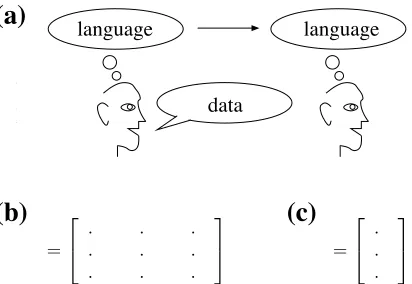
Figure 1: (a) A general model of the cultural transmis-sion of languages. A language is passed from one learner to another, and the matrix Qencodes the probability a learner will learn a particular languagei from someone who knows languagej. (b) An example transition matrix Qwith three states. (c) The solution to the eigenvector equation Qπ=π for this transition matrix. π gives the equilibrium probability that a learner will learn a particu-lar language when languages are transmitted via a process that has transition matrixQ.
one will learn languageifrom someone who knows language j. These can be encoded in a transition matrixQwhere the(i,j)th entry of the matrix cor-responds toqi j (see Figure 1).
Using this framework, we can formally define learnability biases and determine whether a learn-ability bias for some property necessarily implies that this property will be present in the majority of languages. As mentioned previously, we define learnability bias to mean that one type of language is more likely to be transmitted accurately to the next generation than another; this is similar to the notion of “cognitive bias” discussed in Wilson (2003) and is what is tested in experiments. Formally, a learn-ability bias for some language i over some other language jmeans thatqii>qj j. For example, one
might expose one group of learners to languageiand another group to language j. If more learners in the first group accurately learned the language they were exposed to, this would indicate a learnability bias for languageiover language j.
We can extend the idea of a learnability bias to a property of a language, rather than a specific guage, by applying a similar definition to sets of lan-guages. Imagine there are two sets of languages,H1
andH2. These sets might be defined by classifying
[image:2.612.316.522.70.212.2]all languages with a particular property in H1 and
all languages without the property inH2. One way
of defining a learnability bias that favors a particular property is for each language with that property to be more likely to be transmitted successfully than each language without that property. That is, for all pos-sible pairsi∈H1and j∈H2,qii>qj j. This would
indicate a general learnability bias for languages in
H1over languages inH2.
Using this definition of a learnability bias, we can determine whether such a bias is sufficient to estab-lish that the property will be present in the majority of languages. That is, if H1 denotes the languages
with the property of interest, we want to determine whether a learnability bias for languages inH1
im-plies that after many generations, the majority of the languages in the population will be in H1 and not
inH2. We can determine the consequences of many
instances of language transmission in this model by appealing to existing results on the equilibrium of this linear dynamical system. As mentioned above, this linear transmission model is related to two kinds of models that have been used to study language evolution: If we assume that learners are organized in a chain, this linear model is called iterated learn-ing (Kirby, 2001); alternatively, if we assume that there are an infinite number of learners in the pop-ulation, the model is called the replicator dynam-ics (Schuster & Sigmund, 1983). In either case, the probability that a learner will learn languageh, as-suming the population has reached equilibrium, is given by the solution to the eigenvector equation
Qπ=π, normalized such that∑n
i=1πi =1 (for
de-tails, see Griffiths & Kalish, 2007). For languages in
H1to occur the majority of the time, it thus must be
the case that∑h∈H1πh>∑h∈H2πh.
We can now identify one context in which a learn-ability bias is not sufficient to ensure that a property will appear in the majority of languages. Consider the example transition matrixQshown in Figure 1 (b). LetH1 ={s1} andH2={s2,s3}, where each
statesi represents a distinct language. We have that
q11>qiifor alli∈H2: each state inH2 has a lower
self transition probability than states1, the only state
in H1. Thus, we have a learnability bias for state
s1 over all states in H2. However, the eigenvector
π shown in Figure 1 (c) indicates that the equilib-rium of this system, which will be reached after
lan-guages are transmitted from person to person many times, favors states3over the other states. Overall,
∑h∈H1πh=0.39 while∑h∈H2πh=0.61: most of the learners will learn a language inH2.1
Intuitively, this result comes from the fact that transmission failures tend to favor languages inH2.
A learner who learns from someone who speaks a language i in H2 will rarely learn the language in
H1, although she may learn a different language than
iinH2. This pattern of transmission failures
over-whelms the learnability bias that the language inH1
has over the languages inH2. Note that this pattern
holds even given thatq1i>qi1for alli∈H2, another
common criterion for a learnability bias.
This result implies that if the linear transmission model is an accurate model for understanding hu-man language evolution, then it is not sufficient to compare how accurately languages are maintained over a single generation in order to predict what trends will emerge after many generations. Instead, one must also look at what happens when languages are not maintained accurately. The ways in which mutations occur may be as important as the relative fidelities of transmission in determining long term trends. When one only looks for a learnability bias, the rate of different mutations is not accounted for, leaving open the possibility that predictions about long term trends will be incorrect.
3 Simulating Language Transmission
In the previous section, we used a simple linear transmission model to identify one context in which a learnability bias is not sufficient for languages with a certain property to become prevalent. We now ex-plore a second context in which a learnability bias is not sufficient to guarantee that languages with a particular property become prevalent, using a sim-ulation of language transmission. We use an iter-ated learning model in which our representation of language is inspired by the principles and parame-ters approach (Chomsky & Lasnik, 1993). Rafferty, Griffiths, and Klein (2009) present a model similar to the one we consider here and show that
compa-1While one might try to resolve this issue by collapsing all
languages inH2into a single state in the Markov chain, such a transformation is possible only in cases whereqi j=qikfor all languages j,k∈H2andi∈/H2(Burke & Rosenblatt, 1958; Kemeny & Snell, 1960).
0 200 400 600 800 1000 0
512 1024
Language
Samples From Transition Matrix
0 256 512 768 1024 0
3500 7000
Frequency
Language Frequency
Other Target 0
5000 10000
Frequency
Relative Frequency of Target Language
0 200 400 600 800 1000 0
512 1024
Sample Iteration
Language
0 256 512 768 1024 3500
0 7000
Language
Frequency
Other Target 0
5000 10000
Frequency
λ = 0.6
[image:4.612.100.491.61.167.2]λ = 0.1
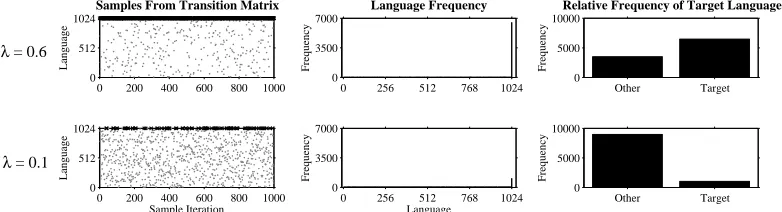
Figure 2: Model results for the frequency of the target language based on adjusting the bias towards that hypothesis. The rows in the above figure correspond to two possible values ofλ; largerλresults in a higher prior probability on the target language. The leftmost column shows 1,000 samples from the transition matrix, with black x marks
corre-sponding to occurrences of the target language. The middle column corresponds to the frequency of each language in the full 10,000 samples; the rightmost bar in each figure corresponds to the target language. The rightmost column
shows the frequency of the target language versus all other languages for the same 10,000 samples.
rable results hold using other representations of lan-guage, such as those based on optimality theory.
In order to define the transition matrixQ, we need to specify the process by which learners select a lan-guage. We assume that learners are Bayesian, mean-ing that they infer a languagehbased on the datad
that they receive according to Bayes’ rule. The pos-terior probabilityassigned tohafter observingd is
p(h|d)∝p(d|h)p(h), wherep(d|h)(thelikelihood) indicates the probability ofd being generated from
h, and p(h)(theprior) indicates the extent to which the learner was biased towardshbefore observingd. If we assume learners select hypotheses with proba-bility equal to their posterior probaproba-bility, we obtain a transition matrixQwith entries
qi j=p(h(t+1)=i|h(t)= j)
=
∑
d
p(h(t+1)=i|d)p(d|h(t)= j)
whereh(t)andh(t+1)are the languages of learners at
iterationstandt+1 respectively.
To represent languages, we use binary vectors of lengthN. Each place corresponds to the setting for a particular parameter. We consider one particular setting of the parameters to be the target language and include a learnability bias for this language in the model; we then look at whether this language is more prevalent than other languages after many transmissions. In the iterated learning model that we use, learners are organized into a chain, with each learner learning from data generated by the previous learner (Kirby, 2001). The previous learner
gener-ateskpieces of data that match her or his language. These pieces of data each specify the correct param-eter setting for one of the properties represented by the binary vector. The otherN−kproperties are left unspecified in the data given to the next learner.
In order to define the transition probability be-tween languages, we need to define the two terms in Bayes rule: the prior p(h) and the likelihood
p(d|h). Intuitively, the prior probability distribution over languages corresponds to how much evidence is required for the learner to learn each hypothesis. If one hypothesis has a very high prior probability, only a small amount of evidence will be required to convince the learner that that hypothesis is the cor-rect one. By controlling the prior probability of the target language versus the other languages, we can manipulate the learnability bias for the target lan-guage. We thus set the prior probability of the target language toλand then divide the remaining proba-bility mass of 1−λuniformly across all of the lan-guages (including the target language). The param-eterλ thus controls the strength of the learnability bias for the target language, but this language is al-ways favored for anyλgreater than 0.
learner will have a 1 in theith spot if the data had a 0 in that spot. This gives:
p(d|h) =∏Ni=1,di6=?ε
I(h`di)(1−ε)I(h0di)
whereh`dimeans thathhas the same setting of the
ith property asdi.
Given these specifications for the prior and the likelihood, we can calculate the 2N×2N transition
matrix and sample from this matrix to simulate a sequence of learners each learning a language from the utterances produced by the previous learner. We let N=10 and k =5. As shown in Griffiths and Kalish (2007), in this model – iterated learning with Bayesian learners – the equilibriumπis simply the prior distribution p(h). The distribution over lan-guages is thus unaffected by the error parameterε; this parameter only affects the time to reach equilib-rium (Rafferty et al., 2009). We present results using
ε=0.25. Figure 2 shows how relative frequency of the target language is affected by changing the pa-rameterλ, usingλ=0.6 andλ=0.1. Frequencies
are based on taking 11,000 samples from the ma-trix and discarding the first 1,000 to ensure that the
population had reached equilibrium.
The middle column of Figure 2 shows that the frequency with which learners chose the target lan-guage was greater than that of the other lanlan-guages for both values of λ. This is consistent with the target language having a higher prior probability than other languages. However, depending on the strength of the bias, this language may still not be chosen the majority of the time, as shown in the rightmost column of Figure 2. When λ is large, its probability overwhelms that of its competitors. However, ifλis relatively small, the combined fre-quencies of all other languages exceed that of the target language. Thus, despite being favored by a learnability bias, the target language is not chosen by the majority of learners. Like the previous example, this simulation demonstrates that learnability biases may not always lead to accurate prediction of long term trends. More specifically, it highlights that one must consider the size of the comparison set: If there are many alternate possible languages, learners may tend to learn one of these languages even if some particular language with a learnability bias is more frequent than any other given individual language.
4 Language Transmission in the Lab
While we have shown two scenarios in which a sim-ple linear transmission model does not predict that learnability biases will necessarily lead to linguistic universals, human learners are not necessarily con-sistent with this model and could follow a differ-ent pattern. Thus, we conducted two experimdiffer-ents to determine if the same dissociation between in-dividual bias and long-term change can be shown when teaching human learners an artificial gram-mar. In Experiment 1, we establish a learnability bias for a linguistic pattern that is common in the world’s languages over an arbitrary pattern. In Ex-periment 2, we explore what happens when a lan-guage with the common pattern is transmitted mul-tiple times among learners in the lab. Each learner learns a language and then produces data from this language to teach the next learner. By examining the languages that emerge after several transmissions, we will show that the learnability bias in Experi-ment 1 does not translate to the pattern becoming widespread across the learned languages in Experi-ment 2. This pattern is an instance of the scenario in which the many alternative languages overwhelm the language with the learnability bias.
In our experiments, we use the property of vowel harmony. Relatively common across the world’s languages (van der Hulst & van de Weijer, 1995), vowel harmony is a linguistic pattern wherein the vowels in words in a language must share some phonological feature. For example, in Turkish, the plural suffix is -larin bash-lar ‘heads’, but -lerin
bebek-ler‘babies’ so as to adhere to the requirement that words are front-back harmonic. In the former, both vowels are back vowels and in the latter, both vowels are front vowels. Harmony is well-suited for use in this case because English speakers have no fa-miliarity with vowel harmony from their native lan-guage input and because previous work has shown that typologically attested vowel harmony patterns are generally more easily learned (Moreton, 2008; Finley & Badecker, 2009).
5 Experiment 1: Establishing a Bias
5.1 Methods
Participants. There were 40 participants who
received either monetary compensation or course
credit for their participation. All were native speak-ers of English.
Stimuli. A native speaker of English was recorded
saying 160 CVCVC words. Each word began with one of 80 CVC stems, twenty each with the vow-els /i/, /e/, /u/ and /o/ and random consonants. Each stem was recorded with both variants, or al-lomorphs, of a suffix, [it] and [ut]. Thus, half the words were front-harmonic (e.g., pel-it, bis-it) and half were front-disharmonic (e.g., pel-ut, bis-ut).
Procedure.The procedure followed a modified
arti-ficial grammar paradigm. Participants were assigned to one of two conditions: the harmonic condition or the height-front dependency condition, which is unattested. In both conditions, participants were ex-posed in training to 40 words from the language they were learning. In the harmonic condition, 40 harmonic words were selected. In the height-front dependency condition, words were selected such that mid-vowel stems received the front vowel suffix (e.g., pel-it, bod-it) and high-vowel stems received the back-vowel suffix (e.g., bis-ut, tug-ut). This rule was chosen arbitrarily from the space of possible languages to test the hypothesis that vowel harmony would have a learnability bias over other patterns.
Participants were familiarized with the words in the same way regardless of condition. They were given alternating blocks of passive listening and blocks in which for each trial, two words were played and they were required to choose which word they had previously heard. In the forced choice tri-als, the choice was between a word that had been played in the passive listening section and a word with the same prefix and the alternate allomorph. A total of five blocks of 40 trials each were included in training: three passive listening blocks with a forced choice block in between each.
Following the training trials, participants com-pleted one block of 80 test trials. On each test trial, participants were asked to choose which of two words they thought was from the language they had learned in the training trials. In each trial, the two words both had the same stem and differed in the suffix. 40 of the test trials included words from training, and 40 were generalization trials involving novel words.
Height−Frontness Harmony 0
0.5 1
Proportion of Generalizations
Proportion of Generalizations Following Training Set Rule
Height−Frontness Harmony 0
0.5 1
Test Accuracy
[image:6.612.319.536.60.131.2]Test Accuracy by Training Set Rule
Figure 3: Results for harmonic versus height-frontness rule conditions. By condition, there are significant dif-ferences in the proportion of generalizations following the rule (0.70 for harmony rule versus 0.57 for height-frontness rule, t(38) =2.05,p<0.05; left) and in test accuracy (0.80 for harmony rule versus 0.68 for height-frontness rule,t(38) =2.23,p<0.05; right).
5.2 Results
As shown in Figure 3, we found a learnability bias for the harmonic language. Learners had signifi-cantly greater accuracy in test when they learned the vowel harmonic language than when they learned the height-front dependency language (80% correct for learners of the harmony rule versus 68% cor-rect for the height-frontness rule,t(38) =2.23,p<
0.05). Additionally, 70% of generalizations made by learners in the harmony rule condition followed the harmonic rule while only 57% of generaliza-tions made by learners in the height-front depen-dency condition followed the height-frontness rule (t(38) =2.05,p<0.05).2 The result of these two
phenomena was that the final languages produced by the learners in the harmony condition had a greater prevalence of harmonic words than the final lan-guages of learners in the height-frontness depen-dency had of adhering words.
These results establish that the probability of tran-sitioning from a harmonic language to another lan-guage with a high proportion of harmonic words is higher than the probability of transitioning from a height-front dependency language to another lan-guage with a high proportion of adhering words. In
2For the second experiment, participants who had low
terms of the transition matrix, this corresponds to
q`harm,`harm >q`h-f,`h-f, where `harm is the set of lan-guages with a high proportion of harmonic words and`h-f is the set of languages with a high
propor-tion of words that follow the height-frontness rule. In other words, the harmonic language is easier to learn than the height-front dependency language.
6 Experiment 2: Language Transmission
6.1 Methods
Participants. There were a total of 104
partici-pants who received either monetary compensation or course credit for their participation. All were native speakers of English.
Stimuli. The same stimuli were used as in
Experi-ment 1.
Procedure. The procedure for this experiment was
similar to Experiment 1, but the way that words were chosen for training differed. For the first subject in each chain, a total of 40 prefixes were selected at random, and based on the starting condition of the chain, the allophone for each prefix was selected. For example, for the 50% harmonic starting con-dition, 40 prefixes were chosen and of those pre-fixes, half were chosen to have the appropriate al-lophone to make the word harmonic and half were chosen to have the allophone to make the word non-harmonic. For subsequent subjects in each chain, 40 words were chosen at random from those words which the previous subject had said was in the lan-guage. In order to exclude subjects who had not ac-tually learned the language in training, subjects were not included in the chain if their accuracy in test on previously seen words was below 62.5%; this is the
lowest level of accuracy that is significantly differ-ent (binomial test, p<0.05) from chance guessing.
Chains were started at 100%, 75%, 50%, 25%, and 0% harmonic. One chain with 10 subjects was run for each starting point except for 100%. Four chains of 10 subjects each were run at this starting point as this is the point of most interest: given a learnabil-ity bias, does the percentage of harmonic words in a language remain consistently large?
6.2 Results
While Experiment 1 showed a learnability bias for the harmonic language over an arbitrarily chosen
language, the iterated learning chains in Experiment 2 did not favor the harmonic language. As shown in Figure 4, all chains tended toward languages with approximately 50% harmonic words, and after sev-eral generations, the chains that began with 100% harmonic words did not differ significantly from the other chains. There is also no difference in accuracy on the harmonic items over time, as shown in Figure 5. This is empirical evidence that the pattern shown in simulation can also occur with human learners: One language is more accurately transmitted than others, but due to the large number of other possi-ble languages, this language does not predominate after many transmissions.
7 General Discussion
In this paper, we formalized language transmission using a linear model in order to examine whether a learnability bias for some property of language is sufficient for that property to become prevalent in human languages. We showed two ways in which a learnability bias for a property can exist but not cause that property to become prevalent. First, using a mathematical analysis, we showed that this can oc-cur when transmission failures favor languages other than those that have greater learnability. This illus-trates the importance of considering the entire trans-mission matrix, not just the probabilities of accurate transmissions that are considered when establishing a learnability bias.
Second, we showed that it is possible for the sheer number of other possible languages to overwhelm greater learnability for a particular language. We then illustrated that this second scenario might lead to incorrect predictions in an experimental context. In artificial language experiments, greater learnabil-ity is often established by comparing the accuracy of transmission for a language with the property of interest to an arbitrary language. However, in our experiment, we established such a learnability bias for vowel harmony, but this did not result in vowel harmony being maintained after many instances of transmission. This result seems to be due to the fact that numerous languages other than harmonic lan-guages were possible, so learners tended to learn one of these many other languages.
One limitation of our analysis is the use of the
1 2 3 4 5 6 7 8 9 10 0.2
0.4 0.6 0.8 1.0
Proportion Harmonic
Proportion of Harmonic Words Chosen in Test
100% 75% 50% 25% 0%
1 2 3 4 5 6 7 8 9 10
0.2 0.4 0.6 0.8 1.0
Proportion of Generalizations in Test that were Harmonic
Iteration in Chain
Proportion Harmonic
[image:8.612.143.475.59.184.2]100% 75% 50% 25% 0%
Figure 4: Iterated learning chain results. Dotted lines show the two-tailed 95% confidence interval for chance re-sponding; confidence intervals differ between the two graphs because there are 40 opportunities to generalize versus 80 opportunities to choose harmonic words.
1 2 3 4 5 6 7 8 9 10
0.2 0.4 0.6 0.8 1.0
Accuracy
Accuracy for Harmonic Words
1 2 3 4 5 6 7 8 9 10
0.2 0.4 0.6 0.8 1.0
Iteration in Chain
Accuracy
Accuracy for Non−Harmonic Words
100% 75% 50% 25% 0% 100% 75% 50% 25% 0%
Figure 5: Accuracy on harmonic versus non-harmonic words by iteration. Overall, there is no difference in accuracy.
simple linear transmission model, in which each learner learns from one member of the previous gen-eration. It is easy to imagine variants on this model that make more realistic assumptions about cultural transmission of languages. However, we suspect that these more complex models would not alter the conclusions that we have drawn here. For exam-ple, learning from multiple members of the previous generation tends to dilute the effects of learnability on the languages produced by a population (Smith, 2009; Burkett & Griffiths, 2010).
Overall, the result of a more complicated relation-ship between learnability biases and linguistic uni-versals is congruent with the evidence that all lan-guages do not exhibit all properties for which learn-ability biases have been found. Indeed, in histori-cal linguistics, the general principle is one of lan-guage divergence, rather than convergence on some universal language (e.g., Greenberg, 1971). Given this relationship, one must rethink using experimen-tal evidence for particular learnability biases to ex-plain linguistic tendencies. Instead, one must either
estimate all of the values in the transmission matrix, or actually simulate the process of multiple trans-missions in the lab to establish whether a particu-lar property with a learnability bias is actually main-tained over many generations. While this process is dependent on assuming a particular model of how transmission occurs in populations, such as the lin-ear iterated llin-earning paradigm we used in our exper-iments, it provides a way of understanding what mu-tations are likely to occur and of exploring the long term trends that result from particular learnability bi-ases. As we showed for vowel harmony, long term trends may not match what one predicted based on a learnability bias. Given such a result, one must look to factors other than the learnability bias to explain why a property is common across languages.
Acknowledgements. This work was supported by an
[image:8.612.134.479.244.362.2]References
Becker, M., Ketrez, N., & Nevins, A. (2011). The surfeit of the stimulus: Analytic biases filter lexical statistics in turkish laryngeal alternations.Language,87(1), 84-125.
Burke, C. J., & Rosenblatt, M. (1958). A Markovian function of a Markov chain.The Annals of Mathemat-ical Statistics,29(4), 1112–1122.
Burkett, D., & Griffiths, T. (2010). Iterated learning of multiple languages from multiple teachers. InThe Evolution of Language: Proceedings of the 8th Inter-national Conference (EVOLANG8).
Chomsky, N., & Lasnik, H. (1993). The theory of prin-ciples and parameters. In J. Jacobs, A. von Stechow, W. Sternefeld, & T. Vannemann (Eds.),Syntax: An in-ternational handbook of contemporary research (pp. 506–569). Berlin: Walter de Gruyter.
Comrie, B. (1981). Language universals and linguistic typology. Chicago: University of Chicago Press. Croft, W. (2002). Typology and universals. Cambridge
University Press.
Finley, S., & Badecker, W. (2007). Towards a substan-tively biased theory of learning. Berkeley Linguistics Society,33.
Finley, S., & Badecker, W. (2009). Artificial language learning and feature-based generalization. Journal of Memory and Language,61, 423–437.
Greenberg, J. (Ed.). (1963). Universals of language. Cambridge, MA: MIT Press.
Greenberg, J. (1971). Language, culture, and communi-cation. Stanford: Stanford University Press.
Griffiths, T. L., & Kalish, M. L. (2007). A Bayesian view of language evolution by iterated learning. Cognitive Science,31, 441-480.
Kemeny, J., & Snell, J. (1960). Finite markov chains. Princeton, NJ: van Nostrand.
Kirby, S. (2001). Spontaneous evolution of linguistic structure: An iterated learning model of the emergence of regularity and irregularity. IEEE Journal of Evolu-tionary Computation,5, 102-110.
Komarova, N. L., & Nowak, M. A. (2003). Language dynamics in finite populations. Journal of Theoretical Biology,221, 445-457.
Labov, W. (2001). Principles of linguistic change. Vol-ume II: Social Factors. Blackwell.
Moreton, E. (2008). Analytic bias and phonological ty-pology.Phonology,25(1), 83–127.
Rafferty, A. N., Griffiths, T. L., & Klein, D. (2009). Convergence bounds for language evolution by iterated learning. Proceedings of the Thirty-First Annual Con-ference of the Cognitive Science Society.
Schuster, P., & Sigmund, K. (1983). Replicator dynam-ics.Journal of Theoretical Biology,100(3), 533 - 538.
Slobin, D. (1973). Cognitive prerequisites for the acqui-sition of grammar. In C. Ferguson & D. Slobin (Eds.), Studies of child language development(pp. 173–208). Smith, K. (2009). Iterated learning in populations of
Bayesian agents. In Proceedings of the 31st Annual Conference of the Cognitive Science Society.
van der Hulst, H., & van de Weijer, J. (1995). Vowel har-mony. In J. Goldsmith (Ed.),The Handbook of Phono-logical Theory(pp. 495–534). Blackwell.
Wilson, C. (2003). Experimental investigation of phono-logical naturalness. Proceedings of the 22nd West Coast Conference on Formal Linguistics.
Wilson, C. (2006). Learning phonology with substan-tive bias: An experimental and computational study of velar palatalization.Cognitive Science,30, 945–982.