Hindi Derivational Morphological Analyzer
Nikhil Kanuparthi LTRC IIIT-Hyderabad
India
{nikhil.kvs,abhilashi}
Abhilash Inumella LTRC IIIT-Hyderabad
India
@research.iiit.ac.in
Dipti Misra Sharma LTRC
IIIT-Hyderabad India
Abstract
Hindi is an Indian language which is rela-tively rich in morphology. A few morpholog-ical analyzers of this language have been de-veloped. However, they give only inflectional analysis of the language. In this paper, we present our Hindi derivational morphological analyzer. Our algorithm upgrades an existing inflectional analyzer to a derivational analyzer and primarily achieves two goals. First, it suc-cessfully incorporates derivational analysis in the inflectional analyzer. Second, it also in-creases the coverage of the inflectional analy-sis of the existing inflectional analyzer.
1 Introduction
Morphology is the study of processes of word for-mation and also the linguistic units such as mor-phemes, affixes in a given language. It consists of two branches: derivational morphology and in-flectional morphology. Derivational morphology is the study of those processes of word formation where new words are formed from the existing stems through the addition of morphemes. The meaning of the resultant new word is different from the original word and it often belongs to a different syntactic cat-egory. Example: happiness (noun) = happy (adjec-tive) + ness. Inflectional morphology is the study of those processes of word formation where various in-flectional forms are formed from the existing stems. Number is an example of inflectional morphology. Example: cars = car + plural affix ’s’.
The main objective of our work is to develop a tool which executes the derivational morphological
analysis of Hindi. Morphological analysis is an im-portant step for any linguistically informed natural language processing task. Most morphological ana-lyzers perform only inflectional analysis. However, derivational analysis is also crucial for better perfor-mance of several systems. They are used to improve the efficiency of machine translators (C Gdaniec et al., 2001). They are also used in search engines to improve the information extraction (J Vilares et al., 2001). Since derivational processes can often be productive in a language, the development of an ef-fective derivational analyzer will prove beneficial in several aspects.
We developed a derivational analyzer for Hindi over an already existing inflectional analyzer devel-oped at IIIT Hyderabad. In this approach, first, the derived words in Hindi were studied to obtain the derivational suffixes of the language. Then the rules were designed by understanding the properties of the suffixes. The Hindi Wikipedia was also utilized to collect the required background data. Finally, an al-gorithm was developed based on the above findings. This algorithm has been used to upgrade the inflec-tional analyzer to a derivainflec-tional analyzer.
In the sections that follow, we describe the ap-proach we followed to develop our derivational an-alyzer and the experiments that we conducted using our system.
2 Related Work
There is no derivational morphological analyzer for Hindi to the best of our knowledge. However, a few inflectional morphological analyzers (IIIT; Vishal and G. Singh, 2008; Niraj and Robert, 2010)
of this language have been developed. There are derivational analyzers for other Indian languages like Marathi (Ashwini Vaidya, 2009) and Kannada (Bhuvaneshwari C Melinamath et al., 2011). The Marathi morphological analyzer was built using a Paradigm based approach whereas the Kannada ana-lyzer was built using an FST based approach. As far as English is concerned, there are some important works (Woods, 2000; Hoeppner, 1982) pertaining to the area of derivational morphological analysis. However, both of these are lexicon based works.
For our work, we employed a set of suffix replace-ment rules and a dictionary in our derivational ana-lyzer, having taken insights from the Porter’s stem-mer (Porter, 1980) and the K-stemstem-mer (R. Krovetz. 1993). They are amongst the most cited stemmers in the literature. The primary goal of Porter’s stem-mer is suffix stripping. So when a word is given as input, the stemmer strips all the suffixes in the word to produce a stem. It achieves the task in five steps applying rules at each step. Given a word as input, the Krovetz stemmer removes inflectional suffixes present in the word in three steps. First it converts the plural form of the word into a singular form, then it converts past tense to present tense, and fi-nally removes -ing. As the last step, the stemmer checks the dictionary for any recoding and returns the stem. Our algorithm uses the main principles of both the Porters stemmer and Krovetz stemmer. The suffix replacement rules of our algorithm resemble that of the Porters and a segment of the algorithm is analogous to the dictionary based approach of the Krovetzs stemmer.
3 Existing Inflectional Hindi Morphological Analyzers
A derivational morph analyzer can be developed from an existing morph analyzer instead of build-ing one from scratch. So three inflectional analyzers were considered for the purpose. The morphological analyzer developed by Vishal and Gurpreet stores all the commonly used word forms for all Hindi root words in its database. Thus, space is a constraint for this analyzer but the search time is quite low. The morph analyzer developed by Niraj and Robert ex-tracts a set of suffix replacement rules from a corpus and a dictionary. The rules are applied to an inflected
word to obtain the root word. They show that the process of developing such rulessets is simple and it can be applied to develop morphological analyzers of other Indian languages.
However, our derivational analyzer is an exten-sion of an existing inflectional morphological ana-lyzer developed at IIIT Hyderabad (Bharati Akshar et al, 1995). The inflectional analyzer is based on the paradigm model. It uses the combination of paradigms and a root word dictionary to provide in-flectional analysis. Given an inflected Hindi word, this inflectional analyzer returns its root form and other grammatical features such as gender, num-ber, person, etc. For example: if the input word to the morphological analyzer isbAgabAnoM1 (gar-deners), the output will be bAgabAna (gardener), noun, m, pl, etc. Here the word bAgabAna is the root word of the input word. ’Noun’ is the cate-gory of the input word, ’m’ means masculine and ’pl’ means that the input word is plural in number.
The analyzer uses a root word dictionary for the purpose. If a word is present in the root word dic-tionary, the analyzer handles all the inflections per-taining to that word. For example:xe(give) is a root word present in the dictionary of the analyzer.xewA
(gives),xenA(to give),xiyA(gave) and other inflec-tional forms of the root word xe are handled by the analyzer. There are 34407 words in the root word dictionary.
The analyzer handles inflected words using the paradigm tables. Every entry (word) in the dic-tionary has values like lexical category, paradigm class, etc. For example: there is a wordpulisavAlA
(policeman) in the dictionary. Its paradigm class is ladakA. Table 1 shows the paradigm forms of
ladakA. Since the paradigm value of pulisavAlAis
ladakA, its four inflections will be similar to the four paradigms ofladakA(root paradigm). The four in-flections of pulisavAlA are pulisavAlA, pulisavAle, pulisavAle, pulisavAloM. Only the root form (word)
pulisavAlAis present in the dictionary. In this way every root word present in the dictionary belongs to a paradigm class and this paradigm class has a struc-tured paradigm table containing all the inflections of the main paradigm. This paradigm table is used by
1The Hindi words are in wx-format
Table 1: Paradigm table ofladakA
Case Singular form Plural form Direct ladakA(boy) ladake(boys) Oblique ladake(boy) ladakoM(boys)
the analyzer to reconstruct all the inflections of the root words belonging to this paradigm class. There-fore the analyzer can analyze a word only if its root word is present in the dictionary.
This inflectional morphological analyzer works as a platform for our derivational morphological ana-lyzer. So our tool gives derivational analysis of all the words whose root forms are present in the root word dictionary. Our tool also tackles certain words whose root forms are not present in the root word dictionary of the IIIT morphological analyzer.
4 Approach
We pursued the following five step approach for building our derivational analyzer.
4.1 Studying Hindi Derivations
To build the derivational morphological analyzer, we first conducted a study to identify the derivational suffixes and the related morphological changes. Af-ter identifying the suffixes, the rules pertaining to these suffixes were obtained.
First, the nouns present in the Hindi vocabulary were studied. The study of nouns helped us in iden-tifying some of the most productive derivational suf-fixes present in the language. For example, let us consider the wordmaxaxagAra (helper). This word is derived from the word maxaxa (maxaxagAra =
[image:3.612.339.511.77.294.2]maxaxa (help) + gAra). But gAra cannot be con-firmed as a suffix because of just one instance. In order to confirmgAraas a suffix, even other words ending withgAramust be examined. The more the number of words we find, the greater is the pro-ductivity of the suffix. Words like yAxagAra (de-rived from yAxa) and gunAhagAra (criminal) (de-rived from gunAha (crime)) prove that gAra is a derivational suffix. However, every word ending with gAra need not be a derived word. For exam-ple: the wordaMgArais not a derived word. There-fore only relevant words were studied and the suf-fixes were obtained only from them.
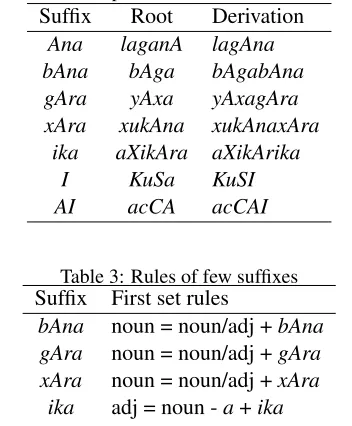
Table 2: Example derivations of some suffixes Suffix Root Derivation
Ana laganA lagAna bAna bAga bAgabAna gAra yAxa yAxagAra xAra xukAna xukAnaxAra
ika aXikAra aXikArika I KuSa KuSI AI acCA acCAI
Table 3: Rules of few suffixes Suffix First set rules
bAna noun = noun/adj +bAna gAra noun = noun/adj +gAra xAra noun = noun/adj +xAra
ika adj = noun -a+ika
The entire process of obtaining the derivational suffixes was done manually and was a time consum-ing process. This process was repeated for adjec-tives as well. Only those suffixes that participate in the formation of nouns and adjectives were found. A total of 22 productive derivational suffixes were procured. Table 2 shows a few suffixes and their derivations.
4.2 Derivational Rules
After finding the derivational suffixes, two sets of derivational rules were developed for each suffix. The first set explains the formation of the derived words from their root words. Let us consider the suffixgAra. This suffix generates nouns from nouns and adjectives. The rule of this suffix explains the formation of derivations likeyAxagAra (yAxagAra
= yAxa(noun) + gAra) andmaxaxagAra ( maxaxa-gAra=maxaxa+gAra). The second set consists of reverse rules of the first set. The reverse rule for the previous example is noun/adj = noun - suffix. In this way, rules were developed for all the 22 derivational suffixes. These rules form a vital component of our algorithm. Table 3 contains the derivational rules of a few suffixes.
4.3 Finding Majority Properties
[image:3.612.337.513.79.292.2]ex-hibit. Example: let us consider the derived words of the suffix vAlA. There are 36 derived words of the vAlA suffix in the root word dictionary. Some of these words are adjectives but the majority are nouns. Hence noun is fixed as the category (major-ity category) for derived words of this class. Simi-larly the majority paradigm class of these words is
ladakA. The majority properties of derived words pertaining to all the 22 suffixes were acquired.
The majority properties of a suffix help us in the derivational analysis of the unknown derived words of that suffix. For example: consider the word Gar-avAlA (housekeeper). Let us assume that it is not present in the root word dictionary. Therefore the lexical category, paradigm value and other important features of this word are not known. But let us as-sume that this word is a genuine derived word of the suffixvAlA. So the tool must handle this case. The majority properties of thevAlAsuffix are assigned to this word. So noun andladakAare fixed as the cat-egory and paradigm of this word. Thus the genuine derived words which are unknown to the analyzer will be analyzed using the majority properties.
The majority properties of derived words were ob-tained in two main steps. First, a suffix was consid-ered. Then all the derived words pertaining to that suffix were acquired. Only genuine derived words were taken into consideration. Genuine derivations were found out using the suffix derivational rules. Example: let us take the wordmaxaxagAra(ending withgAra). First, the root word of this word is re-trieved using the gAra derivational rule. The root word according to the rule ismaxaxa. This word is present in the dictionary and it also satisfies the cat-egory condition of the rule. The word maxaxais a noun. Hence the wordmaxaxagArais accepted as a derived word. If the wordmaxaxais not found in the dictionary or if its category is not a noun/adjective, the wordmaxaxagAra will be rejected. In this way all the valid derivations of the suffix were acquired. This process was repeated for other suffixes as well. In the second step, the majority properties of the de-rived words were directly retrieved.
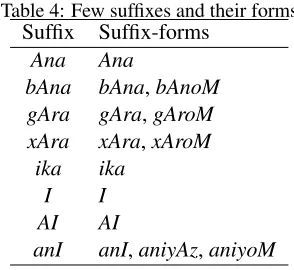
Finally, a suffix table was built using the major-ity properties of the derived words. The suffix table contains all the suffixes and their inflectional forms. Table 4 contains few suffixes and their inflectional forms. For example: the majority paradigm of
de-Table 4: Few suffixes and their forms Suffix Suffix-forms
Ana Ana
bAna bAna,bAnoM gAra gAra,gAroM xAra xAra,xAroM
ika ika I I AI AI
anI anI,aniyAz,aniyoM
rived words of vAlAsuffix is ladakA. This implies that the derived words of this suffix end withvAlA,
vAleand vAloM. Thus the possible inflections of a suffix can be derived from its majority properties. This information was stored in a table. The majority properties and the suffix table play an important role in the analysis of the unknown words. Their usage in our algorithm will be described in the later sections.
4.4 Using Wikipedia Data for Confirming
Genuineness
If an invalid word is not analyzed by the inflec-tional analyzer, there is no need for proceeding to the derivational analysis of that word. Therefore the genuineness of a word must be tested before going for the derivational analysis. The Hindi Wikipedia was chosen as a resource that enables us to test the genuineness of a word.
A total of 400k words were extracted from the Hindi Wikipedia. This data contains many words which do not exist in Hindi vocabulary. So 220k proper Hindi words were selected (on the basis of frequency) from the data and a list containing those 220k words was created. A word will be treated as a genuine word only when it is present in that list. This assumption is used by our algorithm. The Wiki data is used as a standard corpus.
4.5 Algorithm for Derivational Analysis
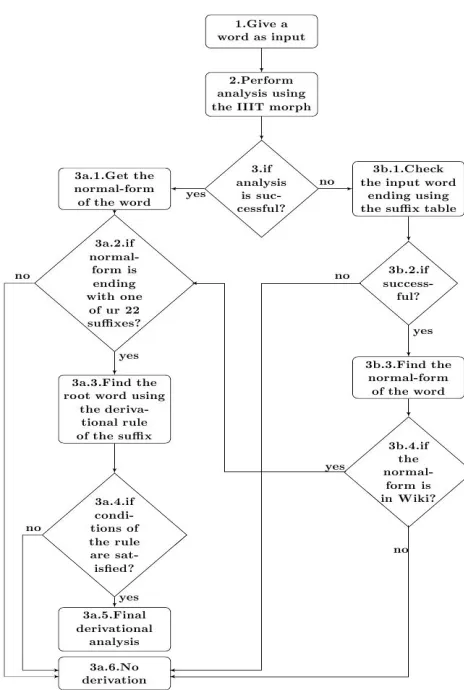
[image:4.612.352.499.69.204.2]un-known derivations.
Figure 1: Algorithm
The input to the algorithm is a word. The out-put is a combination of the inflectional analysis and the derivational analysis of the input word. For ex-ample: if the input word is bAgabAnoM (garden-ers). First, the algorithm gives the inflectional anal-ysis of the input word. In this case the word bAga-bAnoM is a noun, plural in number, etc. Then it gives the information (category, gender) of the root word (bAga(garden)) from which the input word is derived (derivational analysis). So a dual analysis of the input word is provided.
4.6 Examples
The following 4 examples explain the working of the algorithm in 4 different cases. These examples are provided to give a clear picture of the complete algorithm.
a) Example 1
Input word:pulisavAle(Policemen)
In the step-2, the word is analyzed by the IIIT inflectional analyzer. In the step 3a.1, the word
pulisavAlA (Policeman) is the normal-form of the input word. The normal-form is ending (vAlA) with one of our 22 suffixes. The rule of the suffix is noun = noun/verb + vAlA. So the root word is
pulisa because pulisavAlA = pulisa + vAlA. The word pulisa should be a noun or a verb in order to satisfy the rule. All the conditions are met and the step 3a.5 becomes the vital final step. This step gives the information that the final root word
pulisa is a masculine noun and the input word is also a masculine noun and it is plural in number. Here the information about the final root word and the input word is again given using the inflectional morphological analyzer.
b) Example 2
Input word:kirAexAroM(Tenants)
The IIIT inflectional analyzer cannot analyze this word. The word kirAexAroM is ending with one of the forms (xAroM) present in the suffix table. The normal-form of the input word is obtained by replacing the suffix form in the input word with the suffix. Hence the normal-form of the input word kirAexAroM is kirAexAra. In this way, the normal-form of the input word is acquired without the inflectional analyzer. The word kirAexAra is present in Wiki data and it is ending with one of the 22 suffixes. The rule of the suffix is noun = noun/adj +xAra. So the root word iskirAebecause
kirAexAra=kirAe+xAra.
c) Example 3
Input word:ladake(Boys)
In the step-2, the word is analyzed by the IIIT inflectional analyzer. The normal form of the word isladakA(boy). The normal-form of the word is not ending with any of our 22 suffixes. So there is no derivational analysis of this particular case.
d) Example 4
Input word:ppppwA(invalid word)
normal-form (ppppwA) is not present in Wikipedia. So there is no derivational analysis for this particular case.
4.7 Expanding Inflectional Analysis
The algorithm for derivational analysis was also used for expanding the inflectional analysis of the analyzer. Consider the second example in the pre-vious section. The word kirAexAroM is analyzed by the derivational analyzer even though its root form (kirAexAra) is not present in the root word dic-tionary. Words likekirAexAra are genuine deriva-tions and can be added to the root word dictio-nary. The addition of such kind of words will extend the inflectional analysis of the analyzer. For exam-ple. if the word kirAexAra is added, its forms ki-rAexAroMandkirAexArawill be automatically ana-lyzed. This is because the wordkirAexArawould be added along with its features/values like category, paradigm class, etc.
Therefore all the words which fall into the example-2 category of the previous section can be added to the dictionary. All such words must be ob-tained in order to expand our dictionary. For this purpose, a Wiki data consisting of 220k Wiki words was extracted from Wikipedia. Out of these 220k words, 40k words are ending with our 22 suffixes and their forms. So the derived words which can be analyzed by our system are part of this sub-dataset. Out of 40k words, the derivational analyzer analyzed 5579 words. The inflectional analyzer analyzed only 2362 words out of 40000. So the derivational an-alyzer analyzed 3217 derived words more than the inflectional analyzer. So these words were added to the root word dictionary for expanding the inflec-tional analysis of the analyzer. The algorithm which was designed to perform derivational analysis also inflated the inflectional analysis of the analyzer.
5 Experiments and Results
The performance of our derivational analyzer must be compared with an existing derivational analyzer. Since there is no such derivational analyzer, we compared the performance of our tool with the ex-isting IIIT inflectional analyzer (or the old morpho-logical analyzer). The two tools must be tested on a gold-data (data that does not contain any errors).
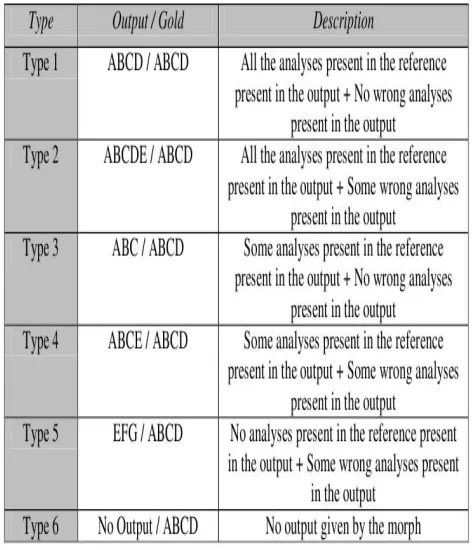
[image:6.612.315.551.253.528.2]For example: let us assume that we have a data of 100 words and their morphological analysis. The analysis of these 100 words does not contain any errors and it is a gold-data. Now we must get the analysis of these 100 words from both the deriva-tional analyzer and the old morphological analyzer. Then their analyses must be compared against the gold-data. This is nothing but directly comparing the outputs of the derivational analyzer and the old morphological analyzer. This will help in evaluating the derivational analyzer. This method of evaluation will also tell the improvement the derivational ana-lyzer achieved.
Figure 2: Evaluation Methodology for Morph Analyzers
Table 5: Output analysis of old morph analyzer Type Number of instances % of Type Type1 2361 47.2
Type2 763 15.2
Type3 419 8.4
Type4 575 11.5
Type5 599 11.9
Type6 288 5.8
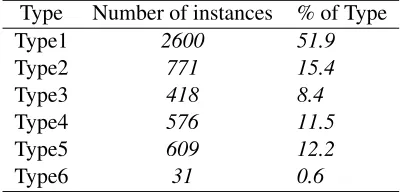
Table 6: Output analysis of derivational analyzer Type Number of instances % of Type Type1 2600 51.9
Type2 771 15.4
Type3 418 8.4
Type4 576 11.5
Type5 609 12.2
Type6 31 0.6
that the old morphological analyzer could not an-alyze 10 words but there is gold analysis of those words. In this way, each type forms an important part of the evaluation process. Similarly we evalu-ate the analysis of the 100 words by the derivational analyzer. Finally we compare the evaluations of the old morphological analyzer and our derivational an-alyzer. This is our evaluation methodology.
So a gold-data consisting of the analysis of 5000 words was taken. The linguistic experts of IIIT Hy-derabad have built this data and it was acquired from that institution. The 5000 words were tested on both the derivational analyzer and the inflectional ana-lyzer.
Both the analyzers were tested on the gold-data containing 5000 words. The table 6 proves that the performance of the new derivational analyzer is better than the old morphological analyzer. The old analyzer could not provide any output of 288 words (Type-6) whereas that number is only 31 in-case of the derivational analyzer. As a result of this improvement, the overall Type-1 (Perfect output which is completely matching with the gold output) of derivational analyzer is nearly 5% more than that of the old morphological analyzer. The data size is small (only 5000). A testing on a larger gold-data will show an even better picture of the improvement that can be achieved by the derivational analyzer.
6 Conclusions
We presented an algorithm which uses an exist-ing inflectional analyzer for performexist-ing derivational analysis. The algorithm uses the main principles of both the Porters stemmer and Krovetz stemmer for achieving the task. The algorithm achieves decent precision and recall. It also expands the coverage of the inflectional analyzer. But it must be incorpo-rated in applications like machine translators which use derivational analysis for understanding its real strengths and limitations.
References
Claudia Gdaniec, Esm Manandise, Michael C. McCord. 2001. Derivational morphology to the rescue: how it can help resolve unfound words in MT, pp.129–131. Summit VIII: Machine Translation in the Information Age, Proceedings, Santiago de Compostela, Spain. Jesus Vilares, David Cabrero and Miguel A. Alonso.
2001. Applying Productive Derivational Morphology to Term Indexing of Spanish Texts. In Proceedings of CICLing.
Vishal Goyal, Gurpreet Singh Lehal. 2008. Hindi Mor-phological Analyzer and Generator, pp. 1156–1159. IEEE Computer Society Press, California, USA. Niraj Aswani, Robert Gaizauskas. 2010.
Develop-ing Morphological Analysers for South Asian Lan-guages: Experimenting with the Hindi and Gujarati Languages. In Proceedings of LREC.
Ashwini Vaidya. 2009. Using paradigms for certain morphological phenomena in Marathi. In Proceedings of ICON.
Bhuvaneshwari C Melinamath, Shubhagini D. 2011. A robust Morphological analyzer to capture Kannada noun Morphology, VOL 13. IPCSIT.
William A. Woods. 2000. Aggressive Morphology for Robust Lexical Coverage. In Proceedings of ANLC. Wolfgang Hoeppner. 1982. A multilayered approach to
the handling of word formation. In Proceedings of COLING.
R. Krovetz. 1993. Viewing morphology as an inference process. In Proceedings of COLING.
M. F. Porter. 1980. An algorithm for suffix stripping. Originally published in Program, 14 no. 3, pp 130-137. Bharati Akshar, Vineet Chaitanya, Rajeev Sangal. 1995.
Natural Language Processing: A Paninian Perspec-tive. Prentice-Hall of India.
[image:7.612.85.287.211.307.2]