Proceedings of the Workshop on Evaluation Metrics and System Comparison for Automatic Summarization, pages 36–43,
The Heterogeneity Principle in Evaluation Measures for Automatic
Summarization
∗Enrique Amig´o Julio Gonzalo Felisa Verdejo UNED, Madrid
{enrique,julio,felisa}@lsi.uned.es
Abstract
The development of summarization systems requires reliable similarity (evaluation) mea-sures that compare system outputs with hu-man references. A reliable measure should have correspondence with human judgements. However, the reliability of measures depends on the test collection in which the measure is meta-evaluated; for this reason, it has not yet been possible to reliably establish which are the best evaluation measures for automatic summarization. In this paper, we propose an unsupervised method called Heterogeneity-Based Ranking (HBR) that combines summa-rization evaluation measures without requiring human assessments. Our empirical results in-dicate that HBR achieves a similar correspon-dence with human assessments than the best single measure for every observed corpus. In addition, HBR results are more robust across topics than single measures.
1 Introduction
In general, automatic evaluation metrics for summa-rization are similarity measures that compare system outputs with human references. The typical develop-ment cycle of a summarization system begins with selecting the most predictive metric. For this, evalu-ation metrics are compared to each other in terms
∗
This work has been partially funded by the Madrid gov-ernment, grant MA2VICMR (S-2009/TIC- 1542), the Spanish Government, grant Holopedia (TIN2010-21128-C02-01) and the European Community’s Seventh Framework Programme (FP7/ 2007-2013) under grant agreement nr. 288024 (LiMo-SINe project).
of correlation with human judgements. The sec-ond step consists of tuning the summarization sys-tem (typically in several iterations) in order to maxi-mize the scores according to the selected evaluation measure.
There is a wide set of available measures beyond the standard ROUGE: for instance, those comparing basic linguistic elements (Hovy et al., 2005), depen-dency triples (Owczarzak, 2009) or convolution ker-nels (Hirao et al., 2005) which reported some relia-bility improvement with respect to ROUGE in terms of correlation with human judgements. However, in practice ROUGE is still the preferred metric of choice. The main reason is that the superiority of a measure with respect to other is not easy to demon-strate: the variability of results across corpora, ref-erence judgements (Pyramid vs responsiveness) and correlation criteria (system vs. summary level) is substantial. In the absence of a clear quality crite-rion, the de-facto standard is usually the most rea-sonable choice.
system-produced summary improves each of the rest of summaries in comparison.
Our empirical results indicate that HBR achieves a similar correspondence with human assessments than the best single measure for every observed cor-pus. In addition, HBR results are more robust across topics than single measures.
2 Definitions
We consider here the definition of similarity mea-sure proposed in (Amig´o et al., 2011):
Being Ω the universe of system outputs (sum-maries)sand gold-standards (human references)g, we assume that a similarity measure is a function
x : Ω2 −→ < such that there exists a decompo-sition function f : Ω −→ {e1..en} (e.g., words
or other linguistic units or relationships) satisfying the following constraints; (i) maximum similarity is achieved only when the summary decomposition re-sembles exactly the gold standard; (ii) adding one element from the gold standard increases the simi-larity; and (iii) removing one element that does not appear in the gold standard also increases the simi-larity.Formally:
f(s) =f(g)⇐⇒x(s, g) = 1
(f(s) =f(s0)∪ {eg∈f(g)\f(s)}) =⇒
x(s, g)> x(s0, g)
(f(s) =f(s0)− {e¬g∈f(s)\f(g)}) =⇒ x(s, g)> x(s0, g)
This definition excludes random functions, or the inverse of any similarity function (e.g. f(1s)). It covers, however, any overlapping or precision/recall measure over words, n-grams, syntactic structures or any kind of semantic unit. In the rest of the paper, given that the gold standardgin summary evaluation is usually fixed, we will simplify the notation saying thatx(s, g)≡ x(s).
We consider also the definition of heterogeneity
of a measure set proposed in (Amig´o et al., 2011):
The heterogeneityH(X)of a set of measuresXis defined as, given two summariessands0 such that
g 6=s6=s0 6=g(gis the reference text), the
proba-bility that there exists two measures that contradict each other.
H(X)≡
Ps,s06=g(∃x, x0 ∈ X/x(s)> x(s0)∧x0(s)< x0(s0))
3 Proposal
The proposal in this paper is grounded on the hetero-geneity property of evaluation measures introduced in (Amig´o et al., 2011). This property establishes a relationship between heterogeneity and reliability of measures. However, this work does not provide any method to evaluate and rank summaries given a set of available automatic evaluation measures. We now reformulate the heterogeneity property in order to define a method to combine measures and rank systems.
3.1 Heterogeneity Property Reformulation
The heterogeneity property of evaluation measures introduced in (Amig´o et al., 2011) states that, as-suming that measures are based on similarity to hu-man references, the real quality difference between two texts is lower bounded by the heterogeneity of measures that corroborate the quality increase. We reformulate this property in the following way:
Given a set of automatic evaluation measures based on similarity to human references, the prob-ability of a quality increase in summaries is corre-lated with the heterogeneity of the set of measures that corroborate this increase:
P(Q(s)≥Q(s0))∼H({x|x(s)≥x(s0)})
whereQ(s)is the quality of the summarys accord-ing to human assessments. In addition, the proba-bility is maximal if the heterogeneity is maximal:
H({x|x(s)≥x(s0)}) = 1⇒P(Q(s)≥Q(s0)) = 1
a positive match between the automatic summary and the human references, according to any feature, should never be a negative evidence of quality.
As for the second part, if the heterogeneity of a measure set X is maximal, then the condition of the heterogeneity definition (∃x, x0 ∈ X.x(s) > x(s0)∧x0(s) < x0(s0)) holds for any pair of sum-maries that are different from the human references. Given that all measures inX corroborate the simi-larity increase (X ={x|x(s)≥x(s0)}), the hetero-geneity condition does not hold. Then, at least one of the evaluated summaries is not different from the human reference and we can ensure thatP(Q(s)≥ Q(s0)) = 1.
3.2 The Heterogeneity Based Ranking
The main goal in summarization evaluation is rank-ing systems accordrank-ing to their quality. This can be seen as estimating, for each system-produced sum-mary s, the average probability of being ”better” than other summaries:
Rank(s) =Avgs0(P(Q(s)≥Q(s0)))
Applying the reformulated heterogeneity property we can estimate this as:
HBRX(s) =Avgs0(H({x|x(s)≥x(s0)}))
We refer to this ranking function as the Heterogene-ity Based Ranking (HBR). It satisfies three crucial properties for a measure combining function. Note that, assuming that any similarity measure over hu-man references represents a positive evidence of quality, the measure combining function must be at least robust with respect to redundant or random measures:
1. HBR is independent from measure scales and it does not require relative weighting schemes between measures. Formally, beingf any strict growing function:
HBRx1..xn(s) =HBRx1..f(xn)(s)
2. HBR is not sensitive to redundant measures:
HBRx1..xn(s) =HBRx1..xn,xn(s)
3. Given a large enough set of similarity instances, HBR is not sensitive to non-informative measures. In other words, being xr a random function such that P(xr(s) > xr(s0)) = 12, then:
HBRx1..xn(s)∼HBRx1..xn,xr(s)
The first two properties are trivially satisfied: the ∃operator in H and the score comparisons are not af-fected by redundant measures nor their scale proper-ties. Regarding the third property, the Heterogeneity of a set of measures plus a random functionxris:
H(X ∪ {xr})≡
Ps,s0(∃x, x0∈ X ∪{xr}|x(s)> x(s0)∧x0(s)< x0(s0)) =
H(X) + (1−H(X))∗1
2 =
H(X) + 1
2
That is, the Heterogeneity grows proportionally when including a random function. Assuming that the random function corroborates the similarity in-crease in a half of cases, the result is a proportional relationship between HBR and HBR with the addi-tional measure. Note that we need to assume a large enough amount of data to avoid random effects.
4 Experimental Setting
4.1 Test Bed
We have used the AS test collections used in the DUC 2005 and DUC 2006 evaluation campaigns1 (Dang, 2005; Dang, 2006). The task was to gener-ate a question focused summary of 250 words from a set of 25-50 documents to a complex question. Sum-maries were evaluated according to several criteria. Here, we will consider the responsiveness judge-ments, in which the quality score was an integer be-tween 1 and 5. See Table 1 for a brief numerical description of these test beds.
In order to check the measure combining method, we have employed standard variants of ROUGE (Lin, 2004), including the reversed precision version for each variant2. We have considered also the F
1
http://duc.nist.gov/
2Note that the original ROUGE measures are oriented to
DUC 2005 DUC 2006 #human-references 3-4 3-4
#systems 32 35
#system-outputs-assessed 32 35
#system-outputs 50 50
[image:4.612.181.436.71.154.2]#outputs-assessed per-system 50 50
Table 1: Test collections from 2005 and 2006 DUC evaluation campaigns used in our experiments.
measure between recall and precision oriented mea-sures. Finally, our measure set includes also BE or Basic Elements (Hovy et al., 2006).
4.2 Meta-evaluation criterion
The traditional way of meta-evaluating measures consists of computing the Pearson correlation be-tween measure scores and quality human assess-ments. But the main goal of automatic evaluation metrics is not exactly to predict the real quality of systems; rather than this, their core mission is de-tecting system outputs that improve the baseline sys-tem in each development cycle. Therefore, the issue is to what extent a quality increase between two sys-tem outputs is reflected by the output ranking pro-duced by the measure.
According to this perspective, we propose meta-evaluating measures in terms of an extended version of AUC (Area Under the Curve). AUC can be seen as the probability of observing a score increase when observing a real quality increase between two sys-tem outputs (Fawcett, 2006).
AU C(x) =P(x(s)> x(s0)|Q(s)> Q(s0))
In order to customize this measure to our scenario, two special cases must be handled:
(i) For cases in which both summaries obtain the same value, we assume that the measure rewards each instance with equal probability. That is, if x(s) =x(s0),P(x(s)> x(s0)|Q(s)> Q(s0)) = 12.
(ii) Given that in the AS evaluation scenarios there are multiple quality levels, we still apply the same probabilistic AUC definition, considering pairs of summaries in which one of them achieves more quality than the other according to human assessors.
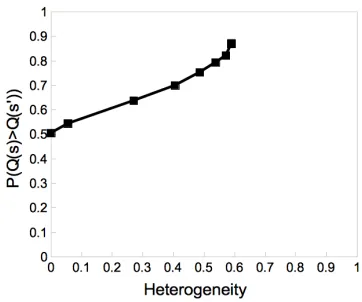
Figure 1: Correlation between probability of quality in-crease and Heterogeneity of measures that corroborate the increase
5 Experiments
5.1 Measure Heterogeneity vs. Quality Increase
We hypothesize that the probability of a real similar-ity increase to human references (as stated by human assessments) is directly related to the heterogeneity of the set of measures that confirm such increase. In order to verify whether this principle holds in prac-tice, we need to measure the correlation between both variables. Therefore, we compute, for each pair of summaries in the same topic the heterogeneity of the set of measures that corroborate a score increase between both:
H({x∈ X |x(s)≥x(s0)})
The Heterogeneity has been estimated by counting cases over 10,000 samples (pairs of summaries) in both corpora.
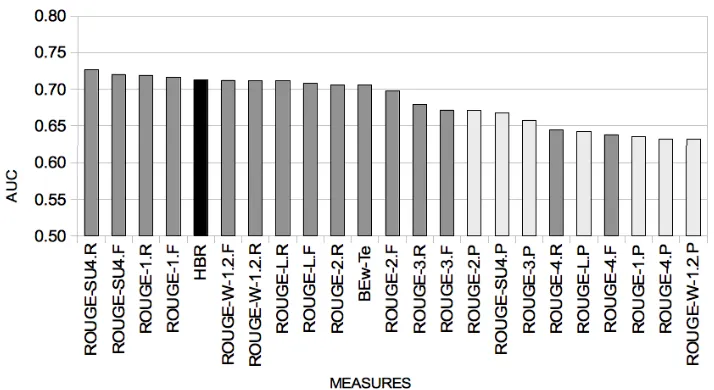
[image:4.612.336.517.194.345.2]Figure 2: AUC comparison between HBR and single measures in DUC 2005 and DUC 2006 corpora.
each interval, we have computed the average hetero-geneity of the set and the probability of real quality increase (P(Q(s)≥Q(s0))).
Figure 1 displays the results. Note that the direct relation between both variables is clear: a key for predicting a real quality increase is how heteroge-neous is the set of measures corroborating it.
5.2 HBR vs. Single Measures
In the following experiment, we compute HBR and we compare the resulting AUC with that of single measures. The heterogeneity of measures is esti-mated over samples in both corpora (DUC 2005 and DUC 2006), and HBR ranking is computed to rank summaries for each topic. For the meta-evaluation, the AUC probability is computed over summary pairs from the same topic.
Figure 2 shows the resulting AUC values of sin-gle measures and HBR. The black bar represents the HBR approach. The light grey bars are ROUGE measures oriented to precision. The dark grey bars include ROUGE variants oriented to recall and F, and the measure BE. As the Figure shows, recall-based measures achieve in general higher AUC val-ues than precision-oriented measures. The HBR measure combination appears near the top. It is im-proved by some measures such as ROUGE SU4 R, although the difference is not statistically significant (p = 0.36for a t-test between ROUGE SU4 R and HBR, for instance). HBR improves the 10 worst
single measures with statistical significance (p <
0.025).
5.3 Robustness
The next question is why using HBR instead of the “best” measure (ROUGE-SU4-R in this case). As we mentioned, the reliability of measures can vary across scenarios. For instance, in DUC scenarios most systems are extractive, and exploit the maxi-mum size allowed in the evaluation campaign guide-lines. Therefore, the precision over long n-grams is not crucial, given that the grammaticality of sum-maries is ensured. In this scenario the recall over words or short n-grams over human references is a clear signal of quality. But we can not ensure that these characteristics will be kept in other corpora, or even when evaluating new kind of summarizers with the same corpora.
Our hypothesis is that, given that HBR resembles the best measure without using human assessments, it should have a more stable performance in situa-tions where the best measure changes.
Figure 3: Average rank of measures over the 10% of topics with lowest results for the measure.
gets the worst ranks. Figure 3 shows the results: the worst performance of HBR across topics is better than the worst performance of any single measure. This confirms that the combination of measures us-ing HBR is indeed more robust than any measure in isolation.
5.4 Consistent vs. Inconsistent Topics
The Heterogeneity property is grounded on the as-sumption that any similarity criteria represents a positive evidence of similarity to human references. In general, we can assert that this assumption holds over a large enough random set of texts. However, depending on the distribution of summaries in the corpus, this assumption may not always hold. For instance, we can assume that, given all possible sum-maries, improving the word precision with respect to the gold standard can never be a negative evidence of quality. However, for a certain topic, it could hap-pen that the worst summaries are also the shortest, and have high precision and low recall. In this case, precision-based similarity could be correlated with negative quality. Let us refer to these as inconsis-tenttopics vs. consistent topics. In terms of AUC, a measure represents a negative evidence of quality when AUC is lower than 0.5. Our test collections contain 100 topics, out of which 25 are
inconsis-tent (i.e., at least one measure achieves AUC values lower than 0.5) and 75 are consistent with respect to our measure set (all measures achieve AUC values higher than 0.5).
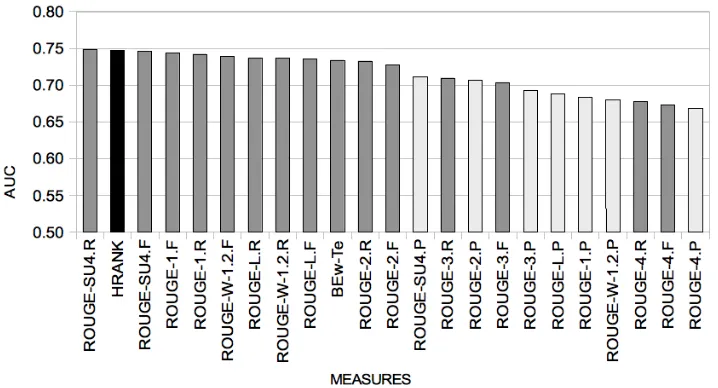
Figure ?? illustrates the AUC achieved by mea-sures when inconsistent topics are excluded. As with the full set of topics, recall-based measures achieve higher AUC values than precision-based measures; but, in this case, HBR appears at the top of the rank-ing. This result illustrates that (i) HBR behaves par-ticularly well when our assumptions on similarity measures hold in the corpus; and that (ii) in prac-tice, there may be topics for which our assumptions do not hold.
6 Conclusions
In this paper, we have confirmed that the heterogene-ity of a set of summary evaluation measures is cor-related with the probability of finding a real quality improvement when all measures corroborate it. The HBR measure combination method is based on this principle, which is grounded on the assumption that any similarity increase with respect to human refer-ences is a positive signal of quality.
addi-Figure 4: AUC comparison between HBR and single measures in corpora DUC2005 and DUC 2006 over topics in which all measures achieve AUC bigger than 0.5.
tion, HBR results are more robust across topics than single measures. Our experiments also suggest that HBR behaves particularly well when the assump-tions of the heterogeneity property holds in the cor-pus. These assumptions are conditioned by the dis-tribution of summaries in the corpus (in particular, on the amount and variability of the summaries that are compared with human references), and in prac-tice 25% of the topics in our test collections do not satisfy them for our set of measures.
The HBR (Heterogeneity Based Ranking) method proposed in this paper does not represent the “best automatic evaluation measure”. Rather than this, it promotes the development of new measures. What HBR does is solving –or at least palliating– the prob-lem of reliability variance of measures across test beds. According to our analysis, our practical rec-ommendations for system refinement are:
1. Compile an heterogenous set of measures, cov-ering multiple linguistic aspects (such as n-gram precision, recall, basic linguistic struc-tures, etc.).
2. Considering the summarization scenario, dis-card measures that might not always represent a positive evidence of quality. For instance, if very short summaries are allowed (e.g. one word) and they are very frequent in the set of system outputs to be compared to each other,
precision oriented measures may violate HBR assumptions.
3. Evaluate automatically your new summariza-tion approach within this corpus according to the HBR method.
Our priority for future work is now developing a reference benchmark containing an heterogenous set of summaries, human references and measures satisfying the heterogeneity assumptions and cover-ing multiple summarization scenarios where differ-ent measures play differdiffer-ent roles.
The HBR software is available at http://nlp.uned.es/∼enrique/
References
Enrique Amig´o, Julio Gonzalo, Jesus Gimenez, and Fe-lisa Verdejo. 2011. Corroborating text evaluation re-sults with heterogeneous measures. InProceedings of the 2011 Conference on Empirical Methods in Natu-ral Language Processing, pages 455–466, Edinburgh, Scotland, UK., July. Association for Computational Linguistics.
Hoa Trang Dang. 2005. Overview of DUC 2005. In Pro-ceedings of the 2005 Document Understanding Work-shop.
[image:7.612.128.487.73.267.2]Tom Fawcett. 2006. An introduction to roc analysis. Pattern Recogn. Lett., 27:861–874, June.
Tsutomu Hirao, Manabu Okumura, and Hideki Isozaki. 2005. Kernel-based approach for automatic evaluation of natural language generation technologies: Applica-tion to automatic summarizaApplica-tion. In Proceedings of Human Language Technology Conference and Confer-ence on Empirical Methods in Natural Language Pro-cessing, pages 145–152, Vancouver, British Columbia, Canada, October. Association for Computational Lin-guistics.
Eduard Hovy, Chin-Yew Lin, and Liang Zhou. 2005. Evaluating DUC 2005 using Basic Elements. Proceed-ings of Document Understanding Conference (DUC). Vancouver, B.C., Canada.
Eduard Hovy, Chin-Yew Lin, Liang Zhou, and Junichi Fukumoto. 2006. Automated Summarization Evalu-ation with Basic Elements. InProceedings of the 5th International Conference on Language Resources and Evaluation (LREC), pages 899–902.
Chin-Yew Lin. 2004. Rouge: A Package for Auto-matic Evaluation of Summaries. In Marie-Francine Moens and Stan Szpakowicz, editors,Text Summariza-tion Branches Out: Proceedings of the ACL-04 Work-shop, pages 74–81, Barcelona, Spain, July. Associa-tion for ComputaAssocia-tional Linguistics.