Adaptive Phase Matching in Grover’s Algorithm
Panchi Li1*, Kaoping Song2
1School of Computer & Information Technology, Northeast Petroleum University, Daqing, China 2School of Petroleum Engineering, Northeast Petroleum University, Daqing, China
E-mail:*[email protected]
Received June 28, 2011; revised August 16, 2011; accepted August 26, 2011
Abstract
When the Grover’s algorithm is applied to search an unordered database, the successful probability usually decreases with the increase of marked items. In order to solve this problem, an adaptive phase matching is proposed. With application of the new phase matching, when the fraction of marked items is greater
3 5
8 , the successful probability is equal to 1 with at most two Grover iterations. The validity of the new phase matching is verified by a search example.Keywords:Quantum Computing, Quantum Searching, Grover’s Algorithm, Phase Matching, Adaptive Phase Shifting
1. Introduction
Shor’s prime factoring algorithm and Grover’s quantum search algorithm are two of the great quantum algorithms [1,2]. Grover’s search algorithm provides a dramatic example of the potential speedup offered by quantum computers [2,3]. The problem addressed by Grover’s algorithm can be viewed as trying to find a marked ele-ment in an unsorted database of size N. To solve this problem, a classical computer would need, on average,
2
N database queries and N queries in the worst case. Using Grover’s algorithm, a quantum computer can ac-complish the same task using merely O
N
queries.The importance of Grover’s result stems from the fact that it proves the enhanced power of quantum computers compared to classical ones for a whole class of oracle- based problems, for which the bound on the efficiency of classical algorithms is known. At present, Grover’s quan- tum search algorithm has been greatly noticed and has become a challenging research field. However, the Grover’s algorithm also has some limitations. When the fraction of marked items is greater than a quarter of the total items in the database, the success probability will rapidly decrease, and when the fraction of marked items is greater than half of the total items in the database, the algorithm will be disabled.
Up to now, many efforts in improving Grover’s origi-nal algorithm have been done. Boyer et al. have given analytical expressions for the amplitude of the states in
Grover’s search algorithm and tight bounds on the algo-rithm [4]. Zalka has improved these tight bounds and showed that Grover’s algorithm is optimal [5]. Biron et al. generalized Grover’s algorithm to an arbitrarily dis-tributed initial state [6]. Pati recast the algorithm in geo-metric language and studied the bounds on the algorithm [7]. Ozhigov showed that quantum search can be further speeded up by a factor of 2 by parallelism [8]. Gin-grich et al. also generalized Grover’s algorithm with par-allelism with improvement [9]. The Grover’s original algorithm consists of inversion of the amplitude in the desired state and inversion-about-average operation [2]. In [10], Grover presented a general algorithm: Q
I U I U
, where U is any unitary operation, U is the adjoint of U, I I 2 , I I 2 , is an initial state and is a desired state. When
U U H, where H is the Walsh-Hadamard trans-formation, and 0 , the general algorithm becomes the original algorithm. Long extended Grover’s algo-rithm [11]. In Long’s algoalgo-rithm, I and I are ex-pressed as I I
1 ei
and I I
1 ei
, respectively. When π, Long’s algo-mes Grover’s original algorithm. Li et al. pro-posed that U in Long’s algorithm can be replaced by any unitary operation V [12,13]. Biham generalized the Grover’s algorithm to deal with an arbitrary pure initial state and an arbitrary mixed initial state [14,15]. In [16], Grover presented the new algorithm by replacing the selective inversions by selective phase shifts of rithm beco
P. C. LI ET AL. 44
al s
Just like classic earch algorithms the algorithm has a fixed point in state-space toward which it preferentially converges. Li et al. studied the changes of the approxi-mation error in the fixed-point search algorithm obtained by replacing equal phase shifts of π3 by different phase shifts [17].
The methods mentioned above cannot solve the prob-lem that the algorithm efficiencies decrease as the marked items increase. In this paper, we study the phase matching in Grover’s algorithm, and propose an adaptive matching, namely, f
, where is the fraction of marked items, and f
is the polynomial for . With application of the new phase matching, when is a rational number in range
3 5
8 to 1/4, the probability of getting correct results is equal to 1 with two Grover iterations, and when is greater than 1/4, the probability of getting correct results is equal to 1 with only one Grover iteration.This paper is organized as follows: In Section 2, we introduce Grover’s algorithm and its drawbacks. Section 3 is used to propose an adaptive phase matching with the higher success probability. Section 4 gives an example to verify the validity of new phase matching. Section 5 summarizes the whole paper.
2. Grover’s Algorithm and Its Problem
2.1. Grover’s Algorithm Summary
Suppose we wish to search through a search space of N elements. Rather than search the elements directly, we concentrate on the index to those elements, which is just a number in range 0 to . For convenience we as-sume , so the index can be stored in n qubits, and that the search problem has exactly M solutions, with
1 N
2n N
1MN. The algorithm begins with the state 0 n. The Walsh-hadamard transform is used to put the state
0n in the equal superposition state,
1
1 N
0
x
x N
(1)The Grover quantum search algorithm then consists of repeated application of a quantum subroutine, know as the Grover iteration or Grover operator, which we denote G. The Grover iteration may be broken up into four steps.
1) Apply the oracle O. The oracle is a unitary operator defined by its action on the computational basis
O x q x qf x (2) where x is the index register, denotes addition modulo 2, and the oracle qubit q is a single qubit which is flipped if , and is unchanged
other-wise.
1f x
2) Applying the Walsh-Hadamard transformHn. 3) Perform a conditional phase shift, with every com-putational basis state except 0 receiving a phase shift of –1, x
1x0 x .4) Applying the Walsh-Hadamard transformHn. It is useful to note that the combined effect of steps 2, 3, and 4 is
2 0 0
2n n
H I H I (3) where is the equally weighted superposition of states, (1). Thus the Grover iteration, G, may be written as G
2 I
O.Let M N, and CI(x) denote the integer closest to the real number x, where by convention we round halves down. Then repeating the Grover iteration
arc cos CI
2 arc sin
R
(4)
times rotates to within an angle arc sin π 4
of a superposition of marked states [18]. Observation of the state in the computational basis then yields a solution to the search problem with probability at least one-half.
2.2. Grover’s Algorithm Success Probability
In fact, the Grover iteration can be regarded as a rotation in the two-dimensional space spanned by the starting vector and the state consisting of a uniform super-position of solutions to the search problem. Let
represent a normalized states of a sum over all which are not solutions to the search problem, and represent a normalized states of a sum over all which are solutions to the search problem. Simple algebra shows that the initial state may be re-expresses as
cos t sin t
(5) where tarc sin . After R Grover iterations, the initial state is taken to
cos 2 1 arc sin
sin 2 1 arc sin R
G R
R
(6)
Hence, the success probability is
sin 2 2 1 arc sin
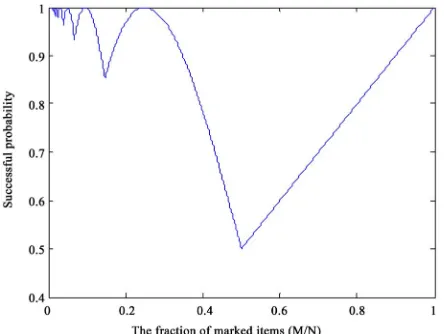
P R (7) The curve of P is shown in Figure 1.
2.3. The Drawback of Grover’s Algorithm
Figure 1. The success probability of Grover’s algorithm.
that when
3 5 8
0.14645, P decreases rap-idly. When 0.14645 1 4, P inc eases rapidly. When r1 4 1 2, P decreases rapidly. When 1 2, 0
R , P
there is , and the algorithm is disabled. Hence, the Grover's algorithm is no longer useful when
1 4
.
The reason for the problem is that the two phase rota-tions in Grover iteration are fully equivalent in both am-plitude and direction, namely . According to Ref. [18], the result of such phase rotations is that, for the one Grover iteration, the phase of the
π
increases 2arc sin
radians, and that rotating through at least arc cos
radians takes the to . When 3 5, 1 8
,
there are only 1
1 4 and 2
3 5
8
make R an
inte-ger, namely, 1
1
1 arccos
1, 2 arcsin
R
2
2
2 arccos
2 2 arcsin
R
.
3. The Adaptive Phase Matching for
Grover’s Algorithm
3.1. The Adaptive Phase Matching
The two phase shift operators in the Grover’s algorithm may be generally expressed as follows
1
1 ei M
m m m
U I
(8)
1 ei
eV iI (9) In the Grover’s original algorithm, there is π. According to the postulates of quantum mechanics [18], the evolution of a closed quantum system is described by
a unitary transformation. So as far as the unitarity of op-erators described by Equation (8) and Equation (9) is concerned, we have the following conclusions.
Theorem 1 The operators described by Equation (8) and Equation (9) are unitary.
Proof
1
U 1 ei M
m
I
1 1 2
1
2 e e
1 e 1 e
M M
i i
m m
M
i i
m
U U I
I
Hence, the operator described by Eqaution (8) is uni-tary.
1
1 e e
1 e 1 e
e e 2
M
i i
m
i i
i i
V I
V V
I I
Hence, the operator described by Equation (9) is uni-tary.
For the matching of and , we propose an adap-tive phase matching described by Theorem 2.
Theorem 2
1) When 1 4 1 and arc cos 2 1 2
,
the success probability P1 can be obtained after only one iteration.
2) When 3 5 1
8 4
and
3 5
arc cos 1 4
,
the success probability P1 can be obtained after only two iterations.
Proof 1) For described by Equation (1), applying one Grover iteration gives
1 3
1
j k
UV A x B x N
where
1 0
e e e
N M
i
i i
j
A M N
M
1
0
e e 1
M
i i i
k
B N M Me
P. C. LI ET AL. 46
using some simple algebra gives 831224
83 122 4 cos
43 82 5 . When cos
21 2
, namely, arc cos 2
1 2
,
2
3 2
3 2
max 3 2
8 12 4
4 8 5 1
4 3 4
P P
.
From cos 1, the range 1 4 1 may be ob-tained.
2) Reapplying one Grover iteration to 1 gives
2 1 5
1
j k
UV A x B x N
where
1 0
1 0
2 2
1 e e
1 1 e 1 e
1 e e
1 1 e 1 e
e e e
e e e e
N M
i i
j
i i
M
i i
k
i
i
i i
i i i i
A N C
N M C M D
B N D
i M D N M C
C M N M
D N M M
D Let
1 e e 1 1 e
1
i i i
i p N D M
N M e C
the success probability P is equal to M p
N5
2. Where , use some simple algebra gives
5 4 4 5 4 3 3
5 4 3 2 2
5 4 3 2
5 4 3 2
16 16 cos 64 112 48 cos
96 240 188 44 c os
64 208 232 100 12 cos
16 64 92 56 13 .
P
where cos 1 3 5
4
, P P max 1.
From cos 1, the range
3 5 8
1 may be obtained. Taking into account the only iteration is needed when 1 4 1, hence, the range for takes the form
3 5 8
14, and the adaptive phase matching takes the form arc cos 1
3 5 4
. □According to thorem 2, applying the adaptive phase matching, the Equation (8) and Equation (9) can be re- expressed as follows
1
1 ei M
m U I
(10)
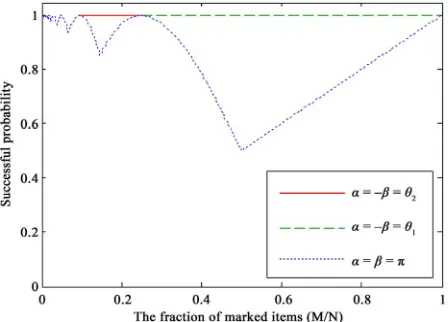
V 1 ei eiI (11) On the basis of the adaptive phase matching, the suc-cess probability curve is shown in Figure 2.
3.2. The Algorithm Description Based on the Adaptive Phase Matching
According to , we divide the search process into three cases.
1) When 0
3 5
8 , the original phase matching is applied.2) When
3 5 8
14create the phase of , the adaptive phase matching is applied. The search process can be described as follows:
Step 1 Applying Equation (10) to
the marked states rotate arc cos 4
3 5
4
radians, namely, 1 U .
Step 2 Applying Equation (11) to rotate the system superposition state 1 to 1 , namely, 1 V1
1
V U
.
Step 3 Reapplying Equation (10) to 1 , namely,
2
U 1 .
Step 4 Reapplying Equation (11) to 2 , namely, 2
V 2 V U
1
. Step 5 Measuring 2 . [image:4.595.312.536.512.673.2]3) When 1 4 1, the adaptive phase matching is applied. The search process can be described as fol-lows:
Figure 2. Comparison of success probability curves between Grover’s original algorithm and improved ones, where
1 arc cos 2 1 2 ,
Step 1 Applying Equation (10) to create the phase o the marked states rotate
f
arc cos 2 1 2
T e 2. The mbers an es.
Serial bers Marked states radians, namely, 1 U .
Step 2 Applying Equation superposition stat
(11) to rotate the system e 1 to 1 , namely, 1 V 1
V U
.
Step 3 Measuring 1 .
4. Searching Example
ss whose serial numbers are range 0 to 31. 1) The search targets are the students There are 32 students in a cla
in
whose serial number satisfies nCI 5
k3 3 ,
where0, 1, , 18
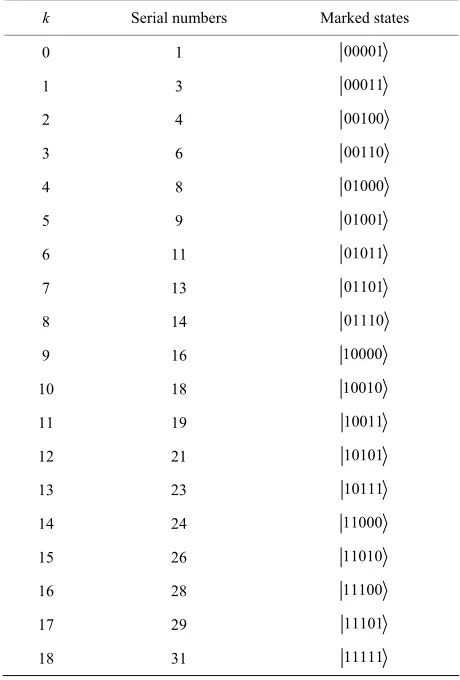
k . The target serial numbers and marked states are shown in Table 1. 2) are the serial number satisfies n9k2, where
0, 1, 2, 3
k . The target serial numbers and marked states are shown in Table 2.
wo searches, n 32
The search targets
In these t students whose
, using 5 qubits can store all serial numbers. The initial state of the is ex
erial numbers and marked states.
[image:5.595.56.286.383.723.2]pressed as follows
Table 1. The target s
k Serial numbers Marked states
0 1 00001
1 3 00011
2 4 00100
3 6 00110
4 8 01000
5 9 01001
6 11 01011
7 13 01101
8 14 01110
9 16 10000
abl target serial nu d marked stat
k num
0 2 00010
01011 1 11
2 20 10100
3 29 11101
1 0 1 31
4 2
1) In this search, M N19 32. According to eorem 2, applying
th arc cos 2
1
2
arc cos 3 19
correct
to this search, the probability of getting results is equal to 1 only one Grover iteration. The search process can be described as follows
10 18 10010
11 19 10011
12 21 10101
13 23 10111
14 24 11000
15 26 11010
16 28 11100
17 29 11101
18 31 11111
1
1 1
, 1, 1
e , 1, e , e , 1, e , 1, e , e , 1, e , 32
1, e , e , 1, e , 1, e , e , 1, e
1 e e
, , , , , , , , , , , 1
32 32
i
i i i i i i i
i i i i i i
i i
I
I
a b a b b a b a b b a
, , , , ,
, , , , , , , , , , , , , , , b a b b a b a b b a b a b b a b a b b a b
where
1 1 e
1, e , 1, e , e , 1, e , 1, e , e M
i
m m
m
i i i i i
19 ei ei 6 0,
a b19ei13ei 26
512 32 32
19 19 i
. The probability of finding the marked states is given as follows
2
2 2
1 512 32 32
19 1.
19 19
32
32
P
matching, as
For the original phase 19 32 0.5 , gure 1 is P
the success probability, according to Fi . ds rapidly In fact, here, the success probability descen
after applying a Grover iteration, which is described as follows
1
1
2M m m
m I
1, 1, 1, 1, 1, 1, 1, 1, 1, 1, 1, 1
1, 1, 1, 1, 1, 1, 1, 1, 1, 1, 1, 32
1, 1, 1, 1, 1, 1, 1, 1, 1, 1
P. C. LI ET AL. 48
1 2 1
, , , , , , , , , , , , , , , , 1 , , , , , , , , , , , , , , , , 32 32 I
a b a b b a b a b b a b a b b a b a b b a b a b b a b a b b a b
where
2) In this search, 11
a , b5.
1 8 M N
. According to theo-rem 2, applying arc cos 2 5 5
arc cos 2 5 5
getting correct results is to this search, the probability of
equal to 1 after only two Grover iterations. The search process can be described as follows
1 i 1 1 1 1 e , , , , , , , , , , , , , , , , 1 , , , , , , , , , , 32 32 M m m i i Ia a b a a a a a a a a b a a a a a a a a b a a a a a a
, , , , ,a a b a a
where
1, 1, e , 1, 1, 1, 1, 1, 1, 1, 1, e , 1, 1, 1, 1, 1
32 1, 1, 1, 1, e , 1, 1, 1, 1, 1, 1, 1, 1, e , 1, 1,
1 e e
m
i i
i i I
4 ei e i 24
a , b28 2 e
i
4ei.
2 1 1 1 e , , , , , , , , , , , , , , , , 1 , , , , , , , , , , , , , , , 32 32 M i m m m Ia a c a a a a a a a a c a a a a a a a a c a a a a a a a a c a a
where a4 e
iei
24, c28 2e
i 1
4ei2.
2 2
2
1 e e
, , , , , , , , , , , , , , , , 1
, , , , , , , , , , , , , , ,
32 320
i i
d d f d d d d d d d d f d d d d d d d d f d d d d d d d d f d d
I
where d16 e
i2ei2
320 e
iei
352 0 ,
2
i i i i2
16e 448e 134 112e 2016
512 4 5 4 i 5 1 20 5 44 .
The probability of finding the marked states is given as follows 4e f
2 2 2 2 2 5124 4 5 4 5 1 20 5 44 1
32 32
P
For the original phase matching, π, the mber of iterations is
nu-
arc cos arc cos 1 8
R
2 arc sin 2arc sin( 1 8)2
The search process can be described as follows
1
1
1, 1, 1,
1 m m m 2
1, 1, 1, 1, 1, 1, 1, 1, 1, 1, 1, 1, 1, 1, 1, 1, 1, 1, 1, 1, 1, 1, 1, 1, 1, 1, 1, 1, 1 32 M I
1 2 1
1, 1, 5, 1, 1, 1, 1, 1, 1, 1, 1, 5, 1, 1, 1, 1, 1
1, 1, 1, 1, 5, 1, 1, 1, 1, 1, 1, 1, 1, 5, 2 32
1, 1
I 2 1 1 2
1, 1, 5, 1, 1, 1, 1, 1, 1, 1, 1, 5, 1, 1, 1, 1, 1
1, 1, 1, 1, 5, 1, 1, 1, 1, 1, 1, 1, 1, 5, 1, 1 2 32 M m m m I
2 2 2
, , , , , , , , , , , , , , , , 1 , , , , , , , , , , , , , , , 4 32 I
a a b a a a a a a a a b a a a a a a a a b a a a a a a a a b a a
1,
a b11. where
2 11
4 0.9453125.
4 32 P
5. Conclusions
An adaptive phase matching in Grover's algorithm is d. Wit pplication of the new phase matching, fraction of arked items is greater than
propose h a
when the m
3 5
equal
8, the probability of getting correct results is to 1 after at most two Grover iterations. The valid-y of the new phase matching is verified bvalid-y two search
esearch Foundations of Heilongjiang Provin-rant No. 11551015).
. References
it
examples.
6. Acknowledgements
This paper was supported by National Natural Science Foundation of China (Grant No. 61170132), Chinese Po- stdoctoral Science Foundation (Grant Nos.20090460864 and 201003405), Heilongjiang Province Postdoctoral Science Foundation of China (Grant No. LBH-Z09289), Scientific R
cial Education Department (G
7
[1] P. W. Shor, “Algorithms for Quantum Computation: Dis-crete Logarithms and Factoring,” Proceedings of the 35th Annual Symposium on Foundations of Computer Science, Santa Fe, 20-22 November 1994, pp. 124-134.
doi:10.1109/SFCS.1994.365700
ACM Symposium on the Theory of Computing, 1996, pp.
] L. K. Grover, “Quantum Mechanics Helps in Searching for Database Search,” Proceedings of the 28th Annual
212-221. [3
for a Needle in a Haystack,” Physical Review Letters, Vol. 79, No. 2, 1997, pp. 325-328.
doi:10.1103/PhysRevLett.79.325
[4] M. Boyer, G. Brassard, P. HØyer and A. Tapp Bounds on Quantum Searching,”
, “Tight
Fortschritte Der Physik,
Vol. 46, No. 4-5, 1998, pp. 493-505.
doi: 10.1002/(SICI)1521-3978(199806)46:4/5<493::AID-PROP493>3.0.CO;2-P
[5] C. Zalka, “Grover’s Quantum Searching Algorithm Is Optimal,” Physical Review A, Vol. 60, No. 4, 1999, pp. 2746-2751. doi:10.1103/PhysRevA.60.2746
[6] D. Biron, O. Biham, E. Biham, “Generalized Grover Search Algorithm
M. Grassl and D. A. Lidar for Arbitrar
rithm and Bounds of Iterated Quantum Search by
Generalized
sing Any Transformation,” Physical Review Le
, y Ini-tial Amplitude Distribution,” quant-ph/9801066, 1998, pp. 1-8.
[7] A. K. Pati, “Fast Quantum Search Algo on It,” quant-ph/9807067, 1998, pp. 1-4. [8] Y. Ozhigov, “Speedup
Parallel Performance,” quant-ph/9904039, 1999, pp. 1- 21.
[9] R. Gingrich, C. P. Williams and N. Cerfm, “
Quantum Search with Parallelism,” quant-ph/9904039, 1999, pp. 1-14.
[10] L. K. Grover, “Quantum Computers Can Search Rapidly
by U tters,
Vol. 80, No. 19, 1998, pp. 4329-4332.
doi:10.1103/PhysRevLett.80.4329
[11] G. L. Long, Y. S. Li and W. L. Zhang, “Phase Matching in Quantum Searching,” Physics Letters A, Vol. 262, No. 1, 1999, pp. 27-34. doi:10.1016/S0375-9601(99)00631-3
[12] D. F. Li and X. X. Li, “More General Quantu
Algorithm Q = –I VI Uγ τ and the Precise Formula for the m Search Amplitude and the Non-syssetric Effects of Different Rotating Angles,” Physics Letters A, Vol. 287, No. 5-6, 2001, pp. 304-316.
doi:10.1016/S0375-9601(01)00498-4
[13] D. F. Li, X. X. Li and H. T. Huang, “Phase Condition for the Grover Algorithm,” Theoretical and Mathematical Physics, Vol. 144, No. 3, 2005, pp. 1279-1287.
doi:10.1007/s11232-005-0159-x
Grover’s Quantum [14] E. Biham, O. Biham and D. Birom, “
Search Algorithm for an Arbitrary Initial Amplitude Dis-tribution,” Physical Review A, Vol. 60, No. 4, 1999, pp. 2742-2745. doi:10.1103/PhysRevA.60.2742
[15] E. Biham and D. Kenigsberg, “Grover’s Quantum Search
.
Press, Algorithm for an Arbitrary Initial Mixed State,” Physical Review A, Vol. 66, No. 6, 2002, pp. 1-4.
[16] L. K. Grover, “Fixed-Point Quantum Search,” Physical Review Letters, Vol. 95, No. 15, 2005, pp. 1-4
[17] D. F. Li, X. R. Li, H. T. Huang and X. X. Li, “Fixed- Point Quantum Search for Different Phase Shifts,” quant- ph/0604062, 2006, pp. 1-8.