IN VITRO COMPARATIVE EVALUATION OF THE TRANSVERSE STRENGTH OF THREE
PROVISIONAL FIXED PARTIAL DENTAL PROSTHESES MATERIALS OF
DIFFERENT CHEMICAL COMPOSITION
Dr. Ulhas E. Tandale, *Dr. Jitendra J. Mete
Department of Prosthodontics,
ARTICLE INFO ABSTRACT
Aim: Evaluation and comparison of the transverse strength of three provisional prostheses
Material and Methods:
x10mm x1.5mm; and 35mm x10mm x2mm) were fabricated in three provisional prostheses
PMMAre
saliva before testing. All the specimens were subjected to three testing machine at cross head speed of 1mm/min to evaluate tra followed by Newman
Results:
the other two materials. DPI autopolymerising the three groups.
Conclusion:
anterior and posterior regions. DPI and Revotek LC materials should be restricted for t
anterior fixed partial dental prosthesis or posterior short span bridges where less forces are exerted.
Copyright © 2018, Dr. Ulhas E. Tandale et al. This unrestricted use, distribution, and reproduction in any medium,
INTRODUCTION
Provisional restoration is one of the most important components of fixed prosthesis. (Kim and Watts
et al., 2004) After tooth preparation and before the insertion of
final prosthesis, provisional restorations must be delivered to the patient for protection of prepared teeth, functional and esthetic purpose. In fixed partial dental prostheses (FPDP) treatment, the importance of provisional restorations is often ignored, resulting in various biological, esthetic, and functional complications.Provisional restorative material should serve mechanical, biological, and esthetic purposes.
al., 2006) Polymerization shrinkage, wear resistance, color stability, and strength of resin are important properties affecting biological, esthetic, and functional performance of provisional FPDP. (Koumjian and Nimmo,
al., 2005) From a mechanical viewpoint, the temporary restorative material should be chosen according to resista functional loads and removal forces. (Rosenstiel
*Corresponding author:Dr. Jitendra J. Mete,
Department of Prosthodontics, Government Dental College, Aurangabad, Maharashtra, India.
ISSN: 0975-833X
Vol.
Article History: Received 09th October, 2017 Received in revised form 15th November, 2017 Accepted 21st December, 2017 Published online 19th January, 2018
Citation: Dr. Ulhas E. Tandale, Dr. Jitendra J. Mete, Dr. Shankar P. Dange, Dr. Sonali S. Dahiwale and Dr. Vilas L.
comparative evaluation of the transverse strength of three provisional fixed partial dental prostheses materials of different International Journal of Current Research, 10, (01), 64041
Key words: Temporization, Self-cure PMMA resin, BISGMA resin, UDMA resin.
CASE STUDY
IN VITRO COMPARATIVE EVALUATION OF THE TRANSVERSE STRENGTH OF THREE
PROVISIONAL FIXED PARTIAL DENTAL PROSTHESES MATERIALS OF
DIFFERENT CHEMICAL COMPOSITION
Dr. Jitendra J. Mete, Dr. Shankar P. Dange, Dr. Sonali S. Dahiwale
and Dr. Vilas L. Rajguru
of Prosthodontics, Government Dental College, Aurangabad, Maharashtra, India
ABSTRACT
Evaluation and comparison of the transverse strength of three provisional prostheses materials of different chemical composition with varying thickness.
Material and Methods: Total ninety samples of three different sizes (35mm x10mm x1mm; 35mm x10mm x1.5mm; and 35mm x10mm x2mm) were fabricated in three provisional
prostheses materials of different chemical composition (Revotek LC, Protemp 3, and DPI PMMAresin). All the samples were stored at room temperature for twenty
saliva before testing. All the specimens were subjected to three-point bending tests by using universal testing machine at cross head speed of 1mm/min to evaluate transverse strength. One
followed by Newman-Keuls test was used for stastically analyzing the results.
Results: Protemp 3 exhibited superior transverse strength at any given thickness when compared with the other two materials. DPI autopolymerising PMMA resin showed least transverse strength amongst the three groups.
Conclusion: Protemp 3 can be usedfor provisional long span fixed partial dental prostheses in both anterior and posterior regions. DPI and Revotek LC materials should be restricted for t
anterior fixed partial dental prosthesis or posterior short span bridges where less forces are exerted.
This is an open access article distributed under the Creative Commons medium, provided the original work is properly cited.
Provisional restoration is one of the most important Watts, 2004; Hamza After tooth preparation and before the insertion of provisional restorations must be delivered to the patient for protection of prepared teeth, functional and esthetic purpose. In fixed partial dental prostheses (FPDP) treatment, the importance of provisional restorations is often ous biological, esthetic, and functional complications.Provisional restorative material should serve mechanical, biological, and esthetic purposes. (Rosenstiel et
Polymerization shrinkage, wear resistance, color are important properties affecting biological, esthetic, and functional performance of , 1990; Haselton et
From a mechanical viewpoint, the temporary restorative material should be chosen according to resistanceto
Rosenstiel et al., 2006)
Department of Prosthodontics, Government Dental College, Aurangabad,
One of the important aspects of provisional
especially in case of long-span interim prosthesis with short height pontics and connectors, is their transverse strength. The transverse strength of interim prosthesis also plays a critical role in patients with parafunctionalhabits, bruxism clenching. (Nejatidanesh et al
integrity of provisional prostheses leads to tooth movement and functional and esthetic problems. In addition, a repairing procedure may be boring and time consuming.
1998) Materials used for provisional FPDP haveevolved, their first generationof acrylics and premade crown to more recent BIS-GMA materials and computer
computeraided manufacturing (CAD/CAM) restorations. and Magnuson, 2012; Nejatidane
chemical composition, the provisional restorativematerials can be divided in to 3 groups; Polymethyl methacrylate (PMMA), Microfilledbisphenol A-glycidyl Dimethacrylate (BIS
composite resin, and urethane dimethacrylat polymerizing resins). Poly (methyl methacrylate) (PMMA) resins arerelatively inexpensive; they render good color stability, good marginal accuracy, and excellent polish. However, the main drawbacks of this type of resins arehigh
International Journal of Current Research
Vol. 10, Issue, 01, pp.64041-64046, January, 2018
Dr. Ulhas E. Tandale, Dr. Jitendra J. Mete, Dr. Shankar P. Dange, Dr. Sonali S. Dahiwale and Dr. Vilas L.
comparative evaluation of the transverse strength of three provisional fixed partial dental prostheses materials of different 64041-64046.
Available online at http://www.journalcra.com
IN VITRO COMPARATIVE EVALUATION OF THE TRANSVERSE STRENGTH OF THREE
PROVISIONAL FIXED PARTIAL DENTAL PROSTHESES MATERIALS OF
Dr. Sonali S. Dahiwale
Maharashtra, India
Evaluation and comparison of the transverse strength of three provisionalfixed partial dental materials of different chemical composition with varying thickness.
Total ninety samples of three different sizes (35mm x10mm x1mm; 35mm x10mm x1.5mm; and 35mm x10mm x2mm) were fabricated in three provisional fixed partial dental materials of different chemical composition (Revotek LC, Protemp 3, and DPI sin). All the samples were stored at room temperature for twenty-four hours in artificial point bending tests by using universal nsverse strength. One-way ANOVA Keuls test was used for stastically analyzing the results.
Protemp 3 exhibited superior transverse strength at any given thickness when compared with PMMA resin showed least transverse strength amongst
Protemp 3 can be usedfor provisional long span fixed partial dental prostheses in both anterior and posterior regions. DPI and Revotek LC materials should be restricted for temporization of anterior fixed partial dental prosthesis or posterior short span bridges where less forces are exerted.
Commons Attribution License, which permits
One of the important aspects of provisional restorations, span interim prosthesis with short-height pontics and connectors, is their transverse strength. The transverse strength of interim prosthesis also plays a critical role in patients with parafunctionalhabits, bruxism, or
et al., 2009) Fracture or loss of
integrity of provisional prostheses leads to tooth movement and functional and esthetic problems. In addition, a repairing procedure may be boring and time consuming. (Ireland et al., Materials used for provisional FPDP haveevolved, from their first generationof acrylics and premade crown to more GMA materials and computer-aided design/ manufacturing (CAD/CAM) restorations. (Perry
Nejatidanesh et al., 2006) Based on their chemical composition, the provisional restorativematerials can be divided in to 3 groups; Polymethyl methacrylate (PMMA), glycidyl Dimethacrylate (BIS - GMA) composite resin, and urethane dimethacrylate(light-polymerizing resins). Poly (methyl methacrylate) (PMMA) resins arerelatively inexpensive; they render good color good marginal accuracy, and excellent polish. However, the main drawbacks of this type of resins arehigh
INTERNATIONAL JOURNAL OF CURRENT RESEARCH
polymerization shrinkage, exothermic polymerization, low strength, low wear resistance, and pulpal irritationas the result of excess free monomers. In comparisonto PMMA resins, poly R′ methacrylate have lowpolymerization shrinkage and low exothermic reaction. However, they have limitations in clinical use such aslow strength, low wear resistance, and low color stability. Bis-acryl composite resins are superior to methacrylatebase resins as the result of their low polymerizationshrinkage, low exothermic reaction, good wear resistance, and good strength. Nonetheless, they are expensive, brittle, less polishable, and much more difficult to repair. (Jo et al., 2011)There is no interim material which can fulfill all requirements for every situation. (Robinson and Hovijitra, 1982; Wang et al., 1989) Therefore, clinicians always select their product based on the determinant factors such as cost effectiveness, esthetic, strength, marginal adaptability, and easy manipulation. (Nejatidanesh et al., 2009)As mentioned earlier, the flexural strength of provisional material is important, particularly when the patient must use the provisional restoration for an extended period, when the patient exhibits parafunctional habits, or when a long span prosthesis is planned.
Hence this study is undertaken to determine the transverse strength of three commercially available and commonly used provisional restorative materials of varied chemical composition: Revotek LC (Urethane Dimethacrylate Visible Light Cure Resin) Protemp 3 Garant (Bis-Acrylic composite Resins) and DPI tooth colored autopolymerising resin (Poly Methyl Methacrylate Resin) in three clinically significant thicknesses of 1mm, 1.5mm and 2mm simulating full metal, metal ceramic and full ceramic restorations respectively.
MATERIALS AND METHODS
Three provisional restorative materials to be tested were divided in to three groups:
Group I - Light-Cured UDMA resin (Revotek LC, GC Corporation; Tokyo, Japan),
Group II - BIS-GMA composite resin (Protemp 3 Garant, 3M ESPE; Seefeld, Germany), and
Group III – Autopolymerising PMMA resin (DPI, India). Each group was further divided in to three subgroups based on thickness: A, B and C for the thickness of 1mm, 1.5mm and 2mm respectively. Thus total ninety specimens were fabricated, ten in each nine groups that is: Group IA, Group IB, Group IC, Group IIA, Group IIB, Group IIC, Group IIIA, Group IIIB and Group IIIC.
Two metal master plates of dimension 70x50mm and three split plates with slots of the dimensions 35mm x10mm x 1mm, 35mm x10mm x 1.5mm, and 35mm x10mm x 2mm were used to fabricate the specimens of materials to be tested as described below (Figure 1).
Revotek LC: Revotek LC is a visible light cured urethane
dimethacrylate resinsupplied in a single paste form. The material was placed the split plate molds with the help of spatula provided by manufacturer and a well-lubricated glass slab was placed over it under a constant pressure of five kilograms. Then the material was light cured for sixty seconds with a light cure gun. The glass plate was removed to retrieve the specimens. Specimens were placed for sixty seconds in
[image:2.595.310.557.111.307.2]light curing chamber for complete curing of the material. The excess was removed from the specimens using a fine grit abrasive paper and the dimensions were confirmed using a Vernier Caliper.
Figure 1. Metal master mold consisting of two metal master plates and three split plates with slots used for fabricating test specimens
Protemp 3 Garant: Protemp 3 Garant is a Bis-acryl composite
resin supplied in auto mixing cartridge form. The resin was directly loaded in the split plate molds which were well lubricated with petroleum jelly. The molds were placed under the constant load of five kilograms for removal of excess material (Figure 2). Specimens were retrieved from the mold after 6 minutes and excess was removed using a fine grit abrasive paper and the dimensions were confirmed using a Vernier Caliper.
Figure 2. Application of a constant load of five kilograms under universal testing machine
DPI Tooth colored Autopolymerising Acrylic Resin:
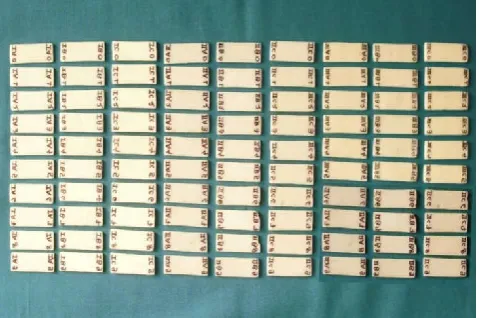
[image:2.595.308.561.466.671.2]from the molds. The excess was removed from the sample using a fine grit abrasive paper and the dimensions were confirmed using a Vernier Caliper. In this way total of ninety samples were prepared and were stored in room temperature for twenty-four hours under normal atmospheric conditions before the three-point bending test for transverse strength (Figure 3). Each specimen was mounted on a specially designed self-aligning jig for resistance testing on Universal Testing Machine, which secured it firmly at its ends, keeping the span for loading for the 3-point bending test (Figure 4). The 3- point bending test was carried at a crosshead speed of 1mm/min using the Universal Testing Machine (Model 4467, Bluestar, India). The fracture load (load at which the specimen fractured) was noted on the specific meters. The procedure was repeated accordingly for fracture of all the specimens. The values of the fracture load were obtained in Kilo Newton. Transverse strength of specimens was calculated by using following formula: δ =3 PI/2BD2
Figure 3. Total 90 specimens of three materials of three thicknesses
[image:3.595.42.280.455.653.2][
Figure 4. Testing of specimens under universal testing machine
Where, P: fracture load, I: distance between the supports, B: width of the specimen, and D: thickness of the specimen. The results obtained were statistical analyzed by using one-way ANOVA followed by Newman-Keuls test.
RESULTS
Table 1 shows the mean transverse strengths of the three provisional restorative materials and their standard deviation with 95% confidence interval for three thicknesses. The
Revotek LC shows a mean transverse strength of 91.08±5.31 for 1mm, 103.60±3.86 for 1.5mm and 115.89±1.22 for 2mm. Protemp 3 Garant shows a mean transverse strength of 104.63±3.69 for 1mm, 117.99±2.22 for 1.5mm, 128.83±1.13 for 2mm. DPI shows a mean transvers strength of 80.01±2.88 for 1mm, 91.19±2.55 for 1.5mm and 103.07±1.58 for 2mm. Protemp 3 Garant exhibits superior transverse strength at any given thickness when compared with the other two materials. DPI showed least transverse strength amongst the three groups. Table 2 shows the one-way ANOVA results amongst and within the three thicknesses for the three materials (Revotek LC, Protemp 3 Garant and DPI). Stastically significant difference in mean transverse strength was seen in all the groups tested (P <0.05). Group IA (91.08 MPa) was compared with all other Groups to determine the level of significance in the values of transverse strength by Newman-Keuls test. The results revealed high statistical significance with all groups except Group IIIB (91.19 MPa). Group IB (103.60 MPa) was compared with all other Groups to determine the level of significance in the values of transverse strength by Newman-Keuls test. The results showed statistically significant difference with all other groups except Group IIA (104.63 MPa) and Group IIIC (103.07MPa). Group IC (115.89 MPa) was compared with all other groups to determine the level of significance in the values of transverse strength by Newman-Keuls test. The results show high statistical significant difference with all other groups except Group IIB (117.99 MPa).
Group IIA (104.63 MPa) was compared with all other groups to determine the level of significance in the values of transverse strength by Newman-Keuls test. The results show high statistical significance with all other groups except Group IB (117.99 MPa) and Group IIIC (103.07 MPa).Group IIB (117.99 MPa) was compared with all other groups to determine the level of significance in the values of transverse strength by Newman-Keuls test. The results indicatestatistically significant difference with all other groups except Group IC (115.89 MPa). Group IIC (128.83 MPa) was compared with all other groups to determine the level of significance in the values of transverse strength by Newman-Keuls test. The results show high statistical significance with all other groups. This group reveals highest transverse strength in all the groups compared. Group IIIA (80.01 Mpa) was compared with all other groups to determine the level of significance in the values of transverse strength by Newman-Keuls test. The results show high statistical significance with all other groups. This group reveals lowest strength in all the groups compared. Group IIIB (91.19 MPa) was compared with all other groups to determine the level of significance in the values of transverse strength by Newman-Keuls test. The results show high statistical significance with all other groups except Group IA (91.08 MPa) which reveals statistically insignificant results. Group IIIC (103.07 MPa) was compared with all other groups to determine the level of significance in the values of transverse strength by Newman-Keuls test. The results show high statistical significance with all other groups except Group IB (103.60 MPa) and Group IIA (104.63 MPa) which seems statistically insignificant.
DISCUSSION
(Rosentritt et al., 2004)Fracture of a provisional restoration is annoying to the patient and the dentist. If the restoration is repaired it may re-fracture in the future. Alternatively, remaking of the provisional restoration may be time consuming. (Wang et al., 1989)Some research has been done regarding the fracture resistance of provisional restorative materials of various available commercial brands and acrylic resins. However, there is not much information available regarding the transverse strength of provisional restorative materials used in varying thicknesses resembling the various clinical situations in which operator prepare tooth for various types of fixed partial denture prostheses i.e.1mm for metal. 1.5mm for metal ceramic and 2mm for all ceramic restorations. In the clinical situation a fixed partial denture is subjected to a variety of forces under load. These forces have been shown by three-point bend test, which analyzes the stress as compressive at the point of application of load, and tensile, and shear at the points of resistance to that load. (Haselton et al., 2002)Present study encompasses the comparison of the transverse strength of three commercially available provisional restorative materials, Revotek LC (visible light cured urethane dimathacrylate), Protemp 3 Garant (bis-acryl composite) and, DPI (polymethyl methacrylate) in three clinically significant thicknesses of 1mm, 1.5mm and 2 mm simulating full metal, metal ceramic and full ceramic restorations respectively. For the 1mm thick samples, the samples made from Protemp 3 Garant showed superior transverse strength showing a mean of 104.63 MPa with a range between 101.99 and 107.27 MPa. Revotek LC showed a mean transverse strength of 91.08 MPa with a range between 87.24 and 94.83 MPa. DPI showed least transverse strength with a mean of 80.01 MPa and a range between 77.95 and 82.07 MPa. For the 1.5mm thick samples, the samples made from Protemp 3 Garant showed superior transverse strength showing a mean of 117.99 MPa with a range between 116.41 and 119.58 MPa. Revotek LC showed a mean transverse strength of 103.60 MPa with a range between 100.83 and 106.40 MPa. DPI showed least transverse strength with a mean of 91.19 MPa and a range between 89.36 and 93.01 MPa.
For the 2mm thick samples, the provisional restorations made from Protemp 3 Garant showed superior transverse strength showing a mean of 128.83 MPa with a range between 128.03
and 129.64 MPa. Revotek LC showed a mean transverse strength of 115.89 MPa with a range between 115.02 and 116.77 MPa. DPI showed least transverse strength with a mean of 103.07 MPa and a range between 101.94 and 104.20 MPa. Differences in transverse strength can be partly attributed to differences in chemical composition. Traditional methyl methacrylate-type resins (DPI) are monofunctional. They are low molecular weight, linear molecules that exhibits decreased strength and rigidity. Bis-acryl composite materials are difunctional (Protemp 3 Garant) and capable of cross linking with another monomer chain. This crosslinkage imparts strength and toughness to the material. Protemp 3 Garant have high molecular weight monomer Bis-GMA which is very viscous at room temperature to reduce viscosity; a low viscosity dimethacrylate such as TEGDMA (Triethyleneglycol dimethacrylate) is added. The monomer used in the Revotek LC is urethane dimethacrylate which is high molecular weight monomer. The difunctional monomer with high molecular weight have ability to produce the polymers of big size than that of the monofunctional methyl methacrylate, with superior strength. The mechanical properties of difunctional monomers; Bis-GMA and urethane dimethacrylate, are superior to those of monofunctional methyl methacrylate resin. (Yilmaz and Baydas, 2007)Protemp Garant has been modified and marketed as Protemp 3 Garant.
[image:4.595.110.491.76.229.2]The modification includes a newly developed monomer system, not with the rigid intermediate chain characteristic of some Bis-acryl homologues, but with a somewhat flexible chain in comparison to other synthetic resins. This attribute allows a balance between high mechanical strength and limited elasticity of the composite material. According to the manufacturer, the result is a material that can withstand high stresses until fracture and that can tolerate brief deformation. This study confirmed a significant increase in transverse strength of Protemp 3 Garant compared to its predecessor. The dimethacrylate (Protemp 3 Garant and Revotek LC) based materials have a three dimensional network structure which offers greater resistance to mechanical forces, while the monomethacrylate (DPI) based material allow movement of polymer molecules with relative ease under the mechanical forces. (Lang et al., 2003)
Table 1. The mean transverse strength of provisional restorative materials and their standard deviation for three thicknesses
Group Sub Groups N Mean ± SD 95% Confidence Interval for Mean
Lower Bound Upper Bound
Group I
Group IA(1 mm) 10 91.08±5.31 87.24 94.83
Group IB (1.5 mm) 10 103.60±3.86 100.83 106.40
Group IC (2 mm) 10 115.89±1.22 115.02 116.77
Group II
Group IIA (1 mm) 10 104.63±3.69 101.99 107.27
Group IIB (1.5 mm) 10 117.99±2.22 116.41 119.58
Group IIC (2 mm) 10 128.83±1.13 128.03 129.64
Group III Group IIIA (1 mm) 10 80.01±2.88 77.95 82.07
Group IIIB (1.5 mm) 10 91.19±2.55 89.36 93.01
Group IIIC (2 mm) 10 103.07±1.58 101.94 104.20
Table 2. Results of one-way ANOVA for Inter and Intra group comparison
Source of variation Sum of squares Degree of freedom Mean sum of squares Calculated ‘F’ value Statistical Significance (P <0.05)
Between groups 18630 8 2329 256.7 Yes
Within groups 735 81 9.074 ---
[image:4.595.31.569.262.303.2]The different values among the materials shown in this study may be explained by different composition of the material, filler type, filler size, filler distribution and various quantities of remaining double bonds. (Key et al., 2003) This is in accordance with the study conducted by Haselto et al in which they have compared 13 materials which were categorized into methacrylate or bis-acrylate. Bis-acrylates showed the greatest transverse strength than methacrylates. (Haselton et al., 2002) The results of this study are also in accordance with a study conducted by Lang et al. who compared the fracture strength of seven commercial interim fixed partial denture materials in an artificial oral environment. The poly methyl methacrylate and composite Tempofit provisional fixed partial denture material showed poor strength and stability during artificial aging, whereas the highest strength values in combination with low fracture rates were found for the Protemp 3 Garant composite provisional fixed partial denture material. (Lang et al., 2003)
The results of this study that the Revotek LC, urethane dimethacrylate resin has shown superior transverse strength than the DPI chemically polymerizing poly methyl methacrylate resin are in accordance with a study conducted by Gegauff A. who compared the transverse strength of visible light cured and chemical initiated provisional restorative materials, in which he found greater fracture resistance by visible light cured composite resin than that of the autopolymerising methyl methacrylate resin. (Gegauff and Pryor, 1987)Young HM conducted a study to compare the bis acrylic resin and poly methyl methacrylate to evaluate the handling properties, occlusion, contour, marginal adaptation and finish of 222 provisional crowns fabricated by two groups. Bis acrylate composite resin was significantly superior to polymethyl methacrylate resin. This is due to difference in chemical composition, filler content and their cartridge delivery system. This dispensary method not only is convenient but also may allow for a more accurate proportioning, less number of porosities and consistent mix. (Young et al., 2001)
The mean strength value shown by Protemp 3 Garant in 1.5 mm thickness (117.99 MPa) is not significantly superior to the mean value shown by the 2mm thickness Revotek LC (115.89 MPa). DPI sample of 2mm thickness (103.07 MPa) shows significantly less strength than 1.5mm thickness of Protemp 3 Garant and 2mm Revotek LC. The mean strength value shown by Protemp 3 Garant of 2mm (128.83 MPa) thickness were highly significant than that of the Revotek LC and DPI at any given thickness.The mean strength value shown by DPI 1mm thickness (80.01 MPa) was significantly less than that of other two materials of any thickness. As the thickness of material increases the transverse strength increases and the material becomes stronger and brittle revealing less deflection. With the data obtained from this study measuring the transverse strength of provisional restorative materials stored at room temperature for 24 hours, it was observed that Protemp 3 Garant shows superior strength in comparison to both Revotek LC and DPI for all the three thicknesses. DPI exhibited the least transverse strength amongst the three. Clinical relevance of observations of present study is that DPI and Revotek LC materials can be used for temporization of tooth where less forces are exerted such as anterior fixed partial prosthesis or posterior short span bridges and temporization for short period of time whereas Protemp 3 Garant can be recommended for long span bridges, temporization for extended period of time and patients having parafunctional habits where restoration has to stand excessive forces.
Conclusion
Within the limitations of this in-vitro study the following conclusions were drawn:
1. Protemp 3 Garant showed superior transverse strength in comparison to both Revotek LC and DPI for all the three thicknesses.
2. Revotek LC exhibited the intermediate transverse strength amongst the three.
3. DPI showed least transverse strength.
4. Protemp 3 Garant at lesser thickness showed greater transverse strength than Revotek LC and DPI at successively greater thicknesses.
REFERENCES
Gegauff AG. and Pryor HG. 1987. Fracture toughness of provisional resins for fixed prosthodontics. J Prosthet Dent., 58:23-9.
Hamza TA, Rosenstiel SF, Elhosary MM. and Ibraheem RM. 2004. The effect of fiber reinforcement on the fracture toughness and flexural strength of provisional restorative resins. J Prosthet Dent., 91: 258-264.
Haselton DR, Diaz-Arnold AM. and Dawson DV. 2005. Color stability of provisional crown and fixed partial denture resins. J Prosthet Dent., 93: 70-75.
Haselton DR, Diaz-Arnold AM. and Vargas MA. 2002. Flexure strength of provisional crown and fixed partial denture resins. J Prosthet Dent., 87:225-228.
Ireland MF, Dixon DL, Breeding LC. and Ramp MH. 1998. In vitro mechanical property comparison of four resins used for fabrication of provisional fixed restorations. J Prosthet Dent., 80: 158-162.
Jo LJ, Shenoy KK. and Shetty S. 2011. Flexural strength and hardness of resins for interim fixed partial dentures. Indian
J Dent Res., 22: 71-76.
Key F, Uzun G. and Mutlu M. 2003. The effects of HEMA-monomer and air atmosphere treatment of glass fibre on the transverse strength of a provisional fixed partial denture resin. J Oral Rehabil., 30:1142-8.
Kim SH. and Watts DC. 2004. Exothermic behavior of the polymerbased provisional crown and fixed partial denture materials. Dent Mater., 20: 383-387.
Koumjian JH. and Nimmo A. 1990. Evaluation of fracture resistance of resins used for provisional restorations. J
Prosthet Dent., 64: 654-647.
Lang R, Rosentritt M, Behr M. and Handel G. 2003. Fracture resistance of PMMA and resin matrix composite-based interim FPD materials. Int J Prosthodont., 16:381-4. Nejatidanesh F, Lotfi HR. and Savabi O. 2006. Marginal
accuracy of interim restorations fabricated from four interim autopolymerizingresins. J Prosthet Dent., 95: 364- 367.
Nejatidanesh F, Momeni G. and Savabi O. 2009. Flexural strength of interim resin materials for fixed prosthodontics.
J Prosthodont., 18: 507-511.
Perry RD. and Magnuson B. 2012. Provisional materials: key components of interim fixed restorations. Compend Contin
Educ Dent., 33: 59-60, 62.
Robinson FB. and Hovijitra S. 1982. Marginal fit of direct temporary crowns. J Prosthet Dent., 47: 390-392.
Rosentritt M, Behr M, Lang R. and Handel G. 2004. Flexural properties of prosthetic provisional polymers. Eur J
Prosthodont Restor Dent., 12:75-9.
Wang RL, Moore BK, Goodacre CJ, Swartz ML. and Andres CJ. 1989. A comparison of resins for fabricating provisional fixed restorations. Int J Prosthodont., 2:173-84.
Yilmaz A. and Baydas, S S. 2007. Fracture Resistance of Various Temporary Crown Materials. J Contemp Dent
Pract., 8:44-51.
Young HM, Smith CT. and Morton D. 2001. Comparative in vitro evaluation of two provisional restorative materials. J
Prosthet Dent., 85:129-32.