
http://dx.doi.org/10.4236/tel.2012.21001 Published Online February 2012 (http://www.SciRP.org/journal/tel)
Spatio-Temporal Patterns for a Generalized Innovation
Diffusion Model
Fariba Hashemi1, Max-Olivier Hongler2,Olivier Gallay3
1
College of Management of Technology, Swiss Federal Institute of Technology, Lausanne, Switzerland 2
School of Engineering, Laboratory of Microengineering for Manufacturing, Swiss Federal Institute of Technology, Lausanne, Switzerland 3
Mathematical and Computational Sciences Department, IBM Zurich Research Laboratory, Rueschlikon, Switzerland
Email: [email protected]
Received October 18, 2011; revised November 15, 2011; accepted December 25, 2011
ABSTRACT
We construct a model of innovation diffusion that incorporates a spatial component into a classical imitation-innovation dynamics first introduced by F. Bass. Relevant for situations where the imitation process explicitly depends on the spa-tial proximity between agents, the resulting nonlinear field dynamics is exactly solvable. As expected for nonlinear col-lective dynamics, the imitation mechanism generates spatio-temporal patterns, possessing here the remarkable feature that they can be explicitly and analytically discussed. The simplicity of the model, its intimate connection with the original Bass’ modeling framework and the exact transient solutions offer a rather unique theoretical stylized frame-work to describe how innovation jointly develops in space and time.
Keywords: Diffusion of Innovation; Bass’ Model; Interactive Multi-Agent Systems; Local Interactions; Imitation Processes; Stochastic Dynamics; Alternating Renewal Processes; Mean-Field Dynamics; Discrete Velocity Collisions Models; Nonlinear Field Equations; Exact Transient Evolutions
1. Introduction
Since the middle of the XXth century, a substantial lit-erature emphasizes the importance of quantitative models that enable the forecasting of the diffusion of techno-logical innovations (DTI) not only for pure academic interest, but for its practical relevance. While the empiri-cal evidence that quantification of DTI is possible was initially recognized by E. Mansfield [1] and Z. V. Griliches [2,3], the first quantitative stylized dynamical modeling framework was proposed by F. Bass in his seminal 1969 paper [4]. Similar in essence to the P.-F. Verhulst’s epidemiological logistic equation, the Bass’ model uses an aggregated differential approach ena-bling the reproduction of the relevant dynamical features of the adoption of a new product and/or a new technol-ogy in a society of consumers. Bass’ nonlinear dynamics is basically governed by the ratio of two control parame-ters, namely the innovation and imitation rates. Intro-ducing a quadratic nonlinearity into the evolution equa-tion, the model mathematically describes consumer imi-tative interactions. This nonlinearity leads to an evolution characterized by two distinct time scales, i.e. a fast initial exponentially growing phase followed by a slow asymp-totic evolution when full equilibrium demand is nearly
reached. The seminal works of J. A. Schumpeter [5] and subsequently of B. Jovanovic and R. Rob [6] support this observation by illustrating the importance of imitation waves in DTI and the formation of business cycles.
to acquire knowledge leading to innovation waves as firms attempt to glean information on best practice tech-niques, which they subsequently imitate. For additional models where preference orderings over alternatives in a choice set can depend on the actions chosen by other agents, see [25-28].
The original Bass’ dynamics is aggregated and hence fails to detail the influence of spatial location of agents in the imitative behavior of consumers. Intuitively, spa-tial considerations strongly affect the interactions be-tween agents and the underlying imitation mechanisms. In fact spatial proximity is argued to be a major driving force of innovation diffusion which often exceeds the external marketing efforts such as advertising [29,30]. In 1991, P. Krugman [31] pointed out that production is remarkably concentrated in space. This observation opened a strong research effort devoted to the understanding of the spatial dimension of innovation diffusion. M. P. Feldman [32,33] echoed P. Krugman’s observation in pointing out that geographical effects are even more stringent for innovative activity because the rationale for the formation of adopter clusters is related to the role of word-of-mouth and imitation in the diffusion of innova-tions. As emphasized in [34], a clear correlation exists between geographical proximity and the strength and speed of word-of-mouth spread, sometimes labeled as the
neighborhood effect.
In addition to these works, a wealth of empirical stud-ies exemplify the importance of geography in the diffu-sion of knowledge and R & D. Spatially-mediated knowl-edge spillovers of R & D are explicitly discussed in [35- 38]. It is noteworthy to observe that this pure geographic view can be generalized by defining metric distances on abstract state spaces in order to describe the evolution of technological advance, R & D investment volume or any other abstract features [39] on which agents can compete by adjustment of their individual behavior.
Recent literature suggests that imitation interactions between interacting agents like bacteria, flies, quadru-peds or fishes can explain the formation of compact spa-tio-temporal patterns, i.e. swarms or platoons, which spatially evolve as quasi-solid bodies [40,41]. The flock-ing mechanism originates from mimetic type decisions based on agents’ observations of their neighbors. To the best of our knowledge, spatial flocking mechanisms seem to be barely discussed in the interaction-based socioeco-nomic literature. Hence a natural and simple attempt to analytically infer the role of spatial parting is to introduce spatial effects and it is the aim of our paper to incorporate their influence into the original Bass’ evolution.
Adding a spatial dimension transforms the Bass’ ordi-nary differential equation into a partial differential equa-tion (PDE). Due to the underlying imitaequa-tion mechanism, the resulting PDE will be intrinsically nonlinear, a
per-spective that generally offers little hope for explicit solu-tions in the realm of field theories. The present paper illustrates how a simple natural spatial extension of the original Bass’ dynamics leads nevertheless to a fully solvable nonlinear field dynamics, a truly remarkable result. The resulting equations belong to the discrete ve-locities Boltzmann equations (DVBE) which describe the macroscopic properties of a dilute gas. The specific DVBE that can be derived from the Bass’ dynamics coincide with the Ruijgrok-Wu (RW) model introduced and solved by T. W. Ruijgrok and T. T. Wu [42]. This intimate con-nection with statistical physics suggests that the Bass’ dynamics can be obtained, via a mean-field limit, from a microscopic point of view in which a large number of agents interact. While the mean-field approach is a basic tool in statistical physics of large systems, it has now been explicitly used in recent econometric studies as well (see illustrations in [10-12,14,15,28]). Relying on the law of large numbers, the mean-field limit allows one to write deterministic evolution for probability densities in question. In the sequel, we will explicitly construct the microscopic connection that exists between the Bass’ imitation model with spatial effects and the RW model inspired by a similar approach adopted in [43] for a multi- agent dynamics in logistics and econophysics contexts. In [43], the dynamics exhibit a nonlinear term due to a specific imitation mechanism giving rise to the famous Burgers’ nonlinear PDE to describe the emergence of spatio-temporal patterns. As illustrated in [44], RW dy-namics actually generalizes the Burgers’ equation, the spatio-temporal Bass’ model presented here can itself be viewed as a natural generalization of the multi-agent imitation model studied in [43].
Besides its direct practical relevance, the simplicity of the original Bass model, for which exact analytical solu-tions are available, has undoubtedly contributed to its popularity in the economics and management literatures. Endowing Bass’ dynamics with spatially-dependent imi-tation mechanisms confers a new dimension to interac-tion-based socioeconomic modeling, opening the possi-bility to analytically study the generation of spatio-tem- poral patterns in a highly nonlinear context. Our stylized dynamics can be viewed as an exceptional possibility to analytically observe the spatio-temporal effects arising for a collection of agents subject to imitation interactions.
2. Spatially-Dependent Imitation Dynamics
Consider a collection N autonomous agents which are in a migration process on the one-dimensional real line . A any time t assume that the com-plete population is composed by two types of agentsof
t , we
,V x t
change t
on ny tim , each agent is subject to modify his/her velocity. Agents ak, k= 1, ,
velocity either spontaneously or after an autonomous decision based on an imitation process (IP). Let us write
,. At a e
N heir
2,,
x t
, respectively
x t, , as t -taneous transformation rates from states x t, , x t,
. hese
sponta-neous transitions, additional transitions are assumed to be triggered by mutual agents’ interactions. Specifically, for an agent ak, located at po ion x at time t
he spon t
respectively Apart from
sit ,
the IP m sm is assumed to depend on the observa-tion of the current velocity states, (i.e. V or V
echani
), adop d by other proximity members located in the neighborhood k
x,te
t
of agent ak (by
bor-hood k
,neigh
,
x t
we ass
mic rule fo
g u
r an
me here a linear interval around the location x of agent ak, it will be ther defined in
Equation (5)). For an arbitrary agent ak,, we de-er imitation decision rule according to his/hde-er interactions with other agents as follows:
1) Dy
fur
agent ak,
y ob fine his/h
t na
locity) state of the a
. At time serve
, the agent ak, simultaneousl s the (ve-ents contained in his/her neighbor-hood k
x t, . The presence of agents aj,k
x t, ,jk ak, triggers an imita
enhances th ansition rate towards the state V
, see which
n by tion mechanism
e tr ,
i.e.
x t,
x t, ik
x t, . The extra contribu
k
i x onotonically
increas-ing with) the number of agents ,
tion
,t is proportional to (i.e. is m
j
a , jk, in the neighborhood k
x t, of agent ak,.2) Dynamic rule agent ak,
g for an
e
. At time observe
,
the agent ak, simultaneousl s the (ve-nts contained in his/her neighbor-hood k
,t y
locity) state of the a x t
and does not modify its velocity what-ever he erves.
According to these /s
po
he obs
dynamic rules, the time-dependent sition Xk
t of agents ak, k= 1, 2,,N, canbe writte set of cou tochastic differential equations (SDEs):
k k
n as a pled s
= 1, 2,
= , ,
X t I t k N (1) where Ik
tthe
stands for a two-velocity-states Markov chain (i.e. state space is here :=
V
x t V, , x t,
), the transition rates of which are d
,
,V x t V x t
:
x t, (2)viewed as efined by
, ,
,
ik x t V
(1) ca
t quation , x t
x t .
V x
source in E
The a
noise n also be
non-homogeneous, alternating, Markov renewal proc-ess in which the inverse transition rates
x t, 1 and
1, k ,
x t i x t
are respectively the m ourn
,t and V
x t, . We can therefore directly observ Equat , the coupling be-tween the various agents is realized via the extraean soj times in states V
xthat
e in ion (1)
, k i x ttransition rate.
For an agent ak,, located at position x at time
t, we shall write:
x t, =
, = , , ,
k a a x t a x t
j j k j k
j k j k
i
(3)
where k
x t, is the neighborhood affecting the imi-tation rate of agent ak,, and stands for the indica-tor function. From on, we consider a very large population of agents, i.e. N , and instead of indi-vidual agent trajectories, w hink in terms of prob-ability densities in order to characterize the evolution of the global population of agents. To this aim, we writenow
e now t
,
0,1P x t and Q x t
,
0,1
to denote the density of agents aj, to be found at position xand aj, at . For such a large populati
time t
on of agents, individual fluc-tuations become negligible and we can adopt a mean- field approach (MFA). This consists in considering that, statistically, the time evolution of an arbitrary agent is representative of the whole population. When this repre-sentative agent is located at position x at time t, the MFA views the influence of other agents in /her neighborhood
side his
x t, as an external effective inter-active mean-fi h enables us to replace Equation (1) by a single scalar SDE:
eld whic
=
X t I t , (4) where in Equation (4), the ik
x,t transition rates are replaced by an effective rate i x t
, defined by:
2
, , , d ,
i x t i x t P z t z 2
k
x (5)where the radius
x
al
characterizes the size of the neighborhood interv
x t, which triggers the IP of the representative agent at for diffusion processes, SDEs of the type given by Equation (1), driven by WGN, have been recently used for describing multi-agent dy-namics with IP in [43]. In this particular situation, the rigorous mathematical foundations for the MFA proce-dure have been established in [45].Associated with the SDEs given . Note th
by Equations (4) and (5), the MFA enables us to write a Fokker-Planck equa-tion for the probability densities P x t
, and Q x t
, , [44]:
, , , = , , , , , , , , = , , , , ,P x t V x t P x t x
,
,
J P x t Q x t P x t Q x t
Q x t V x t Q x t x
J P x t Q x t P x t Q x t
(6)
2
, , , = , x , d .
2
x
J P x t Q x t Q x t
P z t z (7) The dynamics in Equation (6) is a coupled set of nonlocal and nonlinear field equations, which barely offers hope for any analytical discussion. However, for small radius (i.e. infinitesimal interaction neighbor-hoods), we m Taylor expand Equation (6), up to first order in , to obtain:ay
, , , = , , , , , , , , = , , , , .P x t V x t P x t
x
P x t Q x t P x t Q x t
Q x t V x t Q x t
x
P x t Q x t P x t Q x t
(8)
We directly observe that Equation (8) can be viewed as
, the summation of bo
a generalized Bass’ dynamics which confers relevance to the spatial dimension on which agents evolve. Indeed, similarly to the original Bass’ model, we include an imi-tation process, represented in Equation (8) by the nonlin-ear contribution P x t Q x t
, , .Writing P x
,t
Q x t
, =
x,tin (8) yields a continui
th equations ty equation:
x t, V
x t, V
x t,
x t,t x = 0,
(9)
which in turn implies the normalization constraint: (10) Although the dynamics given by Equation (
de
, d
, d 1, .P x t x Q x t x t
8) has been rived for non-homogeneous and non-stationary pa-rameters
x t, ,
x t, and V
x t, , in the sequel we will restrict ou ion to situ ns where these parameters can be assimilated to constants (i.e. ,r attent atio
and V).
Spatial Homogeneous Regimes—Bass’ Model
om
,
, (11)
with the notation
When V =V = 0, the spatial character disappears fr ics given
n (8) be
the dynam by Equation (8), which implies that
,
P x t P t and Q x t
, Q t
. More precisely, comes:
=
P t P t Equatio
=
Q t P t Q t
Q t P t Q t P t Q t
d
:= d
P t P t
t
. The constraint given
by Equation (10) now simply becomes P t
Q t
= 1e following and enables us to rewrite Equation (11) in th
form:
2
= 1
P t P t P t .
(12)
At this stage, it is worth observing that for = 0 and
= 1
, Equation (12) reduces to
= 1
,P t P t P t (13) is precisely the original B
which ass’ dynamics [4] with
being the ratio between the imitation
rates. Eq
and innovation
For completeness of the exposition, let us integrate uation (12), with the initial condition P t
= 0 =
P0, to get:
0
2
=
t
b P b e b
P t 0 2 0 0 t P b
P b P b e
(1 with the definitions:
4)
1 =
2
2 1
= 4
b
and 2 . In the asymptotic time limit , Equation (14) converges to:
t
= s = .lim tation
t
P t P
(15) For the orig
b
inal Bass’ model obtained when = 0 and = 1, we have = 1
1
2
1 = 1
b and
2
.
A to the
Bass’
ccordingly, with P0= 0, Equation (14) reduces original solution:
1 1 1 1 1 1 = , = t t t t e eP t Q t
e e
. (16)
Moreover Pstation = b= 1
adop expected in the o
hen = 0
, which expresses the fact that all agents ultimately t the new technology, as it is obviously riginal Bass’ modeling framework, w .
3. Bass’ Dynamics with S
sionless coordinates via the Galileo
patio-Temporal
Effects
Coming back to the dynamics given by Equation (8) and introducing dimen
transformation
x t, y s, defined by:
2
= ,
0
V V V V
V V
x y
s t
(17) we straightforwar dly have:
2 , x y y sV V
and t V V
which transforms Equation (8) into the coupled set of nonlinear partial differential equations (PDEs):
= ,
= .
s y
s y
P P PQ P Q
Q Q PQ P Q
(19)
model of Boltzmann equations, first studied in [42]. The dynamics given by Equation (19) is remarkable, as
alized Hopf-Cole logarithmic transformatio
The set of non-linear PDEs given by Equation (19) can be interpreted as being a discrete two velocity
using a gener-n, we get:
, = slog
, ylog
,P y s H y s H y s
(20)
, = slog , ylog ,
Q y s H y s H y s
(21)
which actually reduces Equation (19) into the Tele-graphist equation:
,
, 2
,ssH y s yyH y s H y s
= 0. ( Accordingly, the dynamics given by Equation (
s as:
22) 8) with constant parameters can be exactly solved for any ini-tial conditions P y0
and Q
y . According to [42], the general solution0 read
1 2
1
, , ,
2 2
s
1
, =
2
H y s A y s A y s
y s y s
(23)
where
=
and wher
e we have the following
definitions:
2
2
1 , = 0 d ,
y s y s
y s
s yy B y y
and
2
2 2
1 2 2
,
1
, y s
y s
= y s s y y A y dy
s y y
and being the modified Bessel’s functi nd:
with 0
ons a
1
0
0
1
= ,
2
B y P y Q y A y
(24)
0
0
d .2 0 1 = exp y
A y P y Q y y
(25)
Behavior of the Solutions
Though fully explicit and exact, the soluti
Equations (20) and (21) deserves discussion and i pretation for specific situations and this is precisely objective of this section. In what follows, we will
sys-
on given by
the tematically choose = 1 and unit velocities V = 1 .
cs that result Let us here focus on the Bass’ dynami s when = 0. This directly implies that = = 0
and hence Equation (22) coincides with the ordinary wave equation. By definition of Bessel’s functions [46], we have that 0
0 = 1 and 1
0 = 0, thus leading to the usual wave solution in the form:
, =1
1
d .2 2
y s y s
H y A y s A y s B
s
y y(26) Due to the fact that = 0, we expect that the agents’ population velocit 1 increases by opposition to the population ofwith y
ts with velocity
=
V agen
= 1
V wh do Let us now
ex-plore the transient nature of the solution and this for types of initial conditions.
:
ich is omed to extinction.
three a) Initial conditions P0
y =δ
y and Q y =0
0 In this case, the time-dependent solution reads as:
, =
and
, 0.P y s ys Q y s (27) as it can be checked directly from Equations (20) and (21). Equation (27) is clearly consistent with the fact that
= 0
and hence that no transitions from V= 1 to
= 1
V velocities occur. Hence, starting with all agents locity
with ve V= 1 , they stay with their d the
original ve-locity an density P y s
, is a uniformb)
ly traveling Dirac mass with velocity V= 1 towards the positive
-axis.
Initial conditions: P y =0
0 and Q0
y by direct substitution into Equation (19) or al-ternatively by usi quations (20) and (21), one can verify that the time-dep solution in this case reads as:y =δ
Either
ng E endent
, = 2y s
and
,
=
2
s
P y e y s Q y s
s s e y
(28) where
ys
is a Heaviside cutoff function which identically vanishes for negative arguments. The dynam-ics P y s
,locity V
of the spatial dispersion of the agents with ve = 1 is illustrated in Figure 1.
The behavior of the solution given by Equation (28) can be easily understood. Indeed, the Dirac mass for
,Q y s
= 1
V
expresses the fact that agents with velocity are gradually depopulated at the rate s
for
the benefit of agents traveling with velocity V = 1
and hence migrating to P y s
, . The Heaviside function
y s
at
Figure 1. Spatial dispersion P(y, s) of the agents with velocity V+ = +1 for different times s = [0.01; 20; 40]. The
initial conditions are given by P0(y) = 0 and Q0(y) = δ(y), α =
0 and β = 0.1. In this case, the agents are immediately segregated and there are no imitation processes.
given in Equation (16) is equal to
1
. This over-comes the regat
1
adoption rate th ain below in
nd defini-vely seg , wh hence ne itation
at we will obt
ver allows im te disc
-Equation (29), due to the fact that in the present configu ration, imitation process does not enter into play in our spatial model, which drastically moderates the overall adoption rate. Indeed, in this limiting regime the agents’ populations and are immediately a
ti ed
ich
processes to take effect (the unit ra repancy be-tween the
adoption rate occurring in Equation (16) and the rate in Equation (29) is obtained from the = 1 choice). The resulting temporal evolution of the agents’ overall adoption rate obtained in the present case (P t
=
P y t
, dy ), compared with the one of the
original Bass odel, will be illustrated later in Figure 4. Finally, let us observe that, from Equation (28), one immediately obtains:
, d = 1 and
, d = ,’ m
s s
P y s y e Q y s y e
(29)thus ing that Equation (10) is fulfilled. In addition, for asymptotic times
show
s , Equation (29) indicates that al adopt the V = 1 velocity as it is expected for the = 0
l agents ultimately
regime. c) Initial conditions:
tanh
tanh
0 0
1 8
P y = Q y = y γ y γ
γ
For these initial conditions and for the particular choice
= 2
and = 1 4, the resulting time-dependent solu-tion of our spatial Bass’ model is given by:
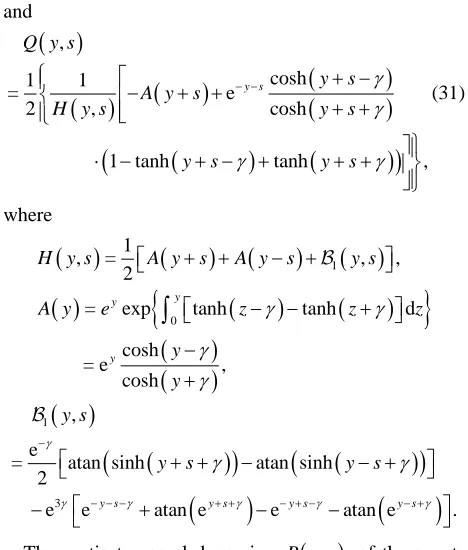
1 tanh y s tanh y s
P y s,
cosh
= 2 e
2 , cosh
y s y s
A y s
H y s y s
1 1
and
,
cosh
1 1
= e
2 , cosh
1 tanh tanh ,
y s Q y s
y s
A y s
H y s y s
y s y s
(31)
where
1
0 1
, = , ,
2
= exp tanh tanh d
cosh
= e , cosh
y y
y
H y s A y s A y s y s
A y e z z z
y y
(30)
1
3 , e
= atan sinh atan sinh
2
e e y s atan ey s e y s atan ey s .
y s
y s y s
The spatio-temporal dynamics of the agents with velocity
,P y s = 1
V ns of
is illu gure 2. The joint evolutio
strated in Fi
,sV 3 P y velocity wn in Figure
and (representing
agents with
respec-tively) are dra
In the present configuration, the two types of agents have an identical initial spatial distribution (i.e.
,Q y s and V = 1
.
= 1
0 = 0 ,
P y Q y
y
). Hence, half of the agents have initially the velocity = 1
V , the other half having the velocity V = 1 , i.e.
0 0
1
= d =
y Q y y
[image:6.595.306.540.86.361.2]
P y d
2.Figure 2. Spatial dispersion P(y, s) of the agents with velocity V+ = +1 for different times s = [0; 0.2; 3; 10]. The
initial conditions are given by
P y0 Q y0 y y
1
= = tanh tanh
8 , = 0
[image:6.595.308.538.462.655.2]Figure 3. Spatial dispersions P(y, s) and Q(y, s) of the agents with velocity V+ = +1 and V– = –1 respectively, for times s =
[0; 0.3; 1.2]. The initial conditions are given by
P y0 =Q y0 = 1 tanh y tanh y8 , = 0
, = 2 and = 1 4.
The spatio-temporal behavior of the solution given by Equations (30) and (31) can be split into two different time phases. For short times of the dynamics, the overlap between and is non-null (i.e. the two populati agents are not spatially segreg lead imitation processes between t . anging their velocity
from h imitation and
spon is
gradu-ally d e
imita-tion proc rlap between
,P y s ons of ated), thus
he agents = 1 to ous tran opulated
esses and Q y
,Q y s
and ing to stron Agents are c
= 1 due s. Accord e benefit o
reasing as the gets
g h to bot ingly,
f smaller, b
V tane ep
sV sition for th are dec
,s
,Q y s
,P y s . Th ove ut the rate
,
P y of
spontaneous transitions from V = 1 to V= 1 re-mains itself constant with time. In the time asymptotic regime, almost all the agents have adopted velocity
= 1 nsity un
V de
, leading iformly trav
,s to b eling withP y ehave
velo
as a pr city V
oba = 1
bility
to-In temporal evolution of the overall
t
wards th tive Figure 4, the
e posi -axis.
adoption rate P t
=
P y t
, dy of the agents is illus-trated and compared to the one observed for the Bass’ original model. For the present configuration, the overall adoption ra e st nds betwa een , the rate observed for our spatial Bass’ model i bsence of imitation processes (Section 3.1.b), and 1,n a
the rate obtained for the original aggregated Bass’ model. Hence, in general, the overall adoption rate of our spatial Bass’ model will be equal to
t ,
t
0,1 , with
t depending the initial distributions of the agents and on the m l parameters. Remember that the imitation rate (and hence the overall adoption rate) is rolled by the number of neighborsthat each agent effectively observes during the imi tion process. In the aggregated (original) Bass’ model, this number is maximum as each agent systematically observes
Figure 4. Temporal evolution of the overall adoption rate P(t): 1) for the original Bass’ model, 2) for our spatial Bass’ model when there are imitation processes (Section 3.1.c) and 3) for our spatial Bass’ model when there are no imitation processes because the two populations of agents
and are immediately segregated (Section 3.1.b).
the global population of agents. In the limiting regime of Section 3.1.b, the number of observed agents is equal to 0 as the two populations of agents and are initially and hence permanently segregated, thus allowing no imitation processes.
4. Conclusions and Perspectives
Often, agents’ remoteness may naturally reduce the effi-ciency of imitation processes, a feature that is totally absent in the original aggregated Bass’ approach. Incor-porating a spatial dimension into the Bass’ dynamics is however not a minor extension. It transforms indeed a nonlinear single dimension dynamics into a nonlinear
of ult
alculated. Indeed, the quadratic nonlinearity, due here to
ic and exact modeling framework patio-temporal infinite dimensional field dynamics for which, in general, no solution methods are available. It is hence remarkable that our spatial generalization of the original Bass’ dy-namics leads to a class of models for which the evolution
the res ing spatio-temporal patterns can be exactly c
the underlying imitation mechanism, coincides with the collision term found in a solvable Boltzmann equation, the RW dynamics, used for gas models in mathematical physics. Our paper points out that the RW dynamics, solvable via a linearizing logarithmic transformation, offers a unique, synthet
to study nonlinear features generated by s imitation processes in economics systems. on
ode cont
ta
In this paper, we mainly focused on Bass’ dynamics which does not allow back transitions (i.e. = 0, im-plying no transitions from V to V). Allowing > 0, regimes involving shock waves with propagating veloci- ties w emerge and the velocity range is <w< 1
[image:7.595.60.290.84.238.2][42]. When a dominant spontaneous tendency to stay in the V state exists (i.e. > ), imitations enhance the spontaneous -flow from V V and may lead to a time-independent (i.e. w= 0), shock type inhomogene-ous solution. Depending on the initial conditions, this marginal stationary w= 0 solution separates two re-gimes of shocks propagating with either positive or nega-tive velocities, a rich dynamical behavior that deserves further investigations in economy.
REFERENCES
[1] E. Mansfield, “Technical Change and the Rate of Imita-tion,” Econometrica, Vol. 29, No. 4, 1961, pp. 741-766. doi:10.2307/1911817
[2] Z. V. Griliches, “Hybrid Corn: An Explor in the Economics of Technol ical C ange,” Econom t , Vol. 25, No. 4, 1957, pp. 501-522. doi:10.2307/1905380
ation
og h e rica
[3] Z. V. Griliches, “Hybrid Corn and the Economics of In-novation,” Science, Vol. 132, No. 3422 - 280. doi:10.1126/science.132.3422.275
, 1960, pp. 275
[4] F. Bass, “A New Product Growth Model for Consumer urables,” Management Science, Vol. 15, No. 5, 1969, pp. 215-227. i:10.1287/mns 5
D
do c.15.5.21
[5] J. A. Schumpeter, “ ss Cycles: A Theoretical, His-torical and Statistical Analysis of the Capitalist Process,” McGraw-Hill, New York, 1939.
[6] B. Jovanovic and R. Rob, “Long Waves and Short Waves: Growth through Intensive and Extensive Search,” Econo- metrica, Vol. 58, No. 6, 1990, pp. 1391-1409.
doi:10.2307/2938321 Busine
[7] R. Pastor-Satorras and A. Vespigniani, “Epidemic Spread-ing in Scale-Free Networks,” Physics Review Letters, Vol. 86, No. 14, 2001, pp. 3200-3203.
doi:10.1103/PhysRevLett.86.3200
[8] E. Glaeser, B. Sacerdote and J. Scheinkman, “Crime and Social Interactions,” Quarterly Journal of Economics, Vol. 111, No. 2, 1996, pp. 507-548. doi:10.2307/2946686 [9] R. Cont and J. P. Bouchard, “Herd Behavior and Aggre-gate Fluctuations in Financial Market,” Macroeconomic Dynamics, Vol. 4, No. 2, 2000, pp. 170-196.
doi:10.1017/S1365100500015029
A. Corcos, J.-P. Eckmann, A. Malaspinas, Y.
[10] Malevergne
and D. Sornette, “Imitation and Contrarian Behavior: Hyperbolic Bubbles, Crashes and Chaos,” Quantitative Finance, Vol. 2, No. 4, 2002, pp. 264-281.
doi:10.1088/1469-7688/2/4/303
[11] P. Dai Pra, W. J. Runggaldier, E. Sartori and M. Tolotti, “Large Portfolio Losses: A Dynamic Contagion Model,” Annals of Applied Probability, Vol. 19, No. 1, 2009, pp. 347-394. doi:10.1214/08-AAP544
[12] U. Horst, “Stochastic Cascades, Credit Contag Large Porfolio Losses,
ion ” Journal of Economic Behavior
and & Organization, Vol. 63, No. 1, 2007, pp. 25-54.
doi:10.1016/j.jebo.2005.02.005 [13] D. Lopez-Pintado and D. J. Wat
Binary Decisions and Collective D
and Society, Vol. 20, No. 4, 2008, pp. 399-443. doi:10.1177/1043463108096787
[14] D. Lopez-Pintado, “Diffusion in Complex Social Net-works,” Games and Economic Behavior, Vol. 62, No. 2, 2008, pp. 573-590. doi:10.1016/j.geb.2007.08.001
[15] F. Collet, P. Dai Pra and E. Sartori, “A Sim Field Model for Social Interaction
ple Mean- s: Dynamics, Fluctua-tions, Criticality,” Journal of Statistical Physics, Vol. 139, 2010, pp. 820-858. doi:10.1007/s10955-010-9964-1 [16] T. W. Valente, “Network Models of Diffusion of
Innova-tions,” Hampton Press, New York, 1995.
[17] W. Brock and S. N. Durlauf, “Discrete Choice with So-cial Interactions,” Review of Economic Studies, Vol. 68, No. 2, 2001, pp. 235-260. doi:10.1111/1467-937X.00168
[18] L. Blume, “The Statistical Mechanics of Strategic Inter-actions,” Games and Economic Theory, Vol. 5, 1993, pp. 387-424. doi:10.1006/game.1993.1023
[19] M. Schultz, “Statistical Physics and Economics—Con- cepts, Tools and Applications,” Springer Verlag, Berlin,
8. 2003.
[20] L. Blume and S. N. Durlauf, “The Interactions-Based Approach to Socioeconomic Behavior,” Mimeo, Depart-ment of Economics, University of Wisconsin, 199 [21] W. Brock and S. N. Durlauf, “Interaction-Based Model,”
In: J. Heckmann and E. Leamer, Eds., Handbook of Econometrics, Vol. 5, North Holland, 2001, pp. 3297- 3380.
[22] G. Ellison, “Learning, Local Interactions and Coordina-tion,” Econometrica, Vol. 61, No. 5, 1993, pp. 1047-1071. doi:10.2307/2951493
[23] G. Ellison and D. Fudenberg, “Rules of Thumb for Social Learning,” Journal of Political Economy, Vol. 101, 1993, pp. 612-644. doi:10.1086/261890
[24] R. Andergassen, F. Nardini and M. Ricottilli, “Innovation Waves, Self-Organized Criticality and Technological Convergence,” Journal of Economic Behavior & Or-ganization, Vol. 61, No. 4, 2006, pp. 710-728.
doi:10.1016/j.jebo.2004.07.009
[25] D. Levine, “Is Behavioral Economics Doomed?” Max Weber Lecture, 2009.
[26] D. Levine and D. Fudenberg, “Learning and Equilib-rium,” Annual Review of Economics, Vol. 1, No. 1, 2008, pp. 385-419.
[27] D. Levine and W. Pesendorfer, “Evolution of Cooperation through Imitation,” Games and Economic Behavior, Vol. 58, No. 2, 2007, pp. 293-315.
doi:10.1016/j.geb.2006.03.007
[28] U. Horst, “Dynamic Systems of Social Interactions,” Journal of Economic Behavior & Organization, Vol. 73, No. 3, 2010, pp. 158-170. doi:10.1016/j.jebo.2009.09.007
[29] A. Foster and M. Rosenzweig, “Learning by Doing and Learning from Others: Human Capital and Technical Change in Agriculture,” Journal of Political Economy, Vol. 103, No. 6, 1995, pp. 1176-1209.
doi:10.1086/601447 ts, “Social Influence,
ynamics,” Rationality
omplementary and
Inno-F01065139
[31] P. Krugman, “Geography and Trade,” MIT Press, Cam-bridge, 1991.
[32] M. P. Feldman, “Knowledge C
vation,” Small Business Economics, Vol. 6, 1994, pp. 363-372. doi:10.1007/B
“Spatial Patterns in Household Demand,” [33] M. P. Feldman, “The Geography of Innovation,” Kluwer
Academic Publishers, Boston, 1994. [34] A. C. Case,
Econometrica, Vol. 59, No. 4, 1991, pp. 953-965. doi:10.2307/2938168
[35] D. B. Audretsch and M. P. Fel overs and the Geography of Inn
dman, “Knowledge Spill-ovation and Production,”
f Econom-. 76, NoEconom-. 2, 1994, ppEconom-. 336-340Econom-. American Economic Review, Vol. 86, No. 3, 1966, pp. 630-640.
[36] Z. J. Acs, D. B. Audretsch and M. P. Feldman, “Real Effects of Academic Research: Comment,” American Economic Review, Vol. 82, No. 1, 1992, pp. 363-367. [37] Z. J. Acs, D. B. Audretsch and M. P. Feldman, “R & D
Spillovers and Recipient Firm Size,” Review o ics and Statistics, Vol
doi:10.2307/2109888
[38] A. Jaffe, M. Trajtenberg and R. Henderson, “Geographic
s,” Quarterly Journal of Economics, Vol. Localisation of Knowledge Spillovers as Evidenced by Patent Citation
108, No. 3, 1993, pp. 577-598. doi:10.2307/2118401
[39] G. A. Akerlof, “Social Distance and Social Decisions,” Econometrica, Vol. 65, No. 5, 1997, pp. 1005-1027.
doi:10.2307/2171877
[40] T. Vicsek, A. Czirok, E. Ben-Jacob, I. Cohen and O.
Sho-ett.75.1226
chet, “Novel Type of Phase Transition in a System of Self-Driven Particles,” Physical Review Letters, Vol. 75, No. 6, 1995, pp. 1226-1229.
doi:10.1103/PhysRevL
[41] F. Cucker and S. Smale, “Emergent Behavior in Flocks,” IEEE Transactions on Automatic Control, Vol. 52, No. 5, 2007, pp. 852-862. doi:10.1109/TAC.2007.895842 [42] T. W. Ruikgrok and T. T. Wu, “A Completely Solvable
(82)90147-9
Model of the Nonlinear Boltzmann Equation,” Physica A, Vol. 113, No. 2, 1982, pp. 401-416.
doi:10.1016/0378-4371
4162-4171.
[43] M.-O. Hongler, O. Gallay, M. Hülsmann, P. Cordes and R. Colmorn, “Centralized Versus Decentralized Control —A Solvable Stylized Model in Transportation,” Physica A, Vol. 389, No. 19, 2010, pp.
doi:10.1016/j.physa.2010.05.047
[44] M.-O. Hongler and L. Streit, “A Probabilistic Connection between the Burgers and a Discrete Boltzmann Equa-tion,” Europhysics Letters, Vol. 12, 1990, pp. 193-197.
.
andbook of Mathe-[45] E. Gutkin and M. Kac, “Propagation of Chaos and the
Burgers’ Equation,” SIAM Journal of Applied Mathemat-ics, Vol. 434, No. 4, 1963, pp. 971-980
![Figure 3. Spatial dispersions P(y, s) and Q(y, s) of the agents with velocity V+ = +1 and V– = –1 respectively, for times s = [0; 0.3; 1.2]](https://thumb-us.123doks.com/thumbv2/123dok_us/9257221.414830/7.595.60.290.84.238/figure-spatial-dispersions-agents-velocity-v-respectively-times.webp)
