Conditional Diagnosability of the Locally Twisted
Cubes under the PMC Model
*
Ruitao Feng
1, Genqing Bian
1, Xinke Wang
21
School of Information and Control Engineering, Xi’an University of Architecture and Technology, Xi’an, China
2Department of Mathematics, Xidian University, Xi’an, China E-mail: {qinshiyue2003, bgq_00}@163.com,[email protected]
Received August 11, 2011; revised September 20, 2011; accepted September 30, 2011
Abstract
In a multiprocessor systems, it is important to local and to replace the faulty processors to maintain
systemp-silas high reliability. The fault diagnosis, which is the process of identifying fault processors in a
multipro-cessor system through testing. The conditional diagnosis requires that for each promultipro-cessor u in a system, all
the processors that are directly connected to u do not fail at the same time. In this paper, we study the
condi-tional diagnosability of the n-dimensional locally twisted cubes. After showing some properties of the locally
twisted cubes, we prove that it under the PMC model is 4
n
–7 for
n
≥5.
Keywords:
Locally Twisted Cubes, Diagnosability, Conditional Diagnosability, PMC Mode
1. Introduction
In recent years, the number of the processors in a multi-processor system increases as fast as the technology de-velopment. Thus some processors may fail in such a multiprocessor operating system. So locating the faulty processors is important for system maintenance and de-pendable computing. System level diagnosis is an im-portant approach for fault diagnosis in a multiprocessor system. Many different models for system level diagno-sis in multiprocessor systems have been proposed, e.g., the PMC (the Perfect Minicomputer Corporation) model [1], the comparison model [2] and the BGM model [3]. So far, the well-studied mode is the PMC model intro-duced by Preparata, Metze, and Chien [1].
A multiprocessor system is an interconnected collec-tion of processors and can be represented by an undi-rected graph G = (V, E), where each vertex of the vertex set V represents a processor and each edge of the edge set E represents a communication link between a pair of processors. Two processors interact with each other by sending messages over the communication link. Under the PMC model, two processors can test each other if and only if there is a link between them. The processor which
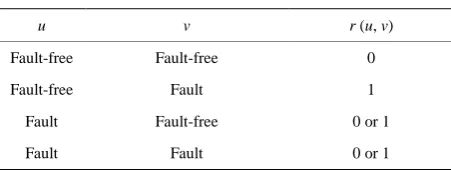
tests the status of the other is called a tester. It is assumed that the test result is reliable if and only if the tester is fault free; otherwise, the test result is unreliable. The collection of all test results is called a syndromeσ ·r(u, v) denotes the test result of processor u testing processor v. If v pass the test executed by u, r(u, v) = 0; otherwise, r(u, v) = 1. Table 1 shows all possible test results of the test r(u, v).
For a given syndrome σ , a subset of vertices
[image:1.595.310.536.635.720.2]F⊆V is said to be consistent with σ if σ can arise from the circumstance that all nodes in F are faulty and all nodes in V-F are fault free. It is worth pointing out that a given set F of faulty vertices may be consistent with different syndromes. Let σ
( )
F be the set contain-ing all syndromes which can be produced by F. Two distinct sets F1, F2⊆V are said to be distinguishable ifσ( )
F1 σ( )
F2 = ∅ otherwise, F1, F2 are said to be in- distinguishable.Table 1. Test results.
u v r (u, v)
Fault-free Fault-free 0
Fault-free Fault 1
Fault Fault-free 0 or 1
Fault Fault 0 or 1
*
A system is said to be t-diagnosable if given a syn-dromeσ , all processors can correctly be identified faulty or faulty free, provided that the number of faulty proces-sors present in the system does not exceed t. The diag-nosability of a system is the maximal number of faulty processors that the system can guarantee to diagnose. The diagnosability of some interconnection networks have been discussed under the PMC model, see [4-6].
Lai et al. in [7] introduced conditional diagnosability by restricting that for each processor u in a system, all processors adjacent to u are not faulty at the same time, and showed that conditional diagnosability of the n-dimensional hypercube (Qn) is 4n – 7 for n ≥ 5, which
is about four times as large as its classical diagnosability [8]. Zhu et al. in [9] presented that under PMC-model the conditional diagnosability of FQn (tc(FQn)) was 4n – 3
when n ≥ 5 or n > 8; tc(FQ3) = 3, tc(FQ4) = 7.
In recent years, conditional diagnosability of several interconnection networks has also been explored under the PMC model [7,9-12].
In the paper, we prove that conditional diagnosability of locally twisted cubes under the PMC model is tc
(
LTQn)
4n 7 for n 5.
= − ≥
The rest of paper is organized as follows: Preliminary knowledge is provided in Section 2; The main results of this paper are presented and proven in Section 3; The conclusions are made in Section 4.
2. Preliminaries
For all the terminologies and notations not defined here, we follow [13]. For a graph G = (V, E) and S ⊂ V(G) or S ⊂ G, we use NG(S) to denote the set of neighboring
vertices of S in G-S, when it is easy to know from the context what G denotes, it is usually simplified with N(S). We use AG(S) to denote the union of S and NG(S). And
similarly AG(S) can be simplified with A(S).
That is, NG(S) = {v∈ V (G)-S|∃ u ∈S such that (u, v) ∈
E(G)}, AG(S) = NG(S) S.
We use dG(u) to denote the degree of u in G and dG(u)
can be simplified with d(u).
Definition 1. [14] For n ≥ 2, an n-dimensional locally twisted cube, denoted by LTQn, is defined recursively as
follows:
1) LTQ2 is a graph consisting of four nodes labeled with 00, 01, 10 and 11, respectively, connected by four edges {00, 01}, {01, 11},{11, 10} and {10, 00}.
2) For n ≥ 3, LTQn is built from two disjoint copies of
LTQn–1 according to the following steps: Let 0LTQn–1 denote the graph obtained from one copy of LTQn–1 by prefixing the label of each node with 0. Let 1LTQn–1 de-note the graph obtained from the other copy of LTQn–1 by prefixing the label of each node with 1. Connect each
node 0x x2 3xn of 0LTQn 1 to the node
(
2)
31 x + x xn xn of 1LTQn1 with an edge, where “+” represents the modulo 2 addition.
Figure 1 shows two examples of locally twisted cubes. The locally twisted cubes can also be equivalently de-fined in the following non-recursive fashion.
Definition 2. [14] For n ≥ 2, the n-dimensional locally twisted cube, LTQn, is a graph with {0, 1}n as the node
set. Two nodes x=x x1 2xn and y=y y1 2yn of LTQn are adjacent if and only if either one of the
follow-ing conditions are satisfied.
1) xi=yi and xi+1 = yi+1 + ynfor some 1 ≤ i ≤ n – 2,
and xj = yj for all the remaining bits;
2) xi=yi for i ∈{n – 1, n}, and xj = yjfor all the
remaining bits.
The definition of the conditional diagnosability is as follows.
Definition 3. [7] A faulty set F ⊆ V is called a condi-tional faulty set if N(v) ⊄ F for any vertex v ∈ V. A sys-tem G(V, E) is conditionally t-diagnosable if F1 and F2 are distinguishable, for each pair of conditional faulty sets F1, F2⊆ V , and F1≠ F2 with |F1|; |F2| ≤ t. Condition-al diagnosability of a system G, written as tc(G) is
de-fined to be the maximum value of t such that G is condi-tionally t-diagnosable.
Let F1, F2 be two distinct sets, the symmetric differ-ence of F1 and F2 is denoted by F1∆F2, that is, F1∆F2 = (F1 – F2) ∪ (F2 – F1). The following lemma proposed by
Dahbura and Masson [15] gives a necessary and suffi-cient condition for a system to be t-diagnosable.
Lemma 1. [16] A system G(V, E) is t-diagnosable if and only if, for each pair F, F2 ⊂ V with|F1|, |F2| ≤ t and F1 ≠ F2, there is at least one test from V – F1 ∪ F2 to F1∆F2.
Lemma 2. [14] k(LTQn) = n for n ≥ 2.
Lemma 3. [17] k (LTQn) = 2n – 2 for n ≥ 3.
Lemma 4. [17] Let S be a set of vertices
S ⊂ V(LTQn) with |S| = n, if LTQn-S is disconnected,
there exists a vertex u ∈ V(V(LTQn)) such that N(u) = S
for n ≥ 2.
The following lemma is derived based on [18,19].
[image:2.595.319.527.590.704.2]
Lemma 5. Let F be a subgraph of LTQn with
( )
4≤V F ≤3n−5, we have
( )
4 8n
LTQ
N F ≥ n− .
3. Conditionally Diagnosability
Lemma 6. Let S be a set of vertices S ⊂ V(LTQn) and n ≥
3. Suppose that LTQn – S is disconnected. The following
two conditions hold: (1) |S| ≥ n;
(2) If n ≤ |S| ≤ 2n – 3, then LTQn-S has exactly two
components, one is trivial and the other is nontrivial. The nontrivial component of LTQn-S contains 2n– |S| – 1
ver-tices.
Proof: By lemma 2 k(LTQn) = n, so condition (1)
holds. We need to prove that condition (2) is true. Since
n
LTQ −S is disconnected, there are at least two com-ponents in LTQn−S. We will prove that |S| ≥ 2 n – 2 when LTQn−S contains at least two trivial compo-nents or two nontrivial compocompo-nents. It implies that n ≤ |S| ≤ 2n – 3 when LTQn−Scontains a trivial components and nontrivial components.
Case 1. LTQn−S contains at least two trivial compo-nents. Let u1, u2∈ V(LTQn) and {u1}, {u2} be two trivial components. Then N(u1) ⊂ S and N(u2) ⊂ S. Since any two distinct vertices of a LTQnhave at most two
com-mon neighbors, we have |N(V1) |N(V2)| ≤ 2.
Hence, |S | ≥ |N(V1)| + |N(V2)| – |N(V1) N(V2)| ≥ 2n + 2n – 2 = 2(2n – 1).
Case 2. LTQn-S contains at least two nontrivial
com-ponents. We prove condition (2) by induction on n. Suppose n ≤ |S| ≤ 2n – 3, it is easy to see that |S| = 3 for n = 3. The connectivity of LTQ3 is 3. By Lemma 4, there exist a vertex u ∈ V (LTQ3) such that S = N(u) Thus LTQ3-S has exactly two components: one is trivial and the other is nontrivial. Therefore, if LTQ3-S has at least two nontrivial components, |S| ≥ 2n – 2, where n = 3. Assume that the result holds for all n – 1, n – 1 ≥ 3. In the following we show that it holds for n.
Let S0 = S V(0LTQn–1) and S1 = S V (1LTQn–1), F and F' be two nontrivial component of LTQn-S. So
|V(F)| ≥ 2 and |V(F′)| ≥ 2.
We consider the following three cases:
Case 2.1. F, F′⊆ 0LTQn–1 or F, F′⊆ 1LTQn–1. Without loss of generality, let F, F′ ⊆ 0LTQn–1, then 0LTQn-1 -S0
is disconnected and|S1| ≥ |F| +|F′| ≥ 4. So |S0| ≥ k2 = 2n – 4 by lemma 3. Thus |S| = |S0| + |S1| ≥ 2n – 2.
Case 2.2. F ⊆ 0LTQn–1 and F′ ⊆ 1LTQn–1, or F′ ⊆ 1LTQn–1 and F ⊆ 1LTQn–1. Without loss of generality, let F ⊆ 0LTQn–1 and F′⊆ 1LTQn–1. If both 0LTQn–1 – S0 and 1LTQn–1 – S1 are connected, then |S0| ≥ 2n – 4 and S1| ≥ 2n – 4. So |S| = |S0| + |S1| ≥ 2n – 4 + 2n– 4 ≥ 2n – 2 for n
≥ 3. If exactly one of 0LTQn–1 – S0 and 1LTQn–1 – S1 is disconnected, let 0LTQn–1 – S0 be disconnected, then
( )
0LTQn
N F ⊆ S0. So
( )
0
2 2 4 2 2 2.
n LTQ
S ≥N F + = n− + = n−
Case2.3. 0LTQn–1 F≠ ∅and 1LTQn–1 F≠ ∅, or 0LTQn–1 F′ ≠ ∅ and 1LTQn–1 F′ ≠ ∅ . Without loss of generality, let 0LTQn–1 F≠ ∅and 1LTQn-1 F≠ ∅. Since there is another component
F′ of LTQn – S, at least one of the two graphs 0LTQn–1 – S0 and 1LTQn–1 – S1 is disconnected. So we drive the re-sult by consider two Subcase.
Case 2.3.1. Both 0LTQn–1 – S0 and 1LTQn–1 – S1 are disconnected. Since k(LTQn–1) = n – 1, |S0| ≥ n – 1 and
|S1| ≥ n – 1. Then |S| = |S0| + |S1|≥ 2n – 2.
Case 2.3.2. Exactly one of the two subgraphs 0LTQn–1 – S0 and 1LTQn–1 – S1 is disconnected. Without loss of generality, assume that 0LTQn–1 – S0 is connected and 1LTQn–1 – S1 is disconnected. Then |S1| ≥ n – 1 and N0LTQn(F) ⊆ S0. Hence, |S0| ≥ |V(F′)| ≥ 2. If |S1| ≥ 2n – 4, then |S| = |S0| + |S1| ≥ 2 + (2n – 4) = 2n – 2. Otherwise, n – 2 ≤ |S1| ≤ 2n – 5. By induction hypothesis, 1LTQn–1 – S1 has exactly two components: one is trivial and the other is nontrivial. We know that 1LTQn–1 F and F′ are two components of 1LTQn–1 – S1, and F′ is a nontrivial component. Thus 1LTQn–1 F must be a trivial com-ponent of 11LTQn–1 – S1, and |V(F′)| = 2n–1 – |S1| – 1. Note that N0LTQn(F′) ⊆ S0. Hence, |S| = |S0| + |S1| ≥ |V(F′)| + |S1|
= 2n–1 – |S1| – 1 + |S1| ≥ 2n – 2 for n ≥ 4. Consequently, condition (2) holds.■
Lemma 7: Let S be a set of vertices S ⊂ V(LTQn) and
n ≥ 5. Suppose that LTQn-S is disconnected and every
component of LTQn-S is nontrivial, and there exists one
component F of LTQn-S such that dF (v) ≥ 2 for any
ver-tex v ∈ F. Then one of the following two conditions must hold:
(1) |S| ≥ 4n – 8; (2) |V(F)| ≥ 4n – 9.
Proof: Let F0 = 0LTQn–1 F, F1 = 1LTQn–1 F, S0. = S V(0LTQn–1) and S1 = S V(1LTQn–1). We consider two cases: (a) F ⊂ 0LTQn–1 or F ⊂ 1LTQn–1. (b) 0LTQn–1 F≠ ∅and 1LTQn–1 F≠ ∅.
Case 1. F ⊂ 0LTQn–1 or F ⊂ 1LTQn–1. Without loss of generality, let F ⊂ 0LTQn–1. Then F ⊂ S1. In the follow-ing we consider two cases.
Case 1.1. 0LTQn–1-F is connected. Then |S| = |S0| + |S1|
≥ |S0| + |V(F)| = 2
n–1≥ 2
n – 2 for n ≥ 4 and conditional (a) holds.
Case 1.2. 0LTQn–1 – F is disconnected. If 4 ≤ |V(F)| ≤ 3n – 5, by Lemma 5, we have |S0| ≥ |NLTQn
( )
F | ≥ 4n –is disconnected and |S1| ≥ |V(F)| ≥ 3n – 4. Thus |S| = |S0| + |S1| ≥ n – 1 + 3n – 4 = 4n – 5 and conditional (a) holds. Otherwise, |V(F)| ≥ 4n – 9 and conditional (b) holds.
Case 2. 0LTQn–1 F≠ ∅and 1LTQn–1 F≠ ∅. Since every vertex x in F0 (resp. y in F1) has at most one neighbor in F1(resp. F0), we have dF0
( )
x ≥1 and( )
1F
d x . Since LTQn – S is disconnected, there are at least
two components in LTQn – S. At least one of the two
graphs 0LTQn–1 – S0 and 1LTQn–1 – S1 is disconnected since both LTQn and LTQn–1 contain some non-empty part of the component F.
In the following we drive the result by consider two cases.
Case 2.1. Exactly one of the two graphs 0LTQn–1 – S0 and 1LTQn–1 – S1 is disconnected. Without loss of gene-rality, assume that 0LTQn–1 – S0 is connected and 1LTQn–1 – S1 is disconnected. Let F′ be another non-trivial component of LTQn – S other than F. Then
F′ ⊂
(
1LTQn−1−S1)
andN0LTQn−1( )
F' ⊂S0. Note that both F′ and F1 are nontrivial component. By Lemma 6, |S1| ≥ 2n – 4. If j|S0| ≥ 2n – 4, then |S| = |S0| + |S1| ≥ 4n – 8 and condition (1) holds. Otherwise, |S0| ≤ 2n – 5. ThenV F( )
0 =2n−1−S0 since V LTQ(
n−1)
= S0V (F0).Thereby, |V(F)| = |V(F0)|+|V(F1)| ≥
(
(
)
)
1
2n− − 2n−5 + 2 ≥ 4n – 9 for n ≥ 4 and condition (2) holds.
0LTQn–1 – S0 and 1LTQn–1 – S1 are disconnected. We consider the following three subcases.
Case 2.1.1. |S0| ≥ 2n – 4 and |S1| ≥ 2n – 4.Clearly, S| = |S0| + |S1| ≥ 8n – 8. Therefore, condition (1) holds.
Case 2.2.2. Either n – 1 ≤ |S0| ≤ 2n – 5, |S1| ≥ 2n – 4 or |S0| ≥ 2n – 4, n – 1 ≤ | S1| ≤ 2n – 5. Without loss of gene-rality, assume that S0| ≥ 2n – 4, n – 1 ≤ | S1| ≤ 2n – 5. Then we have | V(F1)| = 2n–1 – |S1| – 1 by the lemma 6. Since
( )
0 1
F
d u ≥ for any vertex u ∈ V (F0),|V(F0)| ≥ 2. Thus, |V(F)| = |V(F0)| + |V(F1)| ≥ 2 +
(
)
1
2n− −2n−4 ≥ 4n – 9 for n ≥ 5. Hence, condition (2) holds.
Case 2.2.3. n – 1 ≤ | S0| ≤ 2n – 5 and n – 1 ≤ | S1| ≤ 2n – 5. By the lemma 6, we have |V(F0)| = 2n–1 – |S0| – 1 and |V (F1)| = 2n–1 – |S1| – 1. So |V(F)| = |V(F0)| + |V (F1)| = 2n – |S| – 2. If |S| ≥ 4n – 8, then condition (1) holds. Otherwise, |S| ≤ 4n – 9, then |V (F)| = 2n – (4n – 9) – 2 ≥ 4n – 9 for n
≥ 4. Hence, condition (2) holds.
Consequently, the lemma holds. ■
Theorem 1. Let F1, F2⊂ V LTQ
(
n)
be twoindistin-guishable conditional faulty sets, then either |F1| ≥ 4n – 6 or |F2| ≥ 4n – 6 for n ≥ 5.
Proof: Let S = F1 F2, according to LTQn – S is
connected or not, we consider the following two cases. Case 1. LTQn – S is connected. We assert that F0∆F1 = V (LTQn) – S. Otherwise, suppose u ∈
V(LTQn – S) – F1∆F2 = V (LTQn) – F1 F2.Then u is connected to F1∆F2 since LTQn – S is connected. That is,
there is an edge between F1∆F2 and V – F1 F2. This is a contradiction to the fact F1 and F2 are an indistin-guishable. Since |F1| + |F2| = |F1|∆|F2| = |V(LTQn)| = 2n≥
8n – 13 for n ≥ 5, either |F1| ≥ 4n – 6 or |F2| ≥ 4n – 6. Then the result follows.
Case 2. LTQn – S is disconnected. Since F1 and F2 is indistinguishable, there is no edge between F1∆F2 and V (LTQn) – F1F2 by Lemma 1.That is, for any vertex u
∈ F1 ∆ F2, NLTQn
( )
u ⊂ F1 F2. Since both F1and F2 are conditional faulty set,( )
n LTQ
N u ⊄ F1 and
( )
2. So ( )(
2 1)
n n
LTQ LTQ
N u ⊄F N u F −F
and ( ) ( 2 1) 1
n
LTQ
N u F −F ≥ .
Thus for any vertex u ∈ F1 ∆ F2 , |NF F1∆2
( )
u | ≥ 2. SoLTQn – S has a component P with V (P) ⊂ F1 ∆ F2 such that dP(u) ≥ 2 for any vertex u ∈ V(P). By Lemma 7,
we have |S| ≥ 4n – 8 or |V(P)| ≥ 4n – 9 for n ≥ 5. So we consider the following two subcases.
Case 2.1. |S| ≥ 4n – 8. Let C be a cycle in P. Since
( )
2P
d u ≥ for each vertex u ∈ V(F), and V (LTQn) ≥ 4,
the cycle C of length is not less than 4. Because V(C) ⊂ V(P) ⊂ F1 ∆ F2, either |F1 – F2| ≥ 2 or |F2 – F1| ≥ 2. Th e-reby, either |F1| = |S| + |F1 – F2| ≥ 4n – 6 or |F2| = |S| + |F1 – F2| ≥ 4n – 6.
Case 2.2. |V(P)| ≥ 4n – 9. Since |V(P)| ≥ 4n – 9 and V (P) ⊂ F1 ∆ F2, either |F1 – F2| ≥ 2n – 4 or |F2 – F1| ≥ 2n – 4. And since there is no isolated vertex in LTQn
(both F1 and F2 are conditional faulty set) and LTQn – S
is disconnected, |S| ≥ 2 n – 2 by lemma 3. Thereby, ei-ther|F1| = |S| + | F1 – F2| ≥ 4n – 6 or |F2| = |S| + |F2 – F1| ≥ 4n – 6.
Consequently, the theorem holds. ■
The theorem 1 shows that the conditional diagnosabil-ity of LTQn is not less than 4n – 7 for n ≥ 5. In the fo
l-lowing we will show that the conditional diagnosability of LTQn is not more than 4n – 7 for n ≥ 5.
Theorem 2. tc
(
LTQn)
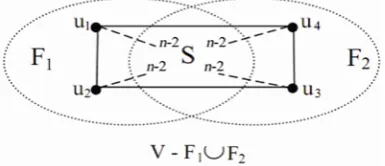
≤ 4n – 7 for n ≥ 3.Proof: (See Figure 2) Let C = (u1, u2, u3, u4) be a cycle of length 4 in LTQn. u1, u2, u3, u4 are the four con-secutively vertices in the cycle C. Let F1 = NLTQn
( )
C {u1, u2} and F2 =NLTQn
( )
C {u3, u4}. It is easy to verify that F1and F2 are two indistinguishable conditional faultyset. It is easy to see that there exists no triangle in LTQn and
any two distinct vertices in LTQn have at most two
common neighbors. Thus we have |F1F2| = NLTQn
( )
C= 4n – 8 and | F1 – F2| = |F2 – F1|. So |F1| = |F2| = 4n – 6. Hence, LTQn is not conditionally (4n – 6) diagnosable.
We are done. ■
By Theorems 1 and 2, the following corollary holds. Corollary1. tc
(
LTQn)
= 4n – 7 for n ≥ 5.4. Conclusions
Since the probability that any faulty set contains all the neighbors of some processor is very small, conditional diagnosability, requiring that each processor of a system is incident with at least one fault-free processor, can bet-ter measure the diagnosability of inbet-terconnection. In this paper, the main contribution is the determination of the conditional diagnosability of the locally twisted cubes. We obtain that the conditional diagnosability of a locally twisted cube under the PMC model is tc
(
LTQn)
= 4n – 7 for n ≥ 5.5. References
[1] G. M. F. P. Preparata and R. T. Chien, “On the Connec-tion Assignment Problem of Diagnosable Systems,” IEEE Transactions on Electronic Computers, Vol. EC-16, No. 6, December 1967, pp. 848-854.
[2] M. M. J. Maeng, “A Comparison Connection Assignment for Self-Diagnosis of Multiprocessors Systems,” Pro-ceedings of the 11th International Symposium on Fault- Tolerant Computing, Portland, 1981, pp. 173-175.
[3] F. G. F. Barsi and P. Maestrini, “A Theory of Diagnosa-bility of Digital Systems,” IEEE Transactions on Com-puters, Vol. C-25, No. 6, June 1976, pp. 585-593.
[4] R. Ahlswede and H. Aydinian, “On Diagnosability of Large Multiprocessor Networks,” Discrete Applied Mathematics, Vol. 156, No. 18, 2008, pp. 3464-3474.
[5] D. Wang, “Diagnosability of Enhanced Hypercubes,” IEEE Transactions on Computers, Vol. 43, No. 9, 1994, pp. 1054-
1061
[6] J. Fan, “Diagnosability of the Mobius Cubes,” IEEE Transactions on Parallel and Distributed Systems, Vol. 9, No. 9, 1998, pp. 923-928.
[7] P.-L. Lai, J. Tan, C.-P. Chang and L.-H. Hsu, “Condi-tional Diagnosability Measures for Large Multiprocessor Systems,” IEEE Transactions on Computers, Vol. 54, No. 2, 2005, pp. 165-175.
[8] S. Hsieh and C. Lee, “Diagnosability of Two-Matching Composition Networks under the MM* Model,” IEEE Transactions on Dependable and Secure Computing, Vol. 8, No. 2, 2009, pp. 246-255.
[9] Q. Zhu, S.-Y. Liu and M. Xu, “On Conditional Diagno-sability of the Folded Hypercubes,” Information Sciences, Vol. 178, No. 4, 2008, pp. 1069-1077.
[10] M. Xu, K. Thulasiraman and X.-D. Hu, “Conditional Diagnosability of Matching Composition Networks under the Pmc Model,” IEEE Transactions on Circuits and Systems II: Express Briefs, Vol. 56, No. 11, 2009, pp.
875- 879.
[11] Q. Zhu, “On Conditional Diagnosability and Reliability of the bc Networks,” The Journal of Supercomputing, Vol. 45, No. 2, 2008, pp. 173-184.
[12] S.-M. Zhou, “The Conditional Diagnosability of Locally Twisted Cubes,” Proceedings of the 4th International Conference on Computer Science and Education, 2009, pp. 221-226.
[13] J. A. Bondy and U. S. R. Murty, “Graph Theory with Applications,” North Holland, New York, 1976.
[14] X.-F. Yang, D. J. Evans and G. M. Megson, “The Locally Twisted Cubes,” International Journal of Computer Mathe-matics, Vol. 82, No. 4, April 2005, pp. 401-413.
[15] G. M. A. T. Dahbura, “An O(n2.5) Fault Identification Algorithm for Diagnosable Systems,” IEEE Transactions on Computers, Vol. C-33, No. 6, 1984, pp. 486-492.
[16] A. T. Dahbura and G. M. Masson, “An O(n2.5) Fault Identification Algorithm for Diagnosable Systems,” IEEE Trans- actions on Computers, Vol. 33, No. 6, 1984, pp. 486-492.
doi:10.1109/TC.1984.1676472
[17] J.-X. Fan, S.-K. Zhang, et al., “The Restricted Connectiv-ity of Locally Twisted Cubes,” 2009 10th International Symposium on Pervasive Systems, Algorithms, and Net-works (ISPAN), Kaohsiung, 14-16 December 2009, pp.
574-5
[18] J. Fan and X. Lin, “The t/k-Diagnosability of the BC Graphs,” IEEE Transactions on Computers, Vol. 54, No. 2, 2005, pp. 176-184.