COMPARISON BETWEEN J2EE Vs ASP.NET
Department of Computer Applications, Chandigarh Group of Colleges, Landran (Mohali), India
ARTICLE INFO ABSTRACT
There is great competition between
used to develop web application by adding new features. In this paper, we will compare the features of the two technologies which are J2EE and ASP.NET. We will discuss the similarities and diffe which include: IDE, Databases, Market value, MVC, Low
those who are not involved in web development or those who want to change the technology either to Java or .NET and want to increase their knowledge wi
Copyright©2017, Davinder Kaur. This is an open access article distributed under the Creative Commons Att distribution, and reproduction in any medium, provided the original work is properly cited.
INTRODUCTION
In the present time World Wide Web has great impact on which the different organizations present their content on the Internet. Today in the market, there are two technologies and Asp.net which had great influence over the Web Applications. Java technology is developed by Sun Microsystems which is further extended to the J2EE technology whereas Asp.net is the technology developed by Microsoft which is supported by various languages of Microsoft on .NET framework. At the present time, both the technologies had enormous competition in the market. J2EE is the java platform which is used for application development whereas Microsoft has the .NET Framework for developing the web based application. In this paper we will study the two platforms- J2EE and ASP.NET. These two frameworks are used for developing the web applications. Both software engineer and software managers should select a technology which represents the best optimal solution to their business This study compares both the web technologies.
of each one is explained in such a way to understand the architecture of both the technologies. Some features of J2EE and ASP.NET are compared in the second section. Conclusion is described in the third section of the paper.
J2EE
Java 2 Enterprise Edition is the industry standard for java technology application development. It is widely used platform
*Corresponding author: Davinder Kaur, Department of Computer Applications, Chandigarh Group of Colleges, Landran (Mohali), India
ISSN: 0975-833X
Article History: Received 25th January, 2017
Received in revised form 05th February, 2017
Accepted 22nd March, 2017
Published online 20th April,2017
Key words:
J2EE, ASP.NET, Databases, .NET Framework, JSP, JSF.
Citation: Davinder Kaur, 2017. “Comparison between J2EE Vs ASP.NET
RESEARCH ARTICLE
COMPARISON BETWEEN J2EE Vs ASP.NET
*Davinder Kaur
Department of Computer Applications, Chandigarh Group of Colleges, Landran (Mohali), India
ABSTRACT
There is great competition between the Java and .NET from many years. These two technologies are used to develop web application by adding new features. In this paper, we will compare the features of the two technologies which are J2EE and ASP.NET. We will discuss the similarities and diffe which include: IDE, Databases, Market value, MVC, Low-level code safety. This paper is helpful to those who are not involved in web development or those who want to change the technology either to Java or .NET and want to increase their knowledge with a new platform.
is an open access article distributed under the Creative Commons Attribution License, which distribution, and reproduction in any medium, provided the original work is properly cited.
In the present time World Wide Web has great impact on which the different organizations present their content on the Internet. Today in the market, there are two technologies- Java ence over the Web Java technology is developed by Sun Microsystems which is further extended to the J2EE technology whereas Asp.net is the technology developed by Microsoft which is supported by various languages of ET framework. At the present time, both the technologies had enormous competition in the market. J2EE is the java platform which is used for application development whereas Microsoft has the .NET Framework for developing paper we will study the two J2EE and ASP.NET. These two frameworks are used for developing the web applications. Both software engineer and software managers should select a technology which represents the best optimal solution to their business. This study compares both the web technologies. The structure of each one is explained in such a way to understand the architecture of both the technologies. Some features of J2EE and ASP.NET are compared in the second section. Conclusion
the third section of the paper.
Java 2 Enterprise Edition is the industry standard for java technology application development. It is widely used platform
Department of Computer Applications, Chandigarh Group of Colleges, Landran (Mohali), India
for the server programming in the java programming language. It is used for building enterprise application and classified in the following ways (Available from: ht
edu/~evans/pubs/cs06/cs06.pdf
1.J2ME (Java 2 Micro Edition) is a java technology which allows the programmers to develop programs for mobile wireless information devices such as cell phones, gateways and personal digital assistants (PDAs).
2.J2SE (Java 2 Platform, Second Edition) or SE is a java platform used for programming. It is widely used for desktop and server environments. J2SE consists of set of libraries used to run java programs.
3.J2EE (Java 2 Enterprise Edition) or EE is a java platform designed for the large scale. It is used for servers programming. This platform consists a set of services, Application Programming Interfaces (APIs) and protocols which provide the functionality for de
applications.
J2EE Architecture
J2EE is the platform which provides the environment to encode enterprise application using the multi
It includes three tiers in J2EE applications are
Middle tier/Business Logic Integration and Enterprise Information tier/Database Management System.
is a web form which can be presented on any the web browser like Internet Explorer, Mozilla Firefox.
International Journal of Current Research
Vol. 9, Issue, 04, pp.48720-48724, April, 2017
INTERNATIONAL
OF CURRENT RESEARCH
Comparison between J2EE Vs ASP.NET”, International Journal of Current Research
Department of Computer Applications, Chandigarh Group of Colleges, Landran (Mohali), India
the Java and .NET from many years. These two technologies are used to develop web application by adding new features. In this paper, we will compare the features of the two technologies which are J2EE and ASP.NET. We will discuss the similarities and differences level code safety. This paper is helpful to those who are not involved in web development or those who want to change the technology either to
th a new platform.
ribution License, which permits unrestricted use,
for the server programming in the java programming language. It is used for building enterprise application and classified in Available from: http://www.cs.virginia. edu/~evans/pubs/cs06/cs06.pdf):
(Java 2 Micro Edition) is a java technology which allows the programmers to develop programs for mobile wireless information devices such as cell phones, gateways and
PDAs).
(Java 2 Platform, Second Edition) or SE is a java platform used for programming. It is widely used for desktop and server environments. J2SE consists of set of libraries used
(Java 2 Enterprise Edition) or EE is a java platform designed for the large scale. It is used for servers programming. This platform consists a set of services, Application Programming Interfaces (APIs) and protocols which provide the functionality for developing Web-based
J2EE is the platform which provides the environment to encode enterprise application using the multi-tier architecture. It includes three tiers in J2EE applications are- Client tier, Logic Integration and Enterprise Information tier/Database Management System. The Client tier is a web form which can be presented on any the web browser like Internet Explorer, Mozilla Firefox.
INTERNATIONAL JOURNAL OF CURRENT RESEARCH
Fig.1. J2EE Architecture
The Middle tier is also known as Server tier. This layer accepts the input from the user validates it and then supplies to the Business Logic Layer. Java Server Faces uses the several library tags (Sandbox, Extension Core JSF, and Tomahawk) present in the Presentation layer. It processes the requests from the Client tier and interacts with the Integration layer. The Enterprise level is stored in the Relational database. This level comprises of components, containers and services. Different approaches of database such as JDBC (Java Database Connectivity), ORM (Object Relational Mapping), or Entity Beans used to implement the integration tier.
.NET
.NET framework is developed by Microsoft in which the window applications are developed and run. It allows several programming languages and libraries. It is technology of collection or set of technologies to develop windows and web applications. The .NET framework consists of two components:
1.Common Language Runtime (CLR): .NET framework
provides the runtime environment which is known as Common Language Runtime (CLR). All the .NET programs are run on this environment. For example .Net supports programming languages like C#, visual basic, and java script.
2.Framework Class Library (FCL): The .Net Framework
Class Library (FCL) is a huge collection of reusable classes, interfaces and value types that optimize the development process and provide access to system functionality.
By using .Net Technology we can build the secure applications.
.Net Architecture
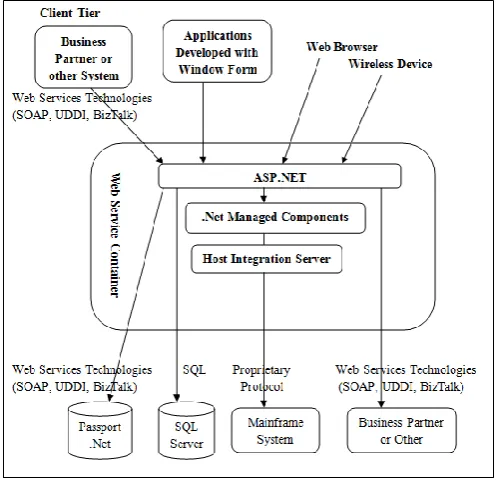
The .NET architecture shows the place of ASP.NET in the figure below.
[image:2.595.310.560.114.355.2]The Web Container contains the .Net application. The Container provides the essentials qualities for enterprise applications. For example transactions, message servicing and security are the part of it.
Fig.2. NET Architecture
Business processing has been done by the business layer of .Net application with the help of components of .Net. By using Active Data Objects (ADO) the connection to database and existing system is possible in ASP.NET. This service is provided by the Microsoft Host Integration Server. By using Web Services Technologies such as SOAP, UDDI, BizTalk, is connected to Business Partners. By using .NET application, Business partners are connected to the Web technologies like SOAP, UDDI, WSDL and BizTalk. Active Server Pages (ASP.NET) is connected with the Web browsers, Clients, wireless devices which provides interface to user in HTML, XHTML, XML. In Windows Forms, heavyweight user interfaces are built.
ASP.NET
ASP.NET is the .NET platform developed by Microsoft technology for developing web applications and descendant of Active Server Pages (ASP). Due to the complaints and problem in ASP, the Microsoft developed the ASP.NET. The main difference in ASP and ASP.NET is only the presentation layer of the content. So the benefit of ASP.NET over ASP is the clean code. ASP.NET uses the Common Language Runtime (CLR) which helps to develop the web applications with the .NET languages such as C#, Visual Basic. The pages of ASP.NET are known as the “Web Forms”. The pages of ASP.NET are saved with the extension of ASPX file which holds the HTML tags inside it. There are many versions of ASP.NET released with .NET Framework.
Java Server Faces (JSF)
example- Java Model View Controller (MVC) is a request driven approach for web development.
JSF has the following features
JSP is based on the concept of Model View Controller (MVC).
It is used to represent User Interface Components which is a collection of APIs. The APIs manages the input validation, event handling, page navigation, initializing and accessibility.
Rapid application development approach Tool support (IBM, Oracle, Sun etc)
Managed beans are dependency injections created by java beans.
It supports both the languages JSP and ASP.NET.
JSF 1.0 version is released on 11th March 2004 by Java Community Process. Further the changes are made and many new versions came in the market. The last version of JSF is 2.1 and upcoming version 2.2 is being developed.
Comparison
Java Enterprise Edition (J2EE) and ASP.NET both the technologies are used for developing web applications. These technologies are based on event driven as well as user component. In J2EE components are used as naming components whereas in ASP.NET components are Controls. In this section, market value of J2EE and ASP.NET are compared as key comparison of both the technologies. Then the features of both the technologies are compared in which similarities, differences and constraints of these technologies are compared.
J2EE & .NET Market Value
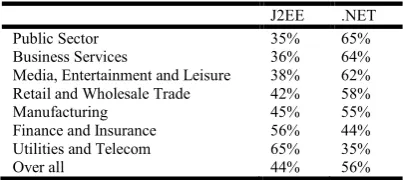
[image:3.595.313.547.58.195.2]It is not pragmatic for enterprise to develop a single platform on which all development is possible. To choose the one platform, the main differences between them should be understood and then the appropriate technology is chosen. Following table represents the percentage which each platform is using for the development work.
Table 1. Comparison according to 322 software decision-makers at North Americans Companies
J2EE .NET
Public Sector 35% 65%
Business Services 36% 64%
Media, Entertainment and Leisure 38% 62%
Retail and Wholesale Trade 42% 58%
Manufacturing 45% 55%
Finance and Insurance 56% 44%
Utilities and Telecom 65% 35%
Over all 44% 56%
[image:3.595.61.263.584.674.2]The above result shows that .NET is used as the main platform in the development of web application. .NET is stronger than J2EE in "Manufacturing, Retail and Wholesale trade, Media, Entertainment and Leisure and Business Services" whereas J2EE is stronger than .NET in "Utilities and Telecom, and Finance and Insurance". Researchers result about market analysis of both the technologies of Java and .NET will gather the market share. Following figure shows the Marketing shares during the year 1998-2005.
Figure 3. Comparison of Java and .NET platform usage in development projects during some years
According to the above figure 3, .NET is used more than Java in the development. Although we can conclude that as per the security is concerned, Java is preferred as the trusted platform.
IDE
IDE stands for Integrated Development Environment (IDE) which is a software application that provide feature to the developers for the web development. This feature is for the beginners to develop the software which find easy to start. There are many IDEs for J2EE such as JDeveloper of Oracle, Java Studio Creator of Sun and WSAD of IBM. These are the visual editing IDEs for JSF components. But on the other hand .NET is having only one IDEs which is Visual Studio ASP.NET.
Database
Both the technologies are having feature of accessing information or data. ASP.NET access the data by using the ADO.NET feature. There is a component in ADO.NET which drags and drops the table directly from the server explorer to a web form. This component in ADO.NET is GridView component which is the descendant of DataGrid component. With the use of GridView, Visual Studio automatically creates all the code which is needed (Available from: http://www.cs.virginia.edu/~evans/pubs/cs06/cs06.pdf). To manage the view, there are some classes such as DataTable, DataSet are used. To access the data in java, Java Database Connectivity (JDBC) feature is used. Developer use JDBC to work offline and online mode.
[image:3.595.319.547.629.781.2]In JSF, it has three tier level architecture. Instructions/ Commands are sent to the middle layer. Middle layer send the command to data source where it interprets the commands and return the result to the middle layer. Middle layer interprets and further send back to the user layer.
Figure 5. Three-tier architecture for JSF data access
MVC
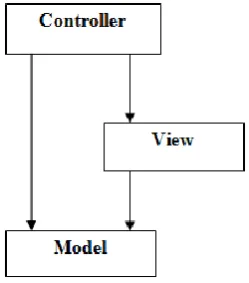
The Model View Controller (MVC) is a design pattern which separates the business layer from user interface layer in the web development. This pattern is used in programming languages such as Java, Smalltalk, C, C++. This pattern is used by developers as the object code is reuse and reduces the time to develop the applications.
The Model View Controller (MVC) has three main components which are used in the software development. The components are as follow:
A MODEL represents the logical structure of data in software application. This model does not interact with the user interface.
A VIEW is a collection of classes which represents the elements which manages the display of information. A CONTROLLER represents the classes which
connects the model and view to communicate between the classes of model and view. It manages the event handling of an application.
Figure 6. MVC Components
[image:4.595.311.551.131.222.2]MVC pattern is easier to implement in ASP.NET while in Java the pattern is studied further in depth. Even the developers can implement their own MVC patterns.
Table 3. Different items of MVC in both the technologies
Low-Level Code Safety
Low-level code safety consists the properties of code that make it type, memory and control-flow safe. Without these properties, applications could avoid all high-level security mechanism. Java and .NET achieve low-level code safety through static runtime checks. In java implementation, a static check is done through the java bytecodes whereas in ASP.NET, Just in Time (JIT) compilation is used. All the codes are firstly complied, before the execution (JSF vs. ASP.NET, What are their limits? http://www.idt.mdh.se/ kurser/ct3340/archives/ht08/papersRM08/34.pdf).
Platform Overview
Both the technologies Java and ASP.NET are the virtual machines for executing the programs. Java is the high-level programming language and the platform used to execute the program of java comprises of Java Virtual Machine (JVM) which converts the source code into the bytecodes. A Java archive (JAR) contains the Java class and the other resources such as pictures or digital signature.
Figure 7. Execution Process
[image:4.595.313.547.523.695.2] [image:4.595.110.235.629.771.2]Conclusion
As we cannot entirely opt for one technology as a top result in all subjects. Java and .NET have almost similar goals and system to execute the programs. .NET has benefited over the JAVA, for example: MSIL instruction set, code access security. Where Java has been evolved from a platform with the security capabilities. Depending upon the need of the developer one can use the technology. For example, if a developer is in college or university, then it may be opt for the Java. For the small business, those who do not have the financial support, they may opt for the ASP.NET. The projects made in ASP.NET are easy and faster and would not find any difficulty on the client side. As a whole opting for one of the technologies depends upon the factors had been discussed and decides by the developer itself.
REFERENCES
Available from: http://www.cs.virginia.edu/~evans/pubs/cs06/ cs06.pdf
Available from: https://www.tutorialspoint.com/asp.net/asp. net_ado_net.htm
Available from:http://www.theserverside.com/news/1365389/ J2EE-vs-MicrosoftNET-A-comparison-of-building-XML-based-web-services
Available from: http://www.vogella.com/tutorials/JavaServer Faces/article.html
Comparing J2EE with .NET http://gcc.upb.de/WWW/ WI/WI2/wi2_lit.nsf/KPoolKeywords/33FC5AE469A854B 7C1256C4D00509CFA?OpenDocument
JSF vs. ASP.NET, What are their limits? http://www.idt. mdh.se/kurser/ct3340/archives/ht08/papersRM08/34.pdf J2EE vs. Microsoft .NET - IBM http://www01.ibm.
com/software/smb/na/J2EE_vs_NET_History_and_Compa rison.pdf
J2EE vs. Microsoft Dot Net: A Qualitative and Quantitative Comparison for Building Enterprises Supporting XML-based Web Services http://digitalcommons.unf.edu/cgi/vi ewcontent.cgi?article=1343&context=etd
J2EE Application Program Interfaces (APIs) http://www. service-architecture.com/articles/application-servers/ j2ee_application_program_interfaces_apis.html
Web Services and Application Frameworks (.NET and J2EE) http://www.nws.noaa.gov/oh/hrl/hseb/docs/ApplicationFra meworks.pdf
Available From: http://www.javaworld.com/javaworld/jw-03-2002/jw-0308-j2eenet.html
Understanding Detailed Architecture of ASP.NET 4.5 - Dot Net Tricks http://www.dotnettricks.com/learn/aspnet/ understanding-detailed-architecture-of-aspnet-45