ISSN Online: 2327-5901 ISSN Print: 2327-588X
DOI: 10.4236/jpee.2018.69003 Sep. 7, 2018 21 Journal of Power and Energy Engineering
Optimization of Temperature Drop Formula for
Annular Gathering Pipeline in High Water Cut
Oil Region of Central Hebei Province
Haonan Cai, Lining Zhao, Xuemei Chen, Xintong Chen,
Tong Guan, Jinxiu Wang, Bolin Lv, Shuaibin Li
Engineering Technology Institute of PetroChina Huabei Oil Field, Renqiu, China
Abstract
In order to respond to the national policy of energy saving and consumption reduction, the temperature drop formula of annular pipeline should be estab-lished to optimize the water mixing temperature and water mixing flow. The traditional temperature drop formula applies the high water cut actual situa-tion to 13.7%. On the basis of the tradisitua-tional Schulhof temperature drop for-mula, the influence of hydraulic friction on the oil flow temperature is calcu-lated by the calculus idea. The heat transfer coefficient of the pipeline under the complex condition is obtained by the inverse algorithm, and the water mixing flow and water temperature are simulated with MATLAB. The func-tion surface diagram of the degree and the back stafunc-tion temperature. The ac-tual error can be reduced to 4.8%, and the return station temperature can be optimized by 7 degrees.
Keywords
Circular Water Collecting Oil, Hydraulic Friction, Inverse Algorithm, Saving Energy Cost
1. Introduction
East oilfield going most of the oil gradually stepped into the stage of high water cut exploitation (moisture content of 90% or more), most of the oil collecting process adopted cricoid watered oil gathering process, and the energy consump-tion of oil collecting part take up little 65% - 80% of total energy consumpconsump-tion, for countries to provide energy at the same time, and consumes a lot of energy, as the national energy conservation and consumption reduction policy enforce-How to cite this paper: Cai, H.N., Zhao,
L.N., Chen, X.M., Chen, X.T., Guan, T., Wang, J.X., Lv, B.L. and Li, S.B. (2018) Optimization of Temperature Drop For-mula for Annular Gathering Pipeline in High Water Cut Oil Region of Central Hebei Province. Journal of Power and Energy Engineering, 6, 21-26.
https://doi.org/10.4236/jpee.2018.69003
DOI:10.4236/jpee.2018.69003 22 Journal of Power and Energy Engineering ment, annular watered oil gathering process saving energy and reducing con-sumption a difficult task, and in the annular oil gathering process in the past, water temperature and water flow are two key parameters adjusted by produc-tion supervisors with artificial experience, now need to through the establish-ment of theory of pipeline medium temperature drop formula, To calculate the optimal water blending temperature and water blending flow value, so as to achieve the purpose of energy saving and consumption reduction.
However, in the traditional theoretical equation of temperature drop of pipe-line media, the schuhof temperature drop formula is usually adopted [1]. Second, in the pipeline buried underground, it is necessary to consider the heat dissipation effect between fluid and pipe wall, wall with thermal insulation layer between the heat dissipation effect, thermal insulation layer and soil between the cooling effect and so on the many kinds of complicated conditions, the total fric-tion coefficient of pipe in the tradifric-tional engineering manual already does not apply to the complicated working condition.
2. Mathematical Model
In the process of annular oil collection, the change of heat is mainly reflected in the two processes of pipeline heat dissipation and single well fluid mixing during linear transmission [2]. Straight pipes of heat mainly adopts the revised ShuHuoFu temperature drop formula, and in the process of single well output liquid mix-ture, were it not for the heat loss by the collision, the temperature of the oil pipe-line is the starting point should be for a period of piping within the medium mixed with oil well produced fluid temperature, after finishing the conclusion:
1
1
( )
n
W Wj W j yj yj y
j n
j Wj i yj
C G T G C T
T
C G G
=
=
+ =
+
∑
∑
(1) For the heat capacity of the mixed liquid of J/(kg∙˚C), for mixed fluid flow kg/s, as the temperature of the mixed liquid ˚C, for the well produced fluid flow kg/s, as well the heat capacity of the produced fluid J/(kg∙˚C), for the mouth of the well produced fluid temperature ˚C.2.1. Modify the Schuhof Temperature Drop Formula
In the process of transmission line, the traditional model using ShuHuoFu tem-perature drop formula, namely from the starting point of the fluid temtem-perature
L, starting point for the temperature, the temperature of the surrounding me-dium for D m pipe diameter, pipe length L, m, pipe quality of oil-water mixture flow G kg/s, pipeline total heat transfer coefficient KW/(m2·˚C).
0 ( 0)
K DL CG
L Q
T =T + T T e− π (2)
DOI: 10.4236/jpee.2018.69003 23 Journal of Power and Energy Engineering heating [3]. The heat loss caused by pipeline hydraulic friction is not considered in the traditional schuhof temperature drop formula.
Revised ShuHuoFu temperature drop formula, is the premise of considering the friction heat, assuming a pipeline diameter D, G throughput and the tem-perature of the surrounding medium for, take the oil temtem-perature in dL infinite-simal section is T, take for hydraulic grade I, crude oil temperature drop for dT
produced on the dL. Under stable conditions, the heat balance equation of dL
segment is:
(
0)
KD T T dLπ − = −GCdT GgidL+
(3) The left part of the equation above is the heat dissipation from the pipeline to the surrounding medium, and the right part is the sum of heat release from oil flow temperature drop and heat of friction resistance [4]. As dL goes up, dT goes down, so minus sign is introduced [5]. After the above equation is deformed, the sukhoff temperature drop formula considering friction-heat generation can be obtained, that is, the modified sukhoff temperature drop formula is:
(
0)
[ ( 0 )] aLL R
T = T b+ + T − T b e+ −
(4)
KD a
GC
π
= , b gi
Ca
=
2.2. Fixed the Total Heat Transfer Coefficient of the Pipeline
Most of the gathering and transportation pipelines are buried pipelines, whose heat transfer is divided into three parts: heat dissipation between the fluid and the inner wall of the pipeline; Heat conduction between the outer wall of the pipe and the insulating layer or the insulating layer; Heat dissipation between the insulation layer and the surrounding environment. The total heat transfer coefficient of crude oil pipeline can be expressed as:
( 1)
1 1 2
1 ln 2
i
I i w
K D
D D D
D D D
α γ α
+
=
+
∑
+(5)
where K is the total heat transfer coefficient of the pipeline W/(m2·˚C);
1
α , the heat release coefficient W/(m2·˚C),
2
α , between oil flow and pipe inner wall, and is the heat release coefficient W/(m2·˚C)
I
γ , between pipe wall and soil. Is the heat conduction coefficient W/(m2·˚C) corresponding to each layer, and D is
the calculated pipe diameter. If there is no insulation layer, the pipe outer di-ameter can be directly adopted. If there is an insulating layer, the inner didi-ameter of the insulating layer m is adopted. D is the inner and outer diameter m of steel tube and asphalt insulation layer; Is the pipe outer diameter m.
DOI:10.4236/jpee.2018.69003 24 Journal of Power and Energy Engineering R
T as the section temperature ˚C, TZ as section temperature ˚C, LR for the section length m.
0
0 ln R
R Z
T T GC
K
DLπ T T − =
− (6)
3. Model Validation and Analysis
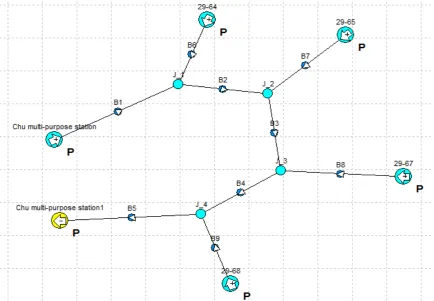
In order to verify the accuracy of the models and applied, the use of Huabei oil-field third production plant is high moisture content of the annular watered oil collecting data (month 12, water temperature, water flow rate, back to the station temperature, pipe diameter size, etc.), and the simulation of temperature drop data and compare [7]. First, use Pipesim to draw the well location diagram, as shown in Figure 1.
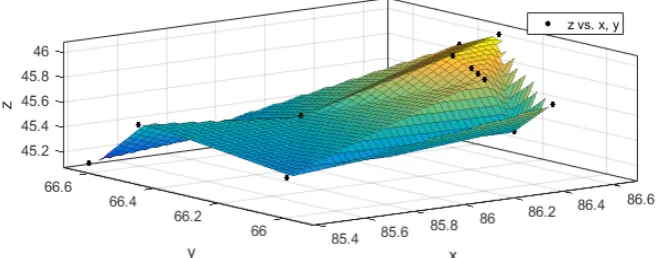
[image:4.595.106.541.404.705.2]According to the ring of the outbound parameters such as temperature, the temperature of back to the station, the inverse calculation formula to calculate the total heat transfer coefficient K, each output of the well fluid flow, tempera-ture, pipe parameters, buried temperature constant coefficient substitution model, the water flow rate set for x G, water blending temperature T is set to y, back to the station temperature as the dependent variable is set to z. After the mesh treatment of the model with matlab, the relationship between the return station temperature and water incorporation rate and water incorporation tem-perature is obtained, as shown in Figure 2.
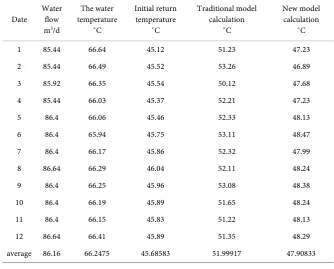
DOI: 10.4236/jpee.2018.69003 25 Journal of Power and Energy Engineering The actual water temperature, water flow into the traditional model (using the traditional ShuHuoFu total heat transfer coefficient of the model and the direct use of engineering manual) and the revised model respectively to calculate the temperature, back to the station to get the following Table 1; The actual temper-ature of the return station was marked on the graph of the function surface of water incorporation rate, water incorporation temperature and temperature of the return station, as shown in Figure 3.
[image:5.595.214.540.253.392.2]According to the data obtained, the error between the calculated results of the traditional model and the actual return station temperature is approximately 13.7%. The error between the calculated results of the modified model and the ac-tual return temperature is approximately 4.8%. It can be seen that the calculated
Figure 2. The relation between the temperature of return station and the flow rate and surface function of water blending temperature.
Table 1. Water incorporation rate, water incorporation temperature statistics table.
Date Water flow m3/d
The water temperature
˚C
Initial return temperature
˚C
Traditional model calculation
˚C
New model calculation
˚C
1 85.44 66.64 45.12 51.23 47.23
2 85.44 66.49 45.52 53.26 46.89
3 85.92 66.35 45.54 50.12 47.68
4 85.44 66.03 45.37 52.21 47.23
5 86.4 66.06 45.46 52.33 48.13
6 86.4 65.94 45.75 53.11 48.47
7 86.4 66.17 45.86 52.32 47.99
8 86.64 66.29 46.04 52.11 48.24
9 86.4 66.25 45.96 53.08 48.38
10 86.4 66.19 45.89 51.65 48.24
11 86.4 66.15 45.83 51.22 48.13
12 86.64 66.41 45.89 51.35 48.29
[image:5.595.204.539.458.727.2]DOI:10.4236/jpee.2018.69003 26 Journal of Power and Energy Engineering Figure 3. Function surface marked by actual return temperature.
error of the temperature drop formula obtained after the modification is signifi-cantly reduced.
4. Conclusions
1) After correction ShuHuoFu temperature drop formula and the total heat transfer coefficient, in view of the north China, Huabei Oilfield chu a high water cut oil region, the revised model calculated back to the station temperature compared with traditional model calculated results error is reduced from 13.7% to 4.8%, the temperature drop of the optimized model for going more in line with high water cut oil ring watered oil temperature drop model, it has applica-tion value.
2) Get a more accurate temperature drop model, generally known crude oil freezing point of 35˚C, considering the safety of 3˚C temperature coefficient, the optimal back stand temperature for 38˚C, and now back to the station tempera-ture 45˚C. In the annular watered oil collecting the existing process, through the model can further adjust the water flow and water temperature, finally can also be made back to the station 7˚C to 38˚C temperature drop, so as to further re-duce energy consumption.
References
[1] Su, H. (2017) Optimization of Energy Consumption for Crude Oil Pipeline. Xi’an Petroleum University.
[2] Wu, C.C. and Yan, D.F. (1989) Two Level Hierarchical Optimization Model for Steady Operation of Hot Oil Pipeline. Acta Sinica, 10, 109-117.
[3] Wang, B.Q., Lin, Y.H., Dai, Y.B., et al. (2012) Current Situation and Prospect of China’s Crude Oil Pipeline. Petroleum Planning and Design, 23, 8-11.
[4] Liu, Y. and Guan, X.J. (1993) Optimal Design of Oil and Gas Gathering and Trans-portation System. Natural Gas Industry, No. 2, 36-38.
[5] Liu, Y. and Guan, X.J. (1993) Topology Optimization Design of Annular Gathering Pipeline Network. Acta Petrota Sinica, No. 3, 28-30.
[6] Shi, G.Y. and Dong, J.L. (1999) Optimization Method. Higher Education Press, 53-57. [7] Jiang, J.S., He, C.X. and Pan, S.H. (2007) Optimization Calculation Method South