Journal of Signal and Information Processing, 2011, 2, 184-189
doi:10.4236/jsip.2011.23025 Published Online August 2011 (http://www.SciRP.org/journal/jsip)
Improving Mutual Coherence with Non-Uniform
Discretization of Orthogonal Function for Image
Denoising Application
Hani Nozari1, Alireza Siamy2
1Department of Electrical Engineering, Iran University of Science and Technology, Tehran, Iran; 2Department of Electrical Engi-neering, Mazandaran University, Babol, Iran.
Email: [email protected]
Received April 27th, 2011; revised May 20th, 2011; accepted May 27th, 2011.
ABSTRACT
This paper presented a novel method on designing redundant dictionary from known orthogonal functions. Usual way of discretization of continuous functions is uniform sampling. Our experiments show that dividing the function defini-tion interval with non-uniform measure makes the redundant dicdefini-tionary sparser and it is suitable for image denoising via sparse and redundant dictionary. In this case the problem is to find an appropriate measure in order to make each atom of dictionary. It has shown that in sparse approximation context, incoherent dictionary is suitable for sparse ap-proximation method. According to this fact we define some optimization problems to find the best parameter of distribu-tion measure (in our study normal distribution). For better convergence to optimum point we used Genetic Algorithm
(GA) with enough diversity on initial population. We show the effect of this type of dictionary design on exact sparse recovery support. Our results also show the advantage of this design method on image denoising task.
Keywords:Grassmaniann Frames, Normal Distribution, Mutual Coherence, Genetic Algorithm, Image Denoising
1. Introduction
Since the sparse representation of signals has leaded to improvements in many applications such as coding, de-noising, feature extraction and etc. in signal and image processing, there has been a growing interest in the study of this method in recent years. Sparse and redundant re-presentation modeling of data assumes an ability to de-scribe signal as linear combinations of a few atoms from a pre-specified dictionary [1], where the linear coeffi-cients are sparse. In this case we use a matrix
, as a dictionary, either to compactly express or efficiently approximate a signal. Let
and
:
d N d N
D dN
d y
N
x be the given signal and the coefficient vec-tor respectively. We can express sparse equation as
0, 0 2: min
x
P x
subject to y Dx
(1)
where 0
been proposed in order to reach an approximate solution and all of them can be categorized as greedy algorithms like matching pursuit (MP) [1] and its derivations [3], and relaxation method, like basis pursuit (BP) [4]. Image denoising via sparse and redundant representation uses this fact. Suppose Z is zero-mean white Gaussian noise
with known standard deviation , and X be a cleaned
image. Y = X + Z would be noisy image. Image denoising
via redundant dictionary is a kind of energy minimization [5] and it can be expressed by following functional ex-pression
2 22 2
0
, , ij ij
ij i i j
j
j i X X Y D R
f
X
(2)
The first term of above expression says the difference between measured image Y and its denoised version X.
second and third part of this expression represent sparse approximation. Choosing a dictionary D which have to
be an overcomplete dictionary is one of the most impor-tant fundamental choices that must be considered [6]. An overcomplete dictionary D that leads to sparse
represen-x is the norm, counting the nonzero en-tries of a vector. With
0 l
0
tations can either be chosen as a pre-specified set of functions (dictionary of this type include wavelets [7], Curvelets [8], Contourlets [9] and bandelets [10], among others.) or designed by adapt its content to fit a given set of sample signals such as method of optimal direction (MOD) [11], the K-SVD [12] and others. Using a pre-specified dictionary leads to creating simple and fast algorithms for the evaluations of the sparse representa-tion. These types of dictionaries are called non-adaptive dictionaries. Adaptive dictionary is time consuming for sparse approximation so working with pre-specified functions still have its own interest.
In this paper we used different ways to signals atom from pre-specified functions. Each column of the dic-tionary is selected from a set of orthogonal functions in a specific dimension. In order to make a dictionary of size we should sample d times from each N atoms.
The main question is how one can sample the function definition interval in order to achieve a sparser dictionary. To divide the interval of function definition in order to select each sample of function formed with normal dis-tribution
dN
, , we used some optimization tech-niques to find the best parameter of normal distribution. For confidence in convergence we implement our opti-mization task with Genetic Algorithm (GA). As describe later our objective function has several extremum so enough diversity on initial population decrease the possi-bility of trapping in local minimum. With this discretiza-tion, the result dictionary has smaller mutual coherence than uniform one as a result of this fact better Peak-Sig- nal-to-Noise-Ratio (PSNR) achieve in image processing. This type of dictionary design is also improved the re-quired time for image denoising.
2. Tight Frames
The concept of a frame is a generalized concept of an orthonormal basis. Each vector in the space can be rep-resented as the sum of the elements in the frame, but it is not necessarily unique. The frame theory gives energy equivalence conditions to solve both synthesis and analy-sis problems with stable operators. A family
p is aframe of the Hilbert space . If then we can have [7]:
d
V BA0
2 2
Λ
, , p
m
h V A h h B h
2(3)
where the usual Hermitian inner product is denoted with .,. , and . is written for the associated norm. when A = B we will have tight frames. We can achieve the unit
norm tight frames when p 1. With concatenating N frames of we have overcomplete dictionary. In fol-lowing part of this section we explain the process of
de-signing overcomplete dictionary from a specific family of frames.
d
2.1. Overcomplete Dictionary
Suppose
1, 2 N
d N D
are a set of N orthogonal con-tinuous functions in the [a,b] interval. In order to make N
vectors of size “d” (d < N), we should sample these
func-tions d times on its definition interval. The outcome of this process is a d N :dN matrix called over- complete dictionary that is used in sparse representations. Which distribution we should use to sample these frames? The answer of this question completely depends on the type of orthonormal frames, but experiments show that normal distribution is suitable for majority of orthonor-mal functions. Nororthonor-mal distribution
,
has two parameters; mean and standard deviation . Dif-ferent parameters of this distribution define difDif-ferent type of discretization so we have distinct dictionary for each pair of parameters. In this paper we want to discuss dif-ferent methods in order to find the best parameters of normal distribution, after that we define some optimiza-tion problem to find these parameters. At first we men-tion some definimen-tions for dicmen-tionary selecmen-tion in sparse representations. A substantial parameter in dictionary selection for sparse representation is mutual coherence. The mutual coherenceof a dictionary D, , expressthe coherency between atoms of dictionary. This pa-rameter defined by inner product between each distinct normalized atoms of dictionary D [13]
D
max | |T i j i j T T
i j i j
a a D
a a a a
(4)
Minimum
D is suitable for sparse representation. For an orthogonal matrix D, we have . But fora redundant dictionary mutual coherence is greater than zero because of its redundancy in known dimension. For an overcomplete dictionary (N > d) it has shown that
there exist a lower bound. It has been shown in [14] that for all full rank matrix of size
D 0
dN
1
G
k n n k
(5)
G
Improving Mutual Coherence with Non-Uniform Discretization of Orthogonal Function for 186
Image Denoising Application
minimize this distance. Following part represent con-struction of our objective function.
2.2. Optimization Problem
Let D
1, 2, ,N
.T DD D be a dictionary in , we de-fine as gram matrix of D. Each element of this matrix represents the coherency of each two atoms that obtain with an inner product between corresponding atoms. Suppose G be a square matrix in which the
absolute value each of off diagonal elements are d N
and the diagonal element is 1 (Gram matrix of Grassmannian frames). In order to make a dictionary, which have min-imum distance in frobenious norm to Grassmannian frames, we can define our objective function as a dis-tance minimization of D and G
ٛ
: D G F
OBJ (6)
.F stands for frobenious norm; D and G is
Gram matrix of dictionary D and Grassmannian frames
respectively
.F stands for frobenious norm. This is a big objective function to minimization, so we need to break down this function in order to achieve better opti-mization problem. In other words, we want to link this problem to sampling process of orthogonal set. The main ongoing question is how to sample orthogonal functions. Suppose
k , be a set of N orthogonal func-tions in the [a,b] interval. To divide this interval to dsample we use methods that are explained as 1
k N
, 1 0 0,k k 1 k,k 1, 2,
t t t d (7)
where 1 , and the values of
0
d
k k
b a
k
are de-termined by normal distribution
t, ,
. As it has been explained before, each element of D
is an inner product of corresponding atoms
(D
i,j i
t, ,
,j t, ,
). We canrewrite the objective function as below:
2 1 2
, ,
D G F D G
i j
i j i j F u,s
(8)
So with this assumption the objective function only depends on ,
. So we can use any optimization algo-rithm to minimize this objective function [17]. The value of F u s
, or distance between Gram matrix of de-signed dictionary and Grassmannian frames implicitly depend on orthogonal function, so different set of or-thogonal function has different value for F u s
, . 2.3. Solving the Problem: GAObjective function that defined in (7) is a non-convex problem. We might be in trouble if we want to solve this problem with gradient methods; because these methods
need an initial intelligent guess on initial point for confi-dence in real convergence and not trapped in local min-ima. GA is a method that we should use to conquest to this problem. The main part of GA is its initial popula-tion that should have enough diversity. Our experiments show that uniform distribution on and is suit-able for finding absolute minimum. This algorithm re-peatedly modifies a population of individual solutions. At each step, it randomly selects individuals from the current population to be parents and uses them to pro-duce children for the next generation [18]. Number of variables in optimization process is two. In the next sec-tion we implement our algorithm on trigonometric func-tion as an orthogonal set.
3. Implementation and Results
This section illustrated our simulation results. As men-tion above we can apply this algorithm on any set of or-thogonal function. We implement our algorithm on Si-nusoid functions
sin
nx
as a specific set ofor-thogonal function. At first we perform our optimization process and find the best parameters of normal distribu-tion and compare the distance to Grassmannian frames with uniform version of this function. Second part of this section demonstrated the ability of this kind of dictionary design on sparse coding. The last part shows the effect of normal sampling type dictionary design on image de-noising.
3.1. Design Dictionary
sin nx
is an orthogonal set in
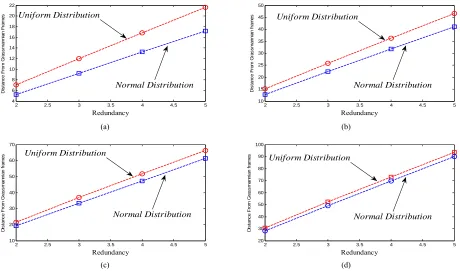
0,π . We want to compare uniform and normal distributions in order to make overcomplete dictionary in sparse representations. To optimize the (8) function we used “ga” command of Matlab software. We implement our algorithm on several lengths of dictionary’s atom and different redundancy factor and plotted the distance of Gram matrix of each dictionary from Grassmannian frames in Figure 1. As it is obvious, the dictionary that has been designed with normal distribution is closer to Grassmannian frames than the uniform one. Optimize parameters for normal distribution, are listed in Table 1 for different atom length and dictionary redundancy.3.2. Sparse Coding
This part demonstrated the ability of sampling with nor-mal distribution in terms of exact sparse recovery. In this experiment we use the method that presented in [19] and plotted the probability of success in sparse coding versus the cardinality of solution and our result be depicted in Figure 1. As it clear from the Figure 2, normal type
2 2.5 3 3.5 4 4.5 5 4 6 8 10 12 14 16 18 20 22 Redundancy D is tan c e F rom G ras s m anni an Fr ames
2 2.5 3 3.5 4 4.5 5
10 15 20 25 30 35 40 45 50 Redundancy D is tan c e F rom G ras s m anni an f rames
Uniform Distribution Uniform Distribution
Normal Distribution Normal Distribution
(a) (b)
2 2.5 3 3.5 4 4.5 5
10 20 30 40 50 60 70 Redundancy D is tanc e F rom G ras s m an ni an f ra m es
2 2.5 3 3.5 4 4.5 5
20 30 40 50 60 70 80 90 100 Redundancy D is tanc e F rom G ras s m an ni an f ra m
es Uniform Distribution
Uniform Distribution
Normal Distribution Normal Distribution
[image:4.595.72.532.94.365.2](c) (d)
Figure 1. Distance from Grassmannian frames for different length of atom and redundancy factor (a) d = 16, (b) d = 64, (c) d = 128, (d) d = 256.
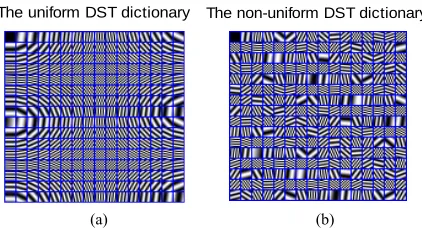
3.3. Image Denoising process for Boat image in different noise level. Paying attention to the figures the advantages of using this type of design is obvious. In Figure 4 these two types of overcomplete dictionaries are shown as an element in gray scale.
As a result of this type of dictionary design, we per-formed our algorithm on image denoising. We used im-age denoising method which was proposed in [17]. In this type of image denoising a controversial point is se-lecting overcomplete dictionary. Signal to noise ratio (PSNR) of resulted image with these two types of over-complete dictionaries are illustrated in Table 2 (the value of PSNR are average for 10 times running the pro-gram )The length of each atom of dictionary in this ex-periment selected to 64 and redundancy factor is 4. A considerable point in this method of image denoising is decreasing of denoising process time in normal type dic-tionary design. Figure 3 shows the time of denoising
4. Conclusions
[image:4.595.310.539.586.724.2]In this paper we defined new method on overcomplete dictionary design from orthogonal functions. Our experi-ment showed that non-uniform sampling of thesefunction makes a dictionary that is closer to Grassman nian frames
[image:4.595.60.283.612.721.2]Table 2. PSNR of denoised image for uniform and normal type sampling dictionary (bolded numbers are related to normal type dictionary design).
Table 1. Optimized
,
for each dictionary.Redundancy d
2 3 4 5
16 (–0.25,0.64) (–0.3,0.88) (1.76,0.1) (–0.6,0.7) 64 (–0.25,0.8) (–0.45,0.58) (1.02, –0.35) (–0.65,1.95) 128 (–0.45,1) (–0.5,0.8) (1.4, –0.35) (–0.65,1.22) 256 (–0.5,1.16) (–0.5,1.26) (1, –0.5) (–0.70,1.22)
Noise Level Image
10 20 30 40 50
barbara 33.40/ 33.59 29.80/ 30.00 27.71/ 27.83 26.16/ 26.34 25.01/ 25.13
lena 34.61/
34.73 31.51/ 31.64 29.65/ 29.76 28.34/ 28.41 27.29/ 27.41
boat 33.01/
Improving Mutual Coherence with Non-Uniform Discretization of Orthogonal Function for 188
Image Denoising Application
0 2 4 6 8 10 12 14 16 0
0.1 0.2 0.3 0.4 0.5 0.6 0.7 0.8 0.9 1
Cardinality of the Solution
P
ro
b
a
b
il
it
y
o
f
S
u
cces
s
Normal Distribution Dictionary
Uniform Distribution Dictionary
Cardinality of the Solution
P
roba
bi
li
ty
o
f t
h
e Soc
ce
[image:5.595.64.283.98.251.2]ss
Figure 2. Comparison of two type dictionary design in exact sparse recovery.
10 15 20 25 30 35 40 45 50
0 50 100 150 200 250 300 350
Noise Level
Requ
ir
ed
T
im
e F
or
D
enoi
s
ing (
s
ec
ond)
Normal Distribution Uniform Distribution
[image:5.595.61.287.290.468.2]Normal Distribution Uniform Distribution
Figure 3. Time required for denoising process for two type dictionary design.
The uniform DST dictionary The non-uniform DST dictionary
(a) (b)
Figure 4. (a) uniform DST dictionary, (b) non-uniform (normal) DST dictionary.
compared to the uniform one. Normal distribution is used for sampling and its parameters (mean and standard de-viation) are optimized through some optimization proce- sses. Proposed method design has some advantage in sparse coding and we show this result with plotted the
probability of success in exact sparse recovery. In this framework we showed that this type of dictionary design has better performance than uniform sample dictionary design in image denoising application with improving the PSNR of result image and decrease the required time for image denoising. As mention in paper, we can apply this type redundant dictionary design on any orthogonal set and also we can use other distribution for sampling the interval of function definition.
REFERENCES
[1] S. Mallat and Z. Zhang, “Matching Pursuits with Time Frequency Dictionaries,” IEEE Transactions on Signal Processing, Vol. 41, No. 12, 1993, pp. 3397-3415.
doi:10.1109/78.258082
[2] G. Davis, “Adaptive Nonlinear Approximations,” Ph.D. Dissertation, New York University, New York, 1994. [3] T. Blumensath and M. Davies, “Gradient Pursuits,” IEEE
Transactions on Signal Processing, Vol. 56, No. 6, 2008, pp. 2370-2382.doi:10.1109/TSP.2007.916124
[4] S. Chen, D. Donoho and M. Saunders, “Atomic Decom-position by Basis Pursuit,” SIAM Journal on Scientific Computing, Vol. 20, No. 1, 1998, pp. 33-61.
doi:10.1137/S1064827596304010
[5] M. Elad, “Sparse and Redundant Representations: From Theory to Applications in Signal and Image Processing,” Springer, New York, 2010.
[6] R. Rubinstein, A. M. Bruckstein and M. Elad, “Diction-aries for Sparse Representation Modeling,” IEEE Pro-ceedings—Special Issue on Applications of Sparse Rep-resentation & Compressive Sensing, Vol. 98, No. 6, April
2010, pp. 1045-1057.
[7] S. Mallat, “A Wavelet Tour of Signal Processing,” 3rd Edition, Academic, New York, 2009.
[8] E. J. Candès and D. L. Donoho, “Curvelets—A Surpris-ingly Effective Nonadaptive Representation for Objects with Edges,” Vanderbilt University Press, Nashville, 1999. [9] M. N. Do and M. Vetterli, “The Contourlet Transform: An
Efficient Directional Multiresolution Image Representa-tion,” IEEE Transaction on Image Processing, Vol. 14, No. 12, 2005, pp. 2091-2106.doi:10.1109/TIP.2005.859376 [10] E. LePennec and S. Mallat, “Sparse Geometric Image
Representations with Bandelets,” IEEE Transaction on Image Processing, Vol. 14, No. 4, 2005, pp. 423-438.
doi:10.1109/TIP.2005.843753
[11] K. Engan, S. O. Aase and J. H. Husoy, “Method of Opti-mal Directions for Frame Design,” IEEE International Conference on Acoustics, Speech, and Signal Processing, Phoenix, 15-19 March 1999, pp. 2443-2446.
[12] M. Aharon, M. Elad and A. M. Bruckstein, “The K-SVD: An Algorithm for Designing of Overcomplete Dictionaries for Sparse Representation,” IEEE Transactions on Signal Processing, Vol. 54, No. 11, 2006, pp. 4311-4322.
[image:5.595.66.277.506.620.2][13] M. Aharon, M. Elad and A. M. Bruckstein, “On the Uni-queness of Overcomplete Dictionaries, and a Practical Way to Retrieve Them,” Journal of Lineaar Algebra and Applications,Vol. 416, No. 1, 2006, pp. 48-67.
[14] T. Strohmer and R. Heath, “Grassmannian Frames with Applications to Coding and Communication,” Applied and Computational Harmonic Analysis, Vol. 14, No. 3, 2003,
pp. 257-275.doi:10.1016/S1063-5203(03)00023-X [15] J. Tropp, I. Dhillon, R. Heath Jr. and T. Strohmer,
“De-signing Structural Tight Frames via an Alternating Pro-jection Method,” IEEE Transactions on Information Theory, Vol. 51, No. 1, 2005, pp. 188-209.
doi:10.1109/TIT.2004.839492
[16] M. Yaghoobi, T. Blumensath and M. Davies, “Dictionary Learning for Sparse Approximations with the Majorization
Method,” IEEE Transactions on Signal Processing, Vol.
57, No. 6, 2009, pp. 2178-2191.
doi:10.1109/TSP.2009.2016257
[17] J. C. Lagarias, J. A. Reeds, M. H. Wright and P. E. Wright, “Convergence Properties of the Nelder-Mead Simplex Method in Low Dimensions,” SIAM Journal of Optimiza-tion, Vol. 9 No. 1, 1998, pp. 112-147.
doi:10.1137/S1052623496303470
[18] D. E. Goldberg, “Genetic Algorithms in Search, Optimi-zation and Machine Learning,” Addison Wesley, Reading, 1989.
[19] M. Elad and M. Aharon, “Image Denoising via Sparse and Redundant Representations over Learned Dictionaries,”
IEEE Transactions on Image Processing, Vol. 15, No. 12,