Parallel algorithms for computing finite semigroups
J. Jonuˇsas, J. D. Mitchell, and M. Pfeiffer
October 17, 2017
Abstract
In this paper, we present two algorithms based on the Froidure-Pin Algorithm for computing a finite semigroup. If U is any semigroup, andA be a subset of U, then we denote by hAi the least subsemigroup ofU containingA.
IfB is any other subset ofU, then, roughly speaking, the first algorithm we present describes how to use any information abouthAi, that has been found using the Froidure-Pin Algorithm, to compute the semigrouphA, Bi. More precisely, we describe the data structure for a finite semigroupSgiven by Froidure and Pin, and how to obtain such a data structure forhA, Bifrom that forhAi. The second algorithm is a lock-free concurrent version of the Froidure-Pin Algorithm.
As was the case with the original algorithm of Froidure and Pin, the algorithms presented here produce the left and right Cayley graphs, a confluent terminating rewriting system, and a reduced word of the rewriting system for every element of the semigroup they output.
1
Introduction
Asemigroup is just a setU together with an associative binary operation. If Ais a subset of a semigroup U, then we denote by hAithe smallest subsemigroup ofU containingA, and refer toAas thegenerators
ofhAi. The question of determining the structure of the semigrouphAigiven the set of generators Ahas a relatively long history; see the introductions of [2] or [3] for more details.
In [3] the authors present an algorithm for computing a finite semigroup; we refer to this as the
Froidure-Pin Algorithm. More precisely, given a set A of generators belonging to a larger semigroupU, the Froidure-Pin Algorithm simultaneously produces the left and right Cayley graphs ofhAi, a confluent terminating rewriting system forhAi, and a reduced word of the rewriting system for every element ofhAi. The Froidure-Pin Algorithm is perhaps the first algorithm for computing an arbitrary finite semigroup and is still one of the most powerful, at least for certain types of semigroup. Earlier algorithms, such as those in [6,7], often only applied to specific types of semigroups, such as those of transformations or boolean matrices.
The Froidure-Pin Algorithm involves determining all of the elements of the semigrouphAiand storing them in the memory of the computer. In certain circumstances, it is possible to fully determine the structure ofhAiwithout enumerating and storing all of its elements. One such example is the Schreier-Sims Algorithm for permutation groups; see [12,13,15]. In [2], based on [6–8], the Schreier-Schreier-Sims Algorithm is utilised to compute any subsemigrouphAi of a regular semigroup U. Of course, this method is most efficient when trying to compute a semigroup containing relatively large, in some sense, subgroups. In other cases, it is not possible to avoid enumerating and storing all of the elements ofhAi. For example, if a semigroupS isJ-trivial, or a subsemigroup of a non-regular semigroup, then the algorithms from [2] simply enumerateS exhaustively, with the additional overheads that the approach in [2] entails. It is to these types of semigroups that the Froidure-Pin Algorithm is best suited.
In this paper, we present two algorithms based on the Froidure-Pin Algorithm from [3]. The first algorithm (Algorithm4.3) can be used to extend the output of the Froidure-Pin Algorithm for a given semigrouphAi, to compute a supersemigroup hA, Biwithout recomputinghAi. This algorithm might be useful for: changing generators in a presentation forhAi; finding small or irredudant generating sets for
hAi; computing the maximal subsemigroups of certain classes of semigroup [1].
The second algorithm (Algorithm5.6) is a lock-free concurrent version of the Froidure-Pin Algorithm. Since computer processors are no longer getting faster, only more numerous, the latter provides a means for fully utilising contemporary machines for computing finite semigroups.
Both algorithms are implemented in C++ in the libsemigroups library [9] and available in the
GAP[4] packageSemigroups[10], both of which are open source software.
In Section3 we describe the Froidure-Pin Algorithm and prove that it is valid. While there is much overlap between Section3and [3], this section is necessary to prove the validity of Algorithms4.3and5.6, and because some details are omitted from [3]. Additionally, our approach is somewhat different to that of Froidure and Pin’s in [3]. The first of our algorithms, for computinghA, BigivenhAi, is described in Section4, and the lock-free concurrent version of the Froidure-Pin algorithm is described in Section 5.
2
Preliminaries
In this section, we recall some standard notions from the theory of semigroups; for further details see [5]. Iff :X −→Y is a function, then dom(f) =X and im(f) =f(X) ={f(x) :x∈X}.
IfS is a semigroup andT is a subset ofS, thenT is a subsemigroupifab∈T for alla, b∈T.
A semigroupSis amonoid if it has an identity element, i.e. an element 1S ∈Ssuch that 1Ss=s1S =s for alls∈S. Asubmonoid T ofS is a subsemigroup containing the identity ofS. IfS is a semigroup, we writeS1 for the monoid obtained by adjoining an identity 1
S toS if necessary.
Acongruenceρon a semigroupSis an equivalence relation onS which is invariant under the multipli-cation ofS. More precisely, if (x, y)∈ρands, t∈S, then (xs, ys),(tx, ty)∈ρ. Ahomomorphism from a semigroupS to a semigroupT is just a functionf :S−→T such thatf(xy) =f(x)f(y) for allx, y∈S. Amonoid homomorphism from a monoidS to a monoidT is a semigroup homomorphism that maps the identity ofS to that of T. Ifρis a congruence on a semigroupS, then the quotient S/ρ ofS byρis the semigroup consisting of the equivalence classes{s/ρ:s∈S}ofρwith the operation
x/ρ y/ρ= (xy)/ρ
for allx, y∈S. Iff :S−→T is a homomorphism of semigroups, then thekernel off is
ker(f) ={(x, y)∈S×S:f(x) =f(y)},
and this is a congruence. There is a natural isomorphism between S/ker(f) and (S)f = {t ∈ T : t = f(s) for somes∈S}which is a subsemigroup ofT.
Analphabet is just a finite setAwhose elements we refer to asletters. A word is just a finite sequence w= (a1, . . . , an) of letters a1, . . . , an in an alphabetA. We will write a1· · ·an instead of (a1, . . . , an). A non-emptysubword of a worda1· · ·an is a word of the formai· · ·aj where 1≤i≤j≤n.
Thefree monoid over the alphabetA is the set of all words overAwith operation the concatenation of words; we denote the free monoid onAbyA∗. The lengthof a wordw=a1· · ·an∈A∗ is justnand is denoted|w|. We denote the identity ofA∗, which is the unique word of length 0, by ε; we may also refer to this as theempty word. The free monoidA∗ has the property that every functionf :A−→S, where S is a monoid, can be uniquely extended to a monoid homomorphismν:A∗−→S.
If<is a well-ordering ofA, then<induces a well-ordering ordering onA∗, which we will also denote by<, defined byu < vif|u|<|v|or there existp, u0, v0∈A∗ anda, b∈A, a < b, such thatu=pau0 and v=pbv0. We refer to<as theshort-lex order onA∗. If S is a monoid, A⊆S, andν :A∗ −→S is the natural homomorphism, thenu∈A∗ with the property that
u= min{v∈A∗:ν(u) =ν(v)}
with respect to the short-lex order onA∗, is referred to as areduced word forS. For every word w∈A∗, there is a unique reduced word forS, which we denote byw.
Proposition 2.1 (cf. Proposition 2.1 in [3]). Let A be any alphabet, let u, v, x, y∈A∗, and leta, b∈A. Then the following hold:
(a) if u < v, thenau < avandua < va; and
(b) if ua≤vb, thenu≤v.
(c) if u≤v, thenxuy≤xvy.
Proposition 2.3 (cf. Proposition 2.3 in [3]). If S is a monoid, A ⊆ S, ν : A∗ −→ S is the natural homomorphism, then the setR={w:w∈A∗} with the operation defined by u·v=uvis a monoid.
Throughout this paper, we refer to the semigroupU as theuniverse, and we letS be a subsemigroup ofU given by a finite setAof generators. The algorithms described herein, require that we can:
• computing the product of two elements inU;
• test equality of elements inU;
By adjoining an identity, if necessary, we may assume without loss of generality thatU is a monoid. If
hAihappens not to be a submonoid ofU, then we can simply adjoin the identity ofU tohAi, apply either of our algorithms tohAi1, and then remove or ignore the adjoined identity in the returned data structure. In this way, we may assume without loss of generality thathAiis a submonoid ofU.
3
The Froidure-Pin Algorithm
In this section we describe the Froidure-Pin Algorithm from [3] and prove that it is valid.
Throughout this section, letU be any monoid, letS be a submonoid ofU generated byA⊆U where 1U ∈A, and letν :A∗−→Sbe the natural homomorphism. Sinceν(a) =afor alla∈A, we can compute ν(s) for anys∈A∗ by computing products of elements inS.
We require functionsf, l:A∗−→Aandp, s:A∗−→A∗ defined as follows.
• ifw∈A∗andw=aufor somea∈Aandu∈A∗, thenf(w) =aands(w) =u, i.e. f(w) is the first letter ofwands(w) is the suffix ofwwith length|w| −1;
• ifw∈A∗ and w=vbfor someb∈A andv ∈A∗, thenl(w) =b andp(w) =v, i.e. l(w) is the last letter ofwandp(w) is the prefix ofwwith length|w| −1.
Definition 3.1. The input of the Froidure-Pin Algorithm [3] is a data structure for S which is a tuple (A, Y, K, B, φ) where:
(i) A={a1, . . . , ar}is a finite collection of generators for S;
(ii) A⊆Y ={y1, . . . , yN} is a collection of reduced words forS andy1< y2<· · ·< yN;
(iii) if x∈A∗is reduced, then either x∈Y or x > y
N;
(iv) 1≤K≤ |Y|+ 1
(v) ifK≤ |S|, then
φ: A× {y1, . . . , yL}
∪ {y1, . . . , yK−1} ×A
∪ {yK} ×B
−→Y
satisfies:
(a) eitherL=K−1 orL < K−1 andLis the largest value such that|yL|<|yK−1|; (b) eitherB=∅or B={a1, . . . , as} for some 1≤s≤r; and
(c) ν(φ(u, v)) =ν(uv) for all u, v∈dom(φ).
Note that in part (iv) of Definition3.1,φ(u, v)≤uvfor allu, v∈dom(φ) sinceφ(u, v)∈Y is reduced. The output of the algorithm is another data structure of the above type where: the output value of Kis at least the input value; the output value of Y contains the input value as a subset; and the output functionφis an extension of the input function. In this way, we say that the output data structureextends
the input data structure.
The minimal data structure required by the Froidure-Pin Algorithm forS =hAiis:
(A, A,1,∅,∅). (3.2)
If (A, Y, K, B, φ) is a data structure for the monoidS, then|Y|is referred to as its size, its elements are the elements ofY, and x∈S belongs to the data structure ifx∈Y.
Lemma 3.3. If(A, Y, K, B, φ) is a data structure forS andw=a1· · ·ar∈A∗, then w=φ(· · ·φ(φ(a1, a2), a3), . . . , ar).
Proof. Certainly,u=φ(· · ·φ(φ(a1, a2), a3), . . . , ar)∈Y and so uis reduced, and
ν(u) =ν(φ(· · ·φ(φ(a1, a2), a3), . . . , ar)) =ν(a1· · ·ar) =ν(w),
by repeated application of Definition3.1(v). Thereforeu=ware required.
Lemma 3.4. If (A, Y, K, B, φ) is a data structure for a semigroup S,a is the least generator in A\B,
w∈A∗ is reduced, and w < yKa, thenw∈Y.
Proof. Since w =p(w)l(w)< yKa, it follows that either p(w)< yK or l(w)< a by Proposition 2.1. In both cases, (p(w), l(w))∈dom(φ), and sow=φ(p(w), l(w))∈Y.
Next we describe the Froidure-Pin Algorithm, a proof that the algorithm is valid can be found in Lemmas3.4and 3.6. We divide the algorithm into two separate procedures so that it is easier to digest, and so that we can reuse part of the proof later in the paper.
Algorithm 3.1Update
Input: A data structure (A, Y, K, B, φ) for a semigroupS.
Output: A data structure for S which extends (A, Y, K, B, φ) and which contains yKa where a is the least element ofA\B.
1: a:= min{A\B}andN :=|Y|
2: if s(yK)ais not reducedthen [φ(s(yK), a)< s(yK)a]
3: φ(s(yK), a) =yi for someyi∈Y 4: φ(yK, a) :=φ(φ(f(yK), p(yi)), l(yi))
5: else if ν(yKa) =ν(yi) for somei < N then
6: φ(yK, a) :=yi 7: else
8: yN+1:=yKaandY ←Y ∪ {yN+1}
9: φ(yK, a) :=yN+1
10: end if
11: return(A, Y, K, B∪ {a}, φ)
Lemma 3.5. If (A, Y, K, B, φ)is a data structure for a semigroupS andais the least generator inA\B, then Algorithm3.1returns a data structure containing yKa.
Proof. There three cases to consider:
(a) s(yK)ais not reduced
(b) ν(yKa) =ν(yi) for somei < N
(c) neither (a) nor (b) holds.
(a). The only component of the data structure which is modified isφ, and so we must verify thatφis well-defined, and satisfies Definition3.1(v).
In this case, the elementyi∈Y exists becauses(yK)∈Y ands(yK)< yKand soφ(s(yK), a) is already defined. Sincep(yi)l(yi) =yi< s(yK)a, either|p(yi)|<|s(yK)|or |p(yi)l(yi)|=|s(yK)a|. In either case, p(yi)≤s(yK)< yK. Henceφ(f(yK), p(yi)) is defined and
By the definition ofφand sinceν is a homomorphism,
ν(yKa) = ν(f(yK)s(yK)a) =ν(f(yK))ν(s(yK)a) =ν(f(yK))ν(φ(s(yK), a))
= ν(f(yK))ν(yi) =ν(f(yK)yi) =ν(f(yK)p(yi))ν(l(yi))
= ν(φ(f(yK), p(yi)))ν(l(yi)) =ν(φ(f(yK), p(yi))l(yi))
= ν(φ(φ(f(yK), p(yi)), l(yi))).
If we defineφ(yK, a) := φ(φ(f(yK), p(yi)), l(yi)) as in Algorithm3.1, then φ continues to satisfy Defini-tion3.1(v).
(b). The only component of the data structure which is modified is φ, and so again we must only verify thatφsatisfies Definition3.1(v). By the assumption of this case, ν(φ(yK, a)) =ν(yi) =ν(yKa).
(c). Both φandY are modified in this case. We start by showing thatyKais reduced. Let w ∈ A∗ be the minimum word such that ν(w) = ν(y
Ka). By the assumption of this case, ν(yKa)6=ν(y) for all y ∈Y, and so w6∈Y. Ifw < yKa, then, by Lemma 3.4, w∈Y, a contradiction. Hencew=yKais reduced.
SinceyKa6∈Y, it follows by Definition3.1(iii) thatyKa > yN, and so definingyN+1=yKa,Y∪{yN+1} satisfies part Definition3.1(ii).
If w ∈ A∗ is any reduced word such that w < yN+1 = yKa, thenw ∈Y, and so Definition 3.1(iii) holds.
Finally,ν(φ(yK, a)) =ν(yN+1) =ν(yKa) by definition and so Definition3.1(v) holds and the proof is complete.
Algorithm 3.2FroidurePin
Input: A data structure (A, Y, K,∅, φ) for a semigroupS and a limitM ∈N.
Output: A data structure forS which extends (A, Y, K,∅, φ) and with size at least min{M,|S|}.
1: whileK≤ |Y|and|Y|< M do
2: l:=|yK|
3: while K≤ |Y|and|Y|< M and|yK|=l do
4: B:=∅
5: whileB\A6=∅do [loop over the generators in (short-lex) order]
6: (A, Y, K, B, φ)←Update((A, Y, K, B, φ), a)
7: end while
8: K←K+ 1
9: end while
10: if K >|Y|or|yK|> lthen
11: L= max{i∈N:|yi|< l} 12: fori∈ {L+ 1, . . . , K−1} do
13: fora∈Ado [extendφso that A× {yi} ⊆dom(φ)]
14: φ(a, yi) :=φ(φ(a, p(yi)), l(yi)) 15: end for
16: end for
17: end if
18: end while
19: return(A, Y, K,∅, φ).
Note that both the input and output of Algorithm3.2 has fourth component equal to∅, and as such it would appear to be unnecessary. However, it is used in the definition, so that in Algorithm3.1we can succinctly describe the output. Algorithm 3.2 could be modified to return a data structure where the fourth component was not empty, but for the sake of relative simplicity we opted not to allow this.
Lemma 3.6. If (A, Y, K,∅, φ) is a data structure for a semigroup S and M ∈ N, then Algorithm 3.2
returns a data structure forS with at leastmin{M,|S|}elements.
If |Y| ≥ M and |yK| = |yK−1| = l, then the condition in line 3 is not satisfied, and neither is the condition in line10. Furthermore, the condition in line1is not satisfied, and so (A, Y, K, A, φ) is returned. By the assumption of this case, that|yK|=|yK−1|=l, it follows that (A, Y, K, A, φ) is a data structure forS, as required.
IfK=|Y|+ 1, then the condition in line3 is not satisfied and, in this case, the condition in line10is satisfied.
IfK≤ |Y|and|yK| 6=|yK−1|=l, then the condition in line3is not satisfied, and, again in this case, the condition in line10is satisfied.
In either of the last two cases, the tuple (A, Y, K, B, φ) satisfies Definition3.1(i) to (iv) but fails to satisfy part (v), sinceφ is not defined on A× {yM+1, . . . , yK−1}, where M ∈ N is the maximum value such that|yM| <|yK−1|. The only component of (A, Y, K, B, φ) that is modified within the if-clause is φ. Hence by the end of the if-clause (A, Y, K, B, φ) is a data structure for S, provided that φ(a, yi) is well-defined for alli∈ {r, . . . , K−1}andν(φ(a, yi)) =ν(ayi) for alla∈A.
Since |p(yi)| = |yi| −1 and |yi| = |yK−1|, φ(a, p(yi)) is defined and, since φ(a, p(yi)) ≤ ap(yi),
|φ(a, p(yi))| ≤ |ap(yi)| = |yK−1|. In other words, since yK−1 is the largest (with respect to the short-lex order) reduced word of length |yK−1|, and so φ(a, p(yi)) = yj for some j < K. But φis defined on every (yj, a) wherej < K anda∈A. In particular, φ(φ(a, p(yi)), l(yi)) is defined, and so the assignment in line14is valid.
Leta∈Aandi∈ {M+ 1, . . . , K−1}be arbitrary. Then
ν(φ(a, yi)) = ν(φ(φ(a, p(yi)), l(yi))) =ν(φ(a, p(yi))l(yi)) =ν(φ(a, p(yi)))ν(l(yi))
= ν(ap(yi))ν(l(yi)) =ν(ap(yi)l(yi)
= ν(ayi),
as required.
Finally, the algorithm halts if |K| > |Y| in which case the data structure contains |S| elements, or
|Y| ≥M. In either case,|Y| ≥min{M,|S|}, as required.
Corollary 3.7. If(A, Y, K,∅, φ)is a data structure for a semigroupS andM ∈Nis such thatM ≥ |S|,
then Algorithm 3.2returns (A, R,|S|+ 1,∅, φ) where R is the set of all reduced words for elements ofS
anddom(φ) = (A×R)∪(R×A).
Proof. Suppose that the data structure returned by Algorithm 3.2is (A, Y,|S|+ 1,∅, φ).
Under the assumptions of the statement, the last iteration of while-loop starting in line3 terminates whenK=N+ 1. Hence the condition of the if-clause in line10is satisfied, and so dom(φ) = (A×R)∪
(R×A).
Assume that there exists a reduced wordw∈A∗ such thatw6∈Y. Then we may assume without loss of generality thatwis the minimum such reduced word. Hencep(w) is a reduced word andp(w)< wand so p(w) ∈Y. But then φ(p(w), l(w)) is defined, and so w =φ(p(w), l(w)) ∈Y, a contradiction. Hence Y =R.
4
The closure of a semigroup and some elements
In this section we give the first of the two new algorithms in this paper. Given a data structure for a semigroupS =hAi ≤U and some additional generatorsX ⊆U, this algorithm returns a data structure forT =hA, Xi. The restriction of the natural homomorphismν: (A∪X)∗−→T toA∗ is just the natural homomorphism fromA∗ toS, and so we only require the notationν: (A∪X)∗−→T.
Lemma 4.1. If (A, Y, KS,∅, φS) is a data structure for a semigroup S ≤ U and X ⊆ U, then
Algo-rithm4.3returns a data structure forT =hX, Ai.
Proof. At the start of Algorithm4.3, (A∪X, Z, KT, B, φT) is initialised as (A∪X, A∪X,1,∅,∅), which is the minimal data structure forT by (3.2).
Additionally,λ:A−→Z satisfies the following two conditions:
(a) dom(λ) ={y∈Y :∃z∈Z, ν(y) =ν(z)}; and
Algorithm 4.3Closure
Input: A data structure (A, Y, KS,∅, φS) for a semigroupS≤U, and a collection of elementsX ⊆U\Y. Output: A data structure (A∪X, Z, KT,∅, φT) forhS, Xiwhich containsY X.
1: A={z1=y1, . . . , zm=ym} andX ={zm+1, . . . , zm+n},z1< z2<· · ·< zm+n 2: Z:=A∪X,KT := 1,φT =∅
3: λ:{y∈Y :∃z∈Z, ν(y) =ν(z)}=A−→Z is the identity function onA.
4: while{y∈Y :∃z∈Z, ν(y) =ν(z)}= dom(λ)6=Y do
5: R:=|zKT|
6: while dom(λ)6=Y and|zKT|=Rdo
7: if ∃yi∈Y,ν(zKT) =ν(yi) andi < KS then
8: fora∈Ado [loop over the old generators in (short-lex) order]
9: if φS(yi, a)∈dom(λ)then 10: φT(zKT, a) :=λ(φS(yi, a))
11: else
12: φT(zKT, a) =zKTa
13: z|Z|+1:=zKaandZ ←Z∪ {zKTa}
14: λ(φS(yi, a)) =zKTa 15: end if
16: end for
17: B:=A 18: else
19: B:=∅
20: end if
21: while(A∪X)\B 6=∅do
22: a:= min{(A∪X)\B}
23: (A∪X, Z, KT, B, φT)←Update(A∪X, Z, KT, B, φT)
24: if φ(zKT, a) =zKTaandν(zKTa) =ν(yi) for someyi ∈Y then
25: λ(yi) :=zKTa
26: end if
27: end while
28: KT ←KT + 1
29: end while
30: if KT >|Z| or|zKT|> R then
31: L= max{i∈N:|zi|< R}
32: fori∈ {L+ 1, . . . , KT −1}do
33: fora∈A∪X do
34: φT(a, zi) :=φT(φT(a, p(zi)), l(zi))
35: end for
36: end for 37: end if
38: end while
If Y = dom(λ), then the minimal data structure forT is returned, and there nothing to prove. So, suppose that Y 6= dom(λ). We proved in Lemma 3.5, that Algorithm 3.1 returns a data structure for T, given a data structure for T. The data structure (A∪X, Z, KT, B, φT) is otherwise only modified within the while-loop starting on line6, in the case that there existsyi∈Y such thatν(zKT) =ν(yi) and i < KS. Hence it suffices to verify that after performing the steps in the if-clause starting in line7 the tuple (A∪X, Z, KT, B, φT) is still a data structure forT. In order to do this, we use the properties ofλ given above. Hence we must also check thatλcontinues to satisfy conditions (a) and (b) whenever it is modified (i.e. in lines14and25).
Suppose thatλsatisfies conditions (a) and (b) above, and that there existsyi∈Y such thatν(zKT) = ν(yi) andi < KS and that a∈A. Sincei < KS,φS(yi, a) is defined for alla∈A.
If φS(yi, a) ∈ dom(λ), then in line 10 we define φT(zKT, a) = λ(φS(yi, a)). In this case, (A∪
X, Z, KT, B, φT) satisfies Definition3.1(i) to (iv) trivially and
ν(φT(zKT, a)) =ν(λ(φS(yi, a))) =ν(φS(yi, a)) =ν(yia) =ν(zKTa).
and so Definition3.1(v) holds.
IfφS(yi, a)6∈dom(λ), then we defineφT(zKT, a) =zKTa. Sinceν(φT(zKT, a)) =ν(zKTa) by definition, it suffices to show thatzKTa is reduced with respect to T. Suppose, seeking a contradiction, that u∈ (A∪X)∗ is reduced,ν(u) =ν(yia), and u < zKTa. Then eitherp(u)< zKT orp(u) =zKT andl(u)< a. In either case, φT(p(u), l(u)) = u is defined and so u ∈ Z. Thus ν(φS(yi, a)) = ν(yia) = ν(u) and so φS(yi, a)∈ dom(λ) by (a), which contradicts the assumption of this case. Hence zKTa is reduced. We must verify conditions (a) and (b) onλafter defining λ(φS(yi, a)) =zKTa∈Z in line14. Condition (a) holds, since we extended bothZ and dom(λ) by a single value. Since
ν(λ(φS(yi, a))) =ν(zKTa) =ν(zKT)ν(a) =ν(yi)ν(a) =ν(yia) =ν(φS(yi, a))
condition (b) also holds.
The only other part of the algorithm where λis modified is line25. Suppose thata has the value in defined line22. Thenais the least element in (A∪X)\B before Algorithm3.1is called.
If φ(zKT, a) =zKaand ν(zKT) =ν(yi) for someyi ∈Y, then in Algorithm 3.1 we were in the final case of the if-statement (lines8 and9). In other words,z|Z|=zKTa which is reduced. In this case, we defineλ(yi) =zKTa. Conditions (a) and (b) hold by the above argument.
We have shown that within the while-loop starting on line6, the tuple (A∪X, Z, KT, B, φT) satisfies Definition3.1(i) to (iv). Additionally, we have shown that conditions (a) and (b) hold forλ.
If|KT| ≤ |Z|and |zKT| 6=|zKT−1|=l or |KT|>|Z|, then Definition3.1(v) fails to hold, since φT is not defined on (A∪X)× {zL+1, . . . , zKT−1}, whereL∈Nis the maximum value such that|zL|<|zKT−1|. In this case, the condition of the if-clause in line13 holds, and so by the argument given in the proof of Lemma3.6, (A∪X, Z, KT, B, φT) is a data structure by the end of this if-clause.
If|KT| ≤ |Z|and|zKT|=|zKT−1|=l, then dom(λ) =Y, and Definition 3.1(v) holds, and we do not fall into the if-clause in line13.
4.1
Experimental results
In this section we compare the performance of Algorithms3.2and 4.3. It might be worth noting at this stage, that in the implementation of Algorithms4.3inlibsemigroups[9], the data structure forS=hAi
is modified in-place to produce the data structure forT =hA, Xi, and that none of the elements ofS need to be copied or moved in memory during Algorithms4.3.
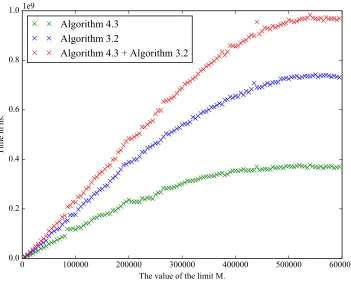
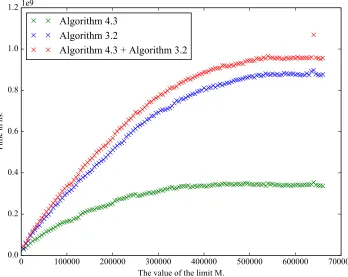
In Figures1 and2 we plot the run times of Algorithms3.2and 4.3on some examples of a semigroup S=hAiandT=hA, Xi. For some specified values ofM ∈N, Algorithm3.2was used to a data structure forS until it contained M elements, after which Algorithm4.3 was run on the data structure for S and the set X. We denote by t1 and t2 the amount of time (in nanoseconds) to perform these two steps, respectively, and we denote byM0 the size of the data structure forhA, Xiafter Algorithm 4.3. We also ran Algorithm3.2on a separate minimal data structure forS until it containedM0 elements. We denote byt3the amount of time to perform this step.
0
100000
200000
300000
400000
500000
600000
The value of the limit M.
0.0
0.2
0.4
0.6
0.8
1.0
Time in ns.
1e9
Algorithm 4.3
Algorithm 3.2
[image:9.612.130.481.70.352.2]Algorithm 4.3 + Algorithm 3.2
Figure 1: Run times for Example4.2.
Example 4.2. In Figure 1, we compare Algorithms 3.2 and 4.3 for the transformation semigroup S generated by the setAconsisting of:
1 2 3 4 5 6 7 8
2 8 3 7 1 5 2 6
1 2 3 4 5 6 7 8
3 5 7 2 5 6 3 8
1 2 3 4 5 6 7 8
4 1 8 3 5 7 3 5
1 2 3 4 5 6 7 8
4 3 4 5 6 4 1 2
1 2 3 4 5 6 7 8
5 4 8 8 5 6 1 5
1 2 3 4 5 6 7 8
6 7 4 1 4 1 6 2
1 2 3 4 5 6 7 8
7 1 2 2 2 7 4 5
and the setX consists of the single transformation:
1 2 3 4 5 6 7 8
8 8 5 1 7 5 2 8
.
The semigroupS has 533961 elements, andhA, Xihas 597369 elements.
Example 4.3. In Figure1, we compare Algorithms3.2and4.3for the semigroupS of Boolean matrices generated by the setAconsisting of:
0 1 0 0 0
0 0 1 0 0
0 0 0 1 0
0 0 0 0 1
1 0 0 0 0
,
0 0 0 0 1
0 0 0 1 0
0 0 1 0 0
0 1 0 0 0
1 0 0 0 1
,
0 0 0 0 1
0 0 0 1 0
0 1 1 0 0
1 0 1 0 0
1 1 0 0 0
0
100000
200000
300000
400000
500000
600000
700000
The value of the limit M.
0.0
0.2
0.4
0.6
0.8
1.0
1.2
Time in ns.
1e9
Algorithm 4.3
Algorithm 3.2
[image:10.612.131.479.73.350.2]Algorithm 4.3 + Algorithm 3.2
Figure 2: Run times for Example4.3.
and the setX consists of the single boolean matrix:
0 0 0 1 1
0 0 1 0 1
0 1 0 1 0
1 0 1 0 0
1 1 0 0 0
.
The semigroupS has 538781 elements, andhA, Xihas 663336 elements.
It appears from these examples, that Algorithm4.3 is particularly beneficial when the complexity of the multiplication is higher. This is perhaps to be expected since it avoids multiplying elements that were previously multiplied in Algorithm3.2, but does a similar amount of other work.
5
A lock-free concurrent version of the Froidure-Pin Algorithm
In this section we describe a version of the Froidure-Pin Algorithm that can be run concurrently in multiple distinct processes.
Throughout this section, we again letU be any monoid, letSbe a submonoid ofUgenerated byA⊆U where 1U ∈A, and letν : A∗ −→S be the natural homomorphism. We also denotef, l :A∗ −→Aand p, s:A∗−→A∗ be the functions defined at the start of Section3.
We require the following definition.
Definition 5.1. Afragment for S is a tuple (A, Y, K, φ) where: (i) A={a1, . . . , ar}is a finite collection of generators for S;
(iii) 1≤K≤ |Y|+ 1 andyK−1= max{yi∈Y :|yi|=|yK−1|}; (iv) ifR⊆A∗ is the set of all reduced words for elements ofS, then
φ: A× {y1, . . . , yL}∪ {y1, . . . , yK−1} ×A−→R
where either L = K−1 or L < K−1 and L is the largest value such that |yL| < |yK−1|, and ν(φ(u, v)) =ν(uv) for allu, v∈dom(φ).
Note that in part (iii) the condition thatyK−1= max{yi ∈Y :|yi|=|yK−1|}implies that either yK does not exist or|yK|>|yK−1|.
We refer to the size, elements, extension, and so on of a fragment for a semigroupS, in the same way as we did for the data structures forS.
We suppose throughout this section that howeverφin Definition5.1is actually implemented, it supports concurrent reads of any particular valueφ(x, y) when (x, y)∈dom(φ) and that it is possible to defineφ(x, y) for any (x, y)6∈dom(φ) concurrent with any read of φ(x0, y0) for (x0, y0)∈dom(φ). Note that in the last case, we are by definition not reading and writing the same value concurrently. The implementation in
libsemigroups[9] representsφas a pair of C++ Standard Template Library, which support this behaviour
provided that no reallocation occurs when we are definingφ(x, y) for (x, y)6∈dom(φ). In Algorithm5.6, all of the reduced wordsw∈A∗ of a given length are produced before any value ofφ(w, a) orφ(a, w) is defined, and so we can allocate enough memory to accommodate these definitions and thereby guarantee that it is safe to read and write values ofφ(x, y) concurrently.
The next lemma describes when some fragments forS can be assembled into a data structure forS.
Lemma 5.2.Suppose that(A, Y1, K1, φ1), . . . ,(A, Yk, Kk, φk)are fragments forSwhereYi ={yi,1, . . . , yi,Ni}
such that the following hold:
(i) Yi∩Yj=∅for alli, j,i6=j;
(ii) for all reduced w∈A∗ either
w∈
k
[
i=1
Yi or w >max k
[
i=1
Yi;
(iii) |yj,Kj−1|= max{|y|:y∈Yj, |y| ≤T} whereT = max{|yi,Ki−1|: 1≤i≤k} (iv) dom(φi) = (A× {yi,1, . . . , yi,Ki−1})∪({yi,1, . . . , yi,Ki−1} ×A)for all i; and
(v) im(φi)⊆S k
j=1Yj for alli.
If Y = Sk
i=1Yi = {y1, . . . , yN}, y1 < · · · < yN, K ∈ N is such that yK−1 = max{y ∈ Y : |y| = T} or K= 1 if T = 1, andφ=Sk
i=1φi, then (A, Y, K,∅, φ)is a data structure forS.
Proof. It is clear that Definition 3.1(i) to (iv) are satisfied. It therefore suffices to show that part (v) of Definition3.1holds. Part (i) of the assumption of this lemma implies thatφis well-defined. It suffices to verify that
dom(φ) = (A× {y1, . . . , yK−1})∪({y1, . . . , yK−1} ×A), im(φ)⊆Y, and ν(φ(u, v)) =ν(uv) for allu, v ∈ dom(φ). That im(φ)⊆Y follows from (v). If (u, v)∈ dom(φ), then (u, v)∈ dom(φi) for somei, and soν(φ(u, v)) =ν(φi(u, v)) =ν(uv).
Let (a, yi) ∈A× {y1, . . . , yK−1}. Then yi ∈ Yj for some j and so yi = yj,t for some t. But |yj,t| =
|yi| ≤ |yj,Kj−1| by the definition of K and part (iii) of the assumption of this lemma. Hence either
|yj,t|<|yj,Kj−1| and so yj,t < yj,Kj−1, or |yj,t|=|yj,Kj−1|and, by Definition 5.1(iii), yj,t < yj,Kj−1. In either case, t≤ Kj−1, and so (a, yi) = (a, yj,t)∈ dom(φj)⊆dom(φ). If (yi, a)∈ {y1, . . . , yK−1} ×A, then (yi, a)∈dom(φ) by a similar argument.
A collection of fragments for a semigroup S is minimal if its union (as defined in Lemma 5.2) is the minimal data structure forS.
In Algorithm 5.4, and more generally in our concurrent version of the Froidure-Pin Algorithm, we require a method for assigning reduced wordsw ∈ A∗ that do not belong to any existing fragment for S, to a particular fragment for S. If we want to distribute S into k fragments, then we let b : R :=
{w∈A∗:wis reduced forS} −→ {1, . . . , k}be any function. Preferably so that our algorithms are more efficient,b should have the property that|(i)b−1|is approximately equal to |R|/k for alli. For example, we might take a hash function forν(w) modulok, as the value ofb(w). If the number of fragments k= 1 orb(w) is constant for all reduced wordswforS, then Algorithm5.6is just Algorithm3.2with some extra overheads.
Algorithm 5.4ApplyGenerators
Input: A collection of fragments (A, Y1, K1, φ1), . . . ,(A, Yk, Kk, φk) for a semigroup S where im(φi) ⊆ Y1∪ · · · ∪Yk for all i, |yi,Ki−1| = |yj,Kj−1| for all i, j; a value j ∈ {1, . . . , k} such that dom(φj) = (A× {yj,1, . . . , yj,Kj−1})∪({yj,1, . . . , yj,Kj−1} ×A).
Output: A setQj ={(b(w), w) :|w|=|yj,Kj|+ 1} ⊆ {1, . . . , k} ×A∗\(Y1∪ · · · ∪Yk) and modifiesφj.
1: Qj:=∅andL:=|yj,Kj| [Qj is a container for new reduced words.]
2: whileKj≤ |Yj| and|yj,Kj|=Ldo
3: fora∈A do [loop over the generators in (short-lex) order]
4: if s(yj,Kj)ais not reducedthen [φj(s(yj,Kj), a)< s(yj,Kj)a]
5: φi(s(yj,Kj), a) =y∈Y1∪ · · · ∪Yk wheres(yj,Kj)∈Yi
6: Setw:=φi0(f(yj,K
j), p(y)) wherep(y)∈Yi0
7: if w∈Yj then
8: φj(yj,Kj, a) :=φj(w, l(y))
9: continue
10: else if |w|<|yj,Kj|then
11: φj(yj,Kj, a) :=φi00(w, l(y)) wherew∈Yi00
12: continue
13: end if
14: end if
15: if ν(yj,Kja) =ν(y) for somey ∈Y1∪ · · · ∪Yk then
16: φj(yj,Kj, a) :=y
17: else if ν(yj,Kja) =ν(v) for some (b(v), v)∈Qj then
18: Qj←Qj∪ {(b(yj,Kja), yj,Kja)}
19: end if
20: end for
21: Kj ←Kj+ 1 22: end while
23: returnQj
Lemma 5.3. Algorithm5.4can be performed concurrently on each fragment(A, Yj, Kj,∅, φj)of its input.
Proof. Every value assigned to φj in Algorithm 5.4 equals a value for φ defined in Algorithm 3.1. It is possible that some assignments made in Algorithm3.1forφcannot be made forφj here. In particular, in Algorithm3.1ifs(yj,Kj)ais not reduced, thenφj(s(yj,Kj), a) is always defined in Algorithm3.1but is only defined in some cases in Algorithm5.4. Hence thatφj is well-defined follows by the proof of Lemma3.5.
The values φi(s(yj,Kj), a), φi0(f(yj,Kj), p(y)), and φi00(w, l(y)) are read in Algorithm 5.4 and may belong to other fragments. But|s(yj,Kj)|,|p(y)| < L and φi00(w, l(y)) is only used if |w| < L. The only value which is written in Algorithm5.4isφj(yj,Kj, a), and|yj,Kj|=L.
It follows that Algorithm5.4only reads values ofφr(u, a) orφr(a, u) when|u|< L, while the algorithm only writes to values ofφj(u, a) when|u|=L. By the assumption that|yi,Ki−1|=|yj,Kj−1|for alli, j, the value ofL does change between different fragments. Therefore there are no concurrent reads and writes by concurrent processes running Algorithm5.4on the same fragments and different values ofj.
Lemma 5.4. If Qj is the output of Algorithm 5.4, (b(w), w)∈Qj, and u∈Yj anda∈A are such that ν(ua) =ν(w), thenua≥w.
Proof. Suppose that (b(w), w)∈Qj andu∈Yj anda∈Aare such that ν(ua) =ν(w).
Ifua < wandφj(u, a) is defined in line5or11, thenφj(u, a)∈Y1∪· · ·∪Ykand soν(ua) =ν(φj(u, a)) = ν(y). Henceν(w) =ν(y) and so (b(w), w)6∈Qj, which is a contradiction.
Ifφj(u, a) is not defined in line5or 11, then, since (b(ua), ua)6∈Qj, it must be thatν(ua) =ν(y) for somey∈Y1∪ · · · ∪Yk, which is a contradiction as above.
Algorithm 5.5ProcessQueues
Input: A setQwhich is the union of the setsQ1, . . . , Qk whereQi={(b(wa), wa) :|wa|+ 1 =|yi,Ki|} ⊆
{1, . . . , k} ×A∗\(Y1∪ · · · ∪Yk) is the output of Algorithm 5.4and a valuej∈ {1, . . . , k}.
Output: A fragment forSextending (A, Yj, Kj, φj), which contains every reducedwasuch that (j, wa)∈
Q.
1: for(b(wa), wa)∈Qdo [loop over (b(wa), wa)∈Qin short-lex order onwa]
2: if b(wa) =j andν(wa)6=ν(y) for ally∈Yj then
3: Yj ←Yj∪ {wa} 4: φj(w, a) :=wa 5: end if
6: end for
7: return(A, Yj, Kj, φj)
Lemma 5.5. Algorithm 5.5 is valid, it can be performed concurrently on each fragment (A, Yj, Kj, φj), and after Algorithm 5.5has been run dom(φj) = A× {yj,1, . . . , yj,L}∪ {yj,1, . . . , yj,Kj−1} ×A
where
L < Kj−1 andLis the largest value such that|yL|<|yKj−1|
Proof. If Algorithm5.5is run concurrently ink processes, for distinct values ofj, then each process only writes to the fragment specified by its input. Furthermore, Algorithm5.5only reads fromQwhich is not modified.
To prove that Algorithm 5.5 is valid, it suffice to show that the output (A, Yj, Kj, φj) is a fragment. Parts (i) and (ii) of Definition5.1hold trivially. Also it is easy to see that 1≤Kj≤ |Yj|+ 1. SinceKj is not modified by Algorithm5.5its input is the output of Algorithm5.4, the condition in the while-loop on line2of Algorithm5.4must be false. In other words, eitheryj,Kj−1is the maximum word inYjwith length L, or Kj >|Yj|, and againyj,Kj−1 is the maximum word inYj with length L. Hence Definition 5.1(iii) holds.
Suppose thatφj(w, a) is defined either in Algorithm5.4or5.5. In the former case,φj(w, a) is reduced by the argument in Lemma3.5. In the case, by Lemma5.4, there existst∈ {1, . . . , k}such that (b(wa), wa)∈
Qt. Since we loop over elements ofQtin short-lex order on the second component, it follows thatφj(w, a) = wa=wais reduced.
By assumption, dom(φj) = (A× {y ∈Yj : |y|< L})∪({y ∈ Yj :|y| < L} ×A) where L =|yKj−1| is defined in line 1 of Algorithm5.4. If y ∈Yj is such that|y|=L and a∈ A, then either the value of φj(y, a) is defined in Algorithm5.4or (b(ya), ya)∈Qj. In the latter case, the value ofφj(y, a) is defined in Algorithm5.5. Hence dom(φj) = A× {yj,1, . . . , yj,L}
∪ {yj,1, . . . , yj,Kj−1} ×A
whereL < Kj−1 andLis the largest value such that|yL|<|yKj−1|. That ν(φ(u, v)) =ν(uv) for allu, v∈dom(φ) follows by the argument in the proof of Lemma3.5.
Lemma 5.6. Algorithm5.6is valid.
Proof. We begin by noting that by line5 in Algorithm5.6, the collection of fragments (A, Yj, Kj, φj) for S is minimal. By Lemma5.3 and5.4, at line9, each of (A, Yj, Kj, φj) is a fragment forS, and the loops applying Algorithm5.4 and5.5can be run concurrently.
Algorithm 5.6ConcurrentFroidurePin
Input: A data structure (A, Y, K,∅, φ) for a semigroupS and a limitM ∈N.
Output: A data structure forS which extends (A, Y, K,∅, φ) and with size at least min{M,|S|}.
1:
2: forj∈ {1, . . . , k}do
3: Yj :={a∈A:b(a) =j},Kj:= 1, andφj:=∅ [Split the data structure into fragments]
4: end for
5: whileK≤ |Y|and|Y|< M do
6: Q:=∅
7: forj∈ {1, . . . , k}do [This can be done concurrently]
8: Q←Q∪ApplyGenerators(A, Yj, Kj, φj)
9: end for
10: forj∈ {1, . . . , k}do [This can be done concurrently]
11: (A, Yj, Kj,∅, φj)←ProcessQueues(Q, j);
12: end for
13: forj∈ {1, . . . , k}do [This can be done concurrently]
14: L= max{i∈N:|y|<|yj,Kj−1|, y∈Yj}
15: fori∈ {L+ 1, . . . , Kj−1} do
16: fora∈Ado
17: φj(a, yj,i) :=φj00(φj0(a, p(yj,i)), l(yj,i)) wherep(yj,i)∈Yj0 andφj0(a, p(yj,i))∈Yj00.
18: end for
19: end for
20: end for
21: end while
22: return (A, Y, K,∅, φ) where Y = Ski=1Yi = {y1, . . . , yN}, y1 < · · · < yN, K ∈ N is such that yK−1= max{yj,Kj−1: 1≤j≤k}, andφ=
Sk
i=1φi.
component which is modified inside the for-loop. Hence it suffices to verify Definition 5.1(iv). That ν(φj(u, v)) =ν(uv) for allu, v∈dom(φj) follows again by the same argument as in Lemma3.6.
By Lemma5.4,
dom(φj) = A× {yj,1, . . . , yj,L}∪ {yj,1, . . . , yj,Kj−1} ×A
whereL < Kj−1 is the largest value such that|yL|<|yKj−1|. After the for-loop starting in line15, it is clear that
dom(φj) = A× {yj,1, . . . , yj,Kj−1}
∪ {yj,1, . . . , yj,Kj−1} ×A
, (5.7)
as required.
At the end of the for-loop in line20, we will show that the conditions in Lemma5.3 are satisfied by the collection of fragments.
A reduced wordybelongs toYj if and only ifb(y) =j, and henceYi∩Yj=∅ifi6=j. In other words, Lemma5.3(i) holds.
To show that Lemma5.3(ii) holds, it suffices to show thatSk
i=1Yi={w∈A∗:|w| ≤ |yN|, wis reduced}. Suppose thatw∈A∗ is reduced and|w| ≤ |y
N|. Then|p(w)|<|yN|and so p(w)∈ {yj,1, . . . , yj,Kj−1} for somej. Hence (p(w), l(w))∈dom(φj) and sow=φj(p(w), l(w))∈Sk
i=1Yi, as required.
For everyj, the value of |yj,Kj−1| is 1 after the first call to Algorithm 5.4. The values of Kj are not modified anywhere else in Algorithm5.6. Every subsequent call to Algorithm5.4either increases|yj,Kj−1| by 1, or there are no words of length|yj,Kj−1|+ 1 in thejth fragment. We have shown that Lemma5.3(iii) holds. We showed in (5.7) that Lemma 5.3(iv) holds and Lemma 5.3(v) holds trivially. Therefore after line20, the union of the fragments is a data structure forS and so the tuple returned by the algorithm is a data structure too.
5.1
Experimental results
In this section we compare the original version of the Froidure-Pin Algorithm 3.2 as implemented in
n 3 4 5 6 7 8
|Tn|=nn 27 256 3125 46656 823543 16777216
Algorithm3.2 40 340 3877 54592 926136 18285899
[image:15.612.126.489.49.162.2]Algorithm5.6(1 fragments) 45 405 4535 66293 1048758 20235231 Algorithm5.6(2 fragments) 45 415 4586 67835 1106562 22763829 Algorithm5.6(4 fragments) 47 406 4587 67682 1153668 23093948 Algorithm5.6(8 fragments) 46 405 4589 67433 1155484 23411798 Algorithm5.6(16 fragments) 46 402 4596 67578 1153832 23616000 Algorithm5.6(32 fragments) 46 404 4563 67755 1152818 23566915
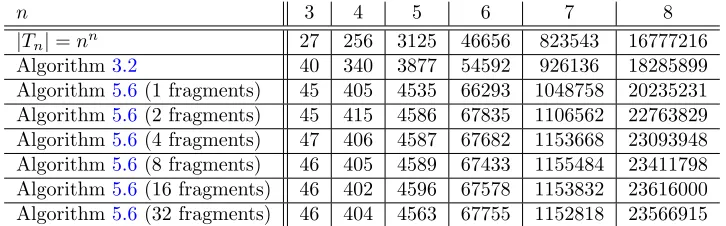
Figure 3: Comparison of the number of products of elements in Algorithms3.2and5.6applied to the full transformation monoidTn.
We start by comparing the number of products of elements inS that are actually computed in Algo-rithms 3.2and 5.6. In [3, Theorem 3.2], it is shown that the number of such products in Algorithm3.2
is|S|+|R| − |A| −1 where R is the set of relations forS generated by Algorithm3.2. One of the main advantages of the Froidure-Pin Algorithm, concurrent or not, is that it avoids multiplying elements ofS as far as possible by reusing information learned about S at an earlier stage of the algorithm. This is particularly important when the complexity of multiplying elements inSis high. Algorithm5.6also avoids multiplying elements ofS, but is more limited in its reuse of previously obtained information. The number of products of elementsS depends on the number of fragments kused by Algorithm5.6and the function b:A∗ −→ {1, . . . , k}. Thefull transformation monoid Tn of degree n∈N consists of all functions from
{1, . . . , n}to{1, . . . , n}under composition of functions. It is generated by the following transformations:
1 2 3 · · · n−1 n
2 3 4 · · · n 1
,
1 2 3 · · · n−1 n
2 1 3 · · · n−1 n
,
1 2 3 · · · n−1 n
1 2 3 · · · n−1 1
.
We compare the number of products of elements ofSin Algorithms3.2and5.6for each ofk= 1,2,4, . . . ,32 fragments and for the full transformation monoid of degree n = 3, . . . ,8; see Figure 3. The number of products in Algorithm3.2 is a lower bound for the number in Algorithm 5.6, and we would not expect Algorithm 5.6 to achieve this bound. However, from the table in Figure 3 it can be observed that the number of products in Algorithm5.6is of the same order of magnitude as that in Algorithm5.6. In [3], it was noted that there are 678223072849 entries in the multiplication table forT7but only slightly less than a million products are required in Algorithm3.2; we note that only slightly more than a million products are required in Algorithm5.6.
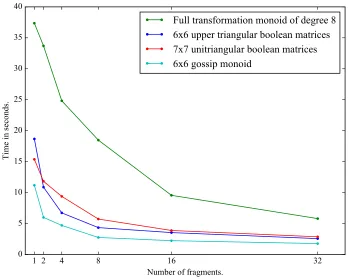
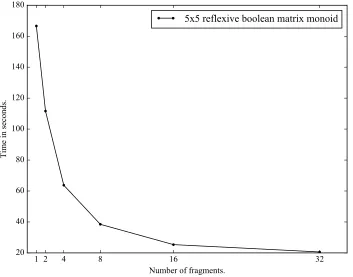
In Figures4 and5 we plot the performance of Algorithm5.6against the number of fragments it uses for a variety of examples of semigroupsS. As would be expected, if the semigroupS is relatively small, then there is no advantage to using Algorithm5.6; see Figure4. However, if the semigroupSis relatively large, then we see an improvement in the runtime of Algorithm5.6 against Algorithm 3.2; see Figure 5
and6. Note that the monoid of reflexive 5×5 boolean matrices has 1414 generators.
All of the computations in this section were run on a Intel Xeon CPU E5-2640 v4 2.40GHz, 20 physical cores, and 128GB of DDR4 memory.
References
[1] C. Donoven, J. D. Mitchell, and W. Wilson, Computing maximal subsemigroups of a finite semigroup, https://arxiv.org/abs/1606.05583
[2] J. East, A. Egri-Nagy, J. D. Mitchell, and Y. P´eresse, Computing finite semigroups, to appear in
Journal of Symbolic Computation, http://arxiv.org/abs/1510.01868
[3] V´eronique Froidure and Jean-Eric Pin, Algorithms for computing finite semigroups, In Foundations of computational mathematics (Rio de Janeiro, 1997), pages 112–126. Springer, Berlin, 1997.
[5] John M. Howie, Fundamentals of semigroup theory, volume 12 ofLondo, Mathematical Society Mono-graphs. New Series, The Clarendon Press Oxford University Press, New York, 1995, Oxford Science Publications.
[6] Janusz Konieczny, Green’s equivalences in finite semigroups of binary relations, Semigroup Forum, 48(2):235–252, 1994.
[7] Gerard Lallement and Robert McFadden, On the determination of Green’s relations in finite trans-formation semigroups, J. Symbolic Comput., 10(5):481–498, 1990.
[8] S. A. Linton, G. Pfeiffer, E. F. Robertson, and N. Ruˇskuc, Groups and actions in transformation semigroups, Math. Z., 228(3):435–450, 1998.
[9] J. D. Mitchell et al, libsemigroups - C++ library - version 0.0.3, December 2016, https: //james-d-mitchell.github.io/libsemigroups/
[10] J. D. Mitchell et al, Semigroups - GAP package, Version 2.8.0, May 2016, http://gap-packages. github.io/Semigroups/
[11] Jean-Eric Pin, Semigroupe 2.01: a software for computing finite semigroups, April 2009, https: //www.irif.fr/~jep/Logiciels/Semigroupe2.0/semigroupe2.html
[12] ´Akos Seress, Permutation group algorithms, volume 152 of Cambridge Tracts in Mathematics, Cam-bridge University Press, CamCam-bridge, 2003.
[13] Charles C. Sims, Computational methods in the study of permutation groups, In Computational Problems in Abstract Algebra (Proc. Conf., Oxford, 1967), pages 169–183. Pergamon, Oxford, 1970.
[14] Charles C. Sims, Computation with finitely presented groups, Encyclopedia of mathematics and its applications, Cambridge University Press, Cambridge, England, New York, 1994.
1 2
4
8
16
32
Number of fragments.
0
100
200
300
400
500
600
Time in ms.
Full transformation monoid of degree 6
5x5 gossip monoid
[image:17.612.126.475.78.357.2]5x5 upper triangular boolean matrices
5x5 unitriangular boolean matrices
6x6 unitriangular boolean matrices
Figure 4: Run times for Algorithm5.6against number of fragments.