ISSN Print: 2162-2078
DOI: 10.4236/tel.2019.94071 Apr. 29, 2019 1093 Theoretical Economics Letters
The Valuation of Cryptocurrencies in
Single-Asset and Multiple-Asset Models
Rebecca Abraham
1, Zhi Tao
21Finance and Economics, Nova Southeastern University, Fort Lauderdale, FL, USA 2University of North Texas, Denton, TX, USA
Abstract
Cryptocurrencies are virtual currencies employed in blockchain transactions. They are particularly worthy of theoretical examination, given the limited academic literature on the subject. This paper constructs valuation models of bitcoin and altcoins, both as single investments and components of mut-liple-asset portfolios. As single investments, cryptocurrencies are valued at the confluence of Legendre utility functions, with Esscher transformed Geo-metric Levy pricing processes. As part of portfolios, cryptocurrencies are contained in traditional Markowitz portfolios which are varied by increasing the proportion of the riskless asset, shorting the risky asset, or adding cur-rency options. Theoretical formulations show that Markowitz models com-bined with bitcoin, located on the Capital Market Line (which we term CML portfolios), have low returns, mainly due to the presence of the riskless asset. Such portfolios are appropriately suited to the investment goals of risk-averse traders, while overlooking the preferences of risk-takers. To satisfy less risk- averse investors, we propose a high-return portfolio with 9 asset choices, con-sisting of risky assets, cryptocurrencies, US dollars, soybean futures, Treasury bond futures, oil futures, currency options on the US dollar, currency options on the Mexican peso, and technology, or biotechnology stocks. Laplace trans-forms are employed to suppress volatility, skewness, or kurtosis of returns, which empirical studies have found to contribute to tail risk contained in out-liers in fat-tailed distributions.
Keywords
Legendre Function, Esscher Transformation, Cryptocurrency, Bitcoin, Laplace
1. Introduction
Cryptocurrencies, led by bitcoin, are virtual currencies, used in transactions rec-How to cite this paper: Abraham, R. and
Tao, Z. (2019) The Valuation of Crypto-currencies in Single-Asset and Multiple- Asset Models. Theoretical Economics Let-ters, 9, 1093-1113.
https://doi.org/10.4236/tel.2019.94071 Received: March 13, 2019
Accepted: April 26, 2019 Published: April 29, 2019
Copyright © 2019 by author(s) and Scientific Research Publishing Inc. This work is licensed under the Creative Commons Attribution International License (CC BY 4.0).
http://creativecommons.org/licenses/by/4.0/
DOI: 10.4236/tel.2019.94071 1094 Theoretical Economics Letters orded on the blockchain, a global public ledger. The sentiment that the block-chain will have far-reaching disruptions, from global supply block-chains to shipping, has led to a surge in bitcoin prices. With a 168% increase in bitcoin prices from 2016-2017, reaching a peak of $2700 in May, 2017, the market capitalization of funds flowing into cryptocurrencies rose from $ 25 billion in April 2016-$1000 billion in June, 2017 [1].
The blockchain is available to all computers with the bitcoin protocol, grant-ing every user access to each transaction. A seller verifies that a buyer has the bitcoins associated with his or her address, then completes the sale, recording it in the public blockchain ledger. As an address cannot be linked to a user, the privacy of buyer and seller are maintained [2]. Unlike coins and paper currency, cryptocurrencies lack intrinsic value, meaning that they have no physical form. Their value is not supported by a government. The benefits of decentralization of authority are that it avoids the concentration of power that would permit a single user to control the system, or loss of resilience from the failure of the computer system at a central point [3]. Alternate cryptocurrencies to bitcoin, such as litecoin, with a faster hashtag function, peercoin, with superior verifica-tion, ether, with lower cost, and appcoins, which can be used as currencies have emerged, though bitcoin still dominates, with 93% market share [4].
DOI: 10.4236/tel.2019.94071 1095 Theoretical Economics Letters in our formulations of various portfolio models including cryptocurrency.
The remainder of this paper is organized as follows. Section 2 is a Review of Literature, Section 3 includes Single-Asset Cryptocurrency Portfolios, while Sec-tion 4, consists of Multiple-Asset Capital Market Line Portfolios. SecSec-tion 5 de-scribes the Conclusions.
2. Review of Literature
2.1. Investor Demand for Cryptocurrencies
The reinforcement effect consists of risk-taking informed traders, recognizing the future uses of cryptocurrencies, in reducing both a business’s cost of goods sold, and its administrative expenses. Consider an importer. Currently, the firm will need to pay for foreign goods through bank loans, having to provide letters of credit to the foreign bank, along with verification documents. After the first transaction, all of these items may be stored on the blockchain, with cryptocur-rencies being used to complete the transaction. All management of inventory and accounts receivable will occur on the blockchain, diminishing administra-tive expenses. Other businesses in the global supply chain, shipping, and retail, will benefit, leading to significant positive spillover economic effects. [4] pre-dicted that this “winner-take-all,” feature of bitcoin would lead to the network effect of attracting more and more investors. In the four quarters from May 2013-May 2014, they observed price increases of 143% - 400% with increased demand for all cryptocurrencies. Positive correlations between bitcoin and six other cryptocurrencies provided further support for the reinforcement effect in Quarter 1 and Quarter 3, with some substitution of bitcoin by litecoin and peer-coin, in Quarter 2 and Quarter 4.
DOI: 10.4236/tel.2019.94071 1096 Theoretical Economics Letters call options on acquirer stock in cash mergers, along with significant informed purchase of put options on acquirer stock in stock mergers, have been observed ([18]). [11] theorized that informed traders differed in their attitudes towards risk aversion. Risk-taking informed traders actively trade on the basis of privi-leged information. For example, they may purchase stocks forecasted to exceed earnings expectations, the day before the earnings announcement, in anticipa-tion of price increases the next day. In contrast, risk-averse informed traders prefer to forego trading fearing losses from momentary price changes. They may sell information by creating a mutual fund. The load on the fund permits the fund manager to charge for information that he or she provides to investors, in-cluding the investments selected by the fund manager for the client, and the op-timal time to purchase.
The only examination of informed trading in the bitcoin market was under-taken by [9], who observed informed trading on both positive and negative sig-nals. On positive signals, order sizes of informed buyer-initiated bitcoin orders were significantly higher than uninformed seller-initiated bitcoin orders. On negative signals, order sizes of informed seller-initiated bitcoin orders were sig-nificantly higher than buyer-initiated bitcoin orders.
2.2. The Role of Cryptocurrencies in a Portfolio
Single-Asset Investments. Successive empirical examinations of the deter-minants of bitcoin prices have established that prices are being fueled by expec-tations of future gain. For instance, [19] found that initial interest in cryptocur-rency, as determined by Google Trends and Wikipedia search terms, using 2011-2013 data, increased price. These results were supported by [20]’s ex-panded 2009-2014 sample, in which Internet searches determined price, initially, in the short-term. The subsequent increased velocity of bitcoin usage, coupled with news about surges in bitcoin prices, stimulated further demand, signifi-cantly accelerating long-term price increases. [21] extended the above studies by including macroeconomic and financial variables, such as the Consumer Price Index, industrial production, real personal consumption expenditures, the S&P 500 Index, the 10-year Treasury note, the euro exchange rate, and change in unemployment, in an assessment of predictors of bitcoin prices. Only the proxy of consumer expectations for future profitability, represented by the spread of daily high and low prices, was a significant predictor of bitcoin prices.
es-DOI: 10.4236/tel.2019.94071 1097 Theoretical Economics Letters tate increasing returns with annualized returns of 36.11%, though they were less successful in reducing risk. [22] returns outperformed an S & P 500 portfolio, with less risk, as measured by volatility and skewness. Only the kurtosis measure of risk, was higher for the [22] time series momentum portfolio of stocks and bitcoins.
3. Single Asset Cryptocurrency Portfolios
Single-Asset Bitcoin Portfolios. Perceiving the risk-taking benefit of the blockchain, risk-taking informed traders invest in bitcoin, their lack of concern for risk being exemplified by the upward-sloping utility function, OS, in Figure 1, where the promise of profit potential encourages purchases of bitcoin. Risk-averse informed traders increase their investment as shown in the down-ward-sloping portion of the utility function, FP, as their risk aversion declines upon sale of information to a mutual fund. The utility function, OSFP, in the form of a harmonic wave, may be described by a Legendre function. In other words, the path of the random variable, z, that describes the beliefs of the risk-taking informed traders, is listed in the Legendre-based utility function in Equation (1) ([23]),
(
1−z2)
⋅d w dz2 2−2z dw dz+v v(
+ −1)
µ
2(
1−z2)
w=0
(1)
where, μ and v are complex constants. The branch points of z are at F and P, where the direction of risk aversion changes. Figure 1 shows a single-asset in-vestment in bitcoin, At O, the propensity for taking risk increases for the risk-taking informed trader, while at F, risk-taking propensity decreases for the risk-averse trader. The risk-averse trader, must be paid compensation, XP, for assuming the additional risk of the bitcoin investment.
We add a utility function that is equivalent to this compensation to Equation (1), as derived by [24],
(
)
(
)
(
)
[
]
(
)
2 2 2 2 2
2 3 2
2 1 2 1
1 2 1 1
3 1 2 3 3 3
z d w dz z dw dz v v z w
m m m m
µ
θ θ θ θ θ
− ⋅ − + + − −
+ − − + − + (2)
m1= coefficient of absolute risk aversion,
m2= change in coefficient of absolute risk aversion,
θ function = profit function of investing in a risky gamble.
The risk-averse trader’s acceptance of a risky bitcoin investment in a mutual fund is predicated upon his or her desire to avoid risk (risk aversion), decreasing more than the increase in profit potential, or −∆[m2/3m1]>∆ [the θ profit function].
The price function for bitcoin follows a martingale process, in that the next price is equal to the present observed value, which is unpredictable from past observations.
DOI: 10.4236/tel.2019.94071 1098 Theoretical Economics Letters Source: This paper.
Figure 1. Optimal price for a single-asset bitcoin portfolio.
at A. Risk-averse traders purchase at bargain prices, at B, their compensation for additional risk being represented by XP.
With a completely unknown trajectory, bitcoin’s prices may follow the Geo-metric Levy process, which is used for highly uncertain jump processes (See [25]
for a review). The Esscher transformation is frequently used to represent collec-tive risk ([26])), in which asset prices react to the investment by a number of in-vestors whose actions are influenced by each other. Therefore, we present bit-coin’s price distribution as an Esscher-Transformed Martingale Measure Geo-metric Levy process. If Skis the price of bitcoin at time period, k, the compound
return on a bitcoin investment may be represented by ∆Zk ([27]).
(
1)
log
k k k
Z S S −
∆ = (3)
[27] presents the return process as,
(
)
(
)
2
1 0
0 1
0.5 1 1
1
t x
t t
t x
p x
Z W b t e x x xvdx
e N dsdx
σ σ
∞ <
= + + + − − ≤
+ −
∫
∫ ∫
(4)We remove the Wtterm, which represents a Weiner process based on a
pre-dictable continuous normal distribution. We retain the Np, the discontinuous
Poisson process with a function x < 1, that describes small jumps.
(
)
(
)
2
1
0 0 1
0.5 t x 1 1 t x 1
t x p
Z = +b
σ
+t e∫
− −x x ≤ xvdx+∫ ∫
∞< e − N dsdxDOI: 10.4236/tel.2019.94071 1099 Theoretical Economics Letters Laplace transform, as follows, (see the L term below),
(
)
(
)
(
)
(
)
(
)
(
)
2
1
0 0 1
2 3 4
0.5 t x 1 1 t x 1
t x p
Z b t e x x x vdx e N dsdx
L x x x
σ
µ σ µ σ µ σ
∞ <
= + + − − ≤ + −
+ − + − + −
∫
∫ ∫
(6)The necessary condition for the maximum price is the second derivative of Equation (6),
(
)
( )
(
)
(
)
(
)
(
)
(
)
1 0 1
2 3 4
1 1 1
0 t
x x
p x
t e x x x v e N
L x µ σ x µ σ x µ σ
∞ < − − ≤ + − ′ + − + − + − =
∫ ∫
(7)The sufficient condition for the maximum price is the second derivative of Equation (6),
(
)
( )
(
) ( )
(
)
(
)
(
)
1
2 3 4
1
0
x x
p
t e x x x v e N
L x µ σ x µ σ x µ σ ′ − ≤ + ′′ + − + − + − = (8)
Equation (8) must be equated to the second derivative of Equation (1) to ob-tain the maximum price for the risk-taking informed trader. The second deriva-tive of Equation (1) is presented in Equation (9),
(
)
4 4 2
2d w dz − −2
µ
1 2− z dw dz (9)Setting z = x, and equating Equation (8) with Equation (9), yields an expres-sion that may be used to obtain the optimal price, x, for the risk-taking informed trader,
(
)
(
)
( )
(
) ( )
(
)
(
)
(
)
4 4 2
1
2 3 4
2 2 1 2
1
x x
p
d w dx x dw dx
t e x x x v e N
L x x x
µ
µ σ µ σ µ σ
− − − ′ = − ≤ + ′′ + − + − + − (10)
For the risk-averse trader, we add the [24] function, to the left side of Equa-tion (10). This funcEqua-tion describes the probability of a risk-averse trader earning a profit with a high-risk gamble. It compensates for the acceptance of risk, that is excessively higher than the risk-averse trader’s normal threshold for risk,
(
)
[
]
(
)
(
)
( )
(
) ( )
(
)
(
)
(
)
4 4 2
2 3 2
2 1 2 1
1
2 3 4
2 2 1 2
3 1 2 3 3 3
1
x x
p
d w dx x dw dx
m m m m
t e x x x v e N
L x x x
µ
θ θ θ θ θ
µ σ µ σ µ σ
− − − + − − + − + ′ = − ≤ + ′′ + − + − + − (11)
DOI: 10.4236/tel.2019.94071 1100 Theoretical Economics Letters peercoin, and the appcoins. Let Ltbe the martingale measure for Geometric Levy
processes, f(s, x) and g(s, x) ([27]).
(
)
{
( )
( )
( )
}
2
0 0 0
,
0 1
, exp 0.5 0.5 ,
1 ,
t t t
t s s s s
t g s x
x
L f g f dW f dW f sds g s x Ndsdx
e g s x vdxds
∞ <
= − − +
− − −
∫
∫
∫
∫ ∫
(12)We remove the Weiner process term, differentiating to yield the necessary condition for the maximum price,
(
)
( )
( ),( )
1
, 0.5 , g s x 1 ,
t x
L f g′ = fsds g s x Ndsdx+ −
∫
∞< e − −g s x vdxds(13) Differentiating Equation (13) to obtain the sufficient condition for price maximiza-tion,
(
)
( )
( ),( )
1
, 0.5 , g s x 1 ,
t x
L f g′′ = f sds g s x Ndsdx′ + ′ −
∫
∞<e − −g s x vdxds (14)Equating the second derivative of the utility function in Equation (9) and Eq-uation (14), the risk-taking trader’s optimal price is given by x below,
(
)
( )
( )( )
4 4 2
, 1
2 2 1 2
0.5 , g s x 1 ,
x
d w dx x dw dx
f sds g s x Ndsdx e g s x vdxds
µ
∞ <
− − −
′ ′
= + −
∫
− − (15)
Given the lower volume of usage for litecoin, we assume that there is greater uncertainty associated with adding it to a portfolio. This increased risk may not affect the risk-taking trader, so that the utility function specified in Equation (1), will remain unchanged. However, the risk-averse trader will demand higher compensation. The compensation will differ from that obtained in Equation (2). With greater risk, the risk-averse investor may demand a definite dollar amount of compensation, termed Y. Since litecoin is less well-known than bitcoin, in-vestor expectations may be satisfied if the optimal least favorable Minimal Dis-tance Martingale Measure for a Geometric Levy process is obtained. Esscher transformations cannot be used, as the low volume of investment in litecoin suggests that fewer risk-averse traders are engaging in collective action. For the risk-averse trader, the second derivative of the utility function in Equation (11) is equated to the price function in Equation (14), with the compensation, Y, in-cluded on the left side,
(
)
[
]
(
)
( )
( )( )
4 4 2
2 3 2
2 1 2 1
,
2 2 1 2
3 1 2 3 3 3
0.5 , g s x 1 ,
d w dx x dw dx
m m m m
f sds g s x Ndsdx e g s x vdx s
Y d µ
θ θ θ θ θ
− − −
+ − − + − +
′ ′
= + − −
+
−
(16)
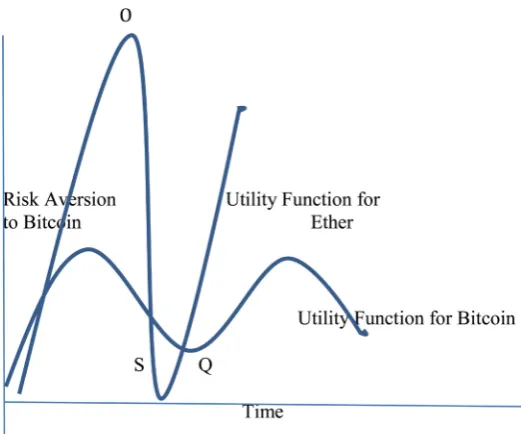
DOI: 10.4236/tel.2019.94071 1101 Theoretical Economics Letters represented by OS, is steeper than the slope of relative risk aversion relative to ether, PQ. We define m3, as the coefficient of relative risk aversion for bitcoin
due to preference for ether, and m4, the change in relative risk aversion for
bit-coin due to preference for ether. If ether investments become more attractive than bitcoin,, m3 and m4 will be positive.. Conversely, if ether investments
be-come less attractive with respect to bitcoin, m3 and m4will be negative. Including
m3 and m4 to Equation (1) with z = x, yields Equation (17) and Equation (18),
the components of the utility function of the risk-taking trader,
( )
(
2)
2 2(
)
2(
2)
3 1 2 1 1
P x =m −x d w dx − x dw dx+v v+ −µ −x w
∗ (17)
( )
(
2)
2 2(
)
2(
2)
4 1 2 1 1
P x =m −x d w dx − x dw dx+v v+ −µ −x w
∗ (18)
As m3> m4,, the displacement of bitcoin by ether slows over time, we may
re-cast m3= k (constant)+m4, and adding Equation (17) and Equation (18), as they
are the utility functions of a single investor,
(
)
(
)
(
)
(
)
(
)
(
)
(
)
2 2 2 2 2
4
2 2 2 2 2
4
1 2 1 1
1 2 1 1
m x d w dx x dw dx v v x w
m x d w dx x dw dx v v k x w µ µ − − + + − − + − − + + − − + ∗
∗ (19)
Given that ether is a substitute, price expectations may be lower for ether than bitcoin, so the price function may yield the optimal least favorable solution. This price process [27], is given in Equation (20),
( )
0t 1( )( )
t x
P x = +b
∫
xNdxds+∫
∞> xv dx ds (20)Where N(ds, dx) is a Poisson process, while v is a constant. We designate x > 1, as the price of ether, subject to large jump discontinuities. The unknown na-ture of funa-ture ether paths suggests excessive uncertainty about funa-ture prices, or large jump discontinuities. We equate Equation (19) and Equation (20),
(
)
(
)
(
)
(
)
(
)
(
)
(
)
(
)
( )( )
2 2 2 2 2
2 2 2 2 2
0 1 4
4
0 1
1 2 1 1
1 2 1 1
,
t t t t
t x x
m x d w dx x dw dx v v x w
m x d w dx x dw dx v v x w
b xN dx ds xv d k x ds µ µ > > − − + + − − + ∗ ∗ + − − + + − − = +
∫ ∫
+∫ ∫
(21)The first differential of Equation (21) yields the necessary condition for max-imization of risk-taking trader gain, (S − P), (sales price − purchase price of ether),
(
)
(
)
(
)
( )
(
)
(
)
( )
3 3 2 2 2
3 3 2 2 2
4
4
2 2 1 2
2 2 1 2
S P m x d w dx x d w dx v v x w
m x d w dx d w dx v v x w xN xv
µ µ ′ − − − + + + ′ + − − + + + = + ∗ ∗
∗ (22)
The second differential of Equation (21) yields the sufficient condition for the maximization of this trader’s gain,
(
)
( )
(
)
(
)
4 4 3 3 2
4
4 4 3 3 2
4
2 2 1 2
2 2 1 2
S P m d w dx d w dx v v w
m d w dx d w dx v v w N v
µ µ ′′ − − − + + + ′′ + − − + + + = + ∗ ∗
DOI: 10.4236/tel.2019.94071 1102 Theoretical Economics Letters Risk-averse traders will invest in ether, if they feel that their investment in bitcoin is becoming unprofitable. Therefore, ether will act as a substitute for bit-coin, if the trader’s perception of profit, as depicted in Equation (2) for bitcoin declines with respect to the utility of profit for ether, i.e. ether promises higher future gain. In Equation (24), the ratio of profit expectations for ether to bitcoin = θ1(profit expectations for ether/θ2(profit expectations for bitcoin)>0,
( )
(
)
(
)
(
)
[
]
(
)(
) (
) (
) (
)(
)
(
) (
)
(
)
2 2 2 2 2
4 3 1 2 1 2 1 2 1 2 1 2 1 2
1
1 2 1 2 1 2 4 3
1 2 1 1
3 1 2
3 3 3
P z x d w dx x dw dx v v x w
m m
m m N v
µ
θ θ θ θ θ θ θ θ θ θ θ θ
θ θ θ θ θ θ−
= − − + + − −
+
⋅
− − +
− +
= +
(24)
Differentiating Equation (24) twice, and equating to the right side of Equation (23),
( )
(
)
( )
[
]
(
)
(
) (
) (
)(
)
(
) (
)
(
)
4 4 3 3 2
4 3 1 2 1 2 1 2 1 2 1 2
1
1 2 1 1 2 3
2
2 4
2 2 1 2
3 2
3 3 3
d w dx d w dx v v w
m m
m m N v
µ
θ θ θ θ θ θ θ θ θ θ
θ θ θ θ θ θ⋅ −
− − + + − −
′′ ′′
+ − +
′′ ′′
− + = +
(25)
The gain to the risk-averse trader is,
(
) ( )
(
)
( )
[
]
(
)
(
) (
) (
)(
)
(
) (
)
(
)
4 4 3 3 2
4 3 1 2 1 2 1 2 1 2 1 2
1
1 2 1 2 2 4
2
1 3
2 2 1 2
3 2
3 3 3
S P d w dx d w dx v v w
m m
m m N v
µ
θ θ θ θ θ θ θ θ θ θ
θ θ θ θ θ θ−
− − − + + − −
′′ ′′
+ − +
′′ ′′ ∗
⋅
− + = +
[image:10.595.242.503.490.707.2](26)
Figure 2 specifies that informed traders will choose ether if the slope of OS, the utility function for ether, is steeper than the slope of PQ, the utility function for bitcoin.
DOI: 10.4236/tel.2019.94071 1103 Theoretical Economics Letters
4. Multiple-Asset Capital Market Line Portfolios
[12] combined risk-free securities with risky stocks, to create diversified portfo-lios that minimize variance, and increase return, on the Capital Market Line. The objective of the Capital Market Line is to minimize risk, with the optimal portfolio being the market portfolio of all risky assets. We assume that the diver-sification of the Capital Market Line reduces the risk of portfolios lying on the Line, to the extent that they meet the risk preferences of risk-averse investors. We exclude risk-takers, who are unlikely to select these portfolios, given their practice of disregarding risk.
If we add bitcoin to a portfolio lying on the Capital Market Line, both the vo-latility and returns will rise substantially. While the increase in return is attrac-tive, the excessive volatility violates the minimum variance objective of the port-folio. Possible solutions include: 1) Increasing the proportion of the risk-free as-set, whose reduced volatility will partly offset the heightened volatility of bitcoin. 2) Short selling the risky asset to reduce volatility, will result in less reduction of returns, than increasing the risk-free asset. The drawback is that high borrowing costs may limit the volume of short selling. 3) Adding foreign currencies, such as the Australian dollar, the British pound, and the euro, reduces covariance risk, as bitcoin has low correlations with these currencies.
The Increased Risk-Free Asset Portfolio. [12] presented the minimum va-riance portfolio of the risk-free asset and the risky asset as follows, with the ob-jective of minimizing risk, Σ, while maintaining returns, m,above a threshold return, μb.
T
Minimize .5w wΣ
(27) Subject to,
T and T 1
b
m w≥µ e w=
where, e is a vector of 1 values. The necessary and sufficient conditions for op-timality are,
0= Σ −w
φ
m−γ
e (28)T , T 1
b m w e w
µ ≤ = (29)
(
T)
0b m
φ −µ =
(30)
w = weights of assets, m = return on assets,
Σ = covariance risk of the portfolio.
We increase the weight of the riskless asset, and include the cryptocurrency. The objective function becomes,
(
1 2 3 4)
Minimize 1 2 w w+ +w w+ ∗Σ′w (31) where, w1, w2, w3,and w4are the weights of riskless asset, risky asset, bitcoin, and
the additional riskless asset. ′
cova-DOI: 10.4236/tel.2019.94071 1104 Theoretical Economics Letters riance risk, Σ >′ 0. Assuming a sufficient quantity of riskless assets are added, the covariance risk could be minimized with Σ−1 multiplying Σ′ to yield Σ,
the covariance risk before the addition of bitcoin. The new optimal objective function becomes,
(
1 2 3 4)
Minimize 1 2 w w+ +w +w ∗Σw
(32)
Yet, as the reduced return of the new portfolio, fails to meet the threshold re-turn.
μb, we cannot prove that mTw is positive definite,
T symmetric matrix * * * *
m ∗ =a a a b b a b b+ + +
(33) This result = 0, when a* and b* are 0, which occurs when
(
T)
0b m
φ −µ = or 1
φ = . Since mT < μ
b, mTw,cannot be positive definite, the Capital Market Line
portfolio of risk-free asset, risky asset, and bitcoin, cannot achieve minimum risk with maximum return.
Short Selling the Risky Asset. The linear programming model to be mini-mized,
(
2 2 2 2 2)
2 2 3 3 1 2 2 3 2 3 3 3 2
Minimize wσ x w+ σ x +2w wσ xσ x x x SKx Kxρ + + −0.4σ x (34)
Subject to,
1 1 2 2 3 3 b
w r w r w r+ + ≥µ (35)
where σ2x
1, the variance of the risk-free asset = 0,
w1 = weight of the risk-free asset,
w2 = weight of the risky asset,
w3 = weight of bitcoin,
μb= the return of a portfolio of the risk-free asset, the risky asset, and bitcoin,
σ2x
2 = the variance of the risky asset,
σ2x
3 = the variance of bitcoin,
1 2
x x
ρ = the correlation coefficient of the risky asset and bitcoin, SK3 = skewness of bitcoin,
Kx3 = kurtosis of bitcoin,
−0.4σ2x
2= 40% of the risky asset that is short sold,
We assume that skewness and kurtosis are only on bitcoin, and that there is a correlation coefficient of −0.9, between bitcoin and the risky asset. Applying a Lagrangian function with coefficient, P, to Equation (35),
(
)
(
)
2 2 2 2
2 2 3 3 2 3 2 3 3 3
1 1 1 2 2 2 3 3 3
Minimize 0.6 1.8
b
w x w x w w x x SKx Kx
P w r x w r x w r x
σ σ σ σ
µ
+ − + +
− + + − (36)
2
2 2 60%
0.6wσ x = of the risky asset that remains in the portfolio,
2 2
2 3 2 3
1.8w wσ xσ x = twice the correlation coefficient of bitcoin with the risky asset, [27] provides a minimal variance martingale measure, which may be equated to Expression (36),
(
)
(
)
(
( ),)
22 2 2 2
2 g 1 , g t x 1
t t t
L −∞∞ e N dt dx L f −∞∞ e vdx dt
= − − + + −
DOI: 10.4236/tel.2019.94071 1105 Theoretical Economics Letters where,
Lt= a martingale process,
(g, s) and f(t, x) = predictable processes, N = Poisson process,
v = a constant.
The necessary condition for minimization is the first derivative of Equation (36), and Equation (37),
(
)
( )
(
(
)
)
(
( ))
( )
2 3
2 2 3 3 2 3 2 3 3 3 1 1 2 2 3 3
2 , 2
1.2 2 7.2 3 4
4 g , 2 g t x
t t
w x w x w w x x x x P w r w r w r
L e N dt dt L e v dx dt
σ + σ − σ σ + σ + σ − + +
′
= − +
(38)
The sufficient condition for minimization is the derivative of Equation (38),
(
)
(
)
(
)
(
)
(
)
(
)
(
)
(
)
(
(
( ))
)
1 1 1 1
2 2 3 3 2 3 2 3
3 3 1 2 33 4 4
, 2 2
1
1.2 1 2 1 7.2 1 1
6 12
4 t , 2
b g t x
g
t
w n w n w w n n
x x P w r w r w r w r
L e N dt dx L e vdx dt
µ µ µ µ
σ σ µ
− − − −
− ⋅ + − ⋅ − − ⋅ − ⋅
′ ′ ′ ′
+ + − + + + −
′ ′′ ′
= − +
(39)
Adding Foreign Currencies. Figure 3 depicts three Capital Market Line (CML) portfolios. The optimal market portfolio of risk-free assets, and risky as-sets intersects the CML at P. The original lending portfolio, S, becomes a bor-rowing portfolio with the addition of cryptocurrency. 1) With the increase in risk-free assets, the lowest return portfolio, U, results, 2) With the short selling of risky assets, the next highest return portfolio, F, results, and 3) With the addi-tion of foreign currencies, the highest return portfolio, G, is obtained.
In Figure 3, the optimal market portfolio of risk-free assets, and risky assets intersects the CML at P. The original lending portfolio, S, becomes a borrowing portfolio at U. Among the borrowing portfolios, 1) The increase in risk-free as-sets yields the lowest-return portfolio, U, 2) The short selling of risky assets creates the next highest return portfolio, F, and 3) The addition of foreign cur-rencies yields the highest return portfolio, G.
[image:13.595.235.496.510.699.2]Source: This Paper.
DOI: 10.4236/tel.2019.94071 1106 Theoretical Economics Letters
2 2 2 2 2 2
2 2 3 3 4 4 5 5 2 3 2 3 2 3
2 2 2 2 2 2
2 4 2 4 2 4 2 5 2 5 2 5 3 4 3 4 3 4
2 2 2 2
3 5 3 5 3 5 4 5 4 5 4 5
1 1 1 2 2 2 3 3 3 4 4 4
Minimize 2
2 2 2
2 2 3 to 5
3 to 5
w x w x w x w x w w x x x x
w w x x x x w w x x x x w w x x x x w w x x x x w w x x x x Skx
Kx P w r x w r x w r x w r x w
σ σ σ σ σ σ ρ
σ σ ρ σ σ ρ σ σ ρ
σ σ ρ σ σ ρ
+ + + +
+ + +
+ + + =
+ = − + + + +
∑
∑
(
5 5 5r x −µb)
(40)
where,
x1 = the risk-free asset,
x2 = the risky asset,
x3 = the first foreign currency,
x4 = the second foreign currency,
x5 = bitcoin,
We assume positive correlation coefficients of +1, between 1) the risky asset, and the first foreign currency, 2) the risky asset, and the second foreign currency, and 3) the risky asset and bitcoin. Negative correlations of −1 are assumed be-tween 1) the 2 foreign currencies, 2) the first foreign currency and bitcoin, and 3) the second foreign currency and bitcoin. The three positive measures of cova-riance risk exactly offset the three negative measures of covacova-riance risk, resulting in the minimum variance portfolio, shown in Equation (41),
(
)
2 2 2 2 2 2
2 2 3 3 4 4 5 5 2 3 2 3
2 2 2 2 2 2 2 2
2 4 2 4 2 5 2 5 3 4 3 4 3 5 3 5
2 2
4 5 4 5 4
1 1 1 2 2 2 3 3 3 4 4 4 5 5 5
Minimize 2
2 2 2 2
2 3 5 3 to 5
b
w x w x w x w x w w x x
w w x x w w x x w w x x w w x x
w w x x Skx to x n Kx P w r x w r x w r x w r x w r x
σ σ σ σ σ σ
σ σ σ σ σ σ σ σ
σ σ µ + + + + + + − − − + = = − + + + + −
∑
∑
(41)The necessary condition for optimization is obtained by differentiating Equa-tion (41) and equating to the right side of EquaEqua-tion (38), given the assumpEqua-tion of a minimal distance martingale measure for the price process,
(
) (
)
(
)
( )
(
)
(
( ))
2 2 3 3 4 4 5 5 2 3 2 3 2 4 2 4
2 5 2 5 3 4 3 4 3 5 3 5 4 5 4 5
2 2 2 3 3 3
3 4 5 3 4 5
1 1 2 2 3 3 4 4
2
2 ,
5 5
2 2 2 2 8 8
8 8 8 8
3 4
4 g 2 g t x
t t
w x w x w x w x w w x x w w x x
w w x x w w x x w w x x w w x x
x x x x x x
P w r w r w r w r w r
L e Ndtdx L e vdx dt
σ σ σ σ σ σ σ σ
σ σ σ σ σ σ σ σ
σ σ σ σ σ σ
+ + + + + + − − − + + + + + + − + + + + = − + (42)
The sufficient condition is obtained by differentiating Equation (42),
(
)
(
)
(
)
(
)
(
)
(
)
(
)(
)
(
)(
)
(
)
(
)
(
)
(
)
(
) (
)
(
)
1 1 1 1
2 2 3 3 4 4 5 5
1 1 1
2 3 2 3 2 4 2 4
1 1 1 1
2 5 2 5 3 4 3 4
1 1 1 1
3 5 3 5 4 5 4 5
3
2
2 1 2 1 2 1 2 1
8 1 1 8 1 1
8 1 1 8 1 1
8 1 1 8 1 1
6 3 to 5 12 3 to 5) 4
x g t
w n w n w n w n
w w n w w n n
w w n n w w n n
w w n n w w n n
L e
µ µ µ µ
µ µ µ µ
µ µ µ µ
µ µ µ µ
σ σ − − − − − − − − − − − − − − − − ⋅ + − ⋅ + − ⋅ + − ⋅ + − ⋅ − + − − + ⋅ − − − − ⋅ − ⋅ − − ⋅ − − − − + = + = ′ = −
∑
∑
(
)
(
,)
2(
(
g t x( ),)
)
t
N dt dx′′ + L e′ vdx dt
(43)
DOI: 10.4236/tel.2019.94071 1107 Theoretical Economics Letters minimum variance, with maximum return. The CML portfolio with additional risk-free assets, has lower return, while the CML portfolio that short sells the risky asset, may have excessive risk. Will similar theoretical formulations result from CML portfolios with other cryptocurrencies? Litecoin and peercoin are so similar to bitcoin, that they may not be expected to differ from bitcoin. Yet, there is no literature that describes its correlations with securities, or foreign currencies. Therefore, ether has greater uncertainty of price expectations, with similar returns. To construct a minimum variance portfolio for ether, we add an additional stable foreign currency, such as the euro, which is constrained to a strict band by the regulations of the European Monetary System, or the Austral-ian dollar, or the New Zealand dollar ([30]. We repeat Equation (42), including the euro, the Australian dollar, or the New Zealand dollar, as the sixth portfolio asset. The sixth asset has a correlation coefficient of +1, with each foreign cur-rency, and a correlation coefficient of −1, with bitcoin. The necessary condition for optimization is,
(
)
(
)
( )
2 2 3 3 4 4 5 5 6 6 2 3 2 3
2 4 2 4 2 5 2 5 2 6 2 6 3 4 3 4
2 2 2
3 5 3 5 4 5 4 5 5 6 5 6 3 4 5
2
6 1 1 2 2 3 3 4 4 5 5 6 6
2
2 2 2 2 2 8
8 8 8 8
8 8 8 3
3 to 6
4 g
t
w x w x w x w x w x w w x x
w w x x w w x x w w x x w w x x
w w x x w w x x w w x x x x x
x SKx P w r w r w r w r w r w r
L e
σ σ σ σ σ σ σ
σ σ σ σ σ σ σ σ
σ σ σ σ σ σ σ σ σ
σ + + + + + + + + − − − − + + + + + = − + + + + + = −
∑
(
)
(
,)
2(
g t x( ),)
2t
N dt dx + L e vdxdt
(44)
The sufficient condition is obtained by differentiating Equation (44),
(
)
(
)
(
)
(
)
(
)
(
)
(
)
(
)
(
)
(
)
(
)
(
)
(
)
(
)
(
)
1 1 1 1
2 2 3 3 4 4 5 5
1 1 1
6 6 2 3 2 3
1 1 1 1
2 4 2 4 2 5 2 5
1 1 1 1
2 6 2 6 3 4 3 4
2 1 2 1 2 1 2 1
2 1 8 1 1
8 1 1 8 1 1
8 1 1 8 1 1
w n w n w n w n
w n w w n n
w w n n w w n n
w w n n w w n n
µ µ µ µ
µ µ µ
µ µ µ µ
µ µ µ µ
− − − − − − − − − − − − − − − − ⋅ + − ⋅ + − ⋅ + − ⋅ + − ⋅ + − ⋅ − ⋅ + − ⋅ − ⋅ + − ⋅ − ⋅ + − ⋅ − − − ⋅ ⋅ − ⋅
(
)
(
)
(
)
(
)
(
)
(
)
(
(
)
(
)
(
)
(
)
(
( ))
1 1 1 1
3 5 3 5 4 5 4 5
1 1
5 6 5 6 3 4 5 6
2 3
1 1 2 2 3 3 4 4 5 5 6 6
2 , 2
8 1 1 8 1 1
8 1 1 6
3 to 6 2 1.5
4 g 2 g t x
t t
w w n n w w n n
w w n n x x x x
x x x P w r w r w r w r w r w r
L e N dtdx L e vdxdt
µ µ µ µ
µ µ σ σ σ σ
σ σ − − − − − − + − ⋅ − ⋅ − − ⋅ − ⋅ − − ⋅ − ⋅ + + + + ′′ ′′ ′′ ′′ ′′ ′′ + = + − + + + + + ′ ′ ′ = − +
∑
(45)The drawback of the CML portfolio, is its employment of the riskless asset. The reduction in risk may only be achieved by reducing returns. This reduction of returns is exacerbated with the strategy of short selling the risky asset. It may be concluded that an optimal cryptocurrency portfolio should be broadly diver-sified to reduce portfolio risk, without the reduction in returns of the riskless as-set.
DOI: 10.4236/tel.2019.94071 1108 Theoretical Economics Letters soybean futures, 5) Treasury bond futures, that rise with declines in bitcoin, or currency options on volatile Mexican pesos 6) risky technology and biotechnol-ogy stocks, 7) cyclical oil futures, 8) relatively stable currency call options on US dollars, and 9) and highly volatile currency call options on Mexican peso. This combination of assets has high returns above the CML. This is in accordance with [5]’s 13-asset portfolio, though that portfolio was less successful in control-ling risk. This paper’s proposed portfolio contains assets with correlation coeffi-cients of zero with other assets, which reduce covariance risk of the portfolio. Equating the Legendre utility function for risk-takers, with the price function of the aforementioned 9 assets,
(
)
(
)
(
)
(
)
( )(
(
)
( )
)
(
)
(
)
(
)
(
)
(
)
(
)
(
)
(
)
( )2
1 1
2
6 6
2 2 2 2
ln 2 2
1 1 1 0 2 2 2
2 3
2
2 2 2 2 2 2
0 1
2
4 2
2 2 2 3 3 3 3 3
ln 2
4 4 4 5 5 5
2
6 6
1
6
1 1 1
1 2 2 1 1
1
, , 2 ,
1 2 5
t
x x
t
t x
x
x
z d x dz z dw dz v v z w
x e Z b t e x x x vdx
e Ndsdx L x x
x tp x t x x x t p x t
Y a b Y a b x e
µ
µ µ
σ σ
µ σ µ σ
µ σ θ σ
σ σ
−
∞ <
− −
− + + − −
= Π + + − − ≤
+ − + − + −
+ − + ∂ + Π ∂ ⋅
+ − + − + Π ⋅
∫
∫ ∫
(7 7)
2 2
7 7 8 9
1 2 exp x 2 1 1
t t
ei x I x dx ei x I x dx
µ
σ − − σ θ θ
+ Π +
∫
< Π +∫
> Π(46)
where,
x1 = risky stock underlying equity options, following a lognormal distribution,
with probability density function ([31]),
x2 = bitcoin value, whose distribution is represented by Equation (6) of this
paper,
x3 = US dollar value, the Fokker-Planck equation with US dollar value,
with currency values based on changes in macroeconomic variables, including inflation, short-term interest rates, long-term interest rates, government debt, export prices, import prices, and political stability.
x4 = soybean futures, Y4=a b x4+ 4 4
x5= Treasury bond futures, Y5 =a b x5+ 5 5
x6 = technology/biotechnology stocks, following a lognormal distribution,
x7 = oil futures values, described by a continuous normal distribution to
cap-ture the cyclical nacap-ture of oil prices,
x8 = currency options on US dollars, Levy-Khintchine distribution of a
cur-rency call option with small jumps,
x9 = currency options on Mexican pesos, Levy-Khintchine distribution for a
currency call option with large jumps,
The necessary condition for the optimization of portfolio risk and return is obtained by differentiating Equation (46). If w = the coefficient of relative risk aversion, the relative risk aversion across 9 assets cancels out, resulting in dw/dx = 0, or the left side reducing to μ2w/2x. The first derivative of Equation (46) is
DOI: 10.4236/tel.2019.94071 1109 Theoretical Economics Letters
(
)
(
)
(
(
)
( )
)
(
)
(
)
(
)
(
)
(
)
2 2 21 1 2 2 2
2 3
2
2 2 2 2 2 2
1
4 2 2
2 2
2
2 3 4 4 4 4 4 5 5
2
1 2 ln 2 1 1
1 , x t x p x w x
e x Z b t e x x x v
e N dsdx L x x
x tp x t dy dx a d y dx dy dx
µ
µ
µ σ µ σ
µ σ
σ ∧
∞ <
= Π − + + − − ≤
′ + − + − + − ′ + − + ∂ + − +
∫
(
)
(
)
(
)
(
)
(
) (
)
22 2 2
5 5 5 6 6 6
2
7 7 7 7 7
8 8 8 9
1 2 ln
2 exp 2 1 1 1 1 1 t t t t
a d y dx e x
x x
ei x i x I x ei i x I x
µ σ
θ
µ σ µ
θ θ θ
∧
+ + Π − −
− − − − −
− − < Π − −
+ + < Π
(47)
The sufficient condition for optimization is the second derivative of Equation (46), given below. We add the gradient vector to reduce volatility, and the Lap-lace transform to reduce skewness and kurtosis.
(
)
(
)
(
(
)
)
(
)
(
)
(
)
(
)
(
)
(
) (
)
2
2 2
1 1 2 2
2 3
2
2 2 2 2 2 2
4 4 4
2 2 2 3 3 3 3
2 2 3 3 2
4 4 4
2
2 5
4 4 5
2
1 2 ln 2 1
1
, 2 , ,
x
x p
w
e x e x x v
e N L x x
x tp x t x x dx x t p x t
d y dy a d y dx d y dx
µ
µ
µ σ µ σ
µ σ θ
σ ∧
= Π − + ≤
′′
+ − + − + −
′′
− − + ∂ + Π ∂
+ − +
(
)
(
)
[
]
(
)(
)(
)
(
) (
)
( )
2 26 6 6
7 7 7 7 7? 7 7
8 8
2 1
8 9
1 2 ln
2 1 4 1
1 1
2
, 2 to 9 2 to 9
t t t t g x i x e x x x
ei x I x ei I x
L s x S
i K
x
x L K
µ σ
µ σ σ
θ µ θ θ µ θ ∧
+ Π − −
− − Π − − −
+ − < Π+ − < Π
+ ∇ +
∑
= +∑
=(48)
where,
Sk = skewness of bitcoin, foreign currency, technology stock, and currency options,
Kx = kurtosis of bitcoin, foreign currency, technology stock, and currency op-tions,
2
gq
∇ = gradient vectors to suppress stock volatility,
L(s, x) = Laplace transforms to suppress skewness and kurtosis.
5. Conclusions
DOI: 10.4236/tel.2019.94071 1110 Theoretical Economics Letters suggesting the need for the inclusion of negatively correlated, or uncorrelated, assets. The proposed portfolio consists of 9 assets, which are predominantly un-correlated with each other, or are unun-correlated with the cryptocurrency, to re-duce risk. As cryptocurrencies are deflationary, we recommend the inclusion of a hedge against deflation. One such inflationary asset, is the Treasury bond fu-ture. This suggestion contrasts with the [5] portfolio, which did not include such a deflationary hedge, resulting in an unbalanced, deflation-inducing portfolio, with gold, and inflation-indexed Treasury securities.
Both the [5] portfolio, and the [22] portfolios had excessive kurtosis, or fat-tailed distributions. [32] and [33] provide empirical evidence of non-Gaussian cryptocurrency distributions with heavy tail risk. What causes tail risk? The presence of an excessive number of outliers causes cryptocurrency distributions to exhibit significant tail risk. Traditional methods of risk reduction, such as portfolio diversification exacerbate tail risk, as observed in successive studies ([34][35]) by introducing additional outliers into existing cryptocurrency port-folio distributions. We posit that tail risk reduction may be achieved by elimi-nating outliers. [33] measured bitcoins extremal index with the US dollar at.55 for 64 runs at run lengths of 3, as opposed to values of >0.7 for similar run lengths for the Australian dollar and Canadian dollar with the US dollar. Trades of bitcoin with extremal index values < 0.6 with the US dollar should be avoided.
Argen-DOI: 10.4236/tel.2019.94071 1111 Theoretical Economics Letters tine peso, linked to the end of capital controls, the Brazilian real, related to high inflation, and political instability, the Mozambique metcal, based on the prices of sugar, coal, and cotton, and the Malawian kwacha, based on limited foreign di-rect investment, based on the prices of sugar, coal, and cotton, and the Malawian kwacha, based on limited foreign direct investment, and high inflation.
The next stage of the theoretical analysis, is to ground cryptocurrency invest-ments within the framework of the Capital Asset Pricing Model, (henceforth, CAPM, [8], and the Fama-French models of security valuation. CAPM views the return on a security in terms of market movements. Yet, cryptocurrencies corre-late poorly with the market, so that the return on a cryptocurrency cannot be explained by CAPM. Consequently, cryptocurrencies are a CAPM anomaly. The
[31] model adjusted CAPM for the aberrations in security returns, due to size (small firms were observed to have higher returns, than large firms), book-to-market (high book-to-market firms had higher returns, than low book-to-market firms), and momentum (stocks, with large price increases in the previous period, outper-formed their counterparts, without such increases). As cryptocurrencies are not larger, have high book-to-market, or higher momentum, their prices cannot be explained by the Fama-French model. If cryptocurrencies are anomalous in tra-ditional security return models, they may be speculative investments, such as de-rivatives. While derivatives are supported by the value of stocks for equity op-tions, real estate for real opop-tions, or currency, for currency derivatives, crypto-currencies are supported by belief in the power of the blockchain to reduce transactions costs for businesses. In essence, cryptocurrencies are supported by faith.
For less rational investors, who seek speedy profits, cryptocurrency valuations have taken the form of a bubble, with speculators driving up prices. The extent of rationality in cryptocurrency price-setting, as opposed to bubble-like specula-tion, may form the basis for future research. Another area of research, is the re-lationship of cryptocurrencies to gold. Both are hedges against inflation. What is the relationship between them? Should a portfolio contain one, or both? Theo-retical and empirical relationships must be explored.
Conflicts of Interest
The authors declare no conflicts of interest regarding the publication of this pa-per.
References
[1] Tepper, F. (2017) What the Hell Is Happening to Cryptocurrency Valuation? Tech-crunch, June 7. https://techcrunch.com
[2] Baron, J., O’Mahoney, A., Manheim, D. and Dion-Schwartz, C. (2015) The Current State of Virtual Currencies, National Security Implications of Virtual Currency. Rand Corporation, Los Angeles.
DOI: 10.4236/tel.2019.94071 1112 Theoretical Economics Letters
https://doi.org/10.1257/jep.29.2.213
[4] Gandal, N. and Halaburda, N. (2014) Competition in the Cryptocurrency Market.
The Workshop on the Economics of Information Security, State College, 23 June 2014, 1-32. https://doi.org/10.2139/ssrn.2506463
[5] Brere, M., Oosterlink, K. and Szafarz, A. (2017) Virtual Currency, Tangible Return: Portfolio Diversification with Bitcoin. Working Paper, 13/031, Centre Emile Bern-heim, Solvay Brussels School of Economics and Management, Brussels.
[6] Black, F. and Scholes, M. (1973) The Pricing of Options and Corporate Liabilities.
Journal of Political Economy, 81, 637-654. https://doi.org/10.1086/260062
[7] Merton, R.C. (1973) An Intertemporal Capital Asset Pricing Model. Econometrica, 41, 867-887. https://doi.org/10.2307/1913811
[8] Sharpe, W.F. (1964) Capital Asset Prices: A Theory of Market Equilibrium under Conditions of Risk. Journal of Finance, 19, 425-442.
https://doi.org/10.1111/j.1540-6261.1964.tb02865.x
[9] Feng, W., Wang, Y. and Zhang, Z. (2017) Informed Trading in the Bitcoin Market.
Finance Research Letters, 26, 63-70. https://doi.org/10.1016/j.frl.2017.11.009
[10] Ferriani, F. (2010) Informed and Uninformed Traders at Work: Evidence from the French Market. Munich Personal RePec No. 24487, Archive.
[11] Admati, A.R. and Pfleiderer, P. (1988) Markets for Information. American Eco-nomic Review, 78, 96-103.
[12] Markowitz, H. (1952) Portfolio Selection. Journal of Finance, 7, 77-99.
https://doi.org/10.2307/2975974
[13] Easley, D.O., O’Hara, M. and Srinivas, P. (1998) Option Volume and Stock Prices: Evidence on Where Informed Traders Trade. Journal of Finance, 53, 431-465.
https://doi.org/10.1111/0022-1082.194060
[14] Florian, G., Zimmerman, K., Haferkorn, M., Weber, M.C. and Siering, M. (2017) Bitcoin: Asset or Currency? Revealing Users Hidden Intentions. The Twen-ty-Second European Conference on Information Systems, Tel Aviv, November 2017, 1-14.
[15] Easley, D. and O’Hara, M. (1992) Time and Process of Security Price Adjustment.
Journal of Finance, 47, 576-605. https://doi.org/10.1111/j.1540-6261.1992.tb04402.x
[16] Heflin, F. and Shaw, K.W. (2002) Blockholder Ownership and Market Liquidity.
Journal of Finance and Quantitative Analysis, 35, 621-633.
https://doi.org/10.2307/2676258
[17] Biais, B., Hillion, P. and Spratt, C. (1995) An Empirical Analysis of the Limit Order Book, and Order Flow on the Paris Bourse. Journal of Finance, 50, 1655-1689.
https://doi.org/10.1111/j.1540-6261.1995.tb05192.x
[18] Abraham, R., Harrington, C.W. and Williams, A.A. (2011) Multimarket Trading at Merger Announcement and Completion. Journal of Derivatives and Hedge Funds, 17, 186-197. https://doi.org/10.1057/jdhf.2011.13
[19] Kristoufek, L. (2013) Bitcoin Meets Google Trends and Wikipedia: Quantifying The Relationship between Phenomena of the Internet Era. Scientific Reports, 3, Article No. 3415. https://doi.org/10.1038/srep03415
[20] Caian, P., Rajcaniova, M. and Kancs, D.A. (2016) The Economics of Bitcoin Price Formation. Applied Economics, 48, 1799-1815.
https://doi.org/10.1080/00036846.2015.1109038
DOI: 10.4236/tel.2019.94071 1113 Theoretical Economics Letters First Look. Applied Economics Letters, 1, 30-34.
https://doi.org/10.1080/13504851.2014.916379
[22] Hong, K. (2016) Bitcoin as an Alternative Investment Vehicle. Information Tech-nology Management, 18, 265-275. https://doi.org/10.1007/s10799-016-0264-6
[23] Abramowitz, M. and Stegun, I. (1964) Handbook of Mathematical Functions with Formulas, Graphs, and Mathematical Tables (National Bureau of Standards Applied Mathematics Series No. 55). U.S. Government Printing Office, Washington DC.
https://doi.org/10.1115/1.3625776
[24] Prakash, A., Chang, C.H. and Hamid, S. (1996) Why a Decision-Maker May Prefer a Seemingly Unfair Gamble. Decision Sciences, 27, 239-253.
https://doi.org/10.1111/j.1540-5915.1996.tb01717.x
[25] Abraham, R. (2018) Pricing Currency Call Options. Theoretical Economics Letters, 8, 2271-2289. https://doi.org/10.4236/tel.2018.811148
[26] Esscher, F. (1932) On the Probability Function in the Collective Theory of Risk.
Skandinavisk Aktuarietidskrift, 15, 175-195.
https://doi.org/10.1080/03461238.1932.10405883
[27] Miyahara, Y. (2012) Option Pricing in Incomplete Markets. Imperial College Press, London. https://doi.org/10.1142/p622
[28] Steadman, I. (2013) Wary of Bitcoin? A Guide to Some Other Cryptocurrencies.
Arts Technica, 5, 11.
[29] Torpey, K. (2017) Will Bitcoin’s Lightening Network Kill off Altcoins Focused on Cheap Transactions? Forbes, December 28. https://forbes.com/sites/ktorpey [30] Yeates, C. (2010) Aussie Now Fifth Most Traded Currency. The Sydney Morning
Herald.
https://www.smh.com.au/business/aussie-now-fifth-mosttraded-currency20100901 -14-nma.html
[31] Fama, E.F. and French, K.R. (1992) The Cross-Section of Expected Stock Returns.
Journal of Finance, 47, 427-465. https://doi.org/10.1111/j.1540-6261.1992.tb04398.x
[32] Chu, J., Chan, S., Nadarajah, S. and Osterrieder, J. (2017) GARCH Modelling of Cryptocurrencies. Journal of Risk and Financial Management, 10, 1-15.
https://doi.org/10.3390/jrfm10040017
[33] Osterrieder, J. and Lorenz, J. (2017) A Statistical Risk Assessment of Bitcoin and Its Extreme Tail Behavior. Annual Financial Economics, 12, 1-13.
https://doi.org/10.1142/S2010495217500038
[34] Ibragimov, R. and Pokhorov, A. (2016) Heavy Tails and Copulas: Limits of Diversi-fication Revisited. Economics Letters, 149, 102-107.
https://doi.org/10.1016/j.econlet.2016.10.024