Copyright © 2011 SciRes. DOI :10.4236/ce.2011.21002
A Formative Study of an E-book Instructional Model in Early
Literacy
Kathleen Roskos, Karen Burstein, Byeong-Keun You, Jeremy Brueck,
Carolyn O’Brien
1John Carroll University,Ohio, United States
2Southwest Institute for Families and Children, Scottsdale, United States 3The University of Akron, Akron, United States
Email: [email protected]
Received August 4th, 2010; revised February 7th, 2011; accepted February 12th, 2011.
The electronic bo ok is a rapidly growing alter native to the conventional book even for very young children; however, empirical studies on e-books as curricular tools in early literacy development and instruction are rare. Few instructional designs have been developed and tested. This formative study investigates the potential func-tionality and usability of a prototy pe 4-component e-book instructional model in a small sample of preschoo l classrooms. Using qualitative analytic strategies, observational data of its components were examined to identify salient indicators and design features, and to assess its feasibility. Re sults yielded design inform ation on eac h component: (1) e-book as a quality technology-mediated environment; (2) physical place criteria; (3) engage-ment indicators; and (4) instructional potential. Strengths and weaknesses of the f our-component model design were identified for purposes of revisi on and stabilizing the model for further testing in a larger classroo m sam-ple.
Keywords: E-books, Preschool, Early Literacy
Introduction
For nearly everyone, the electronic book is a rapidly growing alternative to the conventional book even for v ery young chil-dren. Most major publishing ho uses and man y major libraries now offer e-book collections for young children, not to mention the recent ‘apps’ available from iTunes downloadable to iPods, iPads and iPhones. What the shift from pag e to screen might mean for young literacy learners remains to be seen, although that the e-book has arrived in their world is abundantly clear. Equally uncertain is how the e-book ‘fits’ in the pr eschool classroom as a curr icular tool and an instructional r esource (Teale, 2010). Here we are adrift even as e-books for childr en spread ev er m ore widel y into e veryday life. Re search is ver y needed at this junctur e to b uild an evid ence b ase around e-books for ‘ed utainment’ as w ell as early liter acy education and to offer principles and methods for e-book pedagog y in early childhood classrooms.
What We Know
In general, studies of e-book design show that children’s first e-books are mediocre at best. Examining the technical design of early childhood e-books, (de Jon g & Bus, 2003) developed an analytic method that rated digital elements of e-b ook construc-tion. Coding a corpus of 55 Dutch commercial e-books for features of multimedia, interactivity, print quality and quality of “hotspot” click locations, their analysis revealed generally weak designs in this corpus with many e-books containing low qual-ity m ultimedia additions, l imited child -text in teractivqual-ity, and
hotspots irrelev ant to the stor y lin e. Subsequent studies cor-roborate the lackluster quality of most e-books available for young children across cultures, reflecting what might be termed overall ‘gard en variety’ desi gn (Roskos, Brueck, & Widman, 2009; Korat & Shamir, 2004).
Still, a growing body of primarily lab-based research points to the poten tial of well-d esigned e-books for supporting and influencing young children’s emerging literacy skills. In a se-ries of studies r ooted in Paiv io’s dual- coding theor y (Pav io, 1986; Verhallen & co lleagues, 2006), for example, found that children lagging in language skills benefited from e-books with rich visualizatio ns and sounds and music. Red undancies in these features in the e-book d esign appeared to mobilize chil-dren’s m ental e nergy and to r e-invigorate th eir mental effor t, which led to improved stor y comprehension. Other r esearchers have obtained similar find ings—when e-book design features draw chi ldren’s attention to words , the y learn words (S egers, 2009). When design emphasizes emergent literacy skills (e.g., phonological awareness), th ey learn thes e skills (Sham ir & Korat, 2009). E-books, in sum, show promise as instru ctional tools that may go beyond the power of traditional storybooks.
classrooms have largely gone unexamined—which is not to say that practical efforts have not been tried in classrooms.
Description of the Study
E-books will likely be a part of future early childhood class-rooms, and in l ight of the th in evidence base o n the ir ro le in curriculum and instruction , we u ndertook a formative study to investigate what e-book ped agogy for early literacy might look like in the early childhood classroom (Reigeluth & Frick, 1999). We approached our research from a des ign perspective—much like an engineer—creating a prototype model for implementa-tion in the classroom and testing it to begin a winnowing proc-ess that informs the edu cational design (e-book s in pr eschool for purposes of early literacy instruction) and identifies design features th at ar e fe asible and preferable in a n ins tructional model (Collins & Bielaczyc, 2004; Zaritsky, Flowers, Rogers, & O’Neill, 2003).
At this early stage of proto type creation, we conceptualized an e-book instruction al model th at was pur posefully un-der-specified to allow a wide-angle view of wha t it takes and what happens when e-book technology is inserted into the pre-school classroom. The model c onsists of fo ur components grounded in e-book studies (McKenna & Zucker, 2009) and the knowledge base on early literacy instruction for young children (National Early Literacy Panel, 2008).
The e-book as a technology-mediated environment The physical place of e-book reading in the classroom Engagement in e-book readin g for small groups and in-dividuals
Explicit instruction using e-books
Our res earch ob jectives were to observe, def ine th e salient attributes, and r ate the fun ctioning of each component in situ toward the go al of framing a model for r eplication and furth er testing. To this purpose we em ployed a qua litative appro ach that focus ed on sorting , cluster ing, and aggregating observ a-tional data to derive quality indicators and design features.
Method
Sites and Participants
The model was implemented in four Ear ly R eading First
classroom sites, two of which were located in the Midwest and two in the Southwest region of the United States. Early Reading First is a federally funded program that emphasizes science- based instruction in early language, cognitive, and pre-reading skills pr imarily serving poor children (U. S. Department of Education, 2008 ). A convenience sample was u sed consisting of a volunteer teacher and three children per site. (See Table 1.) It should be no ted that Site 4 served majo rity special n eeds children.
Procedures
The design process unfolded in four phases over a six-month period as described in Figure1. Phase one involved setting de-sign for small g roup and solo e- book reading in the classroom environment. Feasibility studies were conducted in phases two and three to gather data on the functionality (purpose and ca-pacity for achieving learning outcomes) and usability (ease of adoption and use in the setting) of the model components. Data were an alyzed i n phas e four to identif y design strengths and weaknesses and to frame the model for further testing.
Phase One. The design p rocess in phase on e yielded thr ee
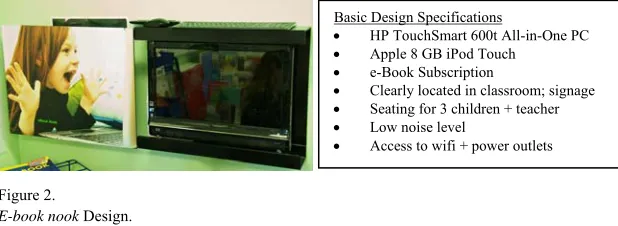
outcomes that set the stage for implementation of the model in the sites: (1) a list of 68 mixed-genre e-books for e-book selec-tion; (2) set-up specifications for an e-book nook in the class-room; and (3) an onlin e tutorial for teacher users. Access and cost factors influenced the titles included in the e-book collec-tion. Subscription rates for some e-book sources are less costly than others and access to some e-book sour ces is limited on mobile devices, such as iPod to uches. Equipment, furnishings and space allocation were deter mining factors in the b asic de-sign of an e-book nook. (See Figure 2) The evidence base on physical environment design in early childhood classrooms also informed e-book nook specifications (Greenman, 1998; Moore, 2001). A short online tutorial was produced to demonstrate how to use the equipment and model shared reading with an e-book.
Phases Two and Three. An 8-week feasibility study was
conducted to observe the implementation of the model in the four sites. Teachers were asked to make arrangements for the e-book nook in the ir classrooms; to plan f or e-book reading sessions for approximately 15 minutes 2 ti mes per week; to select an e-book from a pre-selected list of eight titles for
Table 1.
Participant Demographics.
Classroom Site Teacher Child Sample n = 3 per site
Years of Experience Degree Mean Age in months Mean PPVT Standard Score
1 – Midwest 16 Associate 54 97
2 – Midwest 12 Associate 50 96
3 – Southwest 14 Elem. Ed 57 84
4 --Southwest 2 Special Ed 44 69
Note: PPVT-III: Peabody Picture Vocabulary Test (Dunn & Dunn, 1997).
Phase 1 Phase 2 Phase 3 Phase 4 2 months 4 weeks 4 weeks 2 months Setting Design Fea sibility Fe asibility Data Analysis
Study 1 Study 2 Figure 1.
Basic Design Specifications
HP TouchSmart 600t All-in-One PC
Apple 8 GB iPod Touch
e-Book Subscription
Clearly located in classroom; signage
Seating for 3 children + teacher
Low noise level
Access to wifi + power outlets
Figure 2.
E-book nook Design.
repeated reading each week; and to follow an instructional pro-tocol for teaching children target vocabulary words pre-selected from the e-book set. Research on direct vo cabulary instruction was used to d evelop the instruction al pro tocol (Roskos & Burstein, 2009; Biemiller & Boote, 2006; Silverman, 2007) and select vocabular y words for inst ruction (Roskos et al., 2008 ; Beck, McKeown, & Kucan, 2003; Biemiller & Slonim, 2001
)
.A pool of 80 v ocabulary word s from the e-book set w as identified for direct instruction, using a 2-6-2 ‘rule of thumb’: 20% basic con cept words; 60% root words; 20 % sophisticated words. Vocabulary instruction consisted of a say-tell-do routine where t eachers (T) and children (C) s ay a target word, t ell a child-friendly meaning of it, and do a gesture related to word meaning if appropriate. For ex ample, T say s: I say shovel; we say: shovel; T tells: A shovel, is a tool with a handle. We dig with it. Children tell one another [as best as they can]: Shovel is a tool with a handle. We dig with it. T shows with gestur es: Let’s dig with o ur shovel. Child ren show gestur es of digging with a shovel. Teachers were guided to use the say-tell-do rou-tine before reading the e-book; during reading as appropriate; and to briefly review words after read ing in each e-book ses-sion.
The in itial 4 -week implementation was focused on e-book reading in small groups; the second on small group e-book reading was followed b y solo reading of the same stor y on the mobile d evice. Two debr iefs with teacher p airs wer e con-ducted—one at the 4-week midpoint and the other at the end of the 8-week period.
Videotaped obs ervations of e- book reading s essions were made using the web-cam on the All-in-One-Touch Smart PC to capture children’s behaviors and a F LIP camera operated by a literacy coach to capture t eacher behaviors, totaling 15 hours. Debriefs were conducted for approximately 1 hour using adobe acrobat and were audio taped. Teachers regularly used a one-page lesson plan form to r ecord week ly planning for the e-book sessions. Pre/post measu res on ch ildren’s learn ing of target vocabulary used a Curriculum-Based Decision M easure (CBDM) approach developed by the researchers (Ergul, Burs-tein, & Bryan, in press).
Phase Four. During and following the feasibility study, data were processed using Carney’s ladder of abstraction as a guide (Carney, 1990). Our analytic goal was to formatively assess the functionality of the model in the preschoo l lear ning environ-ment and to gauge its potential usability in early literacy prac-tice. Initially videotaped data o f the e-book sessions were up-loaded into NV ivo 8 (QSR In ternational, 2 007), qu alitative analysis software, and organized into a priori nodes represent- ing bro ad categories of instru ctional ac tivity: organization, support, and aff ect. Each ‘tre e node’ was rep eatedly scann ed for salient indicators in each category, each indicator referred to as a ‘chi ld.’ S alient indi cators i n ea ch category were lab eled
and organized with initial d escriptors into a set of indices for queries. (S ee appendix.) W orksheets fo r calculating the pr es-ence/absence of teaching actions per the vocabulary instruction protocol wer e d eveloped. Debr iefings were su mmarized into research memoranda. Lesson plans were reviewed or marked for evidence of planning before, during and after each e-book ses-sion. E-book qu ality w as summarized using a r esearch-based evaluation (Roskos, Brueck, & Widman, 2009).
Following this initial level of abstraction, observational data were n ext re-or ganized and ag gregated to det ermine frequ en-cies of salient indicators in each componen t an d discern pat-terns. E-books were examined fo r ev idence of research-based design features related to book assistants (e.g., start/stop/pause buttons), m ultimedia il lustrations, print, and i nteractivity (d e Jong & Bus, 20 03). Ph ysical design cr iteria wer e used to ex-amine video /photo samples of the e-book noo k as a ph ysical place in the pr eschool classroom, including lo cation, signag e, space allocation, acoustics and access to e-books (Roskos, 2008; Greenman, 200 5). To gain a w ide-angle v iew of engag ement and instruction during e-book s essions, videotaped data were examined for indices in two ways. Presence of salient indicators in the bro ad ca tegories of a ctivity was id entified a t 1-m inute intervals in a s ub-sample of e- book sessions ( 8 per teach er counter-balanced for e-book session) and fidelity to the instruc-tional pro tocol was examined at 30 -second in tervals on all e-book sessions. Th ese data were cross-referenced with teach-ers’ comments in debriefs and their lesson plans.
Adapting a ty pological analytic strategy (Lofland, 1971) ob-servational data on each component were further abstracted into higher order categories of fun ction and use in the form of rat-ings based on a rudimentar y 0-3 rating scale to represent evi-dence o f pres ence (0 = no pr esence; 1 = low presence; 2 = moderate presence; 3 = high presence) of indicators. Similar to Consumer Reports, r atings w ere organ ized into matrices for purposes of assessment.
Results
E-book Quality
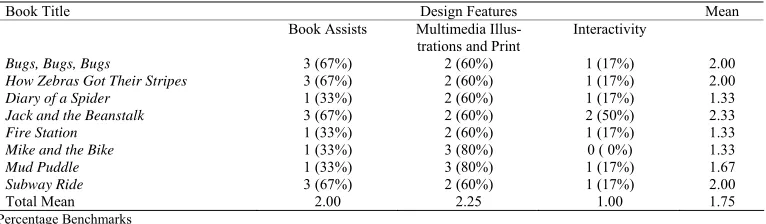
[image:3.595.132.441.84.197.2]Table 2
Rating of Key Features of E-book Quality.
Book Title Design Features Mean
Book Assists Multimedia
Illus-trations and Print Interactivity
Bugs, Bugs, Bugs 3 (67%) 2 (60%) 1 (17%) 2.00
How Zebras Got Their Stripes 3 (67%) 2 (60%) 1 (17%) 2.00 Diary of a Spider 1 (33%) 2 (60%) 1 (17%) 1.33 Jack and the Beanstalk 3 (67%) 2 (60%) 2 (50%) 2.33
Fire Station 1 (33%) 2 (60%) 1 (17%) 1.33
Mike and the Bike 1 (33%) 3 (80%) 0 ( 0%) 1.33
Mud Puddle 1 (33%) 3 (80%) 1 (17%) 1.67
Subway Ride 3 (67%) 2 (60%) 1 (17%) 2.00
Total Mean 2.00 2.25 1.00 1.75
Percentage Benchmarks
3 = 67-100%; 2 = 34-66%; 1 = 1-33%; 0 = 0%
model in t erms of e arly literacy learning outcomes. Design features included the fundamentals of e-books for young chil-dren, namely basic e-book assistants (start-stop features), ani-mated illustrations and print highlights (largely at the sentence level), music, and voice narr ation, bu t few o pportunities to interact with the content or text (e.g., hotspots).
Physical Place
Ratings of the e-book nooks as distinct settings in the class-room si tes p er the p hysical de sign cr iteria are d isplayed in Table 3. Analysis of th e matrix data points to relatively weak implementation of this compone nt in the built environment with a total mean of 1.3. Signage, for example, was totally ab-sent in all sites, which may reflect a lack of signage generally in the preschool environments. Access to th e inter-net and power sources was also very weak, and likely interfered with consis-tent quality in the e-book read ing sessions. Features of setting location and s patial arr angement and app eal w ere a lso in the low range, and again may reflect the broader design qualities of the settings. Attention to acoustical features showed the highest rating, perhaps because the teachers needed to ensure children could hear the e-book narration during e-book reading sessions. Overall, the poo r showing of ph ysical pl ace c riteria i s di sap-pointing s ince t eachers s howed a g enuine e agerness to cr eate the e-book nook s in their classrooms. More explicit guid ance and examples may be needed to help teachers envision what an e-book nookmight look like in the physical environment.
Engagement
Four data sources were clustered to r ate the presence of teacher-child engagement durin g the e-book shared r eading sessions: (i) teacher-child motor behaviors at the touch screen (e.g., poin ting); (ii) children’s facial g estures during e-book reading (e.g., s miling); (iii) teacher-child control of the e-book reading on the touch screen; and (iv) children’s attention indi-cated by directional eye gaze toward the touch screen. Frequen-cies in each cluster were calculated based on the video observa-tional data cod ed at 1-minute in tervals; arbitr ary ben chmarks were established to ra te engagement. T hese data a re summa-rized in Table 4. It is important to note that the length of e-book sessions in classroom 2 were subs tantially shorter than those in the other sites, on average about 12 minutes long, thus reducing the opportunity for demonstrations of engagement. Th at class-room 4 served only special needs children should also be noted.
The strongest evidence of this component is demonstrated in
facial g estures that ind icate children’s positiv e responses to screen content. The y fr equently s miled, contemplated, and gazed int ently at the s creen a cross e-book r eading sessions, suggesting th eir interest in th e stories. Motor b ehaviors als o provide strong evidence of engagement on the part of partici-pants where po sitive t ypes are high and neg ative t ypes low. Incidences of pointing and sitting still predominated over those of wiggling and shifting about ‘as if’ unin terested. Children’s focal attention to teacher and screen also provides evidence of moderate-to-high eng agement in the e-book r eading across sites.
The weakest evidence of engagement involv ed s hared con-trol of the e-book screen. This indicator of engagement did not appear well org anized or man aged at th is point. Several teach-ers reported that asking children to manipu late the controls at the tou ch screen proved disruptive, div erting children’s atten-tion from the st ory line. This, h owever, r epresents a neg ative design feature o f this component . Children’s interactive par-ticipation, such as finger-tracking print, pointing to words and page-turning, is a staple of the shared book instructional routine (Mason, Peterman & Kerr, 1989 ) because it has been found to develop children’s knowledge of print conv entions which are foundational in the learn- to-read process (Morris, 1992). Shared control of th e e-book r eading scr een, therefore, is a critical design factor that needs to be addressed and embedded in the model.
Instruction
[image:4.595.108.491.109.221.2]Table 3.
Physical Place Criteria Ratings by Classroom Site.
Site Design Features Mean
Location Signage Space Acoustics Access
Classroom 1 1 0 1 3 1 1.2
Classroom 2 2 0 1 2 1 1.2
Classroom 3 2 0 2 2 1 1.4
Classroom 4 2 0 2 2 1 1.4
Total Mean 1.75 0 1.50 2.25 1.00 1.3
Criteria Rubric
Location: 3 = clearly defined enclosure; 2 = somewhat defined; 1 = poorly defined; 0 = no enclosure. Signage: 3 = clear signage using print & picture; 2 = printed sign; 1= picture; 0 = no sign
Space: 3 = inviting with comfortable eating, light, color, graphics; 2 = attractive with adequate seating for viewing; adequate light; some coordinated color; 1 = basic setting with seating for viewing; poorly lit; uncoordinated color; 0=no pre-arranged seating.
Acoustics: 3 = low external sound levels; 2 = ordinary background noise; 1 = high volume background noise; interruptions 0 = p ersistent distracting, loud noises; interruptions
Access: 3 high-speed wifi acce ss; >3 power outlets a vailable; 2 = ade quate speed wifi or wire d; 2 power outlets a vailable; 1 = s low speed wifi or wired access;1 power outlet available; 0 = no wifi; extension cords
Table 4.
Ratings of Engagement by Classroom.
Classroom Motor Facial Gestures E-book Control Attention Mean
+
–
+–
Child T +–
1 3 (104) 3(43) 3(169) 3(0) 1 (11) 1(293) 2(73) 2(13) 2.25
2 1 (34) 3(46) 1(70) 3(0) 1 (0) 1(183) 2(70) 2(18) 1.75
3 3 (129) 2(59) 3(191) 3(0) 1 (0) 1(306) 3(169) 3(8) 2.38
4 2 (88) 3(50) 2(141) 3(2) 1(23) 1(262) 3(145) 1(37) 2.00
Total Mean 2.25 2.25 2.25 3.00 1.00 1.00 2.50 2.00 2.10
Frequency Benchmarks
Motor + (e.g., pointing): 1 = 0 - 50; 2 = 1 - 100; 3 => 100 Motor – (e.g., wiggling): 1 > 100; 2 = 51 - 100; 3 = 1-50 Facial + (e.g., smiling): 1=1 - 75; 2=76 - 150; 3=>150 Facial – (e.g., bored): 1 > 30; 2 = 20 - 30; 3 = 0 - 19 E-book Control-Child: 1=1 - 75; 2 =7 6 - 150; 3 => 150
E-book Control-T: 1 => 150; 2 = 75 - 150; 3 =< 75
Attention + (to screen) 1 = 1 - 50; 2 = 51 - 100; 3 > 100 Attention – (distracted): 1 => 25; 2 = 10 - 25; 3 =< 10
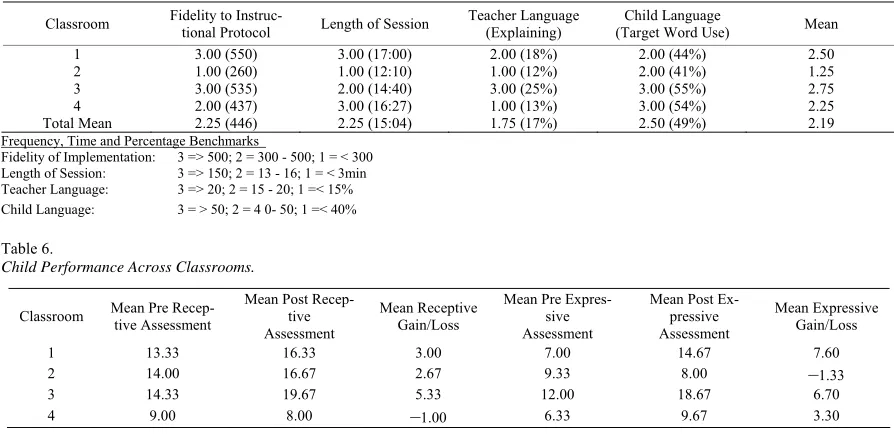
sessions. Ratings are shown in Table 5.
Implementation of this component shows consid erable vari-ability, particularly across indices of fidelity, session length and teacher explanations, which we might expect given th e dynam-ics of instruction in real classrooms. Two pa tterns in the com-ponent ar e notable. With the exception of site 2, evid ence of fidelity to the instruct ional p rotocol—the 12 teaching ac-tions—is moder ate to strong , which suggests th e poten tial strength of an explicit procedure as a des ign f eature. Bu t the generally weak presence of teacher language that supports word learning (explaining word meanings) also suggests that a pro-tocol is an insufficient design feature, in and of itself. Individ-ual teacher knowledge and skill is a powerful factor and needs to be consi dered i n the desig n. Mo re training and self-monitoring may need to be ‘built into’ the design to improve the function-ality and usability of this component. Still, it is worth noting the strong showing of ch ild langu age in th e functioning of th is component that provides further evidence of an explicit instruc-tional protocol as a critical design feature that contributes to the overall fun ctionality of the model for achiev ing learning out-comes. As a proxy for functionality, the CBDM pre/post results support this conjectur e showing that children made vocabu lary gains in either r eceptive or expr essive voc abulary in th e im -plementation sites. (See Table 6)
Discussion
Table 5.
Ratings for Instruction by Classroom.
Classroom Fidelity to Instruc-tional Protocol Length of Session Teacher Language (Explaining) (Target Word Use) Child Language Mean
1 3.00 (550) 3.00 (17:00) 2.00 (18%) 2.00 (44%) 2.50
2 1.00 (260) 1.00 (12:10) 1.00 (12%) 2.00 (41%) 1.25
3 3.00 (535) 2.00 (14:40) 3.00 (25%) 3.00 (55%) 2.75
4 2.00 (437) 3.00 (16:27) 1.00 (13%) 3.00 (54%) 2.25
Total Mean 2.25 (446) 2.25 (15:04) 1.75 (17%) 2.50 (49%) 2.19
Frequency, Time and Percentage Benchmarks
Fidelity of Implementation: 3 => 500; 2 = 300 - 500; 1 = < 300 Length of Session: 3 => 150; 2 = 13 - 16; 1 = < 3min
Teacher Language: 3 => 20; 2 = 15 - 20; 1 =< 15%
Child Language: 3 = > 50; 2 = 4 0- 50; 1 =< 40%
Table 6.
Child Performance Across Classrooms.
Classroom Mean Pre Recep-tive Assessment Mean Post Recep-tive Assessment
Mean Receptive Gain/Loss
Mean Pre Expres-sive Assessment
Mean Post Ex-pressive Assessment
Mean Expressive Gain/Loss
1 13.33 16.33 3.00 7.00 14.67 7.60
2 14.00 16.67 2.67 9.33 8.00
–
1.333 14.33 19.67 5.33 12.00 18.67 6.70
4 9.00 8.00
–
1.00 6.33 9.67 3.30Several str engths in the func tionality and usab ility of the model components emerged . Func tionality of the instruction component, for example, appeared to be enhanced by the inclu-sion of an explicit instructional procedure, as demonstrated in fidelity to a direct vocabulary instruction protocol that appeared to yi eld gains i n children’s vocabulary across implementation sites. The relative power of this feature in the component de-sign needs further testing. F unctionality of the eng agement component emerged in teacher- child motor behaviors at the screen, as wel l as childr en’s ge nerally positiv e affe ct in the context. Usability was marked by a flexibility or ‘play’ in the components that allowed teachers to make adaptations in terms of e-book selection, ph ysical arrangements, and planning for and organ izing sessions to faci litate engagement a nd i nstruc-tion.
Considerable design in each of the components remains, however, to st abilize th e m odel for m ore rigor ous testing in classrooms. One, a high quality set of e-books for preschoolers needs to b e identified and d escribed, including titles, brief an-notations, source information and costs. Two, design specifica-tions of th e e-book nook need to be b etter articulated (e .g., equipment, space n eeds, identity, technology access) and pho-to/graphic examples provided to aid teachers in setting up the e-book nook in their classrooms. Three, guidelines for engaging children at th e screen dur ing e-book shared r eading sessions need to b e developed in co llaboration with teachers to support children’s active par ticipation in shared e-book r eading and to develop screen reading m otor skills. Four, onl ine professional development materials need to be developed that train teachers in the ‘how to’ of e-book r eading (e.g., pacing, pausing , sci-ence-based protocols) and deep en their book-reading language facilitation skills, such as asking questions, clarifying content, extending id eas, etc) . Br ief computer-based tuto rials th at ou t-line st ep-by-step ‘how to’ im plement the m odel in the class-room would also be helpful. Following these improvements,
further design-based research can be pursued on a larg er scale that dev elops a more functiona l a nd usa ble mode l i n t he pre -school setting.
Limitations
Our results at this formative stage are limited by several fac-tors. Technically, the poor quality of some videotaped observa-tions (e.g ., too much backgrou nd noise) rendered them unus-able for coding. As a result, rele vant data may have been lost and not in cluded in the su ccessive analyses that yielded rating scores, thus d egrading the d esign inform ation. Site logisti cs were diff icult d ue to ext ernal factors ( e.g., teacher sch edules, absences, mand atory meetings), which eroded the qu ality of training, site management and debriefings and likely compro-mised these obs ervational data for design purp oses. Analy ti-cally, disciplined data analyses at successively higher lev els of abstraction proved very challenging in a collaborative research approach, which led to some miss-steps in coding and cate-gory-reduction that inf luenced th e emerging assessment of functionality and usability using a rating system. At times frus-trating, this process nonetheless produced refinements in the set of indices for o bserving the model and guided design changes for the next phase of model development and testing.
Conclusion
task, howev er, is not only to u nderstand how these new ag e tools impact early literacy development and learning processes, but also to understand how to use them well in preschool early literacy education. Our e-book m odel is a des ign fr amework that moves in this direction and our ambitious g oal is to dem-onstrate ‘proof of concept’ that improves the instructional po-tential of t he lit eracy-learning environment for te achers and children. We are at the start-point of this research agenda.
References
Beck, I. L., McKeown, M. G., & Kucan, L. (2003). Taking delight i n words: Using or al language to build young children’s vocabularies.
American Educator, 27, 36-46.
Biemiller, A. & . Boote, C. (2006). An effective method for buildin g meaning vocabulary in pr imary grades. Journal of Educational Psy-chology, 98, 44-62.doi:10.1037/0022-0663.98.1.44
Biemiller, A. & S lonim, N . (2001). Esti mating root word vocabulary growth in norm ative and advant aged populations: E vidence for a common sequence of vocabulary acquisition. Journal of Educational Psychology, 93, 498-520.doi:10.1037/0022-0663.93.3.498
Carney, T. F. ( 1990). Collaborative inquiry methodology. W indsor,
Ontario: University of Windsor, Division for Instructional Develop-ment. doi:10.1207/s15327809jls1301_2
Collins, A., Jose ph, D., & Biela czyc, K. (2004). Design research: Theoretical and methodological issues. The Journal of the Learning Sciences, 13, 15-42.
de Jong, M . T . & Bus, A. G. (2003). How well suited ar e electr onic books for supporti ng literacy? Journal of Early Childhood Literacy, 3, 147-164.doi:10.1177/14687984030032002
Dunn, L. M. & Dunn, L. M. (1997). Peabody Picture Vocabulary Test- III. Circle Pines, MN: American Guidance Publishers.
Ergul, C., Burstein, K., & Bryan, T. (in press). Curriculum based deci-sion-making: An assessment model to enhance early literacy skills of ELL preschoolers with and without special needs.
Fishburn, T. (2008). Mobile device early reading interventions in kin-dergarten classrooms, Ph. D. diss ertation, New Cas tle, DE:
Wil-mington University.
Greenman, J. (2005). Caring spaces, learning places: Children’s envi-ronments that work, Redmond, WA: Exchange Press, Inc.
Korat, O. & Sham ir, A. (2004). Do Hebr ew electr onic books dif fer from Dutch electronic books ? A replication of a Dutch content anal-ysis. Journal of Computer Assisted Learning, 20, 257-268.
doi:10.1111/j.1365-2729.2004.00078.x
Kress, G. (2003). Literacy in the new media age. New York: Routledge. Lofland, J. ( 1971). Analyzing social settings: a guide to qualitative
observation and analysis. Belmont, CA: Wadsworth.
Mason, J., Peterman, C., & Ker r, B . ( 1989). Reading to kinder garten children. In D. Strickland and L. Morrow (Eds.), Emerging literacy: Young children learn to read and write. ( pp. 52- 62). Newar k, DE :
International Reading Association.
McKenna, M ., & Z ucker, T . ( 2009). Use of electronic storybooks in reading instruction. In A. Bus and S. B. Neuman (Eds.), Multimedia and literacy development. (pp. 254-272). New York: Routledge.
Moore, G. T. ( 2001). Childr en, y oung peo ple and the ir envir onment.
Keynote address at the Fourth Child and Family Policy Conference,
Dunedin, NZ.
Morris, D. ( 1992). Concept of w ord: A pivotal u nderstanding in t he learning-to-read process. In S. Templeton & D. R. Bear (Eds.), De-velopment of orthographic knowledge and the foundations of liter-acy: A memorial festschrift for Edmund H. Henderson, (pp. 53-77).
Hillsdale, NJ: Erlbaum, Hillsdale.
National E arly L iteracy Panel. ( 2008). A scientific synthesis of early literacy development and implications for intervention. Washington,
DC: National Institute for Literacy.
Paivio, A. (1986). Mental representation: A dual coding approach.
Oxford, England: Oxford University Press.
QSR International (2007) NVivo 8. http://www.qsrinternational.com. Reigeluth, C. M., & Frick, T. W. (1999). Formative research: A
meth-odology for creating and im provingdesign theories. In C. M . Reige-luth (Eds.), Instructional-design theories and models – A new para-digm of instructional theory (pp. 63 3-652). New Je rsey: L awrence
Erlbaum.
Roskos, K. (2008). The benefits of going green. In S. B. Neuman (Ed.), In Educating the other America (pp. 333- 346). Baltim ore, M D:
Brookes Publishing.
Roskos, K. , Br ueck, J. , & Widman, S. ( 2009). Dev eloping analy tic tools for e-book design in early literacy learning. Journal of Interac-tive Online Learning, 8, 2009. Internet Available: http://www.
ncolr.org/jiol.
Roskos, K. & Burstein, K. (2009). Attempting to level the playing field: A vocabulary intervention for at risk and special needs preschoolers. Paper presented at the Annual Meeting of the American Educational Research Association. San Diego, CA.
Roskos, K., E rgul, C., Bryan, T., Burstein, K., Christie, J., & Han, M. (2008). Who’s learning what words and how fast: Pr eschoolers’ vo-cabulary growth in an early lit eracy program. Journal of Research in Childhood Education,22, 275-290.
doi:10.1080/02568540809594627
Segers, E. (2009). Learning from interactive vocabulary books in kin-dergarten. In A. Bus & S. B. Neuman (Eds.), Multimedia and literacy development, (pp. 112-123). New York: Routledge.
Segers, E., Nooijen, M., & de M oor, J. ( 2006). Co mputer vocabulary training in kinder garten child ren with special needs. International Journal of Rehabilitation Research, 29, 343-345.
doi:10.1097/MRR.0b013e328010f4e0
Shamir, A. & Korat, O. (2009). The educational electronic book as a tool for supporting children’s e mergent literacy. In A . Bus & S. B. Neuman (Eds.), Multimedia and literacy development (pp. 168-181).
New York: Routledge.
Silverman, R. ( 2007). A co mparison of thr ee methods of vocab ulary instruction dur ing r ead-alouds in kindergarten. The Elementary School Journal, 108, 97-113. doi:10.1086/525549
Teale, W. (2010). Discussant comments at the 17th Annual Conference
of the Society for the Scientific Study of Reading, Berlin, Germany.
U. S. Department of E ducation, E d.gov. ( 2008). E arly Reading Fir st. URL (last checked 31 January 2011)
http://www2.ed.gov/programs/earlyreading/index.html
Vaughn, S. & Linan-Thompson, S. (2004). Research-based methods of reading instruction. Alexandria, VA: ASCD.
Verhallen, M., Bus, A., & de Jong, M. (2006). The promise of multi-media stor ies for kindergarten childr en at risk. Journal of Educa-tional Psychology,98, 410-419. doi:10.1037/0022-0663.98.2.410
Appendix
Initial Set of Indices for Coding Observational Data
Node Salient Indicators (Child) Descriptors
Organization Position Sitting
Kneeling Laying Standing
Location Chair
Floor Pillow Bench
Controls Auto
Manual Teacher Child
Supports Attention Eye Gaze
Look
Motor Pointing
Moving About
Language Directing
Explaining Questioning Extending Feedback Peer to Peer
Affect Gestures Smiling Clapping
Frowning Contemplating Puzzling Being Scared
Language Expressive
Comments Squeals Noises Personalization Curiosity