Energy and Power Engineering, 2011, 3, 113-119
doi:10.4236/epe.2011.32015 Published Online May 2011 (http://www.SciRP.org/journal/epe)
Economic Dispatch with Multiple Fuel Options Using CCF
Radhakrishnan Anandhakumar, Srikrishna Subramanian
Department of Electrical Engineering, FEAT, Annamalai University, Annamalainagar, India
E-mail: anand_r1979@yahoo.com, [email protected] Received February 6, 2011; revised March 24, 2011; accepted April 2, 2011
Abstract
This paper presents an efficient analytical approach using Composite Cost Function (CCF) for solving the Economic Dispatch problem with Multiple Fuel Options (EDMFO). The solution methodology comprises two stages. Firstly, the CCF of the plant is developed and the most economical fuel of each set can be easily identified for any load demand. In the next stage, for the selected fuels, CCF is evaluated and the optimal scheduling is obtained. The Proposed Method (PM) has been tested on the standard ten-generation set system; each set consists of two or three fuel options. The total fuel cost obtained by the PM is compared with earlier reports in order to validate its effectiveness. The comparison clears that this approach is a promising alterna-tive for solving EDMFO problems in practical power system.
Keywords:Economic Load Dispatch, Composite Cost Function, Multiple Fuel Options, Piecewise Quadratic Function, Mathematical Model
1. Introduction
The economic dispatch problem in a power system is to determine the optimal combination of power outputs for all generating units which will minimize the total cost while satisfying the load and operational constraints [1]. The economic dispatch problem is very complex to solve because of its colossal dimension, a non-linear objective function, and a large number of constraints. Conven-tional techniques lambda iteration method and quadratic programming offer good results, but when the search space is nonlinear and has discontinuities, they become very complicated with a slow convergence ratio and do not always seek the optimal solution. New numerical methods are needed to cope with these difficulties, espe-cially those with high speed search for the optimal and not being trapped in local minima [2].
The stochastic search algorithms such as Simulated Annealing (SA) and Genetic Algorithm (GA) have been applied to determine the optimal generation schedule for economic dispatch problem in a power system [3]. SA is applied in many power system problems, but setting the control parameters of the SA algorithm is a difficult task, and the convergence speed is slow when applied to a real system. The GA methods have been employed to suc-cessfully to solve complex optimization problem, recent research has identified some deficiencies in GA
per-formance. Particle swarm optimization method (PSO) has been applied for solving economic dispatch problems with various operating constraints [4].
A novel optimization approach, Artificial Immune System (AIS) has been applied to solve constrained eco-nomic load dispatch problem [5]. This approach utilizes the clonal selection principle and evolutionary approach wherein cloning of antibodies is performed followed by hyper mutation. A novel coding scheme for practical economic dispatch by modified particle swarm optimiza-tion approach has also been proposed to solve economic dispatch problem [6]. The heuristic search technique, Differential Evolution has been suggested for solving economic dispatch problems [7]. Bacterial Foraging- Nelder Mead method has been applied for the solution of economic dispatch problems [8].
economic dispatch problems has been proposed [10]. An improved adaptive Hopfield Neural Network (HNN) approach has been proposed for finding the solution for economic dispatch with multiple fuel options [11]. The HNN suffers with slow convergence rate and normally takes a large number of iterations. A hybrid real coded GA method has been presented for solving the economic dispatch problem with multiple fuel options [12].
An enhanced Lagrangian neural network has been ap-plied to solve the economic load dispatch problems with piecewise quadratic cost functions [13]. In this method the convergence speeds are enhanced by employing by momentum technique and providing criteria for choosing the learning rate. Economic dispatch solutions with piecewise quadratic cost functions has been solved by using improved genetic algorithm [14]. In order to im-prove the effectiveness of genetic algorithm multi-stage algorithm and directional crossover methods are pro-posed and projection method is introduced to satisfy a linear equality constraint from power balance. The heu-ristic search techniques such as PSO [15] ,Taguchi method (TM) [16], Evolutionary Programming (EP) [17] and its improved version are also been applied to solve the economic dispatch problems with multiple fuel op-tions [18,19].
The CCF is a non-iterative direct method, gives the most economic dispatches of the online units with less computation time. In this paper, the CCF is used to solve the economic dispatch problem with multiple fuel op-tions.
2. Problem Formulation
2.1. Nomenclature
ai, bi, ci Fuel cost coefficients of the units
asj, bsj, csj Fuel cost coefficients of the set S with k fuel options
A, B, C Composite cost coefficients
AS, BS, CS Composite cost coefficients of the set S
AP, BP, CP Composite cost coefficients of the plant
FCSj Fuel cost function of the set S with k fuel options, in $/h
FCS Fuel cost function of the set S, in $/h
FCP Fuel cost function of the plant, in $/h
k Number of fuel options in a plant N Number of generation units
min
S
P Minimum power generation of set S, in MW
max
S
P Maximum power generation of set S, in MW
PS Economic dispatch of the set S, in MW
PG Power generation of the plant, in MW
PD Power demand, in MW
S Set of generating units in a plant λ Incremental production cost, in $/MWh
2.2. Economic Dispatch Problem with Multiple Fuels
The main objective of economic dispatch is to find the optimal combination of power generation that minimizes the total generation cost while satisfying equality and inequality constraints. A piecewise quadratic function is used to represent the input-output curve of a generator with multiple fuel options. For a generator with k fuel options, the cost curve is divided into k discrete regions between lower and upper bounds. The economic dispatch problem with piecewise quadratic function is defined as
Minimize
1 N i i i F P
2 m1 1 1
2
2 2 2 1 2
2 m
1 , 1,
, 2,
, ,
i i i i i i i i
i i i i i i i i
i i
ik i ik i ik ik i i
a P b P c fuel P P P
a P b P c fuel P P P
F P
a P b P c fuel k P P P
in 1 ax (1) where Fi(Pi) is the fuel cost function of the ith unit, Pi is the power output of the ith unit, N is the number of gen-erating units in the system and aik, bik and cik are cost coefficients of the ith unit using fuel type k.
Minimization of the generation cost is subjected to the following constraints:
1) The power balance constraints
1 N i D i P P
(2)where PD is the total system demand in MW. 2) Generating capacity constraints
min max
i i i
P P P (3)
where, and are the minimum and maxi-mum power outputs of the ith unit.
min
i
P max
i
P
3. Composite Cost Function (CCF)
The composite cost coefficients were reported in the lit-erature [9].
1 2
1 1 1 1 N
A a a a (4)
1 1 2 2 N N
B b a b a b a A (5)
2APG B ; where PG PD
2 i Gi i b P a
R. ANANDHAKUMAR ET AL. 115
1 2
2 2 2 2
1 4 1 2 4 2 4
N
N N
C c c c
b a b a b a B A
4 (7)
2
P P G P G P
FC A P B P C (8)
The A, B and C are the composite cost coefficients and can be easily calculated by using Equations (4), (5) and (7) respectively. For a particular load demand, the opti-mal generation of units is directly computed using Equa-tion (6).
4. Proposed Approach for Economic
Dispatch with MFO
The proposed methodology consist two stages of the most economic fuel identification and economic sched-uling. In the first stage, the composite cost function of the plant is developed as detailed in the previous section. The incremental cost of the plant for a particular load demand is calculated and the generation dispatch for each unit is determined. The dispatch of each set directly indicates the most economical fuel and feasible operating region. In the second stage, the dispatch of the generating units is refined within the feasible operating region. The composite cost function is developed with the selected fuels and is solved to obtain the most economic dispatch of generating units.
4.1. Identification of the Most Economic Fuel
Consider a plant consists of ‘S’ set of generation, each set consists of ‘k’ fuel options.
The fuel cost function of the set ‘S’ with ‘k’ fuel op-tions is,
2
min max
,
;
1, 2, , ; 1, 2, ,
Sj Sj S Sj S Sj S S S
FC a P b P c
P P P
S N j
k
(9)
The composite cost function of set ‘S’ is calculated by using Equations (4), (5) and (7).
2
S S S S S S
FC A P B P C (10)
1 2
1 1 1 1
S k
A a a a (11)
1 1 2 2
S k
B b a b a b a Ak S (12)
1 2 2 2 2
21 4 1 2 4 2 4 4
S k
k k S
C c c c
b a b a b a B A
S (13)
In this manner, the CCF for the plant is calculated and is given as,
2
P P G P G P
FC A P B P C (14)
The composite coefficients are constant for any load demands.
The incremental production cost of the plant for the demand is calculated by
2A PP G BP; where PG PD
(15)
The economic dispatch of the set ‘S’ is calculated as,
2 S S
S
B P
A
(16)
The above equation provides the dispatch of each set to meet the load demand. Based on this dispatch, the most economical fuel and the feasible operating region of each set can be easily identified.
4.2. Economic Dispatch of the Selected Fuels
The composite cost function is developed using the most economic fuels. The generation dispatch is refined within the feasible limits as detailed in Section 3.
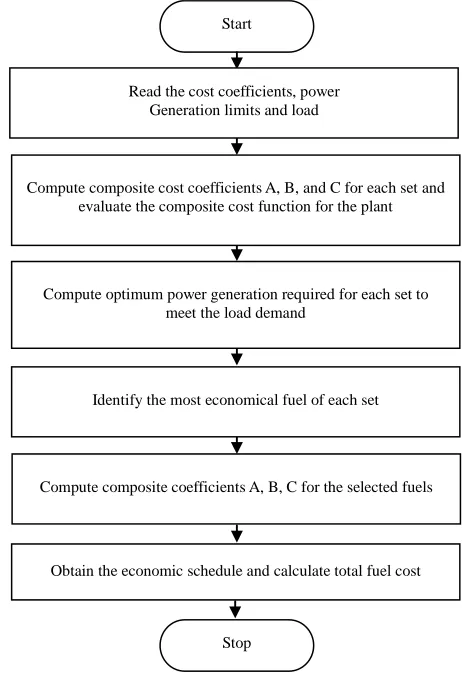
The computational flow of the proposed methodology for solving economic dispatch problem with multiple fuel options is presented as a flow chart in Figure 1.
Start
Read the cost coefficients, power Generation limits and load
Compute composite cost coefficients A, B, and C for each set and evaluate the composite cost function for the plant
Compute optimum power generation required for each set to meet the load demand
Identify the most economical fuel of each set
Compute composite coefficients A, B, C for the selected fuels
Obtain the economic schedule and calculate total fuel cost
[image:3.595.306.537.366.703.2]Stop
5. Numerical Simulation Results and
Discussion
The proposed technique has been implemented in MATLAB on a 2.10 GHz core2Duo processor PC. The simulation studies have been carried out on ten-generat-ing unit system with multiple fuel options [9]. This problem includes one objective function with ten vari-able parameters (P1, P2, , P10), one equality and twenty inequality constraints, i.e. power balance con-straint and maximum and minimum limits of each gen-erating unit.
By the proposed strategy, the economic dispatch solu-tion for the given system can be obtained in two stages: 1) evaluate the composite fuel cost function for the plant and is solved to identify the most economic fuel and fea-sible operating region of each set, and 2) the optimal dispatches are calculated by solving composite fuel cost function with selected fuels.
The implementation of the proposed strategy for the given system is detailed as follows. The equivalent cost function of set ‘S’ is calculated using the Equations (11), (12) and (13). In the selected sample system the number of sets in the plant is ten and the number of units is twenty nine.
For example, the equivalent cost function of the set 5 is,
2
5 0.000044807 5 0.0493 5 91.5841
FC P P (17)
Similarly, for set 8, the equivalent cost function is,
2
8 0.000067369 8 0.04404 8 126.6098
FC P P (18)
In this manner, the equivalent cost function of each set is determined. By combining these cost coefficients, the equivalent cost function of the plant is calculated.
The equivalent cost function of the plant is,
06 2
7.3287 0.3933 1518
P G G
FC e P P
(19)
The incremental cost of the plant is obtained by using Equation (15).
For a load demand of 2400 MW, the λis 0.4285 and the dispatch of each set is determined by using Equation (16). Then, the dispatches of the set 5 and 8 are 278 MW and 265 MW respectively. In this manner, the dispatch of each set is identified and it indicates the most economical fuel and the feasible operating region. For the set 5, the dispatch is 278 MW, then the most economical fuel is 1 and the feasible operating region is 190 MW to 338 MW. For the set 8, the dispatch is 265 MW, then the most economical fuel is 3 and the feasible operating region is 200 MW to 265 MW.
Similarly, the economic dispatch is performed to de-termine the optimal dispatches within the feasible
oper-ating region by using the composite cost function of the selected fuels. During the calculation of dispatch, if the generation of any unit violates the effective limits, its generation are fixed at the violated limit. Then that unit is eliminated from the dispatch procedure. The genera-tion of all the units except the violated unit is recalcu-lated using the above procedure with total generation equal to the load demand minus the generation of the limit violated unit.
The simulation is performed for various load demands of 2400 MW, 2500 MW, 2600 MW and 2700 MW. The optimal dispatches obtained by the proposed methodol-ogy and HM [9] for the above mentioned load demands are compared and the comparison is presented in Table 1. These results signify that the proposed CCF always pro-vides better solution than HM [9]. Though the HM method is an iterative mathematical approach, suffers with the assumption of initial lambda values. In addition, two operating points having same incremental cost also exist and it requires valid assumption to choose the op-timal fuel for a particular demand, improper selection will lead infeasible solution. Additionally, the proposed CCF is a direct or non iterative method, it does not de-mand any initial guess values for economic dispatch of units for the given load demand.
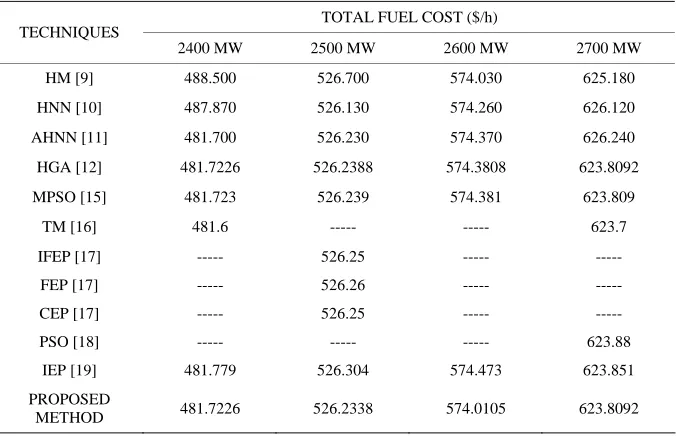
The comparison of total fuel cost obtained by pro-posed methodology, HM [9], HNN [10], AHNN [11], HGA [12], Modified PSO (MPSO) [15], TM [16], Im-proved Fast EP (IFEP) [17], Fast EP (FEP) [17], Classi-cal EP (CEP) [17], PSO [18], and Improved EP (IEP) [19] is presented in Table 2. As seen the comparison, the gen-eration costs obtained by CCF are lowest among the re-sults. Moreover, the optimal fuel cost obtained through the CCF method is exactly same as the HGA [12], except the load demand of 2600 MW. However, the proposed method directly provides the optimal schedule and it utilizes the CCF for fuel selection and economic sched-uling. These comparison results confirm that the CCF provides better solution quality.
The salient features of proposed approach over exist-ing methods are:
The approach is conceptually simple. It is a non iterative method.
The simplified generalized expression directly gives the most economical fuel and the feasible operating region for a particular load demand.
It also provides the most economic schedule of gen-eration with less computational effort.
It requires negligible computational time, hence it is suitable for on line applications.
The performance of the proposed is independent of system size; hence it is suitable for system of any size.
R. ANANDHAKUMAR ET AL. 117
Table 1. Comparison of simulation results between proposed method and HM.
LOAD DEMAND = 2400 MW LOAD DEMAND = 2500 MW
PM HM [9] PM HM [9]
UNIT
FT GEN (MW) FT GEN (MW) FT GEN (MW) FT GEN (MW)
1 1 189.7405 1 193.2 2 206.5190 2 206.6
2 1 202.3427 1 204.1 1 206.4573 1 206.5
3 1 253.8953 1 259.1 1 265.7391 1 265.9
4 3 233.0456 3 234.3 3 235.9531 3 236.0
5 1 241.8297 1 249.0 1 258.0177 1 258.2
6 3 233.0456 1 195.5 3 235.9531 3 236.0
7 1 253.2750 1 260.1 1 268.8635 1 269.0
8 3 233.0456 3 234.3 3 235.9531 3 236.0
9 1 320.3832 1 325.3 1 331.4877 1 331.6
10 1 239.3969 1 246.3 1 255.0562 1 255.2
LOAD DEMAND = 2600 MW LOAD DEMAND = 2700 MW
PM HM [9] PM HM [9]
UNIT
FT GEN (MW) FT GEN (MW) FT GEN (MW) FT GEN (MW)
1 2 216.5442 2 216.4 2 218.2499 2 218.4
2 1 210.6058 1 210.9 1 211.6626 1 211.8
3 1 278.1441 1 278.5 1 280.7228 1 281.0
4 3 239.0967 3 239.1 3 239.6315 3 239.7
5 1 275.5154 1 275.4 1 278.4973 1 279.0
6 3 239.0967 3 239.1 3 239.6315 3 239.7
7 1 285.7585 1 285.6 1 288.5845 1 289.0
8 3 239.0967 3 239.1 3 239.6315 3 239.7
9 1 343.8134 1 343.3 3 428.5216 3 429.2
[image:5.595.130.468.502.720.2]10 1 271.5861 1 271.9 1 274.9667 1 275.2
Table 2. Comparison of the total cost with different techniques.
TOTAL FUEL COST ($/h) TECHNIQUES
2400 MW 2500 MW 2600 MW 2700 MW
HM [9] 488.500 526.700 574.030 625.180
HNN [10] 487.870 526.130 574.260 626.120
AHNN [11] 481.700 526.230 574.370 626.240
HGA [12] 481.7226 526.2388 574.3808 623.8092
MPSO [15] 481.723 526.239 574.381 623.809
TM [16] 481.6 --- --- 623.7
IFEP [17] --- 526.25 ---
---FEP [17] --- 526.26 ---
---CEP [17] --- 526.25 ---
---PSO [18] --- --- --- 623.88
IEP [19] 481.779 526.304 574.473 623.851
PROPOSED
METHOD 481.7226 526.2338 574.0105 623.8092
6. Conclusions
The economic dispatch problem with multiple fuel op-tions is a complex optimization problem whose impor-tance may increase as competition in power generation intensifies. This paper presents economic dispatch prob-lem with multiple fuel options using composite cost function. The proposed CCF based solution for economic dispatch with MFO offers a best contribution in the area of economic dispatch. In contrast to the HM [9], this approach fully explores the cost coefficients and gives a promising value of power for providing improved eco-nomic dispatch. The HM method requires the valid as-sumptions such as initial value of lambda and it itera-tively solves the problem. The proposed methodology is a non-iterative method that directly gives the optimal generation schedule of the generating set and it does not require any assumptions. The numerical results demon-strate that the proposed approach offers a better conver-gence rate, minimum cost to be achieved and better solu-tion than the existing methods. As power systems are usually large scale systems, the proposed method may be suggested for the solution of economic load dispatch problems and it is also suitable for online applications.
7. Acknowledgements
The authors gratefully acknowledge the authorities of Annamalai University, Annamalainagar, Tamilnadu, India, for their continued support, encouragement, and the extensive facilities provided to carry out this research work.
8. References
[1] A. J. Wood and B. F. Wollenberg, “Power Generation Operation and Control,” 2nd Edition, Wiley, New York, 1996.
[2] A. Chakrabarti and S. Halder, “Power System Analysis Operation and Control,” 3rd Edition, PHI, New Delhi, 2010.
[3] K. P. Wong and Y. W. Wong, “Genetic and Genetic/ Simulated-Annealing Approaches to Economic Dis-patch,” IEE Proceedings of Generation, Transmission and Distribution, Vol. 141, No. 5, 1994, pp. 507-513. doi: 10.1049/ip-gtd:19941354
[4] Z. L. Gaing, “Particle Swarm Optimization to Solving the Economic Dispatch Considering the Generator Con-straints,” IEEE Transactions on Power Systems, Vol. 18, No.3, 2003, pp. 1187-1195.
doi: 10.1109/TPWRS.2003.814889
[5] B. K. Panigrahi, S. R. Yadav, S. Agrawal and M. K. Ti-wari, “A Clonal Algorithm to Solve Economic Load Dispatch,” Electric Power Systems Research, Vol. 77, No.
10, 2007, pp. 1381-1389. doi:10.1016/j.epsr.2006.10.007
[6] Cheng-Chien Kuo, “A Novel Coding Scheme for Practi-cal Economic Dispatch by Modified Particle Swarm Ap-proach,” IEEE Transactions on Power Systems, Vol. 23, No. 4, 2008, pp. 1825-1835.
doi: 10.1109/TPWRS.2008.2002297
[7] N. Noman and H. Iba, “Differential Evolution for Eco-nomic Dispatch Problems,” Electric Power Systems Re-search, Vol. 78, No. 8, 2008, pp. 1322-1331.
doi:10.1016/j.epsr.2007.11.007
[8] B. K. Panigrahi and V. R. Pandi, “Bacterial Foraging Optimization: Nelder-Mead Hybrid Algorithm for Eco-nomic Load Dispatch,” IET Generation Transmission Distribution, Vol. 2, No. 4, 2008, pp. 556-565.
doi:10.1049/iet-gtd:20070422
[9] C. E. Lin and G. L. Viviani, “Hierarchical Economic Dis-patch for Piecewise Quadratic Cost Functions,” IEEE Transaction on Power Application Systems, Vol. PAS-103, No. 6, 1984, pp. 1170-1175.
doi:10.1109/TPAS.1984.318445
[10] J. H. Park, Y. S. Kim, I. K. Eom and K. Y. Lee, “Eco-nomic Load Dispatch for Piecewise Quadratic Cost Func-tion using Hopfiled Neural Network,” IEEE Transactions on Power Systems, Vol. 8, No. 3, 1993, pp. 1030-1038. doi:10.1109/59.260897
[11] K. Y. Lee, A. Sode-Yome and J. H. Park, “Adaptive Hop-filed Neural Network for Economic Load Dispatch,” IEEE Transactions on Power Systems, Vol. 13, No. 13, 1998, pp. 519-526. doi:10.1109/59.667377
[12] S. Baskar, P. Subbaraj and M. V. C. Rao, “Hybrid Real Coded Genetic Algorithm Solution to Economic Dispatch Problem,” Computers Electrical Engineering, Vol. 29, No. 3, 2003, pp. 407-419.
doi:10.1016/S0045-7906(01)00039-8
[13] S. C. Lee and Y. H. Kim, “An Enhanced Lagrangian Neural Network for the ELD Problems with Piecewise Quadratic Cost Functions and Nonlinear Constraints,” Electric Power Systems Research, Vol. 60, No. 3, 2002, pp. 167-177. doi:10.1016/S0378-7796(01)00181-X [14] J.-R. Won and Y.-M. Park, “Economic Dispatch
Solu-tions with Piecewise Quadratic Cost FuncSolu-tions Using Improved Genetic Algorithm,” Electric Power Energy Systems, Vol. 25, No. 5, 2003, pp. 355-361.
doi:10.1016/S0142-0615(02)00098-4
[15] J.-B. Park, K.-S. Lee, J.-R. Shin and K. Y. Lee, “A Parti-cle Swarm Optimization for Economic Dispatch with Nonsmooth Cost Functions,” IEEE Transactions on Power Systems, Vol. 20, No. 1, 2005, pp. 34-42.
doi: 10.1109/TPWRS.2004.831275
[16] D. R. Liu and Y. Cai, “Taguchi Method for Solving the Economic Dispatch Problem with Nonsmooth Cost Func-tions,” IEEE Transactions on Power Systems, Vol. 20, No. 4, 2005, pp. 2006-2014.
doi:10.1109/TPWRS.2005.857939
R. ANANDHAKUMAR ET AL. 119
Electric Power Systems Research, Vol. 73, No. 2, 2005, pp. 169-176. doi:10.1016/j.epsr.2004.08.001
[18] D. N. Jeyakumar, T. Jayabharathi and T. Raghunathan, “Particle Swarm optimization for Various Types of Eco-nomic Dispatch Problems,” Electric Power Energy Sys-tems, Vol. 28, No. 1, 2006, pp. 36-42.
doi:10.1016/j.ijepes.2005.09.004