An Improved Wavelet Based Preconditioner for Sparse
Linear Problems
Arikera Padmanabha Reddy, Nagendrapp M. Bujurke Department of Mathematics, Karnatak University, Dharwad, India
E-mail: [email protected], paddu7[email protected]
Received August 9, 2010; revised September 11, 2010; accepted September 14, 2010
Abstract
In this paper, we present the construction of purely algebraic Daubechies wavelet based preconditioners for Krylov subspace iterative methods to solve linear sparse system of equations. Effective preconditioners are designed with DWTPerMod algorithm by knowing size of the matrix and the order of Daubechies wavelet. A notable feature of this algorithm is that it enables wavelet level to be chosen automatically making it more robust than other wavelet based preconditioners and avoids user choosing a level of transform. We demon-strate the efficiency of these preconditioners by applying them to several matrices from Tim Davis collection of sparse matrices for restarted GMRES.
Keywords:Discrete Wavelet Transform, Preconditioners, Sparse Matrices, Krylov Subspace Iterative Methods
1. Introduction
The linear system of algebraic equations
Ax b (1) where A is n n non-singular matrix and b is vec-tor of size n arise while discretising differential equa-tions using finite difference or finite element schemes. For the solution of (1), we have a choice between direct and iterative methods. While direct methods, such as Gaussian elimination, can be implemented if n is small, for very large values of n (from Tim Davis collection of matrices [1]) it is often necessary to resort to iteration methods such as relaxation schemes or Krylov subspace iterative methods (Conjuagate Gradient (CG), General-ised Minimum Residual (GMRES) and their variants etc). Each iterative method is aimed at providing a way of solving a particular class of linear system, but none can be relied upon to perform well for all problems. Usually it is necessary to make use of a preconditioner to accel-erate the convergence of iteration. This means that the original system of equations is transformed into equiva-lent system, which is more amenable to solution by a chosen iterative method (Ford [2]). The combination of preconditioning and Krylov subspace iterations could provide efficient and simple general-purpose procedures that compete with direct solvers (Saad [3]). A
precondi-tioner is a non-singular matrix P(A) with P1A I .
The philosophy is that the preconditioner has to be close to A and still allow fast converging iteration. The broad class of these preconditioners are mainly obtained by splitting A, say, in the form A P Q and writing (1) in the form
I P Q x P b 1
1 . (2)If P is the diagonal of A then the iteration scheme is due to Jacobi (P is not close toA) and the other ex-treme is PA(too close to A). In between these two extremities, we look for Pas band matrix constructed by setting to zero all entries of the matrix outside a cho-sen diagonal bandwidth [4].
band of matrix. Later, an approximate form of this can be formed and taken as preconditioner, which controls fill- in whenever schemes like LUdecomposition is used. Similar criteria is adopted in transforming non-smooth parts, if any, which are horizontal/vertical bands and are shifted to the bottom and right-hand edges of the matrix after applying DWTPer. This procedure is termed as DWTPerMod [7] and takes care of other cases where non-smooth parts are located in the matrix. This scheme is more effective in incorporating missing finer details such as fixing of precise bandwidth and automatic selec-tion of choice of transform level. Using DWTPerMod algorithm Ford [7] has presented its salient features by applying it to standard dense matrices arising in various disciplines/fields of interest.
Kumar and Mehra [8] use iDWT, iDWTPer (imple-mentation of DWT by zero padding [9]) and demonstrate their efficiency as preconditioner for ill conditioned sparse matrices and iDWTPer to be more robust precon-ditioners for sparse systems. Motivated by this work ([5-8]), we have successfully used DWTPerMod algo-rithm in selecting the level of wavelet transform auto-matically by knowing the size of the matrix, order of wavelet used and construct effective preconditioner for sparse unsymmetric linear systems.
The structure of the paper is organised as follows: In Section 2 we explain briefly about orthogonal wavelets. Section 3 contains practical computation details of tran- sforms required. Here, we present the main results of wavelet based preconditioners in the form of Theorem and Algorithms. In Section 4 we illustrate seven typical test problems selected from Tim Davis collection to em-phasize the potential usefulness of preconditioners de-signed using various orders of Daubechies wavelet. Fi-nally, in Section 5 we summarise our conclusion and give future plan of work.
2. Wavelet Preliminaries
The effective introduction to wavelets via multiresolu-tion analysis (MRA) is broad based compared with con-ventional/classical way through scaling function concept and as such the following basics are given below.
2.1.Multiresolution Analysis
A multire solution analysis [9-11] on R is a sequence of closed subspaces
Vj j of L R2
satisfying the following conditions1) nestedness: VjVj1
2) completeness: closure of
Vj
2
L R , nullity:
0 j V
3) scale invariance: f x
Vj f
2x Vj14) shift invariance: f x
V0 f x k
V k Z0, 5) shift invariant basis: there exists function
in V0 whose integer translates
k
are an orthonormal basis for V0.Let W0 be a complement of V0 in V1 , i.e.,
1 0 0
V V W . This implies that there exists a function
0
W
such that its translates
k
k are an orthonormal basis forW0. For eachj k Z, , define
2
, 2j 2j
j k x x k
2
, 2 2
j j
j k x x k
then these form orthonormal bases for Vj and Wj re-spectively and
n k, / ,n k Z
forms an orthonormalbasis of L R2
and1
j j j
V V W (3)
Since V0 and W0are contained in V1, we have
2 k
2
,
2 k
2
k k
x h x k x g x k
for some
hk , gk in l R2
. Here
hk , gk are called lowpass and highpass filter coefficients respec-tively. These filter coefficients can be generated using factorization scheme of Daubechies polynomials [11,12] and the functions and are called scaling and wave- let functions respectively. We define orthogonal projec-tions P Qj, j from
2
L R onto ,V Wj j by
, ,
, . j j k j k
k
P f f
(4)
1 , , . , .
j j j j k j k
k
Q f P f P f f
j
P and Qj are also called approximation and detail operators on f and for any f L R2
,j
P f f in
2
L asj .
3. Practical Computations
Suppose that a vector (signal)
s
from a vector spaceRn is given. One may construct it as an infinite sequence by extending the signal by periodic form/extension [9,11] and use this extended signal as a sequence of scaling coefficients for some underlying function fL in some fixed space VLof L2(from (4)) as
, ,
L L k L k k
f x
s x . (5)From (3), we have VL VrWrWr1 ... WL1, this implies that
, ,
1 , ,
L
L r k r k t i t i k t r i
f x s x d x
,
s d coefficients are called smooth/average (filtered by lowpass) and detail/difference (filtered by highpass) parts of f respectively, where
1, 2 ,
j k m k j m m
s
h s and j 1,k m 2k j m,m
d
g s . (7)1, 2 , 2 ,
j n n k j k n k j k
k k
s
h s
g d . (8)The process of obtaining (7) for various
j
’s is termed as Discrete Wavelet Transform and (8) is inverse of (7) (Mallat Algorithm [10]). DWT transforms a vectorn
s R
to1 1
, , ,... T. T T T T r r r L
w s d d d (9)
The goal of wavelet transform is to make the trans-formed vector to be nearly sparse. This can be achieved by increasing the number of vanishing moments
m ofwavelet function i.e.,
x x dxt 0
, for0,1,..., 1
t m , for a given even D N , there exists compactly supported Daubechies wavelet of order
D(Daub-D) having D/ 2 number of vanishing mo-ments with finite filter coefficients and are related by
1 1n
n D n
g h , D being the length of
hk i.e.,
h h0, ,...,1 hD1
[12].3.1. Wavelet-Based Preconditioners
After applying wavelet transform to a signal
s
, its local features (singularities etc if any) are scattered in (9), i.e., standard wavelet transform is not centred one. To bring (9) to centred one, Chen [6] has applied permutation ma-trices to (9) and hence the name DWTPer. For the brief description of DWT and DWTPer, we have their matrix representations in the following forms.Assume n2L, for some positive integer L and r an integer such that2rD and 2r1D, where D is
the order of Daubechies wavelet,r0,for D2(Haar wavelets) and r1for D4 . In matrix form
w
(from (9)) can be expressed as1 1... 2 2 1 1
k k k k
w P W P W P W PW s (10) w Ws
where, i i i P P J
(11)
with Pi a permutation matrix of size 2i1,
n
1 1
(1,3,5,... 1, 2, 4,..., ),
2 2
i i i
n n
P I Ji is identity matrix
1
of size -2i
n
n and
i i i W W J
(12)
where Wi is defined by the following matrix.
0 1 1
0 1 1
0 1 1
0 1 1
0 1 1
0 1 D-1
2 D-1 0 1
2 D-1 0 1
g g
g g g
g g h h i D D D D D W
h h h
g
h h h
h h h
g
h h
g g g g
1 1. 2i 2i
n n
(13) Let W and Wˆ denote DWT and DWTPer matrices respectively for Daubechies orthogonal wavelet. Chen [6] defines one level DWTPer matrix for Daubechies wave-let of order D and it is given by
0 1 2 1
0 1 2 1
0 ˆ i D D W
h h h h
g g g g
h
2 -1 0 1
2 -1 D D
h h h h
g g
0 1 n n
g
g
(14) Here is an identity matrix of size 2i11 and
’sare block zero matrices. For i1, both and are of size 0, i.e., Wˆ1W1W1. Therefore DWTPer for a vector
n
s R is defined byw Wsˆ ˆ , with W W Wˆ ˆ ˆk k1...W Wˆ ˆ2 1
for k levels. Since Daubechies wavelet is orthogonal, this implies thatW1WT. For implementation point of view nneed not be a power of 2 [5].
perform the wavelet transform independently for each dimension. For two dimensional cases, let A be a
n n matrix then its wavelet transform is T
A WAW . (15) Here A contains four types of coefficients/subbands [13]: LL-lowpass in both the horizontal and vertical di-rections (approximation/average coefficients), LH-low-pass in the vertical, highLH-low-pass in the horizontal direction, HL and HH (detail coefficients). When iterated on the approximation coefficients, the result is multiresolution decomposition as shown in the Figure 1. This LL sub-band contains lowpass information, which is essentially a low resolution and represents a coarser version of the original matrix A very much.
If A is smooth, the transformed matrix A will have a large part of small coefficients, corresponding to detail coefficients (after thresholding). Singularity fea-tures within A give rise to additional large entries in
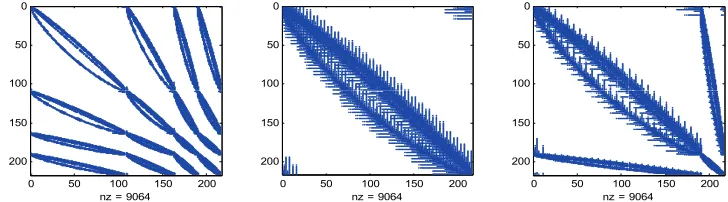
A. For a matrix that is smooth apart from the diagonal, the large entries form a finger pattern, as shown in left- side of Figure 2. This sparsity pattern is not convenient for preconditioning purposes, because of large amount of fill-in that occurs under LU factorisation. One way of avoiding the finger pattern is to permute the rows and columns of A so as to bring the detail coefficients into a diagonal band. The sparsity pattern of this DWTPer transform is shown in the centre of Figure 2. For a ma-trix A of order n n , the DWTPer would give
ˆ ˆ ˆT
A WAW . To relate ˆ to A Afrom a standard DWT or relate ˆ to W W, in [6], it is proved thatA RARˆ T, where
1 2 ...
T T T k
RP P P and each Pi is a permutation matrix as defined in (11).
3.2. Banded Wavelet Based Preconditioner
To solveAx b , using wavelet based preconditioner following algorithm is considered [5-8].
Algorithm 3.1:
1) Apply DWTPer to Ax b to obtain ˆAuz 2) Select a suitable band form ˆMof Aˆ(Theorem 3.1) 3) Use Mˆ as a preconditioner to solve ˆAuz itera-tively.
4) Apply Inverse Wavelet Transform on u to get re-quired solution.
The strategy that we take in preconditioning step is split the given matrixA P Q , where P is a Band
,
for some , . Band
,
means a matrix whose lower bandwidth is
and upper bandwidth is . First apply DWTPer with k levels to give
ˆ ˆ ˆ
Au P Q u z.
Here Pˆ is at most of Band
1, 2
, 1, 2 are first given by Chen [6] and further tightened by Ford [7], which are given in the following Theorem. Select a ma-trix Mˆ as preconditioner of Band
1, 1
part of the matrixAˆ such that11 and 12.Theorem 3.1: When an orderD, level k DWTPer is applied to a band matrix A with lower bandwidth and upper bandwidth , the resulting Aˆ which is at most a Band
1, 2
matrix with
11 2 1 2 1 2 .
k k
D
By using Algorithm 3.1, Kumar and Mehra [8] devel-oped wavelet based preconditioners for Krylov subspace iterative methods for ill conditioned sparse matrices and shown that these preconditioners are more effective compared with that of classical preconditioners by ap-plying them to several test matrices. Performance of Al-gorithm 3.1 depends on the level of wavelet transform used, which must be decided in advance by user. The following impulsive results due to Ford [7] overcome this limitation. In Subsection 3.3 it is briefly summarised.
3.3. Border Block Preconditioner
[image:4.595.312.535.498.553.2]After applying k level of DWT to matrixA, detail coefficients in A are brought to make diagonal band by
Figure 1. Two-dimensional wavelet transform: iteration on the LL subbands (average coefficients).
0 50 100 150 200
0 50 100 150 200
nz = 9064
0 50 100 150 200
0 50 100 150 200
nz = 9064
0 50 100 150 200
0 50 100 150 200
nz = 9064
[image:4.595.113.477.600.701.2]permutation matrices (thus obtained is Aˆ ). Now per-mute the rows and columns so that average coefficients in Aˆ are confined within bands of width n/ 2k
, at
the bottom (horizontal) and to the right-hand (vertical) edges of ˆA. Then preconditioner is constructed by set-ting to zero all entries that fall outside the diagonal band and these two edge bands (right side of Figure 2). This modification is termed as DWTPerMod [7].
Once we determine the diagonal bandwidth (using Theorem 3.1), we can estimate the cost of applying the factorised block preconditioner by forward and backward substitution, based on widths of diagonal, horizontal and vertical bands. The cost of forward and backward sub-stitution is proportional to the number N kz
of non-zero entries in LU factors of .P Hence we choosek
such that N kz
is minimum. A matrix of size n with borders of widthr
and a diagonal band with lower and upper bandwidth p can be factored into LU factors such that N kz
n
3p2r
[14]. We summarise our new preconditioning method as Algo-rithm 3.2.Algorithm 3.2 (DWTPerMod Preconditioner). Given a sparse matrix A of size
n
and a DWT of orderD, compute DWTPerMod preconditioner as follows:1) for 1 2
1, 2,..., logn D
i , compute
p i using Theorem 3.1,
2ir i n , N iz
n p i
3
2r i
.2) Choose k such thatN kz
mini
N iz
. 3) Apply a level k DWTPer to A to obtainAˆ. 4) Permute the rows and columns of ˆA so that the average coefficients lie in bands at the bottom and right hand edges.5) Form a border block preocnditioner M by setting to zero entries inAˆ outside of diagonal band of width
1
p k p k and borders of width r k1
r k
.In the above Algorithm 3.2,
x
: roundsx
to the nearest integer towards minus infinity. For simplicity we took the upper and lower bandwidths equal
. However, this preconditioning strategy is equally appli-cable when bandwidths are different [7].4. Numerical Experiments
To test the robustness of above explained wavelet based preconditioners, we have considered various problems given in Table 1. The right hand side of linear system was computed from the solution vector
x
of all ones. This choice is suggested by Zlatev [15]. We have im-plemented the proposed algorithms using Matlab-7.5 and Mathematica-7. The initial guess is always x00 andstopping criteria is relative residual is less than or equal
to 106 (i.e., 6
2 210
b Ax b ) and the Krylov
Sub-space iterative Method adapted is GMRES (25) [3]. In Table1 n nnz, and k A
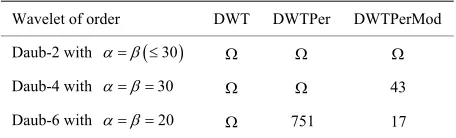
represent the size, number of nonzero entries and condition number of the corre-sponding matrixA. The symbol stands for slow convergence/no convergence in the tables and numbers in the table represent number of iterations required for convergence. Last column of Table 1 isobtainedwithout using preconditioner for GMRES (25). Daubechies wavelets of order two, four and six are considered in our numerical experiments as preconditioners for GMRES (25). Tables 2-4 are obtained for 5. Table5 is obtained for various values of and . [image:5.595.308.538.433.560.2]By applying Algorithm 3.2, we can easily fix the level of transform for a matrix of given size and prescribed Daubechies wavelet in developing wavelet based pre-conditioners for Krylov subspace iterative methods. To illustrate further salient features of DWTPerMod based preconditioner the computed details are shown in Table 5 for Gre__512 matrix. It is of interest to note that DWT based preconditioner fail to yield convergence with Daubechies wavelet of order two, four and six, where as DWTPerMod based preconditioner with Daub-4 and Daub-6 result into faster convergence of iterative sche- mes.
Table 1. Sparse unsymmetric matrices from Tim Davis collection [1].
Matrix Name Size n nnz k A P I
Bcsstk02 66 66 4356 1.2900 10 4 165
Gre_216a 216 216 812 3.0499 10 2
Qc324 324 324 26730 7.3835 10 4
Ck400 400 400 2860 2.1654 10 6
Gre__512 512 512 1976 3.8479 10 2
Epb0 1794 1794 7764 1.4719 10 5
[image:5.595.308.537.603.711.2]Dw8192 8192 8192 41746 1.5001 10 7
Table 2. Convergence details using Daub-2 based precondi-tioners.
Matrix Name DWT DWTPer DWTPerMod
Bcsstk02 93 91 29
Gre_216a 267
Qc324 12 11
Ck400 172 22 23
Epb0 1042 1247
Table 3. Convergence details using Daub-4 based precondi-tioners.
Matrix Name DWT DWTPer DWTPerMod
Bcsstk02 113 67 16
Gre_216a 71 21
Qc324 15 15
Ck400 443 64 51
Epb0 684 214
[image:6.595.58.284.259.359.2]Dw8192 23 25
Table 4. Convergence details using Daub-6 based precondi-tioners.
Matrix Name DWT DWTPer DWTPerMod
Bcsstk02 66 24 16
Gre_216a 765 65
Qc324 394 16 17
Ck400 69 119
Epb0 712 194
Dw8192 36 50
Table 5. Convergence details using various orders of wave-let based preconditioners for Gre__512 matrix.
Wavelet of order DWT DWTPer DWTPerMod
Daub-2 with 30
Daub-4 with 30 43
Daub-6 with 20 751 17
5.
Conclusions and Future Work
DWTPerMod algorithm improves on other precondition-ers providing 1) tighter bounds on the bandwidth for DWTPer band preconditioning, resulting into precondi-tioning to be done at lower cost; 2) it removes uncer-tainty about choosing an appropriate bandwidth, wavelet level and results into more robust scheme.
Convergence details are presented in Tables 2-5. It is remarkable to observe the rapid convergence of GMRES (25) with preconditioners designed using DWTPerMod compared with other schemes. Preconditioners devel-oped here can also be used for other Krylov subspace iterative methods and no user intervention is required to choose an appropriate transform level for each example. This is a significant advancement towards the develop-ment of purely algebraic wavelet based preconditioning strategy for sparse matrices.
We are developing non orthogonal [16,17] wavelet
based preconditioners and compare their efficiency with the existing Daubechies orthogonal wavelet based pre-conditioners for various matrices.
6. Acknowledgements
This research work is supported by DST (SR/S4/MS: 281/05). N. M. Bujurke acknowledges the financial sup-port of INSA, New Delhi.
7. References
[1] T. A. Davis, “University of Florida Sparse Matrix Collec-tion,” NA Digest, Vol. 97, No. 23, 1997, p. 7. http://www. cise.ufl.edu/research/sparse/matrices/
[2] J. M. Ford, “A Black Box at the End of the Rainbow: Searching for the Perfect Preconditioner,” Philosophical Transactions of Royal Society London A, Vol. 361, No. 1813, 2003, pp. 2665-2680.
[3] Y. Saad, “Iterative Methods for Sparse Linear Systems,” SIAM, Philadelphia, 2003.
[4] M. Benzi, “Preconditioning Techniques for Large Linear Systems: A Survey,” Journal of Computational Physics, Vol. 182, No. 2, 1 November 2002, pp. 418-477.
[5] K. Chen, “Matrix Preconditioning Techniques and Ap-plications,” Cambridge University Press, Cambridge, 2005.
[6] K. Chen, “Discrete Wavelet Transforms Accelerated Sparse Preconditioners for Dense Boundary Element Systems,” Electronic Transactions on Numerical Analy-sis, Vol. 8, 1999, pp. 138-153. http://etna.mcs.kent.edu/ vol.8.1999/pp138-153.dir/pp138-153.pdf
[7] J. M. Ford, “An Improved Discrete Wavelet Transform Preconditioner for Dense Matrix Problems,” SIAM Jour-nal on Matrix AJour-nalysis and Applications, Vol. 25, No. 3, 2003, pp. 642-661.
[8] B. V. R. Kumar and M. Mehra, “Wavelet-Based Precon-ditioners for Sparse Linear Systems,” Applied Mathemat-ics and Computation, Vol.171, No. 1, 1 December 2005, pp. 203-224.
[9] D. F. Walnut, “An Introduction to Wavelet Analysis,” Birkhauser,Boston–Basel–Berlin, 2002.
[10] S. Mallat, “A Wavelet Tour of Signal Processing,” Aca-demic Press, Elsevier, California, 1999.
[11] G. Strang and T. Nguyen, “Wavelets and Filter Banks,” Wellesley-Cambridge Press, Wellesley, 1997.
[12] I. Daubechies, “Ten Lectures on Wavelets,” SIAM, Philadelphia, 1992.
[13] G. Uytterhoeven, “Wavelets: Software and Applications,” Ph.D. Dissertation, Katholieke Universiteit Leuven, Bel-gium, 1999.
[image:6.595.58.286.401.470.2]Matrices,” Kluwer, Dordrecht, the Netherlands, 1991. [16] A. Cohen, I. Daubechies and J. C. Feauveau,
“Bior-thogonal Bases of Compactly Supported Wavelets,”
Communications on Pure and Applied Mathematics, Vol. 45, No. 5, June 1992, pp. 485-560.
![Table 1. Sparse unsymmetric matrices from Tim Davis collection [1].](https://thumb-us.123doks.com/thumbv2/123dok_us/8991059.395940/5.595.308.538.433.560/table-sparse-unsymmetric-matrices-from-tim-davis-collection.webp)