doi:10.4236/ajor.2011.12007 Published Online June 2011 (http://www.SciRP.org/journal/ajor)
Optimal Policy and Simple Algorithm for a Deteriorated
Multi-Item EOQ Problem
Bin Zhang, Xiayang Wang
Lingnan College, Sun Yat-Sen University, Guangzhou, China E-mail: bzhang3@mail.ustc.edu.cn, [email protected] Received March 29, 2011; revised April 19, 2011; accepted May 12, 2011
Abstract
This paper considers a deteriorated multi-item economic order quantity (EOQ) problem, which has been stu-died in literature, but the algorithms used in the literature are limited. In this paper, we explore the optimal policy of this inventory problem by analyzing the structural properties of the model, and introduce a simple algorithm for solving the optimal solution to this problem. Numerical results are reported to show the effi-ciency of the proposed method.
Keywords: Inventory, EOQ, Deterioration, Multi-Item
1. Introduction
Multi-item inventory problem with resource constraints is an important topic of inventory management [1]. These constrained inventory models are still hot topics in aca-demic and practice fields, for example, see [2-6]. The re- source constraints typically arise from shipment capacity, warehouse capacity or budgetary limitation. Since some items such as fruits, vegetables, food items, drugs and fashion goods will deteriorate in the shipment or storage process, many works have been done for investigating inventory problems for deterioration items [7-11]. Since items’ deterioration often takes place during the storage period, some researchers have considered economic order quantity (EOQ) models for deteriorating items, for exam-ples see [12,13].
Recently, Mandal et al. [14] present a constrained
multi-item EOQ model with deteriorated items. In [14], the model is firstly formulated as the transcendental form
and the polynomial form, i.e., without and with
trunca-tion on the deterioratrunca-tion terms. These two versions of the model are both solved by applying non-linear program-ming (NLP) method (Lagrangian multiplier method). As [14] points out, the polynomial form is an approximation of the transcendental form. Secondly, the transcendental form is converted to the minimization of a signomial expression with a posynomial constraint, which is solved by applying a modified geometric programming (MGP) method. However, we argue that the studied problem can be solved using a simple algorithm without any model
approximation or conversion.
In this paper, we prove that the deteriorated multi-item EOQ model is a special convex separable nonlinear knapsack problem studied in [15], which is characterized by positive marginal cost (PMC) and increasing marginal loss-cost ratio (IMLCR). PMC requires positive marginal cost of decision variable, and IMLCR means that the marginal loss-cost ratio is increasing in decision variable. Following [15], we explore the optimal policy for the problem, and develop a simple algorithm for solving it. The main purpose of this paper is twofold: 1) to explore the optimal policy of this inventory problem by analyz-ing the structural properties of the model; 2) to introduce a simple algorithm for solving the optimal solution to this problem.
The reminder of this paper is organized as follows. We formulate the problem in the next section. In Section 3, we explore the structural properties of the problem, and provide the optimal policy and algorithm. Numerical results are reported in Section 4, and Section 5 briefly concludes this paper.
2. Problem Formulation
Consider a multi-item EOQ problem with a storage space
constraint, in which all items (i1,,n) deteriorate
after certain periods.
n = Total number of items
Qi= Order quantity
c0i= Purchasing cost
c1i= Holding cost per unit quantity per unit time
c3i= Set-up cost
i
= Constant rate of deterioration (0 i 1)
wi= Required storage quantity per unit time
Di= Demand rate per unit time
Ti= Time period of each cycle
1
( , , n)
TC T T = Total average cost function
W = Available storage space
Following [14], we set aic D0i i ic D1i i i2c3i ,
2
0 1 0
i i i i i i i
b c D c D , and cic D1i i i . Then the
deteriorated multi-item EOQ model can be expressed as
follows (denoted as problem P). We refer the reader to
[14] for the details of this model.
1
1 1
min ( , , )
( ) i i n T n n i
i i i i
i i i i
TC T T
a e
f T b c
T T
, (1)
subject to
1 1
( ) ( ( i i 1))
n n
T i i i i i i i
D
g T w e W
, (2)0
i
T , i1,,n. (3)
The order quantity is given by i( i iT 1)
i i
D
Q e
,
1, ,
i n. The first and second order derivatives of
( )
i i
f T ,i1,,n, and the first order derivative of
( )
i i
g T ,i1,,n, are calculated as follows:
2
( ) i iT( 1 )
i i i i i i
i i
df T a b e T
dT T
, (4)
2 2 2
2 3
( ) 2 i iT(2 2 )
i i i i i i i i
i i
d f T a b e T T
dT T
, (5)
( )
i iT
i i i i i
dg T
D w e dT
. (6)
3. Structural Properties and Algorithm
In this section, we first establish structural properties of
problem P, and then we present an efficient procedure for
solving the optimal solution to problem P.
3.1. Structural Properties
Before presenting the structural properties of problem P,
we give two basic equations, which will be used in our proofs. Since Taylor expansion of exponential function is
1 1
!
i i
k k T i i
k T e k
, then we have2 2
1 1 2 i iT
i iT i iT iTi e
, (7)
for Ti0, i1,,n.
By comparing the definitions of ai and bi, we have
i i
a b, i1,,n. (8)
Considering the objective function of problem P, we
have the following proposition.
Proposition 1. The cost TC T( ,1,Tn) is strictly convex.
Proof. Since the function TC T( ,1 ,Tn) is separable,
we only need to prove that f Ti( )i is strictly convex in
i
T, i1,,n. According to Equations (7) and (8), we
have.
2 2
2 2 2 2 4 4
2 (2 2 )
2 2 1 1
2 2 2
i iT
i i i i i i
i i i i i i i i i i i i i
a b e T T
T T b T
b b T T
.
Substituting the above equation into Equation (5), we have.
2 4 4 4
2 2 3 2 0
i i i i i i i i i i
d f T b T b T
dT T
for Ti0.
Thus, f Ti( )i and
1
( , , n)
TC T T are strictly convex.
QED.
The strictly convexity of TC T( ,1,Tn) ensures that
the optimal solution to problem P is unique. This
prop-erty has also been indicated in [14] by using a more complicated proof procedure.
Denote ProductLog( )z as the principal solution for x
in zxex, which has the same function name in
Ma-thematica to stand for the Lambert W function. Let Tˆi,
1, ,
i n, be a value such that df Ti( )i dTi0. Denote
problem CP as problem P without the constraint in
Equa-tion (2), then the following proposiEqua-tion characterizes the optimal solution to problem CP.
Proposition 2.The optimal solution to problem CP is 1 ProductLog ˆ i i i i i a b e T
, i1,,n. (9)
Proof. Since df Ti( )i dTi0 at the point ˆ
i
T, we have
ˆ ˆ
( 1 ) 0
i iT
i i i i
a b e T . This equation can be rewritten
as i i iTˆ 1( ˆ 1)
i i i a e T b e
, and hence we have
1 ProductLog ˆ i i i i i a b e T .
From Equation (8), we know 1 i
i i i
a
e b e
to [16], we know that ProductLog( )z is an increasing
function for 1
i
z e
, then we have ProductLog( i )
i i
a b e
1
ProductLog( ) 1
i
e
. Substituting this equation into
ˆ
i
T, we have hence Tˆi0, which satisfies the positive
constraint in Equation (3). Thus, ˆ
i
T, 1,i ,n, is an
optimal solution to problem CP. Since the optimal solu-tion is unique, we know that the optimal solusolu-tion to
problem CP is Tˆi, 1,i ,n.
QED. Following [15], we define the marginal loss-cost ratio
of item i(i1,,n) as.
2 ( ) ( ) ( ) i i i i T
i i i i i i i i
i i i i i i
df T
dT a e b T b
r T
dg T D w T
dT
. (10)
Then we have the following proposition.
Proposition 3. r Ti( )i is strictly increasing in
ˆ (0, ]
i i
T T , i1,,n.
Proof. From Equation (7), we know 1 i iT
i iT e
for
0.
i
T The convexity of f Ti( )i guarantees i iT
i i
a b e
( 1 i iT)0 for Ti(0, ]Tˆi . Using ai bi in
Equa-tion (8) and the above two equaEqua-tions, we have
( 2 ) (2 )
[ ( 1 )] [ (1 ) ]
[ ( 1 )] [(1 ) ] 0
i i
i i i i
i i i i
T
i i i i i i
T T
i i i i i i i i
T T
i i i i i i i
b e T a T
a b e T a T b e
a b e T b T e
,
for Ti(0, ]Tˆi . Hence we have
3
( ) [ ( 2 ) (2 )]
0 i iT i iT
i i i i i i i i
i i
dr T e b e T a T
dT DT w
.
Thus, r Ti( )i is strictly increasing in Ti(0, ]Tˆi ,
1, ,
i n.
QED
Since this proposition illustrates that r Ti( )i is strictly
increasing in Ti(0, ]Tˆi , i1,,n, we let ( )T ri i ,
( , 0]
i
r , be the inverse function of r Ti( )i . Although
it is difficult to write T ri( )i in a closed form, the strict
monotony of ( )T ri i ensures that T ri( )i can be easily
determined by applying a bi-section search procedure
over Ti(0, ]Tˆi , for any given ( , 0]
i
r .
3.2. Optimal Policy and Algorithm
We now demonstrate that the deteriorated multi-item EOQ model is a special convex separable nonlinear knapsack problem studied in [15]. Firstly, Proposition 1
illustrates that P is a convex problem; Secondly, from
Equation (6), we know i( )i 0
i dg T
dT , for Ti0,i1,,n,
which means there are positive marginal costs in problem P;
Finally, Proposition 3 ensures that the marginal loss-cost
ratio r Ti( )i is increasing in Ti(0, ]Tˆi , 1,i ,n .
Therefore, the theoretical results and solution procedure
proposed in [15] are both applicable for problem P.
Denote by Ti*, i1,,n, the optimal solution to
problem P. By directly applying the theoretical results in
[15], we can summarize the optimal policy for the dete-riorated multi-item EOQ problem in the following pro- position.
Proposition 4.The optimal policy of problem P is (a)
* ˆ
i i
T T , i1,,n, if 1 ˆ ( ) n i i i
g T W
; (b) *1 ( )
n i i i
g T W
and r Ti( i*)r Tk( k*), i k, 1, ,n, specify the optimal
solution *
i
T , i1,,n, if 1 ˆ ( ) n i i i
g T W
.This proposition is obtained by directly applying the
theoretical results in [15] to problem P, since problem P
has PMC and IMLCR. Based on Propositions 2-4, the idea of the algorithm proposed in [15] can be used for
solving problem P. The basic idea of the algorithm is as
follows: If the constraint in Equation (2) is inactive, i.e.,
1 ˆ ( ) n i i i
g T W
, then the optimal solution to problem P
equals to the optimal solution to the unconstrained
prob-lem, i.e., Ti*Tˆi, i1,,n; Otherwise, Proposition 4(b)
means that obtaining the exact value of r*r Ti( i*)r Tk( k*),
, 1, ,
i k n, is the key to solving the optimal solution to
problem P. The optimal value r* can be searched by
applying a binary search method over the interval
( , 0]
r M , where M is a sufficient large value such
that ( )
1
( ( i i 1))
n T M i i i i D
w e W
.Main steps of the above solution procedure for solving
the optimal solution to problem P are summarized in the
following algorithm.
The Algorithm
1 *
ˆ
1: Solve , 1, , , from Equation (9);
ˆ
2: If ( ) , then
ˆ
let , 1, , , go to 8;
3: Let , 0;
4: Let ( ) 2;
5: Calculate i n i i i i i L U L U i i
Step T i n
Step g T W
T T i n Step
Step r M r
Step r r r
Step T T
1 1( ), 1, , ;
6: If ( ) , then let ;
If ( ) , then let ;
n
i i L
i n
i i U
i
r i n
Step g T W r r
g T W r r
*
* *
Go to 4;
7: Let , 1, , ;
8: Calculate ( , , ), and output
.
i i
i n
Step
Step T T i n
Step TC T T
In comparison with the two methods in [14], there are two main advantages of our algorithm: 1) It is a
polyno-mial algorithm of O(n) order, which ensures that the
al-gorithm is applicable for large-scale problems; 2) It does not need any approximation or conversion of the original model, thus it always solves the optimal solution to
prob-lem P.
4. Numerical Results
In this section, numerical experiments are provided to show the efficiency of the proposed algorithm for
solv-ing problem P. The instances of problem P are all
ran-domly generated. We use the notation x ~ U( , ) to
denote that x is uniformly generated over [ , ] . The
parameters of test instances are generated as follows:
i
w ~ U(1,10), c0i~ U(1,10), c1i~ U(0.5,1.0), c3i ~
(40,100)
U , i ~ U(0.01, 0.10) , Di ~ U(200,500) ,
1, ,
i n, and W 100n.
In this numerical study, we set n=100 and 1000,
re-spectively. For each problem size n, 100 test instances
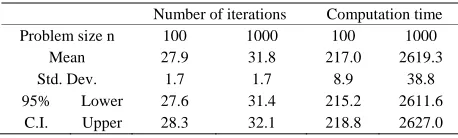
are randomly generated. The statistical results on number of iterations of the binary search and computation time
(in milliseconds) are reported in Table 1, where 95% C.I.
stands for 95% confidence interval.
From Table 1, we can conclude that the proposed
al-gorithm can solve large-scale deteriorated multi-item EOQ models very quickly in few iteration times. Since the ranges of parameters are large, the standard devia-tions of number of iteradevia-tions and computation time are quite low, reflecting the fact that the algorithm is quite effective and robust.
We also use our algorithm to solve the illustrative exam-ple studied in [14], which outputs the optimal solution:
*
1 0.2899
T , *
2 0.2176
T , *
1 102.6397
Q , *
2 98.6801
Q ,
*
2587.1382
TC with *
= 0.5925
r . Unfortunately, this
result cannot be directly compared with that solved by [14],
because there is something wrong with the values of Ti*
and *
i
Q , i1, 2, shown in Tables 2 and 3 of [14], since
[image:4.595.56.285.651.720.2]they violate the basic equation
Table 1. Performance of our algorithm for solving the ran-domly generated instances.
Number of iterations
Comtime
Problem size n
100 1000 100 1000
Mean
27.9 31.8 217.0 2619.3
Std. Dev.
1.7 1.7 8.9 38.8
95%
Lower 31.427.6 215.2 2611.6
C.I.
Upper 32.128.3 218.8 2627.0
( i iT 1) i i
i
D
Q e
, i1, 2. For example, in the Table 2 of [14],
when *
1 0.2414712
T and *
2 0.2419020
T , i i( i iT 1)
i D
Q e
gives Q185.3365, Q2109.7828. In addition, their
mistake can also be verified by our proved optimal
pol-icy * * * *
1( 1) 2( 2)
r T r T . For example, the values of *( *)
i i
r T ,
1, 2
i for the MGP solution presented in Table 3 of
[14] are * *
1( 1) 0.6017
r T , and * *
2(1) 0.5857
r T , which
does not satisfy * * * *
1( 1) 2( 2)
r T r T .
From the above analysis, we illustrate that the solution provided in [14] does not satisfy the optimal policy proved in this paper, which is easily used to verify the
optimality of a solution to problem P. Thus, the
numeri-cal results in [14] are incorrect. Since some comparison of NLP and MGP given by [14] were established based
on the numerical results, especially the results in Tables
2 and 3 of [14], we argue that the comparison of NLP
and MCP in [14] are questionable.
5. Conclusions
In this paper, we explore the structural properties of de-teriorated multi-item EOQ model and propose a simple algorithm for solving the optimal solution by proving that the studied problem is a special convex separable nonlinear knapsack problem. In addition, it is obvious that the basic idea and obtained results in this paper can be simply modified for solving the classical constrained multi-item EOQ problem.
6. Acknowledgements
The authors would like to thank the two reviewers for their insightful comments, which helped to improve the manuscript. This work is supported by national Natural Science Foundation of China (No. 70801065), the Fun-damental Research Funds for the Central Universities of China and Natural Science Foundation of Guangdong Province, China (No. 10451027501005059).
7. References
[1] G. Hadley and T. M. Whitin, “Analysis of Inventory Systems,” Prentice-Hall, Englewood Cliffs, 1963. [2] B. Zhang, X. Xu and Z. Hua, “A Binary Solution Method
for the Multi-Product Newsboy Problem with Budget Constraint,” International Journal of Production Eco-nomics, Vol. 117, No. 1, 2009, pp. 136-141.
[3] S. Sharma, “Revisiting the Shelf Life Constrained Multi- Product Manufacturing Problem,” European Journal of
Operational Research, Vol. 193, No. 1, 2009, pp.
129-139.
Prob-lem with Limited Capacity and Outsourcing,” European
Journal of Operational Research, Vol. 202, No. 1, 2010,
pp. 107-113.
[5] B. Zhang, “Optimal Policy for a Mixed Production Sys-tem with Multiple OEM and OBM Products,” Interna-tional Journal of Production Economics, Vol. 130, No. 1,
2011, pp. 27-32.
[6] B. Zhang and Z. S. Hua, “A Portfolio Approach to Mul-ti-Product Newsboy Problem with Budget Constraint,”
Computers & Industrial Engineering, Vol. 58, No. 4,
2010, pp. 759-765.
[7] F. Raafat, “Survey of Literature on Continuously on De-teriorating Inventory Model,” Journal of Operational Research Society, Vol. 42, No. 1, 1991, pp. 27-37. [8] T. K. Roy and M. Maiti, “Multi-Objective Models of
Deteriorating Items with Some Constraints in a Fuzzy Environment,” Computers and Operations Research, Vol. 25, No. 12, 1998, pp. 1085-1095.
[9] K. Goyal and B. C. Giri, “Recent Trends in Modeling of Deteriorating Inventory,” European Journal of Opera-tional Research, Vol. 134, No. 1, 2001. pp. 1-16.
[10] J. W. Ohlmann and J. C. Bean, “Resource-Constrained Management of Heterogeneous Assets with Stochastic Deterioration,” European Journal of Operational Re-search, Vol. 199, No. 1, 2009, pp. 198-208.
[11] Y. He, S. Y. Wang and K. K. Lai, “An Optimal Produc-tion-Inventory Model for Deteriorating Items with Multi-ple-Market Demand,” European Journal of Operational Research, Vol. 203, No. 3, 2010, pp. 593-600.
[12] M. Cheng and G. Wang, “A Note on the Inventory Model for Deteriorating Items with Trapezoidal Type Demand Rate,” Computers & Industrial Engineering, Vol. 56, No.
4, 2009, pp. 1296-1300.
[13] J. Li, T. C. E. Cheng and S. Wang, “Analysis of Post-ponement Strategy for Perishable Items by EOQ-Based Models,” International Journal of Production Economics, Vol. 107, No. 1, 2007, pp. 31-38.
[14] N. K. Mandal, T. K. Roy and M. Maiti, “Inventory Model Of Deteriorated Items with a Constraint: A Geometric Programming Approach,” European Journal of Opera-tional Research, Vol. 173, No. 1, 2006, pp. 199-210.
[15] B. Zhang and Z. Hua,“A Unified Method for a Class of Convex Separable Nonlinear Knapsack Problems,”
Euro-pean Journal of Operational Research, Vol. 191, No. 1,
2008, pp. 1-6.doi:10.1016/j.ejor.2007.07.005
[16] R. M. Corless, G. H. Gonnet, D. E. G. Hare, D. J. Jeffrey and D. E. Knuth, “On the Lambert W Function,”
Ad-vances in Computational Mathematics, Vol. 5, No. 1,