THE EVALUATION OF AN UNDERGRADUATE
*Aminah Alatas
Universitas Negeri Jakarta, Rawamangun, Jakarta, Indonesia
ARTICLE INFO ABSTRACT
This aimof this study was to evaluate STIKes KESOSI ( Sosial Indonesia)
The study used
component at the end of the evaluation model. The study
collected through documentation analysis, interviews, questionnaires, field notes, and observations. The study found that the health institution under study has relevanc to society and
needs. Th
especially in the context of the input of students, lecturers and staff, management and curriculum. It is also relevant to the regulations in order to improve students’
component concern
competences of patient and health clinic government hospitals. The
needs by
Copyright©2019, Aminah Alatas et al. This is an open access distribution, and reproduction in any medium, provided
INTRODUCTION
Development in the health sector must always be accompanied by the effective development ofa staff
programthat pays attention to national and international requirements. Therefore, nursing service development cannot be separated from nursing professional education. Nursing education aims to produce qualified nurses who
undertaking the science of nursing as well as conducting public services. Institutions are required to systemically develop aspects of ideology (Vision and Mission) and operational development that reflect growth, change and reform
meet the demands of hospitals that must provide accurate, affordable and efficient patient services. the design of high quality health education
internal and external quality assurance committee needs to periodically evaluate programs (Farahani and
Therefore, this research focused on evaluating the program at STIKes KESOSIso that it successfully produce
graduates according to the criteria above. have positive effects on patients, especially those
illness (Dewar et al., 2014; Dewar and Nolan, 2013; Schantz, 2007). Developing nurses’ compassion can be linked they provide responsive action to relieve patients
(Cameron et al., 2013; Dewar and Cook, 2014; Schantz, 2007;
ISSN: 0975-833X
Article History:
Received 26th April, 2019
Received in revised form
19th May, 2019
Accepted 24th June, 2019
Published online 25th July, 2019
Citation: Aminah Alatas, Achmad Ridwan and Yetty Supriyati
International Journal of Current Research, 11, (07), 5296 Available
Key Words:
Antifungal activity, Endophyte, dual culture, Inhibition zone.
*Corresponding author:
RESEARCH ARTICLE
UNDERGRADUATE NURSING PROGRAM USING A
APPROACH
Aminah Alatas, Achmad Ridwan and Yetty Supriyati
Negeri Jakarta, Rawamangun, Jakarta, Indonesia
ABSTRACT
This aimof this study was to evaluate STIKes KESOSI (Sekolah Tinggi Kesehatan Kesetiakawanan Sosial Indonesia) as a nursing college in Jakarta that trains students to
study used a CIPPO (Context, Input, Process, Product) approach that added outcomes (o) component at the end of the evaluation model. The study used a
collected through documentation analysis, interviews, questionnaires, field notes, and observations. study found that the health institution under study has relevanc to society and
needs. The findings showed that the institution’s context is relevant to government regulations, especially in the context of the input of students, lecturers and staff, management and curriculum. It is also relevant to the regulations in order to improve students’‘soft skill
component of the study showed that students’became more empathetic and and showed greater concern for other people. The out come component showedthat
competences of patient and health clinic, or industry through the feedback from private and government hospitals. The study concluded that STIKes KESOSI engaged with patient and hospital needs by successfully developing professional nurses.
access article distributed under the Creative Commons Attribution the original work is properly cited.
Development in the health sector must always be accompanied a staff health education attention to national and international requirements. Therefore, nursing service development cannot ng professional education. Nursing education aims to produce qualified nurses who are capableof the science of nursing as well as conducting public systemically develop the Mission) and operational development that reflect growth, change and reform in order to meet the demands of hospitals that must provide quick, services. To ensure health education programs, the internal and external quality assurance committee needs to and Ahmadi, 2006). Therefore, this research focused on evaluating the program at produces qualified Compassion can those with chronic illness (Dewar et al., 2014; Dewar and Nolan, 2013; Schantz, 2007). Developing nurses’ compassion can be linked to how sive action to relieve patients’ suffering (Cameron et al., 2013; Dewar and Cook, 2014; Schantz, 2007;
Von Dietze and Orb, 2000). respect, empathy, and critical self patients without providinga differen
(Hook, 2014). A robust notion of respect for self and others requires the following: intentional development of self awareness, a capacity for empathy and perspective taking, active and mindful listening, skills of inquiry, and an et foundation that illuminates various dimensions of respect for similarities and differences (Sandell
have an important role to play increeating
care system (Bartels, 2005). They should apply their knowledge and skills, prove their commitment and social values to society (Chitty and Black 2010). The most important attribute of professional nurses is their attitude. Their action is consists with their cognitive and emotional elements (Taylor et al., 2003). Having official authority, self
support from other nurses can affect and develop th professionalism and ability of
professionalism is affect by scientific and research improvements in nursing, ethics and spiritual
acquisition of power and development such as capacity building, professional ethics and commitment, resources, the increase of social structure status,
in knowledge and nursing skills (Ravanipur et al.,
International Journal of Current Research Vol. 11, Issue, 07, pp.5296-5303, July, 2019
DOI: https://doi.org/10.24941/ijcr.35908.07.2019
Yetty Supriyati. 2019.“The evaluation of an undergraduate nursing program using a cippo model approach 5296-5303.
Available online at http://www.journalcra.com
USING A CIPPO MODEL
Yetty Supriyati
Negeri Jakarta, Rawamangun, Jakarta, Indonesia
Sekolah Tinggi Kesehatan Kesetiakawanan students to graduate asprofessional nurses. CIPPO (Context, Input, Process, Product) approach that added outcomes (o) used a qualitative methodology with data collected through documentation analysis, interviews, questionnaires, field notes, and observations. study found that the health institution under study has relevanc to society and to health industry relevant to government regulations, especially in the context of the input of students, lecturers and staff, management and curriculum. It is soft skills’ and ‘hard skills’.The process more empathetic and and showed greater that the graduates fulfill the required or industry through the feedback from private and STIKes KESOSI engaged with patient and hospital
License, which permits unrestricted use,
Von Dietze and Orb, 2000). A nurse should develop their respect, empathy, and critical self-reflection toward the different type of care service (Hook, 2014). A robust notion of respect for self and others requires the following: intentional development of
self-capacity for empathy and perspective taking, active and mindful listening, skills of inquiry, and an ethical foundation that illuminates various dimensions of respect for similarities and differences (Sandell and Tupy, 2015). Nurses play increeating an effective health care system (Bartels, 2005). They should apply their and skills, prove their commitment and social Black 2010). The most important of professional nurses is their attitude. Their action is their cognitive and emotional elements (Taylor et ng official authority, self-confidence, and support from other nurses can affect and develop the of nurses (Bartels, 2005). Nurse affect by scientific and research in nursing, ethics and spirituality in nursing, the acquisition of power and development such as capacity building, professional ethics and commitment, resources, the increase of social structure status, and the frequency of training in knowledge and nursing skills (Ravanipur et al., 2014).
INTERNATIONAL JOURNAL OF CURRENT RESEARCH
The nursing field has significant obstacles such as weakness in scientific knowledge and autonomy that hinder the adoption of professional identity, and hence the successful performance of professional roles related to it. In the process of the developing the nurse professional, various social, political, cultural, scientific, and technological factors create these obstacles which may impede the professional development of nurses and their professional behaviors (Wynd, 2003). Nurses need to think critically, self-critique, synthesise information, link concepts and become self-directed, reflective, life-long learners (Facione, 2006:10; Potgieter, 2012:5). This study uses a CIPPO approachto evaluate the program. The Stufflebeam CIPP evaluation model is effective for both formative and summative assessments and for measuring decision making and problem solving ability (Hasan, et. al, 2015).The CIPP evaluation model is a comprehensive framework for evaluating programs, projects, products, institutions and systems (Stufflebeam, 2007).Evaluation in education aims to find meaning, to clarify and justify based on criteria, andto look for an objective value, quality, profit, and performance (Worthern, Sanders and Fitzpatrick, 1997; Middlewood and Burton, 2001). The goal of evaluation is to assess the educational quality of universities' programs including input, process, and output and to identify the weak and strong aspects of its programs in order to achieve educative goals and to improve quality (Fitzpatrick, Sanders, and Worthon, 2004; Ministry of Health, Treatment, And Medical Education, 2001; Mohamadzadeh, 2003; Yarmohammadian, 2004). Evaluation includes phases of selecting information, obtaining, analyzing, transferring, using and making a decision on the quality of the curriculum.
The components in this study are as follows; Context (Legality, Vision, Mission, Objectives, Existence of the Program), Input (Students, Educators/Lecturers, Curriculum, Facilities and Infrastructure,Management), Process(Lesson Plan, Learning Activities, Learning Assessment), 4. Products (Learning Outcomes, Practical Values, Thesis, Scientific Writing), 5. Outcomes (Graduates).The CIPP performs as a comprehensive framework for directing the evaluation of programs, projects, products, institutions and systems (Hakan and Seval, 2011). The component outcomes in this study aim to evaluate the graduates after they have learned in STIKes KESOSI; and how they contribute to society and the health institution.
MATERIALS AND METHODS
This study employed a qualitative approach to measure the value or benefits of implementing a program. Data wasderived from interviews, observations, field notes and documentation. Theresearch was carried out at STIKes KESOSI Health College in Jakarta. The object of the study was the management of nursing undergraduate study programs. This study used the CIPPO evaluation model derived from the CIPP model developed by Stufflebeam with and additional outcomes component (O). The model therefore consists of five evaluation components; context, input, process, product and outcomes. The data, collected by documents, interviews, observations and questionnaires,was divided into five components of this evaluation. Before the research instrument was used, the contents were first validated. Questionnaires were given to lecturers and other staff to measure the existence of programs, education services, the performance of STIKes KESOSI, parents participation and utilization of facilities at
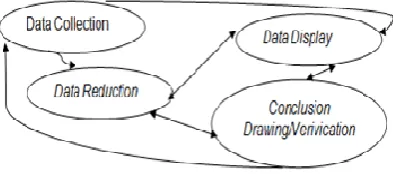
[image:2.595.336.533.134.221.2]the STIKes KESOSI Jakarta.The data was analyzed by the Miles and Huberman models which consist of three processes that occur simultaneously, namely: data reduction, data presentation, and conclusion / verification. The analysis of the data can be described as the figure belows:
Figure 1. Data Analysis
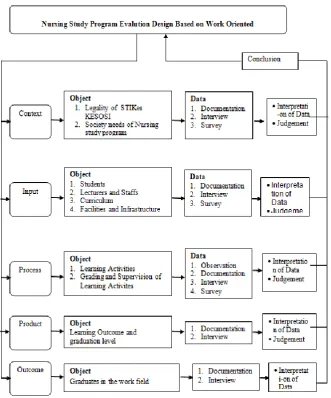
In order to meet demands the hospital must provide services to patients directly, quickly, accurately, by qualified staff at affordable costs. The design of this study can be seen on the Figure 2 below.
RESULTS AND DISCUSSION
Context: In this component, there are goals, objectives, history
and background of the institution (Stufflebeam, 2003). This study found that there was a match between government regulations in Indonesia regarding the guidelines of the implementation and management of higher education institutions with the regulations in STIKes KESOSI. Legal requirements are one of the factors that guarantee the continuity of the learning process to achieve the learning outcomes that have been established. STIKes KESOSI haschosen the right path in accordance with the existing regulatory bases.
The government regulations in this component are Indonesian Law no. 12 in 2012 concerning on higher education and Government Regulation no. 4 in 2014 chapter, section and article are in table below.
Meanwhile STIKes KESOSI already has
Recommendations of the Agency for Human Resource
Development and Empowerment of Health Professionals Republic of Indonesia No. HK.03.2.4.1.02673
Education Ministerial Decree No. 123/0/0/2004
concerning on the Granting of Permit for the Implementation of Study Programs and the Establishment of the Indonesian Institute of Health Sciences (STIKes KESOSI) in Jakarta
License extension for the Implementation of the Study
Program in the STIKES KESOSI: No. 4356 / D / T / 2006.
Higher Education: STIKes KESOSI (033167)
Study Program: Nursing (10105)
Program Level: Bachelor Degree
Figure 2. Research Design Evaluation of Bachelor Degree Program Management in Nursing -Work Oriented in STIKes KESOSI
Table 1. Constitution and Regulation
Constitution of the Republic of Indonesia Number 12 of 2012 Government Regulation 2014 (4)
Article 1 section 3, 6, 8, 9, 10, 11, 12, 13, 14, 15, 17, 18.
Article 13 section (1 to 6)
Article 14 section (1 to 3)
Article 15 section 1
Article 18 section (1 to 5)
Article 35 section (1 to 5)
Article 45 section (1 to 3)
Article 47 section (1 to 4)
Article 1 section 1, 2, 3, 4, 6, 9, 13, 14, 15, 16, 17, 19
Chapter 1;
Article 8 section 2, 3,
Article 13 section 1
Article 14 section 1
Article 15 section 1,2,3
Article 17 section 1,3,4,5
Chapter 3;
Article 22 section 1, 2, 3
Article 31 section 1 & 2
Table 2. Students’ Registration
Year Registered Accepted Average
2016 40 34 7,07
2017 61 56 6,98
2018 78 70 7,09
Table 3. Curriculum
Courses Credits
Core Course 88 credits
Global Issue Course 20 credits
Local Content Course 36 credits
Table 4. Local Content Courses
Courses Description
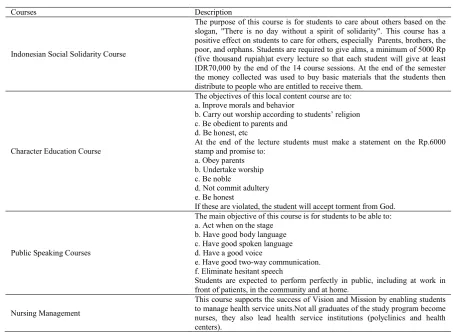
Indonesian Social Solidarity Course
The purpose of this course is for students to care about others based on the slogan, "There is no day without a spirit of solidarity". This course has a positive effect on students to care for others, especially Parents, brothers, the poor, and orphans. Students are required to give alms, a minimum of 5000 Rp (five thousand rupiah)at every lecture so that each student will give at least IDR70,000 by the end of the 14 course sessions. At the end of the semester the money collected was used to buy basic materials that the students then distribute to people who are entitled to receive them.
Character Education Course
The objectives of this local content course are to: a. Inprove morals and behavior
b. Carry out worship according to students’ religion c. Be obedient to parents and
d. Be honest, etc
At the end of the lecture students must make a statement on the Rp.6000 stamp and promise to:
a. Obey parents b. Undertake worship c. Be noble
d. Not commit adultery e. Be honest
If these are violated, the student will accept torment from God.
Public Speaking Courses
The main objective of this course is for students to be able to: a. Act when on the stage
b. Have good body language c. Have good spoken language d. Have a good voice
e. Have good two-way communication. f. Eliminate hesitant speech
Students are expected to perform perfectly in public, including at work in front of patients, in the community and at home.
Nursing Management
[image:4.595.185.409.443.550.2]This course supports the success of Vision and Mission by enabling students to manage health service units.Not all graduates of the study program become nurses, they also lead health service institutions (polyclinics and health centers).
Table 5. Converting Score to Symbol and Grade
No Score Symbol Grade
1 86-100 A 4,00
2 81-85 A- 3,70
3 76-80 B+ 3,30
4 71-75 B 3,00
5 66-70 B- 2,70
6 61-65 C+ 2,30
7 56-60 C 2,00
8 51-55 C- 1,70
9 45-50 D 1,00
10 <45 E 0,00
Table 6. Students’ Practical Score
Year 2016 2017 2018
Average Practical Score 80,56 77,99 78,28
Table 7. Number of Scrubs Generated per year
Year Thesis Score Total
A B C
2016 34 35 0 69
2017 21 49 0 70
[image:4.595.153.444.732.773.2]2018 25 13 0 38
Table 8. Graduates in the last 3 years
Year Graduates Worked Not Working
2016 69 59 10
2017 70 56 14
Regarding: Permit Extension of Nursing Study Program for Undergraduate Degree in STIKES KESOSI.
Based on Accreditation Results C
SK.BAN-PT. No: 211 / SK / BAN-PT / AK-XVI / S1 X / 2013 concerning accreditation of nursing study program in Bachelor degree.
Based on Accreditation
SK.BAN-PT. No: 1200 / SK / BAN PT / AKRED / DPL III / XII / 2015 about Diploma III health analyst accreditation. SK.DIK.TI No: 132 / E / O / 2012. April 20, 2012 about the
professional nurse study program permission.
Institutional accreditation based on SK.BAN-PT. No: 167
/ SK / BAN-PT / Accredited / PT / X / 2015 about institutional accreditation, STIKES KESOSI date: October 3, 2015.
Building Construction Permit SK. Minister of National
Education No: 123 / D / 0/2004 dated: 11 August 2004 about operational permit for STIKES KESOSI.
Ministry of National Research and Higher Education
Regional Coordination Office of Private Universities No.
3575/0 / T / K-1111201 concerning extension permit for nursing study program in STIKes KESOSI.
The development of health institutions (houses of central health services both government and private) increase every year and automatically requiremany professional nurses.
Input
Students: STIKES KESOSI accepted students who were high
school graduates who passed a test held by the Institution,based on its scientific needs. The table below shows the number of the registered and accepted students. Test material was related to basic knowledge such as biology and other health sciences. Acceptance of students involved employees and STIKes KESOSI lecturers. This test was needed to measure the initial knowledge of prospective students.
Lecturers: The lecturers who teach at the STIKes KESOSI
haveto meet criteria such as, permanent lecturers must have a master's degree in line with theirsubject area speciality. Based on this, then by referring to the Regulation of the Minister of National Education in Indonesia No. 16 in 2007 concerning Academic Qualification Standards and Lecturer Competencies, the minimum academic qualifications required for lecturers is master degree.
Curriculum: Curriculum, in its broad sense, has to do with
logical analysis in education in order to increase efficiency, and its impact on resolving the needs of the learners and society (Yamani, Shakour and Ehsanpour, 2013). Based on Indonesian constitution no. 12 in 2012,the curriculum at STIKes KESOSI is on the table below. Based on the above curriculum, of the core courses that must be taken 61% are based onglobal issues,14% are courses, and 25% are local content. The core courses aim to educate students so that they can carry out nursing care after they graduate. Global issues courses consist of oncology nursing, eutology nursing, pandemic nursing, holistic nursing, English language,and trauma nursing which are expected to play a role for graduates of STIKes Nursing Academy in dealing with epidemics globally. In accordance with the Curriculum above, the
excellence of STIKes KESOSI curriculum isin the local contentswhich describe on the table below. Based on the table above, the Local content courses consist of Indonesian Social Solidarity, Character Education, Public Speaking, Marketing Management and Entrepreneurs. These courses support the
improvement of graduates’ soft skills. Nursing graduates are
not only expected to have nursing skillsbut must also have a sense of caring for others and be noble and communicative. The world health organization (WHO) has stressed the importance of medical schools meeting societal needs which is,“ (necessary) for directing education, studies and service activities in line with achieving societal and local priorities and concerns in health issues” (Woollard and Boelen, 2012, 21-27). Facilities and infrastructure. Every health college is required to have adequate facilities and infrastructure. Nursing laboratories must have an Emergency Unit, Medical Nursing Surgery, Maternity Nursing, Basic Nursing, Community and Family Nursing, and Wound Nursing. As yet, STIKes KESOSI does not have the facilities and infrastructure in accordance with government regulations (in this case the Ministry of Health). In order to cover these deficiencies, the STIKes KESOSI managed students to go directly to the society (street vendors in designated hospitals in semester 3, 5 and 7) located on Jl. Bojong Raya No. 58 RT 05 RW 04 Kel. Rawa Buaya Kec. Cengkareng West Jakarta. STIKes KESOSI plans to have 24 medium-sized lecture rooms and 3 (three) small-sized lecture rooms, equipped with LCDs and Whiteboards in each class. It is also planned to have nursing buildings, as mentioned above, a place to pray and some sports facilities. The availability of books in the libraryis insuficient and there are still many (approximately 60%) old books that must immediately be replaced. Furthermore, STIKes KESOSI lacks sufficient journals, especially foreign journals. In order to overcome this problem, the management of STIKes KESOSI library cooperates with other libraries such as: STIKes Istara, STIKes Abdi Nusantara and STIKes Dr. Sismadi. Learning facilities at the STIKes KESOSI includes 8 classrooms equipped with; AC, LCD, OHP and a laboratory equipped with simulation tools that are not all suitable. STIKES KESOSI plans a development by adding space for discussion and laboratory equipment. The replacement of unused equipment is planned to be met within 7 years, while the addition of new tools is scheduled to be completed within 10 years. Operational activities at the STIKES KESOSI will be implemented to procure official vehicles within the next 2 years. Furthermore, in October 2021, the STIKES KESOSI planned to have new 5 floors building.
Management: STIKes KESOSI formed an organization to
Academic regulations
Guidelinesfor academic guidance
Guidelines for final assignments
Guidelines for evaluating
Guidelines for research and community service
Guidelines for examinations
The evaluation was carried out to assess the performance of the
entire academic community, both Study Program
administrators, lecturers, employees and students.
Process
Regulations for students: The Rules of Procedure in the
STIKES KESOSI are very strict, for example regular students are required to be in uniform and class employees / extension students dress modestly and, if violated, they will be fined Rp. 50,000 (Fifty Thousand Rupiah). Students who smoke or dispose of litter incorrectly will be subject to the same sanctions. In addition, students who are 15 (fifteen) minutes late are considered absent even though the student may still be allowed to enter the class and attend lectures. Meanwhile students who do not or are considered not to have attended lectures up to 4 (four) times are not permitted to take part in the final exam.The interview response from the Chairman of STIKes KESOSI explains th regulations further:
Interviewer: I feel the campus is clean and fresh air.
Chairman: We have rules here that must be implemented and for
those who violate the rules clearly subject to get sanctions for example; Smoking in the Campus Environment is fined Rp. 50,000, - / stem, wearing tight clothesis subject to a penalty of Rp. 50,000, - / day, Engaging in narcotics, dating and stealing inside the campus, the penalty was immediately issued, and dispose of waste in place is subject to a penalty of Rp. 50,000.
Interviewer: What is the response of students with fines and violations committed?
Chairman: Students finally realized on their fault because the
sanctions were nothing and this finesaim to discipline them, on the other hand they also knew that the results of the fines were collected and shared with orphans by themselves.
(Chairman’s Interview, 7 June 2018)
Based on the above interview, the students realized that the tight regulationsare aimed at disciplining them so that they have a good attitude towrds obeying the college rules.
Learning Implementation: Learnig activities at the STIKes
KESOSI use a Student Center Learning (SCL) approach, with diverse facilities. Cornelius and Gordon (2008) found that student-centered learning was facilitated by flexibility in content delivery and study strategies, and individual student learning needs were accommodated. Weimer (2002) makes the point that in the student-centered classroom the roles of teacher and student change out of necessity so that the teacher evolves from being the “stage on the stage”, to the “guide on the side”, who views the students not as empty vessels to be filled with knowledge but as seekers to be guided along their intellectual developmental journey. Learning activities are not only conducted on campus such as classrooms and laboratories but are also carried out outside the institution such as in hospitals, parlors, community health clinics, andin society by applying theories that are learned in the institution. A questionnaire given to lecturers regarding the components of the socialization process obtained a score of 3.20 for the socialization process for lecturers with ‘good’ criteria, and a
score of 3.00 for the socialization process for students with‘quite good' criteria, making the average score 3.10 which means the socialization component has a ‘good’ rating.The questionnaire given to students showd that 19% of them stated that the implementation of the socialization process towards students was running poorly with 39% saying it was ‘quite good’ and 42% saying it was ‘good’. It can, therefore, be concluded that the socialization process towards the lecturers went ‘well’ while towards students it went ‘quite well’.
Product
Final Exam Results: This study analyzed students’ final exam
results in the last 3 years to show that students have a good cognitive understanding in the nursing study program. Table 2 below shows students’ grades. Based on the table above (final term exam), from 3 years (2016, 2017, 2018) the average student GPA was ± 3,00 so it can be concluded that the GPA was good.
Practice Results: Based on the documents, the average of
students’ practice score is displayed in the table below.
Students’ Average Practice Results: The fluctuative score on
table above was influenced by motivation and discipline of students in following the field study (in hospitals).
Thesis Results: Thesis is the students’ final assignment with
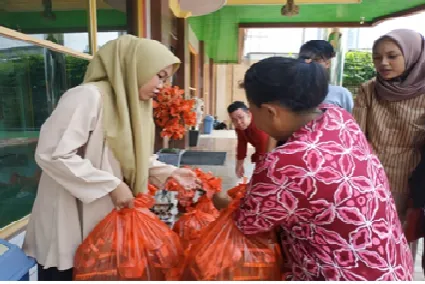
[image:6.595.328.541.646.788.2]results as follows. Based on the final exam results, practice results, and thesis results, it can be concluded that students in STIKes KESOSI have good learning outcomes in the cognitive aspects of the course. Furthermore, the students also improved their attitude and behaviour by learning Local Content courses. These courses developed their concern for others, especially towards parents, brothers, poor people and orphans. In the Indonesian Social Solidarity course, students were required to give donationsin every lecture, at least five thousand rupiah, so that each of them will become disposed to help other people. In the subject of Life Sciences, students were taught to behave honestly so that there is a match between their words and their deeds. The public speaking course aimed to make students able to communicate well in public especiallyin a workplace that deals with patients and society. At the end of the semester the money donated by students to each subject iscollected voluntarily and basic needs are purchased for other people. The students donate these materials to people who are entitled to receive them. It can be said that local content courses, aim at changing students’ behaviour and attitude as a concern of STIKes KESOSI, was successful. Below is a picture of students distributing basic needs to those entitled to receive them.
Outcome: Customer satisfaction was shown by the number of graduatesaccepted in hospitals / institutions or to work in their own clinic. This outcome component used data of STIKes KESOSI graduates who have graduated in the last 3 years. Based on the table 5 above, in 2016, 85.5% of graduates had worked while in 2017, 80% of graduates had worked. In 2018, the graduates who had worked increased to 94.7%. Based on the interviews with the owners of STIKes KESOSI, it was found that most of the graduates who did not work had reasons other than those related to their employability such as following their husbands, and moving. 88 health institutions received KESOSI STIKes graduates in the last three years as shown in the index. The Chairman of STIKes KESOSI commented on the acceptance of graduates as below:
Interviewer: How about the STIKes KESOSI graduates in the work
field?
Chairman: STIKes KESOSI graduatessought after by employment,
even 50% can work before receiving a diploma, especially those outside Jakarta (outside Java) such as Kalimantan, Maluku, Ternate and Papua, many of them occupy the head of the room and even the head nurse. This is because the government established many
hospitals - Regional General Hospitals.
(Chairman’s Interview, 7 June 2018)
Based on theinterviews with the Chairman of the STIKes KESOSI, it was found that graduates were greatly needed by the community, especially by hospitals and nursing homes that were partners of the STIKes KESOSI. This can be seen from the high acceptance the community has towards STIKes KESOSI graduates where around 50% of students have worked even though they have not yet graduated. In addition, STIKes KESOSI often receives requests from institutions to send students to become nurses, this means that the STIKes KESOSI has met the criteria. Providing the health services not only requires doctors to be trained but also for reliable nurses who are able to carry out the duties contained in the implementation of care such as; reviewing the needs of patients, planning actions for patients, carrying out planned actions and evaluating the results of their actions. In addition, a nurse must also be able to provide counseling to patients and their families about actions taken (Jansen et al., 2017). The quality of nursing services is often a determinant of the image of the service institution in the community.
Nurses are expected to know and be able to carry out nursing care, and to work together in a team (team work) with colleagues (Ibertson et al., 2013). Team work is expected to guarantee the arrangement of actions and the continuity of information that is carried out on patients. Nurses must have a sense of empathy for patients to provide a sense of sincerity in serving patients. Empathyinfluences the success with which nurses carry out their duties, thus providing a sense of security to the patient and his family(Agyeman-Yeboah and Korsah, 2018). Trust in the nurse leads to a reciprocal relationship between nurses and patients and their families (Dubois et al., 2013) and will increase patient and family satisfaction (Nilsson, et al., 2008).
Conclusion
STIKes KESOSI, a nursing college in Indonesia, was evaluated using a CIPPO approach which categorized developing professional nurses in terms of societal needs.The
context component of this institution properwith government regulations that concern about higher education and the reason why this institution built. Input components give students ‘hardskills’ (competencies or cognitive parts) ‘softskills’ that are needed in industry and society by implementing an embeded curriculum. Students were taught using a student-centered learning approach which required students to be more active inlearning activities as a component of the process. Furthermore, a system of fineswere used to motivate students to reach the standard learning outcome focused on benefiting society. The product component shows that the students had‘good’ resultsin both the cognitive aspects and in their attitude and behaviour. The outcome component shows that graduates of this institution are alignedwith society and health industry needs as indicated by the number ofgraduates employed in 88 health institutions.
REFERENCES
Agyeman-Yeboah, J. And Korsah A. K. 2018. Non-application of the nursing process at a hospital in Accra, Ghana:
lessons from descriptive research. BMC Nursing, 17(45).
Bartels JE. 2005. Educating nurses for the 21st century.
Nursing and Health Sciences, 7 (4): 221-225.
Cameron, R.A., Mazer, B.L., DeLuca, J.M., Mohile, S.G., Epstein, R.M. 2013. In search of compassion: a new
taxonomy of compassionate physician behaviours. Health
Expect,18 (5), 1672–1685.
Chitty KK, Black BP. 2010. Professional Nursing(6th ed).
Philadelphia: W.B Saunders.
Cornelius, S., and Gordon, C. 2008. Providing a flexible, learner-centred programme: Challenges for educators.
Internet and Higher Education, 11(1), 33-41.
Dewar, B., Cook, F. 2014. Developing compassion through a relationship centred appreciative leadership programme.
Nurse Educ. Today, 34 (9), 1258–1264.
Dewar, B., Nolan, M. 2013. Caring about caring: developing a model to implement compassionate relationship centred
care in an older people care setting. Int. J. Nurs. Stud. 50
(9), 1247–1258.
Dubois, C. A., D’Amour, D., Pomey, M. P., Girard, F and Brault, I. 2013. Conceptualizing Performance of Nursing Care as A Prerequisite for Better Measurement: A
Systematic and Interpretive Review. BMC Nursing, 12(7).
Facione, P. 2006. Critical Thinking: What It Is and Why It
Counts? California: Academic press.
Fitzpatrick, J. L., Sanders, J. and Worthon, B. 2004. Program
Evaluation: Alternative Approaches and Practical
Guidance (3td ed.). Boston: Pearson/Allyn and Bacon
Press.
Hakan, K and Seval, F. 2011. CIPP Evaluation Model Scale:
Development, Reliability and Validity. Procedia Social
and Behavioral Sciences, 15, 592-599.
Hook, J.N. 2014. Engaging patients with cultural
humility.Journal of Psychology and Christianity, 33(3),
277-280.
Jansen et al. 2017. Cost-effectiveness of a nurse-led intervention to optimise implementation of guideline-concordant continence care: Study protocol of the COCON
study. BMC Nursing, 16(10).
lbertson, M. and Carlson, C. 2013. Focus Group Evidence:
Implications for Design and Analysis. American Journal of
Evaluation. 35. 328-345.
Middlewood, David and Neil Burton, 2001. Managing the
Ministry of Health, Treatment, And Medical Education. 2001.
Courier Management of University. Academic Journal
University's Management; Assistant Education and
University Affairs. Tehran: High Council Planning Medical
Sciences.
Mohammadzadeh, Z. 2003. Developing indicators of training
programs graduate courses (MSc - PhD) based on input patterns, processes and outputs of the Department of Health. Isfahan University of Medical Sciences, Research Assistant Medical Education Research Center.
Nilsson, K., Campbell, A. And Andersson, E. P. 2008. Night
nursing – staff's working experiences. BMC Nursing, 7(13).
Ravanipour M, Vanak Z, Afshar L, Azemian A. 2014. The standards of professionalism in nursing: the nursing
instructors’ experiences. Evidence-based Care Journal4
(10): 27-40. doi: 10.22038/EBCJ. 20 14.2392
Sandell, E.J., and Tupy, S.J. 2015. Where cultural competency begins: Changes in undergraduate students’ intercultural
competency. International Journal of Teaching and
Learning in Higher Education, 27(3), 364-381
Schantz, M.L. 2007. Compassion: a concept analysis. Nurs.
Forum 42 (2), 48–55.
Stufflebeam, D. L. 2003. The CIPP model for evaluation. In D.
L. Stufflebeam and T. Kellaghan (Eds.), The international
handbook of educational evaluation (Chapter 2). Boston, MA: Kluwer Academic Publishers.
Stufflebeam, D. L. 2003-b. Institutionalizing evaluation in schools. In T. Kellaghan and D. L. Stufflebeam (Eds.), The international handbook ofeducational evaluation (Chapter 34). Boston: Kluwer.
Stufflebeam, D. L. 2007. CIPP Evaluation Model Checklist.
March. 17, 2007. from http://www.wmich.edu/
evalctr/checklists
Taylor ShE, Peplau LA, Sears DO. 2003. Social psycohology. 11th ed. New Jersey: Pearson Education, Upper Saddle River.
Von Dietze, E., Orb, A. 2000. Compassionate care: a moral
dimension of nursing. Nurs. Inquiry 7 (3), 166–174.
Weimer, M. 2002. Learner-centered teaching: Five key
changes to practice. San Francisco, CA: Jossey-Bass.
WHO. 2005. Bridging the" know-do" gap: Meeting on
Knowledge Translation in Global Health. Retrieved
September 25 2014 from: http://www.who.int/kms/ WHO_EIP_KMS_2006_2.pdf
Woollard, B., and Boelen, C. 2012. Seeking impact of medical schools on health: meeting the challenges of social
accountability. Medical Education, 46(1), 21-27.
Worthern, B. R., Sanders J. R. and Fitzpatrick J. L. 1997.
Program Evaluation – Alternative Approaches and
Practical Guidelines-. New York: Longman, Inc.
Wynd CA. 2003. Current factors contributing to
professionalism in nursing. J Prof Nurs, 19 (5): 251-61.
Yamani, N., Shakour, M., Ehsanpour, S. 2013. Educational
needs of reproductive health students: A Delphi study. The
Journal of Medical Education and Development, 8 (2),65-76.
Yarmohammadian, M. H. 2004. Quality in Higher Education.
Encyclopedia of Higher Education, Ministry of Science, Research, and Technology, Tehran, Iran.