
ISSN Online: 2327-5227 ISSN Print: 2327-5219
DOI: 10.4236/jcc.2019.77015 Jul. 18, 2019 162 Journal of Computer and Communications
IUID Method-Mix: Towards a Systematic
Approach for Intercultural User Interface
Design (IUID)
Rüdiger Heimgärtner
Intercultural User Interface Consulting (IUIC), Undorf, Germany
Abstract
A method-mix for intercultural user interface design (IUID) is explained and exemplified by application examples based on a hybrid approach covering cultural contexts in human-computer interaction (HCI) design using a model of culturally influenced HCI. Cultural influence on HCI is described using cultural variables for user interface design. Assumptions and empirical results regarding the influence of culture on HCI, considering the path of the infor-mation processing and the interaction style between Chinese and German users are explained based on cultural models. Subsequent indicators represent the relationship between culture and HCI (culturally imprinted by the user). Correlations adopted theoretically between cultural dimensions and variables for HCI design were investigated. These correlations represent relevant con-stituents of a model for culturally influenced HCI. Considerations applying this model and evidence for the proper application of the IUID method-mix are presented elucidating why and how cultural aspects play a role in HCI de-sign and usability/UX engineering. The IUID method-mix serves to inspire HCI engineers in the requirement analysis phase as well as HCI designers in the design phase. The readers are thereby sensitized to the challenges of in-tercultural usability/UX engineering and inin-tercultural HCI design and will be equipped with methodological knowledge relevant to the derivation of design recommendations for user interface design for and in their desired cultural contexts. Finally, implications for practitioners are shown, including HCI style scores and practical design recommendations, to prognosticate the effort and the expenditures for considering the cultural context in IUID.
Keywords
Culture, Human Factors, UX, Usability Engineering, Intercultural User Interface Design, Method Mix, HCI Dimensions, HCI, HMI, Cross-Cultural, Design,
How to cite this paper: Heimgärtner, R. (2019) IUID Method-Mix: Towards a Sys-tematic Approach for Intercultural User Interface Design (IUID). Journal of Com-puter and Communications, 7, 162-194.
https://doi.org/10.4236/jcc.2019.77015
Received: April 8, 2019 Accepted: July 15, 2019 Published: July 18, 2019
Copyright © 2019 by author(s) and Scientific Research Publishing Inc. This work is licensed under the Creative Commons Attribution International License (CC BY 4.0).
http://creativecommons.org/licenses/by/4.0/
DOI: 10.4236/jcc.2019.77015 163 Journal of Computer and Communications Intercultural, Culture-Centered, Methods, Tools, Standards, State of Research, Cultural Differences, Communication, Understanding, Empathy, Intercultural Communication, Intercultural HCI Design, Process, Cycle, IUID
1. Introduction and Related Work
DOI: 10.4236/jcc.2019.77015 164 Journal of Computer and Communications cultural contexts, [20]-[25] proposed reflections towards a model for intercul-tural HCI design, [13] purported a semiotic based way to derive design recom-mendations for information systems. Nevertheless, there is still a remarkable knowledge gap regarding the relationship between culture and HCI in order to derive usable design recommendation for practitioners.
2. IUID Method-Mix
Based on feedback from tutorials and workshops on IUID (M & C 2010, Interact 2011, SouthCHI 2013, HCII 2014, IHCI 2015, M & C 2017, M & C 2018) and the summary of the state of research on IUID in [20] [12] and [26], the author re-viewed the synopsis of well documented IUID methods in scientific literature to form a hybrid approach integrating several IUID concepts and methods into one IUID method mix. Today, strategies for IUID address at least one of the follow-ing concepts in the wide context contributfollow-ing to good intercultural usability en-gineering (cf. [27]) and intercultural user interface design [12]:
• User interface characteristics (cf. [28]). • Method of culture oriented HCI design [2]. • Intercultural variables (cf. [2]).
• HCI dimensions (cf. [29]).
These concepts are used to support the design process which finally should lead to good user interfaces of high usability providing excellent user expe-rience. However, the successful application of these approaches strongly de-pends on successful intercultural communication which again dede-pends on the personal ability to mutually understand the web of belief of the others using empathic capabilities [30]. In the following, the elements of this process are described in detail to bridge the divergence represented by the gap in the knowledge of the differences in intercultural HCI design using converging methods and approaches.
2.1. Cultural Dimensions
misunderstand-DOI: 10.4236/jcc.2019.77015 165 Journal of Computer and Communications ing is proportional to the size of the cultural distance ([34], pp. 33-34).
Cultural differences and distances can be described and categorized with the help of cultural models. Cultural models describe the cultural distance, that is, the differences between cultures and allow the comparison of them with each other [35]). One of the best-known cultural models is the iceberg model of cul-ture [5]: Only a few of the attributes of a culture are visible and conscious. The rest is invisible and unconscious and, hence, difficult to investigate. Cultural models help to overcome this methodological gap using cultural standards and dimensions to look beneath the water surface, that is, to probe the unconscious areas of culture.
The organizational psychologist Alexander Thomas established the concept of “cultural standards,” which expresses the normal, typical, and valid attributes for most of the members of a certain culture regarding the kinds of perception, thoughts, judgments, and actions ([31], p. 112). Cultural standards serve as an orientation system for the members of a group and regulate action. The individ-ual grows into its culture by taking over and internalizing these cultural stan-dards. This process encompasses learning basic human abilities in the social arena, control of one’s own behavior and emotions, the satisfaction of basic needs, worldview, verbal and nonverbal communication, and expectations of others as well as the understanding of one’s role and scales for judgment.
DOI: 10.4236/jcc.2019.77015 166 Journal of Computer and Communications family. A low individualism index indicates collectivistic societies, in which per-sons are integrated into collective groups from birth, which protects them for life and expects unconditional loyalty from them ([39], p. 67). Femininity versus masculinity (MAS): This dimension represents the social implications of gender. A society demonstrates how clearly the roles of sexes are delimited from each other. Masculinity means being forceful and strong as well as having a materia-listic orientation. Femininity means being modest, being more sensitive, and at-taching importance to quality of life. Higher femininity indicates a society in which the roles of the sexes overlap: Both women and men should be modest and sensitive and put value on quality of life ([39], p. 101). Uncertainty avoid-ance (UAI): This index represents the degree to which members of a culture feel threatened by uncertain or unknown situations. It is also an indicator for ex-pressing the way to deal with uncertainty regarding controlling emotions and aggression ([39], p. 133). Long-term versus short-term orientation (LTO): Long-term oriented cultures stand for staying power, relation resistance, and the retention of these relations to foster virtues toward future rewards, perseverance and thrift ([39], p. 401). Short-term oriented societies show a high personal sta-bility, keeping dignity (preservation of face), respect for tradition, and fostering virtues related to past and present ([39], p. 403). For example, in China, there is high “power distance” in contrast to Germany. Power distance represents a quantitatively measurable aspect of a national culture, which quantifies the de-gree to which less powerful members of institutions and organizations in a country expect and accept disparate distribution of power ([39], p. 42). The PDI ranges from zero to about 100. Hofstede determined that the power distance in China is high (PDI = 80) compared to Germany (PDI = 35). This may be rele-vant in intercultural HCI design, with respect to accepting help or commands (given by the system) by the user according to his acceptance of external power.
In contrast, Hall based his cultural models such as context information, message speed, and mono-chronic or poly-chronic time orientation on qualitative interviews and field studies [40]. There are many more founders of cultural dimensions, for example, [41] [42] [43] [44] and [45]. The idiosyncratic values of these dimensions have been determined for many nations by their authors (cf. [33], or [46]).
Cultural dimensions are too rough for intercultural user interface design. For this reason, additional inter cultural variables are necessary which—in relation to the user interface design—divide the cultural aspects into smaller units (cf. [2] [47]). These cultural aspects and their manifestations can be empirically deter-mined using qualitative and quantitative methods. Although cultures are con-stantly changing (cf. [48]), for a product life cycle of a few years at least trends can be determined, and for special cases of an application even selective para-meters can be determined which serve the intercultural user interface design.
2.2. Intercultural Variables
DOI: 10.4236/jcc.2019.77015 167 Journal of Computer and Communications design regarding the preferences of the users of different cultures. “Intercultural” variables represent knowledge that can be obtained only by observing at least two cultures and their differences, i.e. doing intercultural research (cf. [50]) to obtain relevant knowledge for internationalization of software and system plat-forms. Their values represent culture-dependent variations that occur at all le-vels of HCI localization (surface, functionality and interaction) (cf. [2]) and can be used for intercultural user interface design. Intercultural variables describe the differences in HCI design with respect to the preferences of users from dif-ferent cultures (cf. Table 1).
[image:6.595.206.540.501.731.2]Direct intercultural variables are most important because they have a direct and essential influence on the HCI design. “Visible” intercultural variables (VIVs) (above the “water surface” of the iceberg-metaphor) are immediately perceptible at a certain time (font, color, window size, navigation, etc.). In con-trast, “invisible” (or “hidden”) intercultural variables (NVIVs) (below the “water surface”) are only recognizable over a certain period (such as interaction speed, information display duration, dialogue display frequency, use of the navigation bar, etc.). The localization of hidden intercultural variables is difficult to realize because the contextual relation to the cultural background as well as to the product is very strong for interaction and dialogue design. However, this cultu-rally distinct context and consequently its cultural dependency is precisely the reason (cf. iceberg metaphor), why these patterns and non-visible intercultural variables are so important for information architecture as well as for interaction design and, hence, for the resulting dialogues of a product ([49], p. 98). And therefore, intercultural variables and their values representing knowledge for a specific culture (relevant for system and software localization) need high re-search priority (e.g. using special tools as suggested by [51]).
Table 1. Intercultural variables according to [49]: 97 et. seqq. (estimated values regarding the difficulty to recognize the variables are added by the author).
Intercultural variable localization Level of HCI design Relation to of the variables Perceivability
Estimated difficulty to
recognize [0 (easy) - 10 (difficult)] Dialog design Interaction Direct Hidden/Over long time and deep analysis 10
DOI: 10.4236/jcc.2019.77015 168 Journal of Computer and Communications 2.3. Method of Culture-Oriented Design
[49]: 108 usedinter cultural variables to develop an approach for the design of intercultural human-machine systems using the “method of culture-oriented de-sign” (MCD), which integrates the factors of new concepts of culture-oriented HCI design and the knowledge of cultural differences into existing concepts of HCI design (cf. Figure 1).
Knowledge about cultural differences is resultantly integrated into existing methods to include intercultural aspects in human-machine interaction. Rele-vant cultural variables for intercultural HCI design must be determined analyti-cally based on literature research and empirical requirement studies.
2.4. User Interface Characteristics
[image:7.595.139.538.475.704.2][47] developed characteristic factors for user interfaces that can influence user interface design to make cultural dimensions available for user interface design: The user interface characteristics “metaphor”, “mental model”, “navigation”, “interaction” and “presentation” are connected to the five cultural dimensions of Hofstede. For instance, according to [28] and [52], Chinese people (and hence users) are rather relationship and family oriented based on traditional powerful social hierarchical structures. In contrast, German users are described as event oriented regarding acts, tools, work, jobs and competition. Some tendencies re-garding cultural differences can be used for intercultural user interface design and further reflections and research. User interface characteristics can be used in conjunction with empirical surveys on their characteristics for the correspond-ing cultural target context to derive recommendations for the development of intercultural user interfaces. Table 2 shows a summary of general recommenda-tions for intercultural user interface design based on [53].
DOI: 10.4236/jcc.2019.77015 169 Journal of Computer and Communications 2.5. HCI Dimensions
Based on the work of [32] [40], and [54], [55] introduced the concept of HCI dimensions to support the determination of the relationship between culture and HCI (cf. [20] [21]).
HCI dimensions (HCIDs) represent the characteristics of HCI by describing the HCI style of the user, i.e. the path of information processing and the interac-tion style exhibited by the user based on the concepts of “informainterac-tion” and “in-teraction” according to HCI dialogs (cf. [56]) that are characterized by transmit-ting pieces of information during user system interaction derived from the basic physical dimensions of space and time as well as from their sub-dimensions: frequency, speed, duration, density, and order (cf. Table 3).
Frequency, density, order and structure are concerned particularly during in-formation processing; frequency and speed are concerned during interaction behavior. HCI dimensions can be regarded as the main factors relevant for HCI design, because they denote the basic classes for variables useful in HCI design.
[image:8.595.57.544.408.599.2]The view of space, time and mental aspects is strongly culture dependent (cf. [57]). HCI is, therefore, also culture dependent, because HCI dialogs, interac-tion, information presentation and with that HCI generally are strongly linked with time (interaction, communication) and space (layout, structure) as well as
Table 2. Summary of recommendations for intercultural HCI design according to the user interface characteristics regarding China and Germany (summarized by the author in accordance to table 6-3 in [53]: 138 as well as to [53]: 305-317).
User Interface Characteristics
China Germany
Metaphor Use clear hierarchy and representation instead of abstraction Use representation instead of abstraction Mental model Use many references without any sequence of relevance, simple
mental models, clear articulation, limited choice and binary logic Use few references with sequence of relevance and fuzzy logic Navigation Use limited and predefined choice and navigation Use open access and arbitrary choice and unique
navigation Interaction Use personalized but team-oriented systems giving direct error
messages, guided help and providing face-to-face interaction
Use distant but supportive (error) messages providing open and flexible interaction with the system (e.g., full text search)
Presentation Use formal speech providing high contextual relationship-oriented
information as well as feminine colors Use informal speech providing low contextual task-oriented information as well as masculine colors
Table 3. HCI Dimensions according to [20].
Derived Physical Sub-Dimensions [Basic Physical Dimension]
Information Related HCI Dimension Interaction Related HCI Dimension
Frequency [Time] Information frequency Interaction frequency Speed [Time] Information speed Interaction speed
Sequentiality/Priority/Order [Time and Space] Information order/Information parallelism Interaction order/Interaction parallelism Density/Quantity [Time and Space]/
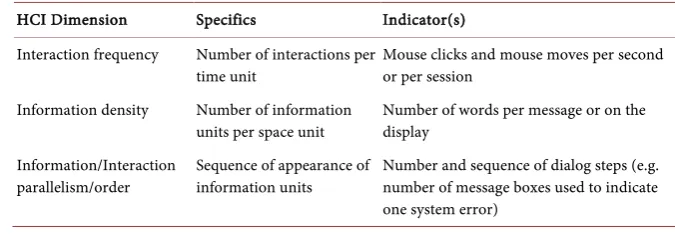
[image:8.595.58.538.604.726.2]DOI: 10.4236/jcc.2019.77015 170 Journal of Computer and Communications with mental aspects (relations, thoughts) (cf. [1] [2] [58]). Hence, HCI dimen-sions represent classes of HCI variables (expresdimen-sions of HCI dimendimen-sions) useful for the HCI design, which are operationalized by means of (interaction) indica-tors in HCI metrics. Information speed (speed of dissemination and frequency of occurrence of information), information density (number and distance of in-formation units) or inin-formation order (sequence of occurrence and arrangement of information), also correlate with culturally different basic patterns of behavior at the information level [20]. Table 4 shows examples of indicators for some HCI dimensions.
For example, the indicator “number of information units per space unit” be-longs to the HCI dimension “information density” and can be expressed by the number of words displayed on the screen. The HCI dimension “interaction fre-quency” contains the variable “number of interactions per time unit” represented for example by the number of mouse clicks per second. At least one indicator as a measurement variable is necessary to constitute the specifics of an HCI dimen-sion. For real use, however, several empirically proven indicators should be used. If HCI dimensions are consistently represented based on intercultural variables, one can use “Intercultural HCI Dimensions”, which express a culturally influ-enced HCI style.
3. Towards a Systematic Approach for IUID
[image:9.595.200.538.612.733.2]Due to the lack of sufficient empirical data and the large research gaps remain-ing in the field of intercultural HCI, it still makes sense to use a basic multi-stage research process based on “Grounded Theory” to develop new theories [20]: Through analytical reflection of already known theories, models and intuitive ideas, hypotheses for a new integration theory can be formed. Then empirical data must establish a foundation (introductory position) to test and verify the hypotheses in order to obtain a new theory. Based on this new theory, new hy-potheses and predictions can then be developed in order to test them empirically again (cf. [59]). In an explanatory model for culturally influenced HCI, these re-lations between culture and HCI are described using cultural interaction indica-tors, thus illustrating the relationship between culture and HCI, which can be determined either data-driven or hypothesis-driven as well as by a mixture of both. The data-driven approach first collects data. The resulting patterns provide
Table 4. HCI Dimensions represented by Specifics and Indicators.
HCI Dimension Specifics Indicator(s) Interaction frequency Number of interactions per
time unit
Mouse clicks and mouse moves per second or per session
Information density Number of information units per space unit
Number of words per message or on the display
Information/Interaction
DOI: 10.4236/jcc.2019.77015 171 Journal of Computer and Communications information about the connection between culture and HCI. In the hypothe-sis-driven approach, hypotheses are derived from existing cultural theories and empirically verified afterwards. Finally, in the hybrid approach, the approaches are brought together and, if necessary, extended by additional methods.
3.1. Data-Driven Approach
In order to find out where the way in which users from different cultural groups interact with an interactive system is different and to derive possible correlations between cultural dimensions and HCI dimensions, the interaction behavior of users with the computer is observed and analyzed. Using automated analytical tools, dynamic aspects of the HCI can be measured by seamless chronological recording of user behavior (cf. e.g. [60]).
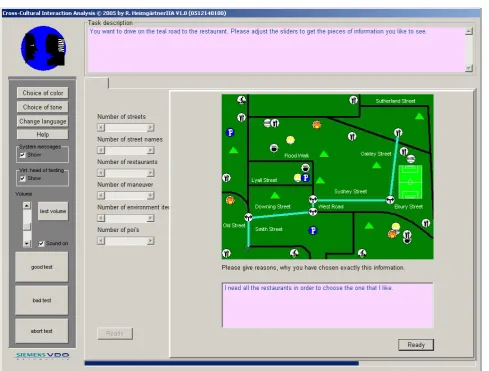
To encourage the culturally different user to interact with the computer and then to record and analyze this interaction, task scenarios were developed which were implemented in a specially developed PC tool (IIA-Tool, [51]). A user test with this tool included several successive parts. First, the demographic data of the subject were collected. Then the task presentation took place: The subject was to perform a series of different tasks, each of which served to examine other cultural aspects of HCI according to the hypotheses. In order to determine the cultural value of the test person, a questionnaire had to be completed (cf. [37]). The final debriefing clarified the purpose of the test and asked questions about the usability of the test system, the difficulty of the tests and whether the hypo-theses had already been guessed during the test (and thus the test validity was lost) or not. By using this tool, parameters relating to the user’s interaction with the system are determined. Thereby, this tool allows the measurement of the values of Cultural Interaction Indicators (CIIs), i.e., HCI parameters that corre-late with variables representing the user’s culture, as well as the expressions of relevant cultural dimensions for the HCI design during the user’s interaction with the system by processing test items and applying the VSM94 questionnaire of [37] within the IIA Tool.
DOI: 10.4236/jcc.2019.77015 172 Journal of Computer and Communications Figure 2. Screenshot of the “Map Display Test Task” during the test session with the IIA Tool.
time, number of errors or number of functions used are recorded [61]. This data shows which correlations occur between the user’s interactive behavior and his culture or cultural dimensions and which implications can be derived from this for intercultural HCI design. In 2006 and 2007, two empirical remote online stu-dies with a total of 14,500 Chinese (C), German (G) and English (E) speaking employees of SiemensVDO worldwide collected interaction data and determined which cultural differences in human-computer interaction (HCI) can be quanti-tatively determined [29].
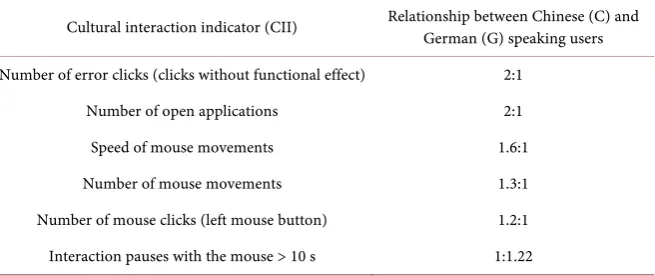
The evaluation of the data collected in the studies showed that there are cor-relations between the interaction of users with the computer and the cultural character of users [29]. The cultural interaction indicators found in Table 5 mainly concern the localization level of the interaction.
DOI: 10.4236/jcc.2019.77015 173 Journal of Computer and Communications Table 5. Cultural differences in the HCI between Chinese (C) and German (G) speaking users.
Cultural interaction indicator (CII) Relationship between Chinese (C) and German (G) speaking users Number of error clicks (clicks without functional effect) 2:1
Number of open applications 2:1 Speed of mouse movements 1.6:1 Number of mouse movements 1.3:1 Number of mouse clicks (left mouse button) 1.2:1 Interaction pauses with the mouse > 10 s 1:1.22
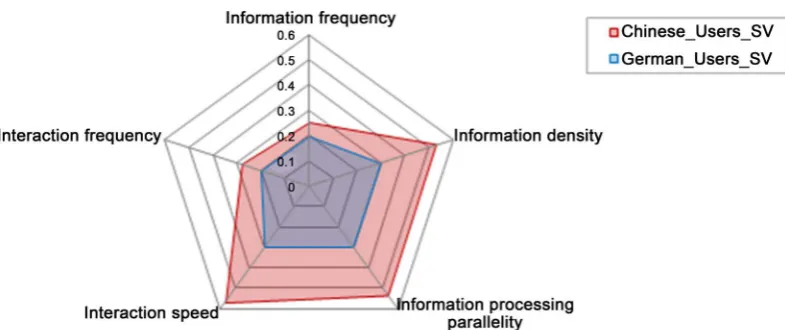
results. The statistical evaluation of the empirical studies showed significant correlations between the culture of corresponding user groups ((C) and (G)) (defined by demographic variables such as nationality, country of birth and mother tongue and values of HCID: Information density, information and inte-raction frequency as well as information and inteinte-raction parallelism are lower for (G) than for (C) according to the relationship orientation, the density of in-formation networks and the time orientation of the users. The cultural differ-ences in HCI between Chinese and German users concern layout (complex vs. simple), information density (high vs. low), personalization (strong vs. low), language (icons vs. characters), interaction speed (higher vs. lower) and interac-tion frequency (higher vs. lower) [20]. This fact also seems to be the reason for the significant differences in the use of anthropomorphic agents, relational di-alogues and message content as well as chat programs between (G) and (C). Ac-cording to the empirically determined values of the cultural interaction indica-tors, the characteristics of the HCI dimensions information frequency, informa-tion processing parallelism, informainforma-tion density, interacinforma-tion speed and interac-tion frequency are significantly higher for Chinese than for Germans. The num-bers in Figure 3 represent the ratio values. For example, the interaction speed at (C) was about twice as high as at (G): (0.57 to 0.30).
The data-driven approach deals with the correlation of HCI data and demo-graphic variables such as citizenship, mother tongue, country of birth, etc. This is a predominantly descriptive approach in which cultural standards or cultural dimensions are still largely ignored and demographic variables such as national-ity or country of birth are used instead. As soon as explanations for the behavior of the user with the system are required from a cultural point of view—as is the case in the hypothesis-driven explanative approach explained in the next sec-tion—cultural models must be included in the considerations.
3.2. Hypothesis-Driven Approach
DOI: 10.4236/jcc.2019.77015 174 Journal of Computer and Communications Figure 3. Characteristics of the HCI dimensions representing the culture-dependent differences in the us-er’s interaction with a computer system.
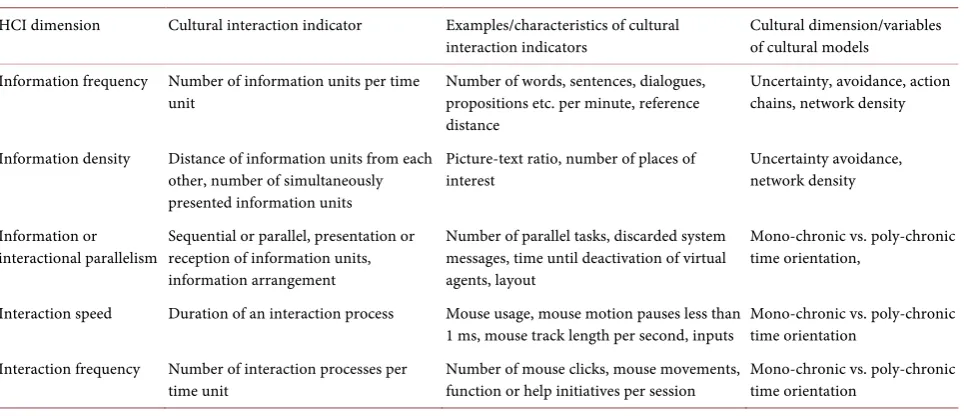
reasonable hypotheses for culturally influenced HCI. Some hypotheses have been developed based on the best classifying CIIs, which is supported by the ba-sic hypothesis that the expressions of the HCI dimensions depend on the cultur-al imprint of the user as follows: the higher the relationcultur-al orientation (collectiv-ism), the higher the information density, information speed, information fre-quency, interaction frequency and interaction speed (and vice versa). [29] ex-amined these hypotheses and confirmed the trend that such relationships exist [20]. Although these findings cannot yet be truly viable prognostic aids within the frame-work of a hypothesis-driven approach (because causal relations have not been identified until now), it is necessary for further research to integrate the tendentious correlations found so far into an initial relationship model in order to be able to use them as a starting point for explanations of the connections between the cultural imprint of the user and his interaction with the system, and thus to establish an initial provisional model of culture-dependent HCI [21]. Table 6 shows possible connections between HCI dimensions, cultural interac-tion indicators and cultural dimensions or variables of cultural models.
DOI: 10.4236/jcc.2019.77015 175 Journal of Computer and Communications Table 6. Cultural interaction indicators and its characteristics representing the relating element between HCI dimensions and cultural dimensions.
HCI dimension Cultural interaction indicator Examples/characteristics of cultural
interaction indicators Cultural dimension/variables of cultural models Information frequency Number of information units per time
unit
Number of words, sentences, dialogues, propositions etc. per minute, reference distance
Uncertainty, avoidance, action chains, network density
Information density Distance of information units from each other, number of simultaneously presented information units
Picture-text ratio, number of places of
interest Uncertainty avoidance, network density
Information or
interactional parallelism Sequential or parallel, presentation or reception of information units, information arrangement
Number of parallel tasks, discarded system messages, time until deactivation of virtual agents, layout
Mono-chronic vs. poly-chronic time orientation,
Interaction speed Duration of an interaction process Mouse usage, mouse motion pauses less than
1 ms, mouse track length per second, inputs Mono-chronic vs. poly-chronic time orientation Interaction frequency Number of interaction processes per
time unit
Number of mouse clicks, mouse movements, function or help initiatives per session
Mono-chronic vs. poly-chronic time orientation
not use the help button as often as German users due to face-saving (see [45]). The speed of mouse movements could be lower for German users due to high uncertainty avoidance and low communication speed or low context and rela-tionship orientation.
Some of the postulated connections between culture and HCI known from the literature were examined repeatedly with the help of the specially developed tool for intercultural interaction analysis (IIA Tool, [51]). The hypotheses were tested, for example again within the “Map Display Test Task” as described be-fore, by presenting the same task to subjects from different cultures. For exam-ple, the hypothesis “there is a high correlation of high information density to re-lation-oriented cultures such as Chinese” could be confirmed by the choice of more POIs by German users compared to Chinese users. Moreover, the results of the investigation based on the differences in the effective values of the mea-surement variables in contrast to the values of the parameters assumed in the hy-potheses supported these results. For example, it was assumed that the number of interactions with the system per time unit (INH) of Chinese users is about four times higher than that of German users (0.8:0.2 = 4). However, the ratio is only 1.4 with respect to the number of average mouse movements in a test session (10,566:7529). This ratio is an indicator of the strength of the postulated hypo-thesis. The confirmation strengths of six out of eight hypotheses were estimated a priori approximately correctly, and all postulated eight hypotheses were con-firmed a posteriori using the online studies with the IIA tool. This shows that the analytical preparatory work and the methods and tools used in the studies were appropriate and that the results can be considered plausible and correct [20].
3.3. Hybrid Approach
DOI: 10.4236/jcc.2019.77015 176 Journal of Computer and Communications within an IUID method mix [21]. Based on the method of the culture-oriented HCI design (MCD, see [2]), cultural differences are identified based on cultural dimensions and cultural variables are derived for the project. With this know-ledge of cultural differences and affected aspects of the HCI system, further ef-fects on the HCI design are determined and supported by hypothesis-driven data transmission using user interface characteristics (see [62]) and HCI dimensions (see [20] by a “toolbox” for IUID consisting of a reasonable arranged method mix, (cf. [21]). The method mix consists of a combined and hybrid use of cultur-al dimensions, interculturcultur-al variables, user interface characteristics, and HCI dimensions. The values of these concepts represent the HCI style of the user in the respective cultural context.
One important goal for intercultural HCI designers and intercultural usability experts is to consider fundamental cultural differences when dealing with mem-bers of cultures interacting with machines. Hence, the most important step is to bridge the gap between cultural aspects (formally derived from cultural dimen-sions) and HCI design by determining relevant cultural parameters for intercul-tural user interface design using analytical research tools and empirical tests. These tests should show whether human-machine interaction runs parallel to cultural dimensions, and if so, to what extent. Cultural models and cultural in-teraction indicators, which have been generated by the analysis of user interac-tion, can be used to describe the needs of the user in terms of the HCI depending on his culture as well as to develop an explanatory model for culturally influ-enced HCI and to improve the methods of intercultural usability engineering. With the help of an explanatory model of culture-dependent HCI, examples of different culturally conditioned behavior of users can be explained with interac-tive systems. For this purpose, the explanatory models must be determined on the basis of analytical considerations and verified using empirical data and sta-tistical methods. Due to the lack of existing modeling and available cultural HCI theories, an iterative, i.e. alternately analytical and empirical approach is neces-sary (i.e. alternately data- and hypothesis-driven), so that an “evolutionary ex-planatory model” gradually emerges.
Successful explanatory models can be applied to new examples or application cases and thus verified, which in turn allows predictive design recommendations to be generated. Finally, complete metrics for representing the usability of inter-active systems (usability measurement systems, cf. [63]) can be derived from high empirical values for the culturally influenced HCI. In order to measure the parameters, the characteristics of the HCI dimensions must be very precise and concrete. Therefore, the HCI dimensions are operationalized in many quantita-tive variables in order to obtain a basic measurement instrument and link it to cultural dimensions, thus generating empirical hypotheses.
DOI: 10.4236/jcc.2019.77015 177 Journal of Computer and Communications influenced HCI. For this reason, initial considerations were made which reflect the relationships between the HCI dimensions and cultural aspects. Thereby, the following hypotheses have been postulated:
• Hypothesis 1: In relationship-oriented countries with high density of com-munication networks, comcom-munication speed, and high context orientation (e.g., China), it is the case that information flow, frequency, and density as well as interaction speed and frequency are high. In task-oriented countries with low density of communication networks, communication speed, and low context orientation (e.g., Germany), information flow, frequency, and density as well as interaction speed and frequency are low.
• Hypothesis 2: In countries with poly-chronic time orientation and low un-certainty avoidance (e.g., China), information and interaction parallelism are high. In countries with mono-chronic time orientation and high uncertainty avoidance (e.g., Germany), information and interaction parallelism are low. The aim was to find out the actual connection between the interaction indica-tors and their (postulated cultural) causes representing the relationships between cultural dimensions and HCI dimensions and their expressions. To solve this, a structural equation model for the relationship between HCI dimensions and cultural dimensions has been generated. The connections between cultural, in-formation-related and interaction-related dimensions were modeled using the cultural interaction indicators. The explanatory model of culture-dependent HCI is all the better the more variances in the empirical data can be statistically explained by the modeled structural equations. For this, a partial model of one side of a complete structural equation model, which has emerged from literature studies, postulated hypotheses in [29] and empirical results from [20] was mod-eled in AMOS. Table 7 shows the resulting relations between cultural and HCI dimensions represented by cultural interaction indicators indicating the cultu-rally different HCI style between Chinese (C) and German (G) speaking users expressed by the quantified ratio of the CIIs between (C) and (G).
Other combinations of cultural interaction indicators (CIIs) are also possible for the allocation to HCI dimensions. The explanatory model is based on some of the best-classifying cultural interaction indicators from the data-driven proach, which have emerged from the hypothesis in the hypothesis-driven ap-proach, namely that the expressions of the HCI dimensions depend on the cul-tural imprint of the users, which can be described by the expressions of culcul-tural dimensions: the higher the relationship orientation (collectivism), the higher the information density, information speed, information frequency, interaction fre-quency and interaction speed (and vice versa).
DOI: 10.4236/jcc.2019.77015 178 Journal of Computer and Communications Table 7. Quantified Ratio of the CIIs representing the cultural distance between cultures (according to [20]).
HCI Dimension Ratio of (C):(G)
Cultural interaction indicator (CII) Examples Cultural dimension
Information frequency 1.25 Distance between notes, number of information units per time unit
Number of words, sentences, dialogues, propositions etc. per minute
Uncertainty avoidance, action chains, network density
Information density 1.77 Number of places of interest Picture-text ratio, distance of information units from each other, number of simultaneously presented information units
Uncertainty avoidance, network density
Information and
interaction parallelism 1.61 Number of parallel tasks, rejected system messages, time to deactivate the virtual agent (“life-like character”, e.g. “Merlin” in Word)
Sequential or parallel presentation or reception of information units and information arrangement (e.g. layout)
All time-relevant cultural dimensions (such as uncertainty avoidance, action chains or time orientation)
Interaction speed 1.89 Mouse motion pauses less than 1 ms
Mouse usage, keyboard entries, length of mouse track per time unit
All time-relevant cultural dimensions
Interaction frequency 1.41 Mouse clicks with left mouse button, number of mouse movement events
Total number of mouse clicks/ mouse movements or number of function or help initiatives per session
All time-relevant cultural dimensions
interaction indicators can be modeled and explained using structural equation models as a basis for the application of the IUID method-mix. Based on H1 and H2, a model of culturally influenced HCI can be created containing the rela-tionships between cultural dimensions and HCIDs. The entire model for cultu-rally influenced HCI consists of more than 300, mainly quantitative, potential parameters that are relevant for intercultural HCI design and, depending on the culture, have been analytically established by the literature study (cf. for details [20]). The model contains the following rules expressing the connection between the values of the cultural dimensions and the values of the HCIDs, thereby de-termining the denotation level for culture and HCI (cf. for details [21]):
1) The lower action chain orientation: a) the higher information frequency.
b) the higher information and interaction parallelism. c) the higher interaction frequency.
2) The lower the IDV:
a) the higher information frequency. b) the higher interaction frequency. 3) The lower the UAI:
a) the higher information frequency. b) the higher interaction frequency. c) the lower interaction exactness. 4) The lower the MAS:
DOI: 10.4236/jcc.2019.77015 179 Journal of Computer and Communications 5) The higher network density and context orientation:
a) the higher information density.
b) the higher information and interaction parallelism. c) the higher interaction frequency.
d) the higher interaction speed. e) the lower interaction exactness. 6) The higher LTO:
a) the higher information frequency. b) the higher interaction speed.
7) And vice versa for all rules (i.e., for Rule 1: the lower action chain orienta-tion, the higher information/interaction frequency and parallelism).
[image:18.595.55.538.594.735.2]According to the changed values of the cultural dimensions on the left side of the model (antecedences in the production rules above), the values of the HCIDs change on the right side of the model (consequences in the production rules above). Therefore, this model does not depend on nations or countries but can be used to cover every cultural group (with at least 20 members if using the VSM to determine the cultural characteristics of the group, cf. [37]). These results lead the author to the concept of intercultural HCI style scores, which can be com-puted for the designated cultural group from Hofstede’s indices. The intercul-tural HCI style score expresses the average degree of information density and frequency as well as interaction frequency and speed the members in the desig-nated cultural group expect according to the model developed by the author (cf. Table 8).
The HCI style score is computed using the following formula according to the rules in the model described above (cf. Equation (1)).
Score Score Score Score Score
HCI Style =IDV +MAS +UAI −LTO (1)
Equation (1) just approximately approaches reality because there are more rules that should be integrated (such as rules 1 and 6). This HCI style score in Equation (1) expresses the average degree of information density and frequency as well as interaction frequency and speed the members in the designated cultur-al group expect according to the specified rules in the model just presented. For instance, the lower the normalized HCI style score (ranging 0-100) the lower the
Table 8. HCI Styles around the World. Anglo-Saxon, German, Asian, South American, Slavic and Scandinavian.
HCI style Cultural characterization Normalized HCI Style Score (group averaged) Asian PDI high, IDV low, MAS middle, UAI low, LTO high 90
DOI: 10.4236/jcc.2019.77015 180 Journal of Computer and Communications expected amount of information and the lower the interaction frequency. The resulting HCI style scores permit the establishment of clusters of countries that have similar HCI scores. According to these cultural clusters identified in the HCI style score continuum, it can be expected that these country clusters exhibit a similar HCI style because of their similar cultural characterization defined by PDI, IDV, MAS, UAI, and LTO. This tendency helps the practitioner to deter-mine the effort needed for IUID for the desired culture.
3.4. IUID Method-Mix from the Hybrid IUID Approach as a First Step towards a Systematic Approach for IUID
The procedure to derive design recommendations for IUID from scratch is as follows: First, the application, main uses cases and the desired target cultures are chosen. Depending on the use case, the respective UI elements (e.g. layout, but-tons, text fields) have to be determined and mapped to the category of the cul-tural variables (direct, indirect, visible, hidden) as well as to the user interface characteristics (presentation, interaction, navigation, mental model and meta-phor). Using this information, the time and space related HCI dimensions con-cerned must be analyzed (such as information density or interaction frequency). Via the rules and the variables in the explanatory model for culturally influenced HCI, the detected HCI dimensions can be related to the cultural dimensions in order to obtain the related cultural interaction indicators. Recommendations for the design of intercultural user interfaces can be drawn as well. Table 9 shows the results obtained by the application of this systematic procedure using the IUID method mix.
The value of the cultural dimensions can be looked up in the literature of cul-tural research (as absolute numeric values from [32] or [64] or as relative cate-gorial numbers by other authors of cultural dimensions such as [40]). For exam-ple, if individualism in a culture is low (e.g. for China (IDV = 20) in contrast to Germany (IDV = 67) according to [32], then information frequency and interac-tion frequency tend to be high (e.g. for China in contrast to Germany according to [20]). Another example: the higher the density of an information network (e.g. as in China compared to Germany according to [40]), the stronger the val-ues of the HCI dimensions are (such as information density and interaction fre-quency) according to [20].
Assume, a UI designer wants to identify design recommendation for IUID for users from China or Germany regarding an application with the use case “send-ing a short text message via SMS on a mobile phone” (cf. last example in Table 9). The first step is to identify the cultural dimensions representing the highest cultural distance between the target cultures. According to Hofstede’s cultural compass, these are power distance, individualism and uncertainty avoidance (cf. Figure 4, retrieved from
DOI: 10.4236/jcc.2019.77015 181 Journal of Computer and Communications layout) that are concerned in the use case and to relate them to the user interface characteristics (e.g. presentation). Now, the mapping of the UI characteristics to the cultural variables is to be done. Presentation concerns direct, visible cultural variables on the surface of the user interface (such as language, color, layout). The relationship between cultural dimensions and HCI dimensions comes into play by following the rules of the explanatory model expressing the connection between the values of the cultural dimensions and the values of the HCIDs. IDV is related to information and interaction frequency. UAI is related to informa-tion and interacinforma-tion frequency as well as to interacinforma-tion exactness. Furthermore, HCIDs are also related to UI characteristics. For example, information density is affected by the cultural presentation requirements (cf. culturally different com-munication patterns, [65]). This different communication behavior can be ex-pressed using adequate cultural interaction indicators such as number of pieces
Table 9. Application of the IUID method mix (extract of the results from IUID method mix workshops by the author).
Application/
Use Case Cultural aspect/ Cultural dimension
UI
characteristics Cultural variable HCI dimension Cultural interaction indicator
IUID implication
Word processing/
Filling in a form Language/ Communication network density
Presentation,
interaction Direct (word length), layout Information density, interaction frequency Average number of chars per word, page
Resizing, calculate size of display according to language E-learning system/Learning content Communication speed, power distance, uncertainty avoidance Presentation,
navigation Visible (character set, buttons)
Information
presentation speed Dialogues per minute, number of breaks in interaction
Adapt speed of guided dialogues (wizards) and button size
Phone/Looking up dialing via name or number
Communication speed, density of the information network Interaction, mental model Indirect (online operating manual)
Interaction speed and interaction style
Number of buttons presses per task
Choose appropriate input method editor (IME) and sorting algorithms Word processor
on a mobile phone/Sending a short text message via SMS Power distance, individualism, uncertainty avoidance Presentation: text, character, character set, layout, skin, edit field, send button, receiver list box Direct, visible, surface (color, skin, language) Information density, interaction frequency and speed, Information and interaction parallelism, interaction exactness
Number of pieces of information per space, number of SMS per day, number of saved contacts
[image:20.595.59.541.295.713.2]Adapt system memory/choose appropriate input method editor (IME) and sorting algorithms/allow customization of the number of entries in lists
DOI: 10.4236/jcc.2019.77015 182 Journal of Computer and Communications of information per space, number of SMS sent per day or number of contacts, which in turn leads to the following requirements for system design and recom-mendation for IUID: An HCI-System needs to have enough memory for storing contacts and sent short messages. Furthermore, it needs an input method editor for the different character sets in China and Germany in order to quickly choose and select the desired receiver name from an adequately sorted list. The user in-terface should be customizable to the number of presented pieces of informa-tion, e.g., the number of entries in lists or menus (cf. hierarchical versus flat menu structure, [66]). Finally, from Hofstede’s data, one can infer that the cul-tural distance between China and Germany is high in contrast to Austria and Germany, which is also reflected in the HCI style score (cf. Table 8) and there-fore in the behavior of the user interaction with the system. The HCI style score for a country is computed as follows:
1) Use Equation (1) for the desired countries delivered by Hofstede. For ex-ample, HCI Style Score China is 20 + 66 + 30 – 87 = 29, HCI Style ScoreAustria is 55
+ 79 + 70 – 60 = 144 and HCI Style ScoreGermany is 67 + 66 + 65 – 83 = 115.
2) Identify the minimal and the maximal HCI Style Score. This step ensures that cultural changes over time (cf. [48]) are considered in the HCI Style Scores. According to the latest empirically determined values by [38], published on the Website by Hofstede
(URL = https://www.hofstede-insights.com/product/compare-countries/, last access 5|4|2019), the HCI Style Score Max is 192 and HCI Style Score Min is 4.
3) Normalize the range between the minimal and the maximal HCI Style Score to the range of 0 - 100, using the following equations:
a) HCI Style Score RangeMax/Min = HCI Style Score Max – HCI Style Score
Min.
i) HCI Style Score RangeMax/Min = 192 − 4 = 188.
b) HCI Style Score Range0-100 = HCI Style Score 100 − HCI Style Score 0.
i) HCI Style Score Range0-100 = 100 – 0 = 100.
c) HCI Style Score RangeNormalizing Factor = HCI Style Score RangeMax/Min/HCI
Style Score Range0-100.
i) HCI Style Score RangeNormalizing Factor = 188/100 = 1.88.
4) Recalculate the HCI Style Score Values for all countries for the new range (0 - 100) using the following equation (use additionally rounding to get integer values if desired): HCI Style ScoreRange 0-100 Country X = (HCI Style ScoreRange Max/Min
Country X − HCI Style Score Min)/HCI Style Score RangeNormalizing Factor
5) Invert the values of the HCI Style Score for every country using the follow-ing equation to mirror the relationship between the cultural and HCI dimen-sions from the model of culture-dependent HCI above: HCI Style ScoreCountry X =
100 − HCI Style ScoreCountry X.
DOI: 10.4236/jcc.2019.77015 183 Journal of Computer and Communications countries can be clustered depending on their cultural behavior representing the cultural distances between the clusters: Anglo-Saxon, German, Asian, European, South American and Scandinavian. These results support the HCI style groups (cf. Table 8) and the taxonomic results in the intercultural HCI styles partially resembles the findings of [67] on “Saxonic”, “Teutonic”, “Gallic” and “Nippon-ic” styles. By analyzing these HCI Style Scores, it is possible to draw conclusions about the number of design recommendations and the effort to implement them for the desired target culture. This allows a project manager to plan the most important work packages and do the related time and cost estimations for future intercultural user interface projects in advance.
4. Discussion
The results so far (postulated and confirmed hypotheses) serve to reveal a basis and some proven facts that are useful for the acquisition of general recommen-dations for trends in intercultural HCI design and for the culturally-adaptive systems (cf. [20]). The IIA tool [51] served to record and analyze the user’s inte-raction with the system to identify culturally influenced variables such as color, positioning, information density, and interaction speed as well as their values, which enabled the verification of parts of the culture-dependent model of HCI as well as preliminary design rules for intercultural HCI design ([20]). Cultural in-teraction indicators (CIIs) serve to determine along cultural imprint also com-puter experience, age, gender etc., which is mostly relevant for building user models necessary for adaptive systems. Real cultural classification works because the variables (CIIs) can be selected according to the expected definition of cul-ture (e.g., nationality). This means that with the right combination of CIIs it is possible to get interaction differences that are really purely culturally imprinted ([20]). The developed metrics consisting of the most discriminating CIIs is ade-quate to measure cross-cultural HCI in culturally adaptive systems ([20]). In ad-dition, the cultural differences in HCI found are measurable quantitatively by a computer system using special combinations of CIIs represented by cultural in-teraction patterns (CIPs) (cf. HCI styles) depending on the culturally imprinted interaction behavior of the user. Thereby, the analysis (recognition and classifi-cation) of cultural interaction patterns in HCI can be achieved purely quantita-tively and cultural differences in HCI can be analyzed quantitaquantita-tively ([20]). A handful CIIs is sufficient for this purpose. Moreover, the cultural interaction patterns representing the cultural differences in HCI and the derived CIIs are sufficiently statistically discriminating enough to detect them and to relate the users to a certain cultural imprint (cf. [20]).
DOI: 10.4236/jcc.2019.77015 185 Journal of Computer and Communications user interface design, which makes it compellingly necessary to deal with the combination or linkage of culture with HCI design.
4.1. Lack of Empirical Confirmation
Not all recommendations have yet been proved empirically according to the five areas of user interface characteristics, even if there is some research in this area. [69] validated some of the aspects pointed out by Marcus doing qualitative stu-dies in China regarding different layouts for Chinese and German users. More-over, regarding metaphors it is the case that in China hierarchical taxonomies and classifying instruments are applied rather than the case in Germany because of the high-power distance values. Most of the recommendations presented must be tested and confirmed empirically in detail by additional studies before being suggested as best practices or even useful guidelines, if not already done so. Fur-thermore, parallel to the research literature, empirical investigations regarding intercultural user interface characteristics are necessary, more specifically by comparing several systems of different cultures (benchmark tests) as well as usa-bility evaluation (usausa-bility testing). For example, it has also been empirically shown that user interaction with the system is influenced not only by culturally related variables such as nationality, mother tongue, country of birth, etc., but also by parameters such as experience and age [29]. The separation degree of the variables must be improved by future research (e.g., by extending the number of considered cultural dimensions).
4.2. Usage of Cultural Dimensions
DOI: 10.4236/jcc.2019.77015 186 Journal of Computer and Communications on the path toward a model of culturally influenced HCI that must be verified, refined, and optimized step by step over time to prove its value.
4.3. Methodological and Empirical Problems of Modeling
Many aspects must be considered simultaneously to obtain possible cultural ex-planations for their effect on HCI. Alternatively, the effects of culture on HCI cannot be explained by only one single aspect but by many different influences due to the complexity of culture. Another problem in cultural research is that one cannot predict how the single parts of the cultural puzzle will fit together (cf. [68]: 130). This has implications for the use of these methods in intercultural HCI design and intercultural usability engineering (cf. [71]). It is problematic to bring cultural models fully in line with HCI dimensions, as not all possible in-terfering variables can be considered due to cultural complexity and models cannot fully describe reality because of their nature. It is difficult to separate cultural influences from experience, because experience is also culturally shaped. The results obtained by the explanatory model therefore also differ from reality. Further modeling must show which cultural interaction indicators and which of their combinations will provide the highest quality of explanation. More detailed studies are therefore needed in order to further verify, refine and optimize such an initial explanatory model. Nevertheless, it is very reasonable for further de-velopment and research to consider some rules of thumb, even if they must be considered provisional and should therefore still be treated with the greatest possible care.
4.4. Vagueness of HCI Styles
in-DOI: 10.4236/jcc.2019.77015 187 Journal of Computer and Communications formation per minute; [20]) must be determined. This can be done using the same use cases and test settings in the arbitrary cultural groups of interest, for example, also for indigenous groups. The test tool developed by the author can be used to support this [51]. Finally, to generalize the postulated correlations many more studies with other cultural groups are required.
4.5. Testing the Explanation Model
The following steps help to verify the model: 1) Reviewing literature about dif-ferent cultures and extraction of HCI data from those cultures (by empirical stu-dies using the intercultural interaction analysis tool as done in [20]). 2) Identi-fying analogies of the cultural features of these hypotheses in the respective cul-tures. More specifically, determining for which cultures all features from the cultural dimensions on the left side of the model match, or inversely which cul-tures fit the HCI data matches (C) and (G) as shown in [20]. 3) Classifying the cultures corresponding to the antecedence of the rules in the model (left side). 4) Classifying the cultures corresponding to the consequence of the rules in the model (right side). 5) Checking how many cultures on the left side are in accor-dance with those on the right side (the higher the analogy, the more correct the rules in the model are). By and by, cultures must be analyzed this way on the country level, within countries and within cultures, user groups, essentially at any possible group level, which also includes all indigenous perspectives, finally leaving the concept of cultural classification at all.. The list of cultures confirm-ing the model will increase with time and with it the reliability and the validity of the model. After the model’s reliability is judged to be good enough (test end criteria could be a list of sufficiently similar cultures as in step 5 just described), it can be applied to any possible context/domain. At present, within the frame-work of the test setting, context must be kept constant or minimized completely to control the confirmative process by capturing truly cultural influences.
4.6. Recommendations and Solutions for IUID
de-DOI: 10.4236/jcc.2019.77015 188 Journal of Computer and Communications sired culture because the model encompasses a standardized set of the characte-ristics of the designated cultural group determined by cultural models that can be adjusted to every culture. After determining the cultural values of the desig-nated culture using VSM08 from [32], or estimating them by reviewing litera-ture in cultural studies (e.g., [33] and [64]), the results can be input to the model. The output of the model can be directly related to HCI design relevant aspects. For instance, more aspects can be addressed in intercultural HCI design from an HCI designer than simple translations and adding input method editors for user interfaces required in China. This also implicates design recommendations re-garding the system architecture: The way in which the computer interacts with the user must be adaptable in such a way that the system can cope with the usage requirements, which depend as much on the cultural imprint and experience of the user as on the current situation. Moreover, the necessary variables must be considered in the design of the system architecture, for example, in the imple-mentation of additional variables (e.g., number of displayed pieces of informa-tion or color styles). These results also serve as a basis for the optimizainforma-tion of the methods and processes of intercultural usability engineering and intercultural user interface design because they describe the interaction behavior of users during communication with technical systems depending on the culture of the user.
5. Conclusion and Outlook
DOI: 10.4236/jcc.2019.77015 189 Journal of Computer and Communications adapted. Only the new characteristics of the culture of the designated group must be determined anew (cf. adapting to new values of [32] or other such as [33] or [64]) and fed as updated input to the values of the cultural dimensions in the model for culturally-adaptive systems (cf. [25]) without classifying to cul-tures (cf. the revised principle of CAHMI in [20]). Hence, the ideas presented in this article represent a reasonable step toward a model of culturally influenced HCI. For example, the HCI style of different cultural groups can be compared using the HCI style score, which is computed from the values of cultural dimen-sions. Using these values, the HCI designer can prognosticate the localization effort and expenditures. However, even if some evidence and rules could be ob-tained for the core of the model of culturally influenced HCI, the final analysis of the intercultural HCI design process and its related cultural differences as well as recommendations for intercultural HCI design is still outstanding. Nevertheless, the presented approach constructed on basic physical dimensions has the power to build the foundation of an general model for intercultural HCI design, which incorporates many more aspects than merely the relationship between cultural dimensions and HCI dimensions such as HCI design rules, recommendations, processes, and methods, which are applicable for cultural contexts in HCI in general. Along the trend in research on culture and HCI, the author plans to create a tool presenting the relationship between the cultural and the HCIDs de-rived from the suggested model and based on the HCI style score. This applica-tion can support HCI designers to get an impression of what HCI aspects must be taken into account when designing user interfaces for another culture and what efforts it requires to take cultural context into account depending on the cultural distance between the culture of the HCI designers and the intended end users described by cultural dimensions. Moreover, the focus of investigating cultural differences will shift from the national level to a regional level and even to any other situation to cover all cultural contexts. Methods, models and theo-ries have to be adapted and improved upon in the near future by taking the re-sults from many empirical studies into account to derive and optimize processes for intercultural HCI design and intercultural usability engineering and thereby to establish international norms and to develop tools that finally augment the international standards of research covering arbitrary cultural contexts in HCI.
Acknowledgements
I thank all persons who supported me since I started work on this topic.
Conflicts of Interest
The author declares no conflicts of interest regarding the publication of this paper.
References
DOI: 10.4236/jcc.2019.77015 190 Journal of Computer and Communications
a Framework for the Elicitation of Cultural Influence in Product Usage.
Interna-tional Journal of Human-Computer Interaction, 12, 327-345.
https://doi.org/10.1080/10447318.2000.9669062
[2] Röse, K. (2002) Model of Culture and Their Applicability for Designing User Inter-faces. Conference WWDU 2002—World Wide Work, Berchtesgaden, 22-25 May 2002, 319-321.
[3] Heimgärtner, R. and Holzinger, A. (2005) Towards Cross-Cultural Adaptive Driver Navigation Systems. In: Holzinger, A. and Weidmann, K.-H., Eds., Empowering
Software Quality: How Can Usability Engineering Reach These Goals? 1st Usability
Symposium, HCI&UE Workgroup, Vienna, 53-68.
[4] Nielsen, J. (1990) Designing User Interfaces for International Use. Elsevier, Ams-terdam, 230.
[5] Hoft, N.L. (1996) Developing a Cultural Model. In: Del Galdo, E.M. and Nielsen, J., Eds., International Users Interface, John Wiley & Sons, Inc., Hoboken, NJ, 41-73. [6] Day, D.L. (1991) The Cross-Cultural Study of Human-Computer Interaction: A
Re-view of Research Methodology, Technology Transfer, and the Diffusion of Innova-tion. 3rd National Conference on Librarians and International Development, Cor-vallis, OR, 30 April 1991, 25 p.
https://eric.ed.gov/?q=The+Cross-Cultural+Study+of+Human-Computer+Interacti on%3A+A+Review+of+Research+Methodology%2C+Technology+Transfer%2C+a nd+the+Diffusion+of+Innovation
[7] Cagiltay, K. (1999) Culture and its Effects on Human-Computer-Interaction. In: Collis, B. and Oliver, R., Eds., Proceedings of World Conference on Educational
Multimedia, Hypermedia and Telecommunications 1999, AACE, Chesapeake, VA,
1626.
[8] Jetter, H.-C. (2004) Interkulturelles UI Design und UI Evaluation. Universität Konstanz,Baden-Württemberg, Germany.
[9] Leidner, D.E. and Kayworth, T. (2006) Review: A Review of Culture in Information Systems Research: Toward a Theory of Information Technology Culture Conflict.
MIS Quarterly, 30, 357-399.https://doi.org/10.2307/25148735
[10] Vatrapu, R. and Suthers, D. (2007) Culture and Computers: A Review of the Con-cept of Culture and Implications for Intercultural Collaborative Online Learning.
In: Lecture Notes in Computer Science: IWIC’07 Proceedings of the 1st
Interna-tional Conference on Intercultural Collaboration, Springer-Verlag, Berlin,
Heidel-berg, 260-275.
[11] Clemmensen, T. and Roese, K. (2010) An Overview of a Decade of Journal Publica-tions about Culture and Human-Computer Interaction (HCI). In: Katre, D., Orngreen, R., Yammiyavar, P. and Clemmensen, T., Eds., Human Work Interaction
Design: Usability in Social, Cultural and Organizational Contexts. IFIP Advances in
Information and Communication Technology, Springer, Berlin, Heidelberg.
https://doi.org/10.1007/978-3-642-11762-6_9
[12] Heimgärtner, R. (2013) Intercultural User Interface Design. In: Blashki, K. and Isaias, P., Eds., Emerging Research and Trends in Interactivity and the
Hu-man-Computer Interface, IGI Global, Hershey, PA.
https://doi.org/10.4018/978-1-4666-4623-0.ch001
[13] Pereira, R., et al. (2015) The Value of Values for HCI: An Informed Discussion beyond Philosophy. In: Proceedings of the 14th Brazilian Symposium on Human
Factors in Computing Systems, ACM, Salvador, Brazil, 1-10.
DOI: 10.4236/jcc.2019.77015 191 Journal of Computer and Communications
[14] Zheng, Y.-L., et al. (2018) An Exploratory Study on Design and Implement an Emo-tional Karaoke Robot (EKR).In: Rau, P.L., Eds., Cross-Cultural Design. Methods,
Tools, and Users. Lecture Notes in Computer Science, Springer International
Pub-lishing, Cham. https://doi.org/10.1007/978-3-319-92141-9_21
[15] Honold, P. (1999) Cross-Cultural Usability Engineering: Development and State of the Art. In: Proceedings of HCI International (the 8th International Conference on
Human-ComputerInteraction) on Human-Computer Interaction: Ergonomics and
User Interfaces, Lawrence Erlbaum Associates Inc.,Mahwah, NJ, 1232-1236.
[16] Heimgärtner, R., et al. (2017) Interkulturelle Erforschung und Gestaltung von Be-nutzungsschnittstellen (UI) und Benutzererfahrung (UX). In: Burghardt, M., Wimmer, R., Wolff, C. and Womser-Hacker, C., Eds., Mensch und Computer 2017
—Workshopband, Gesellschaft für Informatik, Regensburg.
[17] Abdelnour-Nocera, J., et al. (2011) Re-Framing HCI through Local and Indigenous Perspectives. In: Campos, P., Graham, N., Jorge, J., Nunes, N., Palanque, P. and Winckler, M., Eds., Human-Computer Interaction, Lecture Notes in Computer
Science, Springer-Verlag, Berlin, New York.
https://doi.org/10.1007/978-3-642-23768-3_141
[18] Clemmensen, T. (2009) Towards a Theory of Cultural Usability: A Comparison of ADA and CMU Theory. In: Katre, D., Orngreen, R., Yammiyavar, P. and Clem-mensen, T., Eds., Human Work Interaction Design: Usability in Social, Cultural and
Organizational Contexts. IFIP Advances in Information and Communication
Technology, Springer, Berlin, Heidelberg, 98-112.
https://doi.org/10.1007/978-3-642-11762-6_9
[19] Clemmensen, T. (2009) A Framework for Thinking about the Maturity of Cultural Usability. In: Blanchard, E.G. and Allard, D., Eds.,Handbook of Research on
Cul-turally-Aware Information Technology: Perspectives and Models, Idea Group
Pub-lishing, Hershey, PA.
[20] Heimgärtner, R. (2012) Cultural Differences in Human-Computer Interaction. De Gruyter Oldenbourg, Berlin.
[21] Heimgärtner, R. (2013) Reflections on a Model of Culturally Influenced Human Computer Interaction to Cover Cultural Contexts in HCI Design. International
Journal of Human-ComputerInteraction, 29, 205-219.
https://doi.org/10.1080/10447318.2013.765761
[22] Heimgärtner, R. (2014) ISO 9241-210 and Culture?—The Impact of Culture on the Standard Usability Engineering Process. In: Marcus, A., Ed., Design, User
Expe-rience, andUsability. User Experience Design Practice. Lecture Notes in Computer
Science, Springer, Cham, 39-48. https://doi.org/10.1007/978-3-319-07638-6_5
[23] Heimgärtner, R. (2016) Intercultural User Interface Design. In: Web Design and
Development: Concepts, Methodologies, Tools, and Applications, IGI Global,
Her-shey, PA, 113-146.
[24] Heimgärtner, R. (2017) Using Converging Strategies to Reduce Divergence in In-tercultural User Interface Design. Journal of Computer and Communications, 5, 84-115. https://doi.org/10.4236/jcc.2017.54006
[25] Heimgärtner, R. (2018) Culturally-Aware HCI Systems. In: Faucher, C., Ed.,
Ad-vances in Culturally-Aware Intelligent Systems and in Cross-Cultural Psychological
Studies. Intelligent Systems Reference Library, Springer, Cham, 11-37.
https://doi.org/10.1007/978-3-319-67024-9_2
![Table 1. Intercultural variables according to [49]: 97 et. seqq. (estimated values regarding the difficulty to recognize the variables are added by the author)](https://thumb-us.123doks.com/thumbv2/123dok_us/9022964.398844/6.595.206.540.501.731/intercultural-variables-according-estimated-regarding-difficulty-recognize-variables.webp)
![Figure 1. Simplified version of the Method of Culture-oriented Design (MCD) (Source: [20]: 66)](https://thumb-us.123doks.com/thumbv2/123dok_us/9022964.398844/7.595.139.538.475.704/figure-simplified-version-method-culture-oriented-design-source.webp)
![Table 2. Summary of recommendations for intercultural HCI design according to the user interface characteristics regarding China and Germany (summarized by the author in accordance to table 6-3 in [53]: 138 as well as to [53]: 305-317)](https://thumb-us.123doks.com/thumbv2/123dok_us/9022964.398844/8.595.58.538.604.726/recommendations-intercultural-according-interface-characteristics-regarding-summarized-accordance.webp)
![Table 7. Quantified Ratio of the CIIs representing the cultural distance between cultures (according to [20])](https://thumb-us.123doks.com/thumbv2/123dok_us/9022964.398844/17.595.57.538.91.333/table-quantified-ratio-representing-cultural-distance-cultures-according.webp)

