COMPARATIVE STUDY OF SORPTION OF HEAT CURE AND SELF CURE ACRYLIC RESINS IN
DIFFERENT SOLUTION
Thai Moogambigai Dental
ARTICLE INFO ABSTRACT
Objective:
resins in different solutions.
samples of self cure and heat cure. Two square shaped specimens with dimension of (20 mm × 20 mm × 2 mm) were prepared for each acrylic resin (heat cure and self cure) and then immersed in three solutions like disti
cleaning solution for 12 h alternatively at room temperature, and tested sorption by weight gain/loss method, respectively, after 1, 7, and 14 days. The data were analyzed
followed by post hoc Tukey's test.
water is about to be weigh by electronic weighing machine. These values were statistically significant. Overall, analysis of
solution followed by alternative soaking in distilled water and combination of both. Least sorption was observed with distilled water followed by combination of both.
self-cure acrylic resins showed varying water sorption in different solution. Denture cleansing solution is a better storage medium than distilled water and combination of both of heat
cure acrylic resins.
Copyright © 2019, Sathya Narayanan. This is an open distribution, and reproduction in any medium, provided
INTRODUCTION
Acrylic resin is the most utilized material in partial removable and complete denture bases and facings for fixed bridges to improve the aesthetic value of the restoration. Prediction of the service life of acrylic resin material is difficult since many environmental factors affect the durability. One of the properties of acrylic resins is water sorption and release, which causes dimensional instability, thereby subjecting the material to internal stresses that may result in crack formation and eventually fractures of the denture (Rajesh Saini
Hiromori, 2000). Acrylic resins absorb water slowly over a period of time. These imbibitions are primarily due to the polar
properties of the resin molecules (Wong et al
al., 1996). Sorption of material represents the amounts of water
adsorbed on the surface and absorbed into the body of the material during fabrication or while the restoration is in service. Since both adsorption and absorption are involved, the term sorption is generally used to include the total phenomena. Usually, a serious warpage and dimensional change in the material are associated with a high percentage of water
sorption (Lai et al., 2004).
*Corresponding author: Sathya Narayanan,
Thai Moogambigai Dental College and Hospital, India
ISSN: 0975-833X
Article History:
Received 25th November, 2018
Received in revised form 20th December, 2018 Accepted 29th January, 2019
Published online 28th February, 2019
Citation: Sathya Narayanan. 2019. “Comparative study of sorption of heat cure and self cure acrylic resins in different solution
International Journal of Current Research, 11, (02),
Key Words:
Acrylic Resin, Heat-Cure Acrylic, Self-Cure Acrylic, Solubility, Water Sorption.
RESEARCH ARTICLE
COMPARATIVE STUDY OF SORPTION OF HEAT CURE AND SELF CURE ACRYLIC RESINS IN
DIFFERENT SOLUTION – AN INVITRO STUDY
*
Sathya Narayanan
Thai Moogambigai Dental College and Hospital, India
ABSTRACT
Objective: The objective of this study was to compare the sorption of heat
resins in different solutions. Materials and Methods: Two groups of material are used with the samples of self cure and heat cure. Two square shaped specimens with dimension of (20 mm × 20 mm × 2 mm) were prepared for each acrylic resin (heat cure and self cure) and then immersed in three solutions like distilled water, denture cleansing solution, combination of distilled water, and denture cleaning solution for 12 h alternatively at room temperature, and tested sorption by weight gain/loss method, respectively, after 1, 7, and 14 days. The data were analyzed
followed by post hoc Tukey's test. Results: The mean value of self cure and heat cure in distilled water is about to be weigh by electronic weighing machine. These values were statistically significant. Overall, analysis of results showed the maximum sorption value in denture cleansing solution followed by alternative soaking in distilled water and combination of both. Least sorption was observed with distilled water followed by combination of both.
cure acrylic resins showed varying water sorption in different solution. Denture cleansing solution is a better storage medium than distilled water and combination of both of heat
cure acrylic resins.
access article distributed under the Creative Commons Attribution the original work is properly cited.
Acrylic resin is the most utilized material in partial removable and complete denture bases and facings for fixed bridges to improve the aesthetic value of the restoration. Prediction of the service life of acrylic resin material is difficult since many environmental factors affect the durability. One of the properties of acrylic resins is water sorption and release, which causes dimensional instability, thereby subjecting the material to internal stresses that may result in crack formation and Rajesh Saini, 2016; Acrylic resins absorb water slowly over a period of time. These imbibitions are primarily due to the polar
et al., 1999; Varpu et
of material represents the amounts of water adsorbed on the surface and absorbed into the body of the material during fabrication or while the restoration is in service. Since both adsorption and absorption are involved, the to include the total phenomena. Usually, a serious warpage and dimensional change in the gh percentage of water
Dental College and Hospital, India.
Dimensional change that occurs on prosthesis as a result of water absorption of acrylic is an alternate event. If the prosthesis is left in open air and a dry place, it allows water to leave its structure and undergo
patients using removable prosthesis, it is recommended to store the prosthesis in water when they are not in use. The water absorbed into the material acts as a plasticizer and decreases the mechanical properties such as hard
strength, and fatigue limit (
According to the rules of diffusion, water sorption can be explained in the diffusion forces of the resin molecules to separate from each other. This, in turn, creates an expansion size with water helping to relax the stresses with the acrylic resin (Dixon, 1991). Solubility represents the mass of the soluble materials from polymers. The only soluble materials present in denture base resins are initiators, plasticizers, and free monomer. Any observed loss of weight of the resin is the measure of the specimen’s solubility. Therefore, the water sorption and solubility are the critical prob
durability (Fujii, 1989). Takahashi
water molecules spread between the macromolecules of the material, forcing them apart. This behaviour affects the dimensional behaviour and denture stability; therefore, water sorption and solubility of these materia
International Journal of Current Research Vol. 11, Issue, 02, pp.1576-1580, February, 2019
DOI: https://doi.org/10.24941/ijcr.34161.02.2019
Comparative study of sorption of heat cure and self cure acrylic resins in different solution 1576-1580.
COMPARATIVE STUDY OF SORPTION OF HEAT CURE AND SELF CURE ACRYLIC RESINS IN
The objective of this study was to compare the sorption of heat-cure and self-cure acrylic Two groups of material are used with the samples of self cure and heat cure. Two square shaped specimens with dimension of (20 mm × 20 mm × 2 mm) were prepared for each acrylic resin (heat cure and self cure) and then immersed in three lled water, denture cleansing solution, combination of distilled water, and denture cleaning solution for 12 h alternatively at room temperature, and tested sorption by weight gain/loss method, respectively, after 1, 7, and 14 days. The data were analyzed by one-way analysis of variance The mean value of self cure and heat cure in distilled water is about to be weigh by electronic weighing machine. These values were statistically results showed the maximum sorption value in denture cleansing solution followed by alternative soaking in distilled water and combination of both. Least sorption was observed with distilled water followed by combination of both. Conclusion: Both heat-cure and cure acrylic resins showed varying water sorption in different solution. Denture cleansing solution is a better storage medium than distilled water and combination of both of heat-cure and
License, which permits unrestricted use,
Dimensional change that occurs on prosthesis as a result of water absorption of acrylic is an alternate event. If the prosthesis is left in open air and a dry place, it allows water to leave its structure and undergoes contraction. Therefore, for patients using removable prosthesis, it is recommended to store the prosthesis in water when they are not in use. The water absorbed into the material acts as a plasticizer and decreases the mechanical properties such as hardness, transverse (Craig, 2002; Woelfel, 1963). According to the rules of diffusion, water sorption can be explained in the diffusion forces of the resin molecules to separate from each other. This, in turn, creates an expansion in size with water helping to relax the stresses with the acrylic Solubility represents the mass of the soluble materials from polymers. The only soluble materials present in denture base resins are initiators, plasticizers, and monomer. Any observed loss of weight of the resin is the measure of the specimen’s solubility. Therefore, the water sorption and solubility are the critical problems that affect the
Takahashi et al. (1991) found that
es spread between the macromolecules of the material, forcing them apart. This behaviour affects the dimensional behaviour and denture stability; therefore, water sorption and solubility of these materials should be as low as
INTERNATIONAL JOURNAL OF CURRENT RESEARCH
possible (Takahashi et al., 1998). Ideally, polymer networks should be insoluble materials with relatively high chemical and thermal stability. However, most of the monomers used in dental resin materials can absorb water and chemicals from the environment, and also release components into the surrounding environment. Both water sorption and solubility would lead to a variety of chemical and physical processes that may result in deleterious effects on the structure and function of dental
polymers (Cucci et al., 1998). Denture base acrylic resins have
low solubility, and the little that occurs is a result of the leaching out of the traces of unreacted monomer and water soluble additives into the oral fluids. However, these monomers sometimes produce a soft tissue reaction
(Malacarne et al., 2006). It is important to determine the
residual monomer content and solubility of the tested materials as these properties influence the allergy susceptibility of these materials. The water sorption were determined according to the
International Standards Organization (ISO) standards
1567:1999 (Craig, 1992) According to this specification, water
sorption should not exceed 32 mm3 for heat‑cure or self‑cure
materials. The loss in mass per unit volume (soluble material) should not exceed 1.6 mm3 for heat cure and 8.0 mm3 for self
cure materials (Craig et al., 1992; Geukens, 2001). Because
water sorption and solubility play a very important role in the clinical and mechanical performance of acrylic materials, it was, therefore, decided to study these properties of heat cure and self cure acrylic resins in different solutions. The aim of this study was to compare the sorption of heat cure acrylic resin and self cure acrylic resin in the different solutions after 1 day, 7 days, and 14 days.
MATERIALS AND METHODS
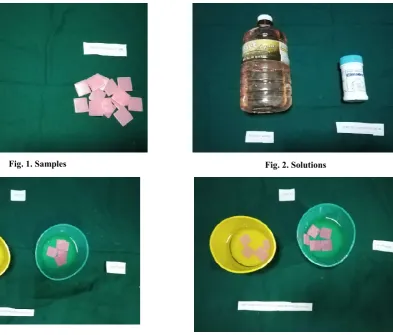
In this study, one heat cure and one self cure acrylic denture base materials were selected for comparative evaluation of sorption in different solutions at different time intervals. For the study, 15 samples each with dimensions of 20 mm × 20 mm × 2 mm were prepared (Fig 1)using heat cure and self cure acrylic resins separately for the different time intervals with three solutions like distilled water (Aqua diet), denture cleansing solution (Clinsodent), and combination of both solution at 1:1 seen in Fig 2. For each solution, five samples were used. Gypsum moulds were used to prepare the samples by using a preformed wax pattern of standard dimension. Gypsum mould preparation Wax patterns measuring 20 mm in length, 20 mm in width, and 2 mm in thickness were used to prepare a gypsum mould. Wax patterns were invested in the dental stone in the base of the flask. Two coatings of alginate separating media (cold mould seal) were then applied onto the set dental stone.
The counterpart of the flask was positioned over the base and filled with dental stone. The flask was placed on top of the vibrator, taking care not to cause air entrapment. The flask was
clamped immediately to ensure metal‑to‑metal contact
between the base and the counterpart of the flask. After setting, the wax was removed by immersing in a hot water bath without damaging the moulds. The moulds formed were then flushed with hot water to remove any traces of residue followed by the application of separating media. The mould cavities so obtained were used for the preparation of acrylic
resin specimen. Preparation of Trevalon ‑ heat cure acrylic
resin specimen The appropriate amount of Trevalon (Dentsply India Pvt., Ltd., Bangalore, India) heat cure acrylic resin required was prepared from a mixture of polymer and
monomer in the ratio of 3:1 by volume. The monomer was poured into a mixing jar and the polymer was slowly added to allow for wetting of the powder. Excess powder was removed. Then, it was thoroughly mixed for 1 min. After attaining the dough forming time, the dough was thoroughly kneaded between the fingers and the mould cavities were filled. The flask was closed and trial closure was carried out using flask clamp. The flask was then clamped, and the pressure was maintained for 30 min to allow proper penetration of monomer into polymer. The flask was immersed in an acrylizer (Confident Dental Equipment Ltd., Bangalore, and Karnataka, India) at room temperature. The temperature was raised to 74°C for 1.5 h, and then the temperature of the water bath was increased to boiling (100°C) for an additional hour.
After the completion of the curing cycle, the flask was removed from the water bath, bench cooled for 30 min, and immersed in cold water for 15 min prior to deflasking. The acrylic specimens were then retrieved, finished, and polished. The dimensions and quality of the specimens were verified. Fifteen specimens of 20 mm × 20 mm × 2 mm dimension were
obtained by this procedure. Preparation of Rapid Repair ‑ self
cure acrylic resin specimen The appropriate amount of Rapid Repair (Dentsply India, Pvt., Ltd.) self cure acrylic resin required was prepared from a mixture of polymer and monomer in the ratio of 3:1 by volume, i.e., three parts of polymer and one part of monomer. The monomer was poured into a mixing jar and the polymer was slowly added to allow for wetting of the powder. Excess powder was removed. Then, it was thoroughly mixed for 1 min. After attaining the dough forming time, the dough was thoroughly kneaded between the fingers and the mould cavities were filled. The flask was closed and trial closure was carried out using flask clamp, and pressure was maintained for 5 min to allow proper penetration of monomer into polymer.
After the completion of the self curing cycle, the flask was removed from the trial closure. The acrylic specimen was then retrieved, finished, and polished. The dimensions and quality of the specimens were verified. Fifteen specimens of 20 cm × 20 cm × 2 mm dimension were obtained by this procedure. Method to obtain sorption and solubility. The specimens were stored in different solutions (Table 1) at room temperature and sorption were tested by the weight gain/loss method, respectively, after 1 day, 7 days and 14 days (2weeks). Sorption was determined by the method described in the American Dental Association (ADA) specification 12 for
denture base polymers (Miettinen et al., 1997)
The samples were then immersed in:
Solution 1: Denture cleansing solution
Solution 2: Distilled water
Solution 3: Combination of Distilled water and denture
cleaning solution for 12 hrs alternatively. Seen in Fig 3, Fig. 4 and Fig. 5
The water sorption per unit volume is determined according to
the ISO standards 1567:1999 (Craig et al., 1992). SPSS 20.0
(Version 20, Dentsply India Pvt., Ltd, Bangalore, India) was used to obtain the statistical results of our study. Post hoc Tukey’s test was used to evaluate the sorption values of the heat cure and self cure resins at a time period of 1 day, 7 days and 14 days. Post hoc test for sorption of heat cured and self cured resins, respectively. Analysis of the results showed a significant difference in the sorption values at all time periods as assessed by Post hoc test.
Significant difference was observed in the solubility values in heat cure and self cure resins separately. There was no linear correlation between sorption values. According to post hoc Tukey’s test, the water sorption between the time and solution of storage was not statistically significant (P > 0.05).
DISCUSSION
[image:3.595.69.312.45.376.2]In the present study, the method recommended by the ISO for measuring water sorption was used.
[image:3.595.131.525.48.383.2]Fig. 1. Samples Fig. 2. Solutions
Fig. 3. Soaked in denture cleansing Fig. 4. Soaked in distilled water
[image:3.595.325.531.52.382.2]Fig. 5. Combination of both
Table 1. Time Interval
[image:3.595.194.406.407.571.2] [image:3.595.58.541.618.660.2]The water sorption was determined according to an increase in mass per unit volume. Acrylic resins absorb water slowly over a period of time, primarily because of the polar properties of the resin molecules. High equilibrium uptake of water can soften an acrylic resin because the absorbed water can act as a plasticizer of acrylate and reduce the strength of the material (Council of Dental Materials and Devices, 1975). The extent and rate of water uptake into polymer networks are predominantly controlled by resin polarity, dictated by the concentration of polar sites available to form hydrogen bonds
with water and network topology. (12) Arima et al. suggested
that the chemical nature of the polymer versus that of the water molecule directly affected the water sorption of resin. Water is absorbed into polymers by the polarity of the molecules in the polymers by unsaturated bonds of the molecules or unbalanced intermolecular forces in the polymers. The present study showed the least sorption value (5.700gm) for self cure resin in distilled water and highest sorption value for heat cure resin in distilled water(6.800gm) ,denture cleanser(6.600gm).
According to earlier studies (Geukens, 2001; Council of Dental
Materials and Devices, 1975)the water sorption of different
types of acrylates is 10–25 mm3. In the present study, the water
sorption values were in accordance with these studies. The rate at which the materials absorbed water or lost soluble components varied considerably with the type of material, the amount of plasticizer or filler content, and the solution in which they were immersed (Fletcher, 1983). This study has demonstrated that the solubility of heat cure and self cure resins in artificial saliva with denture cleanser was significantly higher than that in distilled water. The observed weight loss probably occurred because the plasticizers are more soluble in ionic solutions than in water. Conversely, the value of sorption by heat cure and self cure resins was significantly lower than that of distilled water. The absorption of water by the material results in a weight and volume increase. The compliance of the materials tested is dependent either on the presence of a plasticizer as in the case of the acrylic materials. An ideal material should, therefore, have no component which is soluble in saliva or water and should have a low level of absorption (Fletcher, 1983). The water sorption were determined according to the ISO standards 1567:1999
(Miettinen et al., 1997). According to this specification, water
sorption should not exceed 32 g/mm3 for heat cured or self cured materials.
The loss in mass per unit volume (soluble material) should not exceed 1.6 g/mm3 for heat cured and 8.0 g/mm3 for self cured
materials (Craig, 1992; Geukens et al., 2001) The values of
water sorption that were obtained as a result of our study are consistent with ADA standards and the values of water sorption that were mentioned by researchers above. In general, acrylic resins with incomplete polymerization cannot interact with the media during polymerization because of using all reactive substances. Furthermore, polymer molecules have very little capability of passing through the layers of epidermal tissue and being diffused because of their sizes. The reaction products and residual monomers that are present in the polymer structure move toward the surface and interact with the soft tissues. Thus, only the substances being on the surface
are biologically important. (21) To reduce the amount of these
substances in acrylic resin, this material needs to be kept in water for a long time. In this way, the substances with low molecular weight, in other words, more reactive substances
pass into the water (Henriks Eckerman et al., 2004).
Consequently, these substances cannot solute into a patient’s mouth and, in this way, the amount of potential allergen is reduced. The concentration of residual monomer can be reduced following an appropriate method of polymerization and for that reason, sufficient temperature and time are
required (Kazanji, 1988; Boeckler et al., 2008).In our study,
highly polymerized resin samples absorb more water than other samples. To reduce the amount of residual monomer in acrylic resins and pass it into water, prolonged boiling during
processing and keeping in water for long period is essential. (24)
The water molecules fill the space created in the structure of acrylic resin by diffusion. Therefore, more water sorption in heat cured acrylic resins was observed compared to self cured resins in different time intervals and solutions.
Conclusion
Both heat-cure and self-cure acrylic resins showed varying water sorption in different solution. The results of water sorption in different solutions showed compliance with the International Standards Organization specification. No correlation was found in water sorption in different solutions. Denture cleansing solution is a better storage medium than distilled water and combination of both (distilled water and denture cleansing solution) for both heat-cure and self-cure acrylic resins.
REFERENCES
Arima T., Murata H., Hamada T. 1996. The effects of
cross‑linking agents on the water sorption and solubility
characteristics of denture base resin. J Oral Rehabil.,
23:476‑80.
Barsby MJ. 1992. A denture base resin with low water
absorption. J Dent., 20:240‑4.
Boeckler AF., Morton D., Poser S., Dette KE. 2008. Release of dibenzoyl peroxide from polymethyl methacrylate denture
base resins: An in vitro evaluation. Dent Mater.,
24:1602‑7.
Council of Dental Materials and Devices. Revised American Dental Association specification no. 12 for denture base
polymers. JADA 1975;90:451‑8.
Craig RG. 2002. Restorative Dental Materials. 12th ed. Missouri, USA: Mosby Co. p. 656.
Craig RG., O’Brien WJ., Powers JM. 1992. Dental materials – Properties and manipulation. Plastics in Prosthetics. 5th ed. St. Louis: CV Mosby.
Cucci AL., Vergani CE., Giampaolo ET., Afonso MC. 1998. Water sorption, solubility, and bond strength of two
autopolymerizing acrylic resins and one heat‑polymerizing
acrylic resin. J Prosthet Dent., 80:434‑8.
Dixon DL., Ekstrand KG., Breeding LC. 1991. The transverse
strengths of three denture base resins. J Prosthet Dent.,
66:510‑3.
Fletcher AM., Purnaveja S., Amin WM., Ritchie GM., Moradians S, Dodd AW. 1983. The level of residual
monomer in self curing denture base materials. J Dent Res.,
62:118‑20.
Fujii K. 1989. Fatigue properties of acrylic denture base resins.
Dent Mater J., 8:243‑59.
Geukens S., Goossens A. 2001. Occupational contact allergy to
Henriks‑Eckerman ML., Suuronen K., Jolanki R., Alanko K.
2004. Methacrylates in dental restorative materials. Contact
Dermatitis., 50:233‑7.
Hiromori K., Fujii K., Inoue K. 2000. Viscoelastic properties
of denture base resins obtained by underwater test. J Oral
Rehabil., 27:522‑31.
Kazanji MN., Watkinson AC. 1988. Soft lining materials:
Their absorption of, and solubility in, artificial saliva. Br
Dent J., 165:91‑4.
Lai CP., Tsai MH., Chen M., Chang HS., Tay HH. 2004. Morphology and properties of denture acrylic resins cured
by microwave energy and conventional water bath. Dent
Mater., 20:133‑41.
Malacarne J., Carvalho RM., de Goes MF., Svizero N.,
Pashley DH., Tay FR., et al., 2006. Water
sorption/solubility of dental adhesive resins. Dent Mater.,
22:973‑80.
Miettinen VM., Vallittu PK., Docent DT. 1997. Water sorption
and solubility of glass fiber‑reinforced denture polymethyl
methacrylate resin. J Prosthet Dent., 77:531‑4.
Phillips RW. 1991. Skinner’s Science of Dental Materials. 9th
ed. Philadelphia: WB. Saunders Comp. p. 177‑213.
Rajesh Saini et al. 2016. Comparative study of sorption and
solubility of heat cure and self cure acrylic resins in
different solutions. Indian J Dent Res., 27:288-94.
Takahashi Y., Chai J., Kawaguchi M. 1998. Effect of water sorption on the resistance to plastic deformation of a denture base material relined with four different denture
reline materials. Int J Prosthodont., 11:49‑54.
Varpu M., Vallittu PK. 1996. Water sorption and solubility of glass fiber reinforced denture polymethyl methacrylate
resin. J Prosthet Dent., 76:531‑4.
Wiltshire WA., Ferreira MR., Ligthelm AJ. 1996. Allergies to
dental materials. Quintessence Int., 27:513‑20.
Woelfel JB., Paffenbarger GC., Sweeney WT. 1963. Some physical properties of organic denture base materials. J Am
Dent Assoc., 67:499‑504.
Wong DM., Cheng LY., Chow TW., Clark RK. 1999. Effect of processing method on the dimensional accuracy and water
sorption of acrylic resin dentures. J Prosthet Dent.,
81:300‑4.