Identifying Cascading Errors using Constraints in Dependency Parsing
Dominick Ng and James R. Curran
@-lab, School of Information Technologies University of Sydney
NSW 2006, Australia
{dominick.ng,james.r.curran}@sydney.edu.au
Abstract
Dependency parsers are usually evaluated on attachment accuracy. Whilst easily in-terpreted, the metric does not illustrate the cascading impact of errors, where the parser chooses an incorrect arc, and is sub-sequently forced to choose further incor-rect arcs elsewhere in the parse.
We apply arc-level constraints to MST-parser and ZPar, enforcing the correct analysis of specific error classes, whilst otherwise continuing with decoding. We investigate the direct and indirect impact of applying constraints to the parser. Er-roneous NP and punctuation attachments
cause the most cascading errors, while in-correct PP and coordination attachments
are frequent but less influential. Punctu-ation is especially challenging, as it has long been ignored in parsing, and serves a variety of disparate syntactic roles.
1 Introduction
Dependency parsers are evaluated using word-level attachment accuracy. Whilst comparable across systems, this does not provide insight into why the parser makes certain errors, or whether certain misattachments are caused by other errors. For example, incorrectly identifying a modifier head may only introduce a single attachment error, while misplacing the root of a sentence will create substantially more errors elsewhere. In projective dependency parsing, erroneous arcs can also force the parser to select other incorrect arcs.
Kummerfeld et al. (2012) propose a static post-parsing analysis to categorise groups of bracket er-rors in constituency parsing into higher level error
classes such as clause attachment. However, this cannot account for cascading changes resulting from repairing errors, or limitations which may prevent the parser from applying a repair. It is un-clear whether the parser will apply the repair op-eration in its entirety, or if it will introduce other changes in response to the repairs.
We develop an evaluation procedure to evalu-ate the influence of each error class in dependency parsing without making assumptions about how the parser will behave. We define error classes based on dependency labels, and use the depen-dencies in each class asarc constraintsspecifying the correct head and label for particular words in each sentence. We adapt parsers to apply these constraints, whilst otherwise proceeding with de-coding under their grammar and model. By eval-uating performance with and without constraints, we can directly observe the cascading impact of each error class on each the parser.
We implement our procedure for the graph-based MSTparser (McDonald and Pereira, 2006) and the transition-based ZPar (Zhang and Clark, 2011) using basic Stanford dependencies over the OntoNotes 4.0 release of theWSJ Penn Treebank
data. Our results show that erroneously attach-ingNPs, PPs, modifiers, and punctuation have the
largest overall impact onUAS. Of those, NPs and
punctuation have the most substantial cascading impact, indicating that these errors have the most effect on the remainder of the parse. Enforcing correct punctuation arcs has a particularly large impact on accuracy, even though most evaluation scripts ignore punctuation. We find that punctu-ation arcs are commonly misplaced by large dis-tances in the final parse, crossing over and forcing other arcs to be incorrect in the process.
We will make our source code available, and
The LME stocks decline was about as expected , but the Comex gain was n’t .
det amod
nn
nsubjpass auxpass
auxpass
advmod punct
cc det
nn nsubj ccomp
neg punct
root
The LME stocks decline was about as expected , but the Comex gain was n’t .
det
nn nn nsubj
advmod advmod ccomp
punct cc
det
nn nsubj conj
neg punct
[image:2.595.94.505.62.228.2]root
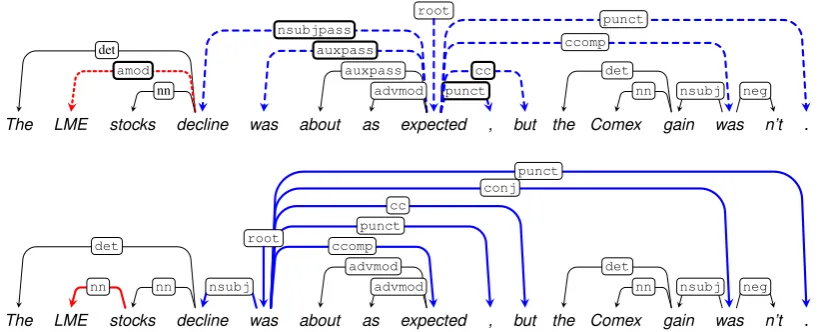
Figure 1: MSTparser output (top) and the gold parse (bottom) for aWSJ22 sentence. MSTparser
pro-duces two independent errors: anNPbracketing error (red, dotted), and an incorrect root (blue, dashed).
Parser UAS LAS usent lsent
MSTparser 91.3 87.5 41.3 26.1
[image:2.595.82.281.279.324.2]ZPar 91.7 89.3 45.1 35.9
Table 1: BaselineUASandLASscores on Stanford
dependencies overWSJ22.
hope that our findings will drive efforts address-ing the remainaddress-ing dependency parsaddress-ing errors.
2 Motivation
Table 1 summarises the performance of MST-parser and ZPar on Stanford dependencies over OntoNotes 4 WSJ 22. ZPar performs slightly
better than MSTparser on UAS, and substantially
better on LAS. However, these numbers do not
show what types of errors are being made by each parser, what errors remain to be addressed, or hint at what underlying problems cause each error.
Figure 1 depicts aWSJ22 sentence as parsed by
MSTparser, and the gold parse. TheUASis 47.1%,
with 8 of 17 arcs correct. By contrast, ZPar (parse not shown) scores 94.1%, with the sole attachment error being on LME (as with MSTparser). While there are nine incorrect arcs overall, MSTparser seems to have made only two underlying errors:
• LMEattached todeclinerather thanstocks(NP
internal). Correcting this repairs one error; • expectedbeing chosen as the root rather than
was. Correcting the root and moving all at-tachments to it from the old root repairs the remaining eight errors.
Intuitively, it seems that the impact of the NP
error is limited. By contrast, the root selection
error has a substantial impact on the second half of the sentence, causing a misplaced subject, mis-attached punctuation, and incorrect coordination. These cascaded errors appear to becaused bythe incorrect root.
What we do not know is whether these intu-itions actually hold. Many dependency parsers, including MSTparser and ZPar, construct trees by repeatedly combining fragments together until a spanning analysis is found, using a small window of information to make each arc decision. An er-ror in one part of the tree may have no influence on a different part of the tree. Alternatively, er-rors may exert long-range influence — particularly if there are higher-order features or algorithmic constraints such as projectivity over the tree. As parsing algorithms are complex, we wish to repair various error types in isolation without otherwise making assumptions regarding the subsequent ac-tions of the parser.
3 Applying Constraints
We investigate how each parser behaves when cer-tain errors in the tree are corrected. We force each parser to select the correct head and label for spe-cific words, but otherwise allow it to construct its best parse. Given a set of constraints, each of which lists a word with the head and label to which it must be attached, we investigate two measures:
1. errors directly corrected by the constraints, called theconstrained accuracy impact;
arcsindirectly destroyed, together called the
cascaded accuracy impact.
The constrained accuracy impact tells us how often the parser makes errors in the set of words covered by the constraints. The cascaded accu-racy impact is less predictable, as it describes what effect the errors made over the constrained set of arcs have over the rest of the sentence. It is the
influence of the set of constraints over the other attachments, which may be mediated through pro-jectivity requirements, or changes in the context used for other parsing decisions.
The core of our procedure is adapting each parser to accept a set of constraints. Following Kummerfeld et al. (2012), we define meaningful error classes grouped with the operations that re-pair them. In dependency parsing, error classes are groups of Stanford dependency labels, rather than groups of node repair operations. The Stan-ford labels provide a rich distinction inNPinternal
structure, clauses, and modifiers, and map well to the error categories of Kummerfeld et al. (2012), allowing us to avoid excessive heuristics in the mapping process. Our technique can be applied to other dependency schemes such as LTH
(Johans-son and Nugues, 2007) by defining new mappings from labels to error types.
The difficulty of the mapping task depends on the intricacies of each formalism. The major challenge withLTHdependencies is the enormous
skew towards the nominal modifier NMOD label. This label occurs 11,335 times in WSJ 22, more
than twice as frequently as the next most fre-quent punctuation P. By contrast, the most com-mon Stanford label is punctuation, at 4,731 occur-rences. TheNMODlabel is split into many smaller, but more informative nominal labels in the Stan-ford scheme, making it better suited for our goal of error analysis.
The label grouping was performed with refer-ence to the Stanford dependencies manual v2.04 (de Marneffe and Manning, 2008, updated 2012). For each error class, we generate a set of con-straints over WSJ 22 for all words with a
gold-standard label in the set associated with the class. Our types are defined as follows:
NP attachment: any label specifically attaching
anNP, includesappos,dobj,iobj,nsubj,
nsubjpass,pobj, andxsubj.
NP internal: any label marking nominal
struc-ture (not including adjectival modifiers),
in-cludes abbrev, det, nn, number, poss, possessive, andpredet.
PP attachment: any label attaching a
preposi-tional phrase, includes prep. Also includes pcompif thePOSof the word isTOorIN.
Clause attachment: any label attaching a
clause, includes advcl, ccomp, csubj, csubjpass, purpcl, rcmod, and xcomp. Also includespcompif thePOSof the word is
notTOorIN.
Modifier attachment: any label attaching
an adverbial or adjectival modifier, includes advmod, amod, infmod, npadvmod, num, partmod,quantmod, andtmod.
Coordination attachment: conj, cc, and
preconj.
Root attachment: therootlabel.
Punctuation attachment: thepunctlabel.
Other attachment: all other Stanford labels,
specifically acomp, attr, aux, auxpass, complm,cop,dep,expl,mark,mwe,neg, parataxis,prt,ref, andrel.
For example, Root constraints specify sentence roots, whilePPconstraints specify heads of
prepo-sitional phrases.
One deficiency of our implementation is that we apply constraints to all arcs of a particular error type in each sentence, and do not isolate multiple instances of the same error class in a sentence. We do this since applying single constraints to a sen-tence at a time would require substantial modifica-tions to the standard evaluation regime.
3.1 MSTparser implementation
MSTparser is a graph-based, second-order parser that uses Eisner (1996)’s algorithm for projective decoding (McDonald and Pereira, 2006).1 Eis-ner’s algorithm constructs and caches subtrees which span progressively larger sections of the sentence. These spans are marked either as com-plete, consisting of a head, a dependent, and all of the descendants of that head to one side, or in-complete, consisting of a head, a dependent, and an unfilled region where additional tokens may be attached. Dependencies are formed between the head and dependent in each complete span, while label assignment occurs as a separate process.
We enforce constraints by allowing complete spans to be formed only from constrained tokens
1As the variant of Stanford dependencies we use are
to their correct heads with the correct labels. Any complete span between an incorrect head and the constrained token is forbidden. The algorithm is forced to choose the constrained spans as it builds the parse; these constraints have no impact on the parser’s coverage as all possible head selections are considered.
3.2 ZPar implementation
ZPar is an arc-eager transition-based parser (Zhang and Clark, 2011) that uses an incremen-tal process with a stack storing partial parsestates
(Nivre et al., 2004). Each state represents tokens that may accept further arcs. The tokens of a sen-tence are initially stored in a buffer, and at each point during parsing, the parser decides whether or not to create an arc between thefront token of the buffer and thetoptoken on the stack.
We apply constraints in a similar way to Nivre et al. (2014). Arc creation actions are factored on the dependency label to be assigned to the arc. ZPar scores each possible action using a percep-tron model over features from the front of the buffer and the top of the stack (as well as some ad-ditional context features which refer to previously created states). The highest scoring actions and their resulting states are kept in a beam; during parsing, ZPar finds the optimal action for all items in the beam, and retains the highest scoring new states at each step.
We disallow any arc creation action that would create an arc that conflicts with any constraints. Due to the use of beam search, it is possible for all of the partial states containing the constrained arcs to be evicted from the beam if they score lower under the model than other states. When this hap-pens, the parser will fail to find an analysis for the sentence, as no head will exist in the beam for the constrained token. We have deliberately chosen to not address this issue as any solution (e.g. increas-ing the beam size from its default of 64) would change the decisions of the parser and model.
We verified that our modifications were work-ing correctly for both parsers by passwork-ing in zero constraints (checking that the output matched the baseline performance), and every possible con-straint (checking that the output scored 100%).
4 Related Work
Kummerfeld et al. (2012) perform a comprehen-sive classification of constituency bracket errors
and their cascading impact, and their work is philosophically similar to ours. They associate groups of bracket errors in the parse with abstract error classes, and identify the tree operations that repair these error types, such as the insertion, dele-tion, or substitution of nodes in the parse tree. The error classes in a particular parser’s output are identified through a heuristic procedure that re-peatedly applies the operation repairing the largest number of bracket errors. This approach differs from our methodology as it is a static post-process that assumes the parser would respond perfectly to each repair, when it is possible that the parser may not perform the repair in full, or even be incapable of constructing the repaired tree.
McDonald and Nivre (2011) perform an in-depth comparison of the graph-based MSTparser and transition-based MaltParser. However, Malt-Parser uses support vector machines to determinis-tically predict the next transition, rather than stor-ing the most probable options in a beam like ZPar. Additionally, they do not focus on the cascad-ing impact of errors, and instead concentrate on higher-level error classification (e.g. by POStag,
labels and dependency lengths) in lieu of examin-ing how the parsers respond to forced corrections. Nivre et al. (2014) describe several uses for arc-level constraints in transition-based parsing. How-ever, these applications focus on improving pars-ing accuracy when constraints can be readily iden-tified, e.g. imperatives at the beginning of a sen-tence are likely to be the root. We focus our con-straints on evaluation, attempting to identify im-portant sources of error in dependency parsers.
Our constraint-based approach shares similar-ities to oracle training and decoding methods, where an external source of truth is used to ver-ify parser decisions. An oracle source of parser actions is a necessary component for training transition-based parsers (Nivre, 2009). Oracle de-coding, where a system is forced to produce cor-rect output if possible, can be used to assess its up-per up-performance bounds (Ng and Curran, 2012).
de-The LME stocks decline was about as expected , but the Comex gain was n’t .
det amod
nn nsubj prep advmod pobj punct
cc
det
nn nsubj conj
neg punct
[image:5.595.122.485.62.146.2]root
Figure 2: MSTparser output for the sentence in Figure 1, where the root dependency is forced to its correct value. The incorrect noun phrase error is not affected by the constraint (dashed, red), six attachment errors are repaired (solid, blue), and two new errors are introduced (dotted, purple).
Constraints 3 7 Remaining Errors None 8 9 see Figure 1
nn 9 8 All exceptdecline→LME
root 14 3 decline→LME about→expected was→about
punct 14 3 decline→LME about→expected was→about
[image:5.595.82.280.214.320.2]ccomp 16 1 decline→LME
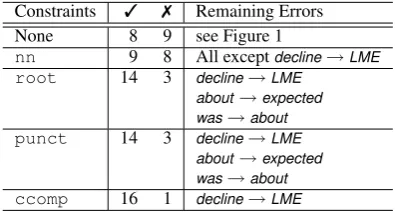
Table 2: Correct and incorrect arcs, and the re-maining errors after applying various sets of con-straints to the sentence in Figure 1.
pendency parsing, achieving parsing speeds close to linear-time transition parsers despite encoding more complex features. Supertagging (Clark and Curran, 2007) and chart pruning (Zhang et al., 2010) have been used to constrain the search space of a CCG parser, and to remove unlikely or
for-bidden spans from repeated consideration. In our work, we use pruning not for parsing speed, but evaluation, and so we prune items based on gold-standard constraints rather than heuristics.
5 Evaluation
We use the training (sections 2-21) and develop-ment (section 22) data from the OntoNotes 4.0 release of the Penn Treebank WSJ data
(Mar-cus et al., 1993), as supplied by the SANCL
2012 Shared Task on Parsing the Web (Petrov and McDonald, 2012). OntoNotes annotates en-riched NP structure compared to the Penn
Tree-bank (Weischedel et al., 2011), meaning that deter-miningNPattachments is less trivial. We changed
all marker tokens in the corpus (e.g. -LRB-and -LCB-) to their equivalent unescaped punctuation marks to ensure correct evaluation. The corpus has been converted to basic Stanford dependencies us-ing the Stanford Parser v2.0,2 and part-of-speech
2nlp.stanford.edu/software/lex-parser.shtml
tagged using MXPOST (Ratnaparkhi, 1996). A
model trained on WSJ sections 2-21 was used to
tag the development set, and 10-fold jackknife training was used to tag the training data.
We implement a custom evaluation script to facilitate a straightforward comparative analysis between the unconstrained and constrained out-put. The script is based on and produces identi-cal scores toeval06.pl, the official evaluation for the CoNLL-X Shared Task on Multilingual Dependency Parsing (Buchholz and Marsi, 2006). We ignore punctuation as defined byeval06.pl in our evaluation; experiments with constraints over punctuation tokens constrain those tokens in the parse, but ignore them during evaluation.
We run the modified parsers over WSJ 22 with
and without each set of constraints. We ex-amine the overall unlabeled and labeled attach-ment scores (UAS and LAS), as well as
identify-ing the contribution to the overall UAS
improve-ment from directly (constrained) and indirectly corrected arcs.
MSTparser uses coarse-grained tags and fine-grained POS tags in its features, both of which
were provided by the CoNLL-X Shared Task. We approximate the coarse-grainedPOStags by taking
the first character of the MXPOST-assigned POS
tag, a technique also used by Bansal et al. (2014)3.
6 Results
Figure 2 and Table 2 show the impact of applying constraints on tokens with various labels to MST-parser for the sentence in Figure 1. Enforcing the goldnnarc betweendecline andLME repairs that noun phrase error, but does not affect any of the other errors. Conversely, enforcing the goldroot arc does not affect the noun phrase error, but re-pairs nearly every other error in the parse. Un-fortunately, the constrained root arc introduces
Error class cover eff eff % disp UAS LAS ∆UAS ∆c ∆u
Baseline 100.0 - - - 91.3 87.5 - -
-NPattachment 95.6 312 4.9 5.2 94.1 90.7 2.3 1.2 1.1
NPinternal 98.2 206 3.2 2.8 92.6 89.2 1.1 0.8 0.3
Modifier attachment 96.8 321 7.9 3.8 93.4 90.3 1.7 1.2 0.5
PPattachment 98.3 378 13.1 4.3 93.2 89.5 1.7 1.4 0.3
Coordination attachment 97.7 238 16.0 5.8 92.9 89.5 1.3 0.9 0.4
Clause attachment 96.7 228 17.9 6.9 93.0 89.6 1.4 0.9 0.5
Root attachment 99.1 77 5.8 9.3 92.2 88.3 0.8 0.3 0.5
Punctuation attachment 93.2 469 14.2 7.4 93.9 89.9 1.8 0.1 1.7
Other attachment 94.3 210 7.0 6.1 93.5 90.8 1.4 0.8 0.6
[image:6.595.86.512.274.442.2]All attachments 98.5 2912 9.3 5.8 100.0 100.0 8.6 8.6 0.0
Table 3: The coverage, effective constraints and percentage, error displacement,UAS,LAS,∆UAS over
the corrected arcs, and the constrained and cascaded∆for MSTparser overWSJ22 (covered by ZPar).
Error class cover eff eff % disp UAS LAS ∆UAS ∆c ∆u
Baseline 100.0 - - - 91.7 89.2 - -
-NPattachment 95.6 277 4.3 4.8 94.9 92.7 2.4 1.0 1.4
NPinternal 98.2 197 3.0 3.0 93.2 91.1 1.2 0.7 0.5
Modifier attachment 96.8 303 7.5 3.9 94.0 92.3 1.8 1.1 0.7
PPattachment 98.3 357 12.4 3.9 93.8 91.4 1.7 1.3 0.4
Coordination attachment 97.7 240 16.2 5.8 93.5 91.1 1.3 0.9 0.4
Clause attachment 96.7 166 13.0 5.6 93.4 91.2 1.2 0.6 0.6
Root attachment 99.1 57 4.3 9.9 92.4 89.9 0.5 0.2 0.3
Punctuation attachment 93.2 430 13.0 7.3 94.5 92.1 1.6 0.2 1.5
Other attachment 94.3 187 6.3 5.5 94.2 92.7 1.3 0.7 0.6
All attachments 98.5 2760 8.8 5.8 100.0 100.0 8.0 8.0 0.0
Table 4: The coverage, effective constraints and percentage, error displacement,UAS,LAS,∆UAS over
the baseline, and the constrained and cascaded∆for ZPar overWSJ22.
two new errors, with the parser incorrectly attach-ing the clausal complement headed by expected and the modifier headed by about. In fact, cor-recting theccomparc in isolation rather than the root arc leads to MSTparser producing the full correct analysis for the second half of the sentence (though again, it does not repair the separate noun phrase error). This example highlights why we have chosen to implement our evaluation as a set of constraints in the parser, rather than Kummer-feld et al. (2012)’s post-processing approach, as we cannot know that the parser will react as we expect it to when repairing errors.
Tables 3 and 4 summarise our results on MST-parser and ZPar, calculated over the sentences covered by ZPar in WSJ22. Results over the full WSJ 22 for MSTparser were consistent with these
figures. We focus on discussingUASresults in this
paper, sinceLASresults are consistent.
TheUASof constrained arcs in each experiment
is the expected 100%. Effective constraints repair an error in the baseline, and the effective constraint percentage is this figure expressed as a percentage, i.e. the error rate. Error displacement is the av-erage number of words that effective constraints moved an attachment point. The overall ∆UAS
improvement is divided into ∆c, the constrained impact, and∆u, the cascaded impact.
It is important to note that a parser may make a substantial number of mistakes on a particular error class (large effective constraint percentage), but correcting those mistakes may have very little cascading impact (small∆c), limiting the overall
6.1 Overall Parser Comparison
When applying all constraints, ZPar has a 8.8% effective constraint percentage compared to 9.3% for MSTparser. This is directly related to theUAS
difference between the parsers. Aside from coor-dination, where the parsers made a nearly identi-cal number of errors, ZPar is more accurate across the board. It makes substantially fewer mistakes on clause attachments, punctuation dependencies, and NP attachments, whilst maintaining a small
advantage across all of the other categories. The relative rank of the effective constraint per-centage per error category is similar across the parsers, with PP attachment, punctuation,
modi-fiers, and coordination recording the largest num-ber of effective constraints, and thus the most er-rors. This illustrates that the behaviour of both parsers is very consistent, despite one considering every possible attachment point, and the other us-ing a linear transition-based beam search. ZPar is able to make fewer mistakes across each error category, suggesting that the beam search pruning is maintaining more desired states than the graph-based parser is able to rank during its search.
ZPar’s coverage is 98.5% when applying all constraints. However, as the number of con-straints is reduced, coverage also drops. This seems counter-intuitive, but applying more con-straints eliminates more undesired states, leaving more space in the beam for satisfying states. Re-ducing the number of constraints permits more states which do not yet violate a constraint, but only yield undesired states later.
Punctuation constraints have the largest impact on coverage, reducing it to 93.2%. NP
attach-ments, clauses, and modifier attachments also in-cur substantial coverage reductions. This suggests that ZPar’s performance will degrade substantially over the sentences which it cannot cover, as they must contain constructions which are dispreferred by the model and fall out of the beam. Constraints with the smallest effect on coverage include root attachments, which only occur once per sentence and are rarely incorrect, andNPinternal andPP
at-tachments. For the latter two, the small displace-ments suggest that alternate attachment points of-ten lie within the same projective span.
6.2 Noun phrases
ApplyingNPattachment constraints causes a 4.4%
drop in coverage for ZPar, and the effective
con-straint percentage is below 5% for both parsers. However, these constraints still result in the largest
∆UAS for both parsers, at 2.6% for MSTparser and 2.2% for ZPar. This reflects the prevalence ofNPattachments in the corpus.
∆UAS is split evenly between correcting con-strained (1.4%) and cascaded arcs (1.2%) for MSTparser, while it skews towards cascaded arcs for ZPar (1.0% and 1.4%). Most error classes skew in the other direction, while repairing oneNP
attachment error typically repairs another non-NP
attachment error.
For NP internal attachments, both parsers have
a similar error rate, with 206 effective constraints for MSTparser and 197 for ZPar. Although this is the second largest class, applying these constraints gives the second smallest ∆u for both parsers. This implies that determining NP internal
struc-ture is a strength, even with the more complex OntoNotes 4 NP structure. ∆c is also small for
both parsers, reinforcing the limited displacement and cascading impact ofNPinternal errors.
Despite fewer effective constraints (i.e. less errors to fix), ZPar exhibits more cascading re-pair than MSTparser using both NP and NP
in-ternal constraints. This will be a common theme through this evaluation: the transition-based ZPar is better at propagating effective constraints into cascaded impact than the graph-based MSTparser, even though ZPar almost always begins with fewer effective constraints due to its better baseline per-formance. One possibility to explain this is that the beam is actually pruning away other erroneous states, while the graph-based MSTparser must still consider all of them.
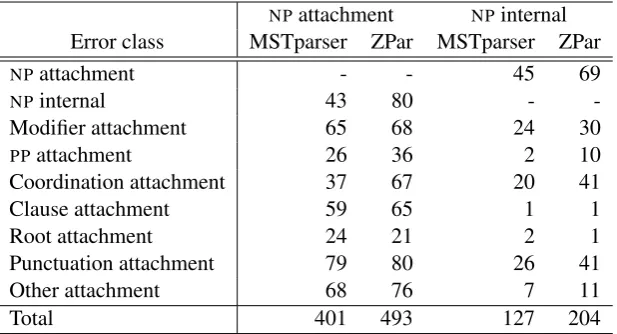
Table 5 summarises the error classes of cor-rected cascaded arcs for the two NP constraint
types, which are closely related. NP attachment
constraints directly identify the head of theNPas
well as its correct attachment, providing strong cues for determining the internal structure. NP
in-ternal constraints implicitly identify the head of an
NP. We can see that for both types of constraints,
many of the cascaded corrections come from the otherNPerror class.
Table 5 also shows that, compared to MST-parser, ZPar repairs nearly twice as manyNP
inter-nal and coordination errors when usingNP
attach-ment constraints, and vice versa when using NP
NPattachment NPinternal
Error class MSTparser ZPar MSTparser ZPar
NPattachment - - 45 69
NPinternal 43 80 -
-Modifier attachment 65 68 24 30
PPattachment 26 36 2 10
Coordination attachment 37 67 20 41
Clause attachment 59 65 1 1
Root attachment 24 21 2 1
Punctuation attachment 79 80 26 41
Other attachment 68 76 7 11
[image:8.595.146.455.62.229.2]Total 401 493 127 204
Table 5: The number of unconstrained errors repaired per error class when enforcingNPattachment and NPinternal constraints for MSTparser and ZPar overWSJ22.
nominal coordination, and often chooses a word which should be a nominal modifier instead.
6.3 Coordination, Modifiers andPPs
These categories are large error classes for both parsers, with constraints leading to UAS
improve-ments of 1.3 to 1.7%.
PPs and coordination have high effective
con-straint percentages relative to the other error classes for both parsers. However, they are also amongst the most isolated errors, with only 0.3% and 0.4% ∆u for MSTparser and ZPar respec-tively. These errors also have minimal impact on ZPar’s coverage. Both classes seem to have rela-tively contained attachment options within a lim-ited projective span. The small error displace-ments reinforce this idea.
Modifiers are relatively isolated errors for MST-parser (0.5%∆u), but less so for ZPar (0.7%∆u). There are substantially more modifier constraints thanPPor coordination, despite all yielding a
sim-ilarUASincrease. This suggests that modifiers are
actually relatively well analysed by both parsers, but there are so many of them that they form a large source of error.
6.4 Clause attachment
MSTparser performs substantially worse than ZPar on clause attachments, with an effective con-straint percentage of 17.9% compared to 13.0%, and ∆c of 0.9% compared with 0.6%. MST-parser’s error rate is the worst of any error class on clause attachments, while it is second to coor-dination attachments for ZPar. Attaching clauses is very challenging for dependency parsers,
partic-ularly considering the small size of the class. ZPar again achieves a slightly larger cascaded impact than MSTparser (0.6% to 0.5%), despite having far fewer effective constraints. This im-plies that the additional clause errors being made by MSTparser are largely self-contained, as they have not triggered a corresponding increase in∆u.
6.5 Root attachment
Both parsers make few root attachment errors, though MSTparser is less accurate than ZPar. However, root constraints provide the largestUAS
improvement per number of constraints for both parsers. Root errors are also the most displaced of any error class, at 9.3 words for MSTparser and 9.9 for ZPar. When the root is incorrect, it is of-ten very far from its correct location, and causes substantial cascading errors.
6.6 Punctuation
Despite ignoring punctuation dependencies in evaluation, applying punctuation constraints led to substantial UAS improvements. On MSTparser, ∆u is 0.1% (due to some punctuation not being excluded from evaluation), but ∆c is 1.7%. On ZPar, the equivalent metrics are 0.2% and 1.5%. Enforcing correct punctuation has a disproportion-ate impact on the remainder of the parse.
Error class MSTparser ZPar
NPattachment 75 51
NPinternal 25 27
Modifier attachment 33 43
PPattachment 45 55
Coordination attachment 87 106
Clause attachment 66 48
Root attachment 59 27
Other attachment 65 69
[image:9.595.74.289.61.203.2]Total 455 426
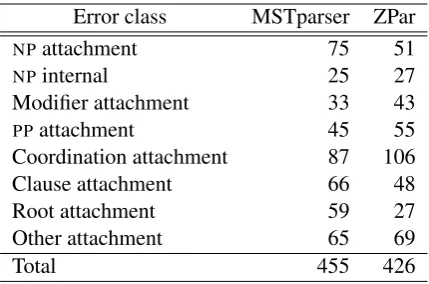
Table 6: The number of unconstrained errors re-paired per error class when enforcing punctuation constraints for MSTparser and ZPar.
contain even more punctuation errors.
Incorrect punctuation heads are displaced from their correct locations by 7.4 words for MSTparser and 7.3 words for ZPar on average, second only to root attachments. Given that we are using projec-tive parsers and a projecprojec-tive grammar, the large av-erage displacement caused by errors indicates that punctuation affects and is in turn affected by the requirement for non-crossing arcs.
Table 6 summarises the error classes of the re-paired cascaded arcs when punctuation constraints are applied. MSTparser has a more even distri-bution of repairs, while ZPar’s repairs are con-centrated in coordination attachment. This shows that MSTparser is relatively better at coordination as a proportion of its overall performance com-pared to ZPar. It also indicates that the majority of punctuation errors in both parsers (and especially ZPar) stem from incorrectly identified coordina-tion markers such as commas.
Punctuation is commonly ignored in depen-dency parser evaluation (Yamada and Matsumoto, 2003; Buchholz and Marsi, 2006), and they are inconsistently treated across different grammars. Our results show that enforcing the correct punc-tuation attachments in a sentence has a substan-tial cascading impact, suggesting that punctua-tion errors are highly correlated with errors else-where in the analysis. Given the broad simi-larities between Stanford dependencies and other dependency schemes commonly used in parsing (Søgaard, 2013), we anticipate that the problems with roots and punctuation will carry across dif-ferent treebanks and schemes.
Punctuation is often placed at phrasal bound-aries and serves to split sentences into smaller
sec-tions within a projective parser. Graph-based and transition-based parsers, both of which use a lim-ited local context to make parsing decisions, are equally prone to the cascading impact of erroneous punctuation. Removing the confounding presence of punctuation from parsing and treating attach-ment as a global post-process may help to allevi-ate these issues. Alternatively, more punctuation-specific features to account for its myriad roles in syntax could serve to improve performance.
7 Conclusion
We have developed a procedure to classify the im-portance of errors in dependency parsers without any assumptions on how the parser will respond to attachment repairs. Our approach constrains the parser to allow only correct arcs for certain tokens, whilst allowing it to otherwise form the parse that it thinks is best. Compared to Kummerfeld et al. (2012), we can observe exactly how the parser re-sponds to the parse repairs, though at the cost of requiring modifications to the parser itself.
Our results show that noun phrases remain chal-lenging for dependency parsers, both in choosing the correct head, and in determining the internal structure. Punctuation, despite being commonly ignored in parsers and evaluation, causes substan-tial cascading errors when misattached.
We are extending our work to other popular de-pendency parsers and non-projective parsing algo-rithms, and hope to develop features to improve and mitigate the cascading impact of punctuation attachment errors in parsing. Given that con-stituency parsers perform strongly when converted to dependencies (Cer et al., 2010; Petrov and Mc-Donald, 2012), it would also be interesting to in-vestigate how they perform on our metrics.
We implement a robust procedure to identify the cascading impact of dependency parser errors. Our results provide insights into which errors are most damaging in parsing, and will drive further improvements in parsing accuracy.
References
Sabine Buchholz and Erwin Marsi. 2006. CoNLL-X Shared Task on Multilingual Dependency Parsing. InProceedings of the Tenth Conference on Computational Natural Language Learning (CoNLL-06), pages 149–164.
Daniel Cer, Marie-Catherine de Marneffe, Dan Jurafsky, and Chris Manning. 2010. Parsing to Stanford Dependencies: Trade-offs between Speed and Accuracy. InProceedings of the Sev-enth International Conference on Language Re-sources and Evaluation (LREC-10).
Eugene Charniak and Mark Johnson. 2005. Coarse-to-Fine n-Best Parsing and MaxEnt Dis-criminative Reranking. In Proceedings of the 43rd Annual Meeting of the Association for Computational Linguistics (ACL-05), pages 173–180.
Stephen Clark and James R. Curran. 2007. Formalism-Independent Parser Evaluation with CCG and DepBank. InProceedings of the 45th Annual Meeting of the Association for Compu-tational Linguistics (ACL-07), pages 248–255. Prague, Czech Republic.
Marie-Catherine de Marneffe and Christopher D. Manning. 2008. Stanford dependencies manual. Technical report, Stanford University.
Jason Eisner. 1996. Three New Probabilistic Mod-els for Dependency Parsing: An Exploration. In
Proceedings of the 16th International Confer-ence on Computational Linguistics (COLING-96), pages 340–345.
Jason Eisner and A. Noah Smith. 2005. Parsing with Soft and Hard Constraints on Dependency Length. In Proceedings of the Ninth Interna-tional Workshop on Parsing Technology (IWPT-05), pages 30–41.
Richard Johansson and Pierre Nugues. 2007. Ex-tended Constituent-to-dependency Conversion for English. In Proceedings of the 16th Nordic Conference of Computational Linguis-tics (NODALIDA-07), pages 105–112. Tartu, Estonia.
Jonathan K. Kummerfeld, David Hall, James R. Curran, and Dan Klein. 2012. Parser Show-down at the Wall Street Corral: An Empirical Investigation of Error Types in Parser Output. InProceedings of the 2012 Joint Conference on Empirical Methods in Natural Language Pro-cessing and Computational Natural Language
Learning (EMNLP-CoNLL-12), pages 1048– 1059.
Mitchell P. Marcus, Beatrice Santorini, and Mary Ann Marcinkiewicz. 1993. Building a Large Annotated Corpus of English: The Penn Treebank. Computational Linguistics, 19(2):313–330.
Ryan McDonald and Joakim Nivre. 2011. Analyz-ing and IntegratAnalyz-ing Dependency Parsers. Com-putational Linguistics, 37(1):197–230.
Ryan McDonald and Fernando Pereira. 2006. Online Learning of Approximate Dependency Parsing Algorithms. In Proceedings of the 11th Conference of the European Chapter of the Association for Computational Linguistics (EACL-06), pages 81–88.
Dominick Ng and James R. Curran. 2012. Depen-dency Hashing for n-best CCG Parsing. In Pro-ceedings of the 50th Annual Meeting of the As-sociation for Computational Linguistics (ACL-12), pages 497–505.
Joakim Nivre. 2009. Non-Projective Dependency Parsing in Expected Linear Time. In Proceed-ings of the Joint Conference of the 47th An-nual Meeting of the ACL and the 4th Interna-tional Joint Conference on Natural Language Processing of the AFNLP (ACL-09), pages 351– 359.
Joakim Nivre, Yoav Goldberg, and Ryan McDon-ald. 2014. Constrained arc-eager dependency parsing.Computational Linguistics, 40(2):249– 257.
Joakim Nivre, Johan Hall, and Jens Nilsson. 2004. Memory-Based Dependency Parsing. In HLT-NAACL 2004 Workshop: Eighth Conference on Computational Natural Language Learning (CoNLL-04), pages 49–56.
Slav Petrov and Ryan McDonald. 2012. Overview of the 2012 Shared Task on Parsing the Web. InNotes of the First Workshop on the Syntactic Analysis of Non-Canonical Language (SANCL-12).
Adwait Ratnaparkhi. 1996. A Maximum Entropy Model for Part-of-Speech Tagging. In Proceed-ings of the 1996 Conference on Empirical Meth-ods in Natural Language Processing (EMNLP-96), pages 133–142.
Pars-ing. In Proceedings of the 2012 Conference of the North American Chapter of the Association for Computational Linguistics: Human Lan-guage Technologies (NAACL-12), pages 498– 507.
Anders Søgaard. 2013. An Empirical Study of Differences between Conversion Schemes and Annotation Guidelines. In Proceedings of the 2nd International Conference on Dependency Linguistics, pages 298–307.
Ralph Weischedel, Eduard Hovy, Mitchell Mar-cus, Martha Palmer, Robert Belvin, Sameer Pradhan, Lance Ramshaw, and Nianwen Xue. 2011. OntoNotes: A Large Training Corpus for Enhanced Processing. In Joseph Olive, Caitlin Christianson, and John McCary, editors, Hand-book of Natural Language Processing and Ma-chine Translation: DARPA Global Autonomous Language Exploitation, pages 54–63. Springer. Hiroyasu Yamada and Yuji Matsumoto. 2003. Sta-tistical Dependency Analysis with Support Vec-tor Machines. In Proceedings of the 8th In-ternational Workshop of Parsing Technologies (IWPT-03), pages 196–206.
Yue Zhang, Byung-Gyu Ahn, Stephen Clark, Curt Van Wyk, James R. Curran, and Laura Rimell. 2010. Chart Pruning for Fast Lexicalised-Grammar Parsing. In Proceedings of the 23rd International Conference on Computa-tional Linguistics (COLING-10), pages 1471– 1479.