Learning Semantic Word Embeddings based on
Ordinal Knowledge Constraints
Quan Liu† and Hui Jiang‡ and Si Wei§ and Zhen-Hua Ling† and Yu Hu§ †National Engineering Laboratory for Speech and Language Information Processing
University of Science and Technology of China, Hefei, China
‡Department of Electrical Engineering and Computer Science, York University, Canada §iFLYTEK Research, Hefei, China
emails: [email protected], [email protected], [email protected], [email protected], [email protected]
Abstract
In this paper, we propose a general frame-work to incorporate semantic knowledge into the popular data-driven learning pro-cess of word embeddings to improve the quality of them. Under this framework, we represent semantic knowledge as many ordinal ranking inequalities and formu-late the learning of semantic word embed-dings (SWE) as a constrained optimiza-tion problem, where the data-derived ob-jective function is optimized subject to all ordinal knowledge inequality constraints extracted from available knowledge re-sources such as Thesaurus and Word-Net. We have demonstrated that this con-strained optimization problem can be ef-ficiently solved by the stochastic gradient descent (SGD) algorithm, even for a large number of inequality constraints. Experi-mental results on four standard NLP tasks, including word similarity measure, sen-tence completion, name entity recogni-tion, and the TOEFL synonym selecrecogni-tion, have all demonstrated that the quality of learned word vectors can be significantly improved after semantic knowledge is in-corporated as inequality constraints during the learning process of word embeddings.
1 Introduction
Distributed word representation (i.e., word embed-ding) is a technique that represents words as con-tinuous vectors, which is an important research topic in natural language processing (NLP) (Hin-ton et al., 1986; Turney et al., 2010). In re-cent years, it has been widely used in various NLP tasks, including neural language model (Ben-gio et al., 2003; Schwenk, 2007), sequence la-belling tasks (Collobert and Weston, 2008; Col-lobert et al., 2011), machine translation (Devlin et
al., 2014; Sutskever et al., 2014), and antonym se-lection (Chen et al., 2015). Typically, word vectors are learned based onthe distributional hypothesis
(Harris, 1954; Miller and Charles, 1991), which assumes that words with a similar context tend to have a similar meaning. Under this hypothe-sis, various models, such as the skip-gram model (Mikolov et al., 2013a; Mikolov et al., 2013b; Levy and Goldberg, 2014) and GloVe model (Pen-nington et al., 2014), have been proposed to lever-age the context of each word in large corpora to learn word embeddings. These methods can ef-ficiently estimate the co-occurrence statistics to model contextual distributions from very large text corpora and they have been demonstrated to be quite effective in a number of NLP tasks. How-ever, they still suffer from some major limitations. In particular, these corpus-based methods usu-ally fail to capture the precise meanings for many words. For example, some semantically related but dissimilar words may have similar contexts, such as synonyms and antonyms. As a result, these corpus-based methods may lead to some antony-mous word vectors being located much closer in the learned embedding space than many synony-mous words. Moreover, as word representations are mainly learned based on the co-occurrence in-formation, the learned word embeddings do not capture the accurate relationship between two se-mantically similar words if either one appears less frequently in the corpus.
To address these issues, some recent work has been proposed to incorporate prior lexical knowl-edge (WordNet, PPDB, etc.) or knowlknowl-edge graph (Freebase, etc.) into word representations. Such knowledge enhanced word embedding methods have achieved considerable improvements on var-ious natural language processing tasks, like (Yu and Dredze, 2014; Bian et al., 2014; Xu et al., 2014). These methods attempt to increase the se-mantic similarities between words belonging to
one semantic category or to explicitly model the semantic relationships between different words. For example, Yu and Dredze (2014) have proposed a new learning objective function to enhance word embeddings by combining neural models and a prior knowledge measure from semantic re-sources. Bian et. al (2014) have recently proposed to leverage morphological, syntactic, and semantic knowledge to improve the learning of word em-beddings. Besides, a novel framework has been proposed in (Xu et al., 2014) to take advantage of both relational and categorical knowledge to learn high-quality word representations, where two reg-ularization functions are used to model the re-lational and categorical knowledge respectively. More recently, a retrofitting technique has been in-troduced in (Faruqui et al., 2014) to improve se-mantic vectors by leveraging lexicon-derived rela-tional information in a post-processing stage.
In this paper, we propose a new and flexible method to incorporate semantic knowledge into the corpus-based learning of word embeddings. In our approach, we propose to represent seman-tic knowledge as many word ordinal ranking in-equalities. Furthermore, these inequalities are cast as semantic constraints in the optimization pro-cess to learn semantically sensible word embed-dings. The proposed method has several advan-tages. Firstly, many different types of seman-tic knowledge can all be represented as a num-ber of such ranking inequalities, such as synonym-antonym, hyponym-hypernym and etc. Secondly, these inequalities can be easily extracted from many existing knowledge resources, such as The-saurus, WordNet (Miller, 1995) and knowledge graphs. Moreover, the ranking inequalities can also be manually generated by human annotation because ranking orders is much easier for human annotators than assigning specific scores. Next, we present a flexible learning framework to learn distributed word representation based on the ordi-nal semantic knowledge. By solving a constrained optimization problem using the efficient stochas-tic gradient descent algorithm, we can obtain se-mantic word embedding enhanced by the ordinal knowledge constraints. Experiments on four pop-ular natural language processing tasks, including word similarity, sentence completion, name en-tity recognition and synonym selection, have all demonstrated that the proposed method can learn good semantically sensible word embeddings.
2 Representing Knowledge By Ranking
Many types of lexical semantic knowledge can be quantitatively represented by a large number of ranking inequalities such as:
similarity(wi, wj)>similarity(wi, wk) (1)
where wi, wj andwk denote any three words in
vocabulary. For example, eq.(1) holds ifwj is a
synonym of wi andwk is an antonym of wi. In
general, the similarity between a word and its syn-onymous word should be larger than the similar-ity between the word and its antonymous word. Moreover, a particular word should be more sim-ilar to the words belonging to the same semantic category as this word than other words belonging to a different category. Besides, eq.(1) holds ifwi
andwjhave shorter distance in a semantic
hierar-chy thanwiandwkdo in the same hierarchy
(Lea-cock and Chodorow, 1998; Jurafsky and Martin, 2000).
Equivalently, each of the above similarity in-equalities may be represented as the following constraint in the embedding space:
sim(w(1)i ,w(1)j )>sim(w(1)i ,w(1)k ) (2)
wherew(1)i ,wj(1)andw(1)k denote the embedding vectors of the words,wi,wjandwk.
In this paper, we use the following three rules to gather the ordinal semantic knowledge from avail-able lexical knowledge resources, such as The-saurus and WordNet.
• Synonym Antonym Rule: Similarities be-tween a word and its synonymous words are always larger than similarities be-tween the word and its antonymous words. For example, the similarity between fool-ish and stupid is expected to be bigger than the similarity between foolish and
clever, i.e., similarity(foolish,stupid) > similarity(foolish,clever).
...
wk-N wk-N+1 wk+N-1 wk+N
wk Skip-gram
wi wj
d(k,i) > d(k,j)
wp wq
d(k,p) > d(k,q)
...
...
Semantic Ordinal Constraints
wt-c wt-c+1 wt+c-1 wt+c
wt
Machine: Hi, please give a similarity value to those two words. Human: Uh, it is difficult to do it, just give me a little time. Paradigm shift…> ranking idea.
Machine: Hi, here are two word pairs, would you please give a similarity ranking decision for them?
Human: Yes, here you are!
W(1) W(2)
wt-c wt-c+1 wt+c-1 wt+c
wt
W(1)
W(2)
sim(wt,wi) > sim(wj,wk)
wi wj wk
Share Embedding
Semantic Knowledge Resources
W(1) WordNet Human Labeling Knowledge Has Knowledge ? Minimize Qsem Semantic Knowledge Input Word YES Maximize Qbase Word Sequence Get training samples
Color
Red Blue Green
Puple Tool
Hammer Chisel Saw
Mallet
wt-c wt-c+1 wt+c-1 wt+c
wt
W(1)
W(2)
sim(wi,wj) > sim(wj,wk)
wi wj wk
Share Embedding
Semantic Knowledge Resources
W(1) WordNet Human Labeling Knowledge Bases Objective-1: Qbase Objective-2: Qsem Joint Optimization
Plessor Hacksaw Jigsaw Hypernym
[image:3.595.75.295.68.127.2]Hyponyms Co-Hyponyms
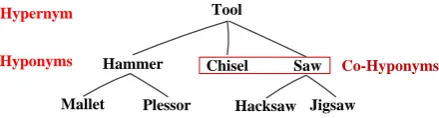
Figure 1: An example of hyponym and hypernym.
knowledge graphs. Figure 1 shows a sim-ple examsim-ple of the relationship between hy-ponyms and hypernyms. From there, it is reasonable to assume the following similar-ity inequalsimilar-ity:similarity(Mallet,Plessor) > similarity(Mallet,Hacksaw).
• Semantic Hierarchy Rule: Similarities be-tween words that have shorter distances in a semantic hierarchy should be larger than similarities of words that have longer dis-tances. In this work, the semantic hi-erarchy refers to the hypernym and hy-ponym structure in WordNet. From Fig-ure 1, this rule may suggest several inequal-ities like: similarity(Mallet,Hammer) > similarity(Mallet,Tool).
In addition, we may generate many such se-mantically ranking similarity inequalities by hu-man annotation through crowdsourcing.
3 Semantic Word Embedding
In this section, we first briefly review the conven-tional skip-gram model (Mikolov et al., 2013b). Next, we study how to incorporate the ordinal sim-ilarity inequalities to learn semantic word embed-dings.
3.1 The skip-gram model
The skip-gram model is a recently proposed learn-ing framework (Mikolov et al., 2013b; Mikolov et al., 2013a) to learn continuous word vectors from text corpora based on the aforementioned distribu-tional hypothesis, where each word in vocabulary (size ofV) is mapped to a continuous embedding space by looking up an embedding matrix W(1). And W(1) is learned by maximizing the predic-tion probability, calculated by another predicpredic-tion matrixW(2), of its neighbouring words within a context window.
Given a sequence of training data, denoted as
w1, w2, w3, ..., wT with T words, the skip-gram
model aims to maximize the following objective function:
Q= T1 XT t=1
X
−c≤j≤c,j6=0
logp(wt+j|wt) (3)
where c is the size of context windows, wt
de-notes the input central word andwt+jfor its
neigh-bouring word. The skip-gram model computes the above conditional probabilityp(wt+j|wt)
us-ing the followus-ing softmax function:
p(wt+j|wt) = exp(w
(2)
t+j·w(1)t )
PV
k=1exp(w(2)k ·w(1)t )
(4)
wherew(1)t andw(2)k denotes row vectors in ma-tricesW(1) andW(2), corresponding to wordwt andwkrespectively.
The training process of the skip-gram model can be formulated as an optimization problem to maximize the above objective functionQ. As in (Mikolov et al., 2013b), this optimization problem is solved by the stochastic gradient descent (SGD) method and the learned embedding matrix W(1) is used as the word embeddings for all words in vocabulary.
3.2 Semantic Word Embedding (SWE) as Constrained Optimization
Here we consider how to combine the ordinal knowledge representation in section 2 and the skip-gram model in 3.1 to learn semantic word embeddings (SWE).
As shown in section 2, each ranking inequal-ity involves a triplet, (i, j, k), of three words, {wi, wj, wk}. Assume the ordinal knowledge is
represented by a large number of such inequalities, denoted as the inequality setS. For∀(i, j, k)∈S, we have:
similarity(wi, wj)>similarity(wi, wk)
⇔sim(w(1)i ,w(1)j )>sim(w(1)i ,w(1)k ).
For notational simplicity, we denote sij =
sim(w(1)i ,w(1)j )hereafter.
Next, we propose to use the following con-strained optimization problem to learn semantic word embeddings (SWE):
{W(1),W(2)}= arg max
W(1),W(2) Q(W
(1),W(2))
...
wk-N wk-N+1 wk+N-1 wk+N
wk Skip-gram
wi wj
d(k,i) > d(k,j)
wp wq
d(k,p) > d(k,q)
...
...
Semantic Ordinal Constraints
wt-c wt-c+1 wt+c-1 wt+c
wt
Machine: Hi, please give a similarity value to those two words. Human: Uh, it is difficult to do it, just give me a little time.
Paradigm shift…> ranking idea.
Machine: Hi, here are two word pairs, would you please give a similarity ranking decision for them?
Human: Yes, here you are!
W(1)
W(2)
wt-c wt-c+1 wt+c-1 wt+c
wt W(1) W(2)
sim(wt,wi) > sim(wj,wk)
wi wj wk
Share Embedding
Semantic Knowledge Resources
W(1) WordNet Human Labeling Knowledge Has Knowledge ? Minimize Qsem Semantic Knowledge Input Word YES Maximize Qbase Word Sequence Get training samples
Color
Red Blue Green
Puple
Tool
Hammer Chisel Saw
Mallet
wt-c wt-c+1 wt+c-1 wt+c
wt W(1)
W(2)
sim(wi,wj) > sim(wi,wk)
wi wj wk
Share Embedding
Semantic Knowledge Resources
W(1) WordNet Human Labeling Knowledge Bases Distributional Hypothesis Knowledge Constraints Joint Optimization
Plessor Hacksaw Jigsaw
Hypernym
[image:4.595.114.491.67.190.2]Hyponyms Co-Hyponyms
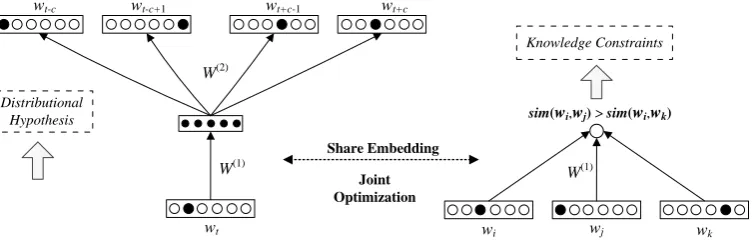
Figure 2: The proposed semantic word embedding (SWE) learning framework (The left part denotes the state-of-the-art skip-gram model; The right part represents the semantic constraints).
subject to
sij > sik ∀(i, j, k)∈S. (6)
In this work, we formulate the above con-strained optimization problem into an uncon-strained one by casting all the constraints as a penalty term in the objective function. The penalty term can be expressed as follows:
D= X
(i,j,k)∈S
f(i, j, k) (7)
where the function f(·) is a normalization func-tion. It can be a sigmoid function likef(i, j, k) = σ(sik−sij) withσ(x) = 1/(1 + exp(−x)).
Al-ternatively, it may be a hinge loss function like
f(i, j, k) =h(sik−sij)whereh(x) = max(δ0, x) with δ0 denoting a parameter to control the de-cision margin. In this work, we adopt to use the hinge function to compute the penalty term in eq.(7) andδ0is set to be 0 for all experiments.
Finally, the proposed semantic word embed-ding (SWE) model aims to maximize the follow-ing combined objective function:
Q0 =Q −β· D (8)
whereβis a control parameter to balance the con-tribution of the penalty term in the optimization process. It balances between the semantic infor-mation estimated from the corpus based on the distributional hypothesis and the semantic knowl-edge encoded in the ordinal ranking inequalities. In Rockt¨aschel et al. (2014), a similar approach was proposed to capture knowledge constraint as extra terms in the objective function for optimiza-tion.
In Figure 2, we show a diagram for the the over-all SWE learning framework to incorporate se-mantic knowledge into the basic skip-gram word
embeddings. Comparing with the previous work in (Xu et al., 2014) and (Faruqui et al., 2014), the proposed SWE framework is more general in terms of encoding the semantic knowledge for learning word embeddings. It is straightforward to show that the work in (Xu et al., 2014; Zweig, 2014; Faruqui et al., 2014) can be viewed as some special cases under our SWE learning framework.
3.3 Optimization algorithm for SWE
In this work, the proposed semantic word em-beddings (SWE) are learned using the standard mini-batch stochastic gradient descent (SGD) al-gorithm. Furthermore, we adopt to use the cosine distance of the embedding vectors to compute the similarity between two words in the penalty term. In the following, we show how to compute the derivatives of the penalty term for the SWE learn-ing.
∂D
∂wt(1) =
X
(i,j,k)∈S
∂f(sik−sij) ∂wt(1)
= X
(i,j,k)∈S
f0· δik(t) ∂sik
∂w(1)t −δij(t)
∂sij ∂w(1)t
!
(9)
whereδik(t)andδij(t)are computed as
δik(t) =
(
1 t=iort=k
0 otherwise (10)
and for the hinge loss functionf(x), we have
f0 =
(
1 (sik−sij)> δ0
0 (sik−sij)≤δ0 (11)
and the derivatives of the cosine similarity mea-sure,sij = w
(1) i ·w(1)j
vec-tor, i.e., ∂sik
∂w(1)i , which can be derived as follows:
∂sij ∂wi(1) =−
sijw(1)i
|w(1)i |2 +
w(1)j
|w(1)i ||w(1)j |. (12)
The learning rate used for the SWE learning is the same as that for the skip-gram model. In each mini-batch of SGD, we sample terms in the same way as the skip-gram model. As for the con-straints, we do not sample them but use all inequal-ities relevant to any words in a minibatch to update the model for the minibatch. Finally, by jointly op-timizing the two terms in the combined objective function, we may learn a new set of word vectors encoding with ordinal semantic knowledge.
4 Experiments
In this section, we report all experiments con-ducted to evaluate the effectiveness of the pro-posed semantic word embeddings (SWE). Here we compare the performance of the proposed SWE model with the conventional skip-gram baseline model on four popular natural language processing tasks, including word similarity mea-sure, sentence completion, name entity recogni-tion, and synonym selection. In the following, we first describe the experimental setup, training corpora, semantic knowledge databases. Next, we report the experimental results on these four NLP tasks. Note that the SWE training codes and scripts are made publicly available athttp:
//home.ustc.edu.cn/˜quanliu/.
4.1 Experimental setup 4.1.1 Training corpora
In this work, we use the popular Wikipedia cor-pus as our training data to learn word embeddings for experiments on the word similarity task and the TOEFL synonym selection task. Particularly, we utilize two Wikipedia corpora with different sizes. The first corpus with a smaller size is a data set including the first one billion characters from Wikipedia1, named asWiki-Smallin our ex-periments. The second corpus with a relatively large size is the latest Wikipedia dump2, named asWiki-Largein our experiments. Both Wikipedia corpora have been pre-processed by removing all
1http://mattmahoney.net/dc/enwik9.zip
2
http://dumps.wikimedia.org/enwiki/latest/enwiki-latest-pages-articles.xml.bz2
the HTML meta-data and hyper-links and replac-ing the digit numbers with English words usreplac-ing the perl script from the Matt Mahoney’s page3. After text normalization, theWiki-Smallcorpus contains totally 130 million words, for which we create a lexicon of 225,909 distinct words appearing more than 5 times in the corpus. Similarly, the Wiki-Large corpus contains about 5 billion words, for which we create a lexicon of 228,069 words ap-pearing more than 200 times.
For the other two tasks, sentence completion and name entity recognition, we use the same training corpora from the previous state-of-the-art work for fair comparisons. The training corpus for the sentence completion is the Holmes text (Zweig and Burges, 2011; Mikolov et al., 2013a). The training corpus for the name entity recognition task is the Reuters English newswire from RCV1 (Turian et al., 2010; Lewis et al., 2004). Refer to section 4.4 and section 4.5 for detailed descrip-tions respectively.
4.1.2 Semantic constraint collections
In this work, we use WordNet as the resource to collect ordinal semantic knowledge. WordNet is a large semantic lexicon database of English words (Miller, 1995), where nouns, verbs, adjectives and adverbs are grouped into sets of cognitive syn-onyms (usually called synsets). Each synset usu-ally expresses a distinct semantic concept. All synsets in WordNet are interlinked by means of conceptual-semantic and/or lexical relations such as synonyms and antonyms, hypernyms and hy-ponyms.
In our experiments, we use the version WordNet-3.1 for creating the corresponding se-mantic constraints. In detail, we follow the fol-lowing process to extract semantic similarity in-equalities from WordNet and Thesaurus:
1. Based on the Synonym Antonym Rule de-scribed in section 2, for each word in vo-cabulary, find its synset and use the syn-onym and antsyn-onym relations to find all re-lated synonymous and antonymous synsets. Note that the antonymous synset is selected as long as there exists an antonymous rela-tion between any word in this synset and any word in an synonymous synset. After find-ing the synonymous and antonymous synsets
of the current word, the similarity inequali-ties could be generated according to the rank-ing rule. After processrank-ing all words, we have collected about 30,000 inequalities re-lated to the synonym and antonym relations. Furthermore, we extract additional 320,000 inequalities from an old English dictionary (Fernald, 1896). In total, we have about 345,000 inequalities related to the synonym and antonym relations. This set of inequali-ties is denoted asSynon-Antonconstraints in our experiments.
2. Based on theSemantic Category Ruleand Se-mantic Hierarchy Rule, we extract another in-equality set consisting of 75,000 inequalities from WordNet. We defined this collection as
Hyper-Hyponconstraints in our experiments.
In the following experiments, we just use all of these collected inequality constraints as is without further manually checking or cleaning-up. They may contain a very small percentage of errors or conflicts (due to multiple senses of a word).
4.1.3 Training parameter setting
Here we describe the control parameters used to learn the baseline skip-gram model and the pro-posed SWE model. In our experiments, we use the open-source word2vec toolkit4 to train the base-line skip-gram model, where the context window size is set to be 5. The initial learning rate is set as 0.025 and the learning rate is decreased lin-early during the SGD model training process. We use the popular negative sampling technique to speed up model training and set the negative sam-ple number as 5.
To train the proposed SWE model, we use the same configuration as the skip-gram model to maximizeQ0. For the penalty term in eq. (7), we
setδ0 = 0for the hinge loss function. The seman-tic similarity between words is computed by the cosine distance. The combination coefficientβ in eq. (8) is usually set to be a number between 0.001 and 0.3 in our experiments.
In the following four NLP tasks, the dimension-ality of embedding vectors is different since we try to use the same settings from the state-of-the-art work for the comparison purpose. In the Word Similarity task and the TOEFL Synonym Selec-tion task, we followed the state of the art work
4https://code.google.com/p/word2vec.
50 55 60 65 70 75 80 85 90 95 100
0.00 0.05 0.10 0.15 0.20 0.25 0.30
Sat
is
fi
ed
R
at
e
(%
)
beta (β)
Semantic Inequality Satisfied Rate Curve
Hyper-Hypon
[image:6.595.310.528.65.208.2]Synon-Anton
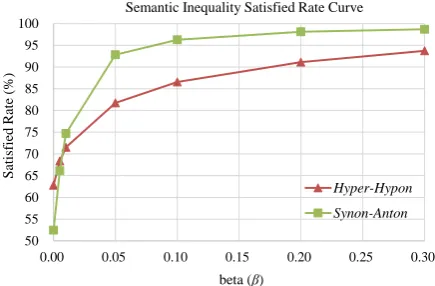
Figure 3: A curve of inequality satisfied rates (All models trained on theWiki-Smallcorpus. Hyper-HyponandSynon-Antonstand for different seman-tic constraint sets employed for training semanseman-tic word embeddings).
in (Xu et al., 2014), to set word embeddings to 300-dimension. Similarly, we refer to Bian et al. (2014) to set the dimensionality of word vectors to 600 for the Sentence Completion task. And we set the dimensionality of word vectors to 50 for the NER task according to (Turian et al., 2010; Pen-nington et al., 2014).
4.2 Semantic inequality satisfied rates
Here we first examine the inequality satisfied rates of various word embeddings. The inequality sat-isfied rate is defined as how many percentage of semantic inequalities are satisfied based on the un-derlying word embedding vectors. In Figure 3, we show a typical curve of the inequality satis-fied rates as a function of β used in model train-ing. This figure is plotted based on theWiki-Small
corpus. Two semantic constraint setsSynon-Anton
andHyper-Hyponcreated in section 4.1.2 are em-ployed to learn semantic word embeddings.
cover a subset of words in vocabulary. Increasing the rate too much may screw up the entire word embeddings due to the sparsity of the constraints.
Meanwhile, we have found that the proposed SGD method is very efficient to handle a large number of inequalities in model training. When we use the total 345,000 inequalities, the SWE training is comparable with the baseline skip-gram model in terms of training speed. In the following, we continue to examine the SWE model on four popular natural language processing tasks, includ-ing word similarity, sentence completion, name entity recognition and the TOEFL synonym selec-tion.
4.3 Task 1: Word Similarity Task 4.3.1 Task description
Measuring word similarity is a traditional NLP task (Rubenstein and Goodenough, 1965). Here we compare several word embedding models on a popular word similarity task, namely WordSim-353 (Finkelstein et al., 2001), which contains WordSim-353 English word pairs along with human-assigned similarity scores, which measure the relatedness of each word pair on a scale from 0 (totally unre-lated words) to 10 (very much reunre-lated or identical words). The final similarity score for each pair is the average across 13 to 16 human judges. When evaluating word embeddings on this task, we mea-sure the performance by calculating the Spearman rank correlation between the human judgments and the similarity scores computed based on the learned word embeddings.
4.3.2 Experimental results
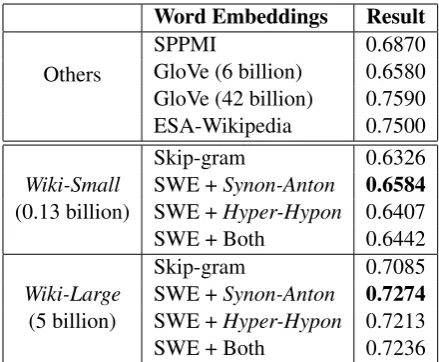
Here we compare the proposed SWE model with the baseline skip-gram model on the WordSim-353 task. Both word embedding models are trained using the Wikipedia corpora. We set the di-mension of word embedding vectors to be 300. In Table 1, we have shown all the Spearman rank cor-relation results. The baseline results on this task include PPMI (Levy and Goldberg, 2014), GloVe (Pennington et al., 2014), and ESA-Wikipedia (Gabrilovich and Markovitch, 2007).
From the results in Table 1, we can see that the proposed SWE model can achieve consistent im-provements over the baseline skip-gram model, no matter which training corpus is used. These re-sults have demonstrated that, by incorporating se-mantic ordinal knowledge into the word vectors,
Word Embeddings Result
Others
SPPMI 0.6870
GloVe (6 billion) 0.6580 GloVe (42 billion) 0.7590
ESA-Wikipedia 0.7500
Skip-gram 0.6326
Wiki-Small SWE +Synon-Anton 0.6584
(0.13 billion) SWE +Hyper-Hypon 0.6407
SWE + Both 0.6442
Skip-gram 0.7085
Wiki-Large SWE +Synon-Anton 0.7274
(5 billion) SWE +Hyper-Hypon 0.7213
[image:7.595.306.526.61.242.2]SWE + Both 0.7236
Table 1: Spearman results on the WordSim-353 Task.
the proposed semantic word embedding frame-work can capture much better semantics for many words. The SWE model using the Wiki-Large
corpus has achieved the state-of-the-art perfor-mance on this task, significantly outperforming other popular word embedding methods, such as skip-gram and GloVe. Moreover, we also find that the Synon-Anton constraint set is more relevant thanHyper-Hyponfor the word similarity task.
4.4 Task 2: Sentence Completion Task 4.4.1 Task description
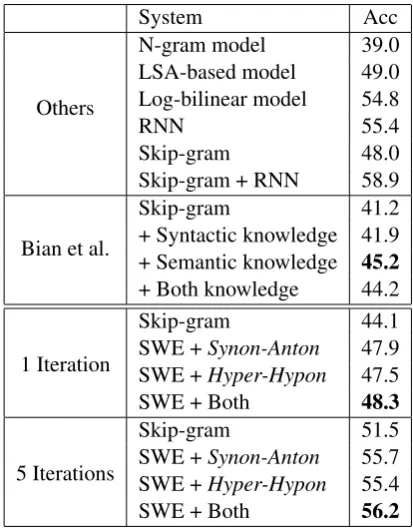
The Microsoft sentence completion challenge has recently been introduced as a standard benchmark task for language modeling and other NLP tech-niques (Zweig and Burges, 2011). This task con-sists of 1040 sentences, each of which misses one word. The goal is to select a word that is the most coherent with the rest of the sentence, from a list of five candidates. Many NLP techniques have already been reported on this task, includ-ing N-gram model and LSA-based model pro-posed in (Zweig and Burges, 2011), log-bilinear model (Mnih and Teh, 2012), recurrent neural networks (RNN) (Mikolov, 2012), the skip-gram model (Mikolov et al., 2013a), a combination of the skip-gram and RNN model, and a knowledge enhanced word embedding model proposed by Bian et. al. (2014). The performance of all these techniques is listed in Table 2 for comparison.
600-dimension word embeddings based on a training corpus of 50M words provided by (Zweig and Burges, 2011), with and without using the col-lected ordinal knowledge. Then, for each sen-tence in the test set, we use the learned word em-beddings to compute a sentence score for predict-ing all surroundpredict-ing words based on each candidate word in the list. Finally, we use the computed sen-tence prediction scores to choose the most likely word from the given list to answer the question.
System Acc
Others
N-gram model 39.0
LSA-based model 49.0
Log-bilinear model 54.8
RNN 55.4
Skip-gram 48.0
Skip-gram + RNN 58.9
Bian et al.
Skip-gram 41.2
+ Syntactic knowledge 41.9 + Semantic knowledge 45.2
+ Both knowledge 44.2
1 Iteration
Skip-gram 44.1
SWE +Synon-Anton 47.9
SWE +Hyper-Hypon 47.5
SWE + Both 48.3
5 Iterations
Skip-gram 51.5
SWE +Synon-Anton 55.7
SWE +Hyper-Hypon 55.4
SWE + Both 56.2
Table 2: Results on Sentence Completion Task.
4.4.2 Experimental results
In Table 2, we have shown the sentence comple-tion accuracy on this task for various word em-bedding models. We can see that the proposed SWE model has achieved considerable improve-ments over the baseline skip-gram model. Once again, this suggests that the semantic knowledge represented by the ordinal inequalities can signif-icantly improve the quality of the word embed-dings. Besides, the SWE model significantly out-performs the recent work in (Bian et al., 2014), which considers syntactics and semantics of the sentence contexts.
4.5 Task 3: Name Entity Recognition 4.5.1 Task description
To further investigate the performance of seman-tic word embeddings, we have further conducted
some experiments on the standard CoNLL03 name entity recognition (NER) task. The CoNLL03 NER dataset is drawn from the Reuters newswire. The training set contains 204K words (14K sentences, 946 documents), the test set contains 46K words (3.5K sentences, 231 doc-uments), and the development set contains 51K words (3.3K sentences, 216 documents). We have listed the state-of-the-art performance in Table 3 for this task (Turian et al., 2010).
To make a fair comparison, we have used the exactly same experimental configurations as in (Turian et al., 2010), including the used training algorithm, the baseline discrete features and so on. Like the C&W model, we use the same training text resource to learn word vectors, which contains one year of Reuters English newswire from RCV1, from August 1996 to August 1997, having about 810,000 news stories (Lewis et al., 2004). Mean-while, the dimension of word embeddings is set to 50 for all experiments on this task.
4.5.2 Experimental results
In our experiments, we compare the proposed SWE model with the baseline skip-gram model for name entity recognition, measured by the standard F1 scores. We present the final NER F1 scores on the CoNLL03 NER task in Table 3. The nota-tion “Gaz” stands for gazetteers that are added into the NER system as an auxiliary feature. For the SWE model, we experiment two configurations by adding gazetteers or not (denoted by “IsGaz” and “NoGaz” respectively).
System Dev Test MUC7
Others C&WC&W + Gaz 92.3 87.993.0 88.9 75.781.4
NoGaz
Skip-gram 92.6 88.3 76.7
+Synon-Anton 92.5 88.4 77.2 +Hyper-Hypon 92.6 88.6 77.7
+ Both 92.6 88.4 77.5
IsGaz
Skip-gram 93.3 89.5 80.0
+Synon-Anton 93.1 89.6 80.7 +Hyper-Hypon 93.1 89.7 80.7
[image:8.595.77.284.208.473.2]+ Both 93.0 89.5 80.8
Table 3: F1 scores on the CoNLL03 NER task.
mat-ter whether the gazetteers features are used or not. The proposed SWE model can also obtain 0.3% improvement in the CoNLL03 test set when no gazetteers is added into the NER system. How-ever, no significant improvement is observed in this test set for the proposed SWE model after we add the gazetteers feature.
4.6 Task 4: TOEFL Synonym Selection 4.6.1 Task description
The goal of a synonym selection task is to se-lect, from a list of candidate words, the semanti-cally closest word for each given target word. The dataset we use for this task is the standard TOEFL dataset (Landauer and Dumais, 1997), which con-tains 80 questions. Each question consists of a tar-get word along with 4 candidate lexical substitutes for selection.
The evaluation criterion on this task is the synonym selection accuracy which indicates how many synonyms are correctly selected for all 80 questions. Similar to the configurations on the word similarity task, all the experiments on this task are conducted on the English Wikipedia cor-pora. In our experiments, we set all the vector di-mensions to 300.
4.6.2 Experimental Results
Corpus Model Accuracy (%)
Wiki-Small
Skip-gram 61.25
+Synon-Anton 70.00
+Hyper-Hypon 66.25
+ Both 71.25
Wiki-Large
Skip-gram 83.75
+Synon-Anton 87.50
+Hyper-Hypon 85.00
[image:9.595.74.289.452.579.2]+ Both 88.75
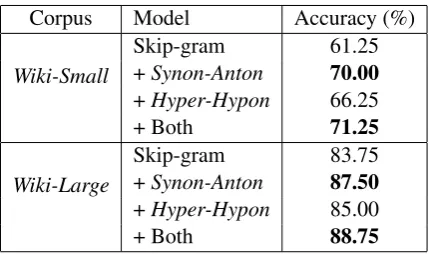
Table 4: The TOEFL synonym selection task.
In Table 4, we have shown the experimen-tal results for different word embedding models, learned from different Wikipedia corpora: Wiki-Small or Wiki-Large. We compare the proposed SWE with the baseline skip-gram model. From the experimental results in Table 4, we can see that the proposed SWE model can achieve consistent improvements over the baseline skip-gram model on the TOEFL synonym selection task, about 5-8% improvements on the selection accuracy. We find the similar performance differences between
the SWE model trained with theSynon-Antonand
Hyper-Hypon constraint set. The main reason would be that the synonym selection task is mainly related to lexical level similarity and less relevant to the hypernym-hyponym relations.
5 Conclusions and Future Work
Word embedding models with good semantic rep-resentations are quite invaluable to many natu-ral language processing tasks. However, the cur-rent data-driven methods that learn word vectors from corpora based on the distributional hypoth-esis tend to suffer from some major limitations. In this paper, we propose a general and flexible framework to incorporate various types of seman-tic knowledge into the popular data-driven learn-ing procedure for word embeddlearn-ings. Our main contributions are to represent semantic knowledge as a number of ordinal similarity inequalities as well as to formulate the entire learning process as a constrained optimization problem. Meanwhile, the optimization problem could be solved by effi-cient stochastic gradient descend algorithm. Ex-perimental results on four popular NLP tasks have all demonstrated that the propose semantic word embedding framework can significantly improve the quality of word representations.
As for the future work, we would incorpo-rate more types of knowledge, such as knowledge graphs and FrameNet, into the learning process for more powerful word representations. We also expect that some common sense related semantic knowledge may be generated as ordinal inequality constraints by human annotators for learning se-mantic word embeddings. At the end, we plan to apply the SWE word embedding models for more natural language processing tasks.
Acknowledgments
References
Yoshua Bengio, R´ejean Ducharme, Pascal Vincent, and Christian Jauvin. 2003. A neural probabilistic lan-guage model. Journal of Machine Learning Re-search, 3:1137–1155.
Jiang Bian, Bin Gao, and Tie-Yan Liu. 2014. Knowledge-powered deep learning for word embed-ding. InMachine Learning and Knowledge Discov-ery in Databases, pages 132–148. Springer. Zhigang Chen, Wei Lin, Qian Chen, Xiaoping Chen,
Si Wei, Xiaodan Zhu, and Hui Jiang. 2015. Revis-iting word embedding for contrasting meaning. In
Proceedings of ACL.
Ronan Collobert and Jason Weston. 2008. A unified architecture for natural language processing: Deep neural networks with multitask learning. In Pro-ceedings of ICML, pages 160–167. ACM.
Ronan Collobert, Jason Weston, L´eon Bottou, Michael Karlen, Koray Kavukcuoglu, and Pavel Kuksa. 2011. Natural language processing (almost) from scratch. Journal of Machine Learning Research, 12:2493–2537.
Jacob Devlin, Rabih Zbib, Zhongqiang Huang, Thomas Lamar, Richard Schwartz, and John Makhoul. 2014. Fast and robust neural network joint models for sta-tistical machine translation. InProceedings of ACL, pages 1370–1380.
Manaal Faruqui, Jesse Dodge, Sujay K Jauhar, Chris Dyer, Eduard Hovy, and Noah A Smith. 2014. Retrofitting word vectors to semantic lexicons. In
Proceedings of the NIPS Deep learning and repre-sentation learning workshop.
James Champlin Fernald. 1896.English synonyms and antonyms. Funk & Wagnalls Company.
Lev Finkelstein, Evgeniy Gabrilovich, Yossi Matias, Ehud Rivlin, Zach Solan, Gadi Wolfman, and Ey-tan Ruppin. 2001. Placing search in context: The concept revisited. In Proceedings of WWW, pages 406–414. ACM.
Ronald A Fisher. 1936. The use of multiple measure-ments in taxonomic problems. Annals of eugenics, 7(2):179–188.
Evgeniy Gabrilovich and Shaul Markovitch. 2007. Computing semantic relatedness using wikipedia-based explicit semantic analysis. InProceedings of IJCAI, volume 7, pages 1606–1611.
Zellig S Harris. 1954. Distributional structure. Word, 10(23):146–162.
Geoffrey E Hinton, James L McClelland, and David E Rumelhart. 1986. Distributed representations. In
Parallel distributed processing: Explorations in the microstructure of cognition. Volume 1: Foundations, pages 77–109. MIT Press.
Dan Jurafsky and James H Martin. 2000. Speech & language processing. Pearson Education India.
Thomas K Landauer and Susan T Dumais. 1997. A solution to plato’s problem: The latent semantic analysis theory of acquisition, induction, and rep-resentation of knowledge. Psychological review, 104(2):211.
Claudia Leacock and Martin Chodorow. 1998. Com-bining local context and wordnet similarity for word sense identification. WordNet: An electronic lexical database, 49(2):265–283.
Omer Levy and Yoav Goldberg. 2014. Neural word embedding as implicit matrix factorization. In Pro-ceedings of NIPS, pages 2177–2185.
David D Lewis, Yiming Yang, Tony G Rose, and Fan Li. 2004. RCV1: A new benchmark collection for text categorization research.Journal of Machine Learning Research, 5:361–397.
Tomas Mikolov, Kai Chen, Greg Corrado, and Jeffrey Dean. 2013a. Efficient estimation of word represen-tations in vector space. InProceedings of Workshop at ICLR.
Tomas Mikolov, Ilya Sutskever, Kai Chen, Greg S Cor-rado, and Jeff Dean. 2013b. Distributed representa-tions of words and phrases and their compositional-ity. InProceedings of NIPS, pages 3111–3119.
Tom´aˇs Mikolov. 2012. Statistical language models based on neural networks. Ph.D. thesis, Ph. D. the-sis, Brno University of Technology.
George A Miller and Walter G Charles. 1991. Contex-tual correlates of semantic similarity. Language and cognitive processes, 6(1):1–28.
George A Miller. 1995. Wordnet: a lexical database for english. Communications of the ACM, 38(11):39–41.
Andriy Mnih and Yee Whye Teh. 2012. A fast and simple algorithm for training neural probabilistic language models. InProceedings of ICML.
Jeffrey Pennington, Richard Socher, and Christopher D Manning. 2014. Glove: Global vectors for word representation. Proceedings of EMNLP, 12:1532– 1543.
Tim Rockt¨aschel, Matko Boˇsnjak, Sameer Singh, and Sebastian Riedel. 2014. Low-dimensional embed-dings of logic. In Proceedings of the ACL 2014 Workshop on Semantic Parsing, pages 45–49, Bal-timore, MD, June. Association for Computational Linguistics.
Holger Schwenk. 2007. Continuous space language models. Computer Speech & Language, 21(3):492– 518.
Ilya Sutskever, Oriol Vinyals, and Quoc VV Le. 2014. Sequence to sequence learning with neural net-works. InProceedings of NIPS, pages 3104–3112. Joseph Turian, Lev Ratinov, and Yoshua Bengio. 2010.
Word representations: a simple and general method for semi-supervised learning. In Proceedings of ACL, pages 384–394. Association for Computa-tional Linguistics.
Peter D Turney, Patrick Pantel, et al. 2010. From frequency to meaning: Vector space models of se-mantics. Journal of artificial intelligence research, 37(1):141–188.
Chang Xu, Yalong Bai, Jiang Bian, Bin Gao, Gang Wang, Xiaoguang Liu, and Tie-Yan Liu. 2014. Rc-net: A general framework for incorporating knowl-edge into word representations. InProceedings of CIKM, pages 1219–1228. ACM.
Mo Yu and Mark Dredze. 2014. Improving lexical em-beddings with semantic knowledge. InProceedings of ACL, volume 2, pages 545–550.
Geoffrey Zweig and Christopher JC Burges. 2011. The microsoft research sentence completion challenge. Technical report, Technical Report MSR-TR-2011-129, Microsoft.