Learning to Adapt Credible Knowledge in Cross-lingual Sentiment
Analysis
Qiang Chen∗,†, Wenjie Li†,?, Yu Lei†, Xule Liu∗, Yanxiang He∗,‡ ∗School of Computer Science, Wuhan University, China
†Department of Computing, The Hong Kong Polytechnic University, Hong Kong
?Hong Kong Polytechnic University Shenzhen Research Institute, China
‡The State Key Lab of Software Engineering, Wuhan University, China ∗{qchen, xuleliu, yxhe}@whu.edu.cn
†{csqchen, cswjli, csylei}@comp.polyu.edu.hk
Abstract
Cross-lingual sentiment analysis is a task of identifying sentiment polarities of texts in a low-resource language by using sen-timent knowledge in a resource-abundant language. While most existing approaches are driven by transfer learning, their performance does not reach to a promising level due to the transferred errors. In this paper, we propose to integrate into knowl-edge transfer a knowlknowl-edge validation mod-el, which aims to prevent the negative influence from the wrong knowledge by distinguishing highly credible knowledge. Experiment results demonstrate the neces-sity and effectiveness of the model. 1 Introduction
With the wide range of business value, sentiment analysis has drawn increasing attention in the past years. The extensive research and development efforts produce a variety of reliable sentiment resources for English, one of the most popular
language in the world. These available rich
resources become the treasure of knowledge to help conduct or enhance sentiment analysis in the other languages, which is a task known as cross-lingual sentiment analysis (CLSA). In the literature of CSLA, the language with abundant reliable resources is called the source language (e.g., English), while the low-resource language is referred to as the target language (e.g., Chinese). However, in this paper, the situation is a low resource language scenario, where the source language is English, and the target language is Chinese.
The main idea of existing CLSA researches is to first build up the connection between the source and target languages to overcome the language barrier, and then develop an appropriate knowl-edge transfer approach to leverage the annotated
data from the source language to train a sentiment classification model in the target language, either supervised or semi-supervised. In particular, these approaches exploit and convert the knowledge learned from the source language to automatically generate and expand the pseudo-training data for the target language.
The machine translation (MT) service is one of the most common ways used to build the language connection (Wan, 2008; Banea et al., 2008; Wan, 2009; Wei and Pal, 2010; Gui et al., 2014). Although it is claimed in Duh et al. (2011) that the MT service is ripe for CLSA, the imperfect MT quality hinders existing MT-based CLSA approaches from the further advance. In our preliminary study, we find that even the
Google translator1 (i.e., one of the most widely
used online MT service (Shankland 2013)) may unavoidably changes the sentiment polarity of the translated text, as illustrated below, with a percentage of around 10%.
[Original English Text]: I am at home on bed
rest and desperate for something good to read. [Sentiment Label:Negative]
[Translated Chinese Text]: ·3[¹K>E
Úý" ÀÜéÐw" {Meaning: I am in bed to rest at home and feel that desperate things are also good to read.}[Sentiment Label:Positive]
The noisy data generated by MT errors for sure will weaken the contribution of the transferred knowledge and even worse may create conflicting knowledge. While it is a critical step in CLSA to localize the sentiment knowledge learned from the source language in the target language, to the best of our knowledge, hardly any previous research has focused on knowledge validation to filter out the noisy knowledge having sentiment changes caused by wrong translations during knowledge transfer.
1http://translate.google.com
To reduce the noisy sentiment knowledge intro-duced into the target language, we are motivated to validate the knowledge transferred from the source language by checking its linguistic distributions and sentiment polarity consistency with the known
knowledge in the target language. Different
from previous co-training based approaches where two language views recommend knowledge to each other in the same manner, we consider the source language as the “supervisor” and the target language as the “learner”. The “supervisor” boosts itself with its own accumulated labeled data (called knowledge) and meanwhile recommends its confident knowledge to the “learner”. The “learner” tries to select trustworthy knowledge based on the recommendation to update and expand its training data. Adding a process to efficiently filter out noisy knowledge and retain the self-adaptive and interested new knowledge makes the subsequent boosting process more credible. This is why our approach can outperform state-of-the-art CLSA approaches.
The rest of this paper is organized as follows. Section 2 summarizes the related work. Section 3 explains the proposed model. Section 4 presents experimental results. Finally, Section 5 concludes the paper and suggests future work.
2 Related Work
2.1 Sentiment Analysis
Sentiment has been analyzed in different language granularity, e.g., entity, aspect, sentence and
document. This paper focuses on sentiment
analysis of online product reviews in the document level.
Existing approaches are generally categorized into lexicon-based and machine learning based approaches (Liu, 2012). Lexicon-based approach-es highly depend on sentiment lexicons. Turney (2002) derives the overall phrase and document sentiment scores by averaging the sentiment scores provided in a lexicon over the words included. Similar idea is adopted in (Hiroshi et al., 2004; Kennedy and Inkpen, 2006). Machine learning based approaches, on the other hand, apply classification models. The task-specific features are designed to train sentiment polarity classifiers. Pang et al. (2002) compare the performance of NB, SVM and ME on movie reviews. SVM is found more effective. Gamon (2004) shows that SVM with deep linguistic
features can further improve the performance. A variety of other machine learning approaches are also proposed to sentiment classification (Mullen and Collier, 2004; Read, 2005; Hassan and Radev, 2010; Socher et al., 2013).
Cross-domain sentiment classification (CDSC) shares certain common characteristics with cross-lingual sentiment classification (CLSC) (Tan et al., 2007; Li et al., 2009; Pan and Yang, 2010; He et al., 2011a; Glorot et al., 2011). Notice that the gap between source domain and target domain is the main difference between CDSC and CLSC. CLSC copes with two different datasets in two different languages. This difference makes CLSC a new challenge, drawing specific attention to researcher recently.
2.2 Cross-lingual Sentiment Analysis
There are two alternative solutions to cross-lingual sentiment analysis. One is ensemble learning that combines multiple classifiers. The other is transfer learning that develops strategies to adapt the knowledge from one language to the other. Wan (2008) is among the pioneers to develop the ensemble learning solutions, where multiple classifiers learned from different training datasets including those in original languages and trans-lated languages are combined by voting. Most researches, on the other hand, explore transfer learning and focus on knowledge adaptation. For example, Wan (2009) applies a supervised co-training framework to iteratively adapt knowledge learned from the two languages by transferring translated texts to each other. Other similar work includes (Wei and Pal, 2010) and (He, 2011b). All these approaches rely on MT to build language connection.
Some existing transfer learning based CLSA methods have attempted to address the noisy knowledge problem caused by wrong labels by
checking label consistency. For example, to
filter out the unconfident labels in Chinese, the supervised learning method proposed by (Xu et al., 2011) runs boosting in Chinese by checking consistency between the labels manually annotat-ed in English and prannotat-edictannotat-ed by Chinese classifiers on translated Chinese. The work in (Gui et al., 2014) follows the same line although it considers knowledge transferring between two languages. On the contrary, the main focus of our work is to filter out the noisy knowledge having sentiment changes by wrong translations. Actually, both label consistency checking and linguistic distribu-tion checking are important. Any one alone cannot work well. In fact, both of them are considered as the knowledge validation in our work, though the later is our focus.
3 Credible Boosting Model
In this paper, we propose a knowledge validation approach to improve the effectiveness of knowl-edge transfer without directly using extra parallel data. Our target is to filter out the noisy senti-ment labels introduced by MT and the incorrect sentiment labels generated by imperfect classifier in the source language. Here, the knowledge is referred to as a collection of distributed document presentations with sentiment labels that have been verified to be robust in sentiment classification (Le and Mikolov, 2014). A novel credible boosting model, namely CredBoost is proposed to apply transfer-supervised learning with an added self-validation mechanism to guarantee the knowledge transferred highly credible and self-adaptive.
3.1 Problem Description
In a standard cross-lingual sentiment analysis setting, the training data includes labeled English
reviews LEN = {(xilen, yi)}Mi=1 and unlabeled
Chinese reviews UCN = {xucnj }Nj=1, where xki
(k = lenor ucn) represents review i and yi ∈
{−1,1}is the sentiment label of reviewxl
i. The
test data is Chinese reviewsTCN ={xtcns }Ss=1.
We now introduce the unlabeled data into
credBoost’s setting. LEN is divided into two
disjoint partsLT
ENandLBEN, whereLTENfor basic
training andLB
EN for self-boosting. We translate
LEN into Chinese to obtain extra labeled Chinese
pseudo-reviews LT rCN = {(xilcnT r, yi)}Mi=1 and
UCN into English to obtain extra unlabeled
English pseudo-reviews UT rEN = {xlenT rj }Nj=1.
Thereby, we obtain a pair of pseudo-parallel data (UCN, UT rEN).
The task is to use LEN and UCN to train a
Chinese classifier to predict sentiment polarity for
the test dataTCN. It is a standard transfer learning
problem. We consider two language views, i.e.,
source language view DS and target language
viewDτ.DSboosts itself with the labeled English
data and recommend translated knowledge toDτ,
whileDtselects self-adaptive ones to boost itself.
3.2 Framework of CredBoost
The CredBoost model involves two synchronously boosting views for two languages respectively. During training, one view acts as a “supervisor” that recommends and passes the knowledge to the other view. The same knowledge is also added into its own view for boosting by automatically updating the weights of the labeled data. The other view acts as a “learner” that receives the recommended knowledge and selects the best-suited new knowledge to learn.
As mentioned before, the knowledge trans-ferred through MT is not reliable. The source language view may also make wrong predictions and thus transfer the wrong knowledge to the target language even the translations are correct. Whether or not the “learner” can benefit from its “supervisor” and how much it benefits highly depends on the credibility and adaptiveness of the recommended knowledge accepted by the “learner”. Knowledge validation is necessary to ensure the quality of learning. The objective of knowledge validation is to identify the new and acquired knowledge from recommendations. Both language views are iteratively trained until learning converges or reaches the iteration upper bound.
In the source language view, at iteration (t),
the CredBoost model first uses LTEN(t) to train a
basic classifierCEN(t) and then usesCEN(t) to predict
LENB(t)andUT rEN(t) . Topmand topninstances are
sampled from LBEN(t) andUT rEN(t) respectively, by
Formula (1) : O(t)
EN={(xLBi0 ,yˆiLB0 )}mi0=1en
T R(t)
EN={(xUT ri ,yˆUT ri )}ni=1en
(1)
into the training data, and T R(ENt) the knowledge to be recommended to the target language view. We use the source knowledge validation function
VS(O(ENt) ) to identify the acquired knowledge
K0(Act) learned in the previous learning process and
the new knowledge K0(Nwt) fresh to the current
knowledge system fromOEN(t) . The importance of
each training instance is updated according to the performance of prediction by Formula (2) :
ω0Ac i0 =
e(t)·
q
νi(0t)·c(i0t) ifyˆ 0Ac
i0 6=yi00Ac q
νi(0t)·c(i0t) otherwise;
ω0Nw j0 =
(
e(t)·log (1 +√e·c(t)
j0) ifyˆ 0Ac
j0 6=yj0Ac0
log (1 +√e·c(t)
j0) otherwise. (2)
where c(jt0) is the confidence of an instance
given byCEN(t) , thus log (1 +√e·c(jt0)) > 1 is to enhance the weight of new knowledge because of the higher significance contributing to the later
learning. νi(0t)(< 1) is the adaptiveness score
given by the source knowledge validation function VS(O(ENt) ). (t)(> 1) is the error rate of CEN(t) ,
thuse(t) > 1is to reward the wrongly predicted
data in the next iteration. yˆ0Ac
i0 is the label
given byCEN(t) andy0Ac
i0 is the manually annotated
label. For the incorrectly predicted instance, the weight is boosted inversely to the performance of the current classifier. The instance identified as the new knowledge which contributes more to performance improvement is given a reward parameter to enhance its significant in the next training iteration. Data sets update by Formula (3).
The training starts with iteration (1), the training
data is initially set asLTEN(1)=LT
EN.
LTEN(t+1)=LTEN(t)∪K0(Act) ∪K0(Nwt)
LBEN(t+1)=LBEN(t)−(K0(Act) ∪K0(Nwt) )
(3)
In the target language view, at iteration (t),
the CredBoost model receives the recommended
knowledge T R(ENt) and projects it to O(CNt) from
the unlabeled Chinese dataUCN(t) with the
pseudo-parallel data (UCN(t) , UT rEN(t) ). OCN
(t) is
validat-ed by the target knowlvalidat-edge validation function
Vτ(OCN(t) ) to identify the acquired knowledge
KAc(t) and the new knowledge KNw(t) . KAc(t) and
KNw(t) are projected to K∗(tAc) and K∗(tNw) from
the unlabeled English pseudo-data UT rEN(t) . The
weight of an instance is updated by Formula (4), and the parameter setting is similar to that in
the source language view. The confidence c(it)
is directly transferred from Ds. We reward the
validated knowledge to raise their significance in the training data considering they are originally Chinese.
ωAc i =
q
c(t)
i ·log(1 +
√
e·v(t)
i )
ωNw
j =elog (1+
√
e·c(jt))= 1 +√e·c(t)
j
(4)
We update the data setting by Formula (5). The
training data is initially set asUCNT(1)=UT
CN. The
CredBoost model is illustrated in Algorithm 1.
L(t+1)
T rCN=L(T rCNt) ∪KAc(t)∪KNw(t)
U(t+1)
CN =UCN(t) −(KAc(t)∪KNw(t))
U(t+1)
T rEN=UT rEN(t) −(K∗(Act) ∪K∗(tNw) )
(5)
Algorithm 1CredBoost Model
Input: English labeled dataLT
EN andLBEN, translated
English unlabeled dataUT rEN, translated Chinese data
LT rCNand unlabeled Chinese dataUCN;
Initialize: Weights WEN(1) = {1}M for LT EN and
W(1)
T rCN={1}MforLT rCN;
For t= 1,· · ·, T: 1. UseLT(t)
EN to learn English classifierCEN(t);
2. UseC(ENt) to predictLENB(t)andUT rEN(t) sample top
mand topninstances fromLB(t)
ENandUT rEN(t) ,OEN(t) and
T R(t)
EN;
3. ValidateO(t)
EN by knowledge validation function
VS(O(ENt) )to identify acquired knowledgeK0(Act) and new knowledge K0(Nwt) , generate the weights for them by Formula (2), then recommendT R(ENt) toDτ;
4. ProjectT R(t)
EN toOCN(t) with pseudo-parallel data
(UCN(t), UT rEN(t) ), and use knowledge validation function
Vτ(O(CNt) )to identify acquired knowledgeKAc(t)and new
knowledge KNw(t), then generate weights for them by Formula (4);
5. UpdateDSby Formula (2) andDτby Formula (5);
End For.
Output: Chinese classifierCCN(T).
3.3 Knowledge Validation
Knowledge is familiarity, awareness or under-standing of someone or something, such as facts, information or skills, which is acquired through experience or education by perceiving,
discovering or learning2. It can be implicit or
explicit.
In machine learning, natural language knowl-edge is a continuously improving hypothesis that consists of both semantic and significant domain
2Definition from Oxford Dictionary of English,
characters. While language is the expression of semantic, semantic is the carrier of sentiment. Using another word, two texts with more smaller semantic distance have higher probability to share the same sentiment polarity. Choi and Cardie (2008) assert that the sentiment polarity of natural language can be better inferred by compositional semantics. They also suggest that incorporating compositional semantics into learning can im-prove the performance of sentiment classifiers.
Saif et al. (2012) also demonstrate that the
addition of extra semantic features can further improve performance.
In order to filter out noisy and incorrect senti-ment labels, we propose a knowledge validation approach to reduce these noisy data that hinder the improvement of learning performance. Knowl-edge validation is a way to identify the acquired knowledge implied in current knowledge system and also the new knowledge fresh to current knowledge system. The knowledge can be repre-sented in the semantic space. (Le and Mikolov, 2014) project documents into a low-dimension semantic space with a deep learning approach,
known as document-to-vector (Doc2Vec3).
Con-sidering that Dov2Vec has been verified to be efficient in many NLP tasks including sentiment analysis, we follow previous research to represent knowledge embedded in product reviews with the vectors generated by Doc2Vec.
Suppose distributed representations (i.e., low-dimensional vectors) of the all reviews including
{LT
EN, LBEN, UT rEN} and {LT rCN, UCN}
are {V(LT
EN),V(LBEN),V(UT rEN)} and
{V(LT rCN),V(UCN)} respectively. At iteration
(t), V(LTEN(t)) is the current knowledge system
of the English view and V(L(T rCNt) ) is that of
the Chinese. The knowledge validation runs
separately in the source and target views.
In the target language view, at iteration (t),
suppose the prediction confidence of the candidate (xU
i ,yˆUi ) ∈ OCN(t) is c(it). We define the
adaptiveness score as the average distance of top
ζ+ semantic distances between the instancexLBi
and the positive cluster of L(T rCNt) , denoted as
L(T rCNt)+ , and topζ−(t)=ζ+·L
(t) +
L(−t) semantic distances
between xU
i and the negative cluster, denoted as
3Doc2Vec is one of the models implemented in the free
python libraryGensimwhich can be freely downloaded at: https://pypi.python.org/pypi/gensim.
LT rCN(t)− , where L+(t) and L(−t) are the numbers of
the elements in L(T rCNt)+ and L(T rCNt)− respectively.
The validation parameters are defined by Formula
(6),ωris the weight of training instanceV(r),νi(t)
is the adaptiveness score, andVlabel
∗ ∈ {1,−1}is
the validated label which denotes the knowledge
belonging to the positive cluster L(T rCNt)+ or the
negative cluster L(T rCNt)− . The validation process
is illustrated in Algorithm 2, where the acquired
knowledge iskAc(t), and the new knowledge isk(Nwt) .
D(V(xLB
i ),V(r)) = V(x LB
i )T· V(r) k V(xLB
i )k · k V(r)k
⇒
ν(t)+
i =ζ1+ P r∈L(ENt)+
ωrD(V(xLBi ),V(r))
ν(t)−
i =ζ(1t)
− P
r0∈L(t)−
EN
ωr0 D(V(xLBi ),V(r0))
⇒ ∆(ν(t)
i ) =ν(it)+−νi(t)− ⇒ δ(t)
i = 1
e1+∆(ν(it))
⇒ Vlabel
∗ =
(
1 ifδ(t)
i >0.5, −1 ifδ(t)
i ≤0.5. ⇒ ν(t)
i =
(
νi(t)+ ifVlabel
∗ = 1,
νi(t)− ifV∗label=−1.
(6)
where D(V(xLB
i ),V(r)) is the Cosine distance
between the distributed representations of the two
reviews.νi(t)+andνi(t)−are the weighted averages
of the semantic distances. δi(t) is the Sigmoid
function which computes the probability that the
data is distributed in the positive clusterL(T rCNt)+ .
In the source language view, at iteration
(t), let’s suppose the prediction confidence of
candidate (xLB
i0 ,yˆiLB0 ) ∈ OEN(t) to be c(i0t). The definitions of validation parameters are similar
to those in the target language view. The
validation process is illustrated in Algorithm 3. The validation is looser, because the training data and candidates are both in English. This differs from it in the target view.
4 Experiments
4.1 Experimental Setup
We evaluate the proposed CredBoost model on an open cross-lingual sentiment analysis task in
NLP&CC 20134. The data set provided is a
4NLP&CC is an annual conference of Chinese
Algorithm 2Knowledge ValidationVτ(Dτ)
Input: Labeled Chinese training dataL(t)
T rCN, weights
of labeled data W(t)
CN and semantics vectors of all
English data for iteration(t):{V(L(t)
T rCN),V(UCN(t))};
Initialize:K(1)
0Ac=φ,K0(1)Nw=φ; For xU
i inO(CNt) :
1. UseL(t)
T rCNto train a classifierC(CNt),
then useCCN(t) predictxU
i, giving
la-belyCN i ;
2. Get validated labelVlabel
∗ , positive and
negative average distancesν(t)+
i ,νi(t)−
ofxU
i by fomula (6);
3.Ifνi(t)+< ψandνi(t)−< ψ: IfyˆLB
i =V∗label:
ThenK(t)
Nw←KNw(t) +xUi;
Else: IfyˆLB
i =V∗label=yCNi :
ThenKAc(t)←KAc(t)+xU i;
End For.
Output:KNw(t),KAc(t).
Algorithm 3Knowledge ValidationVS(DS)
Input: Weights of labeled dataWEN(1) and semantics vectors of all English data for iteration(t):
{V(LTEN(t)),V(LENB(t)),V(UT rEN(t) )};
Initialize:K0(1)Ac=φ,K0(1)Nw=φ; For xLB
i0 inO(ENt) :
1. Get validated labelVlabel
0 , positive and negative average distancesνi(0t)+,νi(0t)− ofxLB
i0 by fomula (6); 2.Ifνi(0t)+< ψandνi(0t)−< ψ:
IfyˆLB
i0 =V0label:
ThenK0(Nwt) ←K0(Nwt) +xLBi0 ; Else:
IfyˆLB
i0 =V0label:
ThenK0(Act) ←K0(Act) +xLBi0 ; End For.
Output:K0(Nwt) ,K0(Act).
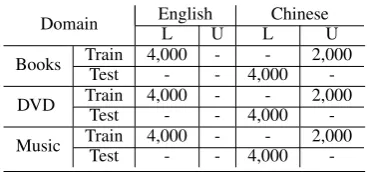
collection of bilingual Amazon product reviews in Books, DVD and Music domains. It contains 4,000 labeled English reviews, 4,000 Chinese test reviews, and 17,814, 47,071, 29,677 unlabeled Chinese reviews in three different domains. We randomly select 2,000 unlabeled Chinese reviews in each domain to train classifiers. Besides, the pseudo-data sets described in CredBoost model are translated with Google translator. The data set is summarized in Table 1.
To better illustrate the significance of knowl-edge validation during knowlknowl-edge transfer, we compare the proposed method with the following baseline methods:
Lexicon-based (LB): The standard English MPQA sentiment lexicons are translated into
resource, you can available at:http://tcci.ccf.org. cn/conference/2013/index.html.
Domain EnglishL U LChineseU Books TrainTest 4,000- -- 4,000- 2,000 -DVD TrainTest 4,000- -- 4,000- 2,000 -Music TrainTest 4,000- -- 4,000- 2,000
-Table 1: Experimental data sets. All data sets are balanced, L represents labeled data and U represents unlabeled data.
Chinese and then utilized together with a small number of Chinese turning words, negations and intensifiers to predict the sentiment polarities of the Chinese test reviews.
Basic SVM (BSVM-CN): The labeled English reviews are translated into Chinese, which are then used as the pseudo-training data to train a Chinese SVM classifier.
Primarily boost transfer learning (BTL-1): The labeled English reviews are used to train the English classifier, which is applied to label the English translations of the unlabeled Chinese reviews. These labeled Chinese reviews obtained via MT together with the Chinese translations of the labeled English reviews are then used as the pseudo-training data to train a Chinese sentiment classifier.
Best result in NLP&CC 2013 (BR2013): This is the best result reported in NLP&CC 2013. Unfortunately, the specification of the method is not available.
Self-boost (SB-CN) in Chinese: The labeled English reviews are translated into Chinese, which are used as the pseudo-training data to train a basic Chinese classifier. This classifier is iteratively refined by choosing the most confidently predicted English reviews to add into the Chinese training data until a predefined iteration number reaches. It can be also considered as a self-adaptive boosting approach.
Iteratively boost transfer learning (BTL-2): This is an enhanced transfer learning method shar-ing the same learnshar-ing framework with CredBoost but it ignores knowledge validation. It iteratively transfers the knowledge from English to Chinese. The learning in both languages iteratively boosts themselves separately. The transfer size is 16, comparable to that in CredBoost.
Basic co-training (CoTr): The co-training method proposed in (Wan, 2009) is implemented.
[image:6.595.324.509.64.150.2]iteration, 10 positive and 10 negative reviews are transferred from one language to the other.
Doc2vec feature CredBoost (dCredB): This method is similar to CredBoost except that document-to-vector is used to generate features
when training basic classifiers. The vectors
are obtained from both original and translated reviews. The dimension of doc2vec is 300, while the other parameters are set as default.
The baseline methods described above are categorized into three classes: the first four which are preliminary methods, the middle three which are several state-of-the-art models being comparable to our proposed model, and the last one which is a comparison to suggest that the knowledge representation is not the answer to the performance improvement. For all the methods excluding LB and BR2013, we use support vector machines (SVMs) as basic classifiers. We use the Liblinear package (Fan et al., 2008) with the
linear kernel5. All methods use Unigram+Bigram
features to train the basic classifiers, except for dCredB.
4.2 Experimental Result
In this work, there are two main parameters that may significantly influence the performance of our proposed model. They are the new knowledge
validation boundary ψ and the validation scale
ζ+ in the training data. We set the values of
parameters with the grid search strategy. We
first fix initial ζ+ = 14 to search the best
new knowledge validation boundary ψ from an
empirical value set{0.30,0.35,0.40,0.45,0.50}.
We then fix the best ψ = 0.40 to check the
suitable validation scaleζ+ from the initial value
set{6,8,9,10,11,12,14,16}in which values are
comparable with the knowledge transfer scale
of CoTr in the training data. Besides, the
recommendation size m for English is set to 20
and the recommendation sizenfor Chinese is set
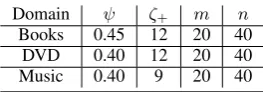
to 40. The final settings are listed in Table 2. The performance is evaluated in terms of accuracy (Ac) defined by Formula (7).
Ac(f) = pf
Pf, Avg Ac= 13·
X
f0∈F
Ac(f0) (7)
where pf is the number of correct predictions
andPf is the total number of the test data; F ∈
{Books, DV D, Music}is the domain set.
5The parameter setting used in this paper is‘-s 7’.
Domain ψ ζ+ m n
Books 0.45 12 20 40 DVD 0.40 12 20 40 Music 0.40 9 20 40
Table 2: Parameter settings of three domains in this paper.
[image:7.595.350.482.64.110.2]Approaches Books DomainDVD Music Avg Ac LB 0.7770 0.7832 0.7595 0.7709 BSVM-CN 0.7940 0.7995 0.7778 0.7904 BTL-1 0.8010 0.8058 0.7605 0.7891 BR2013 0.7850 0.7773 0.7513 0.7712 SB-CN 0.8400 0.8428 0.8012 0.8280 BTL-2 0.8105 0.8265 0.7980 0.8117 CoTr 0.8025 0.8508 0.7812 0.8115 dCredB 0.6485 0.6753 0.6700 0.6646 CredBoost 0.8465 0.8518 0.8093 0.8359
Table 3: Macro performance of all approaches in three domains. All values are accuracies and Avg-Ac represents the average accuracy in three domains.
The performances are reported in Tables 3 and 4. As shown, CredBoost outperforms all the other comparison methods. The first four baselines have poor performances compared to others. This suggests that the CLSA problem cannot be well solved by directly learning from the labeled translated data without any knowledge adaption or knowledge validation. SB-CN, BTL-2 and CoTr employ iterative boosting to adapt knowledge from the source English to the target Chinese with-out validating the transferred knowledge. They inevitably mis-recommend the massive noisy data into Chinese. CredBoost, in contrast, introduces knowledge validation into transfer learning with iterative boosting. It better adapts knowledge from English to Chinese and thus ensures the credibility of the accepted knowledge. Its best result justifies our assumption.
Model (Books) P PositiveR F1 P NegativeR F1 Ac LB 0.7368 0.8400 0.7850 0.8140 0.7000 0.7527 0.7700 BSVM-CN 0.8249 0.7465 0.7837 0.7685 0.8415 0.8033 0.7940 BTL-1 0.8537 0.7265 0.7850 0.7620 0.8755 0.8148 0.8010
BR2013 - - - 0.7850
SB-CN 0.8716 0.7975 0.8329 0.8134 0.8825 0.8465 0.8400 BTL-2 0.7105 0.8881 0.7894 0.9105 0.7588 0.8278 0.8105 CoTr 0.8339 0.7555 0.7928 0.7765 0.8495 0.8114 0.8025 dCredB 0.5310 0.6941 0.6017 0.7660 0.6202 0.6854 0.6485 CredBoost 0.8225 0.8640 0.8427 0.8705 0.8306 0.8501 0.8465
Model (DVD) P PositiveR F1 P NegativeR F1 Ac LB 0.7648 0.8180 0.7905 0.8044 0.7485 0.7754 0.7832 BSVM-CN 0.7745 0.8450 0.8082 0.8295 0.7540 0.7900 0.7995 BTL-1 0.8282 0.7715 0.7988 0.7861 0.8400 0.8122 0.8058
BR2013 - - - 0.7773
SB-CN 0.8853 0.7875 0.8335 0.8086 0.8980 0.8510 0.8428 BTL-2 0.8525 0.8104 0.8309 0.8005 0.8444 0.8219 0.8265 CoTr 0.8374 0.8705 0.8536 0.8652 0.8310 0.8478 0.8508 dCredB 0.6070 0.7030 0.6515 0.7435 0.6542 0.6960 0.6753 CredBoost 0.8440 0.8572 0.8508 0.8595 0.8465 0.8530 0.8518
Model (Music) P PositiveR F1 P NegativeR F1 Ac LB 0.7387 0.8030 0.7695 0.7842 0.7160 0.7485 0.7595 BSVM-CN 0.8492 0.6755 0.7525 0.7306 0.8800 0.7984 0.7778 BTL-1 0.8437 0.6395 0.7275 0.7097 0.8815 0.7863 0.7605
BR2013 - - - 0.7513
[image:8.595.138.462.60.410.2]SB-CN 0.8787 0.6990 0.7786 0.7501 0.9035 0.8197 0.8012 BTL-2 0.7285 0.8461 0.7829 0.8675 0.7616 0.8111 0.7980 CoTr 0.8536 0.6790 0.7564 0.7335 0.8835 0.8015 0.7812 dCredB 0.5860 0.7043 0.6397 0.7540 0.6455 0.6955 0.6700 CredBoost 0.7258 0.8708 0.7917 0.8928 0.7653 0.8241 0.8093
Table 4: Micro performance of all approaches in three domains. P: Precision, R: Recall, F1: micro-F measure, Ac: Accuracy, and - represents unknown. The model in BR2013 is unknown, thus its micro performance is unavailable.
classifier. It is reasonable that a Chinese classifier performs better on Chinese text than an English classifier performs on the translated English text due to the different language distributions and MT errors. However, as shown in Tables 3 and 4, the better performance of our proposed method compared with that of the self-boosting method further suggests the effectiveness of our proposed knowledge validation model.
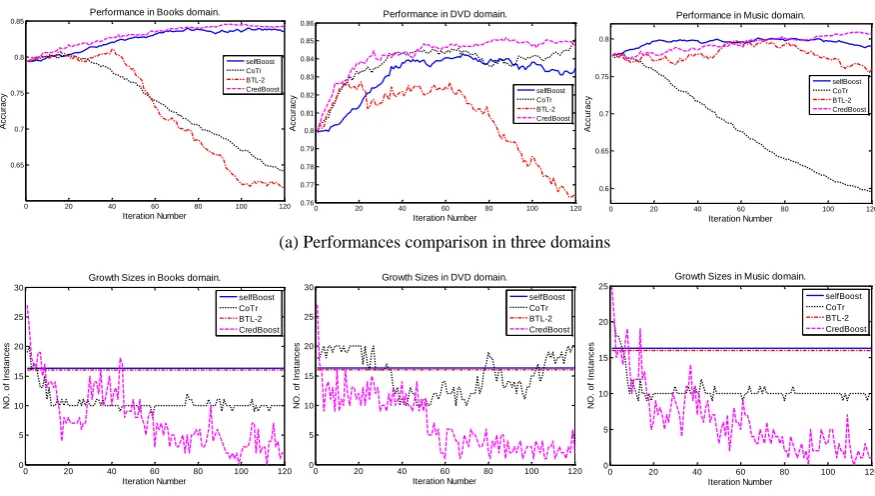
Figure 1 illustrates the continuous changes of performances vs. the corresponding growth sizes of the training data sets for SB-CN, BTL-2, CoTr, and CredBoost. According to our common sense, noisy data have negative influence on performance improvement. Compared to the other three methods, CredBoost accepts less number of training instances during learning while it achieves
more improvement. This verifies the ability
of CredBoost that can filter out the noisy data recommended by the English sentiment classifier. In Figure 1(a), the curves of BTL-2 and CoTr
suggest that directly transferring the knowledge recommended from English imports many noisy data into Chinese. It is also obvious that the performance curve of CredBoost implies a stable improvement trend while the other three decrease after certain iterations because of the accumulated negative influence from the noisy data. Figure 1(b) shows CredBoost accepts decreased training instances after certain iterations because the number of “high-quality” instances decrease when learning proceeds. This finding suggests that knowledge validation would rather abandon “less-credible” knowledge with higher probability than easily accept it. Knowledge validation in the proposed model guarantees highly-credible learn-ing when transferrlearn-ing knowledge from English to Chinese. The results also show that CredBoost has great potential to achieve better performance approaching to supervised approaches if more unlabeled Chinese data are available.
(a) Performances comparison in three domains
(b) Growth sizes comparison in three domains
0 20 40 60 80 100 120 0.65
0.7 0.75 0.8
0.85 Performance in Books domain.
Iteration Number A ccu ra cy selfBoost CoTr BTL-2 CredBoost
0 20 40 60 80 100 120 0.76 0.77 0.78 0.79 0.8 0.81 0.82 0.83 0.84 0.85 0.86
Performance in DVD domain.
Iteration Number A ccu ra cy selfBoost CoTr BTL-2 CredBoost
0 20 40 60 80 100 120 0.6
0.65 0.7 0.75 0.8
Performance in Music domain.
Iteration Number A ccu ra cy selfBoost CoTr BTL-2 CredBoost
0 20 40 60 80 100 120 0 5 10 15 20 25 30
Growth Sizes in Books domain.
Iteration Number N O . o f In st a n ce s selfBoost CoTr BTL-2 CredBoost
0 20 40 60 80 100 120 0 5 10 15 20 25 30
Growth Sizes in DVD domain.
Iteration Number N O . o f In st a n ce s selfBoost CoTr BTL-2 CredBoost
0 20 40 60 80 100 120 0 5 10 15 20 25
Growth Sizes in Music domain.
[image:9.595.81.519.65.313.2]Iteration Number N O . o f In st a n ce s selfBoost CoTr BTL-2 CredBoost
Figure 1: Performances vs. Growth Sizes for SB-CN, CoTr, BTL-2, and CredBoost in three domains. The similar performance curves of CoTr is also reported in (Gui et al., 2014).
Although document-to-vector represents content semantic well, it cannot determine the sentiment polarity of text well, even when the document-to-vectors that are used to train basic classifiers are learned on the mixture of the translated and original reviews. The superior performance of CredBoost to dCredB suggests that the semantic representation is effective to identify highly-credible acquired knowledge and new knowledge but it alone may not be sufficient enough to model the sentiment information.
We also conduct some other experiments to study the sensitivity of the new knowledge
valida-tion boundaryψand the validation scaleζ+in the
training data. The experimental results show that the performances with different parameter settings fluctuate around the best result reported in Tables 3 and 4 in a small range. Our model is basically quite stable.
5 Conclusion
In this paper, we propose a semi-supervised learn-ing model, called CredBoost, to address cross-lingual (English vs Chinese) sentiment analysis without direct labeled Chinese data nor direct parallel data. We propose to introduce knowledge validation during transfer learning to reduce the
noisy data caused by machine translation errors or inevitable mistakes made by the source language
sentiment classifier. The experimental result
demonstrates the effectiveness of the proposed model. In the future, we will explore more suitable knowledge representations and knowledge valida-tion in the CredBoost framework.
Acknowledgements
We thank all the anonymous reviewers for their detailed and insightful comments on this paper. The work described in this paper was supported by the Research Grants Council of Hong Kong project (PolyU 5202/12E and PolyU 152094/14E) and the grants from the National Natural Sci-ence Foundation of China (61272291, 61472290, 61472291 and 61303115).
References
Carmen Banea and Rada Mihalcea, Janyce Wiebe, Samer Hassan. 2008. Multilingual Subjectivity Analysis Using Machine Translation. In Proceed-ings of the 2008 Conference on Empirical Methods in Natual Language Processing, pages 127-135, Honolulu, October.
Cardie, Rada Mihalcea, Janyce Wiebe. 2013. CPN-CORE: A Text Semantic Similarity System Infused with Opinion Knowledge. In Proceedings of the Main Conference and the SHared Task in *SEM 2013, pages 221-228, Atlanta, Georgia, June 13-14, 2013.
Yejin Choi and Claire Cardie. 2008. Learning with Compositional Semantics as Structural Inference for Subsentential Sentiment Analysis. InProceedings of the 2008 Conference on Empirical Methods in Natural Language Processing, pages 792-801, Honolulu, October 2008.
Kevin Duh and Akinori Fujino and Masaaki Nagata. 2011. Is Machine Translation Ripe for Cross-lingual Sentiment Classification? In Proceedings of the 49th Annual Meeting of the Association for Computational Linguistics: shortpapers, pages 429-433, Portland, Oregon, June 19-24, 2011.
Rong-En Fan, Kai-Wei Chang, Cho-Jui Ksieh, Xiang-Rui Wang, Chih-Jen Lin. 2008. LIBLINEAR: A Library for Large Linear Classification. InJournal of Machine Learning Research, 9 (2008) 1871-1874. Micheal Gamon. 2004. Sentiment Classification on Customer Feedback Data: Noisy Data, Large Feature Vectors and the Role of Linguistic Analysis. InProceedings of the 20th International Conference on Computational Linguistics, pages 841-847, CH. Xavier Glorot, Antoine Bordes, and Yoshua Bengio.
2011. Domain Adaptation for Large-scale Senti-ment Classification: A Deep Learning Approach. InProceedings of the 28th International Conference on Machine Learning, pages 513-520, Bellevue, Washington, USA.
Lin Gui, Ruifeng Xu, Qin Lu, Jun Xu, Jian Xu, Bin Liu, Xiaolong Wang. 2014. Cross-lingual Opinion Analysis via Negative Transfer Detection. In Proceedings of the 52th Annual Meeting of the Association for Computational Linguistics (short paper), pages 860-865, Baltimore, Maryland, USA, June 23-25 2014.
Ahmed Hassan and Dragomir Radev. 2010. I-dentifying Text Polarity Using Random Walks. In Proceedings of the 48th Annual Meeting on Association for Computational Linguistics, pages 395-403, Uppsala, Sweden, 11-16 July 2010. Yulan He, Chenghua Lin, Harith Alani. 2011a.
Automatically Extracting Polarity-bearing Topics for Cross Domain Sentiment Classification. In Proceedings of the 49th Annual Meeting of the Association for Computational Linguistics: Huamn Language Technologies, pages 123-131, Portland, Oregon, USA.
Yulan He. 2011b. Latent Sentiment Model for Weakly-Supervised Cross-Lingual Sentiment Classification. InProceedings of the 33th European Conference on Information Retrieval(ECIR 2011), 18-21 Apr 2011, Dublin, Ireland.
KANAYAMA Hiroshi, NASUKAWAA Tetsuya, WATANABE Hideo. 2004. Deeper Sentiment Analysis Using Machine Translation Technology. InProceedings of the 20th International Conference on Computational Linguistics, pages 494-500. Alistair Kennedy and Diana Inkpen. 2006.
Senti-ment Classification of Movie and Product Reviews Using Contextual Valence Shifters. Computational Intelligence,22(2):110-125.
Quoc Le, Tomas Mikolov. 2014. Distributed Representations of Sentences and Documents. In Proceedings of the 31th International Conference on Machine Learning, Beijing, China, 2014. JMLR: W&CP volume 32.
Tao Li, Vikas Sindhwani, Chris Ding, and Yi Zhang. 2009. Knowledge Transformation for Cross-Domain Sentiment Classification. In Proceedings of the 32th International ACM SIGIR Conference on Research and Development in Information Re-trieval, pages 716-717, Boston, MA, USA.
Bing Liu. May 2012.Sentiment Analysis and Opinion Mining. Morgan & Claypool Publisher.
Xinfan Meng, Furu Wei, Xiaohua Liu, Ming Zhou, Ge Xu, Houfeng Wang. 2012. Cross-Lingual Mixture Model for Sentiment Classification. InProceedings of the 50th Annual Meeting of the Association for Computational Linguistics, pages 572-581, Jeju, Republic of Korea, 8-14 July 2012.
Tony Mullen and Nigel Collier. 2004. Sentiment analysis using support vector machines with di-verse inoformation sources. In Proceedings of the Conference on Empirical Methods in Natural Language Processing, pages 412-418, (July 2004) poster paper.
Sinno Jialin Pan and Qiang Yang, Fellow, IEEE. 2010. A Survey on Transfer Learning. InJournal of IEEE Transactions on Knowledge and Data Engineering, Vol.22, NO.10, October 2010.
Bo Pang and Lillian Lee, Shivakumar Vaithyanathan. 2002. Thumps Up? Sentiment Classification using Machine Learning Techniques. In Proceedings of the 2002 Conference on Empirical Methods in Natural Language Processing, pages 79-86, Philadelphia, July 2002.
Kashyap Popat, Balamurali A R, Pushpak Bhat-tacharyya and Gholamreza Haffari. 2013. The Haves and the Have-Nots: Leverage Unlabeled Corpora for Sentiment Analysis. In Proceedings of the 51th Annual Meeting of the Association for Computational Linguistics, pages 412-422, Sofia, Bulgaria, 4-9 August 2013.
Hassan Saif, Yulan He and Harith Alani. 2012. Semantic Sentiment Analysis of Twitter. In Proceedings of the 11th International Semantics Web Conference ISWC 2012, Boston, USA. Stephen Shankland. 2013. Google Translate now
serves 200 millon people daily. In CNET. CBS Interactive Inc. May 18, 2013.
Richard Socher, Alex Perelygin, Jean Y. Wu, Jason Chuang, Chiristopher D. Manning, Andrew Y. Ng and Christopher Potts. 2013. Recursive Deep Models for Semantics Computationality Over a Sentiment Treebank. In Proceedings of the Con-ference on Empirical Methods in Natural Language Processing.
Songbo Tan, Gaowei Wu, Huifeng Tang and Xueqi Cheng. 2007. A Novel Scheme for Domain-transfer Problem in the context of Sentiment Analysis. In CIKM 2007, November 6-8, 2007, Lisboa, Portugal. Peter D. Turney. 2002. Thumps Up or Thumps Down? Semantic Orientation Applied to Unsuper-vised Classification of Reviews. InProceedings of the 40th Annual Meeting of the Association for Com-putational Linguistics, pages 417-424, Philadelphia, July 2002.
Xiaojun Wan. 2008. Using Bilingual Knowledge and Ensemble Technics for Unsupervised Chi-nese Sentiment Analysis. In Proceedings of the 2008 Conference on Empirical Methods in Natual Language Processing, pages 553-561, Honolulu, October 2008.
Xiaojun Wan. 2009. Co-Training for Cross-Lingual Sentiment Classification. InProceedings of the 47th Annual Meeting of the ACL and the 4th IJCNLP of the AFNLP, pages 235-243, Suntec, Singapore, 2-7 August 2009.
Bin Wei and Christopher Pal. 2010. Cross Lingual Adaptation: An Experiment on Sentiment Classifi-cations. InProceedings of the 48 Annual Meeting of the Association for Computational Linguistics (short paper), pages 258-262, Uppsala, Sweden, 11-16 July 2010.