Munich Personal RePEc Archive
Making Carbon Pricing Work
Klenert, David and Mattauch, Linus and Combet,
Emmanuel and Edenhofer, Ottmar and Hepburn, Cameron
and Rafaty, Ryan and Stern, Nicholas
23 August 2017
Online at
https://mpra.ub.uni-muenchen.de/80943/
Making Carbon Pricing Work
David Klenert1*, Linus Mattauch2, Emmanuel Combet3, Ottmar Edenhofer4, Cameron
Hepburn5, Ryan Rafaty6, Nicholas Stern7
August 23, 2017
Abstract
Carbon-pricing initiatives are spreading at an unprecedented rate, but a considerable gap remains between actual prices and those required to achieve ambitious climate change mitigation. This perspective shows that much of this gap could be closed by enhancing
the public’s acceptance of carbon pricing through the effective use of the substantial
revenues raised. We synthesize findings regarding the use of carbon revenues both from recent behavioral and political studies as well as from economic analyses of equity and efficiency. We then compare real-world carbon pricing regimes with insights derived from theory. We find that uniform lump-sum recycling of carbon revenues to citizens is favored among behavioral and political studies that emphasize the importance of distributional fairness, revenue salience, political trust, and policy stability amid partisan changes in government. It is also successfully employed in several real-world recycling schemes, although alternative uses of revenues such as green spending may be appropriate in different national contexts.
1. Introduction
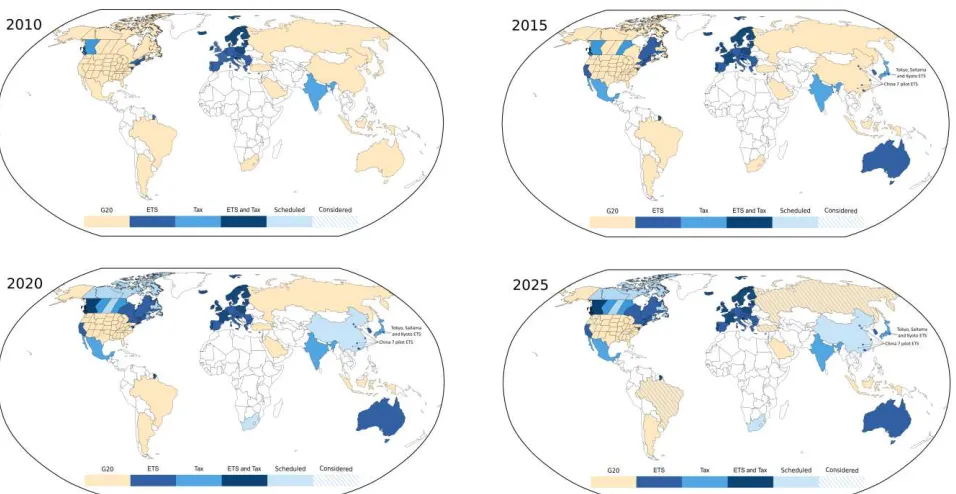
Economic analyses have long recommended carbon pricing as an indispensable strategy for efficiently reducing greenhouse gas emissions and addressing climate change. After setbacks over the past two decades, carbon pricing has become popular once again. Today there are more than 60 national or subnational initiatives, which generated US$ 26 billion in revenue in 2015 alone (World Bank et al., 2016). Since 2016, eight new carbon-pricing initiatives have been implemented (World Bank and Ecofys, 2017), with dozens of additional countries having pledged under the Paris Agreement to consider implementing carbon pricing in the years ahead (Figure 1).
1 Mercator Research Institute on Global Commons and Climate Change, Berlin.
*Contributing author. E-Mail: [email protected]
2 Institute for New Economic Thinking at the Oxford Martin School and Environmental Change Institute,
School of Geography and the Environment, University of Oxford
3Centre International de Recherche sur l’Environnement et le Développement, Nogent sur Marne
4Mercator Research Institute on Global Commons and Climate Change, Berlin, Potsdam-Institute for Climate Impact Research, Technical University of Berlin
5 Institute for New Economic Thinking at the Oxford Martin School, Smith School for Enterprise and the
Environment and New College, Oxford. Grantham Research Institute on Climate Change and the Environment, London School of Economics
The popularization of carbon pricing has been spearheaded partially by the World Bank’s Carbon Pricing Leadership Coalition. Its High-Level Commission on Carbon Prices—of which one of our authors is co-chair and another is commission member— recently concluded that achieving the goals of the Paris Agreement requires a carbon price of $40-$80/tCO2 by 2020, rising to $50-$100/tCO2 by 2030 (Stiglitz and Stern, 2017). With less
than 15 percent of global greenhouse gas emissions currently covered by a carbon price, and less than three percent of existing prices above $40/tCO2, the time is right to expand
coverage and identify viable means of increasing public support for a rising carbon price.
Discussion of carbon pricing is also resurging in the United States, prompted by the
Climate Leadership Council’s widely-discussed proposal for a national carbon tax with revenues recycled to citizens as quarterly or monthly dividends (see Nature Editorial, 2017). California and Massachusetts are also currently considering proposals to reform carbon pricing with revenues primarily recycled as per capita dividends (Barrett, 2015; Roberts, 2017). Our findings below suggest that the appeal of these proposals stems largely from their incorporation of recent lessons from studies in behavioral economics and political science, which we collate and review for the first time. Comparing these
studies’ recommendations to numerous real-world cases of carbon revenue allocation, we find that traditional lessons on efficiency and equity are subsidiary to the primary challenge of garnering greater political acceptability. Nevertheless they matter in the sense that they are also crucial determinants of the acceptability of a carbon price.
Figure 1: The development of carbon pricing Operating, scheduled and considered carbon pricing schemes (Edenhofer et al., 2017). Based on World Bank (2016) and ICAP (2017).
[image:3.612.92.570.390.637.2]views. Comparing these insights against traditional equity and efficiency considerations we provide an ordinal classification of different recycling options by their impact on acceptability, equity and efficiency. We discuss how this classification and its policy implications match or diverge from five real-world carbon-pricing regimes. To our knowledge this contribution is novel.
An important outcome of our assessment is that providing uniform lump-sum dividends to citizens is favored among behavioral and political studies that emphasize the importance of distributional fairness, revenue salience, political trust, and policy stability amid partisan changes in government. It is also successfully employed in several real-world recycling schemes. While alternative uses of revenues such as green spending may be appropriate in different national contexts, our findings suggest that lump-sum dividends may be more stable and successful particularly in countries bogged down with issues of economic inequality, political mistrust, and polarization.
A further challenge for carbon pricing centers on industry concerns about competitiveness and carbon leakage in the context of carbon-pricing policy (Aldy and Stavins 2012; Jenkins 2014; OECD 2015; World Bank 2015). While most companies can simply adapt and innovate in response to a carbon price, certain energy-intensive, trade-exposed industries may require government assistance (Aldy and Pizer 2015). Many countries with a carbon price have granted energy-intensive sectors tax exemptions or free allocations that weaken the price signal and produce substantial windfall profits for a few large companies (Martin et al. 2014). This practice is suboptimal from a mitigation perspective, and as policymakers increasingly transition away from exemptions and free allocation, it will be important to broaden discussions of competitiveness. In this context, governments should note that competitiveness losses in fossil-based production are often partially or fully counterbalanced by gains in competitiveness in growing low-carbon sectors (Hepburn et al. 2006; Andersen and Ekins 2009). Therefore, this perspective instead focuses on how to make carbon pricing work for citizens by the recycling of its revenues.
After reviewing lessons about public preferences on carbon pricing and preferable forms of revenue recycling from the theoretical literature (Sections 2.1, 2.2, and 2.3), we provide an ordinal ranking of options based on the criteria of efficiency, equity, and public acceptability (described in Section 2.4), followed by a review of several real-world carbon pricing regimes (Section 3). We conclude with a brief discussion of the prospects for incorporating these lessons in ongoing and upcoming carbon-pricing proposals.
2. Recent lessons from theory
2.1 Behavioral constraints on carbon pricing
often contradicted in practice and sometimes inadequate as a basis for policy analysis (Camerer et al. 2004; Chetty et al. 2009; DellaVigna 2009). Relaxing some of these assumptions, a nascent literature has begun to assess options for recycling carbon-pricing revenues.
From these studies, five key effects emerge that stress the importance of revenue recycling for the acceptability of a carbon pricing reform: (1) citizens tend to ignore or
doubt the corrective (“Pigouvian”) effect of carbon pricing, but are nevertheless cognizant of the revenue-raising aspect of such a policy. Earmarking the revenue for a specific purpose such as green spending or transfers to disadvantaged households appears to make up for this effect; (2) the labeling of the carbon price is highly important – calling
the price a “fee” or a “climate contribution” tends to enhance acceptability as compared
to calling it a “carbon tax”; (3) the salience of the benefits of a carbon tax reform is crucial. This effect suggests recycling the revenue in a highly visible fashion, such as bi-annual equal per capita transfers; (4) the willingness to pay a carbon price is a function of political, economic, and cultural beliefs, which have to be accounted for when designing the recycling mechanism; (5) Policy reforms tend to be more successful if the costs are dispersed and the benefits are concentrated.
The first major effect concerns the ignorance of the Pigouvian nature of carbon pricing and the argument for earmarking the revenues to compensate for this effect. Conducting a single-price market experiment, Kallbekken et al. (2011) found that citizens often ignore the Pigouvian aspect of carbon prices but are well-aware of the revenue-raising aspect. This finding reflects public suspicions of “big government” and the ostensible revenue-raising motives of the state. When carbon revenues go towards the general government budget, some studies have found that public acceptance is lower (Baranzini et al., 2014; Baranzini and Carattini, 2017). If instead carbon revenues are earmarked for a specific purpose—e.g. as targeted green investments or transfers to particularly affected groups—citizens report greater acceptance of carbon pricing (Baranzini and Carattini, 2017; Baranzini et al., 2014; Kallbekken and Aasen, 2010; Kallbekken et al., 2011).
The second effect concerns the labeling of the carbon price: tax aversion is a prevalent feature of fiscal policy, and carbon pricing is no exception. There is some consensus that overcoming tax aversion is at least partly a matter of how the measure is labeled. Kallbekken et al. (2011) show that relabeling a carbon tax as a “fee” made it more popular, particularly when revenues were recycled back to citizens as uniform lump-sum payments—i.e. “fee and dividend”. Using survey data, Baranzini and Carattini (2017) also find that relabeling the tax by a different name (e.g. a “climate contribution”) increases public acceptance. This may be particularly true in countries with already relatively low levels of taxation as a percentage of GDP.
The third effect concerns the salience of the carbon tax reform. Rivers and Schaeufele
(2015), for instance, demonstrate that British Columbia’s carbon tax reform led to a much
They find that British Columbia’s carbon tax has been 4.5 times more salient than an equivalent change in gasoline prices. But salience appears to be important not just for the price itself but also for the use of revenue: Carattini et al. (2017) perform a survey study on the acceptability of different revenue recycling mechanisms in Switzerland – one of their main conclusions is that uniform lump-sum transfers are superior to other mechanisms in part due to their high visibility and their progressive effect. Ensuring the salience of the benefits includes a good communication strategy of the benefits towards the public (Carattini et al., 2017). These findings reflect earlier results by Chetty et al. (2009) regarding the salience of sales taxes.
The fourth effect is that the public’s willingness to pay a given carbon price is also a function of political, economic, and cultural beliefs. Using discrete choice experiments, Alberini et al. (2016) estimate that Italians are willing to pay €133–164 per ton of CO2
avoided, while Czechs are willing to pay €94 per ton. Ziegler (2017) found that a greater willingness to pay a carbon price in Germany and China is correlated with higher educational attainment and left-green partisan attitudes, whereas in the United States only partisan attitude matters, and to a considerably greater extent. Politically-motivated opposition to carbon pricing in the United States resembles what Campbell and Kay (2014) call “solution aversion”: the tendency for citizens to be more skeptical of environmental problems whose policy solutions contradict or challenge their underlying ideological predisposition, with conservatives, but not liberals, considering taxes to be distinct from and less preferable than subsidies. This finding is confirmed by Kahan et al. (2011) who identify correlations between different worldviews and skepticism towards climate risk. There is indeed strong evidence that this division between egalitarian-communitarian and hierarchical-individualistic worldviews explains a great deal of public disagreement over carbon pricing (Cherry et al., 2017). Hence, from an acceptability perspective, policymakers should avoid triggering “solution aversion” when revenue recycling mechanisms are designed.
The fifth effect concerns the feasibility of policy reforms in general. Olson (1965) argues that a policy reform is more likely to be successful if the costs are diffused and the benefits are concentrated. Kallbekken et al. (2011) conduct a lab experiment that corroborates
Olson’s hypothesis for the case of a carbon pricing reform. In this context, Olson’s (1965) point may generalized as follows: a highly salient payment to a dispersed set of recipients could be more politically powerful than a carbon tax on concentrated polluters. This also resonates with the first behavioral effect mentioned above: earmarking the revenues for helping a targeted group of particularly affected households might compensate for the lack of understanding of Pigouvian taxation.
earmarking effect and Olson’s (1965) criterion would also be fulfilled as such recycling is progressive (see below). These transfers would be very salient since they would be direct transfers received by the households at regular intervals. Further, this type of recycling would be consistent with more center-right worldviews since it is budget-neutral and would not increase the size of the government. The literature that compares the acceptability of uniform lump-sum transfers to other recycling mechanisms seems, at first glance, to be in disagreement. However, these differences can be explained by the underlying study design. Carattini et al. (2017) utilize survey evidence from Switzerland to show that uniform lump-sum transfers are extremely popular compared to tax reductions. Kallbekken et al. (2011), by contrast, use lab experiments to provide arguments for targeted transfers. The reason for the divergence between these two studies is that Kallbekken et al. (2011) do not account for the fact that rich households consume more carbon-intensive goods in absolute terms, while poor households spend a higher share of their income on carbon-intensive goods (Grainger and Kolstad, 2010;
Levinson and O’Brien, 2015). Failure to account for this fact leads to the misleading conclusion that uniform lump-sum recycling is regressive, when it is in fact progressive. We therefore conclude that, on balance, the behavioral literature supports the hypothesis that uniform lump-sum transfers are extremely popular with voters. This literature, however, also provides a rationale for more equitable directed transfers or green spending as recycling options, depending on the specific circumstances. For instance, having a large gap in infrastructure financing could justify using carbon pricing revenue for investment in (green) infrastructure (Edenhofer et al., 2017; OECD, 2017).
2.2 Political science
foundation for the subsequent rise of the carbon price (from 27€/tCO2 in 1991 to
around 130$/tCO2 in 2017).
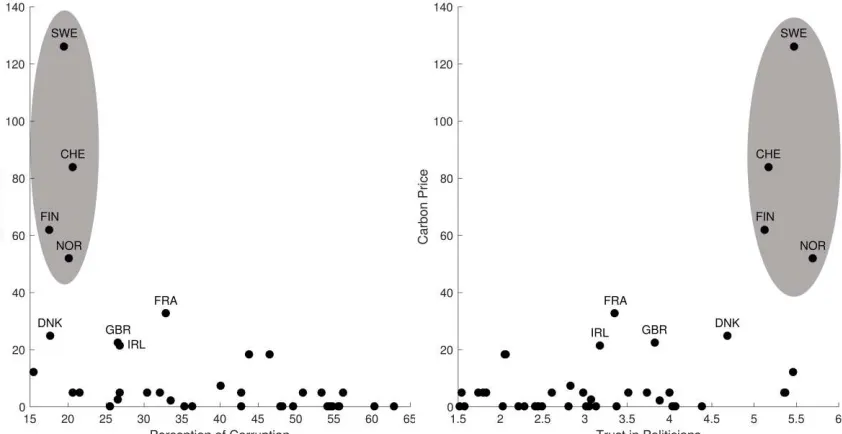
Figure 2: Carbon prices, corruption and trust Carbon prices in selected countries plotted against public perceptions of corruption and levels of trust in government. All data is for 2012. Based on carbon price data from OECD (2016), corruption perception data from Standaert (2015), and trust data from Schwab (2012). Countries are labeled according to ISO countries codes. Countries highlighted in grey have a carbon price above $40/tCO2.
[image:8.612.101.522.122.339.2]These two lessons from the political science literature—on the importance of political trust as well as strategic dynamics of party competition—complement the behavioral studies pointing to the popularity of uniform lump-sum transfers to households. Indeed, uniform transfers may be more effective at resisting carbon-pricing rollback attempts than targeted transfers to particularly affected households. This is because, as Rothstein (1998) concludes in the context of social protection policies, “the“poor,”
the “underprivileged,” the “working class,” or any other such social group is simply too
small to constitute a sufficient electoral base for a comprehensive universal welfare policy. Conversely, one can only reckon with support for this policy from white-collar
groups and the middle class if it is so formulated as to serve their interests as well”
(Rothstein 1998, p. 153). The universality of Social Security and Medicare in the United States, for example, has largely safeguarded these programs from multiple rollback attempts in the twentieth and early twenty-first century. Among carbon revenue options, uniform lump-sum transfers are most likely to reinforce this kind of policy stability. A related consideration is that very few people, not even the poorest citizens, tend to (or want to) think of themselves as poor and therefore needful of government assistance (Gilens, 2009), which may make equal per-capita dividends more popular.
2.3. Recent advances in public economics of carbon pricing
This article takes the perspective that acceptability is the most important consideration for designing carbon pricing schemes. As such, lessons on equity and efficiency as obtained by traditional economic methods are subsidiary to the primary challenge of acceptability. Nevertheless, they matter in a fundamental sense – for good policy design – and in that they also influence the acceptability of a carbon price. We hence consider next the insights on carbon pricing obtained by traditional general equilibrium modeling in economics. This tradition includes (i) small economic models that precisely identify specific effects; and (ii) large numerical models that yield quantitative insight into policies in specific countries.
First, a large body of literature has examined how tax constraints that arise in the context of environmental taxation should influence the design of a carbon tax reform. For example, Klenert and Mattauch (2016) find that uniform lump-sum recycling is preferable to linear income tax cuts from the point of view of enhancing equity. Moreover, real-world governments face informational and political constraints, pre-existing distortionary taxes and resistance of special interest groups (Bennear and Stavins, 2007; Combet, 2013). As a consequence, such analyses will almost always be
“second best”, that is, the optimal carbon tax reform is examined when crucial information or policy options are unavailable.
The constraint generally believed to be most relevant for deriving optimal income
taxes is the unobservability of individual households’ skill levels and the consequential
Mirrlees (1971). Based on these assumptions, recent research determines optimal non-linear labor taxes in the presence of an environmental externality (Aigner, 2014; Cremer et al., 1998, 2010; Cremer and Gahvari, 2001; Jacobs and de Mooij, 2015). One important conclusion from this literature is that income tax cuts are not necessarily more efficient than uniform lump-sum transfers (Jacobs and de Mooij, 2015; Klenert et al., 2016). This result is a consequence of the assumption that all taxes are already optimally set: the labor tax redistributes optimally between households and generates revenue. Additional revenue can be raised by non-distortionary uniform lump-sum transfers. In such a setting, recycling carbon tax revenue by cutting taxes is distortionary and uniform lump-sum recycling is the preferred option – the tax reform is hence only partial in that it concerns only the carbon tax. If, instead, the labor tax system is suboptimal, a comprehensive tax reform is possible in the following sense: The carbon tax revenue can be used to move the tax system closer to its optimum, thus enhancing both equity and efficiency (Klenert et al., 2016).
Second, increased data availability and computational possibilities have popularized the use of larger models that combine micro- and macro-economic analysis. These models can provide quantitative statements by analyzing the equity and efficiency impacts of different revenue recycling mechanisms in a calibrated setting. They can account for various general equilibrium effects that are often neglected in smaller models for analytical tractability.
In sum, traditional equity and efficiency-focused models provide us with two key insights: First, if the initial labor tax system is suboptimal, recycling through non-linear income tax cuts can enhance both equity and efficiency. Second, if the initial tax system is optimal, uniform lump-sum recycling outperforms labor income tax cuts both in terms of equity and efficiency.
2.4 Ranking of the recycling mechanisms
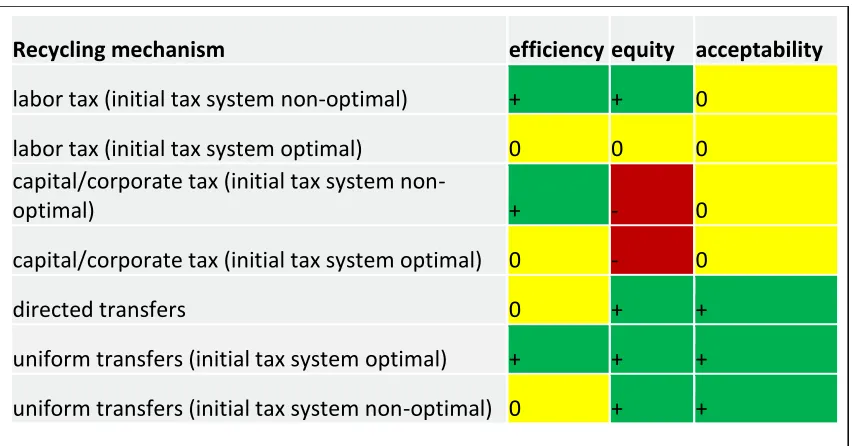
This section evaluates the major possibilities for revenue recycling in the light of the insights of the previous sections (see Table 1). Sections 2.1 and 2.2 cover acceptability by citizens from a variety of perspectives. They provide a rationale for three types of recycling mechanisms from a behavioral/political science standpoint: equal per capita transfers, earmarking the revenues for green spending or directed transfers to especially affected groups. Section 2.3 summarizes studies focusing on equity and efficiency. It provides two crucial insights: First, the most efficient recycling mechanisms tend to be the least equitable (capital/corporate tax reductions) and the most equitable being the least efficient (directed transfers to households). This leads to a trade-off between the equity and efficiency. Second, it is important to know the optimality of the existing tax system. The more distortionary a tax is, the higher the efficiency gains from reducing this tax. If all taxes are set optimally, changing the tax system would distort it. In this case, returning the revenue in an equal per capita fashion would be the superior recycling option.
If the initial tax system is non-optimal, uniform lump-sum recycling only performs well in terms of equity and acceptability – and hence has an effect similar to directed transfers. In that case, using the revenue for non-linear reductions in distortionary labor taxes also performs well in two categories: equity and efficiency. If the initial labor tax system is distortionary, policy makers thus face a trade-off between a more efficient but less acceptable policy and a less efficient more acceptable option. However, a part of the revenue could be directed to efficiency-enhancing measures, while the remainder could be allocated to more popular, more equitable recycling mechanisms (This in fact is done in most existing recycling schemes, see Section 3). In sum, if the initial state of the tax system is unclear, equal per capita transfers might be a safe option, as they always perform well in at least two of the three categories.
3. Real-world experience with carbon revenues
In this section, we review the common and differentiated characteristics of real-world carbon pricing reforms. We find considerable support for recommendations from the aforementioned behavioral and political studies, particularly regarding the advantages of earmarking revenues, ensuring their salience, and ensuring their distributional fairness.
Revenues from real-world carbon-pricing schemes are rarely recycled in any single way. Extant schemes typically incorporate multiple uses of revenues—from recycling to households in order to compensate for higher energy prices, to recycling to firms to address competitiveness concerns, to contributing to general government or clean energy budgets. Figure 3 displays how carbon revenues are recycled in selected real-world
Recycling mechanism efficiency equity acceptability
labor tax (initial tax system non-optimal) + + 0
labor tax (initial tax system optimal) 0 0 0 capital/corporate tax (initial tax system
non-optimal) + - 0
capital/corporate tax (initial tax system optimal) 0 - 0
directed transfers 0 + +
uniform transfers (initial tax system optimal) + + +
[image:12.612.97.525.75.298.2]uniform transfers (initial tax system non-optimal) 0 + +
schemes. All of the analyzed recycling schemes return a share of revenues to households as well as to firms, either in the form of transfers or tax reductions, or as a mixture of the two. Additionally, some regions use carbon revenues for green spending—including R&D in green technologies, subsidizing renewable energy sources, or public spending on energy efficiency upgrades of buildings. All regions adjust revenue priorities to account for preferences of special interest groups, which notably includes transfers to energy-intensive firms that are especially affected by the carbon price.
[image:13.612.92.522.331.636.2]These similarities aside, the cases assessed show stark variation in the relative shares of revenues going to firms, households and the general budget. Even within a single country, different sub-national carbon-pricing schemes follow disparate revenue priorities. The Canadian province of Alberta, for example, plans to allocate more than half of carbon-pricing revenues to green spending, while British Columbia returns all revenues to households and firms. None of the regions strictly accounts for the insights from the literature reviewed in the previous section, although some, particularly Switzerland, do more than others.
Our selection of real-world cases further suggests that societies with higher levels of trust in government are more likely to agree to the government using carbon revenues to invest in green technologies or, as is the case in Sweden, to add the revenue to the general budget. This finding is consistent with conclusions drawn by Rafaty (2017), who conducts a time-series cross-section analysis of industrialized democracies and finds that low levels of public trust and high levels of perceived political corruption are directly related to weaker non-market climate policies. Indeed, higher levels of political mistrust may greatly impede increases in market-based carbon pricing, too. Figure 2 demonstrates that the only carbon prices well above US$ 40/tCO2 exist in high-trust countries.
All regions use some form of transfer system to alleviate the burden of especially affected households, through directed transfers. Only Switzerland allocates a substantial share of revenues to households as uniform lump-sum transfers.
Figure 4: Revenue recycling: ETS vs. carbon tax (net of free allowances) Source: Carl and Fedor (2016). Data from 2013.Shares may not add up to 100% since annual budgeting might not match income flows and categories are not comprehensive.
4. Conclusion
Carbon pricing initiatives are spreading at an unprecedented rate globally, but the scale and ambition of carbon pricing will need to increase significantly to realize the world’s climate targets.
This perspective discusses different recycling strategies for carbon tax revenue in order to make carbon pricing work for citizens. Our contribution is to compare findings from behavioral economics, political science, public finance and integrated assessment modelling to actual carbon pricing regimes.
[image:15.612.125.487.70.375.2]Real-world recycling schemes differ widely across regions but have two things in common: first, several important economic actors are compensated; second, some form of transfer exists to compensate those especially hurt by higher carbon prices, such as rural or low-income households. These similarities are largely driven by the effects discussed in the sections on behavioral economics and political science. We therefore conclude that analytical and numerical models that emphasize the efficiency and productivity gains from particular revenue recycling should serve only as a benchmark, while behavioral considerations aimed at achieving greater political acceptance should take precedence.
Our study has two main policy implications. First, we find that uniform lump-sum recycling is favored by several strands of the economic literature as it is non-distortionary, salient, progressive (and hence perceived as fair) and it ensures broad public support. It is also successfully employed in real-world recycling schemes. This finding aligns with a recent
US proposal of a “fee-and-dividend” approach to carbon pricing (Nature Editorial, 2017).
Second, we conclude that the ideal recycling of carbon pricing revenue strongly depends on the political context: When distributional concerns are the greatest obstacle to higher carbon prices, transfers directed to the poor outperform other recycling mechanisms. When instead efficiency and competitiveness concerns are the greatest obstacle and trust in the government is high, reimbursing firms through transfers or tax cuts can be superior. Earmarking the revenue for green spending might be the option of choice if the main obstacle is that citizens are unconvinced of the environmental benefits of higher carbon prices.
Our findings together help to explain the appeal of current carbon-pricing reform proposals in states such as California and Massachusetts (Barrett, 2015; Roberts, 2017). As additional states, countries, and regions look to enhance the acceptability of carbon-pricing initiatives, there will undoubtedly be additional lessons from these practical experiences to draw upon.
Acknowledgements
Linus Mattauch's research was supported by a postdoctoral fellowship of the German Academic Exchange Service (DAAD). We thank Ira Dorband, Christian Flachsland, Michael Jakob and Jacquelyn Pless for helpful discussions. We further thank Matthias Roesti and Johanna Schiele for excellent research assistance and Olivier Bois von Kursk for compiling Figure 1. We also thank participants of a symposium for the High-Level Commission on Carbon Prices at the Ecole Normale Supérieure and seminar audiences at the Environmental Change Institute, University of Oxford, the Mercator Research Institute on Global Commons and Climate Change and the 23rd annual conference of the European
References
AB. Alberta Government “Carbon levy and rebates” (2016).
https://www.alberta.ca/climate-carbon-pricing.aspx#toc-0
Agel, J., Englund, P., and Södersten J. Tax reform of the century – the Swedish experiment. National Tax Journal, Vol 49 no. 4 pp. 643-64. (1996).
Aigner, R. Environmental taxation and redistribution concerns. FinanzArchiv/Public Finance Analysis 70, 249–277 (2014).
Aklin, M. & Urpelainen, J. Political competition, path dependence, and the strategy of sustainable energy transitions. American Journal of Political Science 57, 643-658 (2013).
Alberini, A., Bigano, A., Šcasný, M. & Zverinová, I. Preferences for Energy Efficiency vs.
Renewables: How Much Does a Ton of CO2 Emissions Cost? Fondazione Eni Enrico Mattei Working Paper No. 064.2016 (Fondazione Eni Enrico Mattei, 2016).
Aldy, Joseph E. and William A. Pizer. The competitiveness impacts of climate change mitigation policies. Journal of the Association of Environmental and Resource Economists 2(4): 565-595. (2015).
Aldy, J. E. & Stavins, R. N. The promise and problems of pricing carbon: Theory and experience. The Journal of Environment & Development 21, 152-180 (2012).
Andersen, Mikael Skou and Paul Ekins (eds.). Carbon energy taxation: lessons from Europe. Oxford: Oxford University Press. (2009).
Baranzini, A. & Carattini, S. Effectiveness, earmarking and labeling: testing the acceptability of carbon taxes with survey data. Environmental Economics and Policy Studies 19, 197-227 (2017).
Baranzini, A., Caliskan, M. & Carattini, S. Economic Prescriptions and Public Responses to Climate Policy. Cahier de recherche No. HES-SO/HEG-GE/C-14/3/1 (Haute École de Gestion de Genève, 2014).
Barrett, M.J. The Commonwealth of Massachusetts Bill No. 1747. Senate Docket, No. 285 Filed on: 1/14/2015. (2015).
Bennear, L. S. & Stavins, R. N. Second-best theory and the use of multiple policy instruments. Environmental and Resource Economics 37, 111-129 (2007).
BC. British Columbia Ministry of Finance “Budget and Fiscal Plan 2016/17 – 2018/19”
Beck, M., Rivers, N., Wigle, R., & Yonezawa, H. Carbon tax and revenue recycling: Impacts on households in British Columbia. Resource and Energy Economics, 41, 40–69 (2015).
Burtraw, D. & Sekar, S. Two world views on carbon revenues. Journal of Environmental Studies and Sciences 4, 110–120 (2014).
Camerer, Colin & Loewenstein, George (2004). Behavioral economics: Past, present, future. In Advances in Behavioral Economics (eds. Camerer, C., Loewenstein, G. & Rabin, M.) 3-51 (Princeton University Press, 2004).
Campbell, T. H. & Kay, A. C. Solution aversion: On the relation between ideology and motivated disbelief. Journal of Personality and Social Psychology 107, 809 (2014).
Carattini, S., Baranzini, A., Thalmann, P., Varone, F. & Vöhringer, F. Green taxes in a post-Paris world: are millions of nays inevitable? Environmental and Resource Economics, 1-32 (2017).
Carbone, J. C., Morgenstern, R. D., Williams III, R. & Burtraw, D. Deficit Reduction and Carbon Taxes: Budgetary, Economic, and Distributional Impacts. Resources for the Future Report (Resources for the Future, 2013).
Carl, J. & Fedor, D. Tracking global carbon revenues: A survey of carbon taxes versus cap-and-trade in the real world. Energy Policy 96, 50-77 (2016).
Cherry, T. L., Kallbekken, S., & Kroll, S. Accepting market failure: Cultural worldviews and the opposition to corrective environmental policies. Journal of Environmental Economics and Management 85, 193-204 (2017).
Chetty, R., A. Looney, & K. Kroft. Salience and taxation: Theory and evidence. American Economic Review 99, 1145-1177 (2009).
Combet, E. and Méjean, A. The Efficiency and Equity of Carbon Tax Revenue Recycling: A Multi-criteria Analysis. Working paper. Available at: http://www2.centre-cired.fr/IMG/pdf/main-3.pdf (2017).
Combet, E. Fiscalité Carbone et Progrès Social (Carbon Taxation and Social Progress). PhD dissertation. Avaialble at: https://tel.archives-ouvertes.fr/tel-00813550/ (EHESS Paris, 2013).
Cremer, H., Gahvari, F. & Ladoux, N. Externalities and optimal taxation. Journal of Public Economics 70, 343–364 (1998).
Cremer, H., Gahvari, F. & Ladoux, N. Environmental tax design with endogenous earning abilities (with applications to France). Journal of Environmental Economics and Management 59, 82–93 (2010).
DellaVigna, S. Psychology and economics: Evidence from the field. Journal of Economic Literature 47, 315-372 (2009).
Edenhofer, O., Flachsland, C., Jakob, M. & Lessmann, K. The atmosphere as a global commons: Challenges for international cooperation and governance. In The Oxford Handbook of the Macroeconomics of Global Warming (eds. Bernard, L. & Semmler, W.) (Oxford University Press, 2015).
Edenhofer, O., Knopf, B., Bak, C. & Bhattacharya, A. Aligning climate policy with finance
ministers’ G20 agenda. Nature Climate Change 7, 464-465 (2017).
FOEN. Swiss Federal Office for the Environment FOEN, “CO2 levy” (2017). http://www.bafu.admin.ch/klima/13877/14510/14511/index.html?lang=en
Gilens, M. Why Americans hate welfare: Race, Media, and the Politics of Antipoverty Policy. (University of Chicago Press, 2009).
Gonand, F. The carbon tax, ageing and pension deficits. Environmental Modeling and Assessment 21, 307–322 (2015).
Goulder, L. H. & Hafstead, M. A. C. Tax Reform and Environmental Policy: Options for Recycling Revenue from a Tax on Carbon Dioxide. Resources for the Future Discussion Paper 13–31 (Resources for the Future, 2013).
Grainger, C. A. & Kolstad, C. D. Who pays a price on carbon? Environmental and Resource Economics 46, 359-376 (2010).
Hammar, H. & Jagers, S. C. Can trust in politicians explain individuals' support for climate policy? The case of CO2 tax. Climate Policy 5, 613-625 (2006).
Hepburn, Cameron, Michael Grubb, Karsten Neuhoff, Felix Matthes, and Maximilien Tse. Auctioning of EU ETS phase II allowances: how and why? Climate Policy 6(1): 137-160. (2006).
Hourcade, J.C. and E. Combet. Fiscalité carbone et finance climat. Un contrat social pour notre temps (book). Ed. Les Petits Matins (2017).
Jacobs, B. & De Mooij, R. A. Pigou meets Mirrlees: on the irrelevance of tax distortions for the second-best Pigouvian tax. Journal of Environmental Economics and Management 71, 90–108 (2015).
Jenkins, J. D. Political economy constraints on carbon pricing policies: What are the implications for economic efficiency, environmental efficacy, and climate policy design? Energy Policy 69, 467-477 (2014).
Jotzo, F. Australia’s carbon price. Nature Climate Change 2, 475–476 (2012).
Kahan, D. M., Jenkins-Smith, H. & Braman, D. Cultural Cognition of Scientific Consensus. Journal of Risk Research 14, 147-174 (2011).
Kallbekken, S. & Aasen, M. The demand for earmarking: Results from a focus group study. Ecological Economics 69, 2183–2190 (2010).
Kallbekken, S., Kroll, S. & Cherry, T. L. Do you not like Pigou, or do you not understand him? Tax aversion and revenue recycling in the lab. Journal of Environmental Economics and Management 62, 53–64 (2011).
Klenert, D., & Mattauch, L. How to make a carbon tax reform progressive: The role of subsistence consumption. Economics Letters, 138, 100–103. (2016).
Klenert, D., Schwerhoff, G., Edenhofer, O. & Mattauch, L. Environmental taxation, inequality and Engel's law: the double dividend of redistribution. Environmental and Resource Economics, 1-20 (2016).
Koch, N., Grosjean, G., Fuss, S. & Edenhofer, O. Politics matters: Regulatory events as catalysts for price formation under cap-and-trade. Journal of Environmental Economics and Management 78, 121-139 (2016).
Levinson, A. & O'Brien, J. Environmental Engel Curves. National Bureau of Economic Research Working Paper w20914 (NBER, 2015).
Martin, R., Muûls, M., De Preux, L. B. & Wagner, U. Industry compensation under relocation risk: A firm-level analysis of the EU emissions trading scheme. American Economic Review 104, 2482-2508 (2014).
Mckibbin, W. J., Morris, A. C., Wilcoxen, P. J. & Cai, Y. The Potential Role of a Carbon Tax in U.S. Fiscal Reform. Brookings Climate and Energy Economics Discussion Paper (The Brookings Institution, 2012).
Nature Editorial. US Republican idea for tax on carbon makes climate sense. Nature 542, 271–272 (16 February 2017).
OECD. Impacts of Carbon Prices on Indicators of Competitiveness: A Review of Empirical Findings (OECD, 2015).
OECD. Effective Carbon Rates: Pricing CO2 Through Taxes and Emissions Trading Systems. (2016).
OECD. Investing in Climate, Investing in Growth (OECD, 2017).
Olson, M. The Logic of Collective Action: Public Goods and the Theory of Groups. (Harvard University Press, 1965).
Rafaty, R. Perceived corruption and its role in weakening climate change policies in industrialized democracies. Global Environmental Politics, (2017).
Rausch, S., Metcalf, G. E. & Reilly, J. M. Distributional impacts of carbon pricing: A general equilibrium approach with micro-data for households. Energy Economics 33, S20–S33 (2011).
Rausch, S., & Reilly, J. Carbon taxes, deficits, and energy policy interactions. National Tax Journal 68, 157–178 (2015).
Rivers, N. & Schaufele, B. Salience of carbon taxes in the gasoline market. Journal of Environmental Economics and Management 74, 23-36 (2015).
Roberts, D. California is about to revolutionize climate policy … again. Vox. (2017). Available at:
https://www.vox.com/energy-and-environment/2017/5/3/15512258/california-revolutionize-cap-and-trade
Rothstein, B. Just Institutions Matter: The Moral and Political Logic of the Universal Welfare State (Cambridge University Press, 1998).
Schwab, Klaus. The Global Competitiveness Report 2012–2013: Full Data Edition. World Economic Forum. (2012).
Standaert, S. Divining the Level of Corruption: a Bayesian State-Space Approach. Journal of Comparative Economics 43 (3): 782-803 (2015).
Stiglitz, J. E. & Stern, N. Report of the High-Level Commission on Carbon Prices (World Bank Carbon Pricing Leadership Coalition, 2017).
Williams, R. C. I., Gordon, H., Burtraw, D., Carbone, J. C. & Morgenstern, R. D. The Initial Incidence of a Carbon Tax across US States. National Tax Journal 68, 195–214 (2015).
World Bank. Carbon Pricing, Competitiveness, and Carbon Leakage: Theory, Evidence and Policy Design (World Bank, 2015).
World Bank, Ecofys & Vivid Economics. State and Trends of Carbon Pricing (World Bank/Ecofys/Vivid Economics, 2016).
World Bank & Ecofys. Carbon Pricing Watch 2017. An Advance Brief from the “State and Trends of Carbon Pricing 2017” report, to be released late 2017 (World Bank/Ecofys, 2017)