ISSN Print: 2327-5952
DOI: 10.4236/jss.2017.511003 Nov. 8, 2017 21 Open Journal of Social Sciences
A Study on the Functions, Target, Influential
Factors and Evaluation System of Science
Popularization Capability Construction of
University Science and Technology Parks
Xinming Han
1,2, Shukun Tang
1, Li Zhao
21Science Communication R&D Center, University of Science and Technology of China, Hefei, China 2Southwest University of Science and Technology, Mianyang, China
Abstract
At present, the scientific literacy of Chinese citizens is still at a low level, and it is still a long way to go for the nation to improve its science popularization capability. University science and technology park is a gathering place and transformation hub for its scientific and technological achievements, which is crucial for promoting the national career of science communication. This pa-per starts from the definition of science popularization capability of university science and technology park. The study illustrates the basic functions of science popularization capability construction of university science and tech-nology park in three aspects: speeding up the transformation university scien-tific and technological achievements; improving the quality of innovative and entrepreneurial talents cultivation; promoting the scientific literacy of univer-sity and local area citizens. The essay also puts forward the ultimate goal for the science popularization capacity construction of university science and technology park. It analyzes its key influential factors on science populariza-tion capability construcpopulariza-tion: science popularizapopulariza-tion environment; the popula-rization ability on science and technology resources; communication skills and operation on science popularization jobs. At last, the paper constructs the evaluation system of science popularization ability of university science and technology park.
Keywords
University Science and Technology Park, Science Popularization Capacity, Construction Goal, Influential Factors, Evaluation System
How to cite this paper: Han, X.M., Tang, S.K. and Zhao, L. (2017) A Study on the Functions, Target, Influential Factors and Evaluation System of Science Populariza-tion Capability ConstrucPopulariza-tion of University Science and Technology Parks. Open Jour-nal of Social Sciences, 5, 21-37.
https://doi.org/10.4236/jss.2017.511003 Received: October 13, 2017
Accepted: November 5, 2017 Published: November 8, 2017
Copyright © 2017 by authors and Scientific Research Publishing Inc. This work is licensed under the Creative Commons Attribution International License (CC BY 4.0).
DOI: 10.4236/jss.2017.511003 22 Open Journal of Social Sciences
1. Introduction
The basic scientific literacy of citizens is necessary to understand the knowledge of science and technology, master the basic scientific method, scientific thinking, scientific spirit, and has the ability to apply them to deal with practical problems, to participate in public affairs. The citizens’ scientific literacy can be measured by surveying the proportion of citizens in the three areas of “understanding scientific knowledge, understanding scientific methods, and understanding the impact of science and technology on individuals and society” [1]. According to the latest data of China’s ninth national census of scientific literacy, it shows that the proportion of citizens with basic scientific literacy in China is 6.20% by 2015, and only those of Shanghai and Beijing are 18.71% and 17.56%, beyond 15% [2]. As early as the early 20th century, the proportion of the basic public scientific li-teracy of the United States has reached 17% [3]. From these data comparison, it can be found that there is certain gap between China and western countries about the basic scientific literacy of citizens, so that there are many tasks that need to be completed.
With the rapid development of science and technology, citizens’ scientific li-teracy has become an important part of the national comprehensive strength and become one of the core elements of the advanced productive forces. Therefore, for a country, if the level of civic scientific literacy has been at a low level, it will inevitably be at a disadvantage in international competition. Therefore, the CPC Central Committee early in the 18th report clearly pointed out that China should plan and promote innovation from the global vision, improve the origi-nal innovation, integration and innovation and the introduction of digestion and absorption of new capacity, and pay more attention to collaborative innovation, to build socialist cultural power and improve the scientific quality of the people. This statement laid the core position of implementation of innovation-driven development strategy, putting forward requirements about promoting scientific and technological innovation and directing the construction of science and technology [4].
DOI: 10.4236/jss.2017.511003 23 Open Journal of Social Sciences
2. The Capability Construction of Scientific Popularization
of Science Park and Its Basic Function
2.1. Definition of Scientific Popularization of Science Park
So far, scientific popularization is not a unified definition and its related descrip-tions scatter in the country’s documents and scholars’ the research results. In 2007, the Ministry of Science and Technology and other eight ministries jointly issued a number of opinions on strengthening construction of national science and technology capacity. The document describes the national scientific popula-rization which means that a country should have the comprehensive strength to provide scientific products and services for the public, including science and technology writings, communication channels, education system, social organi-zation network, talents, government macro management and so on. The former director of the Institute of Science and Technology, Ren Fujun, argued that the science and technology ability is part of the science and technology resources, as the basic conditions, including policy environment, personnel, material, organi-zation and science information [5]. Yu Jiagui thought that science ability is to adapt and meet the needs of public through various means [6]. Li Hanjin has de-fined the ability of scientific popularization in colleges and universities that it is the comprehensive strength of science popularization to provide scientific products and services for the public, including policy environment, infrastruc-ture construction, fund investment and personnel construction and manage-ment, creation and dissemination, resources transformation, channels, results and theoretical research ability [7]. Based on the above discussion, this paper argues that the construction of scientific popularization of science park in col-leges and universities refers that science and technology park as the subject uses its own superiority condition and enhance the science popularization effect through various investment measures, in order to satisfy the public science de-mand, and science and technology park can effectively integrate and disseminate science and technology knowledge, promote scientific and technological achievements, and efficiently allocate scientific and technological information resources timely.
2.2. Definition of Capability Construction of Scientific
Popularization of Science Park
DOI: 10.4236/jss.2017.511003 24 Open Journal of Social Sciences theory of core competence in western management, and the theory of social stratification and capacity building in western sociology and sociology of devel-opment, have explained it respectively.
On the basis of these expositions, this paper argues that the capability con-struction of scientific popularization is to develop the potentials of science sub-jects and science and technology park and stimulate their creativity, through cultivating the scientific subjects human beings, building organization with high quality, and improving the objective conditions fully and correctly, so that the science park and science subjects can rely on their own efforts to continuously improve the performance of science. Therefore, the construction of science and technology popularization ability is not only the process of improving the ability of individual subjects, but also the transformation process of the objective envi-ronment which is conducive to the full and effective development of the indi-vidual. Specifically, the capacity construction mainly includes three aspects. First, the dissemination individual should build the capacity of self-survival and development in the organization; second, the adaptability of organizational changes should be built to promote the individual’s ability; third is environment construction to promote the development of individuals or organizations [8].
2.3. Functions of Capability Construction of Scientific
Popularization of Science Park
According to the provisions of Article 15 of the Law of the People’s Republic of China, the Popularization of Science and Technology, scientific research and technology development institutions, institutions of higher education, natural and social sciences groups should organize and support science and technology workers and teachers to carry out scientific popularization activities and en-courage them to spread science through their own work [9]; conditionally, the laboratory and showroom, as well as other venues and facilities, should be opened to the public, seminars should be held, and advice should be given. Ac-cording to this provision, the science and technology park should rely on its own unique advantages, and constantly strengthen the awareness of popularizing science, and enhance the popularizing ability, increase the strength, and promote the development of science and technology, to cultivate innovative and entre-preneurial talent, improving regional public scientific literacy and building a well-off society. To strengthen the capacity construction of science and technol-ogy park, its roles are presented as follow.
DOI: 10.4236/jss.2017.511003 25 Open Journal of Social Sciences that the scientific environment and market demand is not synchronized, 20.5% think there is lack of intermediary organizations, 10.7% believe that there is lack of the dissemination of scientific and technological achievements platform, and 6.9% think of other factors. It can be seen that building a platform for the disse-mination of scientific and technological achievements and further improving the awareness rate of scientific and technological achievements can improve the conversion rate of scientific and technological achievements in colleges and uni-versities to a certain extent. The emergence of science and technology park, to a certain extent, can solve the problem of the lack of communication platform, but may fail to solve the problem of how to improve the efficiency of scientific and technological achievements in colleges and universities. From a national pers-pective, most science and technology parks have set up a platform for scientific and technological achievements exchange, or a special query database of scien-tific and technological achievements, to facilitate exchange and cooperation be-tween enterprises and university research results. But this kind of communica-tion is only one of the means of science and technology communicacommunica-tion, and the effect is relatively poor. Therefore, the park must continue to strengthen its own ability to communication, and the organizational, interpersonal, mass commu-nication and other means can be used to enhance the awareness rate and atten-tion of scientific and technological achievements in colleges and universities home and abroad, in order to further promote the transformation of scientific and technological achievements.
Second, the science park should continue to strengthen their own s capacity building, to further improve the quality of innovation and entrepreneurial talent training. Cultivating innovative and entrepreneurial talents is one of the basic functions of science park. At present, the domestic university science and tech-nology park using innovation, there are four entrepreneurial talent training modes: knowledge-based, entrepreneurial practice, special project training, and competition activities. Some science and technology parks apply one or several of them, and some apply all of them. However, from the implementation, the results are not ideal. The reason is mainly because the innovation and entrepre-neurship environment has not yet formed in colleges and universities, and the innovation and entrepreneurship of most teachers and students is generally low. Thus, to strengthen the popularization of innovation and entrepreneurship knowledge, and constantly improve the quality of teachers and students’ innova-tion and entrepreneurship, is one of the important initiatives to further improve the quality of innovative and entrepreneurial talents.
im-DOI: 10.4236/jss.2017.511003 26 Open Journal of Social Sciences prove the school teachers, students and the public values, then improve their ideas and behavior, and finally substantially increase scientific literacy. However, in the current working environment, most parks have not realized the signific-ance, and the transformation of science and technology resources, channel con-struction, and the effect are still at a low level, to be improved urgently.
3. The Goals of Capacity Construction of Scientific
Popularization for Science and Technology Park
3.1. The Ultimate Goal
The construction of scientific popularization is an important part of the capacity building of the science and technology park. Its ultimate goal is to construct the self-organizing and popularizing ability, so that the science and technology park has become a system with self-organizing function. A system to form a dissipa-tive structure and access to self-organization development must have four con-ditions: 1) system is open; 2) system is away from the equilibrium state; 3) sys-tem has the non-linear effect; 4) there is a random fluctuation phenomenon [10].
DOI: 10.4236/jss.2017.511003 27 Open Journal of Social Sciences These fluctuations will cause mutation in a certain time, and constitute the source of “creative destruction”, so that the popularizing system would change from the original stable structure to dissipative structure [11].
3.2. The Specific Goals
Based on the above analysis, this paper argues that the self-organizing scientific popularization of university science and technology park means that the scien-tific research institutions and science and technology parks in colleges and uni-versities, as well as enterprises can stimulate themselves in the process of popu-larization without the help of external specific forces (other organizations), and integrate resources and raise funds through relying on their own structure, so as to continuously expand the science and technology pathways in a variety of in-formation platform. Thus, the scientific and technological resources in colleges and universities continue to be transformed into science resources and even-tually transformed into the capacity of social productive forces. It mainly in-cludes the promotion of self-organization ability of popularizing personnel, the ability of content promotion and self-organization and docking of demand, self-organization and delivery ability, self-organization and financing ability of fund.
3.2.1. Ability of Personnel’s Self-Organization of Popularizing Science
The quality of science and technology personnel is an important factor in the quality of scientific popularization. In the process of universal popularization of science and technology, the personnel can study the professional knowledge with low cost, explore the methods and skills, so as to continuously improve their own quality of transmission and improve the effectiveness and efficiency of science and technology dissemination.
3.2.2. Ability of Self-Organization and Delivery of Science Information
In today’s information society, only those enterprises who timely, comprehen-sively and effectively grasp dynamic scientific and technological information can be initiative in the fierce competition. The ability of self-organization and deli-very of science information refers that the science subjects have the ability to collect, process and transmit scientific and technical information according to the needs of enterprises or the public in the popularization of science and tech-nology. Specifically, the subjects will based on the needs of enterprises or the public collect, process and send a variety of scientific and technical information; in the transmission process it can select the means of sending and delivering in-formation by themselves, as far as possible to overcome the inin-formation distor-tion, omissions, lag and other defects, to achieve the purpose of improving the efficiency of information transmission and delivery, reducing the cost.
3.2.3. Ability of Pushing Popularization Content and Grasping Demand
spe-DOI: 10.4236/jss.2017.511003 28 Open Journal of Social Sciences cific needs of enterprises and social investment institutions; second, it should popularize science achievements for the general public (such as college teachers and students, the public, etc.). But both the former and the latter are in a highly discrete state. In this case, if there is no goal to carry out the popular science, it is easy to cause waste and the effect is not good; if completely for the discrete needs to carry out point-to-point science popularization, the cost is too high with low efficiency. If there is a public science community with high efficiency and low operating costs among public, community, business, universities, and the park, the problem can be solved in a large extent. In this process, the science subjects can actively contact the groups with different needs and reach a consensus on the community in the absence of government intervention, in order to achieve a sound and effective treatment of various problems in the process.
3.2.4. Ability of Self-Financing Scientific Popularization
Adequate funding is one of the important guarantees for the effective operation of the popular science system. To ensure the smooth flow of funds sources and improve the efficient use of funds is the essential requirements of the smooth operation of the popularizing science system. The self-financing ability refers to the subjects’ ability of self-organization of science popularization can find new funds channels and strengthen the applied efficiency of funds in the populariza-tion of science and technology. Aimed at projects such as high degree of mate-rialization, high public demand and marketable operation, the popularizing subjects constantly expand the channels of popularization of science and tech-nology funding, while continuously improve the efficiency of the use of funds through self-restraint, with various means, such as self-organized use of com-mercial investment, capital market, private capital and foreign capital.
4. Factors Influencing Capability Construction of Scientific
Popularization in Science Park
The development of scientific popularization of science and technology park is affected by many factors, such as the science and technology awareness, the support of the competent department or local government, the transformation efficiency of science resources, the application of new communication methods, the relevant institutions, teachers, and students involved in the popularity of science, the actual ability of subjects and so on. But in the long run, the complex factors can be classified as the following four aspects.
4.1. Environment of Scientific Popularization
im-DOI: 10.4236/jss.2017.511003 29 Open Journal of Social Sciences portant impact on the scientific popularization of science and technology park.
4.2. Popularizing Capacity of Science and Technology Resources
Ren Fujun argued that the popularization of scientific and technological re-sources is to transform the science and technology rere-sources into popularizing resources. This process is the extension and expansion of the function of science and technology resources from its own application scope, not affecting its attributes, but it has enriched and improved popularizing resources [5]. Thefore, in this sense, the ability of transforming scientific and technological re-sources is the main component of popularizing ability, which defines what should be popularized and enhance the scientific popularization in science and technology park. All along, the scientific and technological resources cannot be transformed into popularizing resources, which is a direct obstacle to the popu-larization. On the other hand, numerous resources in colleges and universities are not applied, causing waster; on the other hand, according to the survey, the total amount of China’s science resources is limited, with less high quality re-sources, and the comprehensive utilization rate is low, causing repeated con-struction [5]. This is because of the low transformation rate of science and tech-nology resources.
4.3. Communication Capability of Science Park
For an organization, the essence of its communication is the establishment or maintenance of “relationships”. An organization with strong “communication ability” can achieve the establishment and maintenance of the relationship be-tween itself and its target objects in the interdependence of the various elements and links of the communication process, so as to achieve the specific goals and interests of the organization. Science and technology park in colleges and uni-versities, as a special organization different from the industrial and commercial organizations and different from the non-profit ones, has the following eight special communication abilities: ability of information, ability of relationship, ability of channels, ability of listening, ability of context, ability to target, ability to empathize, and ability to act. They basically cover all aspects and processes of science popularization, and ultimately focus on the establishment and maintain relationship internally and externally [12].
4.4. Operational Capacity of Science and Technology Park
man-DOI: 10.4236/jss.2017.511003 30 Open Journal of Social Sciences agement ability in order to ensure the effective development of the populariza-tion. Operational capacity is based on the internal management of the park, and its purpose is to ensure the smooth development of popularization. Management ability refers that the park popularizes science and technology in a benign circle, relying on their own advantages to obtain funds. Without the basic operational capacity, the effect of popularizing science must be greatly reduced, and there is no guarantee to carry out popularization. Therefore, the issue of operational ca-pacity occupies an extremely important position in planning work of science parks, and its performance will directly influence the effective implementation of scientific popularization.
These four aspects affect the popularization of science and technology park, and jointly determine the strength. Among them, the ability of communication and the ability of transformation of science and technology resources are the core components, directly determining the actual level of popularization; the ba-sic science environment and the operational capacity impact the sustainable and positive development of science popularization, so as to influence the power and potential of science park.
5. Evaluation System of Capability Construction of Scientific
Popularization in Science Park
According to the connotation and influencing factors of the science popularizing ability of the science and technology park, combined with the current situation of the evaluation system of capability construction in our country, this paper di-vides the evaluation index of the science park into the evaluation index of basic quality and the special ability.
First of all, the evaluation index of basic quality can be built from the popula-rizing ability, the ability of science production and populapopula-rizing support ability. Secondly, according to several influencing factors of popularizing science, the evaluation index of special ability can be built.
5.1. Evaluation Index of Basic Quality of Science and
Technology Park
5.1.1. The Setting of Evaluation Index
1) Investment Ability of Scientific Popularization
im-DOI: 10.4236/jss.2017.511003 31 Open Journal of Social Sciences plementation, and their quality is related to the quality of popularizing activities, so that it can be evaluated through the number of full-time scientific staff, part-time science staff, the proportion of highly educated scientific staff.
2) Productive Ability of Science Popularization
Productive ability of science popularization refers to the transformation and practice ability of the subjects of science and technology park through the science innovation activities to enhance the effectiveness of science. The trans-formation ability of science and technology park mainly refers to the ability of delivering and promoting scientific popularization through certain media. The evaluation index of this ability can be the circulation of newspapers, books, pe-riodicals, CD, radio and television show time, the network click rate and so on. Science and technology activities can be special exhibition, scientific competi-tion, scientific days or weeks, and its index can be the number of the participa-tor, the number of activities, the number of per capital activities, and the open-ing hours.
3) Supporting Ability of Scientific Popularization
Supporting ability refers to the comprehensive ability to maintain populariz-ing activities through the other conditions, and the supportpopulariz-ing ability of science park should include innovation management ability and technological innova-tion ability. The innovainnova-tion management ability is mainly to create a new and effective science resource integration paradigm for the park, which can be re-flected through the evaluation of innovation strategy, mechanism, policy and organization operation efficiency. Technological innovation ability refers to the ability to use and implement new technologies, which will be the strong support of the science park, which can be evaluated through independent innovation product rate, market share and other indicators.
5.1.2. Establishing Evaluation Index System of Basic Ability
Based on the above evaluation index, this paper divides the index of the basic ability into three first-level indicators, seven second-level indicators, and 22 three-level indicators, all of which together constitute the following evaluation indexes System as shown in Table 1 [14].
5.1.3. Establishment of Evaluation Index Weight of Basic Ability
DOI: 10.4236/jss.2017.511003 32 Open Journal of Social Sciences Table 1. Evaluation indexes system of basic popularization ability of science park.
Target
(first-level indicators) (second-level indicators) Criterion Scheme (three-level indicators)
Investment Ability
Funds C1
Proportion C11 Financing amount per capita C12
Applying amount per capita C13
Facilities C2 Number of sites C21 Site area C22
Personnel C3
Full-time staff C31 Part-time staff C32 Proportion of high educated staff C33
Productive Ability
Transmission C4
Circulation of newspapers, books, journals C41 Circulation of CD C42 Show time of radio and TV C43
Online clicking rate C44
Activities C5
Participator number C51 Activity number C52 Participation per capita C53
Opening time of sites C54
Supporting Ability
Innovative management C6
Innovative strategy C61 Innovative mechanism C62
Innovative policy C63 Operation efficiency of
innovative group C64
Technological innovation C7 Independent innovative product rate C71 Market share C72
Source: Adapted from [14].
with the weight the final weight of the program layer to the total target is gotten, and the optimal evaluation scheme is obtained [15]. This is a simple method for quantitative evaluation of non-quantitative indicators in systematic reviews. The simple steps are as follows:
1) Constructing judgment matrix
With U as the goal and fi as the evaluation factors, fi∈C i
(
=1, 2,3, , n)
. ijf represents the relative importance of fi for fj, and the degree of impor-tance is 1, 3, 5, 7, 9, respectively referring to that of equally important, slightly important, very important, obviously important, absolutely important, and with 2, 4, 6, 8 represent the intermediate value of the two adjacent ones [16].
2) Calculating the weights and verify the consistency
DOI: 10.4236/jss.2017.511003 33 Open Journal of Social Sciences eigenvalue is calculated and the consistency verification is carried out. Finally, the components of the unit eigenvector are calculated as the required weight values.
3) A composite sort vector of the weight value (weight)
As the experts are different, there is a discrepancy between understanding of the objectives of the evaluation, which leads to different judgment matrices listed by different experts. And the processing of the weight needs the judgment ma-trix of each expert, to gain the weight of each target vector. Therefore, it is ne-cessary to assume that the weight coefficient of each expert is equivalent, and then use the geometric mean comprehensive ranking vector method to deal with the weight vector, and finally get the weight of the integrated sort vector.
4) Combined with the above qualitative analysis, the weight of each program in the system can be clearly identified.
5.1.4. Evaluation Model and Evaluation Standard
The fuzzy evaluation method is applied.
1) Establish evaluation index factor set, which impacts evaluation index col-lection of scientific popularization of science and technology park.
2) Establish the weight set, and with the analytic hierarchy process determine the weight of the index.
3) Establish evaluation set, which is a set of evaluation results that may be made to evaluate the target, with (V, V = (V1, V2, V3, V4, V5) = (good, good,
general, poor, poor).
4) Evaluation matrix. According to the experts’ assessment results, determine the composition of the single factor judgment matrix Wi.
5) Multi-level fuzzy evaluation. The first-order judgment matrix is obtained by the multi-level judgment matrix Wi, so that the fuzzy matrix is calculated and
i i i
Y X W= ∗ is used as the upper evaluation index evaluation matrix Ry. Obtain the two-level comprehensive evaluation: O X Ry= ∗
Set the weighting coefficient matrix B=
(
9,7,5,3, 2,1)
, and obtain the com-posite flat value: I O B= ∗ .If I ∈ [1, 2], it shows that the popularizing ability of science and technology park is poor; if I ∈ (2, 3), the basic ability is poor; if I ∈ (3, 5), the basic ability is
general; if I ∈ (5, 7), the basic ability is good; if I ∈ (7, 9), the ability is very good.
5.2. Evaluation Index of Special Ability
5.2.1. Setting of Evaluation Index of Special Ability
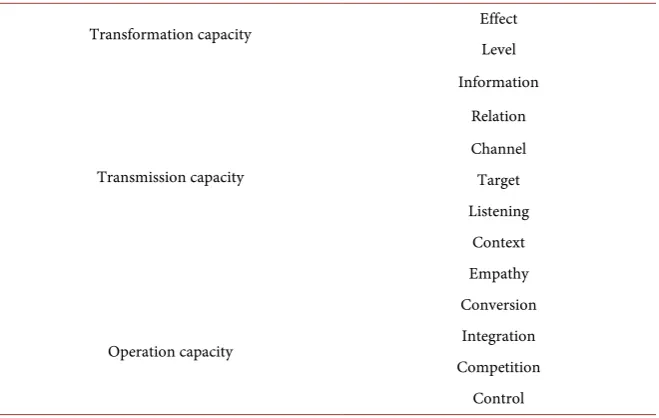
As mentioned earlier, the evaluation index of science and technology capacity building in science and technology park includes two parts: basic ability and special ability. Therefore, it is necessary to set the evaluation index for the special ability. According to the factors of science and technology capacity-building, the following indicators set is made, as described in Table 2 [17].
DOI: 10.4236/jss.2017.511003 34 Open Journal of Social Sciences Table 2. Evaluation indexes system of special popularization ability of science park.
Transformation capacity Effect
Level
Transmission capacity
Information Relation Channel Target Listening
Context Empathy
Operation capacity
Conversion Integration Competition
Control Source: Adapted from [17].
effect and transformation level. The effect can be divided into two parts: the di-rect effect and the indidi-rect effect. The transformation level can be divided into three parts: the quantitative level, the structure level and the quality level. Quan-tity and structure evaluations are related to people, finance, material and other resources, and the quality is evaluated through the novelty, interesting and ad-vanced knowledge. Second, the ability to transmit science mainly covers the above eight capabilities. The information ability is to understand, obtain and use the information, including the analysis of information, evaluation, decision- making, the way to receive information, methods, the use of information to solve practical problems and many other aspects, as well as the use of information technology. The relationship ability focuses on the timely and comprehensive feelings and response. Channel capacity can be evaluated through the proportion and effect of the traditional channels and new channels. The target ability can be evaluated in terms of setting, planning, analysis, and so on. The rest listening, context, and empathy abilities determine the understanding and expression of popularization of the science language, which can be appropriate evaluated. Third, the scientific operational capacity includes conversion, integration, com-petition, and control. Conversion capacity can be evaluated by speed, supply and demand ratio and other aspects; integration capacity is assessed through the in-tegration of all kinds of resources and information; competition capacity can be evaluated through comparing it with the other science and technology parks; evaluation of control ability focuses on that whether capacity building can de-velop according to the plan and whether construction errors can be corrected in time and so on.
5.2.2. Weight Setting and Evaluation Index
DOI: 10.4236/jss.2017.511003 35 Open Journal of Social Sciences which cannot be accurately measured and assessed as quantitative indicators, the proposed Delphi method is applied to evaluate it. Delphi is the most traditional qualitative evaluation method, and the core is anonymously soliciting the opi-nions of the experts, through the organization of expert opinion summary, colla-tion and feedback, so that the views of experts tend to be consistent, and ulti-mately get a unified and reliable conclusions or programs [18].
1) Select peer experts. Experts who have senior titles and rich practical expe-rience, understand the characteristics of capacity construction, and engage in science and technology park management, capacity building of science popula-rization, and scientific research for many years should be selected. The number of experts is R, numbered R R1, , ,2 Rn.
2) Design an expert scoring table, through the literature and extensive solici-tation of expert opinions, as well as reference to analysis methods of capaci-ty-building system.
3) Establish evaluation set E, E = (poor, poor, general, well, well).
4) Perform the first round of expert ratings. Different experts evaluate the weight for different indicators, and collect their evaluation and do the statistical analysis. Calculate the average weight of each indicator, as the corresponding weight of the index
(
Q Q1, , ,2 Qn)
.5) Perform a second round of expert ratings. According to the details of the scoring table, the experts score each of the evaluation indicators, with scores between 0 - 100, and each expert’s results on the index is recorded as
(
)
1 1, 2, , n
R M M M ; R M M2
(
1, 2, , Mn)
; R M M3(
1, 2, , Mn)
(
1, 2, ,)
n n
R M M M .
6) Collect and calculate. Set the final score for each expert evaluation as
1, 2, ,
R R Rn
s s s , for each expert and each evaluation is obtained
(
)
(
)
(
)
1 1
2 2
1 1 2 2
1 1 2 2
1 1 2 2
0 100
0 100
0 100
n n
R n n R
R n n R
R n n R
s Q M Q M Q M s
s Q M Q M Q M s
s Q M Q M Q M s
= ∗ + ∗ + + ∗ < ≤
= ∗ + ∗ + + ∗ < ≤
= ∗ + ∗ + + ∗ < ≤
7) In order to ensure the fairness of the evaluation results, we need to remove one of the highest points and the lowest points from the top to get the average points. If P ∈ [60, 69], the result is poor; if ∈ [70, 79], it is general; if P ∈ [80,
89], it is good; if P ∈ [90, 100], it is very good.
5.3. Establishment of Evaluation Achievements of Capacity
Building of Popularizing Science and
Technology in Science Parks
This paper argues that, as the evaluation includes basic ability and special ability evaluation, the final evaluation result should be the result of two parts. In this case, the results of the basic and the special evaluation index need to be set up.
Gen-DOI: 10.4236/jss.2017.511003 36 Open Journal of Social Sciences eral = 3, I4 = Good = 4, I5 = Very Good = 5;
2) Suppose the special ability evaluation results are followings. P1 =Very Poor = 1, P2 = Poor = 2, P3 = General = 3, P4 = Good = 4, P5 = Very Good = 5;
3) Assuming that the results of the basic ability evaluation are more important than the results of the special one, the weight of the two is 60% and 40% respec-tively; the value of I becomes 0.6, 1.2, 1.8, 2.4, 3; the value of P is 0.4, 0.8, 1.2, 1.6, 2;
4) d Set the final evaluation results as Z, Z I P= ∗ , and the calculation is in the following table:
Z 0.6 1.2 1.8 2.4 3
0.4 0.24 0.48 0.72 0.96 1.2
0.8 0.48 0.96 1.44 1.92 2.4
1.2 0.72 1.44 2.16 2.88 3.6
1.6 0.96 1.92 2.88 3.84 4.8
2 1.2 2.4 3.6 4.8 6
5) Similarly, the conclusion is that if Z ∈ (0,1.2), it shows that the overall
science popularization ability of university science and technology park is very poor; if Z ∈ (1.2,2.4), it is poor; if Z ∈ (2.4,3.6), it is general; if Z ∈ (3.6,4.8), it is
good; if Z ∈ (4.8,6), it is very good.
6. Conclusion and Research in the Future
Based on the previous research results, this paper gives the definition of science popularization ability in University Science Park, and then gives the definition of science popularization ability construction in University Science Park. Then, from the three aspects of the goal, function and influencing factors of science popularizationcapacity-buildingin University Science Park, the connotation of science popularization capacity-building in University Science Park is ex-pounded.
From the two aspects of basic science popularization ability and special science popularization ability of University Science and Technology Park, the evaluation system of science popularization ability construction in University Science and Technology Park has been initially constructed. Of course, this evaluation system is still immature, because it lacks a large amount of empirical data to verify it. In this sense, the construction of University Science and Tech-nology Park capacity-building evaluation system is a systematic project, and the final form of the evaluation system of University Science and Technology Park Science also needs to be combined with the actual repeated verification and trial and error, which should be completed together by scholars and experts of Uni-versity Science and Technology Park.
References
DOI: 10.4236/jss.2017.511003 37 Open Journal of Social Sciences Science Education. Journal of South China Normal University (Social Sciences Edi-tion), No. 6, 9-14, 157.
[2] http://news.sciencenet.cn/htmlnews/2015/9/327326.shtm
[3] Li, Y.Q. and Wang, H.L. (2008) The Significance and Effective Ways of Populariz-ing Science by Colleges and Universities in the New. Tianjin Science and Technol-ogy, No. 6, 69-70.
[4] Shi, Z. (2013) Promoting the Construction of Popularizing Science Ability and Im-proving Innovation based on the Related Statements of the 18th Report. China Re-search Institute for Science Popularization. Tasks and Undertake of Scientific Po-pularization in China through Exploration Its Theory and Practice. Proceedings of the 20th National Symposium on Popular Science, China Research Institute for Science Popularization.
[5] Ren, F.J. (2009) Reflections on the Popularization of Scientific and Technological Resources. Science Popularization, No. 3, 60-65.
[6] Yu, J. (2005) On the Ability Construction of Science Popularization of Science and Technology Communities. Xuehui, No. 7, 48.
[7] Li, H. (2013) A Study on the Ability Construction of Science Popularization in Chi-nese Colleges and Universities. Journal of Architectural Education in Institutions of Higher Learning, 1, 151-154.
[8] Lei, M. (2005) Capacity Building Theory. Party School of Central Committee of CPC.
[9] He, X. (2002) The Burden Is Heavy to Carry out the “Science and Technology Po-pularization Law”. Xiamen Science and Technology, No. 5, 1-4.
[10] Wu, T. (2001) Research on Self-Organization Methodology. Tsinghua University Press, Beijing, No. 6, 28-66.
[11] Wu, X. (2011) A Theoretical Discussion on the Promoting Self-Organization and Promotion Ability of Agricultural Technology. Research of Agricultural Moderni-zation, 4, 457-460.
[12] Ren, X.Y. (2014) Research on Organizational Communication Ability. Lanzhou University, Lanzhou.
[13] Zhang, D. (2008) The Flexibility and Improvement of Operating Ability of Manu-facturing Enterprises. Harbin Institute of Technology.
[14] Zhang, L., Zhang, X. and Chen, F. (2015) Evaluation and Analysis of Regional Science Popularization Ability Based on Fractal Model. Science and Technology Management Research, 2, 44-48.
[15] Wang, W., Zhao, T., Xin, G. and Xu, B. (2016) Comprehensive Ranking of Product Attributes Based on Analytic Hierarchy Process. Journal of Communications, 37, 88-94.
[16] Ma, W., Jiang, L. and Gao, Y. (2007) Fuzzy Comprehensive Evaluation and Case Study of Educational Technology Training Performance of Primary and Secondary School Teachers. China Education Information Technology, No. 6, 70-73.
[17] He, L. (2015) Index System Construction of Enterprise Science Popularization. Science Research Management, S1, 465-469.