Munich Personal RePEc Archive
A Stochastic Model of Competition
between Two Cities for Members of the
Creative Class
Batabyal, Amitrajeet and Yoo, Seung Jick
Rochester Institute of Technology, Sookmyung Women’s University
9 February 2019
A STOCHASTIC MODEL OF COMPETITION BETWEEN TWO CITIES FOR
MEMBERS OF THE CREATIVE CLASS
Amitrajeet A. BATABYAL
Arthur J. Gosnell Professor of Economics
Department of Economics, Rochester Institute of Technology
Rochester, NY 14623-5604, USA
E-mail: [email protected]
Seung Jick YOO
Corresponding Author
Graduate School of International Service, Sookmyung Women’s University
Seoul, Republic of Korea
E-mail: [email protected]
Abstract
Batabyal and Yoo (2019) have recently obtained a significant result in their analysis of the use of utilitarian and Rawlsian policies by two cities to attract the creative class. They show that if one city switches to a Rawlsian or more egalitarian objective when the other city remains utilitarian, the aggregate economy of two cities becomes less egalitarian. We show that this result depends fundamentally on the
assumption that the creative class population can be described by a triangular probability distribution. If this population is modeled instead with an inverted triangular probability distribution then the above result is reversed in the sense that the welfare of the worst-off member of the creative class is always
enhanced when one city switches to a Rawlsian or more egalitarian objective, irrespective of the objective
of the other city.
Keywords:
City, Competition, Creative Class, Rawlsian, Utilitarian
JEL classification:
R11, D63
1. Introduction
The urbanist Richard Florida (2002, 2003, 2005, 2008, 2014) has contended in a number of research contributions that cities and regions that want to flourish in this era of globalization need to do all they can to attract and retain members of the so called creative class who are, we are told, the principal
al. (2019) have answered this query by demonstrating that cities can utilize local public goods such as
cultural amenities, quality schools, and public transit to effectively carry out the “attract” function. (Readers interested in a more detailed discussion of this issue should consult Audretsch and Belitski (2013) and Batabyal and Nijkamp (2016)).
In an interesting recent contribution, Batabyal and Yoo (2019) have shed light on the question posed in the preceding paragraph by analyzing the competition between two cities that use utilitarian and Rawlsian policies to attract the creative class. Inter alia, these researchers show that if one city switches
to a Rawlsian or more egalitarian objective when the other city remains utilitarian, the aggregate economy of two cities becomes less egalitarian. Given this finding, our objective in this paper is to show that this
result obtained by Batabyal and Yoo (2019) depends essentially on the assumption that the creative class population can be described by a triangular probability distribution function. If this population is modeled instead with an inverted triangular probability distribution function then the Batabyal and Yoo (2019) result mentioned above is reversed in the sense that the welfare of the worst-off member of the creative
class is always enhanced when one city switches to a Rawlsian or more egalitarian objective, regardless
of the objective of the other city.
The remainder of this paper is organized as follows. Section 2 delineates our model of an aggregate economy consisting of two cities that builds on Batabyal and Yoo (2019). Note that for ease of comparison with the results obtained by Batabyal and Yoo (2019), the notation we use in our paper is the same as that used by these two researchers. The creative class of interest to us is made up of a
heterogeneous group of individuals possessing creative capital. Section 3 analyzes the welfare of the
worst-off individual in the creative class in the case where one city switches from a utilitarian to a Rawlsian policy regardless of the objective of the other city. Section 4 concludes and then suggests two ways in which the research described in this paper might be extended.
2. The Theoretical Framework
Consider an aggregate economy of two cities denoted by Each of these two cities competes for members of the creative class with its choice of a particular policy. Note that we are using the word “policy” in a general way. As such, one such policy could be how much to provide of a local public good as in Batabyal et al. (2019) and a second policy might be how much funding to make
available to creative class members wishing to undertake one or more entrepreneurial ventures. The policy choice of city is represented by a point on the closed interval
Creative class members differ in their preference for alternate policies put in place by cities and
In particular, a creative class member of type who elects to live in city with policy obtains utility given by the quadratic function
(1)
move given the policy choices of the two cities. With this description of our aggregate economy of two cities out of the way, our next task is to analyze the welfare of the worst-off individual in the creative class in the case where one city switches from a utilitarian to a Rawlsian policy regardless of the objective of the other city.
3. Move from a Utilitarian to a Rawlsian Policy
3.1.Utilitarian policies
Each city selects its policy in accordance with a utilitarian criterion. Specifically, this means that city maximizes the sum of the utilities of the creative class members who live in city Now,
using the symmetry of the distribution of the preferences of the creative class members and the symmetry of the city objective function, we infer that in the equilibrium, the creative class population will be equally divided between cities and
The optimal policy choice of the utilitarian city is given by solving
(2)
where is the density function. The inverted triangular probability distribution function is given by
(3)
Using equation (3) we can simplify city objective function given in equation (2). This gives us
(4)
Integrating the right-hand-side (RHS) of equation (4), we can rewrite city objective function as
(5)
Differentiating equation (5) with respect to and then simplifying the resulting expression gives us the utilitarian solution for city We get
(6)
Now, by symmetry, the utilitarian solution for city is
(7)
We now proceed to address the case in which the two cities adopt Rawlsian policies.
When city adopts a Rawlsian policy, it maximizes the minimum utility of the creative class
members who are resident in city Straightforward computations show that in this case, the analysis is unchanged from the analysis conducted by Batabyal and Yoo (2019). In other words, the actual policy choice of city is and that of city is In addition, the creative class population is equally divided between the two cities.
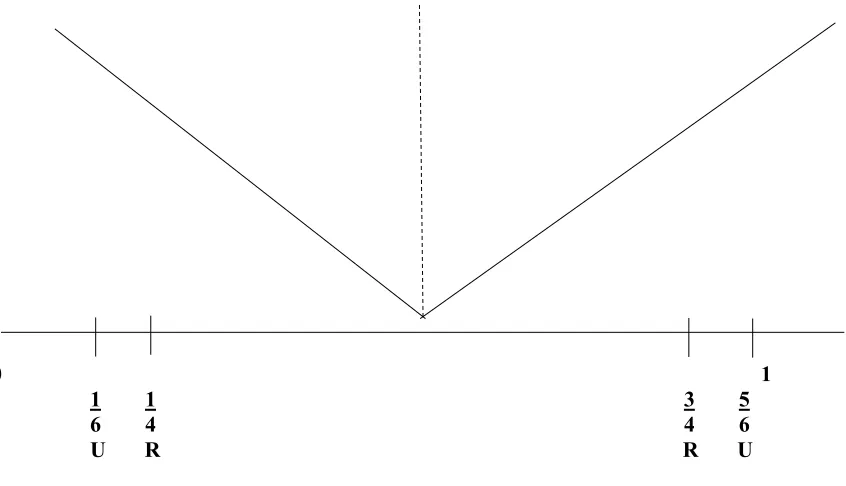
Note that in the Rawlsian case, the two cities choose policies that are at the midpoint of the
preferences of the creative class members who choose to live in these two cities. As shown in figure 1, this gives us the numerical policy choices of and the letter “R” denotes Rawlsian. In contrast, when the two cities pursue utilitarian policies, they choose policies that are at the center of
[image:5.612.82.505.271.514.2]0 1 1 1 3 5 6 4 4 6 U R R U
Figure 1: Rawlsian and utilitarian policy choices
gravity of the preferences of the creative class members who live in these same two cities. Figure 1 shows
that this gives us the numerical policy choices of and the letter “U” denotes utilitarian. Note that because we have chosen to delineate the distribution of the creative class population with the inverted triangular probability distribution function, the distance between the optimal policy choices in the utilitarian case ( is bigger than the corresponding distance in the
Rawlsian case ( Let us now proceed to analyze the case where one city switches from a utilitarian to a Rawlsian policy regardless of the policy objective of the other city.
3.3.
The switch
indifferent between living in the two cities. Second, city Rawlsian policy involves choosing and city utilitarian policy involves selecting
To demonstrate the validity of the two claims in the preceding paragraph, let us begin by using to denote the creative class member who is indifferent between living in either the Rawlsian city or the utilitarian city Then we know that city will choose its policy to minimize the distance for its
worst-off creative class member. This means that city policy choice will be
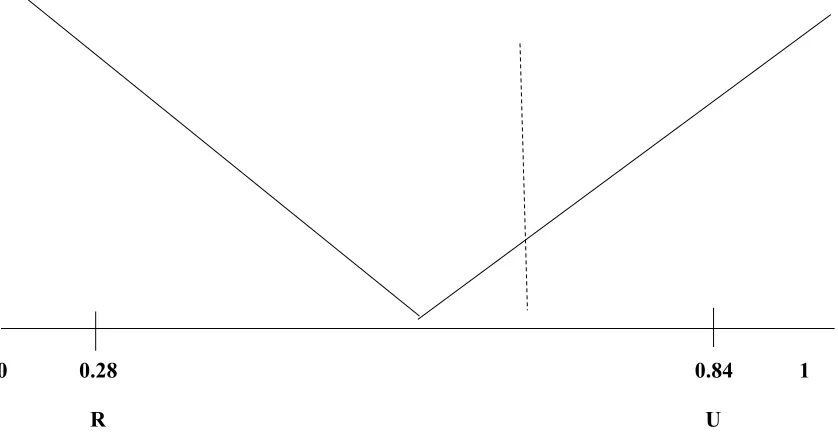
Moving on to city this utilitarian city will select a policy that is at the center of gravity of the closed interval Note that because we are modeling the creative class population distribution in our aggregate economy with the inverted triangular distribution, this center of gravity will always be closer to 1 than to In other words, the use of the inverted triangular distribution function means that more of the creative class population is closer to 1 than to Now, the equilibrium policy choice of the utilitarian city will be because we need the indifferent creative class member denoted by to be equidistant
from the two policy choices of and This constraint and the utilitarian objective function given in equation (1) together tell us that the solution we seek is and the creative class member who is indifferent between living in the two cities is denoted by This solution is illustrated in figure 2.
[image:6.612.82.501.386.607.2]0 0.28 0.84 1 R U
Figure 2: Policy choice leading to a more egalitarian aggregate economy
of gravity results from the fact that more of the creative class population is now close to either 0 or 1 than to Third, with the inverted triangular distribution, the maximum distance of any creative class member from his preferred policy choice is 0.33 in the pure utilitarian case, 0.28 in the part-Rawlsian part-utilitarian case, and 0.25 ( in the pure Rawlsian case. Finally, the preceding three conclusions together tell us that when we use the inverted triangular distribution and not the triangular distribution to model the distribution of the creative class population, the switch of one city to a Rawlsian or more egalitarian objective always enhances the utility of the worst-off member of the creative class irrespective
of the objective of the other city. This completes our analysis of a probabilistic model of competition between two cities for members of the creative class.
4.
Conclusions
In this paper we extended the recent work of Batabyal and Yoo (2019) who studied the competition between two cities to attract the creative class using utilitarian and Rawlsian policies. These researchers showed that if one city switched to a Rawlsian or more egalitarian objective when the other city remained utilitarian, the aggregate economy of two cities became less egalitarian. We first pointed out that this result depended fundamentally on the assumption that the creative class population can be effectively described by a triangular probability distribution function. Next, we showed that if this population is modeled instead with an inverted triangular probability distribution then the above result is reversed in the sense that the welfare of the worst-off member of the creative class is always enhanced when one city switches to a Rawlsian or more egalitarian objective, no matter what the objective of the other city.
The analysis in this paper can be extended in a number of different directions. In what follows, we suggest two possible extensions. First, it would be useful to model the interaction between the creative class and the two cities as a cooperative game in which the two cities cooperate among themselves in one or more ways when they seek to attract members of the creative class to their respective cities. Second, it would also be instructive to embed the aggregate economy of two cities analyzed here in a dynamic environment in which it is possible for one or both cities to switch between utilitarian and Rawlsian policies over time. Studies that examine these facets of the underlying problem will provide further insights into the roles that members of the creative class can play in expanding the economic well-being of cities.
5.
References
Audretsch, D.B., and M. Belitski. 2013. “The missing pillar: The creativity theory of knowledge spillover entrepreneurship.” Small Business Economics, 41, 819-836.
Batabyal, A.A., and P. Nijkamp. 2016. “Creative capital production, inefficiency, and inequality.” International Review of Economics and Finance, 45, 553-558.
Batabyal, A.A., Kourtit, K., and P. Nijkamp. 2019. “Using local public goods to attract and retain the creative class: A tale of two cities.” Forthcoming, Regional Science Policy and Practice.
Batabyal, A.A., and S.J. Yoo. 2019. “Using utilitarian and Rawlsian policies to attract the creative class: A tale of two cities.” MPRA Paper No. 91827, https://mpra.ub.uni-muenchen.de/91827/
Buettner, T., and E. Janeba. 2016. “City competition for the creative class.” Journal of Cultural Economics, 40, 413-451.
Cui, Z. 2018. Land Subsidence Induced by the Engineering-Environmental Effect. Springer Nature, Singapore. Florida, R. 2002. The Rise of the Creative Class. Basic Books, New York, NY.
Florida, R. 2008. Who’s Your City? Basic Books, New York, NY.