305
Compositional Representation of Morphologically-Rich Input
for Neural Machine Translation
Duygu Ataman
FBK, Trento, Italy University of Trento, Italy
Marcello Federico
MMT Srl, Trento, Italy FBK, Trento, Italy
Abstract
Neural machine translation (NMT) mod-els are typically trained with fixed-size in-put and outin-put vocabularies, which creates an important bottleneck on their accuracy and generalization capability. As a solu-tion, various studies proposed segmenting words into sub-word units and performing translation at the sub-lexical level. How-ever, statistical word segmentation meth-ods have recently shown to be prone to morphological errors, which can lead to inaccurate translations. In this paper, we propose to overcome this problem by re-placing the source-language embedding layer of NMT with a bi-directional recur-rent neural network that generates compo-sitional representations of the input at any desired level of granularity. We test our approach in a low-resource setting with five languages from different morpholog-ical typologies, and under different com-position assumptions. By training NMT to compose word representations from char-acter trigrams, our approach consistently outperforms (from 1.71 to 2.48 BLEU points) NMT learning embeddings of sta-tistically generated sub-word units.
1 Introduction
An important problem in neural machine trans-lation (NMT) is translating infrequent or unseen words. The reasons are twofold: the necessity of observing many examples of a word until its in-put representation (embedding) becomes reliable, and the computational requirement of limiting the input and output vocabularies to few tens of thou-sands of words. These requirements eventually lead to coverage issues when dealing with
low-resource and/or morphologically-rich languages, due to their high lexical sparseness. To cope with this well-known problem, several approaches have been proposed redefining the model vocabu-lary in terms of interior orthographic units com-pounding the words, ranging from character n-grams (Ling et al.,2015b;Costa-juss`a and Fonol-losa,2016;Lee et al.,2017;Luong and Manning,
2016) to statistically-learned sub-word units ( Sen-nrich et al.,2016;Wu et al.,2016;Ataman et al.,
2017). While the former provide an ideal open vocabulary solution, they mostly failed to achieve competitive results. This might be related to the semantic ambiguity caused by solely relying on input representations based on character n-grams which are generally learned by disregarding any morphological information. In fact, the second approach is now prominent and has established a pre-processing step for constructing a vocabulary of sub-word units before training the NMT model. However, several studies have shown that seg-menting words into sub-word units without pre-serving morpheme boundaries can lead to loss of semantic and syntactic information and, thus, in-accurate translations (Niehues et al., 2016; Ata-man et al., 2017;Pinnis et al.,2017;Huck et al.,
2017;Tamchyna et al.,2017).
In this paper, we propose to improve the quality of input (source language) representations of rare words in NMT by augmenting itsembedding layer
in-put language directly at training time, thus, avoid-ing the burden of a separate and sub-optimal word segmentation step. We compare our approach against conventional embedding-based represen-tations learned from statistical word segmenta-tion in a public evaluasegmenta-tion benchmark, which pro-vides low-resource training conditions by pair-ing English with five morphologically-rich lan-guages: Arabic, Czech, German, Italian and Turk-ish, where each language represents a distinct morphological typology and language family. The experimental results show that our compositional input representations lead to significantly and con-sistently better translation quality in all language directions.
2 Neural Machine Translation
In this paper, we use the NMT model of Bahdanau et al. (2014). The model essentially estimates the conditional probability of translating a source se-quencex= (x1, x2, . . . xm)into a target sequence
y= (y1, y2, . . . yl), using the decomposition
p(y|x) =
l Y
i=1
p(yj|yi−1, .., y0, xm−1, .., x1) (1)
The model is trained by maximizing the log-likelihood of a parallel training set via stochastic gradient descent (Bottou,2010) and the backprop-agation through time (Werbos,1990) algorithms.
The inputs of the network are one-hotvectors, which are binary vectors with a single bit set to 1 to identify a specific word in the vocabulary. Each one-hot vector is then mapped to an embed-ding, a distributed representation of the word in a lower dimension but a more dense continuous space. From this input, a representation of the whole input sequence is learned using a bi-RNN, theencoder, which mapsxinto mdense sentence vectors corresponding to its hidden states. Next, another RNN, thedecoder, predicts each target to-ken yi by sampling from a distribution computed from the previous target tokenyi−1, the previous decoder hidden state, and thecontext vector. The latter is a linear combination of the encoder hidden states, whose weights are dynamically computed by a feed-forward neural network calledattention model(Bahdanau et al.,2014). The probability of generating each target wordyj is normalized via a softmax function.
Both the source and target vocabulary sizes play an important role in terms of defining the
complex-ity of the model. In a standard architecture, like ours, the source and target embedding matrices ac-tually account for the vast majority of the network parameters. The vocabulary size also plays an important role when translating from and to low-resource and morphologically-rich languages, due to the sparseness of the lexical distribution. There-fore, a conventional approach has now become to compose both the source and target vocabular-ies of sub-word units generated through statistical segmentation methods (Sennrich et al.,2016;Wu et al., 2016; Ataman et al., 2017), and perform-ing NMT by directly learnperform-ing embeddperform-ings of sub-word units. A popular one of these is the Byte-Pair Encoding (BPE) method (Gage, 1994; Sennrich et al., 2016), which finds the optimal description of a corpus vocabulary by iteratively merging the most frequent character sequences. A more recent approach is the Linguistically-Motivated Vocabu-lary Reduction (LMVR) method (Ataman et al.,
2017), which similarly generates a new vocabu-lary by segmenting words into sub-lexical units based on their likeliness of being morphemes and their morphological categories. A drawback of these methods is that, as pre-processing steps to NMT, they are not optimized for the translation task. Moreover, they can suffer from morphologi-cal errors at different levels, which can lead to loss of semantic or syntactic information.
3 Learning Compositional Input Representations via bi-RNNs
In this paper, we propose to perform NMT from input representations learned by composing smaller symbols, such as character n-grams (Ling et al.,2015a), that can easily fit in the model vo-cabulary. This composition is essentially a func-tion which can establish a mapping between com-binations of ortographic units and lexical meaning, that is learned using the bilingual context so that it can produce representations that are optimized for machine translation.
syn-Figure 1: Translation of the Italian sentence tor-nai a casa(I came home) with a word-level repre-sentation composed from character trigrams.
tactic contribution to the word. We implement the network using gated recurrent units (GRUs) (Cho et al., 2014), which have shown compara-ble performance to long-short-term-memory units (Hochreiter and Schmidhuber, 1997), whereas they provide much faster computation. As a min-imal set of input symbols required to cope with contextual ambiguities, we opt to use intersecting sequences of character trigrams, as recently sug-gested by Vania and Lopez (2017).
Given a bi-RNN with a forward (f) and back-ward (b) layer, the input representationwof a to-ken of tcharacters is computed from the hidden stateshft andh0
b,i.e. the final outputs of the for-ward and backfor-ward RNNs, as follows:
w=Wfhtf+Wbh0b +b (2)
where Wf andWb are weight matrices asso-ciated to each RNN and b is a bias vector (Ling et al.,2015a). These parameters are jointly learned together with the internal parameters of the GRUs and the input token embedding matrix while train-ing the NMT model. For an input ofmtokens, our implementation increases the computational com-plexity of the network byO(Ktmaxm), whereK is the bi-RNN cost andtmaxis the maximum num-ber of symbols per word. However, since compu-tation of each input represencompu-tation is independent, a parallelised implementation could cut the over-head down toO(Ktmax).
4 Experiments
We test our approach along with statistical word segmentation based open vocabulary NMT meth-ods in an evaluation benchmark simulating a low-resource translation setting pairing English (En) with five languages from different language fam-ilies and morphological typologies: Arabic (Ar), Czech (Cs), German (De), Italian (It) and
Turk-ish (TR). The characteristics of each language are given in Table1, whereas Table2presents the sta-tistical properties of the training data. We train our NMT models using the TED Talks corpora ( Cet-tolo et al.,2012) and test them on the official data sets of IWSLT1(Mauro et al.,2017).
Language Morphological Morphological Typology Complexity
Turkish Agglutinative High
Arabic Templatic High
Czech Fusional, High Agglutinative
German Fusional Medium
[image:3.595.76.393.62.202.2]Italian Fusional Low
Table 1: The languages evaluated in our study and their morphological characteristics.
Language # tokens # types Pair Src Tgt Src Tgt Tr - En 2,7M 2,0M 171K 53K Ar - En 3,9M 4,9M 220K 120K Cs - En 2,0M 2,3M 118K 50K De - En 4,0M 4,3M 144K 69K It - En 3,5M 3,8M 95K 63K
Table 2: Sizes of the training sets and vocabularies in the TED Talks benchmark. Development and test sets are on average 50K to 100K tokens. (M: Million,K: Thousand.)
ThesimpleNMT model constitutes the baseline in our study and performs translation directly at the level of sub-word units, which can be of four different types: characters, character trigrams, BPE sub-word units, and LMVR sub-word units.
1The International Workshop on Spoken Language
[image:3.595.305.527.316.432.2] [image:3.595.315.519.490.595.2]Thecompositionalmodel, on the other hand, per-forms NMT with input representations composed from sub-lexical vocabulary units. In our study, we evaluate representations composed from char-acter trigrams, BPE, and LMVR units. In order to choose the segmentation method to apply on the English side (the output of NMT decoder), we compare BPE and LMVR sub-word units by car-rying out an evaluation on the official data sets of Morpho Challenge 20102(Kurimo et al.,2010).
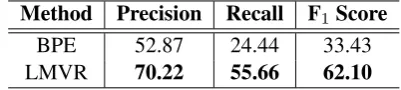
The results of this evaluation, as given in Table
3, suggest that LMVR seems to provide a seg-mentation that is more consistent with morpheme boundaries, which motivates us to use sub-word tokens generated by LMVR for the target side. This choice aids us in evaluating the morpholog-ical knowledge contained in input representations in terms of the translation accuracy in NMT.
The compositional bi-RNN layer is imple-mented in Theano (Team et al., 2016) and inte-grated into the Nematus NMT toolkit (Sennrich et al.,2017). In our experiments, we use a compo-sitional bi-RNN with 256 hidden units, an NMT model with a one-layer bi-directional GRU en-coder and one-layer GRU deen-coder of 512 hidden units, and an embedding dimension of 256 for both models. We use a highly restricted dictio-nary size of 30,000 for both source and target lan-guages, and train the segmentation models (BPE and LMVR) to generate sub-word vocabularies of the same size. We train the NMT models using the Adagrad (Duchi et al.,2011) optimizer with a mini-batch size of 50, a learning rate of 0.01, and a dropout rate of 0.1 (in all layers and embeddings). In order to prevent over-fitting, we stop training if the perplexity on the validation does not decrease for 5 epochs, and use the best model to translate the test set. The model outputs are evaluated using the (case-sensitive) BLEU (Papineni et al.,2002) metric and the Multeval (Clark et al.,2011) sig-nificance test.
2
Shared Task on Unsupervised Morphological Analysis, http://morpho.aalto.fi/events/morphochallenge.
[image:4.595.79.280.670.715.2]Method Precision Recall F1Score BPE 52.87 24.44 33.43 LMVR 70.22 55.66 62.10
Table 3: The performance of different segmenta-tion models trained on the English porsegmenta-tion of our benchmark in the Morpho Challenge shared task.
5 Results
The performance of NMT models in translating each language using different vocabulary units and encoder input representations can be seen in Ta-ble4. With the simple model, LMVR based units achieve the best accuracy in translating all lan-guages, with improvements over BPE by0.85 to 1.09BLEU points in languages with high morpho-logical complexity (Arabic, Czech and Turkish) and0.32to0.53BLEU points in languages with low to medium complexity (Italian and German). This confirms our previous results in (Ataman and Federico, 2018). Moreover, simple models using character trigrams as vocabulary units reach much higher translation accuracy compared to models using characters, indicating their superior perfor-mance in handling contextual ambiguity. In the Italian to English translation direction, the per-formance of simple models using character tri-grams and BPE sub-word units as input represen-tations are almost comparable, showing that char-acter trigrams can even be sufficient as the stand-alone vocabulary units in languages with low lex-ical sparseness. These findings suggest that each type of sub-word unit used in the simple model is specifically convenient for a given morphological typology.
Model Vocabulary Input BLEU
Units Representations Tr-En Ar-En Cs-En De-En It-En
Simple Characters Characters 12.29 8.95 13.42 21.32 22.88
Char Trigrams Char Trigrams 16.13 11.91 20.87 25.01 26.68 Subwords (BPE) Subwords (BPE) 16.79 11.14 21.99 26.61 27.02 Subwords (LMVR) Subwords (LMVR) 17.82 12.23 22.84 27.18 27.34
Composi- Char Trigrams Subwords (BPE) 15.40 11.50 21.67 27.05 27.80
tional Char Trigrams Subwords (LMVR) 16.63 13.29 23.07 26.86 26.84
[image:5.595.76.524.62.218.2]Char Trigrams Words 19.53 14.22 25.16 29.09 29.82 Subwords (BPE) Words 12.64 11.51 23.13 27.10 27.96 Subwords (LMVR) Words 18.90 13.55 24.31 28.07 28.83
Table 4: Experiment results. Best scores for each translation direction are in bold font. All improvements over the baseline (simple model with BPE) are statistically significant (p-value<0.05).
Input e comunque, em@@ ig@@riamo, circol@@iamoe mescol@@iamocos`ı tanto che
(Simple Model) non esiste pi`u l’ isolamento necessario affinch´e avvenga un’ evoluzione .
NMT Output and anyway ,werepair, andwemix so much that
(Simple Model) there ’s no longer the isolation thatweneed to happen to make an evolution .
Input e comunque, emigriamo, circoliamo e mescoliamo cos`ı tanto che
(Compositional Model) non esiste pi`u l’ isolamento necessario affinch´e avvenga un’ evoluzione.
NMT Output and anyway ,wemigrate , circle and mix so much that
(Compositional Model) there ’s no longer the isolation necessary to become evolutionary .
Reference and by the way ,weimmigrate and circulate and intermix so much that you can ’t any longer have the isolation that is necessary for evolution to take place .
Input ama aslında bu resim tamamen , farklıyerlerin foto˘graf@@ larının
(Simple Model) birles¸tir@@ il@@ mesiyle meydana geldi.
NMT Output but in fact , this picturecame up witha completely
(Simple Model) differentplace of photographs.
Input ama aslında bu resim tamamen , farklıyerlerin foto˘graflarının
(Compositional Model) birles¸tirilmesiyle meydana geldi.
NMT Output but in fact , this picturecame from collectingpictures of
(Compositional Model) differentplaces.
Reference but this imageisactually entirelycomposed ofphotographs fromdifferentlocations.
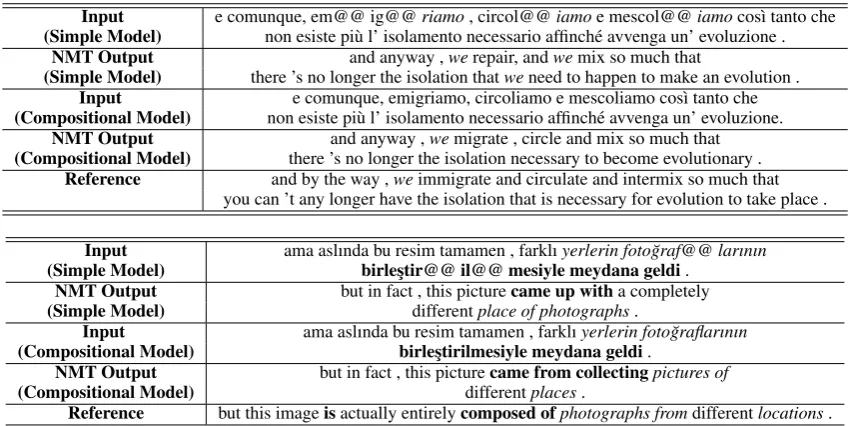
Table 5: Example translations with different approaches inItalian(above) andTurkish(below).
translated by the simple model. On the other hand, the compositional model is able to cap-ture the correct sentence semantics and syntax in either case. These findings suggest that main-taining translation at the lexical level apparently aids the attention mechanism and provides more semantically and syntactically consistent transla-tions. The overall improvements obtained with this model over the best performing simple model are 1.99 BLEU points in Arabic, 2.32 BLEU points in Czech, 1.91 BLEU points in German, 2.48BLEU points in Italian and1.71BLEU points in Turkish to English translation directions. As ev-ident from the significant and consistent improve-ments across all languages, our approach provides a more promising and generic solution to the data sparseness problem in NMT.
6 Conclusion
In this paper, we addressed the problem of trans-lating infrequent words in NMT and proposed to solve it by replacing the conventional sub-word embeddings with input representations composi-tionally learned from character n-grams using a bi-RNN. Our approach showed significant and con-sistent improvements over a variety of languages, making it a competitive solution for NMT of low-resource and morphologically-rich languages. In the future, we plan to optimize our implementa-tion and to test its scalability on larger data sets.
Acknowledgments
[image:5.595.86.515.268.481.2]References
Duygu Ataman and Marcello Federico. 2018. An Eval-uation of Two Vocabulary Reduction Methods for Neural Machine Translation. InProceedings of the 13th Conference of The Association for Machine Translation in the Americas, pages 97–110.
Duygu Ataman, Matteo Negri, Marco Turchi, and Mar-cello Federico. 2017. Linguistically Motivated Vo-cabulary Reduction for Neural Machine Translation from Turkish to English. InThe Prague Bulletin of Mathematical Linguistics, volume 108, pages 331– 342.
Dzmitry Bahdanau, Kyunghyun Cho, and Yoshua Ben-gio. 2014. Neural Machine Translation by Jointly Learning to Align and Translate. InarXiv preprint arXiv:1409.0473.
L´eon Bottou. 2010. Large-Scale Machine Learning with Stochastic Gradient Descent. InProceedings of 19th International Conference on Computational Statistics (COMPSTAT), pages 177–186. Springer.
Mauro Cettolo, Christian Girardi, and Marcello Fed-erico. 2012. Wit3: Web Inventory of Transcribed and Translated Talks. In Proceedings of the 16th Conference of the European Association for Ma-chine Translation (EAMT), pages 261–268.
Kyunghyun Cho, Bart van Merrienboer, Dzmitry Bah-danau, and Yoshua Bengio. 2014. On the properties of neural machine translation: Encoder–decoder ap-proaches. InProceedings of 8th Workshop on Syn-tax, Semantics and Structure in Statistical Transla-tion (SSST), pages 103–111.
Jonathan H. Clark, Chris Dyer, Alon Lavie, and Noah A. Smith. 2011. Better Hypothesis Testing for Statistical Machine Translation: Controlling for Op-timizer Instability. In Proceedings of the 49th An-nual Meeting of the Association for Computational Linguistics (ACL), pages 176–181.
Marta R Costa-juss`a and Jos´e AR Fonollosa. 2016. Character-based neural machine translation. In Pro-ceedings of the 54th Annual Meeting of the Associa-tion for ComputaAssocia-tional Linguistics (ACL), volume 2, pages 357–361.
John Duchi, Elad Hazan, and Yoram Singer. 2011. Adaptive Subgradient Methods for Online Learning and Stochastic Optimization. InJournal of Machine Learning Research, volume 12, pages 2121–2159.
Philip Gage. 1994. A New Algorithm for Data Com-pression. InThe C Users Journal, volume 12, pages 23–38.
Sepp Hochreiter and J¨urgen Schmidhuber. 1997. Long short-term memory. In Neural computation, vol-ume 9, pages 1735–1780. MIT Press.
Matthias Huck, Simon Riess, and Alexander Fraser. 2017. Target-Side Word Segmentation Strategies
for Neural Machine Translation. InProceedings of the 2nd Conference on Machine Translation (WMT), pages 56–67.
Mikko Kurimo, Sami Virpioja, Ville Turunen, and Krista Lagus. 2010. Morpho challenge competition 2005–2010: evaluations and results. In Proceed-ings of the 11th Meeting of the ACL Special Interest Group on Computational Morphology and Phonol-ogy, pages 87–95. Association for Computational Linguistics.
Jason Lee, Kyunghyun Cho, and Thomas Hofmann. 2017. Fully character-Level Neural Machine Trans-lation without Explicit Segmentation. In Transac-tions of the Association for Computational Linguis-tics (TACL), volume 5, pages 365–378.
Wang Ling, Chris Dyer, Alan W Black, Isabel Tran-coso, Ramon Fermandez, Silvio Amir, Luis Marujo, and Tiago Luis. 2015a. Finding function in form: Compositional character models for open vocabu-lary word representation. InProceedings of the 2015 Conference on Empirical Methods in Natural Lan-guage Processing (EMNLP), pages 1520–1530.
Wang Ling, Isabel Trancoso, Chris Dyer, and Alan W Black. 2015b. Character-based Neural Machine Translation. InarXiv preprint arXiv:1511.04586.
Minh-Thang Luong and Christopher D Manning. 2016. Achieving Open Vocabulary Neural Machine Trans-lation with Hybrid Word-Character Models. In Pro-ceedings of the 54th Annual Meeting of the Asso-ciation for Computational Linguistics (ACL), pages 1054–1063.
Cettolo Mauro, Federico Marcello, Bentivogli Luisa, Niehues Jan, St¨uker Sebastian, Sudoh Katsuitho, Yoshino Koichiro, and Federmann Christian. 2017. Overview of the iwslt 2017 evaluation campaign. In
International Workshop on Spoken Language Trans-lation, pages 2–14.
Jan Niehues, Eunah Cho, Thanh-Le Ha, and Alex Waibel. 2016. Pre-translation for Neural Machine Translation. In Proceedings of The 26th Inter-national Conference on Computational Linguistics (COLING), pages 1828–1836.
Kishore Papineni, Salim Roukos, Todd Ward, and Wei-Jing Zhu. 2002. BLEU: a Method for Automatic Evaluation of Machine Translation. InProceedings of the 40th Annual Meeting of the Association for Computational Linguistics (ACL), pages 311–318.
M¯arcis Pinnis, Rihards Kriˇslauks, Daiga Deksne, and Toms Miks. 2017. Neural Machine Translation for Morphologically Rich Languages with Improved Subword Units and Synthetic Data. InProceedings of the International Conference on Text, Speech, and Dialogue (TSD), pages 237–245.
Junczys-Dowmunt, Samuel L¨aubli, Antonio Vale-rio Miceli Barone, Jozef Mokry, et al. 2017. Ne-matus: a toolkit for Neural Machine Translation. In
Proceedings of the 15th Annual Meeting of the Euro-pean Chapter of the Association for Computational Linguistics (EACL), pages 65–68.
Rico Sennrich, Barry Haddow, and Alexandra Birch. 2016. Neural Machine Translation of Rare Words with Subword Units. InProceedings of the 54th An-nual Meeting of the Association for Computational Linguistics (ACL), pages 1715–1725.
Aleˇs Tamchyna, Marion Weller-Di Marco, and Alexan-der Fraser. 2017. Modeling Target-Side Inflection in Neural Machine Translation. InProceedings of the 2nd Conference on Machine Translation (WMT), pages 32–42.
The Theano Development Team, Rami Al-Rfou, Guillaume Alain, Amjad Almahairi, Christof Angermueller, Dzmitry Bahdanau, Nicolas Ballas, Fr´ed´eric Bastien, Justin Bayer, Anatoly Belikov, et al. 2016. Theano: A python framework for fast computation of mathematical expressions. InarXiv preprint arXiv:1605.02688.
Clara Vania and Adam Lopez. 2017. From characters to words to in between: Do we capture morphology? InProceedings of the 55th Annual Meeting of the As-sociation for Computational Linguistics (ACL), vol-ume 1, pages 2016–2027.
Paul J Werbos. 1990. Backpropagation Through Time: What it does and How to do it. In Proceedings of the Institute of Electrical and Electronics Engineers (IEEE), volume 78, pages 1550–1560.