2680
Cross-Modal Commentator: Automatic Machine Commenting Based on
Cross-Modal Information
Pengcheng Yang1,2∗, Zhihan Zhang2∗, Fuli Luo2, Lei Li2, Chengyang Huang3, Xu Sun1,2
1Deep Learning Lab, Beijing Institute of Big Data Research, Peking University 2MOE Key Lab of Computational Linguistics, School of EECS, Peking University
3Beijing University of Posts and Telecommunications
{yang pc, zhangzhihan, luofuli, xusun}@pku.edu.cn
[email protected], [email protected]
Abstract
Automatic commenting of online articles can provide additional opinions and facts to the reader, which improves user experience and engagement on social media platforms. Pre-vious work focuses on automatic commenting based solely on textual content. However, in real-scenarios, online articles usually contain multiple modal contents. For instance, graphic news contains plenty of images in addition to text. Contents other than text are also vital be-cause they are not only more attractive to the reader but also may provide critical informa-tion. To remedy this, we propose a new task: cross-model automatic commenting (CMAC), which aims to make comments by integrating multiple modal contents. We construct a large-scale dataset for this task and explore several representative methods. Going a step further, an effective co-attention model is presented to capture the dependency between textual and visual information. Evaluation results show that our proposed model can achieve better performance than competitive baselines.1
1 Introduction
Comments of online articles can provide rich sup-plementary information, which reduces the diffi-culty of understanding the article and enhances in-teractions between users. Therefore, achieving au-tomatic commenting is necessary since it can con-tribute to improving user experience and increas-ing the activeness of social media platforms.
Due to the importance described above, some work (Qin et al.,2018;Lin et al.,2018;Ma et al., 2018) has explored this task. However, these ef-forts are all focus on automatic commenting based solely on textual content. In real-scenarios, online
∗Equal Contribution.
1
The dataset and code are available at https:// github.com/lancopku/CMAC
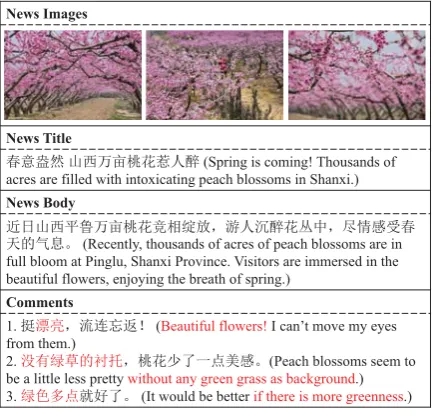
News Images
News Title
᱕⳾❦ ኡ㾯зәṳ㣡ᜩӪ䞹(Spring is coming! Thousands of acres are filled with intoxicating peach blossoms in Shanxi.)
News Body
䘁ᰕኡ㾯ᒣ励зәṳ㣡ㄎ㔭᭮ˈ⑨Ӫ⊹䞹㣡ыѝˈቭᛵᝏਇ᱕ ཙⲴ≄DŽ(Recently, thousands of acres of peach blossoms are in full bloom at Pinglu, Shanxi Province. Visitors are immersed in the beautiful flowers, enjoying the breath of spring.)
Comments
1. ᥪ┲Ӟˈ⍱䘎ᘈ䘄ʽ(Beautiful flowers! I can’t move my eyes from them.)
2. ⋑ᴹ㔯㥹Ⲵ㺜ᢈˈṳ㣡ቁҶа⛩㖾ᝏDŽ(Peach blossoms seem to
[image:1.595.308.527.234.442.2]be a little less pretty without any green grass as background.) 3. 㔯㢢ཊ⛩ቡྭҶDŽ(It would be better if there is more greenness.)
Figure 1: An example in the constructed dataset. Red words indicate the content that is not included in the text but depicted in the images.
articles on social media usually contain multiple modal contents. Take graphic news as an exam-ple, it contains plenty of images in addition to text. Other contents except text are also vital to improv-ing automatic commentimprov-ing. These contents may contain some information that is critical for gen-erating informative comments. In addition, com-pared to plain text, these contents of other modal-ities are more attractive to the reader, making it easily become the focus of comments.
Since the comments depend on the contents of multiple modalities, how to integrate these mul-timodal information becomes the focus. In fact, there exist intrinsic interactions between these in-put multimodal information. Various modalities can benefit from each other to obtain better repre-sentations. For instance, in the graphic news, im-ages can help to highlight the important words in the text, while text also contributes to focusing on key regions of images. Therefore, we present a co-attention model so that the information of multiple modalities can mutually boost for better represen-tations. Experiments show that our co-attention model can substantially outperform various base-lines from different aspects.
The main contributions of this work are summa-rized as follows:
• We propose the task of cross-modal auto-matic commenting (CMAC) and construct a large-scale dataset.
• We present a novel co-attention model, which aims at capturing intrinsic interactions be-tween multiple modal contents.
• The experiments show that our approach can achieve better performance than competitive baselines. With multiple modal information and co-attention, the generated comments are more diverse and informative.
2 Cross-Modal Comments Dataset
We introduce our constructed cross-modal com-ments dataset from the following aspects.
Data collecting We collect data from the photo channels of a popular Chinese news website called Netease News2. The crawled news cover
var-ious categories including entertainment, sports, and more. We tokenize all texts into words, using a python package Jieba3. To guarantee the quality of the comments, we reserve comments with the length between 5 to 30 words and remove useless symbols and dirty words. Besides, we filter out short articles with less than 10 words or 3 images in its content, while unpopular articles with less than 10 pieces of comments are also removed. Fi-nally, we acquire a dataset with 24,134 pieces of news. Each instance contains the news title and its body, several images and a list of high-quality
2http://news.163.com/photo
3https://github.com/fxsjy/jieba
Statistic Train Dev Test Total
# News 19,162 3,521 1,451 24,134 # Comments 746,423 131,175 53,058 930,656 Avg. Images 5.81 5.78 5.81 5.80 Avg. Body 54.75 54.72 55.07 54.77 Avg. Comment 12.19 12.21 12.18 12.19
Table 1: Statistics of the dataset. # Newsand# Com-mentsdenote the total number of news and comments, respectively. Avg. Images is the average number of images per news. Avg. Bodyis the average number of words per body, and similar toAvg. Comment.
Evaluation Flue. Rele. Info. Overall
Score 9.2 6.7 6.4 7.6
Pearson 0.74 0.76 0.66 0.68
Table 2: Quality evaluation results of the testing set.
Flue.,Rele. andInfo. denotes fluency, relevance, and informativeness, respectively.
comments. On average, each news in the dataset contains about 39 human-written comments.
Data Statistics The dataset is split according to the corresponding news. The comments from the same news will appear solely in the training or testing set to avoid overfitting. In more detail, we split the data into 19,162, 3,521 and 1,451 news in the training, development, and testing sets, re-spectively. The corresponding number of com-ments is 746,423, 131,175 and 53,058, respec-tively. The statistics of the final dataset are pre-sented in Table1 and Figure 2 shows the distri-bution of the lengths for comments in both word-level and character-word-level.
Data Analysis High-quality testing set is neces-sary for faithful automatic evaluation. Therefore, we randomly selected 200 samples from the test-ing set for quality evaluation. Three annotators with linguistic background are required to score comments and readers can refer to Section4.3for the evaluation details. Table2shows the evalua-tion results. The average score for overall quality is 7.6, showing that the testing set is satisfactory.
3 Proposed Model
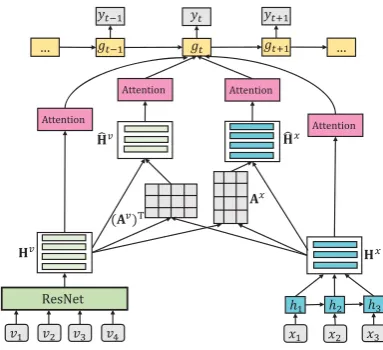
Given the texts4 xand imagesv of an online ar-ticle, the CMAC task aims to generate a reason-able and fluent commenty. Figure3presents the overview of our proposed model, which is elabo-rated on in detail as follows.
4
Figure 2: The distribution of lengths for comments in terms of both word-level and character-level.
3.1 Textual Encoder and Visual Encoder
The textual encoder aims to obtain representations of textual contentx. We implement it as a GRU model (Cho et al.,2014), which computes the hid-den representation of each word as follows:
hxi = GRUhxi−1, e(xi) (1)
wheree(xi)refers to the embedding of the word
xi. Finally, the textual representation matrix is de-noted asHx = {hx1,· · · , hx|x|} ∈ R|x|×d1, where |x| is the total number of textual representations andd1is the dimension ofhxi.
We apply ResNet (He et al.,2016a) as visual en-coder to obtain the visual representation5hv
i of the
i-th imagevi. The final visual representation ma-trix is denoted asHv ={hv1,· · · , hv|v|} ∈R|v|×d2,
where|v|is the number of visual representations andd2is the dimension ofhvi.
3.2 Co-Attention Mechanism
We use co-attention mechanism to capture the in-trinsic interaction between visual content and tex-tual content. The two modal information are con-nected by calculating the similarity matrix S ∈
R|v|×|x|betweenHvandHx. Formally,
S=HvW(Hx)T (2)
whereW ∈ Rd2×d1 is a trainable matrix andS ij denotes similarity between the i-th visual repre-sentation and thej-th textual representation. Sis normalized row-wise to produce the vision-to-text attention weightsAx, and column-wise to produce the text-to-vision attention weightsAv:
Ax= softmax(S)∈R|v|×|x| (3)
Av = softmax(ST)∈R|x|×|v| (4)
wheresoftmax(·)means row-wise normalization. Hence we can obtain the vision-aware textual
rep-5
Multiple representations can be extracted from an image.
۶௩ ۶௫
݄ଵ ݄ଶ ݄ଷ
ǥ ǥ
ݒଵ ݒଶ ݒଷ ݒସ ݔଵ ݔଶ ݔଷ
ሺۯ௩ሻ
ۯ௫
۶௩ ۶௫
݃௧ାଵ
݃௧ିଵ ݃௧
ݕ௧ାଵ ݕ௧
ݕ௧ିଵ
Figure 3: The overview of our proposed model.
resentationsHˆx ∈R|v|×d1 by a product of the
at-tention weightAx and textual representationHx:
ˆ
Hx =AxHx (5) Similarly, the text-aware visual representations
ˆ
Hv ∈R|x|×d2 can be obtained by: ˆ
Hv =AvHv (6)
Since Hx andHv mutually guide each other’s attention, these two sources of information can mutually boost for better representations.
3.3 Decoder
The decoder aims to generate the desired comment yvia another GRU model. Since there exists in-formation from multiple modalities, we equip de-coder with multiple attention mechanisms. The hidden stategt+1 of decoder at time-stept+ 1is computed as:
gt+1= GRUgt,[e(yt);ctx;cvt; ˆcxt; ˆcvt] (7)
where semicolon represents vector concatenation,
yt is the word generated at time-stept andcx t is obtained by attending toHxwithgtas query,
cxt =A(gt,Hx) (8)
whereArefers to the attention mechanism. Read-ers can refer toBahdanau et al.(2015) for the de-tailed approach. cvt, ˆcxt, andˆcvt are obtained in a similar manner by replacing Hx in Eq. (8) with Hv, Hˆx, and Hˆv, respectively. Finally, the de-coder samples a wordyt+1from the output proba-bility distribution as follows:
[image:3.595.319.511.61.236.2]whereUis a weight matrix. The model is trained by maximizing the log-likelihood of ground-truth y∗ = (y∗
1,· · · , yn∗)and the loss function is:
L=− n
t=1
logp(y∗t|y<t∗ ,x,v)
(10)
wherey∗<tdenotes the sequence(y∗1,· · · , yt∗−1).
3.4 Extension to Transformer
We also extend our approach to Transformer (Vaswani et al., 2017). In detail, we adopt self-attention to implement the textual encoder. The representation of each word can be written as:
hxi = SelfAtten(xi,x) (11)
which means that the multi-head attention compo-nent attends to the text xwith the query xi. We strongly recommend readers to refer to Vaswani et al.(2017) for the details of self-attention.
The decoder is also implemented with self-attention mechanism. More specifically, the hid-den state of decoder at time-steptis calculated as:
gt= SelfAtten(yt,y,Hx,Hv,Hˆx,Hˆv) (12)
Inside the decoder, there are five multi-head atten-tion components, using yt as query to attend to y,Hx,Hv,Hˆx, andHˆv, respectively.
4 Experiments
4.1 Settings
The batch size is 64 and the vocabulary size is 15,000. The 512-dim embeddings are learned from scratch. The visual encoder is implemented as ResNet-152 (He et al.,2016a) pretrained on the ImageNet. For the Seq2Seq version of our ap-proach, both textual encoder and decoder is a 2-layer GRU with hidden size 512. For the trans-former version, we set the hidden size of multi-head attention to 512 and the hidden size of feed-forward layer to 2,048. The number of heads is set to 8, while a transformer layer consists of 6 blocks. We use Adam optimizer (Kingma and Ba, 2015) with learning rate10−3and apply dropout (Srivas-tava et al.,2014) to avoid over-fitting.
4.2 Baselines
We adopt the following competitive baselines:
Seq2Seq: We implement a series of baselines
based on Seq2Seq. S2S-V(Vinyals et al., 2015)
Models BLEU-1 ROUGE-L DIST-1 DIST-2
S2S-V 6.1 7.8 1348 3293
S2S-T 6.3 8.1 1771 4285
S2S-VT 6.6 8.5 1929 4437
Our (S2S) 7.1 9.1 2279 4743
Trans-V 5.9 7.6 1336 3472
Trans-T 6.4 8.3 1772 4694
Trans-VT 6.8 8.6 1891 4739
Our (Trans) 7.7 9.4 2265 4941
Table 3: Automatic evaluations of our method and baselines. DIST-1andDIST-2are the number of dis-tinct unigrams and bigrams, respectively.
only encodes images via CNN as input. S2S-T(Bahdanau et al.,2015) is the standard Seq2Seq that only encodes texts as input. S2S-VT (Venu-gopalan et al., 2015) adopts two encoders to en-code images and texts respectively.
Transformer: We replace the Seq2Seq in the
above baselines with Transformer (Vaswani et al., 2017). The corresponding models are named
Trans-V,Trans-T, andTrans-VT, respectively.
4.3 Evaluation Metrics
We adopt two kinds of evaluation methods: auto-matic evaluation and human evaluation.
Automatic evaluation: We use BLEU
(Pap-ineni et al.,2002) and ROUGE (Lin,2004) to eval-uate overlap between outputs and references. We also calculate the number of distinctn-grams (Li et al.,2016) in outputs to measure diversity.
Human evaluation:Three annotators score the 200 outputs of different systems from 1 to 10. The evaluation criteria are as follows. Fluency mea-sures whether the comment is fluent. Relevance
evaluates the relevance between the output and the input. Informativeness measures the amount of useful information contained in the output. Over-all is a comprehensive metric. For each met-ric, the average Pearson correlation coefficient is greater than 0.6, indicating that the human scores are highly consistent.
4.4 Experimental Results
Table3and Table4show the results of automatic evaluation and human evaluation, respectively. We perform analysis from the following aspects.
Models Flue. Rele. Info. Overall
S2S-V 3.1 2.8 2.5 3.2
S2S-T 4.5 4.6 3.7 4.7
S2S-VT 4.6 5.1 4.3 4.9
Our (S2S) 4.8 5.7 4.7 5.1
Trans-V 2.9 2.3 2.8 2.9
Trans-T 4.3 4.8 4.4 4.6
Trans-VT 4.7 4.6 4.7 5.1
Our (Trans) 4.9 5.9 5.0 5.2
Table 4: Results of human evaluation.Flue.,Rele.and
Info. denotes fluency, relevance, and informativeness, respectively.
For instance, the Transformer version of our ap-proach achieves a 13% relative improvement of BLEU-1 score over Trans-VT. This illustrates that our co-attention can contribute to generating high-quality comments. The co-attention mechanism brings bidirectional interactions between visual formation and textual information, so that two in-formation sources can mutually boost for better representations, leading to improved performance.
The universality of co-attention Results show
that both the Seq2Seq and Transformer version of our approach can outperform various baselines based on the same architecture. This shows that our co-attention has excellent universality, which can be applied to various model architectures.
The contribution of visual content According
to Table3and Table4, although the images con-tribute less to generating high-quality comments than texts, they still bring a positive impact on the generation. This illustrates that visual content contains additional useful information, which fa-cilitates the generation of informative comments. Therefore, integrating multi-modal information is necessary for generating high-quality comments, which is also an important value of our work.
5 Related Work
In summary, this paper is mainly related to the fol-lowing two lines of work.
Automatic article commenting. One similar
task to CMAC is automatic article commenting. Qin et al. (2018) is the first to propose this task and constructs a large-scale dataset. Lin et al. (2018) proposes to retrieve information from user-generated data to facilitate the generation of com-ments. Furthermore, Ma et al. (2018) introduces
a retrieval-based unsupervised model to perform generation from unpaired data. However, differ-ent from the article commdiffer-enting that only requires extracting textual information for generation, the CMAC task involves not only the modeling of tex-tual features but also the understanding of visual images, which poses a greater challenge to the in-telligent systems.
Co-attention. We are also inspired by the
re-lated work of co-attention mechanism. Lu et al. (2016a) introduces a hierarchical co-attention model in visual question answering to jointly at-tend to images and questions. Xiong et al.(2017) proposes a dynamic co-attention network for the question answering task and Seo et al. (2017) presents a bi-directional attention network to ac-quire query-aware context representations in ma-chine comprehension. Tay et al. (2018a) pro-poses a co-attention mechanism based on Her-mitian products for asymmetrical text matching problems. Zhong et al.(2019) further presents a coarse-grain fine-grain co-attention network that combines information from evidence across mul-tiple documents for question answering. In addi-tion, the co-attention mechanism can also be ap-plied to word sense disambiguation (Luo et al., 2018), recommended system (Tay et al., 2018b), and essay scoring (Zhang and Litman,2018).
6 Conclusion
In this paper, we propose the task of cross-modal automatic commenting, which aims at enabling the AI agent to make comments by integrating multiple modal contents. We construct a large-scale dataset for this task and implement plenty of representative neural models. Furthermore, an effective co-attention model is presented to capture the intrinsic interaction between multiple modal contents. Experimental results show that our approach can substantially outperform various competitive baselines. Further analysis demon-strates that with multiple modal information and co-attention, the generated comments are more di-verse and informative.
Acknowledgement
References
Dzmitry Bahdanau, Kyunghyun Cho, and Yoshua Ben-gio. 2015. Neural machine translation by jointly learning to align and translate. In3rd International Conference on Learning Representations, Confer-ence Track Proceedings.
David Chen and William B. Dolan. 2011. Collect-ing highly parallel data for paraphrase evaluation. In The 49th Annual Meeting of the Association for Computational Linguistics: Human Language Technologies, Proceedings of the Conference, pages 190–200.
Deli Chen, Shuming Ma, Pengcheng Yang, and Xu Sun. 2018. Identifying high-quality chinese news comments based on multi-target text matching model. arXiv preprint arXiv:1808.07191.
Kyunghyun Cho, Bart van Merrienboer, C¸ aglar G¨ulc¸ehre, Dzmitry Bahdanau, Fethi Bougares, Hol-ger Schwenk, and Yoshua Bengio. 2014. Learning phrase representations using RNN encoder-decoder for statistical machine translation. InProceedings of the 2014 Conference on Empirical Methods in Nat-ural Language Processing, A meeting of SIGDAT, a Special Interest Group of the ACL, pages 1724– 1734.
Zihang Dai, Zhilin Yang, Yiming Yang, William W Cohen, Jaime Carbonell, Quoc V Le, and Ruslan Salakhutdinov. 2019. Transformer-xl: Attentive lan-guage models beyond a fixed-length context. arXiv preprint arXiv:1901.02860.
Kaiming He, Xiangyu Zhang, Shaoqing Ren, and Jian Sun. 2016a. Deep residual learning for image recog-nition. In2016 IEEE Conference on Computer Vi-sion and Pattern Recognition, pages 770–778.
Kaiming He, Xiangyu Zhang, Shaoqing Ren, and Jian Sun. 2016b. Deep residual learning for image recog-nition. In2016 IEEE Conference on Computer Vi-sion and Pattern Recognition, pages 770–778.
Sepp Hochreiter and J¨urgen Schmidhuber. 1997. Long short-term memory. Neural Computation, 9(8):1735–1780.
Diederik P. Kingma and Jimmy Ba. 2015. Adam: A method for stochastic optimization. In 3rd Inter-national Conference on Learning Representations, Conference Track Proceedings.
Jiwei Li, Michel Galley, Chris Brockett, Jianfeng Gao, and Bill Dolan. 2016. A diversity-promoting objec-tive function for neural conversation models. InThe 2016 Conference of the North American Chapter of the Association for Computational Linguistics: Hu-man Language Technologies, pages 110–119.
Chin-Yew Lin. 2004. Rouge: A package for auto-matic evaluation of summaries. Text Summarization Branches Out.
Tsung-Yi Lin, Michael Maire, Serge J. Belongie, James Hays, Pietro Perona, Deva Ramanan, Piotr Doll´ar, and C. Lawrence Zitnick. 2014. Microsoft COCO: common objects in context. InComputer Vision -ECCV 2014 - 13th European Conference, Proceed-ings, Part V, pages 740–755.
Zhaojiang Lin, Genta Indra Winata, and Pascale Fung. 2018. Learning comment generation by leveraging user-generated data. arXiv preprint arXiv:1810.12264.
Jiasen Lu, Jianwei Yang, Dhruv Batra, and Devi Parikh. 2016a. Hierarchical question-image co-attention for visual question answering. InAdvances in Neural Information Processing Systems 29: An-nual Conference on Neural Information Processing Systems 2016, pages 289–297.
Jiasen Lu, Jianwei Yang, Dhruv Batra, and Devi Parikh. 2016b. Hierarchical question-image co-attention for visual question answering. InAdvances in Neural Information Processing Systems 29: An-nual Conference on Neural Information Processing Systems 2016, pages 289–297.
Fuli Luo, Peng Li, Jie Zhou, Pengcheng Yang, Baobao Chang, Zhifang Sui, and Xu Sun. 2019. A dual rein-forcement learning framework for unsupervised text style transfer. arXiv preprint arXiv:1905.10060.
Fuli Luo, Tianyu Liu, Zexue He, Qiaolin Xia, Zhi-fang Sui, and Baobao Chang. 2018. Leveraging gloss knowledge in neural word sense disambigua-tion by hierarchical co-attendisambigua-tion. InProceedings of the 2018 Conference on Empirical Methods in Nat-ural Language Processing, pages 1402–1411.
Shuming Ma, Lei Cui, Furu Wei, and Xu Sun. 2018. Unsupervised machine commenting with neural variational topic model. arXiv preprint arXiv:1809.04960.
Kishore Papineni, Salim Roukos, Todd Ward, and Wei-Jing Zhu. 2002. Bleu: a method for automatic eval-uation of machine translation. InProceedings of the 40th Annual Meeting of the Association for Compu-tational Linguistics, pages 311–318.
Razvan Pascanu, Tomas Mikolov, and Yoshua Ben-gio. 2013. On the difficulty of training recurrent neural networks. InProceedings of the 30th Inter-national Conference on Machine Learning, pages 1310–1318.
Lianhui Qin, Lemao Liu, Wei Bi, Yan Wang, Xiaojiang Liu, Zhiting Hu, Hai Zhao, and Shuming Shi. 2018. Automatic article commenting: the task and dataset. In Proceedings of the 56th Annual Meeting of the Association for Computational Linguistics, Volume 2: Short Papers, pages 151–156.
Nitish Srivastava, Geoffrey E. Hinton, Alex Krizhevsky, Ilya Sutskever, and Ruslan Salakhutdi-nov. 2014. Dropout: a simple way to prevent neural networks from overfitting. Journal of Machine Learning Research, 15(1):1929–1958.
Ilya Sutskever, Oriol Vinyals, and Quoc V. Le. 2014. Sequence to sequence learning with neural net-works. InAdvances in Neural Information Process-ing Systems 27: Annual Conference on Neural Infor-mation Processing Systems 2014, pages 3104–3112.
Yi Tay, Anh Tuan Luu, and Siu Cheung Hui. 2018a. Hermitian co-attention networks for text matching in asymmetrical domains. In Proceedings of the Twenty-Seventh International Joint Conference on Artificial Intelligence, pages 4425–4431.
Yi Tay, Anh Tuan Luu, and Siu Cheung Hui. 2018b. Multi-pointer co-attention networks for recommen-dation. InProceedings of the 24th ACM SIGKDD International Conference on Knowledge Discovery & Data Mining, pages 2309–2318.
Ashish Vaswani, Noam Shazeer, Niki Parmar, Jakob Uszkoreit, Llion Jones, Aidan N. Gomez, Lukasz Kaiser, and Illia Polosukhin. 2017. Attention is all you need. InAdvances in Neural Information Pro-cessing Systems 30: Annual Conference on Neural Information Processing Systems 2017, pages 6000– 6010.
Subhashini Venugopalan, Marcus Rohrbach, Jeffrey Donahue, Raymond J. Mooney, Trevor Darrell, and Kate Saenko. 2015. Sequence to sequence - video to text. In2015 IEEE International Conference on Computer Vision, pages 4534–4542.
Oriol Vinyals, Alexander Toshev, Samy Bengio, and Dumitru Erhan. 2015. Show and tell: A neural im-age caption generator. InIEEE Conference on Com-puter Vision and Pattern Recognition, pages 3156– 3164.
Caiming Xiong, Victor Zhong, and Richard Socher. 2017. Dynamic coattention networks for ques-tion answering. In5th International Conference on Learning Representations, Conference Track Pro-ceedings.
Jun Xu, Tao Mei, Ting Yao, and Yong Rui. 2016. MSR-VTT: A large video description dataset for bridging video and language. In2016 IEEE Confer-ence on Computer Vision and Pattern Recognition, pages 5288–5296.
Pengcheng Yang, Xu Sun, Wei Li, Shuming Ma, Wei Wu, and Houfeng Wang. 2018. SGM: sequence generation model for multi-label classification. In Proceedings of the 27th International Conference on Computational Linguistics, pages 3915–3926.
Peter Young, Alice Lai, Micah Hodosh, and Julia Hockenmaier. 2014. From image descriptions to vi-sual denotations: New similarity metrics for seman-tic inference over event descriptions. TACL, 2:67– 78.
Haoran Zhang and Diane J. Litman. 2018. Co-attention based neural network for source-dependent essay scoring. InProceedings of the Thirteenth Workshop on Innovative Use of NLP for Building Educational Applications, pages 399–409.
Yi Zhang, Jingjing Xu, Pengcheng Yang, and Xu Sun. 2018. Learning sentiment memories for sentiment modification without parallel data. InProceedings of the 2018 Conference on Empirical Methods in Natural Language Processing, pages 1103–1108.