6047
Negative Lexically Constrained Decoding for Paraphrase Generation
Tomoyuki Kajiwara Institute for Datability Science Osaka University, Osaka, Japan
Abstract
Paraphrase generation can be regarded as monolingual translation. Unlike bilingual machine translation, paraphrase generation rewrites only a limited portion of an input sentence. Hence, previous methods based on machine translation often perform conserva-tively to fail to make necessary rewrites. To solve this problem, we propose a neural model for paraphrase generation that first identifies words in the source sentence that should be paraphrased. Then, these words are para-phrased by the negative lexically constrained decoding that avoids outputting these words as they are. Experiments on text simplification and formality transfer show that our model im-proves the quality of paraphrasing by making necessary rewrites to an input sentence.
1 Introduction
Paraphrase generation is a generic term for tasks that generate sentences semantically equivalent to input sentences. These techniques make it pos-sible to control information other than the mean-ing of the text. Typical paraphrase generation tasks include subtasks such as text simplification to control complexity, formality transfer to trol formality, grammatical error correction to trol fluency, and sentence compression to con-trol sentence length. These paraphrase gener-ation applicgener-ations not only support communica-tion and language learning but also contribute to the performance improvement of other natu-ral language processing applications (Evans,2011;
ˇStajner and Popovi´c,2016).
Paraphrase generation can be considered as a monolingual machine translation problem. Sentential paraphrases with different complexi-ties (Coster and Kauchak, 2011; Xu et al., 2015) and formalities (Rao and Tetreault, 2018) were created manually, and parallel corpora
special-ized for each subtask were constructed. As in the field of machine translation, phrase-based (Coster and Kauchak,2011;Xu et al.,2012) and syntax-based (Zhu et al., 2010; Xu et al.,
2016) methods were proposed early. In re-cent years, the encode-decoder model based on the attention mechanism (Nisioi et al., 2017;
Zhang and Lapata, 2017; Jhamtani et al., 2017;
Niu et al., 2018) has been studied, inspired by the success of neural machine transla-tion (Bahdanau et al.,2015).
In machine translation, all words appearing in an input sentence must be rewritten in the target language. However, paraphrase generation does not require rewriting of all words. When some cri-teria are provided, words not satisfying the cricri-teria in the input sentence are identified and rewritten. For example, the criterion for text simplification is the textual complexity, and rewrites complex words to simpler synonymous words. Owing to the characteristics of the task where only a limited portion of an input sentence needs to be rewrit-ten, previous methods based on machine transla-tion often perform conservatively and fail to pro-duce necessary rewrites (Zhang and Lapata,2017;
Niu et al., 2018). To solve the problem of con-servative paraphrasing that copies many parts of the input sentence, we propose a neural model for paraphrase generation that first identifies words in the source sentence requiring paraphrasing. Sub-sequently, these words are paraphrased by the neg-ative lexically constrained decoding that avoids outputting them as they are.
2 Proposed Method
To improve the conservative rewriting of the neu-ral paraphrase generation, we first identify the words to be paraphrased for a given input sen-tence (Section2.1). Next, we paraphrase the in-put sentence using the pretrained paraphrase gen-eration model. Here, we select sentences not in-cluding those words by adding negative lexically constrained decoding to the beam search (Sec-tion 2.2). Because our method only changes the beam search, it can be applied to various para-phrase generation models and model retraining is not necessary.
2.1 Identification of Word to be Paraphrased
We extract words strongly related to the source style included in the input sentence si as
vo-cabulary Vi to be paraphrased. Point-wise
mu-tual information is used to estimate the related-ness between each word w ∈ si and style z ∈ {x, y}(Pavlick and Nenkova,2015). Here,xand
yare the source style (e.g.informal) and the target style (e.g. formal), respectively.
PMI(w, z) = log p(w, z)
p(w)p(z) = log
p(w|z) p(w) (1)
We define the vocabularyVito be paraphrased
us-ing the thresholdθas follows.
Vi={w|w∈si∧PMI(w, x)≥θ} (2)
After extracting the vocabulary Vi to be
para-phrased for each input sentence si, we generate
paraphrase sentences using it as a hard constraints. Note that PMI score is calculated using a training parallel corpus for paraphrase generation.
2.2 Negative Lexically Constrained Decoding
Lexically constrained decoding (Anderson et al.,
2017; Hokamp and Liu, 2017; Post and Vilar,
2018) adds constraints to the beam search to force the output text to include certain words. The effectiveness of these methods are demon-strated in image captioning using given image tags (Anderson et al.,2017) and in the post-editing of machine translation (Hokamp and Liu,2017).
In paraphrase generation, there is no situation that words to be included in the output sentence are given. Therefore, positive lexical constraints used in the image captioning and post-editing of machine translation cannot be applied to this task
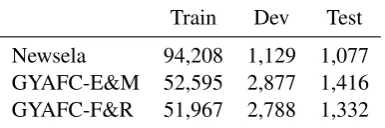
Train Dev Test
Newsela 94,208 1,129 1,077
[image:2.595.321.514.64.128.2]GYAFC-E&M 52,595 2,877 1,416 GYAFC-F&R 51,967 2,788 1,332
Table 1: Number of sentence pairs for each dataset.
as they are. Meanwhile, negative lexical con-straints that are forced to not include certain words in output sentence are promising for paraphrase generation. This is because, for example, text sim-plification is a task of generating sentential para-phrase without using complex words that appear in the source sentence.
In this study, we add negative lexical con-straints to beam search using dynamic beam allo-cation (Post and Vilar,2018), which is the fastest lexically constrained decoding algorithm. In nega-tive lexical constraints, we exclude hypotheses in-cluding the given words during beam search. Con-sequently, the words identified in Section2.1will not appear in our generated sentences.
3 Experiment
We evaluate the performance of the proposed method on two major paraphrase generation tasks. We conduct experiments on text simplification and formality transfer using datasets shown in Ta-ble 1. For text simplification, we identify com-plex words in the input sentence and generate sim-ple paraphrase sentence without using these com-plex words. Similarly, for formality transfer, we identify informal words in the input sentence and generate formal paraphrase sentence without using these informal words.
3.1 Setup
For text simplification, we used the Newsela dataset (Xu et al., 2015) split and tok-enized with the same settings as the previ-ous study (Zhang and Lapata, 2017). For
formality transfer, we used the GYAFC
dataset (Rao and Tetreault, 2018) normalized and tokenized using Moses toolkit.1 For each task, we used byte-pair encoding2(Sennrich et al.,
2016) to limit the number of token types to
16,000. In the GYAFC dataset, it is reported that a correlation exists between manual evaluation
1
Newsela GYAFC-E&M GYAFC-F&R
Add Keep Del BLEU SARI Add Keep Del BLEU Add Keep Del BLEU
RNN-Base 1.8 60.8 22.3 24.1 17.4 31.9 90.0 57.5 71.2 32.9 90.5 61.1 74.7
RNN-PMI 2.8 61.1 36.5 24.7 22.8 33.5 90.0 59.9 71.7 34.3 90.9 63.1 75.9
RNN-Oracle 10.4 82.9 89.9 36.4 40.0 34.8 92.7 72.4 75.2 35.7 93.2 74.6 79.3
SAN-Base 1.8 60.9 23.8 24.0 17.8 34.4 90.0 59.9 71.8 34.5 91.1 63.2 76.7
SAN-PMI 2.5 61.3 38.0 24.6 23.3 35.2 90.0 61.2 72.1 35.3 91.1 64.0 77.0
SAN-Oracle 10.1 82.0 89.4 35.9 39.9 36.6 92.4 71.4 75.1 36.6 92.9 73.7 79.8
Table 2: Performance of our paraphrase generation models on text simplification (complex→simple) in Newsela dataset and formality transfer (informal→formal) in GYAFC dataset. For both RNN and SAN models, our method consistently improves BLEU and SARI scores across styles or domains. In addition, a consistent improvement on Add and Del means that our method promotes active rewriting.
and automatic evaluation using BLEU only when paraphrasing from an informal style to formal style (Rao and Tetreault, 2018). Therefore, we will only experiment with this setting.
For lexical constraints, we identified words with a PMI score above the threshold θ. We selected a threshold θ ∈ {0.0,0.1,0.2, ...,0.7} that max-imizes the BLEU score between the output sen-tence and the reference sensen-tence in the develop-ment dataset. We calculated PMI scores using each training dataset shown in Table1.
As a paraphrase generation model, we con-structed the recurrent neural network (RNN) and self-attention network (SAN) models using the Sockeye toolkit (Hieber et al., 2017).3 Our RNN
model uses a single LSTM with a layer size of 512 for both the encoder and decoder, and MLP attention with a layer size of 512. Our SAN model uses a six-layer transformer with a model size of 512 and a single attention head. We used word embeddings in 512 dimensions tying the source, target, and the output layer’s weight matrix. We added dropout to the embeddings and hidden lay-ers with probability 0.2. In addition, we used layer-normalization and label-smoothing for reg-ularization. We trained using the Adam opti-mizer (Kingma and Ba, 2014) with a batch size of 4,096 tokens and checkpoint the model ev-ery 1,000 updates. The training stopped after five checkpoints without improvement in valida-tion perplexity.
BLEU (Papineni et al.,2002) is primarily used for our evaluation metrics; SARI (Xu et al.,2016) is also used for text simplification. For a more de-tailed comparison of the models, we evaluated the F1 score of the words that are added (Add), kept
3https://github.com/awslabs/sockeye
(Keep), and deleted (Del) by the models.4
Our proposed method is compared with previ-ous methods trained only on the dataset shown in Table 1. For detailed analysis, we chose the methods whose model outputs are published. Among these, Dress-LS (Zhang and Lapata,2017) and BiFT-Ens (Niu et al., 2018) with the highest BLEU score in each task are compared with our model. Following BiFT-Ens, we also used a bi-directional domain-mixed ensemble model for for-mality transfer task.
We also experimented with Oracle settings that can properly identify words to be paraphrased. In this setting, we used all words that did not ap-pear in the reference sentence among the words in-cluded in the input sentence as lexical constraints.
3.2 Results
The experimental results are shown in Table 2. These results in both RNN and SAN architectures and three datasets showed that our PMI-based method consistently improves the Base method that does not use constraints in both BLEU and SARI metrics. As a result of a detailed analysis of the model outputs, our PMI method always im-proves the Base method in terms of Add and Del in both model architectures. These results mean that our proposed method promotes active rewriting as expected. In addition, since Oracle method shows higher performance, it is worthwhile to further im-prove PMI-based identification. In this study, we identified words to be paraphrased using the train-ing corpus for paraphrase generation. In future work, we plan to identify these words using not only a parallel corpus but also larger data.
Newsela GYAFC-E&M GYAFC-F&R
Add Keep Del BLEU SARI Add Keep Del BLEU Add Keep Del BLEU
Source 0.0 60.3 0.0 21.4 2.8 0.0 85.4 0.0 49.1 0.0 85.8 0.0 51.0
Reference 100 100 100 100 70.3 57.2 82.9 61.2 100 56.5 82.7 60.6 100
Dress-LS 2.4 60.7 44.9 24.3 26.6
BiFT-Ens 32.1 90.0 58.2 71.4 32.6 90.6 60.9 74.5
Ours (RNN) 2.8 61.1 36.5 24.7 22.8 33.5 90.0 59.9 71.7 34.3 90.9 63.1 75.9
Ours (SAN) 2.5 61.3 38.0 24.6 23.3 35.2 90.0 61.2 72.1 35.3 91.1 64.0 77.0
Table 3: Comparison with previous models on text simplification in Newsela dataset and formality transfer in GYAFC dataset. Our models achieved the best BLEU scores across styles and domains.
GYAFC-E&M: Informal→Formal
Source mamaso ugly, she scares buzzards off of a meat wagon.
Reference Your mother is so unattractive she scared buzzards off of a meat wagon. SAN-BASE mamais so ugly, she scares buzzards off of a meat wagon.
SAN-PMI The mother is so unattractive that she scares buzzards off of a meat wagon.
GYAFC-F&R: Informal→Formal
Source Well, if the one boypickson you, why like him?
Reference Well, if that one boy bullies you, why the attraction to him? SAN-BASE If the one boypickson you, why like him?
SAN-PMI Well, if the one boy teases you, why like him?
Table 4: Examples of formality transfer. Bolded words are words that are identified as the source style (informal). We succeeded in paraphrasing as follows: mama→mother, picks on→teases.
Table3shows a comparison between our mod-els and comparative modmod-els. Whereas Dress-LS has a higher SARI score because it directly op-timizes SARI using reinforcement learning, our models achieved the best BLEU scores across styles and domains.
Table 4 shows examples of generated para-phrases in formality transfer task. We succeeded in identifying informal expressions of mama and
picks, and successfully paraphrased them. Our
proposed method avoids these informal words dur-ing beam search, and outputs their synonymous formal expressions,i.e.,motherandteases.
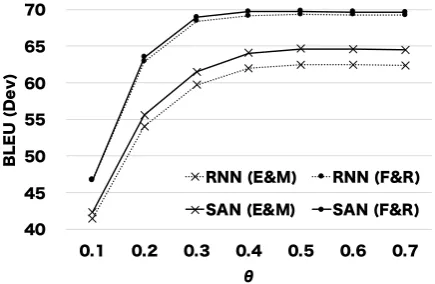
Figure1shows the sensitivity of the quality of generated paraphrases to PMI threshold θon the development dataset. Too low thresholds cause a large amount of constraints, which adversely af-fect paraphrase quality. However, with a high threshold, the proposed method can achieve high performance stably. Finally, we used a threshold ofθ = 0.5 to maximize the BLEU score on the development dataset for formality transfer tasks. Similarly, in the text simplification task, we used a threshold ofθ= 0.2.
40 45 50 55 60 65 70
0.1 0.2 0.3 0.4 0.5 0.6 0.7
BL
E
U
(
D
e
v
)
θ
RNN (E&M) RNN (F&R)
SAN (E&M) SAN (F&R)
Figure 1: Thresholds of PMI and quality of generated paraphrases on the development dataset.
4 Related Work
4.1 Style-Sensitive Paraphrase Acquisition
[image:4.595.314.532.440.582.2]2015). Pavlick and Callison-Burch (2016) fur-ther improved style-sensitive paraphrase acquisi-tion based on supervised learning with addiacquisi-tional features such as frequency and word embeddings. In this study, as in these previous studies, we have identified words that are strongly related to a par-ticular style. Furthermore, we used these words to control the neural paraphrase generation model and improved the performance of sentential para-phrase generation.
4.2 Lexically Constrained Paraphrasing
Hu et al. (2019b) automatically constructed a large-scale paraphrase corpus5 via lexically con-strained machine translation. In a Czech–English bilingual corpus, sentence pairs of a Czech-to-English machine translation and an Czech-to-English refer-ence can be regarded as automatically generated sentential paraphrase pairs (Wieting and Gimpel,
2018). They used words in reference sentences as positive or negative constraints and succeeded in generating diverse paraphrases via machine trans-lation. In addition, recent work (Hu et al.,2019a) has used lexically constrained paraphrase gener-ation for data augmentgener-ation and improve perfor-mance in some NLP applications. Unlike these previous studies, we focused on the paraphrase generation as an application. Furthermore, we have shown that negative lexical constraints con-sistently improve the performance of paraphrase generation applications such as text simplification and formality transfer.
5 Conclusion
To improve the conservative rewriting of the para-phrase generation model, we proposed the identi-fication of words to be paraphrased and the addi-tion of negative lexical constraints on beam search. Experimental results on English text simplification and formality transfer indicated that the proposed method consistently improved the quality of para-phrase generation for both RNN and SAN models across styles or domains. Our proposed method deleted complex or informal words appearing in source sentences and promoted the addition of simple or formal words to paraphrased sentences.
Acknowledgments
We are grateful to Atsushi Fujita, Yuki Arase and Chenhui Chu for helpful discussions. We also
5http://decomp.io/projects/parabank/
thank anonymous reviewers for their constructive comments. This work was supported by JST, ACT-I Grant Number JPMJPR18UB, Japan.
References
Peter Anderson, Basura Fernando, Mark Johnson, and Stephen Gould. 2017. Guided Open Vocabulary Image Captioning with Constrained Beam Search. In Proceedings of the 2017 Conference on Empiri-cal Methods in Natural Language Processing, pages 936–945.
Dzmitry Bahdanau, Kyunghyun Cho, and Yoshua Ben-gio. 2015. Neural Machine Translation by Jointly Learning to Align and Translate. InProceedings of the 3rd International Conference on Learning Rep-resentations, pages 1–15.
William Coster and David Kauchak. 2011. Simple En-glish Wikipedia: A New Text Simplification Task. In Proceedings of the 49th Annual Meeting of the Association for Computational Linguistics: Human Language Technologies, pages 665–669.
Richard J. Evans. 2011. Comparing Methods for the Syntactic Simplification of Sentences in Informa-tion ExtracInforma-tion. Literary and Linguistic Computing, 26(4):371–388.
Juri Ganitkevitch, Benjamin Van Durme, and Chris Callison-Burch. 2013. PPDB: The Paraphrase Database. InProceedings of the 2013 Conference of the North American Chapter of the Association for Computational Linguistics: Human Language Tech-nologies, pages 758–764.
Felix Hieber, Tobias Domhan, Michael Denkowski, David Vilar, Artem Sokolov, Ann Clifton, and Matt Post. 2017. Sockeye: A Toolkit for Neural Machine Translation. arXiv:1712.05690.
Chris Hokamp and Qun Liu. 2017. Lexically Con-strained Decoding for Sequence Generation Using Grid Beam Search. InProceedings of the 55th An-nual Meeting of the Association for Computational Linguistics, pages 1535–1546.
J. Edward Hu, Huda Khayrallah, Ryan Culkin, Patrick Xia, Tongfei Chen, Matt Post, and Benjamin Van Durme. 2019a. Improved Lexically Constrained De-coding for Translation and Monolingual Rewriting. InProceedings of the 2019 Conference of the North American Chapter of the Association for Computa-tional Linguistics: Human Language Technologies, pages 839–850.
Harsh Jhamtani, Varun Gangal, Eduard Hovy, and Eric Nyberg. 2017. Shakespearizing Modern Language Using Copy-Enriched Sequence to Sequence Mod-els. In Proceedings of the Workshop on Stylistic Variation, pages 10–19.
Diederik P. Kingma and Jimmy Ba. 2014. Adam: A Method for Stochastic Optimization. In Proceed-ings of the International Conference on Learning Representations.
Sergiu Nisioi, Sanja ˇStajner, Simone Paolo Ponzetto, and Liviu P. Dinu. 2017. Exploring Neural Text Simplification Models. In Proceedings of the 55th Annual Meeting of the Association for Computa-tional Linguistics, pages 85–91.
Xing Niu, Sudha Rao, and Marine Carpuat. 2018. Multi-Task Neural Models for Translating Between Styles Within and Across Languages. In Proceed-ings of the 27th International Conference on Com-putational Linguistics, pages 1008–1021.
Kishore Papineni, Salim Roukos, Todd Ward, and Wei-Jing Zhu. 2002. BLEU: a Method for Automatic Evaluation of Machine Translation. InProceedings of 40th Annual Meeting of the Association for Com-putational Linguistics, pages 311–318.
Ellie Pavlick and Chris Callison-Burch. 2016. Simple PPDB: A Paraphrase Database for Simplification. In Proceedings of the 54th Annual Meeting of the As-sociation for Computational Linguistics, pages 143– 148.
Ellie Pavlick and Ani Nenkova. 2015. Inducing Lexical Style Properties for Paraphrase and Genre Differen-tiation. In Proceedings of the 2015 Conference of the North American Chapter of the Association for Computational Linguistics: Human Language Tech-nologies, pages 218–224.
Ellie Pavlick, Pushpendre Rastogi, Juri Ganitkevitch, Benjamin Van Durme, and Chris Callison-Burch. 2015. PPDB 2.0: Better Paraphrase Ranking, Fine-grained Entailment Relations, Word Embeddings, and Style Classification. InProceedings of the 53rd Annual Meeting of the Association for Computa-tional Linguistics and the 7th InternaComputa-tional Joint Conference on Natural Language Processing, pages 425–430.
Matt Post and David Vilar. 2018. Fast Lexically Con-strained Decoding with Dynamic Beam Allocation for Neural Machine Translation. InProceedings of the 2018 Conference of the North American Chap-ter of the Association for Computational Linguistics: Human Language Technologies, pages 1314–1324.
Sudha Rao and Joel Tetreault. 2018. Dear Sir or Madam, May I Introduce the GYAFC Dataset: Cor-pus, Benchmarks and Metrics for Formality Style Transfer. InProceedings of the 2018 Conference of the North American Chapter of the Association for Computational Linguistics: Human Language Tech-nologies, pages 129–140.
Rico Sennrich, Barry Haddow, and Alexandra Birch. 2016. Neural Machine Translation of Rare Words with Subword Units. InProceedings of the 54th An-nual Meeting of the Association for Computational Linguistics, pages 1715–1725.
Sanja ˇStajner and Maja Popovi´c. 2016. Can Text Sim-plification Help Machine Translation? Baltic Jour-nal of Modern Computing, 4(2):230–242.
John Wieting and Kevin Gimpel. 2018. ParaNMT-50M: Pushing the Limits of Paraphrastic Sentence Embeddings with Millions of Machine Translations. InProceedings of the 56th Annual Meeting of the As-sociation for Computational Linguistics, pages 451– 462.
Wei Xu, Chris Callison-Burch, and Courtney Napoles. 2015. Problems in Current Text Simplification Re-search: New Data Can Help. Transactions of the Association for Computational Linguistics, 3:283– 297.
Wei Xu, Courtney Napoles, Ellie Pavlick, Quanze Chen, and Chris Callison-Burch. 2016. Optimizing Statistical Machine Translation for Text Simplifica-tion. Transactions of the Association for Computa-tional Linguistics, 4:401–415.
Wei Xu, Alan Ritter, William B. Dolan, Ralph Gr-ishman, and Colin Cherry. 2012. Paraphrasing for Style. InProceedings of the 24th International Con-ference on Computational Linguistics, pages 2899– 2914.
Xingxing Zhang and Mirella Lapata. 2017. Sentence Simplification with Deep Reinforcement Learning. In Proceedings of the 2017 Conference on Empiri-cal Methods in Natural Language Processing, pages 584–594.