58
AlpacaTag: An Active Learning-based Crowd Annotation
Framework for Sequence Tagging
Bill Yuchen Lin†∗ Dong-Ho Lee†∗ Frank F. Xu‡ Ouyu Lan† and Xiang Ren†
{yuchen.lin,dongho.lee,olan,xiangren}@usc.edu,[email protected] †Computer Science Department ‡Language Technologies Institute
University of Southern California Carnegie Mellon University
Abstract
We introduce an open-source web-based data annotation framework (AlpacaTag) for se-quence tagging tasks such as named-entity recognition (NER). The distinctive advantages ofAlpacaTagare three-fold. 1) Active in-telligent recommendation: dynamically sug-gesting annotations and sampling the most in-formative unlabeled instances with a back-end active learned model; 2) Automatic crowd consolidation: enhancing real-time inter-annotator agreement by merging inconsistent labels from multiple annotators;3) Real-time model deployment: users can deploy their models in downstream systems while new
an-notations are being made. AlpacaTag is
a comprehensive solution for sequence label-ing tasks, ranglabel-ing from rapid tagglabel-ing with recommendations powered by active learning and auto-consolidation of crowd annotations to real-time model deployment.
1 Introduction
Sequence tagging is a major type of tasks in natu-ral language processing (NLP), including named-entity recognition (detecting and typing entity names), keyword extraction (e.g. extracting as-pect terms in reviews or essential terms in queries),
chunking(extracting phrases), and word segmen-tation (identifying word boundary in languages like Chinese). State-of-the-art supervised ap-proaches to sequence tagging are highly depen-dent on numerous annotations. New annota-tions are usually necessary for a new domain or task, even though transfer learning techniques (Lin
and Lu, 2018) can reduce the amount of them
by reusing data of other related tasks. How-ever, manually annotating sequences can be time-consuming, expensive, and thus hard to scale.
∗
Both authors contributed equally.
Backend Model
Consolidation&Incremental Training
Matching Frequent NPs
+ Dictionary
Crowd Annotators
A batch of raw sentences
Recommendations
Crowd Annotations Unlabeled Instances
Instance Sampling via Active Learning Real-time Deployment API
Complicated Downstream Systems
[image:1.595.309.524.220.388.2]AlpacaTag
Figure 1: Overview of theAlpacaTagframework.
Therefore, it is still an important research ques-tion that how we can develop a better annotaques-tion framework to largely reduces human efforts.
Existing open-source sequence annotation tools (Stenetorp et al., 2012; Druskat et al., 2014a;
de Castilho et al.,2016;Yang et al.,2018a) mainly focus on enhancing the friendliness of user inter-faces (UI) such as data management, fast tagging with shortcut keys, supporting more platforms, and multi-annotator analysis. We argue that there are still three important yet underexplored ditions of improvements: 1) active intelligent rec-ommendation, 2) automatic crowd consolidation, 3) real-time model deployment. Therefore, we propose a novel web-based annotation tool named
AlpacaTag1to address these three problems.
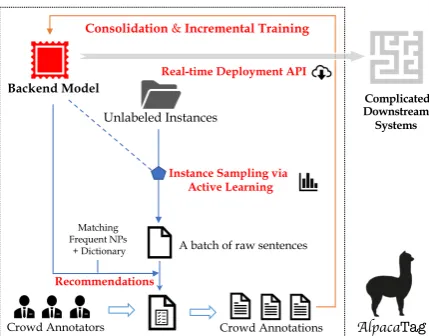
Active intelligent recommendation (§3) aims to reduce human efforts at both instance-level and corpus-level by learning a back-end sequence tag-ging model incrementally with incoming human annotations. At the instance-level, AlpacaTag
applies themodel predictionson current unlabeled sentences as tagging suggestions. Apart from that,
1The source code is publicly available at http://
we also greedily matchfrequent noun phrasesand a dictionary ofalready annotated spansas recom-mendations. Annotators can easily confirm or de-cline such recommendations with our specialized UI. At the corpus-level, we use active learning al-gorithms (Settles,2009) for selecting next batches of instances to annotate based on the model. The goal is to select the mostinformativeinstances for human to tag and thus to achieve a more cost-effective way of using human efforts.
Automatic crowd consolidation(§4) of the an-notations from multiple annotators is an underex-plored topic in developing crowd-sourcing annota-tion frameworks. As a crowdsourcing framework,
AlpacaTag collects annotations from multiple
(non-expert) contributors with lower cost and a higher speed. However, annotators usually have different confidences, preferences, and biases in annotating, which leads to possibly high inter-annotator disagreement. It is shown very challeng-ing to train models with such noisy crowd annota-tions (Nguyen et al.,2017;Yang et al.,2018b). We argue that consolidating crowd labels during an-notating can lead annotators to achieve real-time consensus, and thus decrease disagreement of an-notations instead of exhausting post-processing.
Real-time model deployment(§5) is also a de-sired feature for users. We sometimes need to deploy a state-of-the-art sequence tagging model while the crowdsourcing is still ongoing, such that users can facilitate the developing of their tagging-required systems with our APIs.
To the best of our knowledge, there is no ex-isting annotation framework enjoying such three features. AlpacaTag is the first unified frame-work to address these problems, while inheriting the advantages of existing tools. It thus provides a more comprehensive solution to crowdsourcing annotations for sequence tagging tasks.
In this paper, we first present the high-level structure and design of the proposedAlpacaTag
framework. Three key features are then introduced in detail: active intelligent recommendation (§3),
automatic crowd consolidation(§4), andreal-time model deployment(§5). Experiments (§6) are con-ducted for showing the effectiveness of the pro-posed three features. Comparisons with related works are discussed in§7. Section§8shows con-clusion and future directions.
2 Overview of AlpacaTag
As shown in Figure 1, AlpacaTag has an ac-tively learned back-end model (top-left) in addi-tion to a front-end web-UI (bottom). Thus, we have two separate servers: a back-end model server and a front-end annotation server. The model server is built withPyTorchand supports a set of APIs for communications between the two servers and model deployment. The annotation server is built on Django in Python, which in-teracts with administrators and annotators.
To start annotating for a domain of interest, ad-mins should login and create a new project. Then, they need to further import their raw corpus (with CSV or JSON format), and assign the tag space with associatedcolorsandshortcut keys. Admins can further set the batch size to sample instances and to update back-end models. Annotators can login and annotate (actively sampled) unlabeled instances with tagging suggestions. We further present our three key features in the next sections.
3 Active Intelligent Recommendation
This section first introduces the back-end model (§3.1) and then presents how we use the back-end model for both instance-level recommback-enda- recommenda-tions (tagging suggesrecommenda-tions,§3.2) as well as corpus-level recommendations (active sampling,§3.3).
3.1 Back-end Model: BLSTM-CRF
The core component of the proposedAlpacaTag
framework is the back-end sequence tagging model, which is learned with an incremental active learning scheme. We use the state-of-the-art sequence tagging model as our back-end model (Lample et al., 2016; Lin et al., 2017;
Liu et al., 2018), which is based on bidirectional LSTM networks with a CRF layer (BLSTM-CRF). It can capture character-level patterns, and encode token sequences with pre-trained word em-beddings, as well as using CRF layers to capture structural dependencies in tagging. In this section, we assume the model is fixed as we are talking about how to use it for infer recommendations. How to update it by consolidating crowd annota-tions is illustrated in the Section§4.
3.2 Tagging Suggestions (Instance-level Rec.)
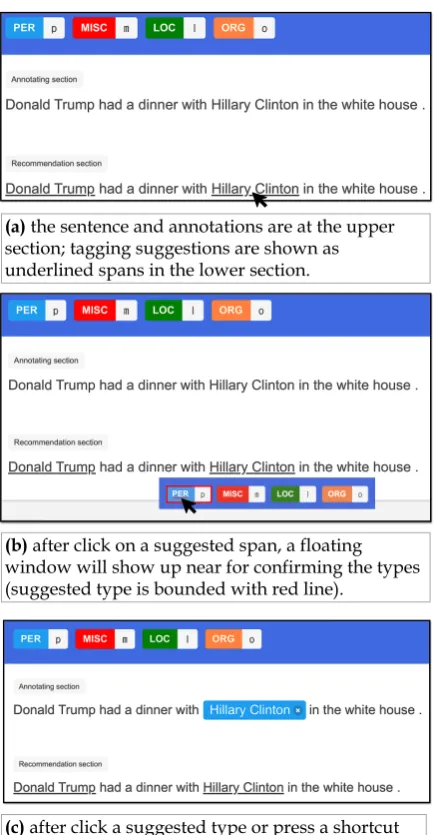
(a)the sentence and annotations are at the upper section; tagging suggestions are shown as underlined spans in the lower section.
(b)after click on a suggested span, a floating window will show up near for confirming the types (suggested type is bounded with red line).
[image:3.595.73.291.58.476.2](c)after click a suggested type or press a shortcut key (e.g. ‘p’), confirmed annotations will show up in the upper annotation section.
Figure 2: The workflow for annotators to confirm a given tagging suggestion (“Hillary Clinton” asPER).
Fig.1:(frequent) noun phrasesand the dictionary of already tagged spans. Specifically, after admins upload raw corpora, AlpacaTag runs a phrase mining algorithm (Shang et al., 2018) to gather a list of frequent noun phrases, which are more likely to be entities. Admins can also optionally enable the framework to consider all noun phrases by chunking as span candidates. These sugges-tions are not typed. Additionally, we also maintain a dictionary mapping from already tagged spans in previous sentences to their majority tagged types. Frequent noun phrases and dictionary entries are matched by the greedy forward maximum match-ing algorithm. Therefore, the final taggmatch-ing sugges-tions are merged from three sources with the
fol-lowing priority (ordered by their precision): dic-tionary matches> back-end model inferences >
(frequent) noun phrases, while the coverage of the suggestions are in the opposite order.
Figure2 illustrates howAlpacaTag presents the tagging suggestions for the sentence “Donald Trump had a dinner with Hillary Clinton in the white house.”. The two suggestions are shown in the bottom section as underscored spans “Don-ald Trump” and “Hilary Clinton” (Fig.2a). When annotators want to confirm “Hilary Clinton” as a true annotation, they first click the span and then click the right type in the appearing float window (Fig. 2b). They can also press the customized shortcut key for fast tagging. Note that the PER
button is underscored in Fig.2b, meaning that it is a recommended type for annotators to choose. Fig.2c shows that after confirming, it is added into final annotations. We want to emphasize that our designed UI well solves the problem of confirming and declining suggestions. The float windows re-duce mouse movement time very much and let an-notators easily confirm or change types by clicking or pressing shortcuts to correct suggested types.
What if annotators want to tag spans not recom-mended? Normally annotating inAlpacaTagis as friendly as other tools: annotators can simply select the spans they want to tag in the upper sec-tion and click or press the associated type (Fig.3). We implement this UI design based on an open-source Django framework nameddoccano2.
1. select a span 3. get a tag 2. click button or press shortcut key
Figure 3: Annotating a span without recommendations.
3.3 Active Sampling (Corpus-level Rec.)
Tagging suggestions are at the instance level, while what instances we should ask annotators to label is also very important to save human efforts. Thus, the research question here is how to actively sample a set of the most infor-mative instances from the whole unlabeled sen-tences, which is named active learning. The measure of informativeness is usually specific
[image:3.595.306.526.497.582.2]to an existing model, which means what in-stances (if labeled correctly) can improve the model performance. A typical example of ac-tive learning is called Least Confidence (Culotta
and McCallum, 2005), which applies the model
on all the unlabeled sentences and treats the in-ference confidence as the negative of informa-tiveness (1 − maxy1,...,ynP[y1, . . . , yn| {xij}]).
For AlpacaTag, we apply an improved version
named Maximum Normalized Log-Probability (MNLP) (Shen et al.,2018), which eliminates the effect of length of sequences by averaging:
max
y1,...,yn
1 n
n X
i=1
logP[yi|y1, . . . , yn−1,{xij}]
Simply put, we manage to utilize the current back-end model for measuring the informative-ness of unlabeled sentences and then sample the optimal next batch for annotators to label.
4 Automatic Crowd Consolidation
As a crowd-sourcing annotation framework,
AlpacaTag aims to reduce inter-annotator
dis-agreement while keeping their individual strengths in labeling specific kinds of instances. We achieve this by applying annotator-specific back-end mod-els (“personal modmod-els”) and consolidate them into a shared back-end model named “consensus model”. Personal models are used for personal-ized active sampling, such that annotators will la-bel the regions of data space that are most impor-tant to be labeled by them respectively.
Assume there areK annotators, we refer them as{A1, . . . , AK}. For each annotatorAi, we refer the corresponding sentences and annotations pro-cessed by it to bexi = {xi,j}lji=1andy
Ai
i ∈ Yli.
The target of consolidation is to generate predic-tions for the test datax, while the resulting labels are referred as yˆ. Note that annotators may an-notate different portions of the data and sentences can have inconsistent crowd labels.
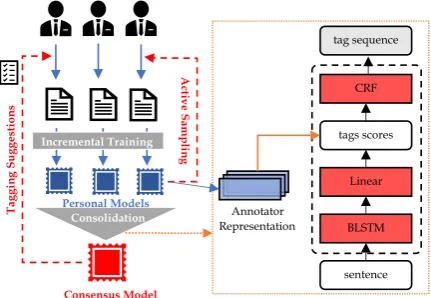
As shown in Fig. 4, we model the behav-ior of every annotator by constructing annota-tor representation matrices Ck from the network parameters of personal back-end models. The personal models share the same BLSTM lay-ers for encoding sentences and avoiding over-parameterizing. They are incrementally updated every batch, which usually consists of50 ∼ 100
sentences sampled actively by the algorithms men-tioned in§3.3. We further merge the crowd
repre-Crowd Annotations Consolidation
T
ag
gi
n
g
S
u
gg
es
ti
on
s
Personal Models
Consensus Model
Ac
tiv
e
S
am
p
lin
g
sentence BLSTM
Linear tags scores
CRF tag sequence
[image:4.595.309.525.64.213.2]Annotator Representation Incremental Training
Figure 4: Reducing inter-annotator disagreement by training personal models for personalized active sam-pling and constructing consensus models.
sentationCk into a representation matrixC, and thus construct a consensus model by using C to generate tag scores in the BLSTM-CRF architec-ture, which is improved from the approach pro-posed byNguyen et al.(2017).
In summary,AlpacaTagperiodically updates the back-end consensus model by consolidat-ing crowd annotations for annotated sentences through merging personal models. The updated back-end model continues to offer suggestions in future instances for all the annotators, and thus the consensus can be further solidified with rec-ommendation confirmations.
5 Real-time Model Deployment
Waiting for a model to be trained with ready hu-man annotations can be a huge bottleneck for de-veloping complicated pipeline systems in infor-mation extraction. Instead, users may want a se-quence tagging model that can be constantly up-dated, even when the annotation process is still un-dergoing. AlpacaTag naturally enjoys this fea-ture since we maintain a back-end tagging model with incremental active learning techniques.
Thus, we provide a suite of APIs for interacting with the back-end consensus model server. They can work for both communication with the annota-tion server and real-time deployment of the back-end model. One can obtain inference results for their developing complicated systems by querying such APIs for downstream applications.
6 Experiments
0 10 20 30 40 50 60 70 80
0 100 200 300 400 500 600 700 800 900 1000
F1-score (%)
Number of Instances
[image:5.595.77.281.65.205.2]w/o active sampling w/ active sampling
Figure 5: Effectiveness of incremental updating with and without active sampling.
inary experiment on theCoNLL2003dataset. We set iteration step size as 100 with the default order for single-user annotation, and incrementally up-date the back-end model for 10 iterations. Then, we apply our implementation for active sampling the optimal batches of samples to annotate dynam-ically. All results are tested on the official test set. As shown in Fig.5, the performance with active learning is indeed improved by a large margin over vanilla training effectively. We also find that with active sampling, using annotations of about 35% training data can achieve the performance of using 100%, confirming the reported results of previous studies (Siddhant and Lipton,2018).
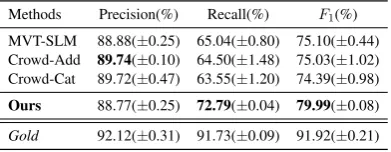
For consolidating multiple annotations, we test our implementation with the real-world crowd-sourced data collected byRodrigues et al.(2013) using Amazon Mechanical Turk (AMT). Our methods outperform existing approaches includ-ing MVT-SLM (Wang et al., 2018) and Crowd-X (Nguyen et al.,2017) (see Tab.1).
7 Related Works
Many sequence annotation tools have been de-veloped (Ogren, 2006; Bontcheva et al., 2013;
Chen and Styler, 2013; Druskat et al., 2014b) for basic annotation features including data man-agement, shortcut key annotation, and multi-annotation presentation and analysis. However,
Methods Precision(%) Recall(%) F1(%)
MVT-SLM 88.88(±0.25) 65.04(±0.80) 75.10(±0.44) Crowd-Add 89.74(±0.10) 64.50(±1.48) 75.03(±1.02) Crowd-Cat 89.72(±0.47) 63.55(±1.20) 74.39(±0.98)
Ours 88.77(±0.25) 72.79(±0.04) 79.99(±0.08)
Gold 92.12(±0.31) 91.73(±0.09) 91.92(±0.21)
Table 1: Comparisons of consolidation methods.
few of them enjoys the above-introduced three fea-tures ofAlpacaTag. It is true that a few existing tools also support tagging suggestions (instance-level recommendations) as follows:
• BRAT (Stenetorp et al., 2012) and
GATE (Bontcheva et al., 2013) can offer
suggestions with a fixed tagging model like CoreNLP (Manning et al., 2014). However, it is hardly helpful when users need to annotate sentences with customized label set specific to their interested domains, which is the most common motivation for people to use an annotation framework.
• YEDDA(Yang et al.,2018a) simply generates suggestions by exact matching against a con-tinuously updated lexicon of already anno-tated spans. In comparison, this is a subset
of AlpacaTag’s recommendations. Note
thatYEDDAcannot suggest any unseen spans.
• WebAnno(Yimam et al.,2013) integrates a
learning component for suggestions, which is based on hand-crafted features and generic online learning framework (MIRA). Nonetheless, the back-end model is too far away from the state-of-the-art methods for sequence tagging and hard to customize for consolidation and real-time deployment.
AlpacaTag’s tagging suggestions are more
comprehensive since they are from state-of-the-art BLSTM-CRF architecture, annotation dictio-nary, and frequent noun phrase mining. An unique advantage is that it also supports active learn-ing to sample instances that are most worth la-beling to reduce human efforts. In addition,
AlpacaTag further attempts to reduce
inter-annotator disagreement during annotating by au-tomatically consolidating personal models to con-sensus models, which pushes further than just pre-senting inter-annotator agreement without doing anything helpful.
While recent papers have shown the power of deep active learning with simulations (
Sid-dhant and Lipton, 2018), a practical
annota-tion framework with active learning is missing.
AlpacaTagis not only an annotation framework
but also a practical environment for evaluating dif-ferent active learning methods.
8 Conclusion and Future Directions
[image:5.595.84.280.676.752.2]users with more advanced features for reducing human efforts in annotating, while keeping the existing basic annotation functions like shortcut keys. Incremental active learning of back-end models with crowd consolidation facilities intel-ligent recommendations and reduce disagreement. Future directions include supporting annotation of other tasks, such as relation extraction and event extraction. We also plan to design a real-time con-sole for showing the status of back-end models based onTensorBoard, such that admins can bet-ter track the quality of deployed models and early stop annotating to save human efforts.
References
Kalina Bontcheva, Hamish Cunningham, Ian Roberts, Angus Roberts, Valentin Tablan, Niraj Aswani, and Genevieve Gorrell. 2013. Gate teamware: a web-based, collaborative text annotation framework. In
Proc. of LREC.
Richard Eckart de Castilho, ´Eva M´ujdricza-Maydt, Seid Muhie Yimam, Silvana Hartmann, Iryna Gurevych, Anette Frank, and Christian Biemann. 2016. A web-based tool for the integrated annota-tion of semantic and syntactic structures. InProc. of
LT4DH@COLING.
Wei-Te Chen and Will Styler. 2013. Anafora: a web-based general purpose annotation tool. In Proc. of NAACL-HLT.
Aron Culotta and Andrew McCallum. 2005.
Con-fidence estimation for information extraction. In
Proc. of AAAI.
Stephan Druskat, Lennart Bierkandt, Volker Gast, Christoph Rzymski, and Florian Zipser. 2014a.
Atomic: an open-source software platform for
multi-level corpus annotation. InKONVENS.
Stephan Druskat, Lennart Bierkandt, Volker Gast, Christoph Rzymski, and Florian Zipser. 2014b. Atomic: An open-source software platform for multi-level corpus annotation.
Guillaume Lample, Miguel Ballesteros, Sandeep Sub-ramanian, Kazuya Kawakami, and Chris Dyer. 2016. Neural architectures for named entity recognition. InProc. of NAACL-HLT.
Bill Y. Lin, Frank F. Xu, Zhiyi Luo, and Kenny Q. Zhu. 2017. Multi-channel bilstm-crf model for emerg-ing named entity recognition in social media. In
NUT@EMNLP.
Bill Yuchen Lin and Wei Lu. 2018. Neural adapta-tion layers for cross-domain named entity recogni-tion. InProc. of EMNLP.
Liyuan Liu, Jingbo Shang, Frank F. Xu, Xiang Ren, Huan Gui, Jian Peng, and Jiawei Han. 2018. Em-power sequence labeling with task-aware neural lan-guage model. InProc. of AAAI.
Christopher D. Manning, Mihai Surdeanu, John Bauer, Jenny Rose Finkel, Steven Bethard, and David Mc-Closky. 2014. The stanford corenlp natural language processing toolkit. InProc. of ACL.
An Thanh Nguyen, Byron C. Wallace, Junyi Jessy Li, Ani Nenkova, and Matthew Lease. 2017. Aggregat-ing and predictAggregat-ing sequence labels from crowd an-notations.Proc. of ACL.
Philip V Ogren. 2006. Knowtator: a prot´eg´e plug-in for annotated corpus construction. In Proc. of NAACL-HLT.
Filipe Rodrigues, Francisco C. Pereira, and Bernardete Ribeiro. 2013. Sequence labeling with multiple an-notators. Machine Learning.
Burr Settles. 2009. Active learning literature survey. Technical report, University of Wisconsin-Madison Department of Computer Sciences.
Jingbo Shang, Jialu Liu, Meng Jiang, Xiang Ren, Clare R. Voss, and Jiawei Han. 2018. Automated phrase mining from massive text corpora. Proc. of TKDE.
Yanyao Shen, Hyokun Yun, Zachary C Lipton, Yakov
Kronrod, and Animashree Anandkumar. 2018.
Deep active learning for named entity recognition. InProc. of ICLR.
Aditya Siddhant and Zachary Chase Lipton. 2018. Deep bayesian active learning for natural language processing: Results of a large-scale empirical study. InProc. of EMNLP.
Pontus Stenetorp, Sampo Pyysalo, Goran Topi´c, Tomoko Ohta, Sophia Ananiadou, and Jun’ichi Tsu-jii. 2012. brat: a web-based tool for NLP-assisted text annotation. InProc. of EACL.
Xuan Wang, Yu Zhang, Xiang Ren, Yuhao Zhang, Marinka Zitnik, Jingbo Shang, Curtis P. Langlotz,
and Jiawei Han. 2018. Cross-type biomedical
named entity recognition with deep multi-task learn-ing.Bioinformatics.
Jie Yang, Yue Zhang, Linwei Li, and Xingxuan Li. 2018a. Yedda: A lightweight collaborative text span annotation tool. InProc. of ACL.
YaoSheng Yang, Meishan Zhang, Wenliang Chen, Wei Zhang, Haofen Wang, and Min Zhang. 2018b. Ad-versarial learning for chinese ner from crowd anno-tations. InProc. of AAAI.