Dependency length minimisation effects in short spans: a large-scale
analysis of adjective placement in complex noun phrases
Kristina Gulordava University of Geneva Kristina.Gulordava,
Paola Merlo University of Geneva [email protected]
Benoit Crabb´e U. Paris Diderot/Inria/IUF
bcrabbe@
univ-paris-diderot.fr
Abstract
It has been extensively observed that lan-guages minimise the distance between two related words. Dependency length min-imisation effects are explained as a means to reduce memory load and for effective communication. In this paper, we ask whether they hold in typically short spans, such as noun phrases, which could be thought of being less subject to efficiency pressure. We demonstrate that minimisa-tion does occur in short spans, but also that it is a complex effect: it is not only the length of the dependency that is at stake, but also the effect of the surrounding de-pendencies.
1 Introduction
One of the main goals in the study of language is to find explanations for those fundamental proper-ties that are found in every human language. The observation that human languages appear to min-imise the distance between any two related words – called the property of dependency length min-imisation (DLM) — is a universal property that has been documented in sentence processing (Gib-son, 1998; Hawkins, 1994; Hawkins, 2004; Dem-berg and Keller, 2008), in corpus properties of treebanks (Temperley, 2007; Futrell et al., 2015), in diachronic language change (Tily, 2010). Func-tional explanations have been proposed for this pervasive linguistic property. If speakers want to reduce memory load and maximise efficiency of processing, they will choose to produce and pref-erentially analyse constructions where words are linearised in such a way that minimises the total distance of related words.
The DLM principle can be stated as follows: if there exist possible alternative orderings of a phrase, the one with the shortest overall depen-dency length (DL) is preferred. We measure the
length of a dependency as the number of words between the head and its dependent.
As an illustration, DLM principle is widely re-ported in the literature to explain the alternation of postverbal complements (Bresnan et al., 2007; Wasow, 2002). Consider, for example, the case when a verb has both a direct object (NP) and a prepositional complement or adjunct (PP). Two al-ternative orders of the verb complements are pos-sible: VP1 = V NP PP, whose length isDL1 and
VP2 = V PP NP, whose length isDL2. DL1 is
DL(V-NP) +DL(V-PP) = |NP|+ 1; DL2 is
DL(V-NP) +DL(V-PP) =|PP|+ 1.1 IfDL1is bigger thanDL2, then VP2is preferred over VP1,
despite the non-canonical V-PP-NP order.
While DLM has been demonstrated on a large scale and explanations have been proposed based on human sentence processing facts in the verbal domain, it is not clear what the effects of DLM are in the more limited nominal domain. If the expla-nations are really rooted in memory and efficiency, will they still hold in phrases that might span only a few words?
In this paper, we look at the structural fac-tors that play a role in adjective-noun word order alternations in Romance languages. We choose Romance languages because they show a good amount of variation, making studies of DLM meaningful. This would not be the case in En-glish, for instance, as English has no variation of word order placement in the noun phrase. Ad-jective placement in Romance is often studied in connection with semantic and lexical properties of adjectives (Bouchard, 1998; Cinque, 2010). There exists, however, a body of work which shows that structural syntactic properties like the size of ad-jective phrase also affect the adad-jective position (Abeill´e and Godard, 2000; Thuilier, 2012).
We demonstrate that, unlike results for the
ver-1The minimal dependency length is equal to one when the head and its dependent are adjacent.
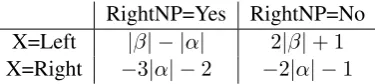
RightNP=Yes RightNP=No X=Left |β| − |α| 2|β|+ 1
[image:2.595.75.263.62.104.2]X=Right −3|α| −2 −2|α| −1
Table 1: Dependency length difference for differ-ent types of noun phrases. By convdiffer-ention, we al-ways calculateDL1−DL2.
bal domain, it is not only the length of the depen-dency that is at stake, but also the effect of the sur-rounding dependencies.
2 Dependency length minimisation in the noun phrase
In applying the general principle of DLM to the dependency structure of noun phrases, our goal is to test to what extent the DLM principle predicts the observed adjective-noun word order alterna-tion pattern in relatively short spans.
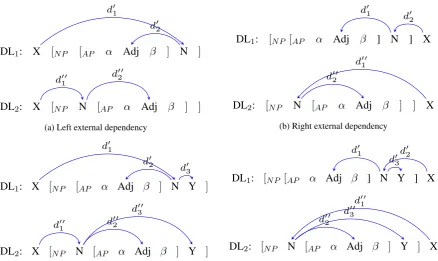
Consider a prototypical noun phrase with an ad-jective phrase as a modifier. We assume two possi-ble placements for an adjective phrase: postnom-inal and prenompostnom-inal. To simplify, we concentrate on noun phrases with only one adjective modifier adjacent to the noun. The adjective modifier can be a complex phrase with both left and right de-pendents (αandβ, respectively, in Figure 1). The noun phrase can have parents and right modifiers (X and Y, respectively, in Figure 1). These alterna-tive orderings yield different dependency lengths, as can be seen from Figure 1. By convention, we will always indicate the prenominal order asDL1,
and the postnominal order asDL2. Their
differ-ence is always calculated asDL1−DL2.
We consider all dependencies in a noun phrase and not only the length of the noun-adjective de-pendency. This is because we assume, as previ-ously done, that DLM is global, and not a local, ef-fect. Our analysis is a faithful interpretation of the very general DLM principle of Gildea and Tem-perley (2010) which is based on the overall de-pendency length of a sentence. We do no take other dependencies in the sentence into account, because their lengths are the same acrossDL1and
DL2. The differenceDL1−DL2is therefore the
difference between the overall dependency length of two sentences that differ only in their placement of one adjective.
The first panel, panel a, shows the case where the parent of the NP is on the left of it. The depen-dency length for the prenominal adjective
struc-ture is equal to DL1 = d01 +d02 = (|α|+|β|+ 1) +|β|and for the postnominal adjective struc-ture isDL2 =d001 +d002 =|α|. The difference
be-tween these lengths is2|β|+ 1, which means that
DL1 > DL2 and suggests that the postnominal
placement is always preferred.
Similarly, the second panel, panel b, in the figure shows how we calculate the dependency lengths when the parent of the NP is on its right. The difference of lengths is equal to −2|α| −1, yielding a preference for prenominal adjectives.
We also consider more complex noun phrases with at least one right dependent, which are very common in Romance languages (around 50% of noun phrases in our sample include, for instance, a complement, such as a relative clause). The third and fourth panels in Figure 1 illustrate the case where three dependencies should be taken into account. The calculations of these depen-dency lengths for the prenominal and postnominal alternatives yield the corresponding differences of
|β|−|α|(in the case of a left external dependency) and−3|α| −2(in the case of a right external de-pendency). These values are different from the dependency length differences for noun phrases without a right dependent (panel a and b). The comparison of the values, where RightNP=Yes is smaller than RightNP=No in both cases, suggests that the presence of a right dependent favours the prenominal placement of adjectives in comparison to the case of a simple noun phrase.
The differences in dependency lengths are sum-marized in Table 1. The expectations based on de-pendency length minimisation are as indicated in (1) below.
(1) a. the presence of a left dependent of an adjective favours the adjective’s prenominal placement;
b. the presence of a right dependent of an adjective favours the adjective’s postnominal placement;
c. when the external dependency is leftwards, X = right, (for canonical subjects, for ex-ample), then the adjective is prenominal, be-cause the difference is negative and it is a function ofα;
DL1: X [NP [AP α Adj β ] N ] d0
1
d0
2
DL2: X [NP N [AP α Adj β ] ]
d001 d002
(a) Left external dependency
DL1: [NP [AP α Adj β ] N ] X
d0
1 d0
2
DL2: [NP N [AP α Adj β ] ] X
d00
1 d002
(b) Right external dependency
DL1: X [NP [AP α Adj β ] N Y ]
d0
1
d0
2 d0
3
DL2: X [NP N [AP α Adj β ] Y ]
d00
1 d
00
2 d00
3
(c) Right noun dependent Y, left external dependency
DL1: [NP [AP α Adj β ] N Y ] X
d0
1 d0d02 3
DL2: [NP N [AP α Adj β ] Y ] X
d001 d00
2 d003
[image:3.595.78.517.65.326.2](d) Right noun dependent Y, right external dependency
Figure 1: Noun phrase structure variants and the dependencies relevant for the DLM calculation.
as evinced by the fact that the RightNP = Yes column is always greater than the RightNP = No column.
The predictions (1a) and (1b) are formulated for an average case of adjective placement, across nouns phrases with different values of X and RightNP factors. Table 1 shows that for each com-bination of these context factors the weight ofαis negative or zero and the weight ofβis positive or zero. On average, therefore, we expect to see a negative effect ofα(1a) and a positive effect ofβ
(1b).
We develop a model to test which of the fine-grained predictions derived from DLM are con-firmed by the data provided by the dependency an-notated corpora of five of the main Romance lan-guages.
3 Identifying dependency minimisation factors
3.1 Materials: Dependency treebanks
We use the dependency annotated corpora of five Romance languages: Catalan, Spanish, Italian (Hajiˇc et al., 2009), French (Agi´c et al., 2015), and Portuguese (Buchholz and Marsi, 2006).
We use part-of-speech information and depen-dency arcs from the gold annotation to extract
noun phrases containing adjectives. Specifically, we first convert all treebanks to coarse universal part-of-speech tags, using existing conventional mappings from the original tagset to the univer-sal tagset (Petrov et al., 2012). We then identify all adjectives (tagged using the universal PoS tag ‘ADJ’) whose dependency head is a noun (tagged using the universal PoS tag ‘NOUN’). In addition, we recover all elements of the noun phrase rooted in this noun, that is, its dependency subtree. For all languages where this information is available, we extract lemmas of adjective and noun tokens which are the features in our analysis. The only treebank without lemma annotation is French, for which we extract token forms.2 We extract a total of around 64’000 instances of adjectives in noun phrases, ranging from 2’800 for Italian to 20’000 for Spanish.
The data present a substantial amount of varia-tion in the placement of the adjective: the ratio of postnominal adjectives ranges from around 65%
for Italian to78%for Catalan. Among all adjective types, at least 10% in each language are observed both prenominally and postnominally (ranging be-tween 147 types for Italian and 445 types for Span-ish).
3.2 Method: Mixed Effects models
We analyse the interactions of several dependency factors, using a logit mixed effect models (Bates et al., 2014). Mixed-effect logistic regression mod-els (logit modmod-els) are a type of Generalized Linear Mixed Models with the logit link function and are designed for binomially distributed outcomes such asOrderin our case.
More precisely, Generalized Linear Mixed Models describe an outcome as the linear combi-nation of fixed effectsX and conditional random effects Z associated with grouping of instances, where β andγ are the corresponding weights of the effects.
(2) y=Xβ+Zγ+
In logistic regression models, this linear combi-nation is then transformed with the logit link func-tion to predict the binomial output:
(3) Order = 1
1 + exp−y
In our model,Order= 0codes the prenominal adjective order and Order = 1 codes the post-nominal order.
3.3 Factors
We define and test the following factors, corre-sponding to the factors illustrated in Figure 1 and example (1), represented as binary or real-valued variables:
• LeftAP- the cumulative length (in words) of all left dependents of the adjective, indicated asαin Figure 1;
• RightAP - the cumulative length (in words) of all right dependents of the adjective, indi-cated asβin Figure 1;
• RightNP- the indicator variable representing the presence (RightNP = 1) or absence (RightNP = 0) of the right dependent of the noun, indicated as Y in Figure 1;
• ExtDep - the direction of the arc from the noun to its parent X, an indicator variable.
ExtDep = 0 when X is on the left of the noun,ExtDep= 1when X is on the right.
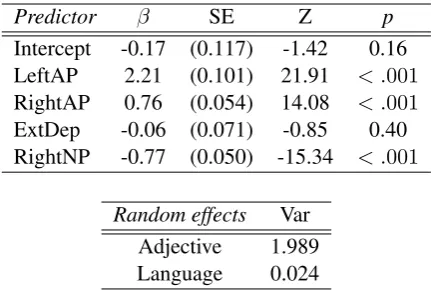
Predictor β SE Z p
Intercept -0.17 (0.117) -1.42 0.16
LeftAP 2.21 (0.101) 21.91 < .001
RightAP 0.76 (0.054) 14.08 < .001
ExtDep -0.06 (0.071) -0.85 0.40
RightNP -0.77 (0.050) -15.34 < .001
Random effects Var
Adjective 1.989
[image:4.595.308.524.61.206.2]Language 0.024
Table 2: Summary of the fixed and random effects in the mixed-effects logit model (N = 15842), shown in (4).
In addition, to account for lexical variation, we include adjective lemmas (for French, we include tokens) as grouping variables introducing random effects. For example, the instances of adjective-noun order for a particular adjective will share the same weight valueγ for the adjective variable, but across different adjectives this value can vary.3
For a given example involving an adjectiveiand belonging to languagej, the linear component of the model is shown in (4).
yij =LeftAP ·βLAP +RightAP ·βRAP+
+RightNP ·βRNP +ExtDep·βED+
+γAdji+γLangj (4)
By fitting the logit mixed-effect model to our dataset, we find the fixed and random effects coef-ficients which best explain the data. To show that a factor has a statistically significant effect on adjec-tive placement, we must show that its fixed effect coefficient is significantly different from zero.
3.4 Results
The logit mixed-effects model fitted to our data, shown in (4), reveals the following picture (Table 2).
Both the LeftAP and RightAP factors favour postnominal placement (βLAP = 2.21,βRAP =
0.76,p <0.001), however there are important dif-ferences between the two.
LeftAP shows a complex behavior. When Lef-tAP is equal to one, it favors (slightly) the prenom-inal placement and when LeftAP is greater than one, it favors the postnominal placement. This re-sult suggests that the adjective can behave differ-ently depending on the size or type of its left pe-riphery. For the moment it is not clear if the differ-ence is due to length or type, as LeftAP of length one are almost always adverbs. It is important to notice that the results for LeftAP then do not en-tirely pattern with the predictions of dependency length minimisation, shown in (1a).
The RightAP factor shows a consistent post-nominal preference, positively correlated to its length. Consequently, we can say that the Righ-tAP is a stronger indicator of the postnominal placement than LeftAP, in agreement with the pre-viously observed ordering patterns of adjective phrases (Abeill´e and Godard, 2000) and the DLM prediction.
The external dependency factor is not signifi-cant (p > 0.1). Moreover, the log likelihood ra-tio between the full model and the model without ExtDep is χ2 distributed with 1 degree of
free-dom with χ2 = 3.8, p = 0.052. This
compar-ison confirms that the introduction of the exter-nal dependency does not help predicting the Order. At first sight, this result suggests that this depen-dency is not subject to the minimisation principle. A plausible explanation claims that only the de-pendencies between the head and theedgeof the dependent phrase are minimised (Hawkins, 1994). In Romance languages, the majority of the noun phrases take an article which unambiguously de-fines the left edge of the noun phrase. There is no need therefore to minimize the external depen-dency to the noun, since the noun phrase can be entirely predicted based on its left corner.
The RightNP factor is significant in the fitted model (βRNP = −0.77,p < 0.001).4 The pres-ence of a noun dependent on the right of the noun favours a prenominal placement, as predicted by DLM (1d). This is a result which, to our knowl-edge, was not previously observed in the literature, and that clearly answers our initial question, con-firming that DLM also applies to very short spans. A much more detailed study of the lexical and structural properties of this effect is developed in
4A log-likelihood test of the model including RightAP, LeftAP and RightNP factors compared to the model including only RightAP and LeftAP factors yieldsχ2 = 107andp <
.001.
(Gulordava and Merlo, 2015).
4 Conclusion
In this paper, we have developed a model of de-pendency length minimisation in the noun phrase and shown subtle interactions among its subcom-ponents. We show that most of DLM predictions are confirmed, and that DLM also apply to short spans. The fact that DLM effects also hold in such short spans casts doubts, in our opinion, on the grounding of this effect in memory limitations. The subtle interactions also raise questions on the exact definition of what dependencies are min-imised and to what extent a given dependency an-notation captures these distinctions, questions that we reserve for future work.
Acknowledgements
We gratefully acknowledge the partial funding of this work by the Swiss National Science Foun-dation, under grant 144362 to the second author. Thanks also to the Labex EFL (ANR-10-LABX-0083 EFL) in Paris for supporting the visit of the first author.
References
Anne Abeill´e and Daniele Godard. 2000. French word order and lexical weight. In Robert D. Borsley, edi-tor,The nature and function of Syntactic Categories, volume 32 ofSyntax and Semantics, pages 325–360. BRILL.
ˇZeljko Agi´c, Maria Jesus Aranzabe, Aitziber Atutxa, Cristina Bosco, Jinho Choi, Marie-Catherine de Marneffe, Timothy Dozat, Rich´ard Farkas, Jennifer Foster, Filip Ginter, Iakes Goenaga, Koldo Gojenola, Yoav Goldberg, Jan Hajiˇc, An-ders Trærup Johannsen, Jenna Kanerva, Juha Kuokkala, Veronika Laippala, Alessandro Lenci, Krister Lind´en, Nikola Ljubeˇsi´c, Teresa Lynn, Christopher Manning, H´ector Alonso Mart´ınez, Ryan McDonald, Anna Missil¨a, Simonetta Monte-magni, Joakim Nivre, Hanna Nurmi, Petya Osen-ova, Slav Petrov, Jussi Piitulainen, Barbara Plank, Prokopis Prokopidis, Sampo Pyysalo, Wolfgang Seeker, Mojgan Seraji, Natalia Silveira, Maria Simi, Kiril Simov, Aaron Smith, Reut Tsarfaty, Veronika Vincze, and Daniel Zeman. 2015. Universal depen-dencies 1.1.
Denis Bouchard. 1998. The distribution and inter-pretation of adjectives in French: A consequence of Bare Phrase Structure. Probus, 10(2):139–184. Joan Bresnan, Anna Cueni, Tatiana Nikitina, and
Har-ald Baayen. 2007. Predicting the dative alternation. In G. Boume, I. Kraemer, and J. Zwarts, editors,
Cognitive Foundations of Interpretation, pages 69– 94. Royal Netherlands Academy of Science, Ams-terdam.
Sabine Buchholz and Erwin Marsi. 2006. CoNLL-X Shared Task on Multilingual Dependency Parsing. In Proceedings of the Tenth Conference on Com-putational Natural Language Learning, CoNLL-X ’06, pages 149–164, Stroudsburg, PA, USA. Associ-ation for ComputAssoci-ational Linguistics.
Guglielmo Cinque. 2010. The Syntax of Adjectives: A Comparative Study. MIT Press.
Vera Demberg and Frank Keller. 2008. Data from eye-tracking corpora as evidence for theories of syntactic processing complexity. Cognition, 109(2):193–210, November.
Richard Futrell, Kyle Mahowald, and Edward Gibson. 2015. Large-Scale Evidence of Dependency Length Minimization in 37 Languages. (Submitted to Pro-ceedings of the National Academy of Sciences of the United States of America).
Edward Gibson. 1998. Linguistic complexity: Local-ity of syntactic dependencies. Cognition, 68(1):1– 76.
Daniel Gildea and David Temperley. 2010. Do Gram-mars Minimize Dependency Length? Cognitive Sci-ence, 34(2):286–310.
Kristina Gulordava and Paola Merlo. 2015. Structural and lexical factors in adjective placement in com-plex noun phrases across Romance languages. In
Proceedings of the Nineteenth Conference on Com-putational Natural Language Learning (CoNLL’15). Jan Hajiˇc, Massimiliano Ciaramita, Richard Johans-son, Daisuke Kawahara, Maria Ant`onia Mart´ı, Llu´ıs M`arquez, Adam Meyers, Joakim Nivre, Sebastian Pad´o, Jan ˇStˇep´anek, Pavel Straˇn´ak, Mihai Surdeanu, Nianwen Xue, and Yi Zhang. 2009. The CoNLL-2009 shared task: syntactic and semantic depen-dencies in multiple languages. In Proceedings of the Thirteenth Conference on Computational Natu-ral Language Learning: Shared Task, CoNLL ’09, pages 1–18, Stroudsburg, PA, USA. Association for Computational Linguistics.
John A Hawkins. 1994. A performance theory of or-der and constituency. Cambridge University Press, Cambridge.
John A. Hawkins. 2004. Efficiency and Complexity in Grammars. Oxford linguistics. Oxford University Press, Oxford, UK.
Slav Petrov, Dipanjan Das, and Ryan T. McDonald. 2012. A Universal Part-of-Speech Tagset. In Pro-ceedings of the Eight International Conference on Language Resources and Evaluation (LREC’12), pages 2089–2096, Istanbul, Turkey.
David Temperley. 2007. Minimization of dependency length in written English. Cognition, 105(2):300– 333.
Juliette Thuilier. 2012. Contraintes pr´ef´erentielles et ordre des mots en franc¸ais. Ph.D. Thesis, Universit´e Paris-Diderot - Paris VII, Sep.
Harry Joel Tily. 2010. The role of processing com-plexity in word order variation and change. Ph.D. Thesis, Stanford University.