J. Range Manage.
50:3943
Effect of weed seed rate and grass defoliation level on diffuse knapweed
ROGER L. SHELEY, BRET E. OLSON, AND LARRY L. LARSON
Authors are assistant professor, Department of Plant, Soil and Environmental Sciences and associate professor, Department of Animal and Range Sciences Montana State University, Bozeman, Mont. 59717; and professor, Department of Rangeland Resources, Oregon State hiver&* Corvallis, Oregon, and sta- tioned at OSlJ-EOSC Agriculture Program, Eastern Oregon State College, L&rande, Ore. 97g%I.
Abstract
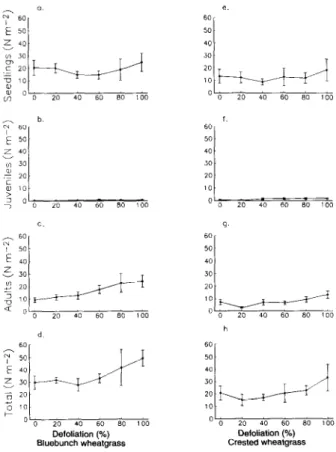
Diffuse knapweed (Cenfaureu diffusu Lam.), an invasive weed, has reduced forage production and biodiversity, and increased soil erosion on over a million hectares of rangeland in the west- ern United States. This study evaluated the effects of a single grass defoliation on establishment of diffuse knapweed seeded at 2 rates into a bluebunch wheatgrass (Pseudoroegneria spicata [Pursh.] Scribn and Smith)/needle-and-thread (Stipa comata Trin. & Rupr.) community and a crested wheatgrass (Agropyron cristatum (L.) Gaertn.) community. Six defoliation levels (0, 20, 40,60,80, 100%) and 2 seeding rates (3,000,6,000 diiuse knap- weed seeds) were applied to 1 m2 plots in a randomixed-com- plete-block design (n=4). Diffuse knapweed was seeded in the fall of 1992, and grasses were defoliated on 28 April 1993. The num- ber of flowering culms and weed seedlings were counted in September 1993. Densities of diffuse knapweed seedlings, juve- niles, and adults, as well as plant standing crop, were determined in May 1994. Seed rate had minimal effect on diffuse knapweed density. By May 1994, densities of diffuse knapweed were about 20 and 30 plants mJ on undefoliated bluebunch wheatgrass and crested wheatgrass plots, respectively, indicating that defoliation is not required for this noxious weed to become established.
Higher levels of grass defoliation (>60%), especially of bluebunch wheatgrass, enhanced diffuse knapweed establishment, indicat- ing that moderate (560%) defoliation would not necessarily accelerate invasion by diffuse knapweed.
Key Words: Centuureu diffusu, bluebunch wheatgrass, crested wheatgrass, defoliation, rangeland weeds.
Diffuse knapweed (Centaurea diffusa Lam.), a deep taprooted biennial, was introduced to North America from Eurasia around 1900 (Roche and RocbC 1988). Between 1950 and 1975, it spread from 9 to 28 counties in the Pacific Northwest (RochC and Talbott 1986). Diffuse knapweed has been found in at least 102 counties and occupies about 1.2 million hectares in the western United States (Lacey 1989). Diffuse knapweed has the potential to invade over 4.8 million hectares of range and forest land in Washington by the year 2007 (RochC 1994).
Published with approval of the director, Montana Agricultural Experiment Station, as Journal No. J-4012.
Manuscript accepted 27 Jan. 1996.
JOURNAL OF RANGE MANAGEMENT 50(l), January 1997
Centaureu spp. (knapweed) invasion has reduced biodiversity and forage for wildlife and livestock, and deteriorated soil and water resources (Watson and Renney 1974, Myers and Berube 1983, Tyser and Key 1988, Lacey et al. 1989). Diffuse knapweed invades pristine, ungrazed native plant communities (Lacey et al.
1990), as well as grazed communities (Roche 1994).
In grazed communities, invasions may be enhanced by selec- tive and excessive grazing of desirable forage species (Lacey et al. 1990). Dense stands of diffuse knapweed may also reflect a greater resistance to defoliation, or altered competitive interac- tions between diffuse knapweed and perennial grasses, or both (Briske 1990).
Timing, intensity, and frequency of defoliation affect the com- petitive interaction between weeds and perennial grasses, and thus the ability of a perennial grass to withstand weed invasion (Maschinski and Whitham 1989, Briske 1990). An appropriate combination of timing, intensity, and frequency of grazing man- agement should allow desirable species to remain competitive.
On seasonally-grazed rangelands free of weeds, moderate defoli- ation and alternating grazing seasons maintains desirable species and constitutes proper grazing management. Because much of the emphasis in weed research in the past has been on control (Zimdahl 1994), little is known about the effects of grazing man- agement on weed establishment.
The objective of this study was to determine the effects of the level of a single grass defoliation and 2 seeding rates of diffuse knapweed on its establishment. A bluebunch wheatgrass domi- nated plant community was used because it is widely distributed, an important native forage species, and susceptible to diffuse knapweed invasion. The crested wheatgrass pasture was selected because this introduced species has been seeded throughout the west, and it is often used to revegetate diffuse knapweed domi- nated rangeland (Hubbard 1975).
Materials and Methods
Study Sites
The study was conducted from 1992 to 1994 on 2 sites. Both sites were within the bluebunch wheatgrass (Pseudoroegeneria spicatu (Pursh) Scribn. & Smith)/needle-and-tad (St@ coma-
ta Trin. & Rupr.) habitat type of eastern Washington (Daubenmire 1970). The sites were about 7 and 9 km northwest of Plymouth, Wash., respectively. Given their proximity to one another, climatic effects were assumed to be similar. This habitat
39
type is susceptible to invasion by diffuse knapweed (RochC 1994). At Site 1, co-dominant species were bluebunch wheatgrass and needle-and-thread. The understory was primarily Sandberg’s bluegrass (Poa sandbergii Vasey), with few forbs present. This site had not been grazed for over 20 years. Site 2 was a seeded monoculture of ‘Fairway’ crested wheatgrass (Agropyron crista- turn (L.) Gaertn.). The stand was established in 1982, and since then has not been grazed or disturbed by humans. Diffuse knap- weed was absent from both sites.
The soil type at both sites was a well-drained, Warden very fine sandy loam (coarse, silty, mixed, mesic, Xerollic Camborthids) with zero slope, that had an effective rooting zone exceeding 90 cm. Elevations at Site 1 and Site 2 were 450 and 720 m, respec- tively. Temperature extremes for the sites range from 50 to -34°C with an average frost-free season of about 145 days. The 59 year average annual precipitation is about 225 mm.
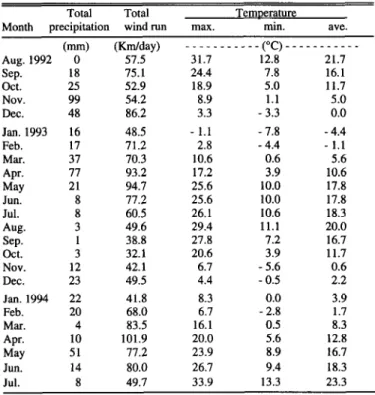
Temperature and precipitation were monitored daily at a weath- er station 1 km from each site within the same habitat type (Table 1). Precipitation for the first year (August 1992-July 1993) of the study was 374 mm with most of the precipitation falling in November (99 mm) and April (77 mm). In the second year (August 1993-July 1994), precipitation was 171 mm with May receiving the highest moisture.
Table 1. Environmental conditions near both study sites. Environmental conditions were monitored daily.
Total Total
Month ureciuitation wind run max.
Temuerature
min. ave.
1 _
(-) NnkW ___________ (“C) _________--
Aug. 1992 0 57.5 31.7 12.8 21.7
SeD. 18 75.1 24.4 7.8 16.1
oci. 25 52.9
Nov. 99 54.2
Dec. 48 86.2
Jan. 1993 16 48.5
Feb. 17 71.2
Mm. 37 70.3
Apr. 77 93.2
May 21 94.7
JUIl. 8 77.2
Jul. 8 60.5
Aug. 3 49.6
Sep. 1 38.8
Oct. 3 32.1
Nov. 12 42.1
Dec. 23 49.5
Jan. 1994 22 41.8
Feb. 20 68.0
Ma. 4 83.5
Apr. 10 101.9
May 51 77.2
Jun. 14 80.0
Jul. 8 49.7
18.9 8.9 3.3 - 1.1 2.8 10.6 17.2 25.6 25.6 26.1 29.4 27.8 20.6 6.7 4.4 8.3 6.7 16.1 20.0 23.9 26.7 33.9
5.0 1.1 - 3.3 - 7.8 - 4.4 0.6 3.9 10.0 10.0
10.6 18.3
11.1 20.0
7.2 16.7
3.9 11.7
- 5.6 0.6
- 0.5 0.0
- 2.8 1.7
0.5 8.3
5.6 12.8
8.9 16.7
9.4 18.3
13.3 23.3
11.7 5.0 0.0 - 4.4 - 1.1 5.6 10.6 17.8 17.8
2.2 3.9
Experimental Design
Twelve treatments (2 diffuse knapweed seeding rates, 6 defoli- ation levels) were applied to 1 m2 plots in a randomized-com- plete-block design (n=4 at each site). Plots were located and clipped to an 8 cm stubble height in mid-August 1992. Diffuse knapweed seeds collected during the summer of 1992 from areas near both sites were broadcast-seeded on the plots. Lots of 500 (3,000 seeds per plot) or 1,000 (6,000 seeds per plot) diffuse
and ending 15 November 1992 to mimic natural seed rain. These rates are within the typical range of seeds produced by a single knapweed plant in this area (unpublished data, Sheley and Larson).
On 28 April 1993, grasses in each plot were hand-clipped to defoliation levels of 0, 20, 40, 60, 80, or 100%. Grasses were in the boot stage, and are often grazed at this time in eastern Washington rangelands. Defoliation levels were calibrated by clipping nearby grasses and comparing their weights with total grass weights. Although diffuse knapweed seedlings were not clipped at this time, they were counted to determine seedling den- sities.
Established diffuse knapweed plants were recounted on 15 and 16 September 1993, and each rosette was measured in 2 direc- tions, perpendicular to one another, to provide an indicator of the foliar cover of each plant. Diffuse knapweed densities were counted at this time. In addition, we counted the number of flow- ering culms on each grass plant.
On 28 May 1994, the above-ground biomass of all grasses was harvested from each plot. In addition densities of seedling (34 leaves), juvenile (5-8 leaves), and adult (greater than 8 leaves) diffuse knapweed plants were determined. Diffuse knapweed plants were harvested on 1 July 1994, dried at 60°C until weights were constant and then weighed.
Data Analysis
Data were first analyzed with multiple linear regression (least squares) models using defoliation level and seeding rate as inde- pendent variables. Scatterplots of the residual versus the stan- dardized predicted values indicated that most of the data did not fit a linear model. Therefore, all data were analyzed with least square means ANOVA. Means were compared using LSDs of P10.05.
Each site was analyzed separately. Year was not included in the model because data represented sequential sampling of plots treated in 1993, and followed through time. In 1993, data were collected nondestructively and only seedling densities were deter- mined, while 1994 data included diffuse knapweed densities by age class and plant weights. All block interactions were non- significant (PrO.05) and were pooled into the residual error term.
Only reduced models were examined. Arithmetic means and stan- dard errors are presented in figures.
Results
Defoliation reduced the number of flowering culms produced by the grasses at both sites by September 1993 (Fig. la,b).
Bluebunch wheatgrass and needle-and-thread plants that were not defoliated had the highest number of flowering culms. Plants defoliated by 20% had more flowering culms than those defoliat- ed by 40, 60, and lOO%, but were not different from those defoli- ated 80% because of high variability. Crested wheatgrass plants defoliated at the 80 and 100% had fewer flowering culms than plants with less defoliation (Fig. lb).
On the bluebunch wheatgrass site, plants defoliated 80 and 100% in April 1993 weighed less 1 year later than those defoliat- ed less than 40% (Fig. lc). Weights of grasses defoliated by 40, 60, and 80% were similar. Plants defoliated by 0 and 20%
weighed the most, but were similar to those defoliated at 40%.
One year after defoliation, crested wheatgrass biomass produc-
tion was similar regardless of defoliation level (Fig. Id).
0.
b.
20 40 60 80 100
2 200 k 160 I
L
’ 0 20 40 60 80 100 Defoliation (7.)
0 20 40 60 80 100
Defoliotion (7.)
Bluebunc h wheotgross Crested wheotgross
0 20 40 60 80 100
Fig. 1. Response of bluebunch wheatgrass and crested wheatgrass flowering culms 5 months after defoliation and biomass 1 year after defoliation. Error bars represent + 1 SE.
Before defoliation in April 1993, diffuse knapweed seedling densities on plots that had been seeded with 3,000 and 6,000 seeds the previous fall were similar (bluebunch wheatgrass, P=O.56; crested wheatgrass, P=O.67). Densities averaged 239 plants m-* at the bluebunch wheatgrass site and 330 plants me2 at the crested wheatgrass site. Grasses had not been defoliated at this time. By September 1993, there was still no effect of seeding rate on diffuse knapweed density across all defoliation treatments (bluebunch wheatgrass, P=O.22; crested wheatgrass, P=O.65).
At the bluebunch wheatgrass site, diffuse knapweed seedling densities were affected by level of defoliation by September 1993 (Fig. 2a). Where grasses were defoliated lOO%, diffuse knapweed density averaged 33 plants m-*. Diffuse knapweed densities in plots with grasses defoliated at the other levels were similar, ranging from 8 to 16 plants me*. On the crested wheatgrass site, diffuse knapweed densities were similar regardless of defoliation level (P=O.23; Fig. 2b).
0.