260
Modality-based Factorization for Multimodal Fusion
Elham J. Barezi, Pascale Fung
Center for Artificial Intelligence Research (CAiRE) Department of Computer Science and Engineering
The Hong Kong University of Science and Technology, Clear Water Bay, Hong Kong
[email protected],[email protected]
Abstract
We propose a novel method, Modality-based Redundancy Reduction Fusion (MRRF), for understanding and modulating the relative con-tribution of each modality in multimodal infer-ence tasks. This is achieved by obtaining an (M+ 1)-way tensor to consider the high-order relationships betweenM modalities and the output layer of a neural network model. Ap-plying a modality-based tensor factorization method, which adopts different factors for dif-ferent modalities, results in removing informa-tion present in a modality that can be com-pensated by other modalities, with respect to model outputs. This helps to understand the relative utility of information in each modality. In addition it leads to a less complicated model with less parameters and therefore could be applied as a regularizer avoiding overfitting. We have applied this method to three different multimodal datasets in sentiment analysis, per-sonality trait recognition, and emotion recog-nition. We are able to recognize relationships and relative importance of different modali-ties in these tasks and achieves a 1% to 4% improvement on several evaluation measures compared to the state-of-the-art for all three tasks.
1 Introduction
Multimodal data fusion is a desirable method for many machine learning tasks where information is available from multiple source modalities, typically achieving better predictions through integration of information from different modalities. Multimodal integration can handle missing data from one or more modalities. Since some modalities can in-clude noise, it can also lead to more robust predic-tion. Moreover, since some information may not be visible in some modalities or a single modality may not be powerful enough for a specific task, con-sidering multiple modalities often improves
perfor-mance (Potamianos et al.,2003;Soleymani et al.,
2012;Kampman et al.,2018).
For example, humans assign personality traits to each other, as well as to virtual characters by inferring personality from diverse cues, both be-havioral and verbal, suggesting that a model to predict personality should take into account multi-ple modalities such as language, speech, and visual cues.
Our method, Modality-based Redundancy Re-duction multimodal Fusion (MRRF), builds on re-cent work in mutimodal fusion utilizing first an outer product tensor of input modalities to better capture inter-modality dependencies (Zadeh et al.,
2017) and a recent approach to reduce the num-ber of elements in the resulting tensor through low rank factorization (Liu et al.,2018). Whereas the factorization used in (Liu et al., 2018) utilizes a single compression rate across all modalities, we instead use Tuckers tensor decomposition (see the Methodology section), which allows different com-pression rates for each modality. This allows the model to adapt to variations in the amount of useful information between modalities. Modality-specific factors are chosen by maximizing performance on a validation set.
Applying a modality-based factorization method results in removing redundant information dupli-cated across modalities and leading to fewer pa-rameters with minimal information loss. Through maximizing performance on a validation set, our method can work as a regularizer, leading to a less complicated model and reducing overfitting. In ad-dition, our modality-based factorization approach helps to understand the differences in useful infor-mation between modalities for the task at hand.
pa-rameters which requires fewer training samples, providing efficient training for the smaller datasets, and accelerating both training and prediction. Our experimental results demonstrate that the proposed approach can make notable improvements, in terms of accuracy, mean average error (MAE), correla-tion, and F1score, especially for the applications
with more complicated inter-modality relations. We further study the effect of different com-pression rates for different modalities. Our results on the importance of each modality for each task supports the previous results on the usefulness of each modality for personality recognition, emotion recognition and sentiment analysis.
In the sequel, we first describe related work. We elaborate on the details of our proposed method in Methodology section. In the following section we go on to describe our experimental setup. In the Results section, we compare the performance of MRRF and state-of-the-art baselines on three different datasets and discuss the effect of compres-sion rate on each modality. Finally, we provide a brief conclusion of the approach and the results. Supplementary materials describe the methodology in greater detail.
Notation The operator⊗is the outer product op-erator where z1 ⊗. . .⊗zM for zi ∈ Rdi leads
to a M-way tensor in Rd1×...×dM. The
opera-tor ×k, for a given k, is k-mode product of a
tensor R ∈ Rr1×r2×...×rM and a matrix W ∈
Rdk×rk as W ×
k R, which results in a tensor ¯
R∈Rr1×...×rk−1×dk×rk+1×...×rM.
2 Related Work
Multimodal Fusion: Multimodal fusion (Ngiam et al., 2011) has a very broad range of applica-tions, including audio-visual speech recognition (Potamianos et al.,2003), classification of images and their captions (Srivastava and Salakhutdinov,
2012), multimodal emotion recognition (Soleymani et al.,2012), medical image analysis (James and Dasarathy,2014), multimedia event detection (Lan et al.,2014), personality trait detection (Kampman et al.,2018), and sentiment analysis (Zadeh et al.,
2017).
According to the recent work by (Baltruˇsaitis et al., 2018), the techniques for multimodal fu-sion can be divided into early, late and hybrid approaches. Early approaches combine the mul-timodal features immediately by simply concate-nating them (D’mello and Kory,2015). Late fusion
combines the decision for each modality (either classification, or regression), by voting (Morvant et al., 2014), averaging (Shutova et al., 2016) or weighted sum of the outputs of the learned models (Glodek et al., 2011;Shutova et al.,2016). The hybrid approach combines the prediction by early fusion and unimodal predictions.
It has been observed that early fusion (feature level fusion) concentrates on the inter-modality information rather than intra-modality informa-tion (Zadeh et al.,2017) due to the fact that inter-modality information can be more complicated at the feature level and dominates the learning process. On the other hand, these fusion approaches are not powerful enough to extract the inter-modality inte-gration model and they are limited to some simple combining methods (Zadeh et al.,2017).
Zadeh et al. (2017) proposed combining n
modalities by computing an n-way tensor as a tensor product of the ndifferent modality repre-sentations followed by a flattening operation, in order to include 1-st order to n-th order inter modal-ity relations. This is then fed to a neural network model to make predictions. The authors show that their proposed method improves the accuracy by considering both inter-modality and intra-modality relations. However, the generated representation has a very large dimension which leads to a very large hidden layer and therefore a huge number of parameters.
The authors of (Poria et al.,2017a,b;Zadeh et al.,
2018a,b) introduce attention mechanisms utilizing the contextual information available from the ut-terances for each speaker. They require additional information like the identity of the speaker, the sequence of the utterance-sentiments while inte-grating the multimodal data. Since these methods, despite our proposed method, need additional in-formation might not be available in the general scenario, we do not include them in our experi-ments.
Low Rank Factorization: Recently (Liu et al.,
2018) proposed a factorization approach in or-der to achieve a factorized version of the weight matrix which leads to fewer parameters while maintaining model accuracy. They use a CAN-DECOMP/PARAFAC decomposition (Carroll and Chang,1970;Harshman,1970) which follows Eq.
to several 1-dimensional vectorswmi ∈Rdk:
W =
r
X
i=1
λiw1i ⊗w2i ⊗. . .⊗wMi
= r
X
i=1
λi⊗Mm=1wim
(1)
where⊗is the outer product operator,λis are scalar
weights to combine rank 1 decompositions. This approach used the same compression rate for all modalities, i.e. r is shared for all the modalities, and is not able to allow for varying compression rates between modalities. Previous studies have found that some modalities are more informative than others (De Silva et al.,1997;Kampman et al.,
2018), suggesting that allowing different compres-sion rates for different modalities should improve performance.
3 Methodology
3.1 Tucker Factorization for Multimodal Learning
Modality-based Redundancy Reduc- tion
Fu-sion (MRRF): We have used Tucker’s tensor
decomposition method (Tucker,1966;Hitchcock,
1927) which decomposes anM-way tensorW ∈ Rd1×d2×...×dM to a core tensorR∈Rr1×r2×...×rM
andM matricesWi ∈Rri×di, withr
i ≤di, as it
can be seen in Eq.2.
W =R×1W1×2W2×3. . .×M WM,
W ∈Rd1×d2×...×dM
R∈Rr1×r2×...×rM,
Wi ∈Rdi×ri
(2)
The operator ×k is a k-mode product of a tensor
R ∈ Rr1×r2×...×rM and a matrix W ∈
Rdk×rk
as R ×k Wk, which results in a tensor R¯ ∈ Rr1×...×rk−1×dk×rk+1×...×rM.
ForM modalities with representationsD1,D2,
. . . and DM of size d1, d2, . . . and dM, an M
-modal tensor fusion approach as proposed by the authors of (Zadeh et al., 2017) leads to a tensor
D = D1 ⊗D2 ⊗ . . .⊗Dm ∈ Rd1×d2×...×dM.
The authors proposed flattening the tensor layer in the deep network which results in loss of the information included in the tensor structure. In this paper, we propose to avoid the flattening and follow Eq.3 with weight tensorW ∈ Rh×d1×d2×...×dM,
where leads to an output layerHof sizeh.
H =W D (3)
The above equation suffers from a large num-ber of parameters (O(Q
i=1dih)) which requires
a large number of the training samples, huge time and space, and easily overfits. In order to reduce the number of parameters, we propose to use Tucker’s tensor decomposition (Tucker, 1966; Hitchcock,
1927) as shown in Eq. 4, which works as a low-rank regularizer (Fazel,2002).
W =R×1W1×2W2×3. . .×M+1WM+1,
W ∈Rh×d1×d2×...×dM,
R∈Rr1×r2×r3×...×rM,
Wi∈Rri×di, i={1, . . . , M},
WM+1 ∈RrM+1×h
(4) The non-diagonal core tensorRmaintain inter-modality information after compression, despite the factorization proposed by (Liu et al.,2018) which loses part of inter-modality information.
3.2 Proposed MRRF framework
We propose Modality-based Redundancy Reduc-tion Fusion (MRRF), a tensor fusion and factoriza-tion method allowing for modality specific com-pression rates, combining the power of tensor fu-sion methods with a reduced parameter complexity. Without loss of generality, we will consider the number of modalities to be 3 in this discussion.
Our method first forms an outer product tensor from input modalitiesD, then projects this via a tensor W to a feature vector H passed as input to a neural network which performs the desired inference task.
H =W D (5)
The trainable projection tensorW represents a large number of parameters, and in order to reduce this number, we propose to use Tucker’s tensor decomposition (Tucker, 1966;Hitchcock,1927), which works as a low-rank regularizer (Fazel,
2002). This results in a decomposition ofW into a core tensorRof reduced dimensionality and three modality specific matricesWi.
W =R×1W1×2W2×3W3 (6)
where×k is a k-mode product of a tensor and a
matrix. Equation5can then be re-written
Z =W1×1W2×2W3×3D
See Figure1for an overview of this process for the case of three separate channels for audio, text, and video. In practice we flatten tensorsZandRto reduce this last operation to a matrix multiplication. Further details of the decomposition strategy can be found in the supplementary materials.
Note that a simple outer product of the input features leads only to the high-order trimodal de-pendencies. In order to also obtain the unimodal and bimodal dependencies, the input feature vec-tors for each modality are padded by 1. This also provides a constant element whose corresponding factors inW act as a bias vector.
Algorithm1shows the whole MRRF process.
Algorithm 1Tensor Factorization Layer.
Input: n input modalities D1, D2, . . . , Dn of
sized1, d2, . . . , dn, correspondingly.
Initialization: factorization size for each modality
r1, r2, . . . , rn.
1: Compute tensorD=D1⊗D2⊗. . .⊗Dn
2: Generate the layers for out = W D which
W = ˆR×1 W1 ×2. . .×M WM in order to
transform the high-dimensional tensorD to the outputh.
3: Use Adam optimizer for the differentiable ten-sor factorization layer to find the unknown pa-rametersW1, W2, . . . , Wn,Rˆ.
Output: Factors for Weight Matrix W:
W1, W2, . . . , Wn, R.
The original tensor fusion approach as proposed in (Zadeh et al.,2017) flattened the tensorDwhich results in loss of the information included in the tensor structure, which is avoided in our approach.
Liu et al.(2018) developed a similar approach to ours using a diagonal core tensorR, losing much inter-modality information. Our non-diagonal core tensor maintains key inter-modality information after compression.
Note that the factorization step is task dependent, included in the deep network structure and learned during network training. Thus, for follow-up learn-ing tasks, we would learn a new factorization spe-cific to the task at hand, typically also estimating optimal compression ratios as described in the dis-cussion section. In this process, any shared, helpful information is retained, as demonstrated by our results.
Analysis of parameter complexity: Following our proposed approach, we have decomposed the trainable W tensor to four substantially smaller trainable matrices (W1, W2, W3, R) leading to
O(PM
i=1(di∗ri) +QMi=1ri∗h)parameters.
Con-cat fusion (CF) leads to a layer size ofO(PM
i=1di)
andO(PM
i=1di∗h)parameters.
The tensor fusion approach (TF), leads to a layer size ofO(QM
i=1di), andO(QMi=1di∗h)
parame-ters. The LMF approach (Liu et al.,2018) requires trainingO(PM
i=1r∗h∗di)parameters, whereris
the rank used for all the modalities.
It can be seen that the number of parameters in the proposed approach is substantially fewer than the simple tensor fusion (TF) approach and comparable to the LMF approach.
4 Experimental Setup
4.1 Datasets
We perform our experiments on the following mul-timodal datasets: CMU-MOSI (Zadeh et al.,2016), POM (Park et al.,2014), and IEMOCAP (Busso et al.,2008) for sentiment analysis, speaker traits recognition, and emotion recognition, respectively. These tasks can be done by integrating both verbal and nonverbal behaviors of the persons.
The CMU-MOSI dataset is annotated on a seven-step scale as highly negative, negative, weakly neg-ative, neutral, weakly positive, positive, highly pos-itive which can be considered as a 7 class classifi-cation problem with 7 labels in the range[−3,+3]. The dataset is an annotated dataset of 2199 opin-ion utterances from 93 distinct YouTube movie reviews, each containing several opinion segments. Segments average of 4.2 seconds in length.
The POM dataset is composed of 903 movie re-view videos. Each video is annotated with the fol-lowing speaker traits: confident, passionate, voice pleasant, dominant, credible, vivid, expertise, enter-taining, reserved, trusting, relaxed, outgoing, thor-ough, nervous, persuasive and humorous.
The IEMOCAP dataset is a collection of 151 videos of recorded dialogues, with 2 speakers per session for a total of 302 videos across the dataset. Each segment is annotated for the presence of 9 emotions (angry, excited, fear, sad, surprised, frus-trated, happy, disgust and neutral).
d1 x d2 x d3
W1 D
W2
W3 1
r1 x r2 x r3 x h
Z R
Z
d1
d2
1 1
d1 x d2 x d3
d3
=
r1 x d1
r2 x d2
r3 x d3
=
Zr1r2r3 x h
r1r2r3
r1 x r2 x r3 r1 x r2 x r3
D R
Tensor Matrix Vector
Hidden Layer and Output
Input Tensor Fusion Compressing Producing output of size H Factorization
Flattening
3 1
2
[image:5.595.73.512.73.334.2]_ _
Figure 1: Diagram of Modality-based Redundancy Reduction Multimodal Fusion (MRRF).
interval (Chen et al., 2017). In order to perform time alignment across modalities, the three modali-ties are aligned using P2FA (Yuan and Liberman,
2008) at the word level.
Pre-trained 300-dimensional Glove word embed-dings (Chen et al.,2017) were used to extract the language feature representations, which encodes a sequence of the transcribed words into a sequence of vectors.
Visual features for each frame (sampled at 30Hz) are extracted using the library Facet1 which in-cludes 20 facial action units, 68 facial landmarks, head pose, gaze tracking and HOG features (Zhu et al.,2006).
COVAREP acoustic analysis framework ( Degot-tex et al.,2014) is used to extract low-level acous-tic features, including 12 Mel frequency cepstral coefficients (MFCCs), pitch, voiced/unvoiced seg-mentation, glottal source, peak slope, and maxima dispersion quotient features.
To evaluate model generalization, all datasets are split into training, validation, and test sets such that the splits are speaker independent, i.e., no speakers from the training set are present in the test sets. Table1illustrates the data splits for all the datasets in detail.
1goo.gl/1rh1JN
Dataset CMU-MOSI IEMOCAP POM
Level Segment Segment Video
Train 1284 6373 600
Valid 229 1775 100
[image:5.595.344.487.371.421.2]Test 686 1807 203
Table 1: The speaker independent data splits for train-ing, validation, and test sets
4.2 Model Architecture
Similarly to (Liu et al., 2018), we use a simple model architecture for extracting the representa-tions for each modality. We used three unimodal sub-embedding networks to extract representations
za,zv andzlfor each modality, respectively. For
acoustic and visual modalities, the sub-embedding network is a simple 2-layer feed-forward neural network, and for language, we used a long short-term memory (LSTM) network (Hochreiter and Schmidhuber,1997).
Dataset CMU-MOSI POM IEMOCAP
Metric MAE Corr Acc-2 F1 Acc-7 MAE Corr Acc F1-Happy F1-Sad F1-Angry F1-Neutral
CF 1.140 0.52 72.3 72.1 26.5 0.865 0.142 34.1 81.1 81.2 65.1 44.1
TFN 0.970 0.633 73.9 73.4 32.1 0.886 0.093 31.6 83.6 82.8 84.2 65.4
LMF 0.912 0.668 76.4 75.7 32.8 0.796 0.396 42.8 85.8 85.9 89.0 71.7
[image:6.595.102.497.63.122.2]MRRF 0.912 0.772 77.46 76.73 33.02 0.69 0.44 43.02 87.71 85.9 90.02 73.7
Table 2: Results for Sentiment Analysis on CMU-MOSI, emotion recognition on IEMOCAP and personality trait recognition on POM. (CF, TF, and LMF stand for concat, tensor and low-rank fusion respectively).
5 Experimental Results and Comparing
with State-of-the-art
We compared our proposed method with three base-line methods. Concat fusion (CF) (Baltruˇsaitis et al.,2018) proposes a simple concatenation of the different modalities followed by a linear com-bination. The tensor fusion approach (TF) (Zadeh et al.,2017) computes a tensor including uni-modal, bi-modal, and tri-modal combination information. LMF (Liu et al.,2018) is a tensor fusion method that performs tensor factorization using the same rank for all the modalities in order to reduce the number of parameters. Our proposed method aims to use different factors for each modality.
In Table 2, we present mean average error (MAE), the correlation between prediction and true scores, binary accuracy (Acc-2), multi-class accu-racy (Acc-7) and F1 measure. The proposed ap-proach outperforms baseline apap-proaches in nearly all metrics, with marked improvements in Happy and Neutral recognition. The reason is that the inter-modality information for these emotions is more complicated than the other emotions and re-quires a non-diagonal core tensor to extract the complicated information. It is worth to note that for the equivalent setting and equal ranks for all the modalities, the result of the proposed method is always marginally better than LMF method.
5.1 Investigating the Effect of Compression Rate on Each Modality
In this section, we aim to investigate the amount of redundant information in each modality. To do this, after obtaining a tensor which includes the combinations of all modalities with the equivalent size, we factorize a single dimension of the ten-sor while keeping the size for the other modalities fixed. By observing how the performance changes by compression rate, one can find how much redun-dant information is contained in the corresponding modality relative to the other modalities.
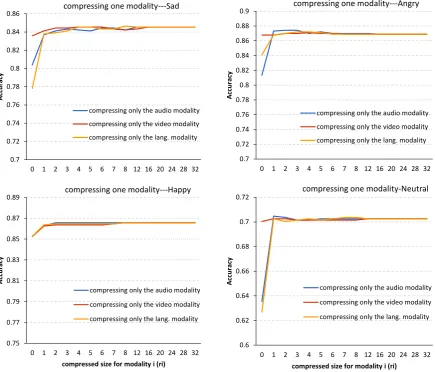
The results can be seen in Fig. 2,3and4. The horizontal axis is the compressed size and the
ver-tical axis shows the accuracy for each modality. Note that due to the padding of eachDiwith 1, we
have usedri+ 1as the new embedding size.
The first point that could be perceived clearly from the different modality diagrams is that each of the modalities changes in a different way when getting compressed, which means they each have a different amount of information that can not be compensated by the non-compressed modalities. In other words, a high accuracy when a modality is highly compressed means that there is a lot of redundant information in this modality — the in-formation loss resulting from factorization could be compensated by the other modalities so perfor-mance was not reduced.
Fig. 2shows results for the CMU-MOSI senti-ment analysis dataset. For this dataset, a notable decrease in accuracy can be seen by compressing the video modality, while the audio and text modal-ities are not notably sensitive to compression. This shows that for sentiment analysis based on CMU-MOSI dataset, the information in Video modality cannot be compensated by other modalities, how-ever most information in the audio and language modalities is covered in video modality. In other words, the video contains essential information for this task whereas information from audio and lan-guage can be recovered from video.
Fig. 3shows the average accuracy over 16 per-sonality types for the POM perper-sonality trait recog-nition dataset. For this dataset also, each of the modalities has a different behavior for different compression rates. We can see that the audio modality includes more non-redundant information for personality recognition as accuracy is highly affected by audio compression. In addition, there is a notable accuracy reduction when the language modality is highly compressed, which shows a small amount of non-redundant information for this task. Note that the POM data does not contain sufficient information for an effective analysis of the 16 personality sub types individually.
emo-0.3 0.35 0.4 0.45 0.5 0.55 0.6 0.65 0.7 0.75
0 1 2 3 4 5 6 7 8 12 16 20 24 28 32
Acc
u
rac
y
compressed size for modality i (ri)
compressing one modality---MOSI
[image:7.595.83.265.67.234.2]compressing only the audio modality compressing only the video modality compressing only the lang. modality
Figure 2: CMU-MOSI sentiment analysis dataset: Ef-fect of different compression rates on accuracy for sin-gle modalities.
0.25 0.27 0.29 0.31 0.33 0.35 0.37
0 1 2 3 4 5 6 7 8 12 16 20 24 28 32
A
cc
u
rac
y
compressed size for modality i (ri)
compressing one modality---POM
compressing only the audio modality
compressing only the video modality
compressing only the lang. modality
Figure 3: POM personality recognition dataset: Effect of different compression rates on accuracy for single modalities.
tion recognition dataset for each of the four emo-tional categories: happy, angry, sad, and neutral. Looking at the sad category, we see notable accu-racy reduction for small sizes (high compression) for all the modalities, showing that each contains at least some non-redundant information. How-ever, high compression of audio and especially lan-guage modalities results in strong accuracy reduc-tion whereas video compression results in relatively minor reduction. It can be concluded that for this emotion, the language modality has the most non-redundant information and the video modality very little — it’s information can be compensated by the other two modalities. Moving on to the angry emotion, small sizes (high compression) result in accuracy reduction for audio and language modali-ties, showing that they contain some non-redundant
information, with the audio modality containing more. Again the information in video can be al-most completely compensated by the other two modalities.
By comparing the highest accuracy values for various emotion categories, it is observed that neu-tral is hard to predict in comparison to the other cat-egories. Again, the audio and Language modalities both include non-redundant information leading to a severe accuracy reduction with high compression of these modalities, with video containing almost no information not compensated by audio and lan-guage.
The happy category is the easiest to predict emo-tion, and it slightly suffers for very small sizes of audio and video and language modalities, indicat-ing a small amount of non-redundant information in all modalities.
6 Conclusion
We proposed a tensor fusion method for multi-modal media analysis by obtaining anM+ 1-way tensor to consider the high-order relationships be-tween M input modalities and the output layer. Our modality-based factorization method removes the redundant information in this high-order de-pendency structure and leads to fewer parameters with minimal loss of information. In addition, a modality-based factorization approach helps to un-derstand the relative quantities of non-redundant information in each modality through investigation sensitivity to modality-specific compression rates. As the proposed compression method leads to a less complicated model, it can be applied as a regu-larizer which avoiding overfitting.
[image:7.595.79.262.297.460.2]0.7 0.72 0.74 0.76 0.78 0.8 0.82 0.84 0.86
0 1 2 3 4 5 6 7 8 12 16 20 24 28 32
Accu
racy
compressed size for modality i (ri)
compressing one modality---Sad
compressing only the audio modality
compressing only the video modality
compressing only the lang. modality
0.7 0.72 0.74 0.76 0.78 0.8 0.82 0.84 0.86 0.88 0.9
0 1 2 3 4 5 6 7 8 12 16 20 24 28 32
A
cc
u
rac
y
compressed size for modality i (ri)
compressing one modality---Angry
compressing only the audio modality
compressing only the video modality
compressing only the lang. modality
0.75 0.77 0.79 0.81 0.83 0.85 0.87 0.89
0 1 2 3 4 5 6 7 8 12 16 20 24 28 32
Accu
racy
compressed size for modality i (ri)
compressing one modality---Happy
compressing only the audio modality
compressing only the video modality
compressing only the lang. modality
0.6 0.62 0.64 0.66 0.68 0.7 0.72
0 1 2 3 4 5 6 7 8 12 16 20 24 28 32
A
cc
u
rac
y
compressed size for modality i (ri)
compressing one modality-Neutral
compressing only the audio modality
compressing only the video modality
[image:8.595.76.512.70.442.2]compressing only the lang. modality
Figure 4: IEMOCAP Emotion Recognition Dataset: Effect of different compression rates on accuracy for single modalities.
fixing the other modalities helping to understand the amount of useful non-redundant information in each modality. Moreover, we have evaluated our method by comparing the results with state-of-the-art methods, achieving a 1% to 4% improvement across multiple measures for the different tasks.
In future work, we will investigate the relation between dataset size and compression rate by ap-plying our method to larger datasets. This will help to understand the trade-off between the model size and available training data, allowing more efficient training and avoiding under- and overfitting.
As the availability of data with more and more modalities increases, both finding a trade-off be-tween cost and performance and effective and effi-cient utilization of available modalities will be vital. Exploring compression methods promises to help identify and remove highly redundant modalities.
Acknowledgments
This work was partially funded by grants #16214415 and #16248016 of the Hong Kong Re-search Grants Council, ITS/319/16FP of Innovation Technology Commission, and RDC 1718050-0 of EMOS.AI. Thanks to Dr. Ian D. Wood and Peyman Momeni for their helpful commnets.
References
Tadas Baltruˇsaitis, Chaitanya Ahuja, and Louis-Philippe Morency. 2018. Multimodal machine learn-ing: A survey and taxonomy.IEEE Transactions on Pattern Analysis and Machine Intelligence.
J Douglas Carroll and Jih-Jie Chang. 1970. Analysis of individual differences in multidimensional scal-ing via an n-way generalization of eckart-young de-composition.Psychometrika, 35(3):283–319. Minghai Chen, Sen Wang, Paul Pu Liang, Tadas
Bal-truˇsaitis, Amir Zadeh, and Louis-Philippe Morency. 2017. Multimodal sentiment analysis with word-level fusion and reinforcement learning. In Proceed-ings of the 19th ACM International Conference on
Multimodal Interaction, pages 163–171. ACM.
Liyanage C De Silva, Tsutomu Miyasato, and Ryohei Nakatsu. 1997. Facial emotion recognition using multi-modal information. In Information, Commu-nications and Signal Processing, 1997. ICICS., Pro-ceedings of 1997 International Conference on, vol-ume 1, pages 397–401. IEEE.
Gilles Degottex, John Kane, Thomas Drugman, Tuomo Raitio, and Stefan Scherer. 2014. Covarepa collabo-rative voice analysis repository for speech technolo-gies. In Acoustics, Speech and Signal Processing
(ICASSP), 2014 IEEE International Conference on,
pages 960–964. IEEE.
Sidney K D’mello and Jacqueline Kory. 2015. A re-view and meta-analysis of multimodal affect detec-tion systems. ACM Computing Surveys (CSUR), 47(3):43.
Maryam Fazel. 2002. Matrix rank minimization with applications. Ph.D. thesis, PhD thesis, Stanford Uni-versity.
Michael Glodek, Stephan Tschechne, Georg Lay-her, Martin Schels, Tobias Brosch, Stefan Scherer, Markus K¨achele, Miriam Schmidt, Heiko Neumann, G¨unther Palm, et al. 2011. Multiple classifier sys-tems for the classification of audio-visual emotional states. InAffective Computing and Intelligent Inter-action, pages 359–368. Springer.
RA Harshman. 1970. Foundations of the parafac pro-cedure: Models and conditions for an” explanatory” multimodal factor analysis. UCLA Working Papers in Phonetics, 16:1–84.
Frank L Hitchcock. 1927. The expression of a tensor or a polyadic as a sum of products. Studies in Applied
Mathematics, 6(1-4):164–189.
Sepp Hochreiter and J¨urgen Schmidhuber. 1997. Long short-term memory. Neural computation, 9(8):1735–1780.
Alex Pappachen James and Belur V Dasarathy. 2014. Medical image fusion: A survey of the state of the art.Information Fusion, 19:4–19.
Onno Kampman, Elham J Barezi, Dario Bertero, and Pascale Fung. 2018. Investigating audio, video, and text fusion methods for end-to-end automatic person-ality prediction. InProceedings of the 56th Annual Meeting of the Association for Computational Lin-guistics (Volume 2: Short Papers), volume 2, pages 606–611.
Diederik Kingma and Jimmy Ba. 2014. Adam: A method for stochastic optimization. arXiv preprint arXiv:1412.6980.
Zhen-Zhong Lan, Lei Bao, Shoou-I Yu, Wei Liu, and Alexander G Hauptmann. 2014. Multimedia classifi-cation and event detection using double fusion. Mul-timedia tools and applications, 71(1):333–347.
Zhun Liu, Ying Shen, Varun Bharadhwaj Lakshmi-narasimhan, Paul Pu Liang, Amir Zadeh, and Louis-Philippe Morency. 2018. Efficient low-rank multi-modal fusion with multi-modality-specific factors. arXiv preprint arXiv:1806.00064.
Emilie Morvant, Amaury Habrard, and St´ephane Ay-ache. 2014. Majority vote of diverse classifiers for late fusion. InJoint IAPR International Work-shops on Statistical Techniques in Pattern Recog-nition (SPR) and Structural and Syntactic Pattern Recognition (SSPR), pages 153–162. Springer.
Jiquan Ngiam, Aditya Khosla, Mingyu Kim, Juhan Nam, Honglak Lee, and Andrew Y. Ng. 2011.
Multimodal deep learning. In Proceedings of the 28th International Conference on Machine Learning
(ICML-11), ICML ’11, pages 689–696, New York,
NY, USA. ACM.
Sunghyun Park, Han Suk Shim, Moitreya Chatterjee, Kenji Sagae, and Louis-Philippe Morency. 2014. Computational analysis of persuasiveness in social multimedia: A novel dataset and multimodal predic-tion approach. InProceedings of the 16th Interna-tional Conference on Multimodal Interaction, pages 50–57. ACM.
Adam Paszke, Sam Gross, Soumith Chintala, Gregory Chanan, Edward Yang, Zachary DeVito, Zeming Lin, Alban Desmaison, Luca Antiga, and Adam Lerer. 2017. Automatic differentiation in pytorch.
Soujanya Poria, Erik Cambria, Devamanyu Hazarika, Navonil Majumder, Amir Zadeh, and Louis-Philippe Morency. 2017a. Context-dependent sentiment anal-ysis in user-generated videos. InProceedings of the 55th Annual Meeting of the Association for Compu-tational Linguistics (Volume 1: Long Papers), pages 873–883.
Soujanya Poria, Erik Cambria, Devamanyu Haz-arika, Navonil Mazumder, Amir Zadeh, and Louis-Philippe Morency. 2017b. Multi-level multiple at-tentions for contextual multimodal sentiment analy-sis. In2017 IEEE International Conference on Data
Mining (ICDM), pages 1033–1038. IEEE.
Gerasimos Potamianos, Chalapathy Neti, Guillaume Gravier, Ashutosh Garg, and Andrew W Senior. 2003. Recent advances in the automatic recogni-tion of audiovisual speech. Proceedings of the IEEE, 91(9):1306–1326.
2016 Conference of the North American Chapter of the Association for Computational Linguistics:
Hu-man Language Technologies, pages 160–170.
Mohammad Soleymani, Maja Pantic, and Thierry Pun. 2012. Multimodal emotion recognition in response to videos. IEEE transactions on affective computing, 3(2):211–223.
Nitish Srivastava and Ruslan R Salakhutdinov. 2012.
Multimodal learning with deep boltzmann machines.
In Advances in Neural Information Processing
Sys-tems 25, pages 2222–2230. Curran Associates, Inc.
Ledyard R Tucker. 1966. Some mathematical notes on three-mode factor analysis. Psychometrika, 31(3):279–311.
Jiahong Yuan and Mark Liberman. 2008. Speaker iden-tification on the scotus corpus.Journal of the Acous-tical Society of America, 123(5):3878.
Amir Zadeh, Minghai Chen, Soujanya Poria, Erik Cam-bria, and Louis-Philippe Morency. 2017. Tensor fusion network for multimodal sentiment analysis.
arXiv preprint arXiv:1707.07250.
Amir Zadeh, Paul Pu Liang, Navonil Mazumder, Soujanya Poria, Erik Cambria, and Louis-Philippe Morency. 2018a. Memory fusion network for multi-view sequential learning. In Thirty-Second AAAI Conference on Artificial Intelligence.
Amir Zadeh, Paul Pu Liang, Soujanya Poria, Pra-teek Vij, Erik Cambria, and Louis-Philippe Morency. 2018b. Multi-attention recurrent network for human communication comprehension. In Thirty-Second AAAI Conference on Artificial Intelligence.
Amir Zadeh, Rowan Zellers, Eli Pincus, and Louis-Philippe Morency. 2016. Mosi: multimodal cor-pus of sentiment intensity and subjectivity anal-ysis in online opinion videos. arXiv preprint
arXiv:1606.06259.
Qiang Zhu, Mei-Chen Yeh, Kwang-Ting Cheng, and Shai Avidan. 2006. Fast human detection using a cascade of histograms of oriented gradients. In Com-puter Vision and Pattern Recognition, 2006 IEEE
Computer Society Conference on, volume 2, pages