151
Automatic Article Commenting: the Task and Dataset
Lianhui Qin
1⇤, Lemao Liu
2, Victoria Bi
2, Yan Wang
2,
Xiaojiang Liu
2, Zhiting Hu, Hai Zhao
1, Shuming Shi
2Department of Computer Science and Engineering, Shanghai Jiao Tong University1, Tencent AI Lab2, {lianhuiqin9,zhitinghu}@gmail.com,[email protected], {victoriabi,brandenwang,lmliu,kieranliu,shumingshi}@tencent.com
Abstract
Comments of online articles provide ex-tended views and improve user engage-ment. Automatically making comments thus become a valuable functionality for online forums, intelligent chatbots, etc. This paper proposes the new task of auto-matic article commenting, and introduces a large-scale Chinese dataset1 with
mil-lions of real comments and a human-annotated subset characterizing the com-ments’ varying quality. Incorporating the human bias of comment quality, we further develop automatic metrics that general-ize a broad set of popular reference-based metrics and exhibit greatly improved cor-relations with human evaluations.
1 Introduction
Comments of online articles and posts provide ex-tended information and rich personal views, which could attract reader attentions and improve inter-actions between readers and authors (Park et al.,
2016). In contrast, posts failing to receive com-ments can easily go unattended and buried. With the prevalence of online posting, automatic arti-cle commenting thus becomes a highly desirable tool for online discussion forums and social media platforms to increase user engagement and foster online communities. Besides, commenting on ar-ticles is one of the increasingly demanded skills of intelligent chatbot (Shum et al.,2018) to enable in-depth, content-rich conversations with humans. Article commenting poses new challenges for machines, as it involves multiple cognitive
abil-⇤
Work done while Lianhui interned at Tencent AI Lab
1The dataset is available onhttp://ai.tencent. com/upload/PapersUploads/article_
commenting.tgz
ities: understanding the given article, formulat-ing opinions and arguments, and organizformulat-ing natu-ral language for expression. Compared to summa-rization (Hovy and Lin,1998), a comment does not necessarily cover all salient ideas of the ar-ticle; instead it is often desirable for a comment to carry additional information not explicitly pre-sented in the articles. Article commenting also dif-fers from making product reviews (Tang et al.,
2017;Li et al.,2017), as the latter takes structured data (e.g., product attributes) as input; while the input of article commenting is in plain text format, posing a much larger input space to explore.
In this paper, we propose the new task of au-tomatic article commenting, and release a large-scale Chinese corpus with a human-annotated sub-set for scientific research and evaluation. We fur-ther develop a general approach of enhancing pop-ular automatic metrics, such as BLEU (Papineni et al.,2002) and METEOR (Banerjee and Lavie,
2005), to better fit the characteristics of the new task. In recent years, enormous efforts have been made in different contexts that analyze one or more aspects of online comments. For example,
Kolhatkar and Taboada(2017) identify construc-tive news comments;Barker et al.(2016) study hu-man summaries of online comment conversations. The datasets used in these works are typically not directly applicable in the context of article com-menting, and are small in scale that is unable to support the unique complexity of the new task.
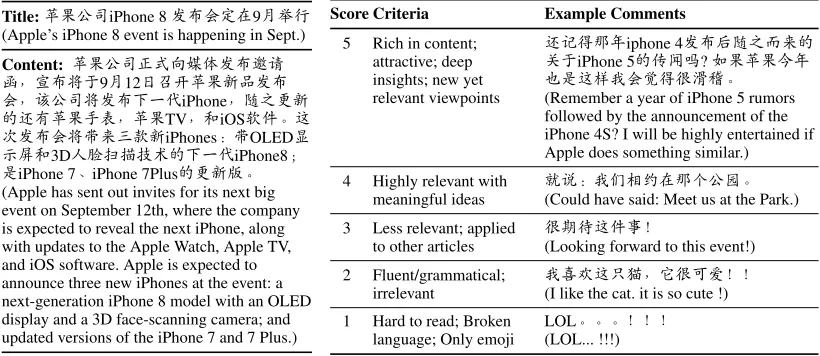
vary-Title:˘úl¯iPhone 8—⇤⇢ö(9 >L (Apple’s iPhone 8 event is happening in Sept.) Content: ˘úl¯c✏⌘íS—⇤Ę ˝ £⇤⌃é9 12ÂÏ ˘ú∞¡—⇤ ⇢ Âl¯⌃—⇤↵ „iPhone èKÙ∞ Ñÿ ˘úKh ˘úTV åiOSoˆ⇥Ÿ !—⇤⇢⌃&e >∞iPhones⇢&OLED> :Oå3D∫8kœÄ/Ñ↵ „iPhone8 /iPhone 7 iPhone 7PlusÑÙ∞H⇥ (Apple has sent out invites for its next big event on September 12th, where the company is expected to reveal the next iPhone, along with updates to the Apple Watch, Apple TV, and iOS software. Apple is expected to announce three new iPhones at the event: a next-generation iPhone 8 model with an OLED display and a 3D face-scanning camera; and updated versions of the iPhone 7 and 7 Plus.)
Score Criteria Example Comments 5 Rich in content;
attractive; deep insights; new yet relevant viewpoints
ÿ∞ó£tiphone 4—⇤ èK eÑ séiPhone 5Ñ ˚⌫?Çú˘ú t _/Ÿ7⌘⇢…óà—=⇥
(Remember a year of iPhone 5 rumors followed by the announcement of the iPhone 4S? I will be highly entertained if Apple does something similar.) 4 Highly relevant with
meaningful ideas
1Ù⇢⌘ϯ¶(£*lÌ⇥ (Could have said: Meet us at the Park.) 3 Less relevant; applied
to other articles
à ÖŸˆã
(Looking forward to this event!) 2 Fluent/grammatical;
irrelevant
⌘ú"ŸÍ+ ÉàÔ1 (I like the cat. it is so cute !) 1 Hard to read; Broken
[image:2.612.105.515.67.245.2]language; Only emoji LOL ⇥⇥⇥ (LOL... !!!)
Table 1: A data example of an article (including title and content) paired with selected comments. We also list a brief version of human judgment criteria (more details are in the supplement).
Train Dev Test #Articles 191,502 5,000 1,610 #Cmts/Articles 27 27 27
#Upvotes/Cmt 5.9 4.9 3.4
Table 2: Data statistics.
ing quality in terms of readability, relevance, argu-ment quality, informativeness, etc (Diakopoulos,
2015;Park et al.,2016). We thus ask human an-notators to manually score a subset of over 43K comments based on carefully designed criteria for comment quality. The annotated scores reflect hu-man’s cognitive bias of comment quality in the large comment space. Incorporating the scores in a broad set of automatic evaluation metrics, we obtain enhanced metrics that exhibit greatly im-proved correlations with human evaluations. We demonstrate the use of the introduced dataset and metrics by testing on simple retrieval and seq2seq generation models. We leave more advanced mod-eling of the article commenting task for future re-search.
2 Related Work
There is a surge of interest in natural lan-guage generation tasks, such as machine transla-tion (Brown et al.,1990;Bahdanau et al.,2014), dialog (Williams and Young, 2007; Shum et al.,
2018), text manipulation (Hu et al.,2017), visual description generation (Vinyals et al.,2015;Liang et al.,2017), and so forth. Automatic article com-menting poses new challenges due to the large in-put and outin-put spaces and the open-domain nature
of comments.
Many efforts have been devoted to studying spe-cific attributes of reader comments, such as con-structiveness, persuasiveness, and sentiment (Wei et al.,2016;Kolhatkar and Taboada,2017;Barker et al.,2016). We introduce the new task of gen-erating comments, and develop a dataset that is orders-of-magnitude larger than previous related corpus. Instead of restricting to one or few spe-cific aspects, we focus on the general comment quality aligned with human judgment, and pro-vide over 27 gold references for each data instance to enable wide-coverage evaluation. Such setting also allows a large output space, and makes the task challenging and valuable for text generation research. Yao et al. (2017) explore defense ap-proaches of spam or malicious reviews. We be-lieve the proposed task and dataset can be poten-tially useful for the study.
Galley et al. (2015) propose BLEU that weights multiple references for conversation gen-eration evaluation. The quality weighted metrics developed in our work can be seen as a generaliza-tion of BLEU to many popular reference-based metrics (e.g., METEOR, ROUGE, and CIDEr). Our human survey demonstrates the effectiveness of the generalized metrics in the article comment-ing task.
3 Article Commenting Dataset
The dataset is collected from Tencent News (news.qq.com), one of the most popular Chinese websites of news and opinion articles. Table 1
[image:2.612.122.278.289.335.2]readability we also provide the English translation of the example). Each instance has a title and text content of the article, a set of reader comments, and side information (omitted in the example) in-cluding the article category assigned by editors, and the number of user upvotes of each comment. We crawled a large volume of articles posted in Apr–Aug 2017, tokenized all text with the popu-lar python library Jieba, and filtered out short arti-cles with less than 30 words in content and those with less than 20 comments. The resulting corpus is split into train/dev/test sets. The selection and annotation of the test set are described shortly. Ta-ble2provides the key data statistics. The dataset has a vocabulary size of 1,858,452. The average lengths of the article titles and content are 15 and 554 Chinese words (not characters), respectively. The average comment length is 17 words.
Notably, the dataset contains an enormous vol-ume of tokens, and is orders-of-magnitude larger than previous public data of article comment anal-ysis (Wei et al.,2016;Barker et al.,2016). More-over, each article in the dataset has on average over 27 human-written comments. Compared to other popular text generation tasks and datasets (Chen et al., 2015; Wiseman et al., 2017) which typi-cally contain no more than 5 gold references, our dataset enables richer guidance for model train-ing and wider coverage for evaluation, in order to fit the unique large output space of the com-menting task. Each article is associated with one of 44 categories, whose distribution is shown in the supplements. The number of upvotes per com-ment ranges from 3.4 to 5.9 on average. Though the numbers look small, the distribution exhibits a long-tail pattern with popular comments having thousands of upvotes.
Test Set Comment Quality Annotations Real human comments are of varying quality. Select-ing high-quality gold reference comments is nec-essary to encourage high-quality comment gener-ation, and for faithful automatic evalugener-ation, espe-cially with reference-based metrics (sec.4). The upvote count of a comment is shown not to be a satisfactory indicator of its quality (Park et al.,
2016;Wei et al.,2016). We thus curate a subset of data instances for human annotation of com-ment quality, which is also used for enhancing au-tomatic metrics as in the next section.
Specifically, we randomly select a set of 1,610 articles such that each article has at least 30
com-ments, each of which contains more than 5 words, and has over 200 upvotes for its comments in total. Manual inspection shows such articles and comments tend to be meaningful and receive lots of readings. We then randomly sample 27 com-ments for each of the articles, and ask 5 profes-sional annotators to rate the comments. The cri-teria are adapted from previous journalistic crite-ria study (Diakopoulos,2015) and are briefed in Table1, right panel (More details are provided in the supplements). Each comment is randomly as-signed to two annotators who are presented with the criteria and several examples for each of the quality levels. The inter-annotator agreement mea-sured by the Cohen’s score (Cohen, 1968) is 0.59, which indicates moderate agreement and is better or comparable to previous human studies in similar context (Lowe et al.,2017; Liu et al.,
2016). The average human score of the test set comments is 3.6 with a standard deviation of 0.6, and 20% of the comments received at least one 5 grade. This shows the overall quality of the test set comments is good, though variations do exist.
4 Quality Weighted Automatic Metrics
Automatic metrics, especially the reference-based metrics such as BLEU (Papineni et al.,2002), ME-TEOR (Banerjee and Lavie,2005), ROUGE (Lin,
2004), CIDEr (Vedantam et al.,2015), are widely used in text generation evaluations. These metrics have assumed all references are of equal golden qualities. However, in the task of article comment-ing, the real human comments as references are of varying quality as shown in the above human annotations. It is thus desirable to go beyond the equality assumption, and account for the differ-ent quality scores of the references. This section introduces a series of enhanced metrics general-ized from respective existing metrics, for leverag-ing human biases of reference quality and improv-ing metric correlations with human evaluations.
Letcbe a generated comment to evaluate,R= {rj} the set of references, each of which has a
quality scoresjby human annotators. We assume
properly normalizedsj2[0,1]. Due to space
Figure 1: Scatter plots showing the correlation between metrics and human judgments.Left: BLEU-1;Middle:METEOR;Right:W-METEOR. Following (Lowe et al.,2017), we added Gaussian noise drawn fromN(0,0.05)to the integer human scores to better visualize the density of points.
original metric by weighting references with sj:
W-METEOR(c,R) = (1 BP) maxjsjFmean,j, (1)
where Fmean,j is a harmonic mean of the preci-sion and recall betweencandrj, andBP is the
penalty (Banerjee and Lavie,2005). Note that the new metrics fall back to the respective original metrics by settingsj= 1.
5 Experiments
We demonstrate the use of the dataset and metrics with simple retrieval and generation models, and show the enhanced metrics consistently improve correlations with human judgment. Note that this paper does not aim to develop solutions for the article commenting task. We leave the advanced modeling for future work.
Metric Spearman Pearson
METEOR 0.5595 0.5109
W-METEOR 0.5902 0.5747
Rouge L 0.1948 0.1951
W-Rouge L 0.2558 0.2572
CIDEr 0.3426 0.1157
W-CIDEr 0.3539 0.1261
BLEU-1 0.2145 0.1790
W-BLEU-1 0.2076 0.1604
BLEU-4 0.0983 0.0099
W-BLEU-4 0.0998 0.0124
[image:4.612.122.278.478.617.2]Human 0.7803 0.7804
Table 3: Human correlation of metrics. “Human” is the results from randomly dividing human scores into two groups. All p-value<0.01. Setup We briefly present key setup, and defer more details to the supplements. Given an article to comment, the retrieval-based models first find a set of similar articles in the training set by TF-IDF,
and return the comments most relevant to the tar-get article with a CNN-based relevance predictor. We use either the article title or full title/content for the article retrieval, and denote the two mod-els with IR-T and IR-TC, respectively. The gen-eration models are based on simple sequence-to-sequence network (Sutskever et al., 2014). The models read articles using an encoder and gen-erate comments using a decoder with or without attentions (Bahdanau et al.,2014), which are de-noted asSeq2seqandAttif only article titles are read. We also set up an attentional sequence-to-sequence model that reads full article title/content, and denote withAtt-TC. Again, these approaches are mainly for demonstration purpose and for eval-uating the metrics, and are far from solving the difficult commenting task. We discard comments with over 50 words and use a truncated vocabu-lary of size 30K.
Results We follow previous setting (Papineni et al.,2002;Liu et al.,2016;Lowe et al.,2017) to evaluate the metrics, by conducting human eval-uations and calculating the correlation between the scores assigned by humans and the metrics. Specifically, for each article in the test set, we ob-tained six comments, five of which come from IR-T, IR-TC, Seq2seq, Att, and Att-TC, respectively, and one randomly drawn from real comments that are different from the reference comments. The comments were then graded by human annotators following the same procedure of test set scoring (sec.3). Meanwhile, we measure each comment with the vanilla and weighted automatic metrics based on the reference comments.
fam-ily correlates best with human judgments, and the enhanced weighted metrics improve over their vanilla versions in most cases (including BLEU-2/3 as in the supplements). E.g., the Pearson of METEOR is substantially improved from 0.51 to 0.57, and the Spearman of ROUGE L from 0.19 to 0.26. Figure1visualizes the human correlation of BLEU-1, METEOR, and W-METEOR, showing that the BLEU-1 scores vary a lot given any fixed human score, appearing to be random noise, while the METEOR family exhibit strong consistency with human scores. Compared to W-METEOR, METEOR deviates from the regression line more frequently, esp. by assigning unexpectedly high scores to comments with low human grades.
Notably, the best automatic metric, W-METEOR, achieves 0.59 Spearman and 0.57 Pearson, which is higher or comparable to au-tomatic metrics in other generation tasks (Lowe et al., 2017; Liu et al., 2016; Sharma et al.,
2017; Agarwal and Lavie, 2008), indicating a good supplement to human judgment for efficient evaluation and comparison. We use the metrics to evaluate the above models in the supplements.
6 Conclusions and Future Work
We have introduced the new task and dataset for automatic article commenting, as well as de-veloped quality-weighted automatic metrics that leverage valuable human bias on comment qual-ity. The dataset and the study of metrics establish a testbed for the article commenting task.
We are excited to study solutions for the task in the future, by building advanced deep generative models (Goodfellow et al.,2016;Hu et al.,2018) that incorporate effective reading comprehension modules (Rajpurkar et al.,2016;Richardson et al.,
2013) and rich external knowledge (Angeli et al.,
2015;Hu et al.,2016).
The large dataset is also potentially useful for a variety of other tasks, such as comment rank-ing (Hsu et al., 2009), upvotes prediction ( Ri-zos et al., 2016), and article headline genera-tion (Banko et al., 2000). We encourage the use of the dataset in these context.
Acknowledgement.We would like to thank anonymous re-viewers for their helpful suggestions and particularly the an-notators for their contributions on the dataset. Hai Zhao was partially supported by National Key Research and Develop-ment Program of China (No. 2017YFB0304100), National Natural Science Foundation of China (No. 61672343 and No.
61733011), Key Project of National Society Science Foun-dation of China (No. 15-ZDA041), The Art and Science In-terdisciplinary Funds of Shanghai Jiao Tong University (No. 14JCRZ04).
References
Abhaya Agarwal and Alon Lavie. 2008. METEOR, m-BLEU and m-TER: Evaluation metrics for high-correlation with human rankings of machine translation output. In Pro-ceedings of the Third Workshop on Statistical Machine Translation, pages 115–118. Association for Computa-tional Linguistics.
Gabor Angeli, Melvin Jose Johnson Premkumar, and Christo-pher D Manning. 2015. Leveraging linguistic structure for open domain information extraction. InACL, volume 1, pages 344–354.
Dzmitry Bahdanau, Kyunghyun Cho, and Yoshua Bengio. 2014. Neural machine translation by jointly learning to align and translate.arXiv preprint arXiv:1409.0473.
Satanjeev Banerjee and Alon Lavie. 2005. METEOR: An automatic metric for mt evaluation with improved corre-lation with human judgments. InACL Workshop, vol-ume 29, pages 65–72.
Michele Banko, Vibhu O Mittal, and Michael J Witbrock. 2000. Headline generation based on statistical translation. InACL, pages 318–325. Association for Computational Linguistics.
Emma Barker, Monica Lestari Paramita, Ahmet Aker, Emina Kurtic, Mark Hepple, and Robert Gaizauskas. 2016. The SENSEI annotated corpus: Human summaries of reader comment conversations in on-line news. InProceedings of the 17th annual meeting of the special interest group on discourse and dialogue, pages 42–52.
Peter F Brown, John Cocke, Stephen A Della Pietra, Vin-cent J Della Pietra, Fredrick Jelinek, John D Lafferty, Robert L Mercer, and Paul S Roossin. 1990. A statistical approach to machine translation. Computational linguis-tics, 16(2):79–85.
Xinlei Chen, Hao Fang, Tsung-Yi Lin, Ramakrishna Vedan-tam, Saurabh Gupta, Piotr Doll´ar, and C Lawrence Zit-nick. 2015. Microsoft COCO captions: Data collection and evaluation server.arXiv preprint arXiv:1504.00325.
Jacob Cohen. 1968. Weighted kappa: Nominal scale agree-ment provision for scaled disagreeagree-ment or partial credit. Psychological Bulletin, 70(4):213.
Nicholas Diakopoulos. 2015. Picking the NYT picks: Edito-rial criteria and automation in the curation of online news comments.ISOJ Journal, 6(1):147–166.
Michel Galley, Chris Brockett, Alessandro Sordoni, Yangfeng Ji, Michael Auli, Chris Quirk, Mar-garet Mitchell, Jianfeng Gao, and Bill Dolan. 2015. deltaBLEU: A discriminative metric for generation tasks with intrinsically diverse targets. InACL.
Eduard Hovy and Chin-Yew Lin. 1998. Automated text sum-marization and the SUMMARIST system. InProceedings of a workshop on held at Baltimore, Maryland: October 13-15, 1998, pages 197–214. Association for Computa-tional Linguistics.
Chiao-Fang Hsu, Elham Khabiri, and James Caverlee. 2009. Ranking comments on the social web. InComputational Science and Engineering, 2009. CSE’09. International Conference on, volume 4, pages 90–97. IEEE.
Zhiting Hu, Xuezhe Ma, Zhengzhong Liu, Eduard Hovy, and Eric Xing. 2016. Harnessing deep neural networks with logic rules. InACL.
Zhiting Hu, Zichao Yang, Xiaodan Liang, Ruslan Salakhutdi-nov, and Eric P Xing. 2017. Toward controlled generation of text. InICML.
Zhiting Hu, Zichao Yang, Ruslan Salakhutdinov, and Eric P Xing. 2018. On unifying deep generative models. In ICLR.
Varada Kolhatkar and Maite Taboada. 2017. Constructive language in news comments. InProceedings of the First Workshop on Abusive Language Online, pages 11–17.
Piji Li, Zihao Wang, Zhaochun Ren, Lidong Bing, and Wai Lam. 2017. Neural rating regression with abstractive tips generation for recommendation. InSIGIR.
Xiaodan Liang, Zhiting Hu, Hao Zhang, Chuang Gan, and Eric P Xing. 2017. Recurrent topic-transition GAN for visual paragraph generation. InICCV.
Chin-Yew Lin. 2004. Rouge: A package for automatic eval-uation of summaries. InACL workshop, volume 8.
Chia-Wei Liu, Ryan Lowe, Iulian V Serban, Michael Nose-worthy, Laurent Charlin, and Joelle Pineau. 2016. How NOT to evaluate your dialogue system: An empirical study of unsupervised evaluation metrics for dialogue response generation.arXiv preprint arXiv:1603.08023.
Ryan Lowe, Michael Noseworthy, Iulian V Serban, Nico-las Angelard-Gontier, Yoshua Bengio, and Joelle Pineau. 2017. Towards an automatic Turing test: Learning to eval-uate dialogue responses. InACL.
Kishore Papineni, Salim Roukos, Todd Ward, and Wei-Jing Zhu. 2002. BLEU: a method for automatic evaluation of machine translation. InACL, pages 311–318.
Deokgun Park, Simranjit Sachar, Nicholas Diakopoulos, and Niklas Elmqvist. 2016. Supporting comment moderators in identifying high quality online news comments. In Pro-ceedings of the 2016 CHI Conference on Human Factors in Computing Systems, CHI ’16, pages 1114–1125, New York, NY, USA. ACM.
Pranav Rajpurkar, Jian Zhang, Konstantin Lopyrev, and Percy Liang. 2016. SQUAD: 100,000+ questions for machine comprehension of text.arXiv preprint arXiv:1606.05250.
Matthew Richardson, Christopher JC Burges, and Erin Ren-shaw. 2013. MCTest: A challenge dataset for the open-domain machine comprehension of text. InProceedings of the 2013 Conference on Empirical Methods in Natural Language Processing, pages 193–203.
Georgios Rizos, Symeon Papadopoulos, and Yiannis Kom-patsiaris. 2016. Predicting news popularity by mining on-line discussions. InProceedings of the 25th International Conference Companion on World Wide Web, pages 737– 742. International World Wide Web Conferences Steering Committee.
Shikhar Sharma, Layla El Asri, Hannes Schulz, and Jeremie Zumer. 2017. Relevance of unsupervised metrics in task-oriented dialogue for evaluating natural language genera-tion.CoRR, abs/1706.09799.
Heung-Yeung Shum, Xiaodong He, and Di Li. 2018. From Eliza to XiaoIce: Challenges and opportunities with social chatbots.arXiv preprint arXiv:1801.01957.
Ilya Sutskever, Oriol Vinyals, and Quoc V Le. 2014. Se-quence to seSe-quence learning with neural networks. In NIPS, pages 3104–3112.
Jian Tang, Yifan Yang, Sam Carton, Ming Zhang, and Qiaozhu Mei. 2017. Context-aware natural language gen-eration with recurrent neural networks. In AAAI, San Francisco, CA, USA.
Ramakrishna Vedantam, C Lawrence Zitnick, and Devi Parikh. 2015. Cider: Consensus-based image description evaluation. InCVPR, pages 4566–4575.
Oriol Vinyals, Alexander Toshev, Samy Bengio, and Dumitru Erhan. 2015. Show and tell: A neural image caption gen-erator. InCVPR, pages 3156–3164. IEEE.
Zhongyu Wei, Yang Liu, and Yi Li. 2016. Is this post persua-sive? Ranking argumentative comments in online forum. InProceedings of the 54th Annual Meeting of the Associ-ation for ComputAssoci-ational Linguistics (Volume 2: Short Pa-pers), volume 2, pages 195–200.
Jason D Williams and Steve Young. 2007. Partially observ-able Markov decision processes for spoken dialog sys-tems.Computer Speech & Language, 21(2):393–422.
Sam Wiseman, Stuart M Shieber, and Alexander M Rush. 2017. Challenges in data-to-document generation. In EMNLP.