5851
Low-resource Deep Entity Resolution with Transfer and Active Learning
Jungo Kasai♥∗ Kun Qian♣ Sairam Gurajada♣ Yunyao Li♣ Lucian Popa♣
♥Paul G. Allen School of Computer Science & Engineering, University of Washington ♣IBM Research – Almaden
{qian.kun,Sairam.Gurajada}@ibm.com {yunyaoli,lpopa}@us.ibm.com
Abstract
Entity resolution (ER) is the task of iden-tifying different representations of the same
real-world entities across databases. It is a
key step for knowledge base creation and text
mining. Recent adaptation of deep
learn-ing methods for ER mitigates the need for dataset-specific feature engineering by con-structing distributed representations of entity records. While these methods achieve state-of-the-art performance over benchmark data, they require large amounts of labeled data, which are typically unavailable in realistic ER
applications. In this paper, we develop a
deep learning-based method that targets low-resource settings for ER through a novel com-bination of transfer learning and active
learn-ing. We design an architecture that allows
us to learn a transferable model from a high-resource setting to a low-high-resource one. To fur-ther adapt to the target dataset, we incorporate active learning that carefully selects a few in-formative examples to fine-tune the transferred model. Empirical evaluation demonstrates that our method achieves comparable, if not bet-ter, performance compared to state-of-the-art learning-based methods while using an order of magnitude fewer labels.
1 Introduction
Entity Resolution (ER), also known as entity matching, record linkage (Fellegi and Sunter, 1969), reference reconciliation (Dong et al., 2005), and merge-purge (Hern´andez and Stolfo, 1995), identifies and links different representa-tions of the same real-world entities. ER yields a unified and consistent view of data and serves as a crucial step in downstream applications, includ-ing knowledge base creation, text mininclud-ing (Zhao et al.,2014), and social media analysis (Campbell
∗
Work done during summer internship at IBM Research – Almaden.
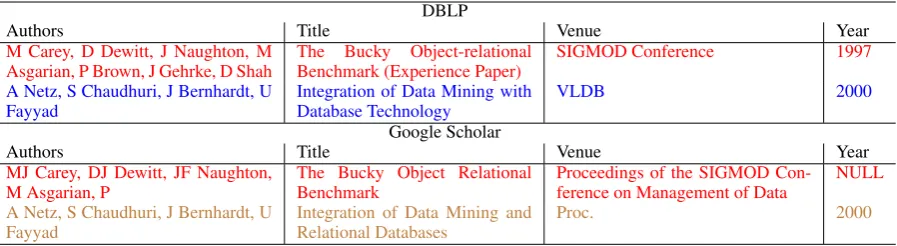
et al., 2016). For instance, seen in Table 1 are citation data records from two databases, DBLP and Google Scholar. If one intends to build a system that analyzes citation networks of publica-tions, it is essential to recognize publication over-laps across the databases and to integrate the data records (Pasula et al.,2002).
Recent work demonstrated that deep learning (DL) models with distributed representations of words are viable alternatives to other machine learning algorithms, including support vector machines and decision trees, for performing ER (Ebraheem et al.,2018;Mudgal et al.,2018). The DL models provide a universal solution to ER across all kinds of datasets that alleviates the ne-cessity of expensive feature engineering, in which a human designer explicitly defines matching functions for every single ER scenario. However, DL is well known to be data hungry; in fact, the DL models proposed in Ebraheem et al. (2018); Mudgal et al. (2018) achieve state-of-the-art per-formance by learning from thousands of labels.1 Unfortunately, realistic ER tasks have limited ac-cess to labeled data and would require substantial labeling effort upfront, before the actual learning of the ER models. Creating a representative train-ing set is especially challengtrain-ing in ER problems due to the data distribution, which is heavily skewed towards negative pairs (i.e. non-matches) as opposed to positive pairs (i.e. matches).
This problem limits the applicability of DL methods in low-resource ER scenarios. Indeed, we will show in a later section that the perfor-mance of DL models degrades significantly as compared to other machine learning algorithms when only a limited amount of labeled data is available. To address this issue, we propose a DL-based method that combines transfer learning and
DBLP
Authors Title Venue Year
M Carey, D Dewitt, J Naughton, M Asgarian, P Brown, J Gehrke, D Shah
The Bucky Object-relational Benchmark (Experience Paper)
SIGMOD Conference 1997
A Netz, S Chaudhuri, J Bernhardt, U Fayyad
Integration of Data Mining with Database Technology
VLDB 2000
Google Scholar
Authors Title Venue Year
MJ Carey, DJ Dewitt, JF Naughton, M Asgarian, P
The Bucky Object Relational Benchmark
Proceedings of the SIGMOD Con-ference on Management of Data
NULL
A Netz, S Chaudhuri, J Bernhardt, U Fayyad
Integration of Data Mining and Relational Databases
[image:2.595.75.524.62.185.2]Proc. 2000
Table 1: Data record examples from DBLP-Scholar (citation genre). The first records from DBLP and Google Scholar (red) refer to the same publication even though the information is not identical. The second ones (blue and brown) record different papers with the same authors and year.
active learning. We first develop a transfer learn-ing methodology to leverage a few pre-existlearn-ing scenarios with abundant labeled data, in order to use them in other settings of similar nature but with limited or no labeled data. More concretely, through a carefully crafted neural network ar-chitecture, we learn a transferable model from multiple source datasets with cumulatively abun-dant labeled data. Then we use active learning to identify informative examples from the target dataset to further adapt the transferred model to the target setting. This novel combination of transfer and active learning in ER settings enables us to learn a comparable or better performing DL model while using significantly fewer target dataset labels in comparison to state-of-the-art DL and even non-DL models. We also note that the two techniques are not dependent on each other. For example, one could skip transfer learning if no high-resource dataset is available and directly use active learning. Conversely, one could use transfer learning directly without active learning. We eval-uate these cases in the experiments. Specifically, we make the following contributions:
• We propose a DL architecture for ER that learns attribute agnostic and transferable rep-resentations from multiple source datasets us-ing dataset (domain) adaptation.
• To the best of our knowledge, we are the first to design an active learning algorithm for deep ER models. Our active learning algorithm searches for high-confidence examples and un-certain examples, which provide a guided way to improve the precision and recall of the trans-ferred model to the target dataset.
• We perform extensive empirical evaluations over multiple benchmark datasets and demon-strate that our method outperforms
state-of-the-art learning-based models while using an order of magnitude fewer labels.
2 Background and Related Work
2.1 Entity Resolution
Let D1 and D2 be two collections of entity
records. The task of ER is to classify the entity record pair he1, e2i, ∀e1 ∈ D1, e2 ∈ D2, into
a match or a non-match. This is accomplished by comparing entity record e1 to e2 on their
corresponding attributes. In this paper, we assume records in D1 and D2 share the same schema
(set of attributes). In cases where they have different attributes, one can use schema matching techniques (Rahm and Bernstein, 2001) to first align the schemas, followed by data exchange techniques (Fagin et al., 2009). Each attribute value is a sequence of words. Table 1 shows examples of data records from an ER scenario, DBLP-Scholar (K¨opcke et al., 2010) from the citation genre and clearly depicts our assumption of datasets handled in this paper.
Since the entire Cartesian product D1 × D2
often becomes large and it is infeasible to run a high-recall classifier directly, we typically decompose the problem into two steps: blocking
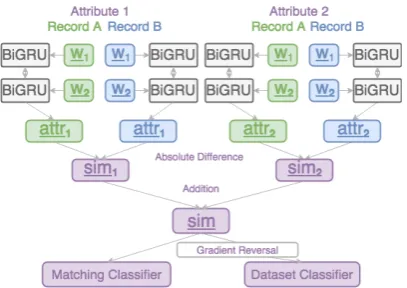
Figure 1: Deep ER model architecture with dataset adaptation via gradient reversal. Only two attributes
are shown.Ws indicate word vectors.
2.2 Learning-based Entity Resolution
As described above, after the blocking step, ER reduces to a binary classification task on candi-date pairs of data records. Prior work has pro-posed learning-based methods that train classifiers on training data, such as support vector machines, naive bayes, and decision trees (Christen, 2008; Bilenko and Mooney, 2003). These learning-based methods first extract features for each record pair from the candidate set across attributes in the schema, and use them to train a binary classifier. The process of selecting appropriate classification features is often called feature engineering and it involves substantial human effort in each ER sce-nario. Recently,Ebraheem et al.(2018) and Mud-gal et al.(2018) have proposed deep learning mod-els that use distributed representations of entity record pairs for classification. These models ben-efit from distributed representations of words and learn complex features automatically without the need for dataset-specific feature engineering.
3 Deep ER Model Architecture
We describe the architecture of our DL model that classifies each record pair in the candidate set into a match or a non-match. As shown in Fig.1, our model encompasses a sequence of steps that com-putes attribute representations, attribute similarity and finally the record similarity for each input pair
he1, e2i. A matching classifier uses the record
sim-ilarity representation to classify the pair. For an extensive list of hyperparameters and training de-tails we chose, see the appendix.
Input Representations. For each entity record pairhe1, e2i, we tokenize the attribute values and
vectorize the words by external word embeddings to obtain input representations (Ws in Fig.1). We use the 300 dimensional fastText embeddings (Bo-janowski et al.,2017), which capture subword in-formation by producing word vectors via charac-ter n-grams. This vectorization has the benefit of well representing out-of-vocabulary words (Bo-janowski et al.,2017) that frequently appear in ER attributes. For instance, venue names SIGMOD
and ACL are out of vocabulary in the publicly available GloVe vectors (Pennington et al.,2014), but we clearly need to distinguish them.
Attribute Representations. We build a universal bidirectional RNN on the word input representa-tions of each attribute value and obtain attribute vectors (attr1 andattr2 in Fig.1) by
concatenat-ing the last hidden units from both directions. Cru-cially, the universal RNN allows for transfer learn-ing between datasets of different schemas without error-prone schema mapping. We found that gated recurrent units (GRUs,Cho et al.(2014)) yielded the best performance on the dev set as compared to simple recurrent neural networks (SRNNs,Elman (1990)) and Long Short-Term Memory networks (LSTMs, Hochreiter and Schmidhuber (1997)). We also found that using BiGRU with multiple layers did not help, and we will use one-layer Bi-GRUs with 150 hidden units throughout the exper-iments below.
Attribute Similarity. The resultant attribute rep-resentations are then used to compare attributes of each entity record pair. In particular, we compute the element-wise absolute difference between the two attribute vectors for each attribute and con-struct attribute similarity vectors (sim1 andsim2
in Fig. 1). We also considered other comparison mechanisms such as concatenation and element-wise multiplication, but we found that absolute difference performs the best in development, and we will report results from absolute difference.
Cora2 datasets have four and eight attributes re-spectively, but the networks can share all weights and biases between the two. We also tried methods such as max pooling and average pooling, but none of them outperformed the simple addition method.
Matching Classification. We finally feed the sim-ilarity vector for the two records to a two-layer multilayer perceptron (MLP) with highway con-nections (Srivastava et al., 2015) and classify the pair into a match or a non-match (“Matching Clas-sifier” in Fig.1). The output from the final layer of the MLP is a two dimensional vector and we normalize it by the softmax function to obtain a probability distribution. We will discuss dataset adaptation for transfer learning in the next section.
Training Objectives. We train the networks to minimize the negative log-likelihood loss. We use the Adam optimization algorithm (Kingma and Ba,2015) with batch size 16 and an initial learn-ing rate of 0.001, and after each epoch we evaluate our model on the dev set. Training terminates after 20 epochs, and we choose the model that yields the best F1 score on the dev set and evaluate the model on the test data.
4 Deep Transfer Active Learning for ER
We introduce two orthogonal frameworks for our deep ER models in low resource settings: transfer and active learning. We also introduce the notion oflikely false positivesandlikely false negatives, and provide a principled active labeling method in the context of deep ER models, which contributes to stable and high performance.
4.1 Adversarial Transfer Learning
The architecture described above allows for sim-ple transfer learning: we can train all parameters in the network on source data and use them to classify a target dataset. However, this method of transfer learning can suffer from dataset-specific properties. For example, the author attribute in the DBLP-ACM dataset contains first names while that in the DBLP-Scholar dataset only has first ini-tials. In such situations, it becomes crucial to con-struct network representations that are invariant with respect to idiosyncratic properties of datasets. To this end, we apply the technique of dataset (do-main) adaptation developed in image recognition
2http://www.cs.umass.edu/mccallum/
data/cora-refs.tar
(Ganin and Lempitsky, 2015). In particular, we build a dataset classifier with the same architec-ture as the matching classifier (“Dataset Classi-fier” in Fig.1) that predicts which dataset the in-put pair comes from. We replace the training ob-jective by the sum of the negative log-likelihood losses from the two classifiers. We add a gra-dient reversal layer between the similarity vector and the dataset classifier so that the parameters in the dataset classifier are trained to predict the dataset while the rest of the network is trained to mislead the dataset classifier, thereby developing dataset-independent internal representations. Cru-cially, with dataset adaptation, we feed pairs from the target dataset as well as the source to the net-work. For the pairs from the target, we disregard the loss from the matching classifier.
4.2 Active Learning
Since labeling a large number of pairs for each ER scenario clearly does not scale, prior work in ER has adopted active learning as a more guided ap-proach to select examples to label (Tejada et al., 2001; Sarawagi and Bhamidipaty, 2002; Arasu et al.,2010;de Freitas et al.,2010;Isele and Bizer, 2013;Qian et al.,2017).
Designing an effective active learning algorithm for deep ER models is particularly challenging be-cause finding informative examples is very dif-ficult (especially for positive examples due to the extremely low matching ratio in realistic ER tasks), and we need more than a handful of both negative and positive examples in order to tune a deep ER model with many parameters.
To address this issue, we design an iterative active learning algorithm (Algorithm 1) that searches for two different types of examples from unlabeled data in each iteration: (1) uncertain ex-amples including likely false positives and likely false negatives, which will be labeled by human annotators; (2) high-confidence examples includ-ing high-confidence positives and high-confidence negatives. We will not label high-confidence examples and use predicted labels as a proxy. We will show below that those carefully selected examples serve different purposes.
pairs be DU = {xi}Ni=1. Denote the probability
that record pair xi is a match according to the current model by p(xi). Then, the conditional entropy of the pairH(xi)is computed by:
−p(xi) logp(xi)−(1−p(xi)) log(1−p(xi))
Uncertain examples and high-confidence exam-ples are associated with high and low entropy.
Given this notion of uncertainty and high confi-dence, one can simply select record pairs with top
K entropy as uncertain examples and those with bottom K entropy as high-confidence examples. Namely, take
argmax D⊆DU|D|=K
X
x∈D
H(x), argmin D⊆DU|D|=K
X
x∈D
H(x)
as sets of uncertain and high-confidence examples respectively. However, these simple criteria can introduce an unintended bias toward a certain di-rection, resulting in unstable performance. For ex-ample, uncertain examples selected solely on the basis of entropy can sometimes contain substan-tially more negative examples than positive ones, leading the network to a solution with low recall. To address this instability problem, we propose a partition sampling mechanism. We first partition the unlabeled dataDU into two subsets: DU and
DU, consisting of pairs that the model predicts as matches and non-matches respectively. Namely,
DU = {x ∈ DU|p(x) ≥ 0.5}, DU = {x ∈ DU|p(x)<0.5}.
Then, we pick top/bottom k = K/2 examples from each subset with respect to entropy. Uncer-tain examples are now:
argmax D⊆DU|D|=k
X
x∈D
H(x), argmax D⊆DU|D|=k
X
x∈D
H(x)
where the two criteria selectlikely false positives
and likely false negatives respectively. Likely false positives and likely false negatives are useful for improving the precision and recall of ER models (Qian et al.,2017). However, the deep ER models do not have explicit features, and thus we use entropy to identify the two types of examples in contrast to the feature-based method used in Qian et al.(2017). High-confidence examples are identified by:
argmin D⊆DU|D|=k
X
x∈D
H(x), argmin D⊆DU|D|=k
X
x∈D
H(x)
where the two criteria correspond to
high-confidence positives and high-confidence
nega-tivesrespectively. These sampling criteria equally partition uncertain examples and high-confidence examples into different categories. We will show that the partition mechanism contributes to stable and better performance in a later section.
Algorithm 1Deep Transfer Active Learning
Require:
Unlabeled data DU, sampling sizeK, batch size B,
max. iteration numberT, max. number of epochsI. Ensure:
Denote the deep ER parameters and the set of labeled examples by W and DL respectively. Update(W, DL
, B) denotes a parameter update function that optimizes the negative log-likelihood of the labeled dataDLwith batch sizeB. Setk=K/2. 1: Initialize W via transfer learning. Initialize also
DL=∅
2: for t∈ {1,2, ..., T}do
3: Select k likely false positives and k likely false negatives from DU
and remove them from DU
. Label those examples and add them toDL
. 4: Select k high-confidence positives and k
high-confidence negatives from DU
and add them with positive and negative labels toDL.
5: for t∈ {1,2, ..., I}do 6: W ←Update(W, DL
, B)
7: Run deep ER model onDLwithWand get the F1 score.
8: ifthe F1 score improvesthen
9: Wbest← W
10: end if 11: end for 12: W ← Wbest
13: end for 14: return W
dataset genre size matches attr
DBLP-ACM citation 12,363 2,220 4
DBLP-Scholar citation 28,707 5,347 4
Cora citation 50,000 3,969 8
Fodors-Zagats restaurant 946 110 6
Zomato-Yelp restaurant 894 214 4
[image:6.595.310.526.60.186.2]Amazon-Google software 11,460 1,167 3
Table 2: Post-blocking statistics of the ER datasets we used. (attr denotes the number of attributes.)
5 Experiments
5.1 Experimental Setup
For all datasets, we first conduct blocking to re-duce the Cartesian product to a candidate set. Then, we randomly split the candidate set into training, development, and test data with a ra-tio of 3:1:1. For the datasets used in Mud-gal et al. (2018) (DBLP-ACM, DBLP-Scholar, Fodors-Zagats, and Amazon-Google), we adopted the same feature-based blocking strategies and random splits to ensure comparability with the state-of-the-art method. The candidate set of Cora was obtained by randomly sampling 50,000 pairs from the result of the jaccard similarity-based blocking strategy described inWang et al.(2011). The candidate set of Zomato-Yelp was taken from Das et al.(2016).3 All dataset statistics are given in Table2. For evaluation, we compute precision, recall, and F1 score on the test sets. In the ac-tive learning experiments, we hold out the test sets
a prioriand sample solely from the training data to ensure fair comparison with non-active learning methods. The sampling sizeKfor active learning is 20. As preprocessing, we tokenize with NLTK (Bird et al.,2009) and lowercase all attribute val-ues. For every configuration, we run experiments with 5 random initializations and report the aver-age. Our DL models are all implemented using the publicly available deepmatcher library.4
5.2 Baselines
We establish baselines using a state-of-the-art learning-based ER package, Magellan (Konda et al.,2016). We experimented with the following 6 learning algorithms: Decision Tree, SVM,
Ran-3We constructed Zomato-Yelp by merging Restaurants 1
and 2, which are available inDas et al.(2016). Though the two datasets share the same source, their schemas slightly differ: Restaurants 1 has an address attribute that contains zip code, while Restaurants 2 has a zip code attribute and an address attribute. We put a null value for the zip code attribute in Restaurants 1 and avoid merging errors.
4https://github.com/anhaidgroup/
deepmatcher
0 1000 2000 3000 4000 5000 6000 7000
92 93 94 95 96 97 98
# Labeled Training examples F1
Deep Learning Decision Tree
SVM Random Forest
Naive Bayes Logistic Regression
[image:6.595.76.282.61.135.2]Linear Regression
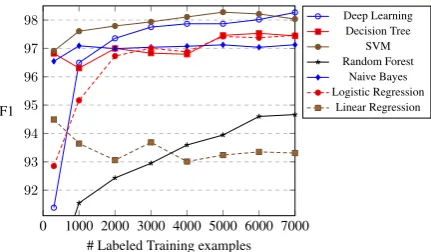
Figure 2: Performance vs. data size (DBLP-ACM).
dom Forest, Naive Bayes, Logistic Regression, and Linear Regression. We use the same feature set as in Mudgal et al. (2018). See the appendix for extensive lists of features chosen.
5.3 Results and Discussions
Model Performance and Data Size. Seen in Fig. 2is F1 performance of different models with vary-ing data size on DBLP-ACM. The DL model im-proves dramatically as the data size increases and achieves the best performance among the 7 mod-els when 7000 training examples are available. In contrast, the other models suffer much less from data scarcity with an exception of Random Forest. We observed similar patterns in DBLP-Scholar and Cora. These results confirm our hypothesis that deep ER models are data-hungry and require a lot of labeled data to perform well.
Transfer Learning. Table 3 shows results from our transfer learning framework when used in iso-lation (i.e., without active learning, which we will discuss shortly). Our dataset adaptation method substantially ameliorates performance when the target is DBLP-Scholar (from 41.03 to 53.84 F1 points) or Cora (from 38.3 to 43.13 F1 points) and achieves the same level of performance on DBLP-ACM. Transfer learning with our dataset adaptation technique achieves a certain level of performance without any target labels, but we still observe high variance in performance (e.g. 6.21 standard deviation in DBLP-Scholar) and a huge discrepancy between transfer learning and training directly on the target dataset. To build a reliable and stable ER model, a certain amount of target labels may be necessary, which leads us to apply our active learning framework.
Target DBLP-ACM DBLP-Scholar Cora
Method Prec Recall F1 Prec Recall F1 Prec Recall F1
Train on Source 86.98 98.38 92.32±1.15 73.41 43.20 41.03±6.33 92.54 24.22 38.30±3.77 +Adaptation 88.71 96.21 92.31±1.36 88.06 39.03 53.84±6.21 40.64 52.16 43.13±3.62
Train on Target 98.30 98.60 98.45±0.22 92.72 93.08 92.94±0.47 98.01 99.37 98.68±0.26
[image:7.595.89.513.62.124.2]Mudgal et al.(2018) – – 98.4 – – 93.3 – – –
Table 3: Transfer learning results (citation genre). We report standard deviations of the F1 scores. For each target dataset, the source is given by the other two datasets (e.g., the source for DBLP-ACM is DBLP-Scholar and Cora.)
0 100 200 300 400
82 84 86 88 90 92 94 96 98
# Labeled Training examples
F1
scor
es
(a) DBLP-ACM
0 200 400 600 800 1000
60 70 80 90
# Labeled Training examples (b) DBLP-Scholar
0 200 400 600 800 1000
20 30 40 50 60 70 80 90 100
# Labeled Training examples (c) Cora
Deep Transfer Active Deep Active Deep Learning Decision Tree SVM Random Forest Naive Bayes Logistic Regression Linear Regression
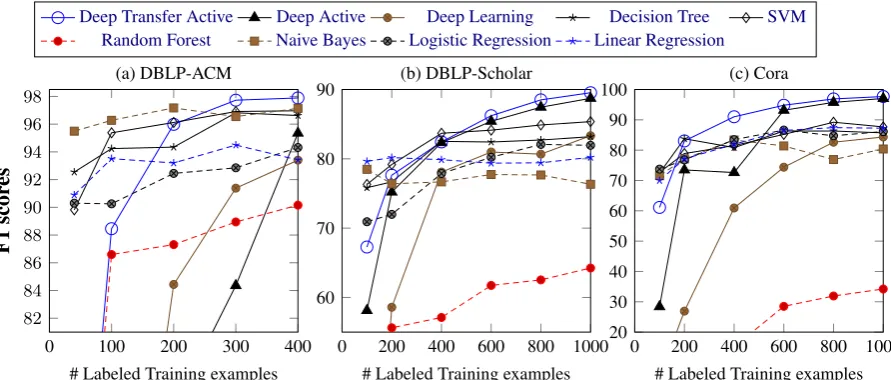
Figure 3: Low-resource performances on different datasets.
randomly sampled.5 Deep transfer active learning (DTAL) initializes the network parameters by transfer learning whereas deep active learning (DAL) starts with a random initialization. We can observe that DTAL models remedy the data scarcity problem as compared to DL models with random sampling in all three datasets. DAL can achieve competitive performance to DTAL at the expense of faster convergence.
Seen in Table 4 is performance comparison of different algorithms in low-resource and high-resource settings. (We only show the SVM re-sults since SVM performed best in each config-uration among the 6 non-DL algorithms.) First, deep transfer active learning (DTAL) achieves the best performance in the low-resource setting of each dataset. In particular, DTAL outperforms the others to the greatest degree in Cora (97.68 F1 points) probably because Cora is the most com-plex dataset with 8 attributes in the schema. Non-DL algorithms require many interaction features, which lead to data sparsity. Deep active learning (DAL) also outperforms SVM and yields compa-rable performance to DTAL. However, the stan-dard deviations in performance of DAL are sub-stantially higher than those of DTAL (e.g. 4.15
5We average the results over 5 random samplings.
vs. 0.33 in DBLP-ACM), suggesting that transfer learning provides useful initializations for active learning to achieve stable performance.
[image:7.595.73.519.166.356.2]solu-Dataset Method Train Size F1 DTAL 400 97.89±0.33
DAL 400 95.35±4.15 DL 400 93.40±2.61 SVM 400 96.97±0.69 DL 7,417 98.45±0.22 DBLP-ACM
SVM 7,417 98.35±0.14 DTAL 1000 89.54±0.39
DAL 1000 88.76±0.76 DL 1000 83.33±1.26 SVM 1000 85.36±0.32 DL 17,223 92.94±0.47 DBLP-Scholar
SVM 17,223 88.56±0.46 DTAL 1000 97.68±0.39
DAL 1000 97.05±0.64 DL 1000 84.35±4.25 SVM 1000 87.66±3.15 DL 30,000 98.68±0.26 Cora
[image:8.595.315.520.62.123.2]SVM 30,000 95.39±0.31
Table 4: Low-resource (shaded) and high-resource (full training data) performance comparison. DTAL, DAL, and DL denote deep transfer active learning, deep ac-tive learning, and deep learning (random sampling).
tion to entity resolution with low annotation effort.
Other Genre Results. We present results from
the restaurant and software genres.6 Shown in
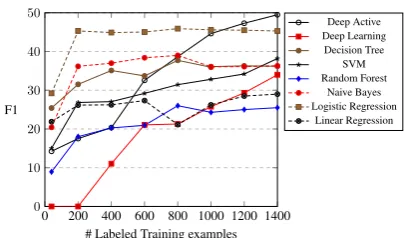
Table5are results of transfer and active learning from Zomato-Yelp to Fodors-Zagats. Similarly to our extensive experiments in the citation genre, the dataset adaptation technique facilitates transfer learning significantly, and only 100 active learning labels are needed to achieve the same performance as the model trained with all target labels (894 labels). Fig. 4 shows low-resource performance in the software genre. The relative performance among the 6 non-DL approaches differs to a great degree as the best non-DL model is now logistic regression, but deep active learning outperforms the rest with 1200 labeled examples (10.4% of training data). These results illustrate that our low-resource frameworks are effective in other genres as well.
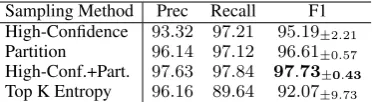
Active Learning Sampling Strategies. As discussed in a previous section, we adopted high-confidence sampling and a partition mechanism for our active learning. Here we analyze the effect of the two methods. Table6 shows deep transfer active learning performance in DBLP-ACM with varying sampling strategies. We can observe that high-confidence sampling and the partition
mech-6We intend to apply our approaches to more genres, but
unfortunately we lack large publicly available ER datasets in other genres than citation. Applications to non-English lan-guages are also of interest. We leave this for future.
Method Prec Recall F1
Train on Src 100.00 6.37 11.76±6.84 +Adaptation 95.33 57.27 70.13±19.89 +100 active labels 100.00 100.00 100.00±0.00 Train on Tgt 100.00 100.00 100.00±0.00
[image:8.595.82.283.63.258.2]Mudgal et al.(2018) – – 100
Table 5: Transfer and active learning results in the restaurant genre. The target and source datasets are Fodors-Zagats and Zomato-Yelp respectively.
0 200 400 600 800 1000 1200 1400 0
10 20 30 40 50
# Labeled Training examples F1
Deep Active Deep Learning
Decision Tree SVM Random Forest
Naive Bayes Logistic Regression
Linear Regression
Figure 4: Low-resource performance (software genre).
anism contribute to high and stable performance as well as good precision-recall balance. Notice that there is a huge jump in recall by adding partition while precision stays the same (row 4 to row 3). This is due to the fact that the partition mechanism succeeds in finding more false nega-tives. The breakdown of labeled examples (Table 7) shows that is indeed the case. It is noteworthy that the partition mechanism lowers the ratio of misclassified examples (FP+FN) in the labeled sample set because partitioning encourages us to choose likely false negatives more aggressively, yet false negatives tend to be more challenging to find in entity resolution due to the skewness to-ward the negative (Qian et al.,2017). We observed similar patterns in DBLP-Scholar and Cora.
6 Further Related Work
[image:8.595.314.519.174.293.2]con-Sampling Method Prec Recall F1 High-Confidence 93.32 97.21 95.19±2.21 Partition 96.14 97.12 96.61±0.57 High-Conf.+Part. 97.63 97.84 97.73±0.43
[image:9.595.89.276.62.113.2]Top K Entropy 96.16 89.64 92.07±9.73
Table 6: Low-resource performance (300 labeled ex-amples) of different sampling strategies (DBLP-ACM).
Method FP TP FN TN
Part 79.65.9 70.45.9 59.25.6 90.85.6 W/o Part 101.67.7 57.415.9 41.64.4 99.422.5
Table 7: Breakdown of 300 labeled samples (uncertain samples) from deep transfer active learning in DBLP-ACM. Part, FP, TP, FN, and TN denote the partition mechanism, false positives, true positives, false nega-tives, and true negatives respectively.
sider active learning. Their distributed represen-tations are computed in a “bag-of-words” fashion, which can make applications to textual attributes more challenging (Mudgal et al., 2018). More-over, their method breaks attribute boundaries for tuple representations in contrast to our approach that computes a similarity vector for each attribute in an attribute-agnostic manner. In a complex ER scenario, each entity record is represented by a large number of attributes, and comparing tuples as a single string can be infeasible. Other prior work also proposed a transfer learning framework for linear model-based learners in ER (Negahban et al.,2012).
7 Conclusion
We presented transfer learning and active learning frameworks for entity resolution with deep learn-ing and demonstrated that our models can achieve competitive, if not better, performance as com-pared to state-of-the-art learning-based methods while only using an order of magnitude less la-beled data. Although our transfer learning alone did not suffice to construct a reliable and stable en-tity resolution system, it contributed to faster con-vergence and stable performance when used to-gether with active learning. These results serve as further support for the claim that deep learning can provide a unified data integration method for downstream NLP tasks. Our frameworks of trans-fer and active learning for deep learning models are potentially applicable to low-resource settings beyond entity resolution.
Acknowledgments
We thank Sidharth Mudgal for assistance with the DeepMatcher/Magellan libraries and replicat-ing experiments. We also thank Vamsi Meduri, Phoebe Mulcaire, and the anonymous reviewers for their helpful feedback. JK was supported by travel grants from the Masason Foundation fellow-ship.
References
Arvind Arasu, Michaela G¨otz, and Raghav Kaushik.
2010. On active learning of record matching
pack-ages. InProc. of SIGMOD.
Kedar Bellare, Suresh Iyengar, Aditya G.
Parameswaran, and Vibhor Rastogi. 2012.
Ac-tive sampling for entity matching. In Proc. of KDD.
Mikhail Bilenko and Raymond J. Mooney. 2003.
Adaptive duplicate detection using learnable string similarity measures. InProc. of KDD, pages 39–48, New York, NY, USA. ACM.
Steven Bird, Ewan Klein, and Edward Loper. 2009.
Natural Language Processing with Python. OReilly Media.
Piotr Bojanowski, Edouard Grave, Armand Joulin, and
Tomas Mikolov. 2017. Enriching word vectors with
subword information.TACL, 5:135–146.
William M. Campbell, Lin Li, Charlie K. Dagli, Joel Acevedo-Aviles, K. Geyer, Joseph P. Campbell, and
C. Priebe. 2016. Cross-domain entity resolution in
social media. InProc. of SocialNLP.
Kyunghyun Cho, Bart van Merrienboer, aglar G¨ulehre,
Dzmitry Bahdanau, Fethi Bougares, Holger
Schwenk, and Yoshua Bengio. 2014. Learning
phrase representations using RNN encoder-decoder for statistical machine translation. In Proc. of EMNLP.
Peter Christen. 2008. Febrl: A freely available record
linkage system with a graphical user interface. In
Proc. of HDKM, pages 17–25, Darlinghurst, Aus-tralia, Australia. Australian Computer Society, Inc.
Sanjib Das, AnHai Doan, Paul Suganthan
G. C., Chaitanya Gokhale, and Pradap
Konda. 2016. The Magellan data repository.
https://sites.google.com/site/
anhaidgroup/projects/data.
Jeff Donahue, Yangqing Jia, Oriol Vinyals, Judy Hoff-man, Ning Zhang, Eric Tzeng, and Trevor Darrell.
2014. DeCAF: A deep convolutional activation
fea-ture for generic visual recognition. In ICML,
vol-ume 32 of Proceedings of Machine Learning
[image:9.595.80.278.165.197.2]Xin Dong, Alon Halevy, and Jayant Madhavan. 2005.
Reference reconciliation in complex information spaces. In Proc. of SIGMOD, pages 85–96, New York, NY, USA. ACM.
Muhammad Ebraheem, Saravanan
Thirumuru-ganathan, Shafiq Joty, Mourad Ouzzani, and Nan
Tang. 2018. Distributed representations of tuples
for entity resolution.VLDB.
Jeffrey L. Elman. 1990. Finding structure in time.
Cognitive Science, 14:179–211.
Ronald Fagin, Laura M. Haas, Mauricio A. Hern´andez, Ren´ee J. Miller, Lucian Popa, and Yannis
Vele-grakis. 2009. Clio: Schema mapping creation and
data exchange. InConceptual Modeling: Founda-tions and ApplicaFounda-tions.
Ivan P. Fellegi and Alan B. Sunter. 1969. A theory for
record linkage.JASA.
Junio de Freitas, Gisele Lobo Pappa, Altigran Soares da Silva, Marcos Andr´e Gonalves, Edleno Silva de Moura, Adriano Veloso, Alberto H. F.
Laen-der, and Mois´es G. de Carvalho. 2010. Active
learning genetic programming for record deduplica-tion.IEEE Congress on Evolutionary Computation, pages 1–8.
Yaroslav Ganin and Victor Lempitsky. 2015.
Unsu-pervised domain adaptation by backpropagation. In
Proc. of ICML, volume 37 of Proceedings of Ma-chine Learning Research, pages 1180–1189, Lille, France. PMLR.
Mauricio A. Hern´andez and Salvatore J. Stolfo. 1995.
The merge/purge problem for large databases. In
Proc. of SIGMOD, pages 127–138, New York, NY, USA. ACM.
Sepp Hochreiter and J¨urgen Schmidhuber. 1997. Long
short-term memory. Neural Computation, 9:1735– 1780.
Robert Isele and Christian Bizer. 2013. Active learning
of expressive linkage rules using genetic program-ming.J. Web Sem., 23:2–15.
Diederik P. Kingma and Jimmy Lei Ba. 2015.ADAM:
A Method for Stochastic Optimization. InICLR.
Pradap Konda, Sanjib Das, C. PaulSuganthanG., An-Hai Doan, Adel Ardalan, Jeffrey R. Ballard, Han Li, Fatemah Panahi, Haojun Zhang, Jeffrey F. Naughton, Shishir Prasad, Ganesh Krishnan, Rohit
Deep, and Vijay Raghavendra. 2016. Magellan:
To-ward building entity matching management systems.
VLDB, 9:1197–1208.
Hanna K¨opcke, Andreas Thor, and Erhard Rahm. 2010.
Evaluation of entity resolution approaches on real-world match problems.VLDB, pages 484–493.
Sidharth Mudgal, Han Li, Theodoros Rekatsinas, An-Hai Doan, Youngchoon Park, Ganesh Krishnan, Ro-hit Deep, Esteban Arcaute, and Vijay Raghavendra.
2018. Deep learning for entity matching: A design
space exploration. InProc. of SIGMOD, pages 19– 34, New York, NY, USA. ACM.
Sahand N. Negahban, Benjamin I. P. Rubinstein, and
Jim Gemmell. 2012. Scaling multiple-source entity
resolution using statistically efficient transfer learn-ing. InProc. of CIKM.
Hanna M. Pasula, Bhaskara Marthi, Brian Milch,
Stu-art J. Russell, and Ilya Shpitser. 2002. Identity
un-certainty and citation matching. InProc. of NeurIS.
Jeffrey Pennington, Richard Socher, and
Christo-pher D. Manning. 2014. GloVe: Global vectors for
word representation. InProc. of EMNLP.
Matthew E. Peters, Mark Neumann, Mohit Iyyer, Matt Gardner, Christopher Clark, Kenton Lee, and
Luke S. Zettlemoyer. 2018. Deep contextualized
word representations. InProc. of NAACL.
Kun Qian, Lucian Popa, and Prithviraj Sen. 2017.
Ac-tive learning for large-scale entity resolution. In
CIKM, pages 1379–1388, New York, NY, USA.
ACM.
Erhard Rahm and Philip A. Bernstein. 2001. A
sur-vey of approaches to automatic schema matching.
VLDB, 10:334–350.
Sunita Sarawagi and Anuradha Bhamidipaty. 2002.
In-teractive deduplication using active learning. In
Proc. of KDD.
Rupesh Kumar Srivastava, Klaus Greff, and J¨urgen
Schmidhuber. 2015. Training very deep networks.
InProc. of NeurIS.
Sheila Tejada, Craig A. Knoblock, and Steven Minton.
2001. Learning object identification rules for
infor-mation integration.Inf. Syst., 26:607–633.
Saravanan Thirumuruganathan, Shameem Puthiya
Parambath, Mourad Ouzzani, Nan Tang, and
Shafiq R. Joty. 2018. Reuse and adaptation
for entity resolution through transfer learning. arXiv:1809.11084.
Jiannan Wang, Guoliang Li, Jeffrey Xu Yu, and
Jian-hua Feng. 2011. Entity matching: How similar is
similar.VLDB, 4(10):622–633.
Keze Wang, Dongyu Zhang, Ya Li, Ruimao Zhang, and
Liang Lin. 2017. Cost-effective active learning for
deep image classification.IEEE Trans. Cir. and Sys. for Video Technol., 27(12):2591–2600.
Xin Zhao, Yuexin Wu, Hongfei Yan, and Xiaoming
Li. 2014. Group based self training for e-commerce
A Appendices
A.1 Deep ER Hyperparameters
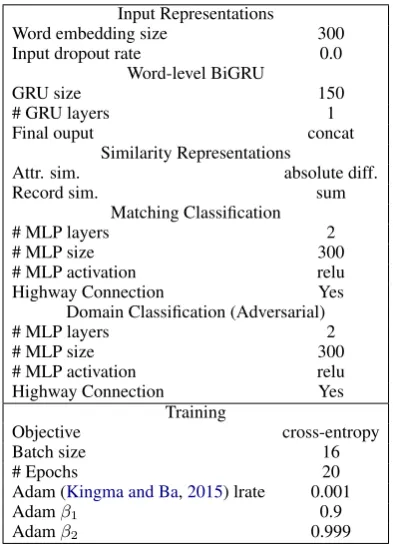
Seen in Table 8 is a list of hyperparameters for our deep entity resolution models. We use the same hyperparameters regardless of scenario and dataset. We initialize the 300 dimensional word embeddings by the character-based pre-trained fastText vectors publicly available.7
Input Representations
Word embedding size 300
Input dropout rate 0.0
Word-level BiGRU
GRU size 150
# GRU layers 1
Final ouput concat
Similarity Representations
Attr. sim. absolute diff.
Record sim. sum
Matching Classification
# MLP layers 2
# MLP size 300
# MLP activation relu
Highway Connection Yes
Domain Classification (Adversarial)
# MLP layers 2
# MLP size 300
# MLP activation relu
Highway Connection Yes
Training
Objective cross-entropy
Batch size 16
# Epochs 20
Adam (Kingma and Ba,2015) lrate 0.001
Adamβ1 0.9
[image:11.595.83.280.192.466.2]Adamβ2 0.999
Table 8: Deep ER hyperparameters.
A.2 Non-DL Learning Algorithms
Magellan (Konda et al.,2016) is an open-source package that provides state-of-the-art learning-based algorithms for ER.8 We use the package to run the following 6 learning algorithms for base-lines: Decision Tree, SVM, Random Forest, Naive Bayes, Logistic Regression, and Linear Regres-sion. For each attribute in the schema, we ap-ply the following similarity functions: q-gram jac-card, cosine distance, Levenshtein disntance, Lev-enshtein similairty, Monge-Elkan measure, and exact matching.
7
https://github.com/facebookresearch/ fastText
8https://sites.google.com/site/