1331
Graph Neural Networks with Generated Parameters for Relation
Extraction
Hao Zhu1 Yankai Lin1 Zhiyuan Liu1 Jie Fu2 Tat-seng Chua3 Maosong Sun1
1State Key Lab on Intelligent Technology and Systems
Department of Computer Science and Technology
Institute for Artificial Intelligence, Tsinghua Univerisity, Beijing, China
2 National University of Singapore, Singapore
3 Universit´e de Montr´eal, Montr´eal, Qu´ebec, Canada
{{zhuhao15,linyk14}@mails,{liuzy, sms}@}tsinghua.edu.cn [email protected],[email protected]
Abstract
In this paper, we propose a novel graph neu-ral network with generated parameters (GP-GNNs). The parameters in the propagation module, i.e. the transition matrices used in message passing procedure, are produced by a generator taking natural language sentences as inputs. We verify GP-GNNs in relation ex-traction from text, both on bag- and
instance-settings. Experimental results on a
human-annotated dataset and two distantly supervised datasets show that multi-hop reasoning mecha-nism yields significant improvements. We also perform a qualitative analysis to demonstrate that our model could discover more accu-rate relations by multi-hop relational
reason-ing. Codes and data are released athttps:
//github.com/thunlp/gp-gnn.
1 Introduction
In recent years, graph neural networks (GNNs) have been applied to various fields of
ma-chine learning, including node classification
(Kipf and Welling, 2016), relation classification
(Schlichtkrull et al., 2017), molecular property
prediction (Gilmer et al.,2017), few-shot learning
(Garcia and Bruna,2018), and achieved promising
results on these tasks. These works have demon-strated GNNs’ strong power to process relational reasoning on graphs.
Relational reasoning aims to abstractly reason about entities/objects and their relations, which is an important part of human intelligence. Be-sides graphs, relational reasoning is also of great importance in many natural language processing
The original idea comes from several discussions be-tween Hao Zhu and Jie Fu while Hao Zhu visiting NUS; Hao Zhu designed research, prepared datasets, and conducted experiments; Jie Fu, Yankai Lin, and Zhiyuan Liu also par-ticipated in discussion while planning experiments; Zhiyuan Liu, Tat-seng Chua and Maosong Sun proofread the paper. Zhiyuan Liu serves as the corresponding author.
tasks such as question answering, relation extrac-tion, summarizaextrac-tion, etc. Consider the example
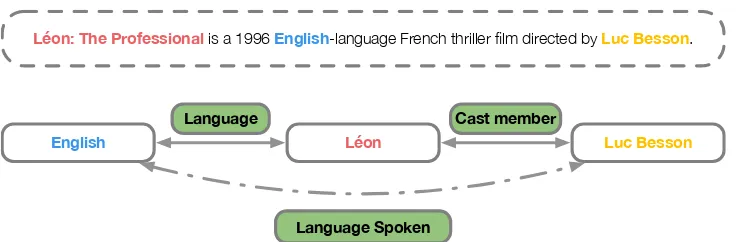
shown in Fig. 1, existing relation extraction
mod-els could easily extract the facts that Luc Besson
directed a film L´eon: The Professional and that
the film is in English, but fail to infer the
rela-tionship between Luc Besson and English
with-out multi-hop relational reasoning. By consider-ing the reasonconsider-ing patterns, one can discover that
Luc Bessoncould speak Englishfollowing a
rea-soning logic thatLuc Besson directedL´eon: The
Professional and this film is inEnglish indicates
Luc Bessoncould speakEnglish. However, most existing GNNs can only process multi-hop rela-tional reasoning on pre-defined graphs and cannot be directly applied in natural language relational reasoning. Enabling multi-hop relational reason-ing in natural languages remains an open problem.
To address this issue, in this paper, we pro-pose graph neural networks with generated pa-rameters (GP-GNNs), to adapt graph neural net-works to solve the natural language relational rea-soning task. GP-GNNs first constructs a fully-connected graph with the entities in the sequence
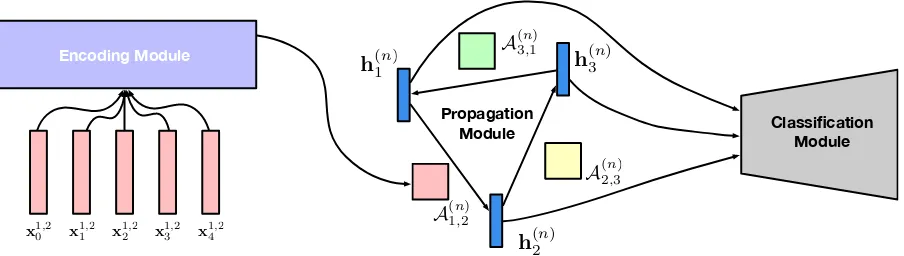
of text. After that, it employs three modules
to process relational reasoning: (1) an encoding module which enables edges to encode rich in-formation from natural languages, (2) a propaga-tion module which propagates relapropaga-tional informa-tion among various nodes, and (3) a classificainforma-tion module which makes predictions with node rep-resentations. As compared to traditional GNNs, GP-GNNs could learn edge parameters from natu-ral languages, extending it from performing infer-ence on only non-relational graphs or graphs with a limited number of edge types to unstructured in-puts such as texts.
Léon: The Professional is a 1996 English-language French thriller film directed by Luc Besson.
Léon
English Luc Besson
Language Spoken
[image:2.595.117.487.58.179.2]Language Cast member
Figure 1: An example of relation extraction from plain text. Given a sentence with several entities marked, we model the interaction between these entities by generating the weights of graph neural networks. Modeling the relationship between “L´eon” and “English” as well as “Luc Besson” helps discover the relationship between “Luc Besson” and “English”.
relation extraction from text. We carry out experi-ments on Wikipedia corpus aligned with Wikidata
knowledge base (Vrandeˇci´c and Kr¨otzsch, 2014)
and build a human annotated test set as well as two distantly labeled test sets with different lev-els of denseness.Experiment results show that our model outperforms other models on relation ex-traction task by considering multi-hop relational reasoning. We also perform a qualitative analysis which shows that our model could discover more relations by reasoning more robustly as compared to baseline models.
Our main contributions are in two-fold:
(1) We extend a novel graph neural network model with generated parameters, to enable rela-tional message-passing with rich text information, which could be applied to process relational rea-soning on unstructured inputs such as natural lan-guage.
(2) We verify our GP-GNNs on the task of re-lation extraction from text, which demonstrates its ability on multi-hop relational reasoning as compared to those models which extract relation-ships separately. Moreover, we also present three datasets, which could help future researchers com-pare their models in different settings.
2 Related Work
2.1 Graph Neural Networks (GNNs)
GNNs were first proposed in (Scarselli et al., 2009) and are trained via the Almeida-Pineda
al-gorithm (Almeida, 1987). Later the authors in
Li et al.(2016) replace the Almeida-Pineda
algo-rithm with the more generic backpropagation and
demonstrate its effectiveness empirically. Gilmer
et al.(2017) propose to apply GNNs to
molecu-lar property prediction tasks. Garcia and Bruna
(2018) shows how to use GNNs to learn clas-sifiers on image datasets in a few-shot manner.
Gilmer et al. (2017) study the effectiveness of
message-passing in quantum chemistry. Dhingra
et al. (2017) apply message-passing on a graph
constructed by coreference links to answer rela-tional questions. There are relatively fewer pa-pers discussing how to adapt GNNs to natural
language tasks. For example, Marcheggiani and
Titov(2017) propose to apply GNNs to semantic
role labeling and Schlichtkrull et al. (2017)
ap-ply GNNs to knowledge base completion tasks.
Zhang et al.(2018) apply GNNs to relation
extrac-tion by encoding dependency trees, and De Cao
et al. (2018) apply GNNs to multi-hop
ques-tion answering by encoding occurence and co-reference relationships. Although they also con-sider applying GNNs to natural language process-ing tasks, they still perform message-passprocess-ing on
predefined graphs. Johnson (2017) introduces a
novel neural architecture to generate a graph based on the textual input and dynamically update the relationship during the learning process. In sharp contrast, this paper focuses on extracting relations from real-world relation datasets.
2.2 Relational Reasoning
Relational reasoning has been explored in various
fields. For example,Santoro et al.(2017) propose
a simple neural network to reason the relationship
of objects in a picture,Xu et al.(2017) build up a
scene graph according to an image, andKipf et al.
(2018) model the interaction of physical objects. In this paper, we focus on the relational rea-soning in the natural language domain. Existing
works (Zeng et al., 2014,2015;Lin et al.,2016)
capa-ble of capturing the pair-wise relationship between
entities in certain situations. For example, Zeng
et al. (2014) is one of the earliest works that
ap-plies a simple CNN to this task, and Zeng et al.
(2015) further extends it with piece-wise
max-pooling. Nguyen and Grishman(2015) propose a
multi-window version of CNN for relation
extrac-tion. Lin et al. (2016) study an attention
mech-anism for relation extraction tasks. Peng et al.
(2017) predict n-ary relations of entities in
differ-ent sdiffer-entences with Graph LSTMs. Le and Titov
(2018) treat relations as latent variables which are capable of inducing the relations without any
su-pervision signals. Zeng et al.(2017) show that the
relation path has an important role in relation
ex-traction. Miwa and Bansal(2016) show the
effec-tiveness of LSTMs (Hochreiter and Schmidhuber,
1997) in relation extraction. Christopoulou et al.
(2018) proposed a walk-based model to do
rela-tion extracrela-tion. The most related work isSorokin
and Gurevych(2017), where the proposed model
incorporates contextual relations with an attention mechanism when predicting the relation of a target entity pair. The drawback of existing approaches is that they could not make full use of the multi-hop inference patterns among multiple entity pairs and their relations within the sentence.
3 Graph Neural Network with
Generated Parameters (GP-GNNs)
We first define the task of natural language rela-tional reasoning. Given a sequence of text with
m entities, it aims to reason on both the text and
entities and make a prediction of the labels of the entities or entity pairs.
In this section, we will introduce the general framework of GP-GNNs. GP-GNNs first build
a fully-connected graph G = (V,E), where V
is the set of entities, and each edge (vi, vj) ∈
E, vi, vj ∈ V corresponds to a sequence s =
xi,j0 , xi,j1 , . . . , xi,jl−1 extracted from the text. After that, GP-GNNs employ three modules including (1) encoding module, (2) propagation module and (3) classification module to process relational
rea-soning, as shown in Fig.2.
3.1 Encoding Module
The encoding module converts sequences into transition matrices corresponding to edges, i.e. the
parameters of the propagation module, by
A(i,jn)=f(E(x i,j
0 ), E(x
i,j
1 ),· · ·, E(x
i,j l−1);θ
n e),
(1)
wheref(·)could be any model that could encode
sequential data, such as LSTMs, GRUs, CNNs,
E(·)indicates an embedding function, andθen
de-notes the parameters of the encoding module of
n-th layer.
3.2 Propagation Module
The propagation module learns representations for nodes layer by layer. The initial embeddings of
nodes, i.e. the representations of layer 0, are
task-related, which could be embeddings that en-code features of nodes or just one-hot embeddings.
Given representations of layern, the
representa-tions of layern+ 1are calculated by
h(in+1) = X
vj∈N(vi)
σ(A(i,jn)h(jn)), (2)
whereN(vi)denotes the neighbours of nodeviin
graph G and σ(·) denotes a non-linear activation
function.
3.3 Classification Module
Generally, the classification module takes node representations as inputs and outputs predictions. Therefore, the loss of GP-GNNs could be calcu-lated as
L=g(h00:|V|−1,h10:|V|−1, . . . ,hK0:|V|−1, Y;θc),
(3)
whereθcdenotes the parameters of the
classifica-tion module,Kis the number of layers in
propaga-tion module andY denotes the ground truth label.
The parameters in GP-GNNs are trained by gradi-ent descgradi-ent methods.
4 Relation Extraction with GP-GNNs
Relation extraction from text is a classic natu-ral language relational reasoning task. Given a
sentence s = (x0, x1, . . . , xl−1), a set of
re-lations R and a set of entities in this sentence
Vs = {v1, v2, . . . , v|Vs|}, where each vi consists
of one or a sequence of tokens, relation extraction from text is to identify the pairwise relationship
rvi,vj ∈ Rbetween each entity pair(vi, vj).
Encoding Module
Propagation
Module Classification Module
h(1n)
h(2n) h(3n)
A(1n,2)
A(2n,3) A(3n,1)
x13,2 x 1,2 4 x12,2
[image:4.595.76.528.63.191.2]x11,2 x10,2
Figure 2: Overall architecture: an encoding module takes a sequence of vector representations as inputs, and output a transition matrix as output; a propagation module propagates the hidden states from nodes to its neighbours with the generated transition matrix; a classification module provides task-related predictions according to nodes representations.
4.1 Encoding Module
To encode the context of entity pairs (or edges in the graph), we first concatenate the position em-beddings with word emem-beddings in the sentence:
E(xi,jt ) = [xt;pi,jt ], (4)
wherextdenotes the word embedding of wordxt
andpi,jt denotes the position embedding of word
positiontrelative to the entity pair’s positioni, j
(Details of these two embeddings are introduced in the next two paragraphs.) After that, we feed the
representations of entity pairs into encoder f(·)
which contains a bi-directional LSTM and a multi-layer perceptron:
A(i,jn)= [MLPn(BiLSTMn((E(xi,j0 ), E(x i,j
1 ),· · ·, E(x i,j l−1))],
(5)
where n denotes the index of layer 1, [·] means
reshaping a vector as a matrix,BiLSTMencodes a
sequence by concatenating tail hidden states of the forward LSTM and head hidden states of the
back-ward LSTM together and MLP denotes a
multi-layer perceptron with non-linear activationσ.
Word Representations We first map each
to-ken xt of sentence {x0, x1, . . . , xl−1} to a k
-dimensional embedding vector xt using a word
embedding matrix We ∈ R|V|×dw, where|V|is
the size of the vocabulary. Throughout this pa-per, we stick to 50-dimensional GloVe embed-dings pre-trained on a 6-billion-word corpus
(Pen-nington et al.,2014).
1Adding index to neural models means their parameters
are different among layers.
Position Embedding In this work, we consider
a simple entity marking scheme2: we mark each
token in the sentence as either belonging to the
first entity vi, the second entity vj or to neither
of those. Each position marker is also mapped to
adp-dimensional vector by a position embedding
matrixP ∈R3×dp. We use notationpi,jt to
repre-sent the position embedding forxtcorresponding
to entity pair(vi, vj).
4.2 Propagation Module
Next, we use Eq. (2) to propagate information among nodes where the initial embeddings of nodes and number of layers are further specified as follows.
The Initial Embeddings of Nodes Suppose we
are focusing on extracting the relationship
be-tween entity vi and entity vj, the initial
embed-dings of them are annotated as h(0)vi = asubject,
andh(0)vj = aobject, while the initial embeddings
of other entities are set to all zeros. We set spe-cial values for the head and tail entity’s initial em-beddings as a kind of “flag” messages which we expect to be passed through propagation.
Anno-tatorsasubjectandaobjectcould also carry the prior
knowledge about subject entity and object entity. In our experiments, we generalize the idea of
Gated Graph Neural Networks (Li et al.,2016) by
settingasubject= [1;0]>andaobject = [0;1]>3.
2As pointed out bySorokin and Gurevych(2017), other
position markers lead to no improvement in performance.
3The dimensions of 1and 0are the same. Hence, d r
Number of Layers In general graphs, the
num-ber of layersKis chosen to be of the order of the
graph diameter so that all nodes obtain informa-tion from the entire graph. In our context, how-ever, since the graph is densely connected, the depth is interpreted simply as giving the model
more expressive power. We treat K as a
hyper-parameter, the effectiveness of which will be
dis-cussed in detail (Sect.5.4).
4.3 Classification Module
The output module takes the embeddings of the
target entity pair (vi, vj) as input, which are first
converted by:
rvi,vj = [[h
(1) vih
(1) vj]
>
; [h(2)vih
(2) vj]
>
;. . .; [h(vKi)h
(K) vj ]
>
], (6)
where represents element-wise multiplication.
This could be used for classification:
P(rvi,vj|h, t, s) =softmax(MLP(rvi,vj)), (7)
wherervi,vj ∈ R, andMLPdenotes a multi-layer
perceptron module.
We use cross entropy here as the classification loss
L=X
s∈S
X
i6=j
logP(rvi,vj|i, j, s), (8)
where rvi,vj denotes the relation label for entity
pair(vi, vj)andSdenotes the whole corpus.
In practice, we stack the embeddings for every target entity pairs together to infer the underlying relationship between each pair of entities. We use
PyTorch (Paszke et al., 2017) to implement our
models. To make it more efficient, we avoid us-ing loop-based, scalar-oriented code by matrix and vector operations.
5 Experiments
Our experiments mainly aim at: (1) showing that our best models could improve the performance of relation extraction under a variety of settings; (2) illustrating that how the number of layers af-fect the performance of our model; and (3) per-forming a qualitative investigation to highlight the difference between our models and baseline mod-els. In both part (1) and part (2), we do three sub-parts of experiments: (i) we will first show that our models could improve instance-level relation extraction on a human annotated test set, and (ii) then we will show that our models could also help
enhance the performance of bag-level relation
ex-traction on a distantly labeled test set 4, and (iii)
we also split a subset of distantly labeled test set, where the number of entities and edges is large.
5.1 Experiment Settings
5.1.1 Datasets
Distantly labeled set Sorokin and Gurevych
(2017) have proposed a dataset with Wikipedia corpora. There is a small difference between our task and theirs: our task is to extract the relation-ship between every pair of entities in the sentence, whereas their task is to extract the relationship be-tween the given entity pair and the context entity pairs. Therefore, we need to modify their dataset: (1) We added reversed edges if they are missing
from a given triple, e.g. if triple (Earth, part
of, Solar System) exists in the sentence, we add a
reversed label, (Solar System,has a member,
Earth), to it; (2) For all of the entity pairs with no
relations, we added “NA” labels to them.5 We use
the same training set for all of the experiments.
Human annotated test set Based on the test set
provided by (Sorokin and Gurevych,2017), 5
an-notators6are asked to label the dataset. They are
asked to decide whether or not the distant super-vision is right for every pair of entities. Only the instances accepted by all 5 annotators are incorpo-rated into the human annotated test set. There are 350 sentences and 1,230 triples in this test set.
Dense distantly labeled test set We further split
a dense test set from the distantly labeled test set. Our criteria are: (1) the number of entities should be strictly larger than 2; and (2) there must be at least one circle (with at least three entities) in the
ground-truth label of the sentence7. This test set
could be used to test our methods’ performance on sentences with the complex interaction between entities. There are 1,350 sentences and more than 17,915 triples and 7,906 relational facts in this test set.
4
Bag-level relation extraction is a widely accepted scheme for relation extraction with distant supervision, which means the relation of an entity pair is predicted by aggregat-ing a bag of instances.
5
We also resolve entities at the same position and remove self-loops from the previous dataset. Furthermore, we limit the number of entities in one sentence to 9, resulting in only 0.0007 data loss.
6
They are all well-educated university students.
5.1.2 Models for Comparison
We select the following models for comparison, the first four of which are our baseline models.
Context-Aware RE, proposed by Sorokin and
Gurevych (2017). This model utilizes attention
mechanism to encode the context relations for pre-dicting target relations. It was the state-of-the-art models on Wikipedia dataset. This baseline is im-plemented by ourselves based on authors’ public
repo8.
Multi-Window CNN. Zeng et al. (2014)
uti-lize convolutional neural networks to classify rela-tions. Different from the original version of CNN
proposed inZeng et al. (2014), our
implementa-tion, followsNguyen and Grishman(2015),
con-catenates features extracted by three different win-dow sizes: 3, 5, 7.
PCNN, proposed by Zeng et al. (2015). This
model divides the whole sentence into three pieces and applies max-pooling after convolution layer piece-wisely. For CNN and following PCNN, the entity markers are the same as originally proposed
inZeng et al.(2014,2015).
LSTM or GP-GNN with K = 1 layer.
Bi-directional LSTM (Schuster and Paliwal, 1997)
could be seen as an 1-layer variant of our model.
GP-GNN withK= 2orK = 3layers. These
models are capable of performing 2-hop reasoning and 3-hop reasoning, respectively.
5.1.3 Hyper-parameters
We select the best parameters for the validation set. We select non-linear activation functions
be-tween relu and tanh, and select dn among
{2,4,8,12,16}9. We have also tried two forms
of adjacent matrices: tied-weights (set A(n) =
A(n+1)) and untied-weights. Table 1 shows our
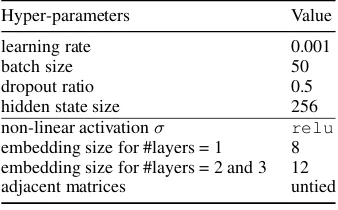
best hyper-parameter settings, which are used in all of our experiments.
5.2 Evaluation Details
So far, we have only talked about the way to imple-ment sentence-level relation extraction. To evalu-ate our models and baseline models in bag-level, we utilize a bag of sentences with a given entity
pair to score the relations between them. Zeng
et al. (2015) formalize the bag-level relation
ex-traction as multi-instance learning. Here, we
fol-8
https://github.com/UKPLab/ emnlp2017-relation-extraction
9We set alld
ns to be the same as we do not see
improve-ments using differentdns
Hyper-parameters Value
learning rate 0.001
batch size 50
dropout ratio 0.5
hidden state size 256
non-linear activationσ relu
embedding size for #layers = 1 8 embedding size for #layers = 2 and 3 12
[image:6.595.332.501.63.168.2]adjacent matrices untied
Table 1: Hyper-parameters settings.
low their idea and define the score function of an
entity pair and its corresponding relation r as a
max-one setting:
E(r|vi, vj, S) = max
s∈S P(rvi,vj|i, j, s). (9)
Dataset Human Annotated Test Set
Metric Acc Macro F1
Multi-Window CNN 47.3 17.5
PCNN 30.8 3.2
Context-Aware RE 68.9 44.9 GP-GNN (#layers=1) 62.9 44.1 GP-GNN (#layers=2) 69.5 44.2 GP-GNN (#layers=3) 75.3 47.9
Table 2: Results on human annotated dataset
5.3 Effectiveness of Reasoning Mechanism
From Table 2 and 3, we can see that our best
[image:6.595.317.517.295.383.2]Dataset Distantly Labeled Test Set Dense Distantly Labeled Test Set
Metric P@5% P@10% P@15% P@20% P@5% P@10% P@15% P@20%
Multi-Window CNN 78.9 78.4 76.2 72.9 86.2 83.4 81.4 79.1
PCNN 73.0 65.4 58.1 51.2 85.3 79.1 72.4 68.1
Context-Aware RE 90.8 89.9 88.5 87.2 93.5 93.0 93.8 93.0
GP-GNN (#layers=1) 90.5 89.9 88.2 87.2 97.4 93.5 92.4 91.9
GP-GNN (#layers=2) 92.5 92.0 89.3 87.1 95.0 94.6 95.2 94.2
[image:7.595.79.276.264.580.2]GP-GNN (#layers=3) 94.2 92.0 89.7 88.3 98.5 97.4 96.6 96.1
Table 3: Results on distantly labeled test set
which may be hard to model for CNN and PCNN.
Similar conclusions are also reached byZhang and
Wang(2015).
0.00 0.05 0.10 0.15 0.20 0.25 Recall
0.80 0.82 0.84 0.86 0.88 0.90 0.92 0.94 0.96
Precision
Ours(#layers=3) Ours(#layers=2) Ours(#layers=1) Context Aware RE
0.00 0.05 0.10 0.15 0.20 0.25 Recall
0.90 0.92 0.94 0.96 0.98 1.00
Precision
Ours(#layers=3) Ours(#layers=2) Ours(#layers=1) Context Aware RE
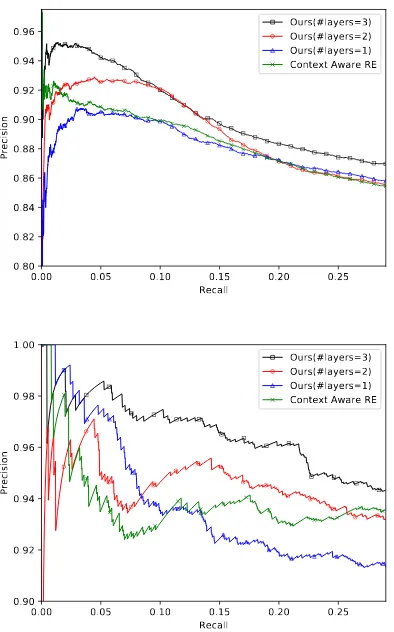
Figure 3: The aggregated precision-recall curves of our models with different number of layers on distantly la-beled test set (left) and dense distantly lala-beled test set (right). We also add Context Aware RE for comparison.
5.4 The Effectiveness of the Number of
Layers
The number of layers represents the reasoning
ability of our models. AK-layer version has the
ability to infer K-hop relations. To demonstrate
the effects of the number of layers, we also com-pare our models with different numbers of
lay-ers. From Table 2 and Table 3, we could see
that on all three datasets, 3-layer version achieves
the best. We could also see from Fig. 3 that
as the number of layers grows, the curves get higher and higher precision, indicating consider-ing more hops in reasonconsider-ing leads to better perfor-mance. However, the improvement of the third layer is much smaller on the overall distantly su-pervised test set than the one on the dense subset. This observation reveals that the reasoning mecha-nism could help us identify relations especially on sentences where there are more entities. We could also see that on the human annotated test set 3-layer version to have a greater improvement over 2-layer version as compared with 2-layer version over 1-layer version. It is probably due to the rea-son that bag-level relation extraction is much eas-ier. In real applications, different variants could be selected for different kind of sentences or we can also ensemble the prediction from different mod-els. We leave these explorations for future work.
5.5 Qualitative Results: Case Study
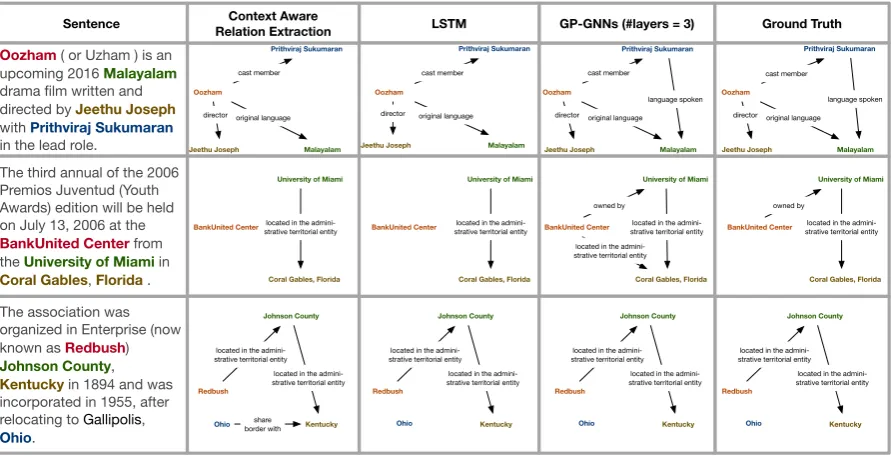
Tab. 4shows qualitative results that compare our
GP-GNN model and the baseline models. The re-sults show that GP-GNN has the ability to infer the relationship between two entities with reasoning. In the first case, GP-GNN implicitly learns a logic
rule ∃y, x −−−−−−−−→∼cast-member y −−−−−−−−−→original language z ⇒
x−−−−−−−−−→language spoken zto derive (Oozham,language spoken, Malayalam) and in the second case our model implicitly learns another logic rule
∃y, x −−−−−→owned-by y −−−−−→located in z ⇒ x −−−−−→located in z
to find the fact (BankUnited Center, located
in, English). Note that (BankUnited Center,
located in, English) is even not in Wikidata, but our model could identify this fact through rea-soning. We also find that Context-Aware RE tends to predict relations with similar topics. For
ex-ample, in the third case,share border with
ter-The association was organized in Enterprise (now known as Redbush)
Johnson County, Kentucky in 1894 and was incorporated in 1955, after relocating to Gallipolis, Ohio.
Sentence Relation ExtractionContext Aware LSTM GP-GNNs (#layers = 3)
Oozham ( or Uzham ) is an upcoming 2016 Malayalam
drama film written and directed by Jeethu Joseph with Prithviraj Sukumaran in the lead role.
Ground Truth
The third annual of the 2006 Premios Juventud (Youth Awards) edition will be held on July 13, 2006 at the
BankUnited Center from the University of Miami in Coral Gables, Florida .
Oozham
Malayalam
Jeethu Joseph
Prithviraj Sukumaran
cast member
director original language
language spoken Oozham
Malayalam
Jeethu Joseph
Prithviraj Sukumaran
cast member
director original language language spoken Oozham Malayalam Jeethu Joseph Prithviraj Sukumaran cast member
director original language
Oozham
Malayalam
Jeethu Joseph
Prithviraj Sukumaran
cast member
director original language
BankUnited Center
University of Miami
Coral Gables, Florida
located in the
admini-strative territorial entity BankUnited Center
University of Miami
Coral Gables, Florida
located in the
admini-strative territorial entity BankUnited Center
University of Miami
Coral Gables, Florida
owned by
located in the admini-strative territorial entity
BankUnited Center
University of Miami
Coral Gables, Florida
owned by
located in the admini-strative territorial entity located in the admini-strative territorial entity
Redbush
Johnson County
Kentucky
Ohio
located in the admini-strative territorial entity
located in the admini-strative territorial entity
Redbush
Johnson County
Kentucky
Ohio
located in the admini-strative territorial entity
located in the admini-strative territorial entity
Redbush
Johnson County
Kentucky
Ohio
located in the admini-strative territorial entity
located in the admini-strative territorial entity
Redbush
Johnson County
Kentucky
Ohio
located in the admini-strative territorial entity
located in the admini-strative territorial entity
[image:8.595.75.521.62.290.2]share border with
Table 4: Sample predictions from the baseline models and our GP-GNN model. Ground truth graphs are the subgraph in Wikidata knowledge graph induced by the sets of entities in the sentences. The models take sentences and entity markers as input and produce a graph containing entities (colored and bold) and relations between them. Although “No Relation” is also be seen as a type of relation, we only show other relation types in the graphs.
ritory issues. Consequently, Context-Aware RE
makes a mistake by predicting (Kentucky,share
boarder with, Ohio). As we have discussed before, this is due to its mechanism to model co-occurrence of multiple relations. However, in our model, since Ohio and Johnson County have no relationship, this wrong relation is not predicted.
6 Conclusion and Future Work
We addressed the problem of utilizing GNNs to perform relational reasoning with natural lan-guages. Our proposed model, GP-GNN, solves the relational message-passing task by encoding natu-ral language as parameters and performing propa-gation from layer to layer. Our model can also be considered as a more generic framework for graph generation problem with unstructured input other than text, e.g. image, video, audio. In this work, we demonstrate its effectiveness in predicting the relationship between entities in natural language and bag-level and show that by considering more hops in reasoning the performance of relation ex-traction could be significantly improved.
Acknowledgement
The authors thank the members of Tsinghua NLP
lab10 for their thoughtful suggestions. This work
10http://thunlp.org
is jointly supported by the NSFC project under the grant No. 61661146007 and the NExT++ project, the National Research Foundation, Prime Minis-ters Office, Singapore under its IRC@Singapore Funding Initiative. Hao Zhu is supported by Ts-inghua Initiative Research Program.
References
Luis B Almeida. 1987. A learning rule for
asyn-chronous perceptrons with feedback in a combinato-rial environment. InProceedings, 1st First Interna-tional Conference on Neural Networks, pages 609– 618. IEEE.
Fenia Christopoulou, Makoto Miwa, and Sophia Ana-niadou. 2018. A walk-based model on entity graphs for relation extraction. InProceedings of ACL, vol-ume 2, pages 81–88.
Nicola De Cao, Wilker Aziz, and Ivan Titov. 2018. Question answering by reasoning across documents
with graph convolutional networks. arXiv preprint
arXiv:1808.09920.
Bhuwan Dhingra, Zhilin Yang, William W Cohen, and Ruslan Salakhutdinov. 2017. Linguistic knowledge
as memory for recurrent neural networks. arXiv
preprint arXiv:1703.02620.
JVictor Garcia and Joan Bruna. 2018. Few-shot
learn-ing with graph neural networks. InProceedings of
Justin Gilmer, Samuel S. Schoenholz, Patrick F. Riley, Oriol Vinyals, and George E. Dahl. 2017. Neural
message passing for quantum chemistry. In
Pro-ceedings of ICML.
Sepp Hochreiter and J¨urgen Schmidhuber. 1997. Long
short-term memory. Neural computation, pages
1735–1780.
Daniel D Johnson. 2017. Learning graphical state tran-sitions. InProceedings of ICLR.
Thomas Kipf, Ethan Fetaya, Kuan-Chieh Wang, Max
Welling, and Richard Zemel. 2018. Neural
rela-tional inference for interacting systems. In Proceed-ings of ICML.
Thomas N Kipf and Max Welling. 2016.
Semi-supervised classification with graph convolutional
networks. Proceedings of ICLR.
Phong Le and Ivan Titov. 2018. Improving entity link-ing by modellink-ing latent relations between mentions.
Yujia Li, Daniel Tarlow, Marc Brockschmidt, and Richard Zemel. 2016. Gated graph sequence neu-ral networks. Proceedings of ICLR.
Yankai Lin, Shiqi Shen, Zhiyuan Liu, Huanbo Luan, and Maosong Sun. 2016. Neural relation extraction with selective attention over instances. In Proceed-ings of ACL, pages 2124–2133.
Diego Marcheggiani and Ivan Titov. 2017. Encoding sentences with graph convolutional networks for
se-mantic role labeling. InProceedings EMNLP.
Makoto Miwa and Mohit Bansal. 2016. End-to-end re-lation extraction using lstms on sequences and tree
structures. In Proceedings of ACL, pages 1105–
1116.
Thien Huu Nguyen and Ralph Grishman. 2015. Rela-tion extracRela-tion: Perspective from convoluRela-tional neu-ral networks. InProceedings of the 1st Workshop on Vector Space Modeling for Natural Language Pro-cessing, pages 39–48.
Adam Paszke, Sam Gross, Soumith Chintala, Gre-gory Chanan, Edward Yang, Zachary DeVito, Zem-ing Lin, Alban Desmaison, Luca Antiga, and Adam Lerer. 2017. Automatic differentiation in pytorch.
Nanyun Peng, Hoifung Poon, Chris Quirk, Kristina Toutanova, and Wen-tau Yih. 2017. Cross-sentence n-ary relation extraction with graph lstms. Transac-tions of the Association for Computational Linguis-tics, pages 101–115.
Jeffrey Pennington, Richard Socher, and Christopher Manning. 2014. Glove: Global vectors for word
representation. In Proceedings of EMNLP, pages
1532–1543.
Adam Santoro, David Raposo, David G Barrett, Ma-teusz Malinowski, Razvan Pascanu, Peter Battaglia, and Tim Lillicrap. 2017. A simple neural network
module for relational reasoning. InProceedings of
NIPS, pages 4967–4976.
Franco Scarselli, Marco Gori, Ah Chung Tsoi, Markus Hagenbuchner, and Gabriele Monfardini. 2009. The
graph neural network model. IEEE Transactions on
Neural Networks, pages 61–80.
Michael Schlichtkrull, Thomas N Kipf, Peter Bloem, Rianne van den Berg, Ivan Titov, and Max Welling. 2017. Modeling relational data with graph convolu-tional networks. arXiv preprint arXiv:1703.06103.
Mike Schuster and Kuldip K Paliwal. 1997. Bidirec-tional recurrent neural networks. IEEE Transactions on Signal Processing, pages 2673–2681.
Daniil Sorokin and Iryna Gurevych. 2017. Context-aware representations for knowledge base relation
extraction. InProceedings of EMNLP, pages 1784–
1789.
Denny Vrandeˇci´c and Markus Kr¨otzsch. 2014.
Wiki-data: a free collaborative knowledgebase.
Commu-nications of the ACM.
Danfei Xu, Yuke Zhu, Christopher B Choy, and Li Fei-Fei. 2017. Scene graph generation by iterative
mes-sage passing. InProceedings of CVPR, volume 2.
Daojian Zeng, Kang Liu, Yubo Chen, and Jun Zhao. 2015. Distant supervision for relation extraction via
piecewise convolutional neural networks. In
Pro-ceedings of EMNLP, pages 1753–1762.
Daojian Zeng, Kang Liu, Siwei Lai, Guangyou Zhou, and Jun Zhao. 2014. Relation classification via
con-volutional deep neural network. In Proceedings of
COLING, pages 2335–2344.
Wenyuan Zeng, Yankai Lin, Zhiyuan Liu, and
Maosong Sun. 2017. Incorporating relation paths
in neural relation extraction. In Proceedings of
EMNLP.
Dongxu Zhang and Dong Wang. 2015. Relation classi-fication via recurrent neural network.arXiv preprint arXiv:1508.01006.
Yuhao Zhang, Peng Qi, and Christopher D. Manning.
2018. Graph convolution over pruned dependency